Feldspar Meaning: Properties, Uses & Symbolism
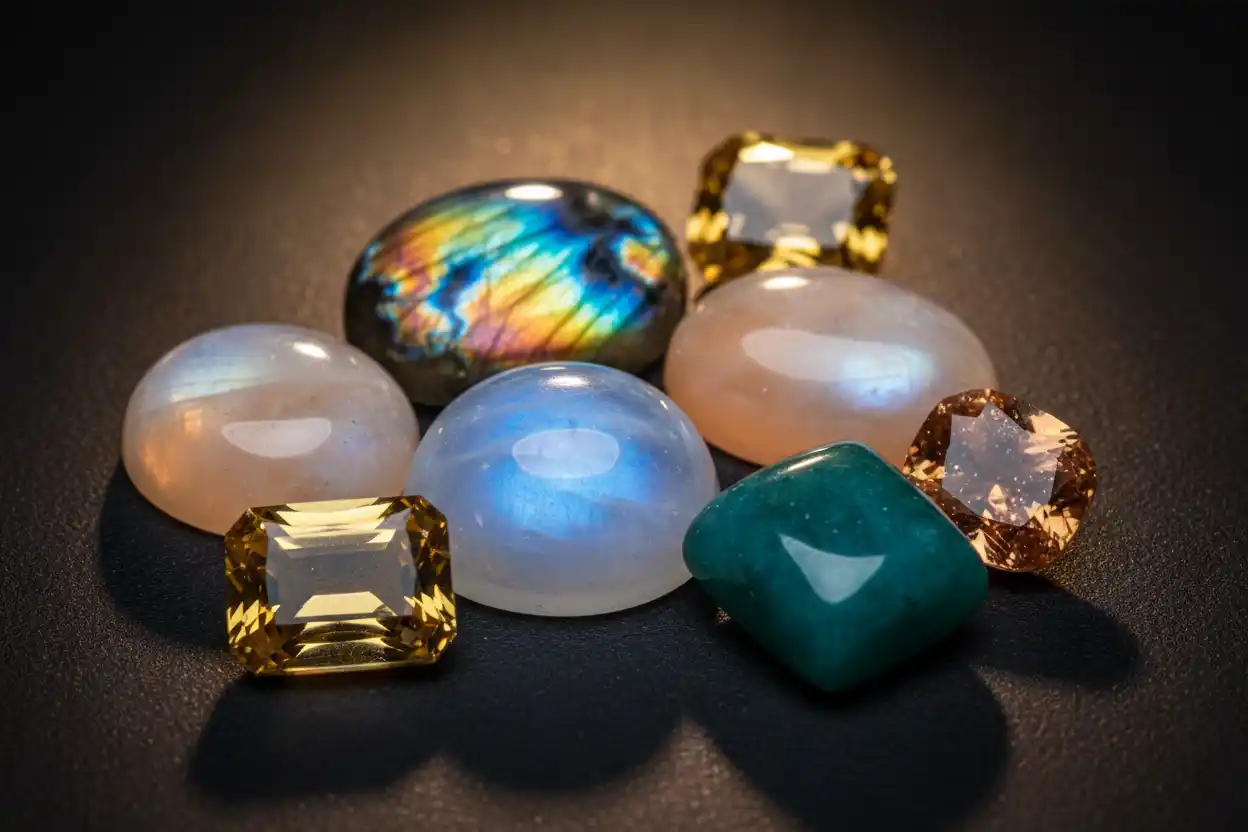
Feldspar meaning begins with an important correction: feldspar is not one mineral species. It is a large family of closely related rock-forming aluminosilicate minerals containing combinations of potassium, sodium, and calcium. Members of the feldspar group are among the most abundant minerals in Earth’s crust and are major constituents of granite, syenite, basalt, gneiss, pegmatite, and many other igneous and metamorphic rocks. Familiar gem and ornamental materials such as moonstone, labradorite, sunstone, and amazonite are connected with particular feldspar compositions or varieties, but those names do not make every feldspar specimen physically or optically identical.
That distinction is essential to a grounded feldspar meaning. The word can refer broadly to a mineral group, while a particular specimen may be orthoclase, microcline, sanidine, albite, oligoclase, labradorite, bytownite, anorthite, or another feldspar composition. Chemistry, crystal structure, exsolution, inclusions, alteration, and geological history determine what the material actually is. Symbolic meanings such as grounding, creativity, intuition, balance, or new beginnings are later human interpretations rather than properties measured by mineralogical testing. Readers comparing other mineral-first references can browse the wider Gemstone Guides without treating all stones sold under colorful trade names as equivalent.
Feldspar Meaning at a Glance
| Feature | Grounded reference |
|---|---|
| Material identity | A group of framework silicate minerals rather than one single species |
| Major chemical system | Potassium-, sodium-, and calcium-bearing aluminosilicates |
| Main divisions | Alkali feldspars and plagioclase feldspars |
| Common crystal systems | Monoclinic or triclinic depending on species and structural ordering |
| Typical colors | White, colorless, cream, gray, pink, salmon, green, yellow, brown, and darker tones |
| Mohs hardness | Commonly about 6–6.5 |
| Cleavage | Two prominent directions, commonly meeting at or near right angles |
| Luster | Usually vitreous; cleavage surfaces can look pearly |
| Major geological role | Essential rock-forming minerals in many igneous and metamorphic rocks |
| Familiar gem varieties | Moonstone, labradorite, sunstone, amazonite and other feldspar materials |
| Optical phenomena | Can include adularescence, labradorescence, aventurescence and schiller depending on structure or inclusions |
| Identification limit | Color or trade name alone cannot establish exact feldspar species |
| Symbolic interpretation | Cultural and personal meaning rather than measurable mineral action |
| Ownership concern | Moderate hardness does not eliminate cleavage, scratching, or impact risk |
This group-level identity is what makes feldspar meaning different from a reference for a narrowly defined mineral species. Saying “this is feldspar” may be scientifically reasonable at one level while still leaving the more precise question—what kind of feldspar?—unanswered.
Feldspar Is a Mineral Group, Not a Single Stone
The feldspar family is commonly divided into two major compositional branches. Alkali feldspars are dominated by potassium and sodium end-members and include minerals such as orthoclase, microcline, and sanidine. Plagioclase feldspars form a compositional series between sodium-rich albite and calcium-rich anorthite, with intermediate names traditionally used for portions of that range.
Those compositional relationships matter because properties vary gradually as chemistry and structure change. A potassium-rich microcline crystal is not simply a different color of calcium-rich plagioclase. The two belong to the same broader family but have different compositions, structural details, geological settings, and possible optical features.
This is also why commercial feldspar labels need context. “Moonstone,” for example, describes material valued for a floating light effect rather than one universal chemical composition. “Labradorite” has both formal mineralogical and gem-market usage connected with plagioclase compositions. “Amazonite” is associated with green microcline. “Sunstone” can describe feldspar showing aventurescent reflections caused by oriented inclusions, but the specific feldspar and inclusion system can vary.
A useful feldspar meaning reference therefore begins with hierarchy:
Feldspar group → feldspar species or composition → variety or optical trade name → individual specimen.
Skipping those levels is one of the easiest ways to turn an approximate label into an unsupported identification.
How Feldspar Forms
Feldspars form across an enormous range of geological environments, which is one reason they are so abundant. In cooling magma, feldspar crystals develop as elements such as silicon, aluminum, potassium, sodium, and calcium become organized into framework silicate structures. The exact feldspar composition depends on magma chemistry, temperature, pressure, cooling history, and interactions with fluids.
Granites and pegmatites commonly contain potassium feldspar and sodium-rich plagioclase, while basaltic and other mafic rocks typically contain more calcium-rich plagioclase. Feldspars are also widespread in metamorphic rocks, where recrystallization under heat and pressure can preserve, modify, or newly form feldspar assemblages. Weathering eventually breaks feldspars down into clay minerals and dissolved constituents, making them important not only in igneous petrology but also in sediment and soil development.
Some visually important gem phenomena form because feldspar compositions change or reorganize as a crystal cools. Fine-scale intergrowths can separate within what was once a more homogeneous crystal, producing structures capable of scattering or interfering with light. Other attractive effects arise from tiny mineral inclusions. The detailed relationship between magma evolution, exsolution, host rocks, and deposit types belongs in feldspar formation and deposit geology rather than being repeated as a full petrology lesson here.
Why Feldspar Occurs in So Many Colors
Many feldspars would be colorless or pale if their structures were chemically ideal and free from defects or inclusions. Natural specimens, however, incorporate trace elements, microscopic inclusions, structural defects, exsolution textures, alteration products, and radiation-related effects that can produce a much broader palette.
Pink and salmon potassium feldspars are common in many rocks. Green amazonite is associated with microcline and owes its color to a more complicated interaction of trace chemistry and structural defects rather than to one simple “green element.” Some feldspars are yellow, brown, gray, reddish, or nearly colorless. Dark-looking material may owe part of its appearance to inclusions or surrounding rock rather than the feldspar structure alone.
Color also needs to be separated from optical phenomena. The floating pale sheen of moonstone, the shifting spectral flashes of labradorite, and the glittering aventurescence of sunstone are not simply body colors. They arise from internal structures or inclusions interacting with light. A gray feldspar can show brilliant blue labradorescence, while a nearly colorless moonstone can display a mobile white or bluish sheen.
The specialized physics and gemological observations behind those effects are covered in feldspar optical properties and color behavior. For feldspar meaning, the important point is simpler: color and optical display can help describe a feldspar, but neither automatically establishes exact species, locality, or treatment status.
Diagnostic Traits That Help Recognize Feldspar
Feldspar identification often starts with a combination of moderate hardness, two prominent cleavage directions, vitreous-to-pearly luster, common rock-forming occurrence, and crystal or twinning features. The two cleavage directions commonly intersect close to 90 degrees, a useful field distinction from minerals with very different cleavage geometry.
Twinning can be particularly informative. Some alkali feldspars display characteristic simple or cross-hatched twinning, while plagioclase may show repeated lamellar twinning that can sometimes be seen as fine parallel lines on cleavage surfaces. These observations can support classification, but they require careful interpretation because weathering, polishing, grain size, and orientation may hide the features.
Hardness around 6–6.5 also provides context without being a standalone identification test. Quartz is harder, while calcite is substantially softer, but many other minerals occupy overlapping ranges. Deliberately scratching a valuable specimen is usually unnecessary and may destroy useful surface evidence.
Magnification can reveal inclusions, exsolution structures, twinning, fractures, alteration, polishing artifacts, and surface-reaching features. A more systematic framework for those observations is provided in the feldspar microscope inclusion notebook. Where exact species or composition matters, optical mineralogy, refractive measurements, spectroscopy, X-ray diffraction, or chemical analysis may be more appropriate than visual identification.
An Original Feldspar Specimen and Photo Checklist
Because “feldspar” covers so many related materials, a good record should preserve observable facts before assigning a variety or locality name. The checklist below is designed for rough crystals, polished stones, rock specimens, inherited collection pieces, and online photographs.
| Observation or claim | Record this first | What it may support | What it does not prove |
|---|---|---|---|
| “Feldspar” | Color, habit, cleavage, matrix and luster | Broad group-level compatibility | Exact species |
| “Potassium feldspar” | Crystal form, twinning, associated minerals, laboratory data if available | Alkali-feldspar classification | Orthoclase versus microcline in every case |
| “Plagioclase” | Fine lamellar twinning, context, optical observations | Plagioclase-family compatibility | Exact albite–anorthite composition |
| “Moonstone” | Body color and moving sheen under several light angles | Adularescent feldspar appearance | One universal feldspar species |
| “Rainbow moonstone” | Transparent-to-white material with blue or multicolor sheen | Common trade usage | That the material is identical to traditional orthoclase moonstone |
| “Labradorite” | Base color and directional labradorescence | Labradorite-like optical behavior | Geographic origin |
| “Sunstone” | Glittering or reflective plate-like inclusions | Aventurescent feldspar appearance | Specific feldspar species or inclusion mineral |
| “Amazonite” | Blue-green to green body color and feldspar texture | Compatibility with amazonite-type microcline | Proven locality |
| “Natural untreated” | Surface condition, color distribution, report wording | What is observable or represented | Absence of every treatment |
| “Rare color” | Actual hue under neutral lighting | Descriptive rarity comparison | Formal rarity classification |
| “Mine direct” | Invoice, mine name, chain-of-custody record | A provenance claim | Origin from appearance |
| “High-grade feldspar” | Transparency, color, optical effect, condition, size | Commercial quality description | Universal standardized grade |
| “Healing feldspar” | Exact symbolic or seller wording | Documentation of a belief claim | Medical efficacy |
| “Energy-enhanced” | Commercial language | Marketing or personal interpretation | Measurable mineral property |
The disputed-name entries are particularly important. “Rainbow moonstone,” for example, is widely used commercially for material often associated with labradorite-type plagioclase rather than simply being a colorful version of all traditional moonstone. A useful specimen record preserves the trade name while also identifying the more precise mineralogical classification when evidence supports it.
This approach avoids two opposite errors: dismissing every trade name as useless or accepting every trade name as a formal mineral species. Trade terminology can communicate appearance and market convention. Mineral nomenclature answers a different question.
Moonstone Is a Feldspar Effect, Not One Universal Composition
Moonstone is among the most familiar names connected with feldspar meaning. Its defining visual feature is adularescence, a soft, floating light that seems to move across or within the stone as the viewing angle changes. That effect arises from fine internal structural relationships within suitable feldspar material rather than from an emitted glow.
Traditional high-quality moonstone has often been associated with alkali feldspar intergrowths, while commercial markets also use “rainbow moonstone” for transparent-to-whitish plagioclase material—commonly labradorite—showing blue or multicolored internal effects. The two can share a similar aesthetic without being identical mineralogically.
This distinction matters because a seller may use a familiar name correctly within gem commerce while a mineralogical description requires more precision. The strongest label can sometimes contain both: the commercial variety name and the underlying feldspar identification.
Labradorite, Sunstone, and Amazonite Show Different Reasons Feldspar Becomes Valuable
Labradorite demonstrates how internal structure can dominate visual value. Its directional flashes can range through blue, green, yellow, orange, and other colors, yet the underlying body may be gray or relatively subdued. The visible phenomenon comes from light interaction with fine internal structures rather than the stone containing patches of luminous pigment.
Sunstone illustrates a different mechanism. Its characteristic glitter or aventurescence can arise from oriented reflective inclusions. Depending on material, these may produce metallic-looking flashes ranging from subtle sparkle to dramatic coppery reflections. The visual effect therefore belongs partly to the relationship between feldspar and inclusions rather than to body color alone.
Amazonite shows another path: the body color itself is the main attraction. This green-to-blue-green microcline variety can display pale streaking, grid-like internal patterns, or uneven color distribution. Its appearance is chemically and structurally distinct from the optical phenomena that create moonstone or labradorite effects.
These examples demonstrate why feldspar meaning should not collapse the entire group into one symbolic or physical profile. The same mineral family can produce very different gemstones for very different structural reasons.
Feldspar Versus Look-Alike Materials
Feldspar can be confused with quartz in pale or colorless rocks because both are abundant and can occur together. Cleavage provides one useful distinction: feldspar develops prominent cleavage surfaces, whereas quartz lacks cleavage and commonly fractures conchoidally. Quartz is also harder.
Polished decorative stones create more difficult comparisons because cutting removes much of the original crystal shape. A blue-green amazonite-like cabochon might be confused with other green minerals, while translucent moonstone-like material can overlap visually with opal, chalcedony, or glass in poor photographs.
Even spectacular optical effects are not unique proof. Iridescence, aventurescence, chatoyancy, and internal reflection occur in many unrelated materials through different physical mechanisms. Exact identification should therefore follow evidence rather than a visual keyword.
The broader lesson also applies when comparing feldspar with unrelated red and multicomponent collector material such as eudialyte meaning. Similar polishing styles or symbolic descriptions do not indicate chemical or geological relationship.
The Documented History of Feldspar
The word feldspar has European linguistic roots associated with a field or rock-forming “spar,” reflecting the mineral family’s historical recognition as a widespread rock constituent. “Spar” was used broadly for minerals showing recognizable cleavage, while the field-related component has been connected with the occurrence of weathered feldspar-rich rock fragments in cultivated ground.
The modern feldspar group became much more precise as crystallography, chemistry, microscopy, and eventually instrumental analysis allowed mineralogists to separate species and compositional series that earlier observers could not distinguish reliably. That history is important because many gem trade names are younger, more appearance-driven, or used differently from formal mineral nomenclature.
Historical naming should not be transformed into metaphysical evidence. Feldspar’s association with the ground or fields in its linguistic history does not prove that it physically “grounds energy.” That may be an understandable modern metaphor, but it is not what mineralogical etymology demonstrates.
For readers interested in how particular stones became famous through culture, jewelry, ownership, or historical events rather than mineral classification alone, famous gemstones provides the appropriate broader context.
Feldspar Meaning in Modern Symbolism
Modern symbolic interpretations of feldspar meaning often use themes such as balance, adaptability, creativity, self-awareness, intuition, persistence, and new perspectives. Because feldspar is a vast family rather than one gem variety, those themes often change depending on which material is being discussed. Moonstone may be framed around cycles and reflection, labradorite around changing perspective, amazonite around communication, and sunstone around confidence or motivation.
These meanings can be used as personal metaphors without being presented as mineral science. Someone examining a feldspar-rich rock might use its interlocking grains as a reminder that complicated systems are built from components with different roles. A moonstone owner could use its shifting visual effect as a prompt to reconsider a problem from another angle. An amazonite specimen might simply become a visual cue for writing down a difficult conversation before having it.
In each case, the useful action comes from the person’s attention, habit, or reflection. There is no scientific evidence that feldspar transmits intuition, regulates emotions, changes another person’s behavior, attracts money, predicts future events, or creates a protective energy field.
The site’s Disclaimer provides the broader boundary between mineral education, cultural symbolism, and medical, financial, or other professional claims.
Feldspar Chemistry Is Not Nutrition or Medicine
Feldspar commonly contains potassium, sodium, calcium, aluminum, silicon, and oxygen. Those elemental names can sound familiar because some also occur in nutrition or human biology, but their presence in a mineral lattice does not make feldspar a dietary source.
Potassium feldspar is not a potassium supplement. Calcium-rich plagioclase is not a calcium supplement. Sodium-bearing feldspar is not a source of dietary sodium. Wearing, touching, or placing these minerals near the body does not provide controlled nutritional doses.
The same boundary applies to psychological and medical claims. Feldspar should not be presented as a treatment for anxiety, depression, cardiovascular conditions, hormonal disorders, neurological disease, sleep disorders, or any other health problem. Personal symbolism may coexist with appropriate healthcare, but it does not replace it.
There is also no need to ingest feldspar, powder it for consumption, or make mineral elixirs. A geological specimen can be appreciated without putting mineral material into food or drinking water.
Safe Ownership of Feldspar
Normal handling of an intact feldspar crystal, polished cabochon, or stable rock specimen is different from cutting, grinding, drilling, sanding, or crushing mineral material. Dust-producing work creates an inhalation hazard that ordinary display and handling do not. Lapidary work should use appropriate wet-processing, ventilation, respiratory protection, eye protection, and professional controls suitable for the complete material being cut, particularly because natural rocks can contain additional silicate minerals.
Mechanical durability also deserves context. Feldspars are moderately hard, but their cleavage means a sharp impact can chip or split them along favorable structural directions. This is particularly important for transparent gems and stones containing internal lamellae, fractures, or contrasting inclusions. Jewelry design therefore needs to consider edge exposure and impact rather than relying on Mohs hardness alone. Those questions are addressed in feldspar setting and wear engineering.
Cutters face additional challenges because orientation can determine whether moonstone sheen, labradorescence, aventurescence, or body color appears strongly face-up. Differential hardness in matrix-rich material can also complicate polishing. Those specialized decisions belong in feldspar cutting, orientation and polish.
Preserving Feldspar Specimens and Their Context
Natural feldspar specimens can preserve twinning, cleavage, alteration surfaces, host-rock relationships, and labels that are more informative than a polished surface. Trimming or cleaning a specimen aggressively may remove some of that evidence permanently.
This is particularly relevant for pegmatite crystals and older collection pieces. A weathered matrix can look untidy while still demonstrating how the feldspar occurred geologically. Likewise, an old locality label may contain incomplete spelling or historic mine terminology while remaining valuable provenance evidence.
Long-term approaches to storage, cleaning decisions, photography, labeling, and condition monitoring are covered separately in feldspar specimen conservation and record keeping. Where origin is commercially or scientifically important, the feldspar provenance disclosure checklist provides a framework for distinguishing documented locality from seller attribution and visual guesswork.
Feldspar Is Not the Same as Fire Agate or Fire Opal
Names based on visual drama can create false relationships between unrelated materials. Fire agate meaning concerns a form of chalcedony associated with layered iron-bearing structures that produce iridescent effects. It is silica-based and mineralogically different from feldspar despite sharing the possibility of colorful optical phenomena.
Fire opal meaning deals with opal, an amorphous hydrated silica material often recognized for yellow, orange, or red body color. Opal lacks feldspar’s crystalline framework and cleavage system. Its durability, optical behavior, water content, and geological formation therefore need a different interpretive framework.
These comparisons expose a useful rule: gem names that share words such as “fire,” “moon,” “sun,” or “rainbow” often describe appearance rather than mineralogical kinship.
What Feldspar Meaning Can Reliably Tell You
A grounded feldspar meaning reference can explain that feldspar is a mineral family, identify the main alkali-feldspar and plagioclase branches, describe why colors and optical effects vary, show which physical traits assist identification, trace the historical use of the group name, and establish where modern symbolism begins.
It cannot determine exact feldspar composition from a photograph, prove that every “moonstone” label refers to the same species, authenticate locality from color, establish treatment status because nothing obvious is visible, or classify every red, green, blue, or iridescent cabochon by appearance alone. Important identifications may require a qualified gemologist, mineralogist, or laboratory using optical, chemical, or structural methods appropriate to the specimen.
Gems Lore’s broader approach to separating material facts from cultural interpretation is described on About Gems Lore. Readers with documented corrections, unusual feldspar labels, or specimen-identification evidence can provide that context through Contact Gems Lore rather than treating a photograph-based guess as final.
FAQ
What is the simplest feldspar meaning?
The simplest feldspar meaning is mineralogical: feldspar is a large group of potassium-, sodium-, and calcium-bearing aluminosilicate minerals that form a major part of many igneous and metamorphic rocks. Modern symbolic meanings are later cultural or personal interpretations.
Is feldspar one mineral?
No. Feldspar is a mineral group. Major members include alkali feldspars such as orthoclase and microcline and plagioclase feldspars ranging compositionally from albite toward anorthite.
Are moonstone and labradorite both feldspar?
Yes, both are associated with feldspar materials, but they are not simply two colors of the same identical substance. Moonstone is defined largely by adularescence in suitable feldspar, while labradorite is a plagioclase feldspar composition known for labradorescence in many gem-quality examples.
Is rainbow moonstone really moonstone?
“Rainbow moonstone” is an established commercial term, commonly applied to transparent-to-whitish feldspar material showing blue or multicolored sheen and often associated mineralogically with labradorite-type plagioclase. The trade name should therefore be preserved while the underlying mineral classification is stated more precisely when known.
Is amazonite a feldspar?
Yes. Amazonite is a green-to-blue-green variety associated with microcline, a potassium feldspar. Its color should not be used by itself to authenticate a locality or prove that every green feldspar specimen is amazonite.
Why does feldspar have cleavage?
Cleavage reflects weaknesses in the internal crystal structure along particular planes. Feldspar commonly shows two good cleavage directions intersecting close to right angles, which can help distinguish it from minerals such as quartz.
Is feldspar safe to wear?
Polished feldspar gems can be worn, but moderate hardness does not eliminate the possibility of scratching, cleavage, or impact damage. Jewelry type, setting protection, existing fractures, and the particular feldspar material all affect durability.
Does feldspar have scientifically proven healing properties?
No. Feldspar has measurable mineralogical and physical properties, but there is no established evidence that wearing or touching it treats physical or mental-health conditions. Symbolic use can remain a personal reflective practice without being presented as medicine.
Does potassium feldspar provide potassium to the body?
No. Potassium incorporated into a feldspar crystal structure is not equivalent to a nutritional supplement. Touching or wearing potassium feldspar does not provide a controlled dietary source of potassium.
Reading Feldspar More Precisely
Feldspar meaning becomes more useful once the family is allowed to remain diverse. A pale orthoclase crystal, green amazonite, blue-flashing labradorite, glowing moonstone, and sparkling sunstone can all belong within feldspar-related mineralogy while differing substantially in chemistry, internal structure, inclusions, optical effects, and practical use. Their shared family identity does not erase those distinctions.
That same precision improves the symbolic side of the subject. A person may associate feldspar with adaptability because the group appears in many geological settings, or use moonstone’s shifting sheen as a metaphor for perspective, without claiming that a crystal chemically causes psychological change. Historical names can inform interpretation without being rewritten as proof of metaphysical effects.
The strongest feldspar meaning therefore comes from reading the material in layers: group identity first, species or composition where evidence allows, variety or optical name next, provenance separately, and symbolism last. That order preserves both the mineralogical complexity of feldspar and the freedom to use gemstones as personal symbols without confusing belief with evidence.