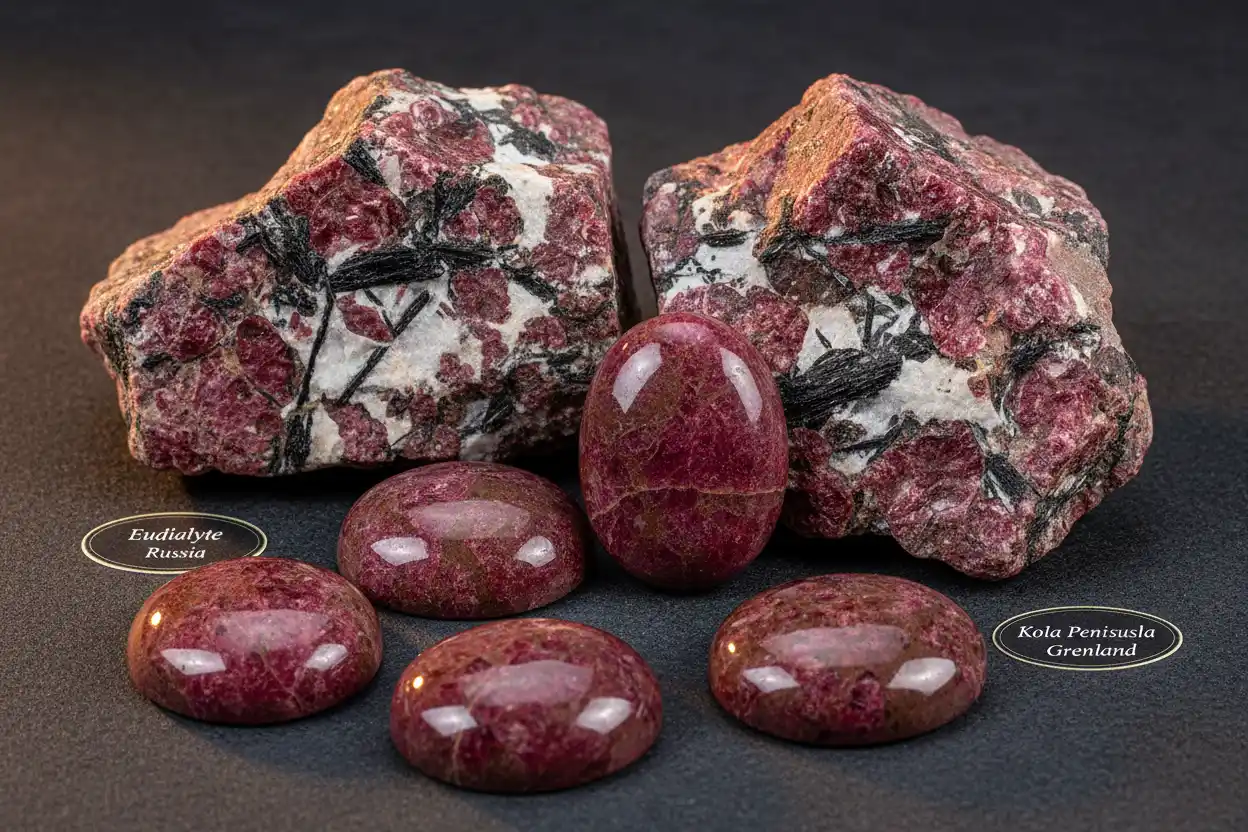
Eudialyte Meaning: Properties, Uses & Symbolism
Eudialyte meaning begins with a mineral whose identity is more complicated than its memorable red and pink appearance suggests. Eudialyte is a complex sodium-calcium zirconium silicate that commonly also contains iron, manganese, chlorine, and other constituents, and it belongs to the broader eudialyte group of chemically related minerals. It crystallizes in the trigonal system and is especially associated with unusual alkaline igneous rocks such as nepheline syenites and related pegmatitic environments. Collector specimens may occur as deep crimson, raspberry-red, pink, burgundy, reddish-brown, yellowish, or occasionally other colored grains and crystals, often contrasting sharply with black, gray, white, or green minerals in the host rock.
That mineralogical starting point matters because eudialyte meaning is frequently presented online almost entirely through symbolic phrases such as vitality, self-love, emotional renewal, creativity, or personal transformation. Those associations can be discussed as modern reflective traditions, but they do not define the material itself. Chemistry, structure, geological setting, hardness, color, luster, inclusions, and physical behavior belong to mineral science. Historical naming can be traced through mineralogical documentation. Symbolic meaning belongs to human interpretation and should remain clearly distinguished from measurable properties. Readers who want the same material-first approach for other stones can explore the broader Gemstone Guides collection.
Eudialyte Meaning at a Glance
| Feature | Grounded reference |
|---|---|
| Mineral identity | Complex sodium-calcium zirconium silicate |
| Mineral family | Eudialyte group |
| Crystal system | Trigonal |
| Common colors | Red, crimson, raspberry, pink, burgundy, reddish-brown, yellowish, and related tones |
| Luster | Commonly vitreous to somewhat greasy |
| Mohs hardness | Roughly 5–5.5 |
| Cleavage | Generally poor to indistinct compared with strongly cleavable gems |
| Fracture | Often uneven to conchoidal |
| Typical occurrence | Accessory mineral in silica-undersaturated alkaline igneous rocks and related pegmatitic bodies |
| Common presentation | Crystals, grains in matrix, polished slabs, cabochons, beads, and collector specimens |
| Major compositional feature | Zirconium-rich silicate chemistry with considerable elemental substitution |
| Identification caution | Red color and black matrix are not sufficient to prove eudialyte |
| Symbolic interpretation | Modern cultural or personal associations, not measurable mineral effects |
| Ownership emphasis | Protect polished material from impact and avoid uncontrolled dust-producing work |
Eudialyte meaning is therefore most useful when the reader understands that “eudialyte” can refer to an individual mineral grain, a crystal, a polished piece rich in eudialyte, or—less precisely in commerce—a multicomponent rock sold under the mineral’s name. Those objects may look similar in a product photograph while representing different proportions of the mineral and different geological materials.
What Eudialyte Actually Is
Eudialyte is not a simple single-element gemstone. Its crystal chemistry is unusually complex, and members of the eudialyte group permit extensive substitution among several structural sites. Sodium, calcium, zirconium, iron, manganese, silicon, chlorine, hydroxyl-bearing components, and smaller amounts of other elements can all play roles in natural material. For this reason, one simplified chemical formula can be useful for orientation but should not be mistaken for an exact analysis of every specimen labeled eudialyte.
This compositional flexibility also affects terminology. Eudialyte is a defined mineral species, but the eudialyte group contains multiple related species that may look very similar without detailed analysis. A red grain in an alkaline rock may be visually compatible with eudialyte while precise group-species identification requires crystallographic and chemical data. Commercial sellers generally do not perform that level of classification on every polished cabochon, so a retail label can be reasonable for trade purposes without necessarily representing a full analytical determination.
Eudialyte meaning should therefore distinguish practical gem-market naming from formal mineral nomenclature. A cabochon cut from a red-and-black rock may be sold simply as “eudialyte” because that is the visually dominant or commercially important component. Scientifically, the piece may contain eudialyte together with feldspar, nepheline, aegirine, arfvedsonite, or other minerals characteristic of alkaline complexes. The whole object is not necessarily a single crystal of eudialyte.
How Eudialyte Forms
Eudialyte is strongly associated with chemically unusual alkaline magmatic systems. It commonly develops in agpaitic nepheline syenites and related pegmatitic or late-magmatic environments where sodium, zirconium, and other normally less concentrated elements become enriched during advanced stages of magma evolution. As more common rock-forming minerals crystallize, the remaining melt and fluids can become progressively enriched in elements that eventually enter uncommon minerals such as eudialyte.
This geological context explains why eudialyte often occurs with an unusual mineral neighborhood. Dark pyroxenes and amphiboles, pale feldspar, nepheline, sodalite-group minerals, and other zirconium- or rare-element-bearing species may appear in the same rocks. The result can be visually dramatic slabs containing red eudialyte against black and pale matrix, but that attractive contrast is fundamentally the record of an alkaline igneous system rather than evidence of a special metaphysical combination.
Formation conditions also explain why a locality claim cannot be proved by appearance alone. Similar red eudialyte-bearing rocks can occur in more than one alkaline complex, and polished surfaces remove many geological clues that might otherwise help interpretation. Readers interested in magmatic evolution, host rocks, mineral associations, and deposit context can continue to eudialyte formation and deposit geology rather than treating this foundational page as a complete petrological study.
Why Eudialyte Is Usually Red or Pink
The red, raspberry, and pink colors strongly associated with eudialyte arise from its transition-metal-bearing chemistry, particularly the presence and structural role of manganese and iron in many specimens. Exact color mechanisms can vary with composition, oxidation state, concentration, structural site, and associated minerals. This is one reason eudialyte does not have a single universal red.
Some specimens appear vivid crimson, others muted burgundy or brownish red. Fine grains dispersed through a pale matrix can look much lighter than a thick transparent-to-translucent crystal. Dark host minerals can increase apparent contrast, while polishing may deepen surface color because reflected light behaves differently on a smooth face than on rough material. Camera saturation and white balance can further exaggerate reds and purples in online listings.
Color therefore contributes to recognition but does not establish identity. Red sodalite-group minerals, garnet-bearing rocks, rhodonite, altered feldspar-bearing material, and several unrelated decorative stones can produce superficially similar combinations. More specialized discussion of light behavior, transparency, compositional color variation, and directional observations belongs in eudialyte optical properties and color behavior.
Diagnostic Traits That Actually Help
A reliable eudialyte identification emerges from several compatible observations rather than from one distinctive-looking photograph. Trigonal crystallography, moderate hardness around 5–5.5, density, luster, characteristic occurrence in alkaline rocks, optical behavior, and chemistry can collectively support identification. In well-formed crystals, habit may provide useful clues, while polished material usually requires more caution because crystal form has been removed.
The moderate hardness is particularly relevant to polished pieces. Eudialyte can take an attractive finish, but it is softer than quartz and can accumulate abrasion when used in exposed jewelry. The surrounding matrix may also contain minerals of different hardnesses, creating uneven polishing behavior. A multicomponent cabochon can therefore have mechanical properties that are not represented accurately by quoting only the Mohs hardness of eudialyte.
Magnification can help document grain boundaries, fractures, associated minerals, polishing pits, surface-reaching structures, and possible filled or repaired areas. Those observations can improve a specimen record without pretending that microscopy alone identifies every constituent. A dedicated framework for such observations is provided in the eudialyte microscope inclusion notebook.
For scientifically important or disputed specimens, chemical analysis, Raman spectroscopy, X-ray diffraction, or other specialist methods may be required. Visual inspection can narrow possibilities; it cannot substitute for structural or compositional analysis when the exact eudialyte-group species is the question.
Original Eudialyte Label and Photo Audit
Eudialyte is especially suited to a claim-audit approach because the commercial object is often a rock containing several minerals rather than an isolated transparent gem. The table below separates useful observations from conclusions that require stronger evidence.
| Label or claim | What can be documented directly | What still requires evidence |
|---|---|---|
| “Eudialyte” | Red or pink grains, visible crystal form, matrix, luster, dimensions | Formal mineral identification if uncertain |
| “Eudialyte group mineral” | Visual compatibility and documented source label | Exact group species |
| “Eudialyte stone” | Commercial name of a polished object | Percentage of actual eudialyte present |
| “Solid eudialyte” | Appearance of a largely red polished surface | That the object is a single mineral rather than fine intergrowth |
| “Eudialyte in matrix” | Multiple visibly different mineral phases | Identity of each matrix component |
| “Russian eudialyte” | Seller or collection locality statement | Geographic origin without provenance records |
| “Kola eudialyte” | Exact historical or dealer attribution | Specific mine or occurrence |
| “Norwegian eudialyte” | Seller documentation and appearance | Locality authentication from color |
| “Rare-earth stone” | Seller terminology | Actual rare-earth-element concentrations |
| “Zirconium-rich gemstone” | Eudialyte’s general mineral chemistry | Quantitative zirconium content in a particular specimen |
| “Untreated” | Seller disclosure and visible condition | Absence of stabilization, filling, coating, or repair |
| “Natural matrix” | Visible multicomponent structure | That pieces were never assembled or repaired |
| “High grade” | Brightness, color coverage, polish, specimen dimensions | Standardized quality grade—none is universal |
| “Healing eudialyte” | Cultural or commercial statement | Medical or physiological effect |
| “Energy stone” | Personal symbolic claim | Detectable energy field attributable to the mineral |
The purpose of this audit is not to assume that commercial descriptions are deceptive. It is to keep different kinds of evidence separate. “Russian eudialyte” may be entirely accurate when supported by a trustworthy collection history, while the same phrase attached to an anonymous polished cabochon may represent only a seller attribution.
Where locality has collector or financial importance, keep original labels, invoices, collection numbers, old photographs, and correspondence. The eudialyte provenance disclosure checklist provides a deeper framework for distinguishing documented provenance from inference.
Eudialyte and Eudialyte-Bearing Rock Are Not Always the Same Thing
This distinction is one of the most useful parts of eudialyte meaning for buyers and collectors. A natural eudialyte crystal is a specimen of a defined mineral. A polished slab containing red eudialyte grains plus black aegirine or amphibole and pale feldspathic material is a rock composed of several minerals. Both can legitimately be sold in the eudialyte market, but they should not be described as though they are physically identical.
The difference matters when discussing hardness, density, polish, durability, chemical behavior, and even apparent color. A matrix piece inherits properties from all its constituent minerals. A scratch may develop preferentially in one phase. A polishing compound can interact differently with adjacent grains. Fractures can follow mineral boundaries rather than cutting through the eudialyte itself.
It also matters for photographs. A dramatically red-and-black polished stone may contain a relatively modest proportion of eudialyte whose color dominates visually. This does not make the object fake; it simply means “eudialyte-bearing rock” can sometimes be the more precise description.
The Documented History Behind the Name Eudialyte
The name eudialyte comes from Greek roots conveying the idea of being “easily decomposed” or “readily dissolved.” The name refers to the mineral’s chemical behavior, particularly its comparatively easy decomposition in acids, rather than to its red color or any spiritual tradition.
That historical meaning creates an important boundary. Modern symbolic descriptions sometimes associate eudialyte with emotional release, dissolving barriers, letting go of old patterns, or breaking through resistance. Those metaphors may be inspired by the name, but the original mineralogical etymology does not demonstrate a psychological effect. Acid decomposition is a chemical property. Emotional transformation is a human experience.
The distinction is similar to many mineral names whose historical origins later become symbolic raw material. Eudialyte meaning can acknowledge modern interpretation without rewriting the scientific history to imply that early mineralogists named the stone for emotional or spiritual purposes.
Eudialyte Meaning in Modern Symbolism
Modern crystal traditions often associate eudialyte meaning with self-acceptance, emotional honesty, motivation, creativity, relationships, courage, and the process of aligning intentions with practical action. The red and pink coloration encourages comparisons with themes of vitality and affection, while the complex multicolored matrix can become a metaphor for integrating different parts of one’s life rather than demanding perfect uniformity.
Those ideas can be used as reflective prompts without making them scientific claims. Someone might keep a polished eudialyte on a desk as a reminder to ask whether a decision reflects genuine priorities or only short-term pressure. Another person might use its mixed mineral matrix as a metaphor for accepting that identity, work, relationships, and goals can coexist without being reduced to one simple label.
In that framework, eudialyte meaning comes from intentional human use of an object as a cue. The mineral is not required to emit a measurable force, influence another person’s behavior, guarantee a romantic outcome, attract money, or alter future events.
There is likewise no scientific basis for presenting eudialyte as a treatment for anxiety, depression, cardiovascular disease, hormonal conditions, neurological problems, fatigue, sexual health concerns, or any other medical condition. The broader distinction between mineral information, personal symbolism, and professional health or financial advice is explained in the site’s Disclaimer.
Zirconium, Manganese, and Other Elements Are Not Medicine
Eudialyte’s complex chemistry makes it tempting to assign health functions to individual elements within the mineral. That is not a valid inference. Zirconium, iron, manganese, sodium, calcium, or other elements incorporated into a crystal lattice do not become nutritional supplements simply because the stone is worn or touched.
Elemental names also tell only part of the chemical story. An element locked into a mineral structure behaves differently from a dietary nutrient, pharmaceutical compound, dissolved ion, or industrial material. Mineral chemistry identifies the substance; it does not establish physiological delivery or benefit.
Eudialyte should therefore not be ingested, powdered for consumption, placed in drinking water to create an elixir, or used as a substitute for medical treatment. Personal symbolism does not require consuming the stone.
Safe Ownership of Eudialyte
Normal handling of an intact polished eudialyte object or stable mineral specimen is different from cutting, grinding, drilling, sanding, crushing, or heating material. The latter processes create fine particles and introduce exposure routes that do not exist when a stone is simply displayed or worn. Lapidary processing should use appropriate professional dust and fragment controls rather than dry household grinding.
Because eudialyte frequently occurs in multi-mineral rock, cutters must also remember that the matrix may have properties different from the red mineral itself. The safest approach is to treat unknown dust from mixed mineral material as something to control rather than something to breathe. Specialized issues involving orientation, differential hardness, fracture management, and finishing belong in eudialyte cutting, orientation and polish.
Everyday jewelry presents a mechanical rather than mystical question. Eudialyte’s moderate hardness means exposed polished surfaces can scratch more readily than harder gems, and matrix material may create additional weak points. Pendants and protected settings can impose different stresses from rings or bracelets subjected to repeated contact with hard surfaces. Those design tradeoffs are covered in eudialyte setting and wear engineering.
Collectors should also avoid casually experimenting with strong acids simply because the mineral’s historical name refers to easy decomposition. Chemical testing can permanently damage the specimen and is unnecessary for ordinary ownership.
Conserving Natural Eudialyte Specimens
A collector specimen carries information beyond its red color. Matrix relationships, crystal surfaces, labels, old repairs, collection numbers, and associated minerals can all matter. Aggressive polishing or trimming may make an object look cleaner while permanently removing evidence about its natural occurrence.
For specimens with historical labels, preservation should include the paperwork as carefully as the mineral. A handwritten locality note may later become more useful than a visually attractive but undocumented replacement label. When cleaning is required, the specific mineral assemblage matters because a treatment safe for one constituent may be unsuitable for another.
Longer-term storage, documentation, display, and condition-record practices are treated separately in eudialyte specimen conservation and record keeping.
Eudialyte Compared With Nearby Mineral References
Material-based comparison prevents eudialyte meaning from being blurred into a generic description of colorful collector stones. Euclase meaning concerns a beryllium aluminum hydroxide silicate whose transparent crystals, high hardness, and pronounced cleavage create a very different material profile from comparatively softer, compositionally complex eudialyte.
Feldspar meaning addresses an enormous family of common rock-forming silicates rather than a rare zirconium-rich mineral of alkaline complexes. Feldspars can occur as major constituents in rocks, whereas eudialyte is usually a much more specialized accessory mineral associated with unusual geochemical environments.
Ethiopian opal meaning deals with hydrated amorphous silica, often displaying play-of-color and hydrophane behavior. Opal lacks the conventional crystal structure that defines eudialyte and presents a completely different combination of optical and durability considerations.
Broader historical examples of minerals and gems that achieved cultural prominence are collected in famous gemstones. Eudialyte’s collector appeal should still be evaluated on its own mineralogical and provenance evidence rather than by borrowing fame, rarity, or significance from unrelated gems.
What Eudialyte Meaning Can Reliably Tell You
A grounded eudialyte meaning reference can explain that eudialyte is a complex zirconium-bearing silicate associated with alkaline igneous environments, why red and pink colors are common, why matrix-rich material requires careful naming, which properties support identification, how the mineral’s name relates to chemical behavior, and where modern symbolism begins.
It cannot determine the exact eudialyte-group species from a photograph, quantify rare-earth or zirconium content by color, authenticate a Russian or Norwegian locality without provenance, prove treatment status from a seller’s silence, or assign a standardized quality grade from the intensity of red alone. It also cannot demonstrate that the mineral heals disease, changes emotional states through a physical energy, guarantees relationship outcomes, or creates financial success.
Gems Lore’s broader material-first approach is described on About Gems Lore. Where a specimen presents an unusual identification, disputed terminology, locality problem, or documented correction, supporting details can be submitted through Contact Gems Lore rather than treating uncertain claims as settled facts.
FAQ
What is the basic eudialyte meaning?
The basic eudialyte meaning is mineralogical: eudialyte is a complex sodium-calcium zirconium silicate mineral associated especially with unusual alkaline igneous rocks. Modern symbolic traditions may connect it with self-acceptance, motivation, emotional honesty, or creativity, but those themes are human interpretations rather than measurable mineral effects.
Why is eudialyte usually red?
Manganese and iron are important contributors to the characteristic red, pink, burgundy, and brownish tones seen in many eudialyte specimens. Exact appearance also depends on composition, grain size, thickness, associated minerals, surface finish, and lighting.
Is every red-and-black eudialyte stone pure eudialyte?
No. Many polished stones sold as eudialyte are multi-mineral rocks containing red eudialyte together with dark and pale matrix minerals. That does not make them inauthentic, but “eudialyte-bearing rock” may sometimes be more mineralogically precise than implying the whole object is one mineral.
Is eudialyte a rare-earth mineral?
Eudialyte-group minerals can incorporate a range of uncommon elements, including rare-earth elements in some compositions, but the phrase “rare-earth stone” does not tell you the concentration in a particular specimen. Quantitative claims require chemical analysis.
Can eudialyte be identified from a photograph?
A photograph can document color, crystal habit, matrix, grain relationships, polish, and visible fractures. It cannot directly establish crystal chemistry or distinguish every member of the eudialyte group. Important or disputed material may require specialist analysis.
Is eudialyte suitable for jewelry?
Eudialyte can be polished into cabochons, beads, and ornamental pieces, but its moderate hardness means exposed surfaces can scratch with wear. Multi-mineral matrix pieces may also contain phases with different durability. Protective designs are generally more appropriate than assuming it behaves like a harder gem.
Does eudialyte have healing properties?
There is no scientifically established evidence that eudialyte treats physical or mental-health conditions. It can be used as a symbolic or reflective object, but that use should remain separate from medical claims.
Is the zirconium in eudialyte beneficial to the body?
No nutritional or medical benefit follows from zirconium being part of eudialyte’s crystal chemistry. The same applies to manganese, iron, sodium, calcium, and other constituents. Wearing or touching the mineral does not make it a dietary supplement.
Why does the name eudialyte mean “easily dissolved”?
The name refers to the mineral’s tendency to decompose comparatively readily in acids. It is a mineralogical observation, not historical evidence that the stone was named for emotional release or spiritual transformation.
Understanding Eudialyte Without Reducing It to a Red Crystal
The most useful eudialyte meaning preserves the mineral’s complexity. Eudialyte is not merely a pink-red decorative stone but part of a chemically intricate mineral group formed in unusual alkaline magmatic environments. Its color reflects real structural chemistry, its matrix can preserve information about the rock in which it formed, and its variable composition means precise identification sometimes requires methods far beyond visual inspection.
Its modern symbolism can still be meaningful when presented within clear limits. A person may use eudialyte as a reminder of self-acceptance, deliberate action, or the value of integrating complicated parts of life without claiming that manganese, zirconium, or another constituent produces those outcomes. Historical etymology can inspire metaphor without being rewritten into spiritual evidence.
That separation gives eudialyte meaning greater depth. The geological material, historical name, commercial labels, specimen evidence, and modern interpretations can all be considered—but they answer different questions. Keeping those questions distinct allows the real mineral to remain at the center of the story.