
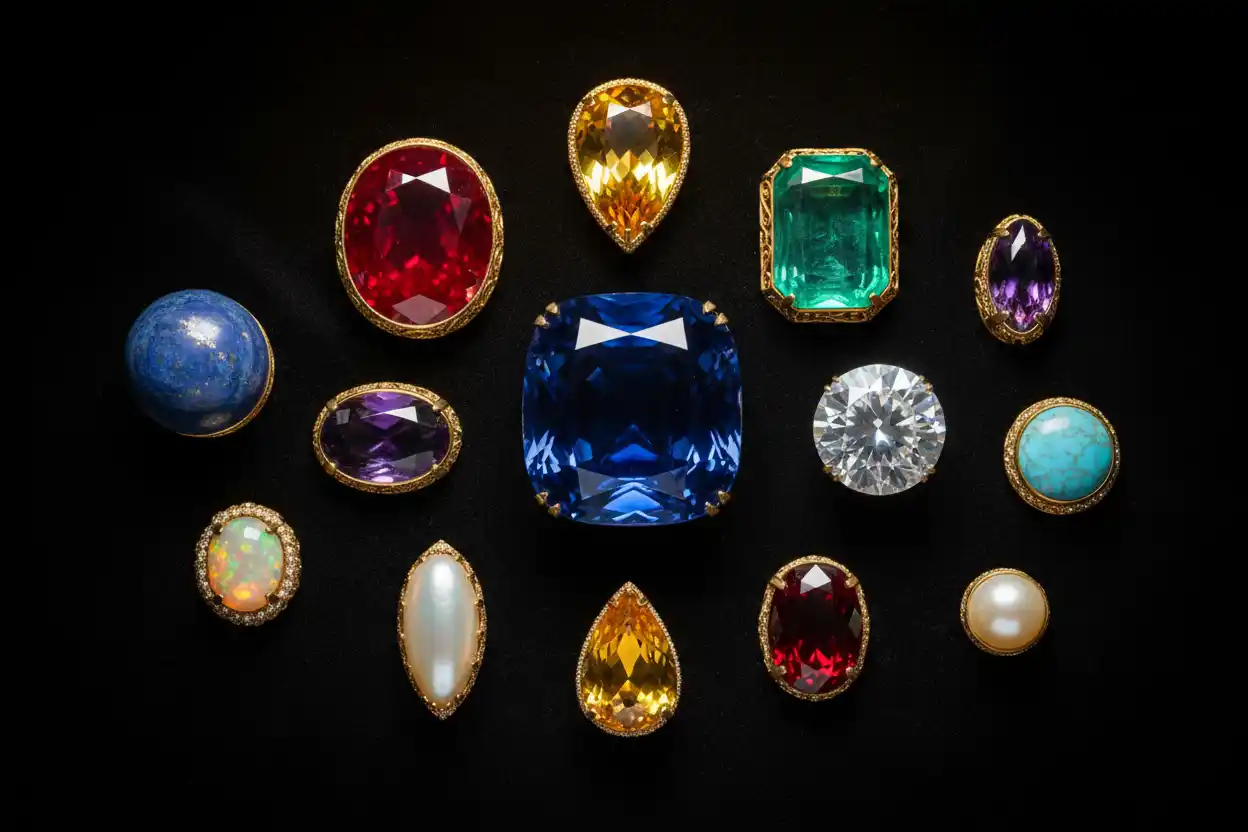

The world’s most famous gemstones became renowned through more than size or beauty. Royal ownership, conquest, mistaken identity, museum display, scientific study, record-setting sales and contested provenance transformed individual stones into historical objects.
Famous Gemstones at a Glance
| Gemstone | Material | Approximate Weight | Why It Is Famous | Present Collection or Status |
|---|---|---|---|---|
| Hope Diamond | Natural blue Diamond | 45.52 ct | French royal history, exceptional blue color and curse legends | Smithsonian Institution |
| Koh-i-Noor | Colorless Diamond | 105.6 ct | Mughal, Persian, Afghan, Sikh and British royal history | British Crown Jewels |
| Cullinan I | Colorless Diamond | 530.2 ct | Largest principal stone cut from the Cullinan rough | British Crown Jewels |
| Regent Diamond | Colorless Diamond | About 140.6 ct | French Crown history and exceptional cut quality | Louvre |
| Sancy Diamond | Pale yellowish Diamond | About 55.2 ct | European royal ownership and unusual double-sided cut | Louvre |
| Dresden Green | Natural green Diamond | About 41 ct | Historic natural green color and Saxon royal collection | Green Vault, Dresden |
| Black Prince’s Ruby | Red Spinel | Not officially treated as a ruby weight grade | Centuries of British royal and military history | Imperial State Crown |
| Timur Ruby | Engraved red Spinel | About 361 ct | Mughal and Persian imperial inscriptions | Royal Collection |
| Star of India | Star Sapphire | 563.35 ct | One of the largest gem-quality star sapphires | American Museum of Natural History |
| Logan Sapphire | Blue Sapphire | 422.98 ct | One of the largest faceted blue sapphires | Smithsonian Institution |
| Rosser Reeves Star Ruby | Star Ruby | 138.7 ct | Exceptional red color and sharply defined star | Smithsonian Institution |
| Hooker Emerald | Emerald | 75.47 ct | Historic Colombian Emerald set in a museum brooch | Smithsonian Institution |
| La Peregrina | Natural Pearl | 50.56 ct | Spanish royal history and Elizabeth Taylor provenance | Privately held after auction |
What Makes a Gemstone Famous?
Size can attract attention, but it rarely explains the complete reputation.
Some stones became famous because they belonged to rulers. Others survived wars, thefts, revolutions or the breakup of royal treasuries.
Scientific discoveries added another source of fame. The Black Prince’s Ruby and Timur Ruby became more interesting once mineralogy established that they were Spinel rather than Ruby.
Modern museum display also shapes public recognition. Millions of visitors encounter the Hope Diamond and Star of India in permanent galleries, while privately held gems may disappear from public view for decades.
Auction prices create headlines, but price alone does not produce lasting historical importance. The mechanisms behind commercial valuation are explained in How Gemstone Prices Work.
1. The Hope Diamond
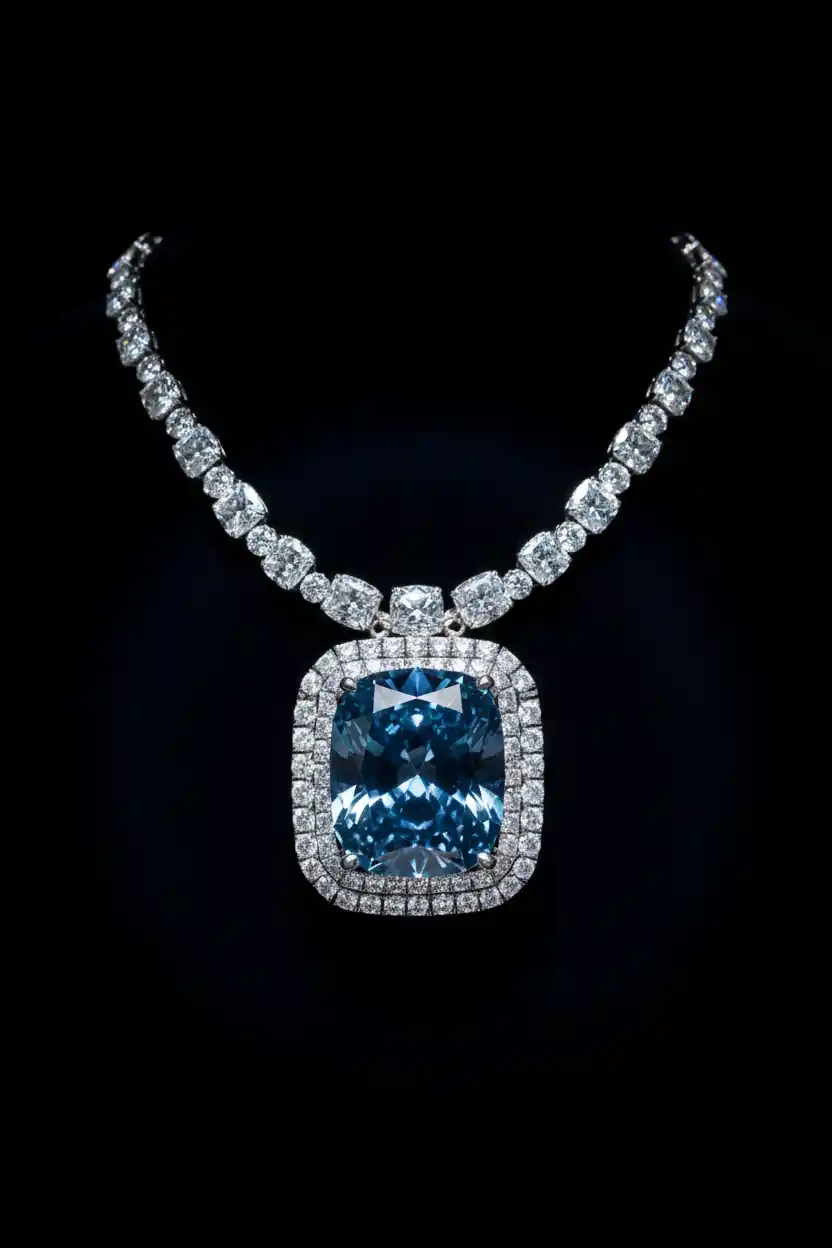
The Hope Diamond is a 45.52-carat deep-blue natural Diamond in the Smithsonian’s National Gem Collection.
Its documented history begins with a much larger blue rough or early-cut stone acquired in India by merchant Jean-Baptiste Tavernier during the seventeenth century.
King Louis XIV purchased the stone and had it recut as the French Blue. It entered the French Crown Jewels before disappearing during the thefts of the French Revolution.
A differently cut blue Diamond surfaced in London decades later and became associated with banker Henry Philip Hope. Modern modeling supports the conclusion that the Hope Diamond was recut from the French Blue.
Harry Winston donated it to the Smithsonian in 1958. Its journey to the museum through registered mail became part of its modern legend.
The stone’s blue color comes primarily from boron-related absorption. Red phosphorescence after ultraviolet exposure adds another scientifically important property.
Curse stories helped popularize the gem, but many were expanded through newspaper promotion and jewelry marketing. Its verified history remains compelling without supernatural claims.
The distinction between normal D-to-Z grading and natural fancy color appears in Diamond Color Meaning.
2. The Koh-i-Noor
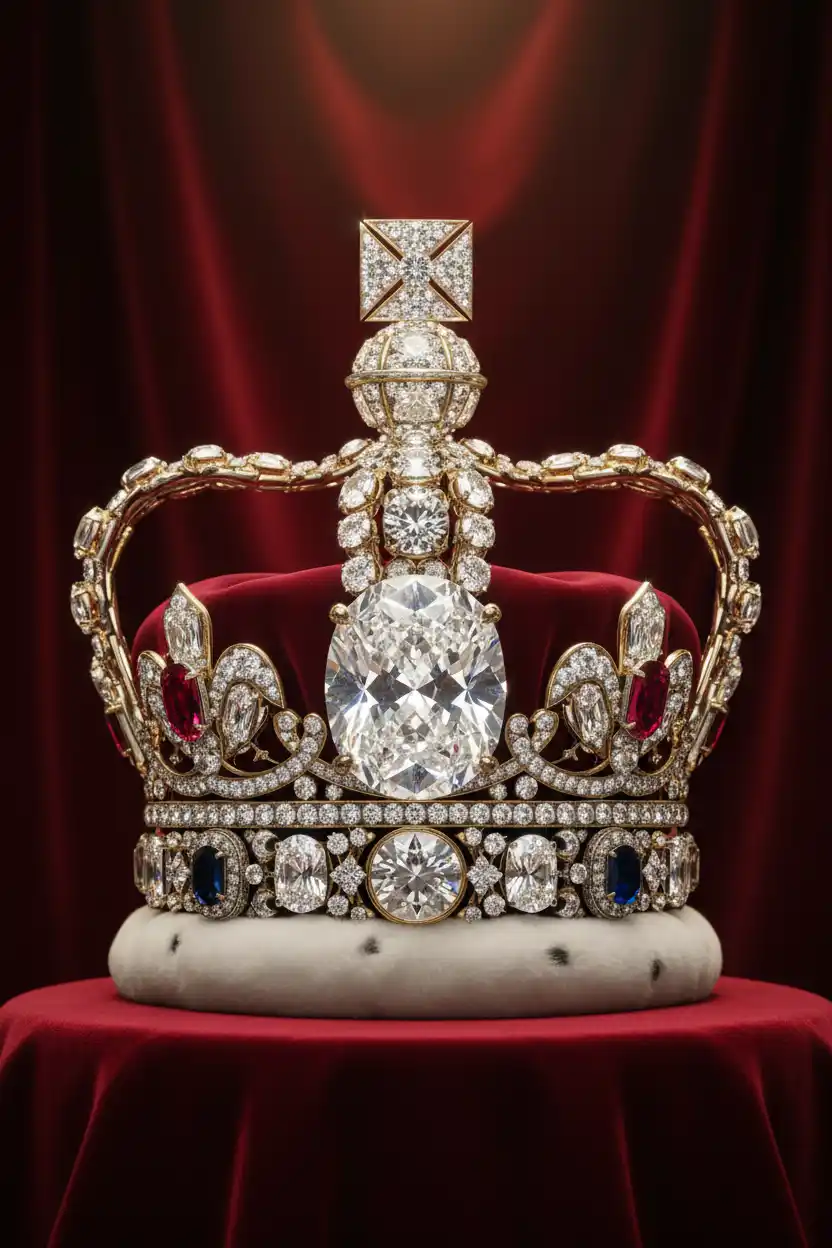
The Koh-i-Noor is a 105.6-carat colorless Diamond mounted in the crown made for Queen Elizabeth, the Queen Mother.
Its name means “Mountain of Light.” The stone passed through Mughal, Persian, Afghan and Sikh control before entering British possession following the annexation of Punjab.
The Diamond was displayed at the Great Exhibition of 1851, where its older cut received criticism for limited brilliance.
It was subsequently recut, reducing the weight but creating a more familiar Victorian appearance.
The Koh-i-Noor now belongs to the British Crown Jewels at the Tower of London. Its ownership remains politically contested, with restitution claims and historical arguments connected to colonial conquest.
The stone illustrates why famous gems cannot be discussed only through carat weight. Legal title, imperial history, coercion and public memory remain central to its significance.
3. Cullinan I and the Cullinan Diamonds
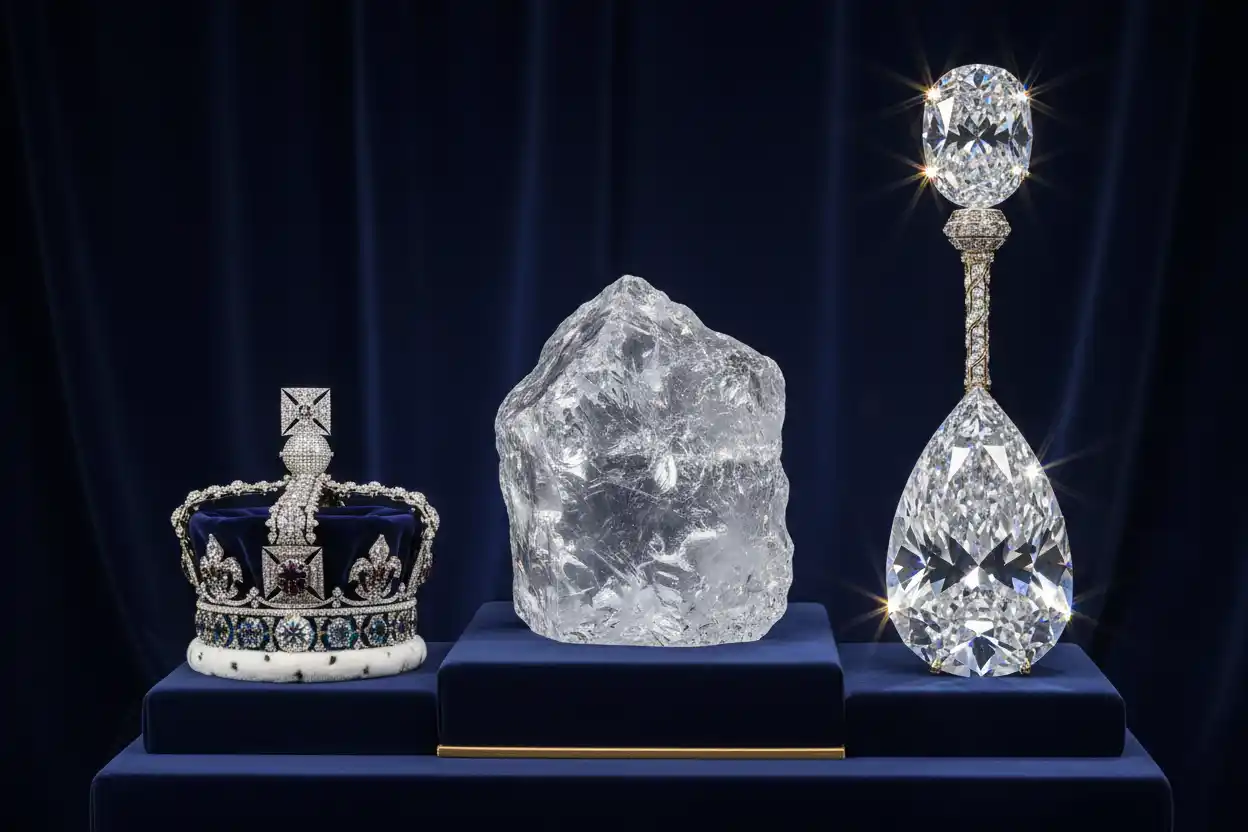
The Cullinan rough Diamond was discovered in South Africa in 1905 and weighed approximately 3,106 carats.
Cutting produced nine principal stones and numerous smaller Diamonds.
Cullinan I, the Great Star of Africa, weighs 530.2 carats and is mounted in the Sovereign’s Sceptre with Cross.
Cullinan II weighs approximately 317.4 carats and sits in the front of the Imperial State Crown.
The remaining numbered Cullinan stones entered royal jewelry and collection pieces.
Their cutting required extensive study because one incorrect blow could have damaged the enormous rough. The result became a landmark in Diamond planning and cleaving.
The stones also reflect the political circumstances of colonial South Africa and the transfer of mineral wealth into European royal collections.
Different natural crystal forms and cut categories are explained in Types of Diamond.
4. The Regent Diamond
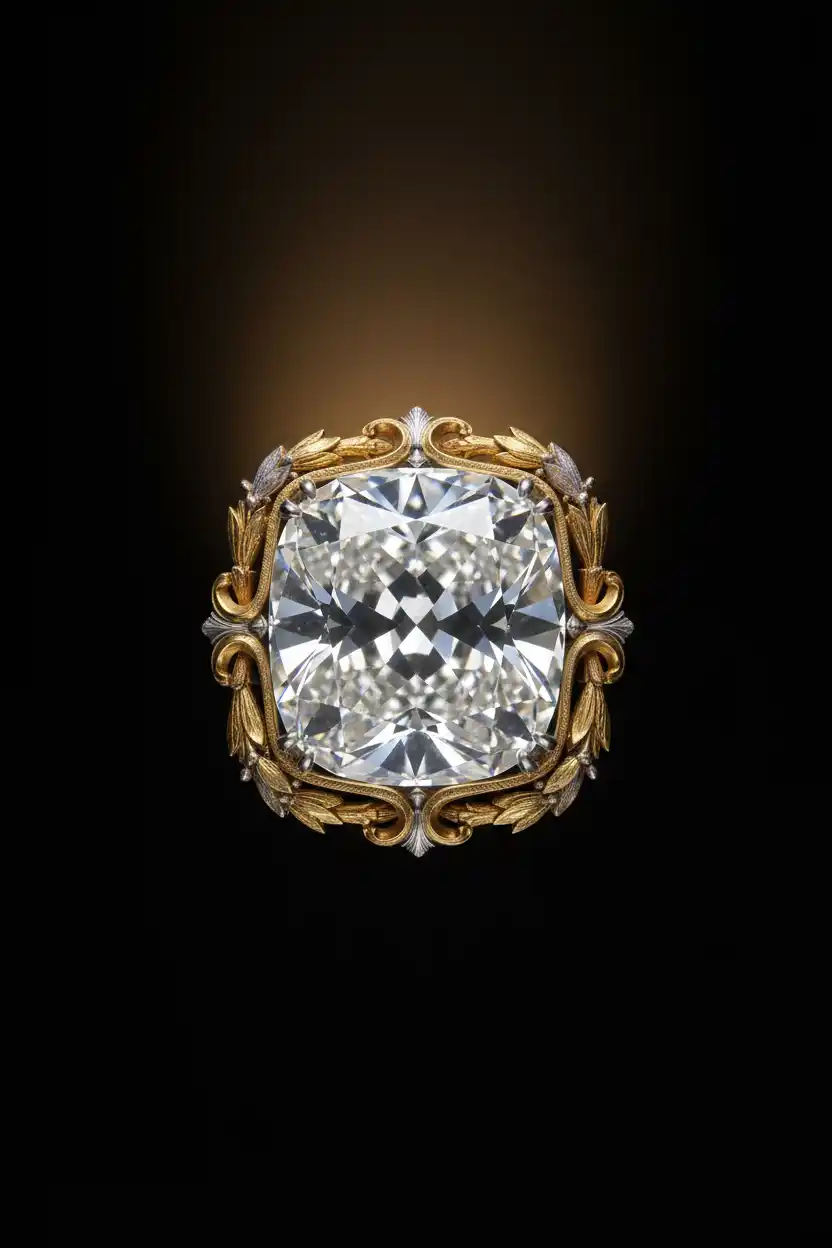
The Regent is an approximately 140.6-carat colorless Diamond held by the Louvre.
The rough was found in India and entered European trade during the early eighteenth century.
Thomas Pitt acquired the stone, arranged its cutting and later sold it to the French regent Philippe d’Orléans.
It subsequently became part of French royal and imperial regalia. The Diamond appeared in the crown of Louis XV and later ornamented objects associated with Napoleon Bonaparte.
Unlike many Crown Jewels dispersed during revolution and political change, the Regent eventually entered France’s national collection.
Its fame comes from a combination of size, symmetry, clarity and repeated use in state symbolism.
5. The Sancy Diamond
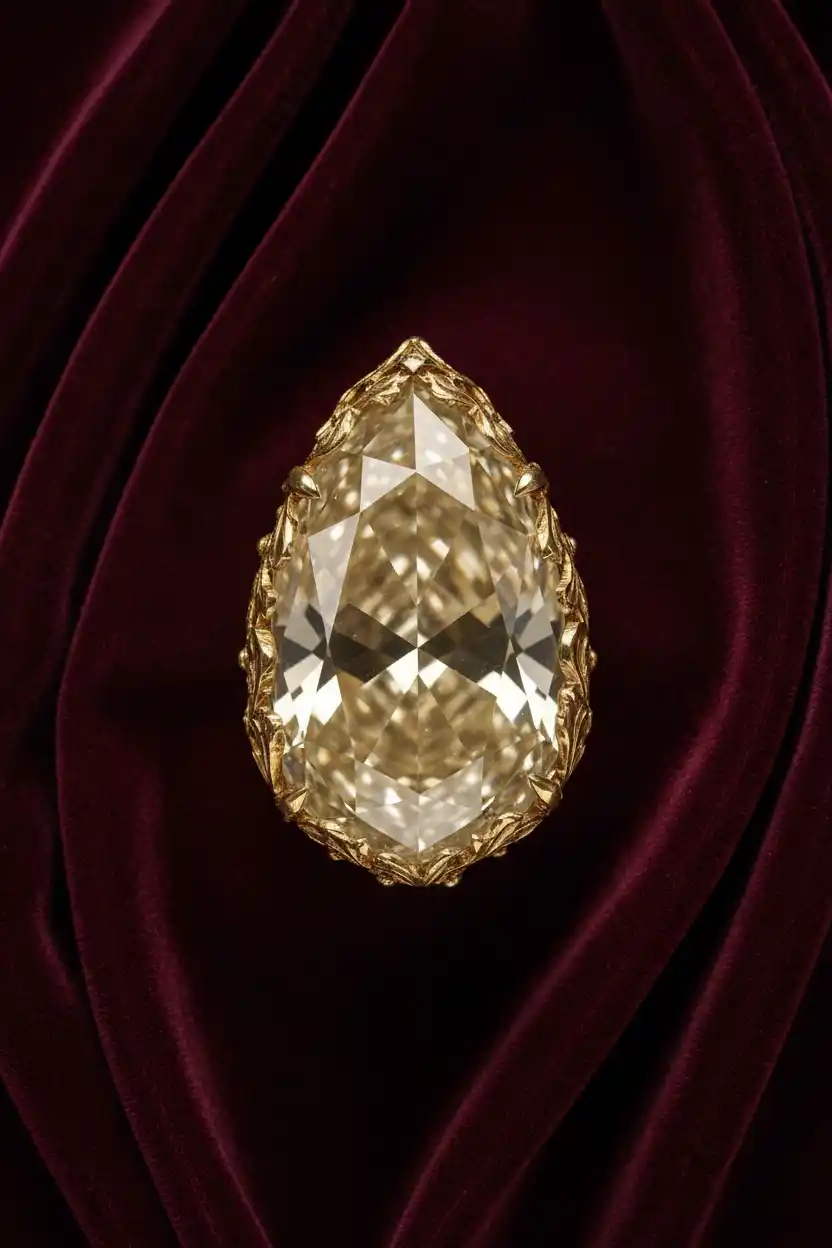
The Sancy is an approximately 55.2-carat pale yellowish Diamond with an unusual pear-like form.
Both sides are faceted, reflecting an early cutting style unlike the conventional flat-table and pavilion structure of modern gems.
The stone passed among European royal and noble owners, including French and English courts.
It became part of the French Crown collection and is now held by the Louvre.
Its complex route through war, debt and diplomacy illustrates how portable gems functioned as financial assets long before standardized grading reports.
6. The Dresden Green Diamond
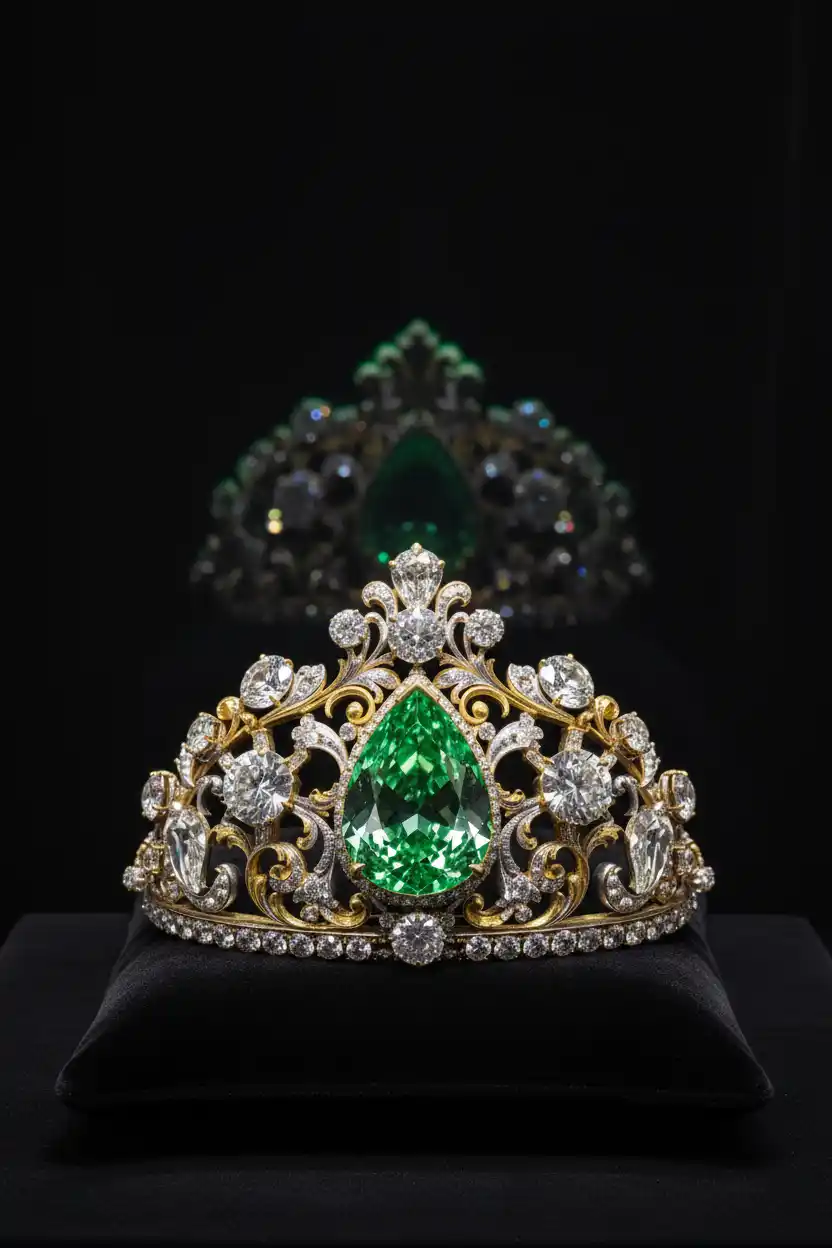
The Dresden Green is a natural green Diamond weighing approximately 41 carats.
It entered the Saxon royal collection during the eighteenth century and is associated with Augustus III.
The stone is mounted in an elaborate hat ornament and belongs to the Green Vault in Dresden.
Natural green Diamond color commonly develops through radiation-related defects. However, laboratory irradiation can create similar appearances.
Historical provenance provides important evidence for the Dresden Green because the gem was documented long before modern treatment technology.
Its fame rests on the combination of size, natural color, historic mounting and continuous collection history.
Natural green and other fancy-colored Diamonds occupy different markets from ordinary colorless stones. Their scarcity and liquidity are examined in Are Colored Diamonds a Good Investment?.
The wider range of natural green materials appears in Green Gemstones.
7. The Black Prince’s Ruby
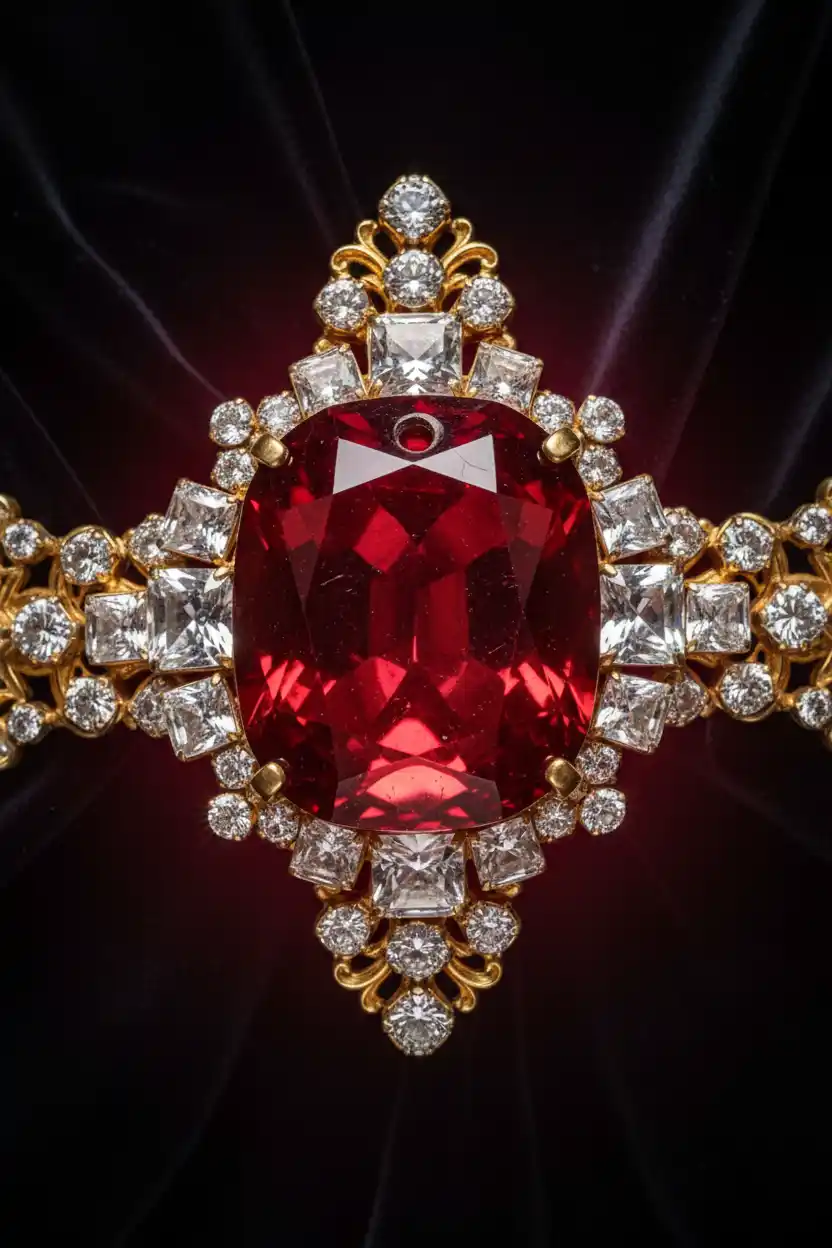
The Black Prince’s Ruby is not a Ruby. It is a large irregular red Spinel mounted in the Imperial State Crown.
Medieval and early modern gem dealers used terms such as balas ruby or ruby for several transparent red stones.
Reliable separation between Spinel and Corundum did not become established until mineralogical science advanced during the eighteenth century.
According to its traditional history, the stone passed from the ruler of Granada to Pedro of Castile and then to Edward of Woodstock, known as the Black Prince.
Later accounts connect it with English kings and battlefield use, including Henry V at Agincourt.
The stone’s identity does not diminish its historical importance. Instead, the correction demonstrates how scientific classification can change the meaning of a centuries-old name.
True Ruby is chromium-bearing red Corundum with different hardness, density and optical properties.
8. The Timur Ruby
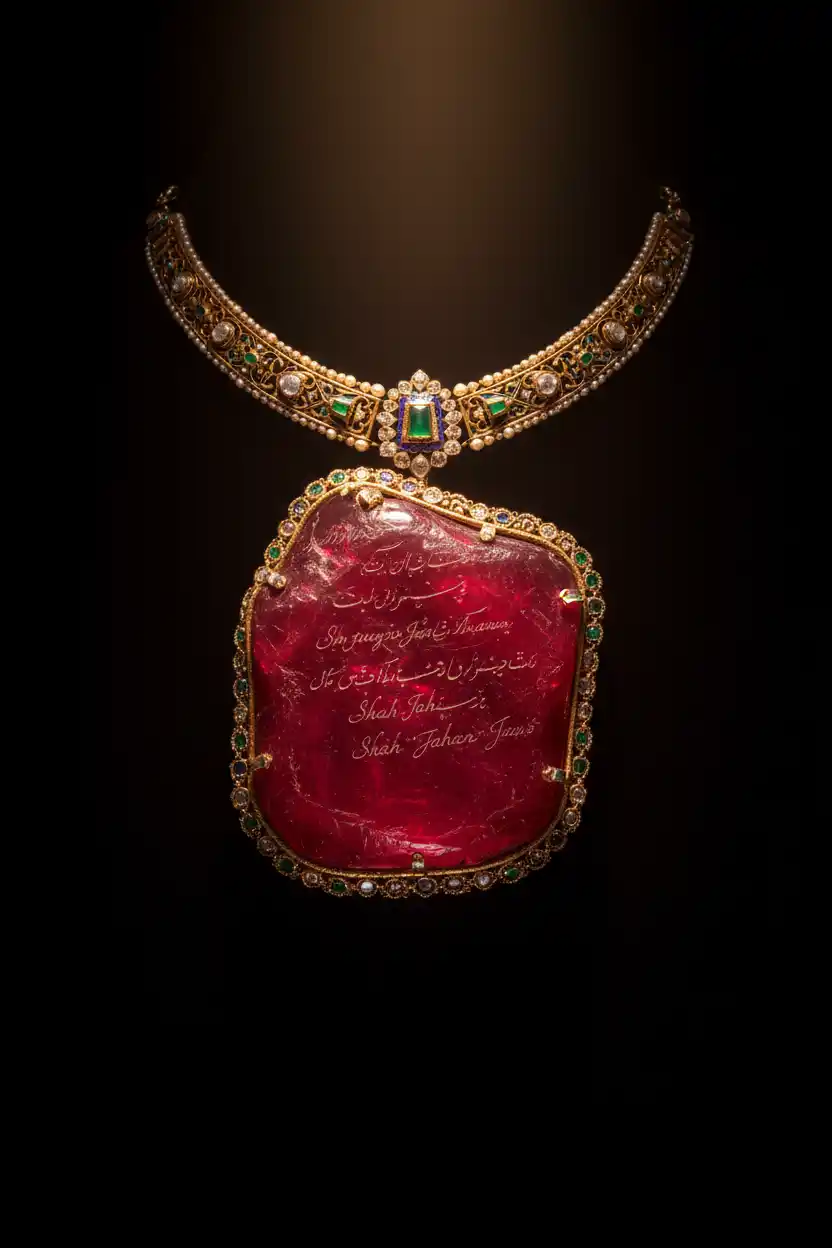
The Timur Ruby is also a red Spinel rather than a Ruby.
The large polished stone carries engraved names and dates connected with Asian rulers and imperial collections.
Its traditional name links it with Timur, although the stone’s precise early ownership has been debated.
It passed through Persian, Mughal, Afghan and Sikh treasuries before entering the British Royal Collection during the nineteenth century.
The gem is now set within a necklace.
Its inscriptions make it particularly valuable as a historical document. Rather than remaining an anonymous mineral, the stone records how rulers used gems to project continuity, legitimacy and conquest.
The Black Prince’s Ruby and Timur Ruby show why red appearance alone cannot establish mineral identity. Other red materials are compared in Red Gemstones.
9. The Star of India

The Star of India is a 563.35-carat blue-gray Star Sapphire from Sri Lanka.
Its rounded cabochon displays a star on both sides, although one side is more prominent.
Asterism forms when light reflects from oriented microscopic inclusions, commonly Rutile needles, within the Corundum.
The stone entered the American Museum of Natural History through financier J. P. Morgan’s gem collection.
In 1964, thieves stole the Star of India and several other museum gems. It was recovered later from a Miami bus-station locker.
The theft added modern notoriety to an already exceptional gemstone.
A sharp star, appropriate cabochon orientation and broad size make it scientifically and visually important beyond its famous name.
10. The Logan Sapphire
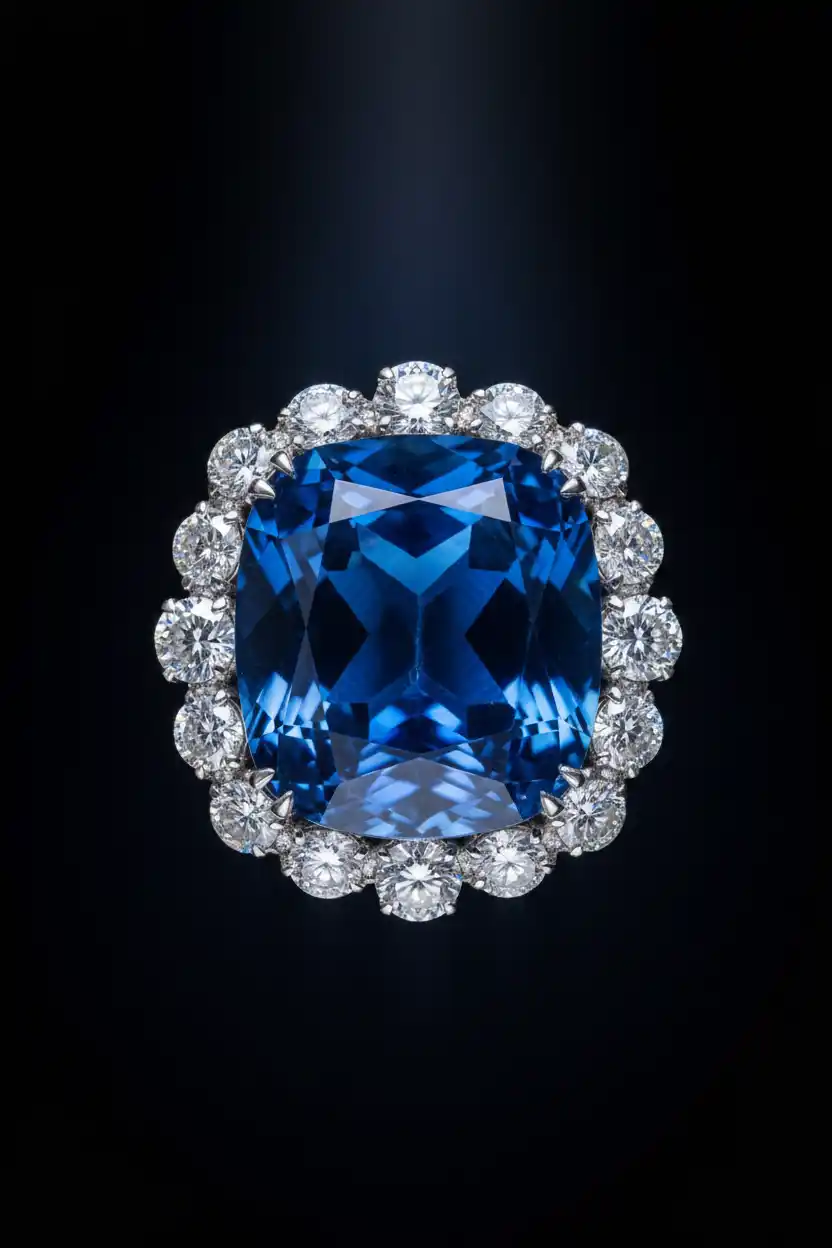
The Logan Sapphire weighs 422.98 carats and is among the largest faceted blue Sapphires.
The stone originated in Sri Lanka and was fashioned as a cushion cut.
Its setting is a brooch framed by twenty round brilliant Diamonds.
The gem belonged to Sir Ellice Victor Sassoon before passing through the Guggenheim and Logan families.
Rebecca Pollard Guggenheim Logan donated it to the Smithsonian in 1960.
Laboratory study found its blue color to be natural and the stone not heat-treated.
Unlike the Star of India, the Logan Sapphire is valued for transparent body color rather than asterism.
Its scale and clarity place it among the most recognizable examples in the Blue Gemstones category.
11. The Rosser Reeves Star Ruby
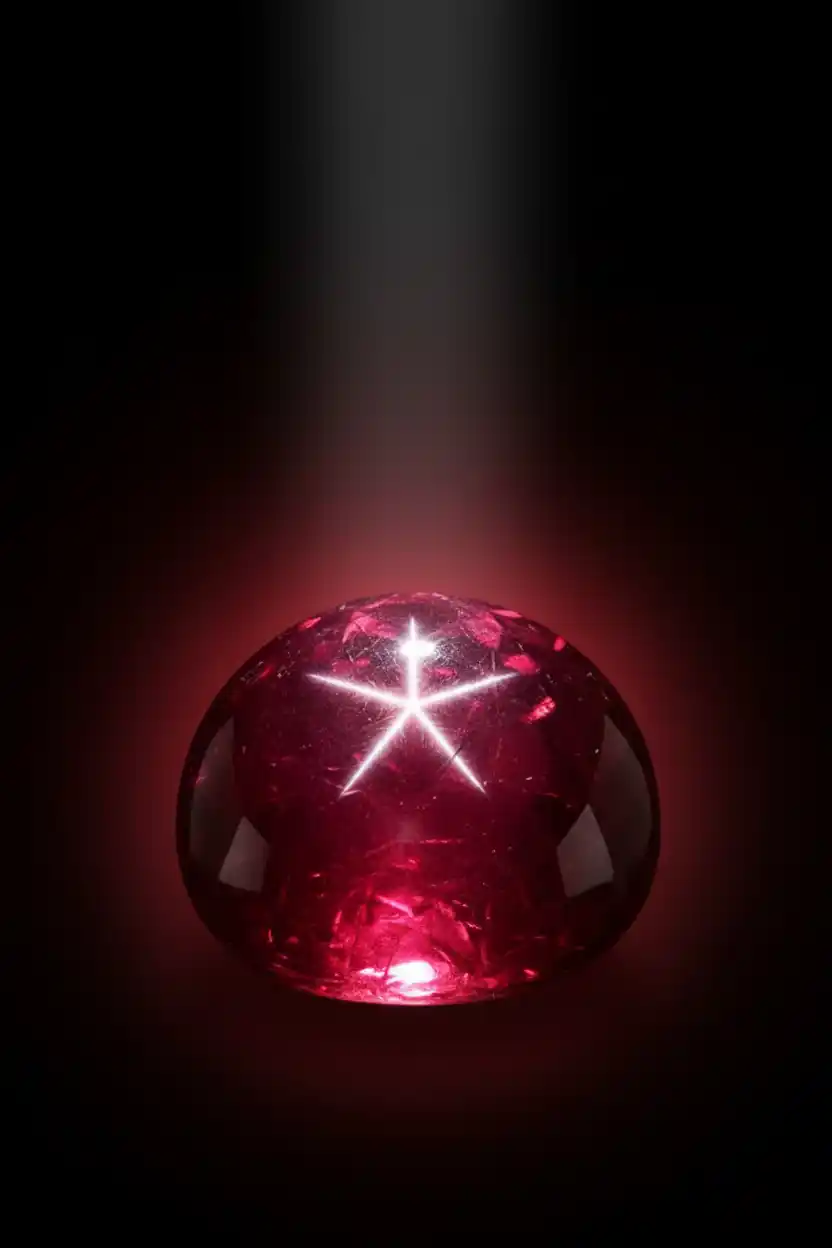
The Rosser Reeves Star Ruby is a 138.7-carat cabochon from Sri Lanka.
Its red body color and sharply defined six-rayed star make it one of the best-known phenomenal Rubies.
The stone was recut from a slightly larger weight to center and strengthen the star.
Advertising executive Rosser Reeves carried it as a personal lucky stone before donating it to the Smithsonian in 1965.
The star results from oriented Rutile inclusions reflecting light in three intersecting directions.
Its identity as Star Ruby depends on both red Corundum chemistry and the optical phenomenon.
12. The Hooker Emerald
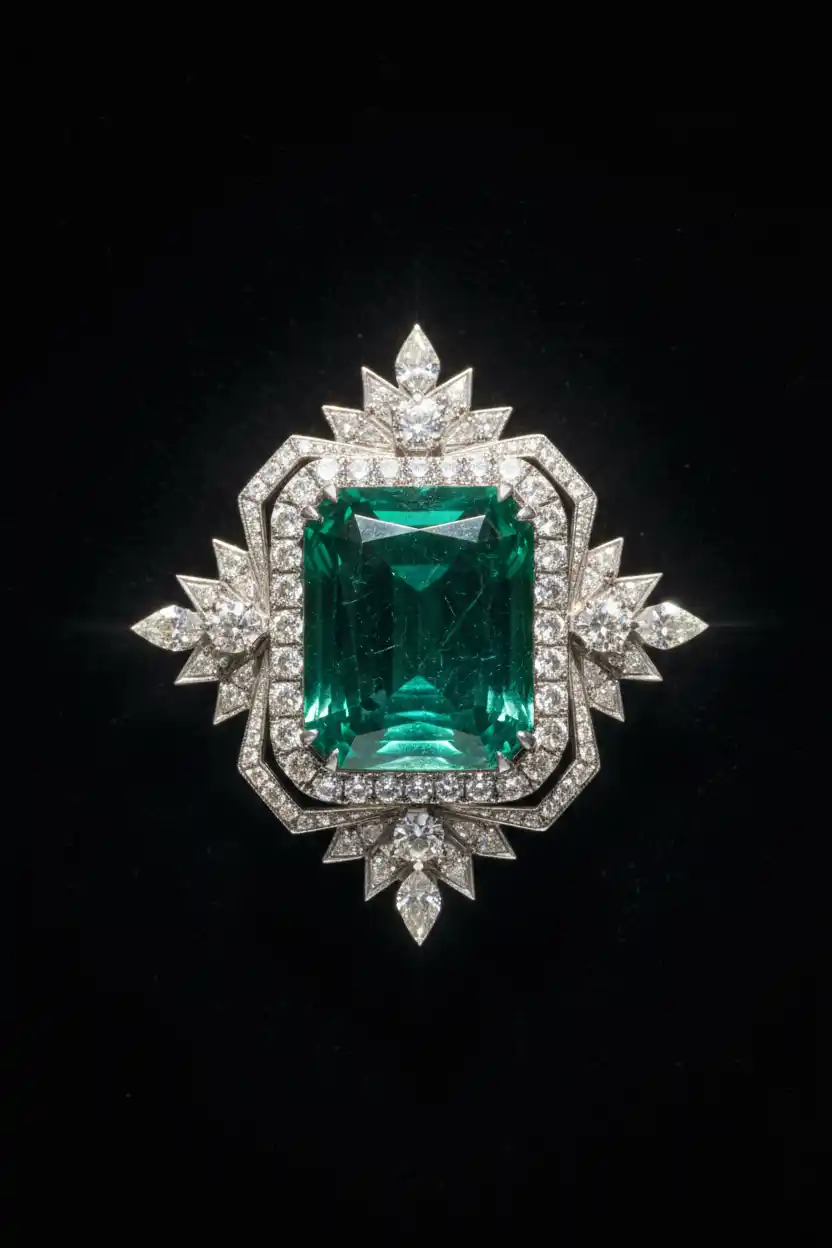
The Hooker Emerald is a 75.47-carat Colombian Emerald mounted in a brooch.
Its history has been associated with Ottoman royal ownership, although parts of its early provenance are less thoroughly documented than its later European and American history.
The stone was recut during the twentieth century and eventually acquired by jeweler Harry Winston.
Janet Annenberg Hooker purchased the brooch and donated it to the Smithsonian.
The gem’s rich green color and large size create its visual impact. Meanwhile, its museum setting preserves the historical jewelry design rather than treating it only as a loose stone.
13. La Peregrina
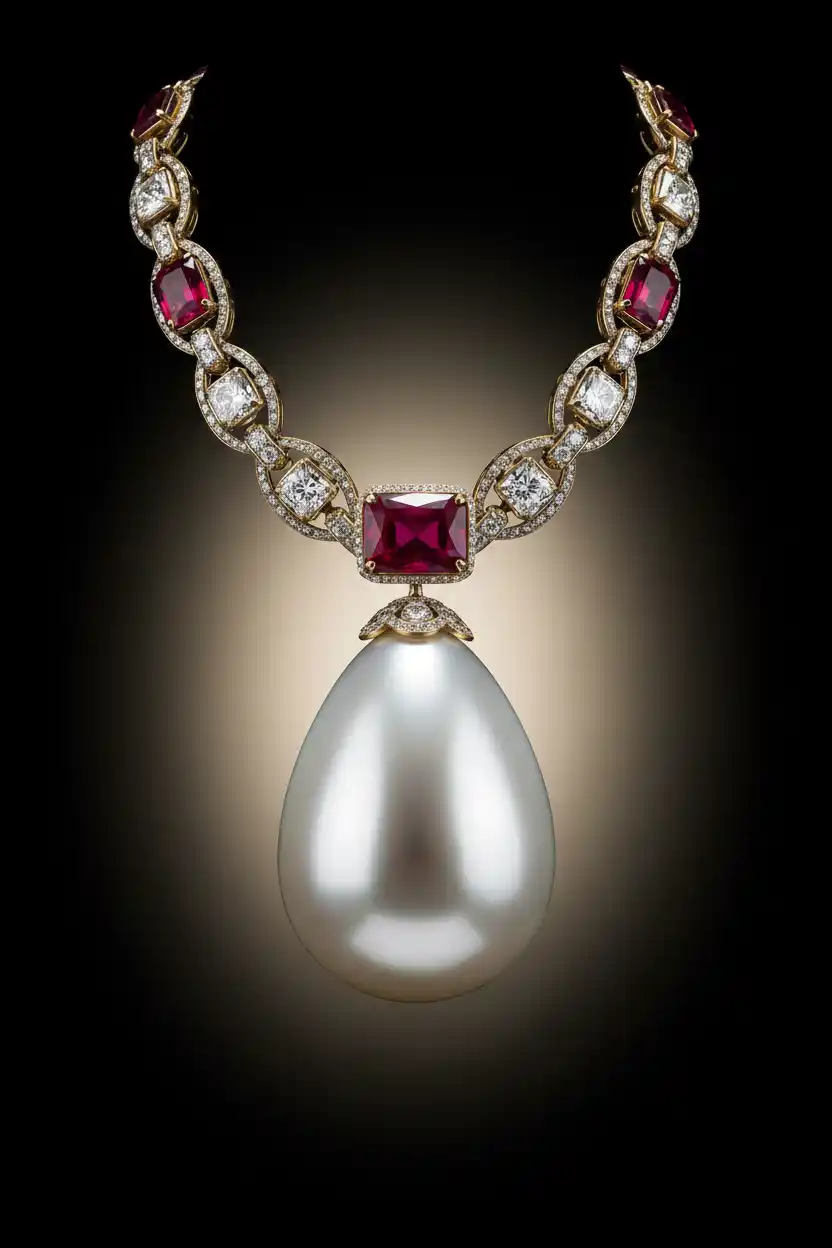
La Peregrina is a natural drop-shaped Pearl weighing approximately 50.56 carats.
Its name means “the wanderer” or “the pilgrim,” reflecting a history that moved through Spanish royal ownership and several private collections.
King Philip II of Spain presented the Pearl to Mary I of England. It later returned to Spanish royal possession and appeared in court portraits.
Actor Richard Burton purchased it for Elizabeth Taylor in 1969.
Cartier designed a Pearl, Ruby and Diamond necklace around the historic drop.
The necklace sold at Christie’s in 2011 for approximately $11.8 million, setting a major auction benchmark for Pearl jewelry at that time.
Unlike crystals cut from mined rough, a natural Pearl forms biologically inside a mollusk. Its fame broadens the history of gems beyond minerals.
Famous Does Not Mean Rarest
Several famous stones belong to minerals that occur in meaningful commercial quantities.
Diamond, Sapphire, Spinel and Emerald are not among the rarest mineral species. However, exceptional combinations of size, color, clarity, provenance and survival make individual examples irreplaceable.
Conversely, many minerals in the Rarest Gemstones in the World list have little public fame because they lack royal history, major museum display or broad cultural recognition.
Fame is therefore a social and historical category rather than a mineralogical measurement.
Famous Names Can Preserve Wrong Identities
The two most obvious examples are the Black Prince’s Ruby and Timur Ruby.
Both retained Ruby names after Spinel became scientifically distinguishable from Corundum.
Historical labels should not always be erased. They can preserve how earlier cultures understood and traded gems.
However, modern descriptions should state the correct mineral identity clearly.
The broader distinction between species, variety, rock and organic gem appears in Types of Gemstones.
How Museums Authenticate Historic Gems
Museums combine documentary and scientific evidence.
Documents may include:
- Royal inventories
- Purchase records
- Portraits
- Early drawings
- Mounting descriptions
- Auction catalogues
- Collection labels
- Engraved inscriptions
- Correspondence
- Insurance records
Scientific examination can involve:
- Weight and dimensions
- Microscopy
- Spectroscopy
- X-ray imaging
- Fluorescence
- Chemical analysis
- Inclusion study
- Historical cut reconstruction
The role and limitations of modern reports are explained in Gemstone Certification.
A laboratory can identify a mineral and investigate treatment. It cannot automatically prove every ownership story attached to that stone.
Provenance, Empire and Contested Ownership
Many royal gemstones changed hands through conquest, annexation, forced treaties, dynastic marriage and colonial extraction.
Consequently, their display is not politically neutral.
The Koh-i-Noor remains the most visible example, but similar questions surround the Cullinan stones and several jewels transferred from South Asian treasuries.
A complete article should neither erase those histories nor reduce every stone to one modern political interpretation.
Responsible discussion separates:
- Confirmed ownership records
- Traditional legends
- Colonial or military transfer
- Current legal custody
- Cultural claims
- Public-access value
- Restitution arguments
The wider questions of mining, traceability and seller claims appear in Ethically Sourced Gemstones.
Why Famous Gemstones Are Difficult to Value
Most museum and royal gems are effectively outside the ordinary market.
Their cultural importance, custom settings and irreplaceable histories prevent straightforward comparison with loose commercial stones.
An insurer may estimate replacement or risk value, but no available replacement can reproduce the same object.
Auction prices provide evidence only when a stone actually sells. La Peregrina has a recorded modern transaction, whereas the Hope Diamond and Crown Jewels do not.
A private hypothetical estimate can create headlines without representing a realizable price.
Pink, blue, green and other historic fancy colors may attract exceptional premiums, but the market factors explained in Pink Gemstones still cannot capture royal provenance fully.
Legends and Curses
Curse stories surround the Hope Diamond, Black Orlov and several additional gems.
Many legends grew after the stones became commercially or publicly famous. Journalists, dealers and owners sometimes repeated dramatic stories because mystery increased attention.
A responsible history separates documented events from later storytelling.
Theft, execution, bankruptcy or death may have occurred in an owner’s life without proving that a mineral caused the event.
Gemstones have no demonstrated ability to create misfortune, protect dynasties or influence political outcomes.
Frequently Asked Questions
What is the most famous gemstone in the world?
The Hope Diamond and Koh-i-Noor are among the strongest candidates because of their global recognition, public display and extensive historical narratives.
What is the largest famous cut Diamond?
Cullinan I weighs 530.2 carats and is the largest principal cut stone from the Cullinan rough.
Is the Black Prince’s Ruby a real Ruby?
No. It is a red Spinel that retained its historic Ruby name.
Is the Timur Ruby also a Spinel?
Yes. Modern mineralogy identifies it as a large engraved red Spinel.
What is the largest famous star sapphire?
The Star of India weighs 563.35 carats and is one of the largest known gem-quality star sapphires.
Where is the Hope Diamond now?
It belongs to the Smithsonian’s National Museum of Natural History in Washington, D.C.
Who owns the Koh-i-Noor?
It forms part of the British Crown Jewels, although its acquisition and ownership remain internationally contested.
Are famous gemstones the most valuable gemstones?
Not always. Fame reflects history and cultural recognition, while commercial value also depends on current ownership, saleability, quality and market demand.
Can a historic gemstone have the wrong name?
Yes. Names established before modern mineralogy may remain in use even after scientific testing identifies another species.
How can a museum prove a gemstone’s history?
Museums combine inventories, portraits, mountings, inscriptions, archival records and scientific examination. No single test establishes an entire chain of ownership.
The enduring importance of these stones comes from the intersection of mineral identity and human history. Treating either side as an afterthought produces an incomplete account.