Fire Opal Benefits: 10 Real Uses, Meaningful Symbolism & Verified Facts, Safe Limits
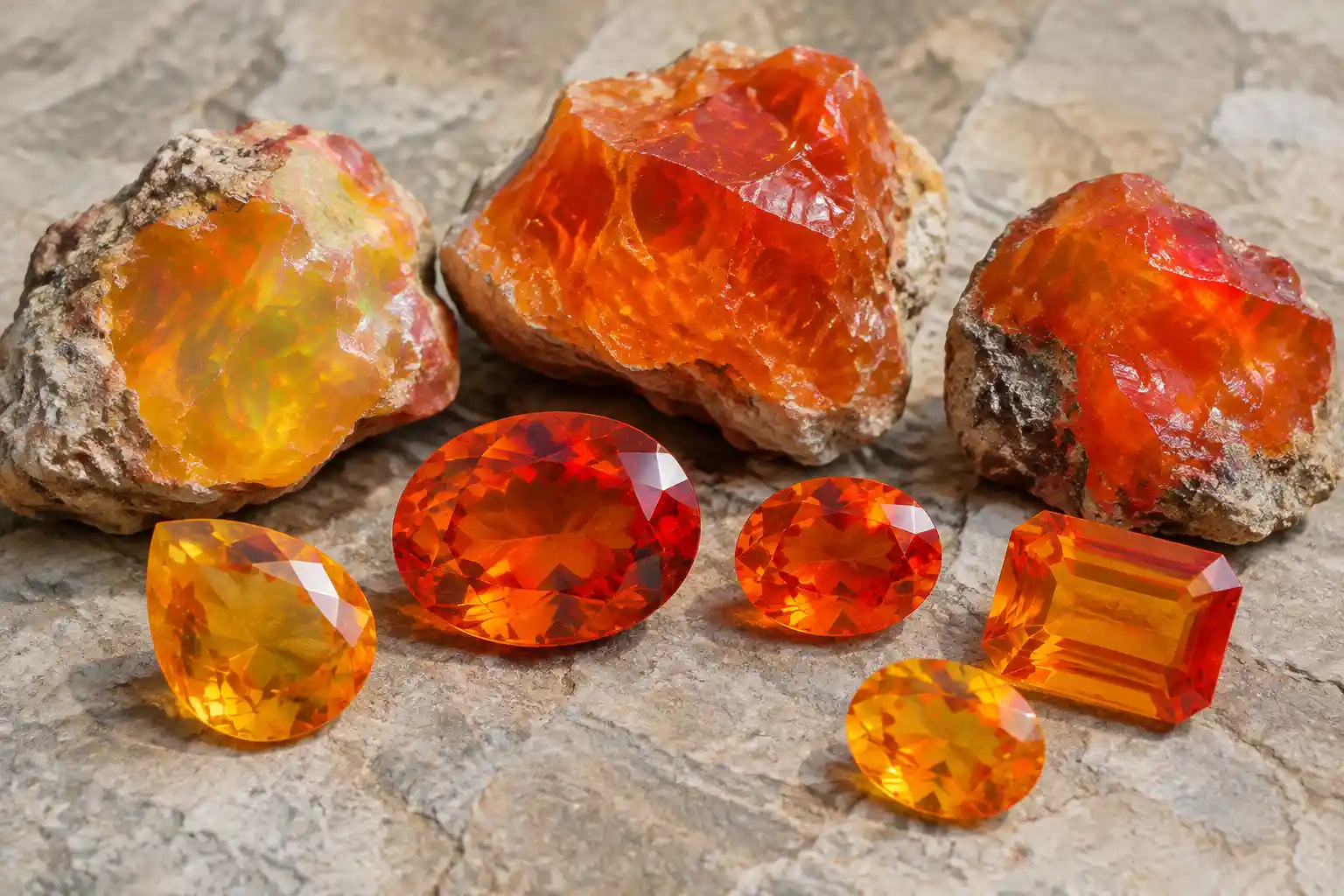
Fire Opal benefits begin with something unusual in the opal world: intense body color can be the main attraction even when play-of-color is weak or completely absent. Fire Opal is transparent to translucent opal with yellow, orange, orange-red, or red body color, and Mexico is the classic source most closely associated with the variety. Some stones display spectral play-of-color in addition to their warm body color, but many desirable Fire Opals are valued primarily for transparency, saturation, brightness, and a glowing appearance rather than rainbow flashes.
Like other opals, Fire Opal is hydrated silica rather than a conventional crystalline gemstone. Opal generally has a Mohs hardness around 5 to 6.5, so it is softer than quartz and substantially softer than sapphire or diamond. Its water content, internal structure, fractures, and possible sensitivity to dehydration or thermal stress also mean that jewelry durability depends on more than hardness. Fine transparent stones can nevertheless make striking earrings, pendants, protected rings, and collector gems when their physical limits are respected.
These measurable qualities create substantial Fire Opal benefits through jewelry, faceting, collecting, geology, gem identification, and visual variety. Modern spiritual traditions may additionally associate the stone with creativity, passion, confidence, motivation, or vitality. Those themes can serve as personal symbolism, but Fire Opal does not medically increase energy, improve fertility, regulate hormones, treat depression, or alter circulation through ordinary wearing or handling.
10 Fire Opal Benefits at a Glance
- Vivid yellow, orange, and red body colors provide strong visual impact even without play-of-color.
- Transparent and translucent stones can be faceted rather than restricted to traditional opal cabochons.
- Some Fire Opals combine warm body color with spectral play-of-color for additional optical interest.
- Mexican volcanic deposits give the gemstone strong geological and locality significance.
- Faceting rewards careful orientation, symmetry, transparency, and color distribution.
- Collectors can compare body color, transparency, play-of-color, inclusions, locality, and natural crystal form.
- Identification helps distinguish Fire Opal from orange glass, citrine, topaz, garnet, synthetic products, and other orange-red gems.
- Relatively low density allows visually substantial opals without the weight of many denser gemstones.
- Jewelry designers gain a warm-colored gemstone capable of working with both minimal and highly decorative settings.
- Modern symbolism can represent creativity, enthusiasm, or deliberate action when kept separate from medical claims.
Warm Yellow, Orange, and Red Color Is the Defining Fire Opal Benefit
Color is the most immediate of all Fire Opal benefits. Fine examples can range from pale yellow and golden orange through saturated tangerine, orange-red, and vivid red. The best-looking stone is not necessarily the darkest one because overly deep tone can reduce transparency and brightness, while a lighter but highly luminous orange may appear more vivid in normal lighting.
This body color distinguishes Fire Opal from many other precious opals, where the main attraction is spectral play-of-color against a white, dark, or colorless background. A Fire Opal can be beautiful even when no rainbow flashes are visible at all. In gemological classification, the warm yellow-to-red body color is fundamental to the variety.
Some stones display play-of-color as well, creating a combination of fiery body color and moving spectral flashes. These examples can be particularly attractive, but buyers should not assume play-of-color is required for a genuine Fire Opal.
Anyone evaluating Fire Opal quality should therefore consider body color, saturation, transparency, cut, clarity, stability, play-of-color when present, and overall visual performance together rather than applying grading rules designed for black or white precious opal.
Transparency Allows Fire Opal to Be Faceted Like Few Other Opals
Faceting is one of the most distinctive Fire Opal benefits. Many opals are cut as cabochons because a smooth dome displays play-of-color effectively, but transparent Fire Opal can be cut with flat polished facets that create brilliance while preserving its warm body color.
Ovals, cushions, pears, emerald-style cuts, rounds, and other shapes are possible when the rough has sufficient transparency and structural integrity. Cutting quality matters because Fire Opal has a lower refractive index than gemstones such as diamond or sapphire, so poor proportions can produce obvious windowing or a weak face-up appearance. Skilled cutters balance depth, symmetry, weight, color distribution, and fracture avoidance.
Faceting also changes the visual character. A transparent orange stone may return crisp flashes from facet surfaces while its body color remains luminous throughout the interior. A play-of-color Fire Opal requires additional judgment because facet reflections should complement rather than overwhelm the spectral effect.
These Fire Opal benefits make the gemstone unusually versatile within the opal family, providing both traditional cabochon possibilities and genuinely attractive faceted gems.
Play-of-Color Is an Optional Bonus Rather Than a Requirement
One of the most important facts for buyers to understand is that Fire Opal does not need play-of-color to qualify as Fire Opal. Many excellent stones are transparent or translucent yellow, orange, or red gems with no obvious spectral flashes.
When play-of-color is present, however, it can add another layer to Fire Opal benefits. Green, red, blue, and other spectral colors may move across the stone as the viewing angle changes. This phenomenon occurs when sufficiently ordered microscopic silica spheres interact with visible light and separate wavelengths through diffraction.
Body color and play-of-color should therefore be evaluated separately. A deeply saturated orange stone with no spectral effect can still be beautiful, while a paler Fire Opal may attract attention because it contains exceptionally bright moving flashes.
This distinction also prevents confusion with Fire Agate. Fire Agate is chalcedony whose iridescent colors arise from thin internal layers associated with iron-rich structures, while Fire Opal is hydrated silica defined primarily by yellow-to-red body color. Similar fiery names do not mean the gemstones share the same optical mechanism.
Mexican Volcanic Geology Gives Fire Opal a Distinctive Origin Story
Mexico is the source most famously associated with Fire Opal, and its volcanic geology forms an important part of the gemstone’s identity. Silica-rich fluids moved through fractures, cavities, and porous volcanic rocks, eventually depositing hydrated silica under suitable conditions. This process produced transparent and translucent opal ranging from pale yellow to vivid orange-red.
Several Mexican regions have produced notable Fire Opal, and the variety became strongly linked with Mexican gem cutting and jewelry. The association is so established that Fire Opal is sometimes called Mexican Opal or Mexican Fire Opal in the trade, although geographic origin should still be documented rather than assumed from color alone.
These geological Fire Opal benefits become particularly interesting when rough specimens preserve volcanic host rock or natural cavity surfaces. A faceted gem emphasizes transparency and color, while rough material preserves more direct evidence of formation.
Collectors can therefore approach Fire Opal from several directions: as a colored gemstone, an opal variety, a volcanic mineralogical product, or a locality-specific collectible.
Fire Opal Provides a Challenging but Rewarding Lapidary Experience
Opal requires more cautious cutting than quartz-family gemstones because it is softer and can contain internal stress, fractures, variable water content, or structurally weaker zones. Fire Opal benefits skilled lapidaries precisely because these challenges make planning important.
Transparent rough allows internal flaws to be studied before cutting, but fractures can still become more serious during sawing or polishing. Excessive heat is particularly undesirable because opal contains water within its structure, and sudden temperature changes can encourage cracking or crazing in vulnerable stones.
The cutter must also decide whether a particular piece is better suited to a cabochon or a faceted design. Strong transparency may favor faceting, while internal play-of-color or unusual inclusions might look better beneath a smooth curved surface.
Good cutting reveals the gemstone’s strongest property rather than forcing every piece into one standard form. A deeply saturated orange oval may need very different treatment from a pale transparent opal whose main attraction is moving spectral color.
Collectors Can Compare Color, Clarity, Locality, and Optical Behavior
Fire Opal benefits collectors because individual stones can vary enormously while remaining part of the same general variety. One specimen may be transparent golden yellow, another vivid orange-red, another cloudy or translucent, and another capable of displaying play-of-color across part of the surface.
Collectors may also seek natural rough, matrix specimens, cut gems, unusual inclusions, or stones with reliable locality information. Transparent rough can reveal internal structures that disappear once faceted, while matrix pieces show how the opal occurred within its volcanic environment.
Color intensity is only one collecting criterion. Stability matters because a brilliant stone that develops cracks has very different long-term appeal from a stable specimen. Transparency, fracture condition, surface quality, natural crystal or cavity form, documentation, and cutting craftsmanship can all contribute.
Someone preparing to buy Fire Opal should therefore examine the actual stone rather than relying on a generic description such as Mexican orange opal. Realistic photos, dimensions, disclosure of cracks or treatments, and several lighting conditions provide a better basis for judgment.
Gem Identification Separates Fire Opal from Similar Orange and Red Stones
Orange gemstones overlap visually more than many buyers realize. Citrine, orange sapphire, topaz, garnet, glass, synthetic products, dyed stones, and Fire Opal can all occupy parts of the yellow-orange-red range.
This makes identification one of the practical Fire Opal benefits for gemology students. Opal has different refractive behavior, density, hardness, internal structure, luster, and microscopic features from crystalline quartz, corundum, topaz, or garnet. Fire Opal also lacks the conventional crystal structure of those minerals because opal is amorphous or poorly crystalline hydrated silica.
Natural versus synthetic opal can create another identification challenge. Some laboratory-grown products reproduce opal’s appearance convincingly, while glass or resin can imitate warm transparent body color without sharing opal’s properties.
Professional examination becomes particularly useful for valuable stones because visual color alone cannot establish identity, geographic origin, or treatment history.
Fire Opal Can Create Striking Jewelry Without Excessive Weight
Opal has relatively low density compared with many familiar gemstones, which gives Fire Opal benefits in designs where a visually substantial center stone is desirable without equivalent weight from a denser gem.
Large transparent ovals, cushions, and freeforms can therefore create significant visual presence. Yellow gold can emphasize orange and red body colors, while white metals create sharper contrast. Rose gold may reinforce pinkish-orange or red tones particularly well.
Design should still account for durability. Pendants and earrings provide relatively protected settings, while rings expose the gemstone to more frequent impact. Protective bezels, halos, or carefully positioned prongs can help reduce edge damage without hiding too much of the stone.
Fire Opal’s unusual combination of warm body color and transparency also allows designers to use the gemstone without depending on rainbow play-of-color. A perfectly attractive piece can succeed through saturated orange alone.
Modern Symbolism Can Represent Creativity, Motivation, and Enthusiasm
Modern crystal traditions frequently describe Fire Opal benefits in terms of passion, creativity, vitality, sexuality, courage, motivation, and enthusiasm. Its yellow-orange-red palette naturally supports these associations because people often connect warm colors with sunlight, fire, activity, excitement, and emotional intensity.
A person may wear Fire Opal while working on a creative project because the color represents enthusiasm, or choose it to mark a career transition because the bright orange feels appropriate to a new beginning. These uses can become meaningful through personal association.
Claims surrounding Fire Opal healing properties may extend into fertility, reproductive health, hormones, metabolism, blood circulation, depression, or sexual function. Those ideas belong to spiritual traditions and have not been established as medical effects of wearing opal.
The gemstone can symbolize vitality without medically increasing vitality, just as it can represent creativity without biologically improving creative ability.
Responsible Care Protects Fire Opal from Impact, Heat, and Dehydration Stress
Care is an essential part of Fire Opal benefits because opal is less hard than quartz and may be vulnerable to cracking, abrasion, and thermal stress. Lukewarm water and a soft damp cloth are generally safer for routine cleaning than aggressive methods, while ultrasonic and steam cleaning are poor default choices for valuable opal.
Sudden temperature changes should be avoided. Leaving a stone near intense heat, exposing it to boiling water, or moving it rapidly between extreme temperatures can place unnecessary stress on its structure. Prolonged dry heat can also be undesirable for opal.
Jewelry should be stored away from harder gemstones that can scratch the surface. Rings deserve extra caution during manual work, while earrings and pendants are generally easier to protect.
Fire Opal should also not be ground for ingestion, placed into homemade drinking remedies, or treated as a therapeutic source of silica or water. Its verified benefits already include color, jewelry, geology, collecting, optical interest, and symbolism without health experimentation.
Conclusion
Fire Opal benefits include vivid yellow-to-red body color, transparency, faceting potential, optional play-of-color, volcanic geological interest, lapidary challenge, collecting diversity, gemstone identification, jewelry versatility, and meaningful modern symbolism. Its defining feature is not necessarily rainbow fire but the warm luminous body color that gives the variety its name.
The strongest Fire Opal benefits emerge when the stone is evaluated on its own terms. Good color, transparency, cutting, stability, treatment disclosure, and careful ownership matter more than exaggerated metaphysical claims. Symbolism involving creativity, motivation, enthusiasm, or personal change can add meaning when it remains separate from medical promises.
FAQs
What are the main Fire Opal benefits?
The most verifiable Fire Opal benefits include vivid body color, jewelry use, faceting, collecting, volcanic geological study, gemstone identification, and personal symbolism.
What colors can Fire Opal be?
Fire Opal commonly ranges from yellow and golden orange through vivid orange, orange-red, and red.
Does Fire Opal always show play-of-color?
No. Many genuine and attractive Fire Opals show little or no play-of-color and are valued primarily for their warm body color and transparency.
Is Fire Opal the same as Fire Agate?
No. Fire Opal is hydrated silica in the opal family, while Fire Agate is chalcedony with iridescence produced by thin internal layers.
How hard is Fire Opal?
Opal generally has a Mohs hardness around 5 to 6.5, so Fire Opal requires more protection from scratches and impact than quartz, sapphire, or diamond.
Why is Mexican Fire Opal famous?
Mexico is the classic source of transparent yellow, orange, and red Fire Opal, particularly from volcanic geological environments.
Is Fire Opal suitable for rings?
Yes, but protected settings and careful wear are advisable because opal is relatively soft and can be vulnerable to impact or cracking.
Can Fire Opal be faceted?
Yes. Transparent Fire Opal is frequently faceted, which distinguishes it visually from many opals that are more commonly cut as cabochons.
Does Fire Opal have healing benefits?
There is no established clinical evidence that Fire Opal treats fertility, hormones, circulation, depression, metabolism, or other medical concerns.
How should Fire Opal be cleaned?
Gentle cleaning with lukewarm water and a soft cloth is usually preferable to steam, ultrasonic cleaning, extreme heat, or harsh chemicals.
Fire Opal benefits described as healing, fertility-related, motivational, creative, sexual, chakra, or energetic effects remain spiritual and personal beliefs and should not replace qualified medical or mental-health care.