Fordite Meaning: Properties, Uses & Symbolism
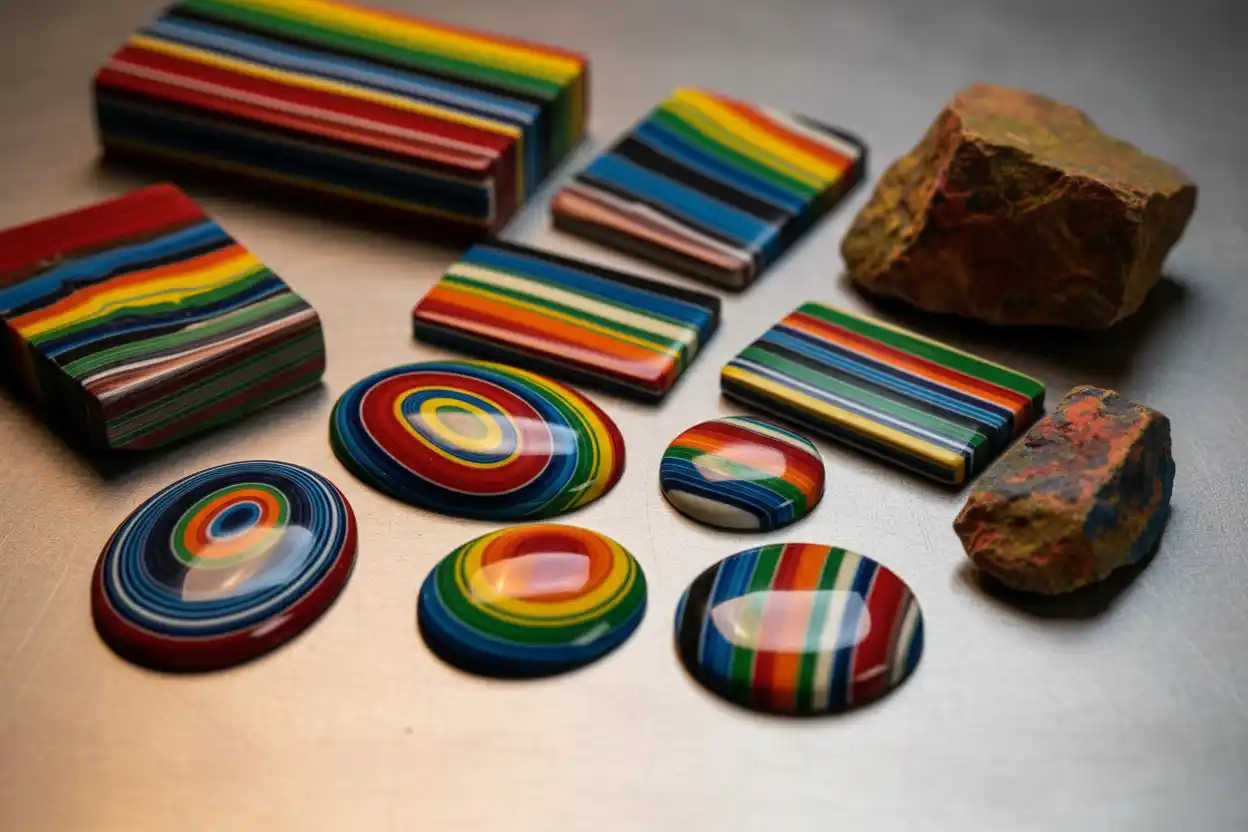
Fordite meaning begins with an unusual fact: Fordite is not a mineral, gemstone, rock, or natural geological material. It is a human-made lapidary material created from many layers of hardened industrial paint, most famously associated with automotive manufacturing. Traditional Fordite developed when sprayed paint accumulated repeatedly on fixtures, carriers, racks, skids, or other equipment inside paint operations. Successive coating and curing cycles hardened those deposits into thick, multicolored masses. When sliced, shaped, and polished, the layers can reveal sweeping bands, tight stripes, irregular folds, metallic sections, and complex patterns that resemble agate closely enough to inspire names such as “Detroit agate” and “Motor City agate.”
That resemblance does not make Fordite a type of agate. Natural agate is microcrystalline silica produced through geological processes, whereas Fordite is an anthropogenic composite whose structure comes from industrial coatings. Its constituents can include pigments, binders, primers, top coats, metallic-effect materials, clear layers, and other coating components depending on where and when the deposit formed. Consequently, there is no single chemical formula, Mohs hardness, density, refractive index, or standardized composition that applies to every piece sold as Fordite.
A grounded Fordite meaning therefore follows a different path from a conventional mineral reference. The material’s identity is industrial rather than geological. Its “formation” is repeated coating and curing. Its color comes from manufactured pigments and coating systems. Its history belongs to factories, paint technology, labor, manufacturing, salvage, and lapidary reuse. Modern symbolism—often associated with reinvention, accumulated experience, transformation, creativity, or industrial heritage—comes afterward and should not be represented as a measurable force emitted by the material. Readers comparing other unconventional lapidary materials with natural stones can browse the broader Gemstone Guides collection while keeping origin categories clearly separated.
Fordite Meaning at a Glance
| Feature | Grounded reference |
|---|---|
| Material identity | Human-made accumulation of hardened industrial paint layers |
| Formal mineral status | Not a mineral species |
| Geological status | Not a naturally formed rock or gemstone |
| Traditional association | Automotive paint operations and repeated coating/curing cycles |
| Other names | Detroit agate, Motor City agate, automotive paint agate, automotive paint slag |
| Main visual feature | Numerous differently colored paint layers exposed by cutting and polishing |
| Typical colors | Potentially almost any paint color, including metallic and clear layers |
| Composition | Variable; depends on the paint systems, pigments, binders, primers, and coatings present |
| Crystal system | None |
| Universal Mohs hardness | None; physical behavior varies with coating composition and aging |
| Typical lapidary use | Cabochons, pendants, earrings, beads, small carvings, display slabs |
| Provenance importance | High, because location and industrial history cannot be proven from color pattern alone |
| Common identification problem | Modern intentionally layered paint can resemble historic factory Fordite |
| Symbolic associations | Transformation, reuse, accumulated experience, craftsmanship, industrial history |
| Safety boundary | Intact polished ownership differs from cutting, sanding, drilling, heating, or generating unknown paint dust |
The most important part of Fordite meaning is this category distinction. Calling Fordite a “stone” can be understandable in ordinary jewelry language because it is cut and polished like a stone, but that wording should not be mistaken for a mineralogical classification.
What Fordite Actually Is
Fordite is best described as a hardened multilayer industrial coating material repurposed for lapidary work. Traditional examples associated with automotive manufacturing formed unintentionally. Paint that did not land on the intended vehicle surface accumulated elsewhere in the paint environment. As additional vehicles or components moved through coating operations, new layers were deposited. Repeated curing hardened the mass until thick sections eventually needed to be removed.
The result could contain dozens or hundreds of visibly different layers. Some are extremely thin. Others are thick, irregular, folded, or interrupted. Primers can create gray, cream, or reddish foundations; color coats introduce stronger hues; metallic paints can produce sparkling sections; and clear coatings can create translucent bands. Depending on the manufacturing period and process, a piece may show highly regular sequences or chaotic swirls created by how paint built up around equipment.
Because the material is heterogeneous, Fordite meaning should not borrow fixed mineral-property tables from quartz, agate, jasper, or other natural stones. One Fordite cabochon may be relatively hard and take a durable polish, while another may contain softer layers, small voids, brittle interfaces, or coatings that respond differently to abrasion. The behavior belongs to the individual composite rather than to one universal species.
For close documentation of layer boundaries, voids, metallic particles, repairs, bubbles, and polishing features, the Fordite microscope inclusion notebook treats the material as a manufactured composite rather than forcing conventional gemstone inclusion terminology onto it.
How Traditional Fordite Forms
Traditional Fordite formation is essentially industrial stratigraphy. A paint operation applies one coating. Some overspray or excess coating reaches a fixture or carrier. That coating cures. Another production cycle adds another layer, perhaps in a completely different vehicle color. Over repeated cycles, the deposit becomes thicker and more complex.
That process is why an authentic section can preserve manufacturing history without recording it in a simple chronological code. A red band may represent one production interval, but it does not automatically identify a particular vehicle model. A metallic blue layer might correspond to an automotive coating, yet its presence alone cannot determine the manufacturer, factory, production line, or exact period. Several paint colors could have been used across multiple products or facilities.
Repeated curing is particularly important to traditional automotive Fordite because the layers became sufficiently hardened to survive removal, cutting, and polishing. The industrial process was not designed to create lapidary rough. Fordite became collectible only after workers, craftspeople, and later sellers recognized that cross-sections of the discarded material could be visually striking.
Modern paint technology complicates the story. Manufacturing processes evolve, and not every contemporary coating operation produces the same kind of thick overspray accumulation associated with classic Fordite. Meanwhile, artisans can intentionally create layered paint composites that resemble factory material. Those newer pieces can be attractive in their own right, but they answer a different provenance question.
The industrial accumulation process, differences between overspray, fixture buildup, intentionally layered material, and other coating residues are treated more fully in Fordite formation and deposit geology—with “deposit geology” understood here as a site architecture inherited from the broader material cluster rather than evidence that Fordite has a geological deposit.
What Creates Fordite’s Colors?
Fordite color comes from manufactured coatings rather than trace elements inside a crystal lattice. Pigments, metallic flakes, effect particles, primers, binders, clear coats, and coating thickness all contribute to the final appearance. That makes color interpretation fundamentally different from a natural gem such as fluorite or fuchsite.
A bright red band does not identify one pigment automatically. A white band is not necessarily one chemical composition. Metallic-looking layers can contain effect pigments or reflective particles, while dark layers may be primer, color coat, accumulated contamination, or another coating component. Without analytical testing or manufacturing records, assigning exact chemistry from appearance is speculative.
Layer thickness influences visual character too. A very thin bright layer may appear as a narrow line in a polished cabochon, while thicker paint deposits create broad fields of color. Clear or translucent coatings can visually deepen neighboring colors. Fine sanding and polishing can expose several layers simultaneously on a curved surface, making the pattern appear to flow even though the underlying deposit was originally stacked.
Lighting changes metallic and pearlescent effects substantially. A layer that looks nearly gray in diffuse light may flash silver, blue, or gold under directional illumination. The specialized relationship between manufactured pigments, layer orientation, transparency, and polished appearance belongs in Fordite optical properties and color behavior rather than being interpreted through natural-gem color-center terminology.
Fordite Patterns Are Cross-Sections Through Industrial Layers
The visual appeal of Fordite comes largely from how a cutter intersects the layered mass. Imagine a stack of paint layers deposited on a flat surface. A straight cut perpendicular to those layers could expose relatively parallel stripes. If the buildup formed around a curved fixture, folded edge, bolt, rack, or irregular support, the same cut could reveal waves, loops, nested arcs, eyes, or highly distorted bands.
A cabochon then adds another geometric transformation. Its curved dome removes different amounts of material across the surface. That exposes deeper layers toward some regions and shallower layers elsewhere, producing complex concentric or flowing patterns.
This means pattern is partly inherited and partly revealed. The factory created the layered composite; the lapidary orientation determines which cross-section the viewer sees.
The distinction also explains why cutting Fordite can destroy its strongest visual feature. Grinding through one attractive sequence may expose a much less interesting area beneath it, and unlike a natural crystal with predictable crystallographic properties, the next paint layer may behave mechanically differently from the previous one. Specialized orientation and finishing questions belong in Fordite cutting, orientation and polish.
Original Fordite Name and Provenance Claim Audit
Fordite’s popularity has created a vocabulary that mixes material description, geographic claims, automotive associations, and marketing. The table below separates what common terms can reasonably communicate from what they cannot prove.
| Name or claim | What it can reasonably indicate | What it does not prove |
|---|---|---|
| Fordite | Layered hardened paint material associated in trade with automotive or industrial coating buildup | Ford Motor Company origin |
| Detroit agate | Informal trade name emphasizing automotive history | Detroit origin |
| Motor City agate | Informal cultural or commercial name | Specific factory provenance |
| Automotive paint agate | Layered paint material linked or attributed to automotive coating processes | Natural agate identity |
| Automotive paint slag | Informal description for hardened paint accumulation | Slag in the metallurgical mineralogical sense |
| Vintage Fordite | Seller claim that material comes from older industrial production | Exact age without documentation |
| Factory Fordite | Claimed industrial-origin material | Which factory produced it |
| Ford Motor Fordite | Specific manufacturer-origin claim | Ford provenance merely because the word Fordite is used |
| GM Fordite | General Motors provenance claim | Authenticity without chain-of-custody evidence |
| Corvette Fordite | Vehicle or production-line association | That particular paint layers came from Corvette bodies |
| Jeep Fordite | Brand or facility attribution | Documented Jeep origin from colors alone |
| Modern Fordite | Newly produced or recently recovered layered coating material | Traditional vintage overspray history |
| Handmade Fordite | Intentionally layered paint composite | Factory overspray origin |
| AAA Fordite | Seller-specific quality language | Universal grading standard |
| Healing Fordite | Metaphysical or commercial wording | Medical or physiological effect |
The most important disputed name is Fordite itself. The term does not mean the material came from Ford Motor Company. Using the word as evidence of Ford manufacturing origin reverses the relationship between trade name and provenance.
Similarly, “Detroit agate” should not be interpreted literally without supporting records. Fordite associated with automotive manufacturing can originate from locations beyond Detroit, and not every polished layered coating offered under the Detroit agate name has a documented Motor City history.
Historic Fordite Versus Modern Layered Paint
A visually convincing Fordite pattern does not automatically establish historic factory origin. Modern artists can deliberately build, cure, stack, or pour paint into thick masses and later cut them. Industrial paint accumulation can also come from non-automotive environments.
Those materials can still be legitimate lapidary composites. The issue is disclosure.
A modern layered-paint cabochon should not need a false vintage factory story to be attractive. Its craftsmanship, colors, pattern, and reuse value can stand on their own. What changes is the historical claim.
When origin affects price, collectability, or cultural significance, provenance becomes essential. A worker’s documented recovery history, original factory connection, dated collection information, photographs of the material before cutting, accompanying notes, or traceable ownership records are more useful than trying to identify a vehicle manufacturer from the layer colors.
A structured method for recording those distinctions is provided in the Fordite provenance disclosure checklist.
Can You Identify Authentic Vintage Fordite From a Photo?
Sometimes a photograph can show material that is highly compatible with Fordite, but it cannot normally establish the complete provenance story.
Visible signs can include numerous thin coating layers, irregular curing boundaries, metallic-effect bands, primer-like sections, bubbles, embedded contamination, pits, folds, and surface patterns consistent with repeated deposition. These observations may distinguish the material from natural agate, but they do not prove which company, factory, vehicle line, or historical period produced it.
A photograph also cannot always distinguish old industrial buildup from a skilled modern layered-paint composite. Artificial aging, polishing, and carefully selected colors can create a plausible vintage appearance.
The correct conclusion may therefore be: “The material is visually consistent with layered industrial paint and is sold as Fordite; the specific factory attribution depends on provenance.” That wording is stronger than inventing certainty.
Fordite Is Not Agate
The “agate” nickname is visual. Natural agate is chalcedony formed through geological silica deposition and has mineralogical properties inherited from quartz-family material. Fordite is a polymeric or coating-based industrial composite.
This difference affects nearly everything beyond appearance. Agate has predictable quartz-family hardness and chemistry. Fordite can vary according to paint technology. Agate banding records geological mineral growth. Fordite layers record repeated human manufacturing processes. Agate can be millions of years old. Fordite belongs to industrial history.
The comparison with flower agate meaning makes this especially clear. Flower agate’s botanical-looking structures formed within natural chalcedony, whereas Fordite’s stripes were applied as manufactured coatings.
The shared word “agate” is therefore useful as a visual metaphor, not a geological classification.
Fordite Versus Fossil Coral
Fordite and the material discussed in fossil coral meaning can both become patterned polished cabochons, but their origins could hardly be more different.
Fossil coral records biological structures preserved and mineralized through geological processes. Fordite records industrial paint application. One can contain recognizable coral colony patterns inherited from an organism; the other contains coating layers inherited from manufacturing cycles.
A polished surface alone can make both look abstract and decorative. That is precisely why material identity should be established before symbolism or value is discussed.
Fordite Versus Colorful Natural Minerals
Fordite’s broad palette can resemble brightly colored minerals, but the mechanisms differ. The colors explored in fluorite color meaning arise within calcium-fluoride crystals through structural defects, trace components, irradiation-related color centers, and related mineralogical processes. Fordite’s colors were deliberately formulated by paint manufacturers.
Likewise, the green appearance discussed in fuchsite meaning comes from a chromium-bearing mica mineral rather than industrial pigment.
The visual similarity of polished materials therefore tells little about their chemical relationship. Fordite may contain colors that look “mineral-like,” but its origin remains manufactured.
The Documented Industrial Story Behind Fordite Meaning
The strongest historical Fordite meaning comes from industrial heritage. Automotive factories once relied on coating processes that could create substantial overspray accumulation on production equipment. Those repeated paint layers were a waste product of manufacturing rather than a material designed for jewelry.
Workers and craftspeople eventually recognized that the hardened buildup could be sliced and polished. Cross-sections revealed colors from numerous production cycles compressed into one object. What began as unwanted industrial accumulation gained a second life as a decorative lapidary material.
That transformation is historically more interesting than a generic claim that Fordite is “an ancient stone of rebirth.” It is not ancient, and its documented story is already one of reuse.
Its nickname also reflects the cultural relationship between automobile manufacturing and particular industrial regions. However, responsible Fordite history should not turn every cabochon into a documented artifact from one famous factory. The broad history can be accurate while the individual specimen’s history remains uncertain.
Fordite Meaning in Modern Symbolism
Modern Fordite meaning commonly centers on transformation, reinvention, accumulated experience, adaptability, creativity, and finding value in material that was once discarded. These themes are unusually well matched to the documented history because Fordite really did begin as industrial buildup before being repurposed.
A polished piece can therefore serve as a personal metaphor without requiring metaphysical claims. Each visible layer can represent one phase in a longer process. Some layers are bright, others dark, some almost disappear, and the final pattern only becomes visible after the material is cut across those accumulated experiences.
Another reflective interpretation involves reuse. Fordite can remind someone that an object does not have to retain its original purpose forever. Waste from one process became material for another craft. That metaphor can support journaling about changing careers, revising a project, learning from past work, or seeing value in an outcome that differed from the original plan.
The useful effect comes from reflection. Fordite does not need to emit transformation energy, attract success, alter another person’s emotions, or change future events.
The broader distinction between symbolic interpretation and medical, financial, or other professional claims is explained in the site’s Disclaimer.
Fordite Has No Scientifically Proven Healing Properties
Fordite is particularly unsuitable for chemistry-based healing claims because there is no universal Fordite chemistry. Different pieces can contain different paint systems from different industrial environments and production periods.
Statements that Fordite “balances minerals,” “detoxifies,” “heals the nervous system,” or provides another physiological benefit have no established scientific basis. Its pigments and binders are manufacturing materials, not nutritional compounds delivered through skin contact.
Fordite should not be presented as a treatment for anxiety, depression, cardiovascular disease, neurological conditions, hormonal disorders, chronic pain, or any other medical issue.
Its symbolism can remain meaningful without becoming medicine.
Safe Ownership: Polished Fordite Versus Paint Dust
Normal ownership of an intact polished Fordite cabochon or display slab is fundamentally different from cutting, grinding, drilling, sanding, heating, burning, or crushing the material.
Because Fordite composition can vary and older coatings may use formulations that are not fully documented, dust should not be assumed harmless. Cutting and sanding can generate fine particles from pigments, binders, primers, metallic-effect layers, clear coats, and contaminants accumulated during industrial use.
The safest general principle is to control exposure rather than guess the chemistry. Lapidary processing should use suitable professional dust collection or wet methods, eye protection, respiratory protection appropriate to the task, good hygiene, and work practices that prevent fine residues from spreading into living or food-preparation spaces.
Fordite should not be burned or deliberately heated to identify it. Thermal decomposition of unknown coatings can produce fumes that are unnecessary to create.
It should also never be ingested or used in crystal elixirs.
Jewelry Durability Depends on the Individual Composite
Fordite can take an attractive polish and is widely fashioned into pendants, earrings, rings, and other jewelry, but it does not have one universal hardness or toughness value. Layer adhesion, aging, paint chemistry, internal voids, existing cracks, and orientation can all affect performance.
A cabochon containing tightly bonded layers may withstand normal occasional wear well. Another piece may develop edge chipping or separation along a weak layer boundary. Exposed rings generally experience more impact and abrasion than protected pendants or earrings.
Mounting should therefore treat the individual Fordite piece as a layered composite. Excessive point pressure on a fragile edge, poorly positioned drill holes, or forcing a cabochon into an undersized setting can create damage even when the surface looks durable.
Material-specific design considerations are addressed in Fordite setting and wear engineering.
Conservation Matters Because Fordite Is Industrial Heritage
A documented vintage Fordite specimen can carry historical value beyond its visual pattern. Uncut material may preserve the original outer surfaces, fixture curvature, attached industrial residue, unusual coating sequences, or evidence useful for tracing its manufacturing history.
Aggressive cleaning can remove those features. Recutting a documented slab can turn a historically informative object into several attractive but less contextualized cabochons. Neither choice is automatically wrong, but the tradeoff should be understood.
Original labels, worker notes, factory associations, photographs, collection records, and acquisition information should remain with the material whenever possible. If a provenance claim becomes uncertain, preserving the original wording is better than silently rewriting it into stronger certainty.
Long-term approaches to condition photography, labeling, storage, and intervention are covered in Fordite specimen conservation and record keeping.
A Practical Fordite Specimen Checklist
Before buying, cutting, documenting, or relabeling a Fordite specimen, record:
| Observation | Why it matters |
|---|---|
| Overall dimensions and weight | Creates a baseline before cutting or alteration |
| Layer count estimate | Documents visual complexity without pretending to reconstruct production history |
| Layer thickness variation | Helps distinguish uniform handmade stacks from more irregular buildup, though not conclusively |
| Metallic or pearlescent layers | Records effect coatings that may be useful for provenance research |
| Primer-like layers | May indicate industrial coating sequences but are not factory-specific |
| Clear or translucent layers | Can affect polish and optical depth |
| Bubbles and voids | May record application and curing behavior and influence durability |
| Folded or curved strata | Can indicate accumulation around irregular equipment |
| Surface contamination | May be historically informative but should be handled conservatively |
| Cracks or delamination | Important for cutting, setting, and storage |
| Original label | Preserves the source claim exactly as received |
| Seller’s factory claim | Should be recorded separately from independently supported provenance |
| Recovery story | Valuable when traceable; weak when repeated without documentation |
| Modern versus vintage disclosure | Essential when historical authenticity affects price |
| Any repair or stabilization | Should remain part of the specimen record |
This checklist does not authenticate Fordite automatically. Its value is that it prevents a visually impressive object from accumulating stronger claims each time it changes hands.
What Fordite Meaning Can Reliably Tell You
A grounded Fordite meaning reference can establish that Fordite is a human-made layered paint material rather than a mineral or natural agate. It can explain how repeated coating and curing created traditional industrial deposits, why cutting reveals striking patterns, why color comes from paint formulation rather than crystal chemistry, and why provenance is central to claims about manufacturer, factory, vehicle line, or age.
It can also identify what cannot be concluded reliably. The word Fordite does not prove Ford Motor Company origin. “Detroit agate” does not prove Detroit provenance. A certain combination of red, blue, silver, and primer layers cannot securely identify one automotive model. A photograph cannot reliably separate every historic factory piece from intentionally layered modern material.
No first-hand factory recovery, manufacturer authentication, chemical analysis, or specialist provenance review is claimed for an individual specimen unless supporting documentation actually exists.
The broader distinction between material evidence, cultural interpretation, and uncertain claims is explained on About Gems Lore. Readers with documented factory provenance, technical corrections, unusual historical material, or evidence clarifying Fordite terminology can provide that supporting context through Contact Gems Lore.
FAQ
What is the basic Fordite meaning?
The basic Fordite meaning is material and historical: Fordite is a layered human-made paint composite, traditionally associated with hardened automotive paint buildup that was later cut and polished. Modern symbolism often uses it as a metaphor for transformation, accumulated experience, reuse, and reinvention.
Is Fordite a real gemstone?
Fordite is a real lapidary and jewelry material, but it is not a natural gemstone or formal mineral species. It consists of hardened layers of manufactured coatings.
Is Fordite actually agate?
No. Names such as Detroit agate and automotive paint agate are visual trade nicknames. Natural agate is microcrystalline silica formed geologically; Fordite consists of manufactured paint layers.
Does Fordite come from Ford factories?
Some Fordite may have documented connections to Ford facilities, but the trade name Fordite does not itself prove Ford Motor Company origin. Specific manufacturer claims require provenance.
Is all Fordite from Detroit?
No. “Detroit agate” is an informal name reflecting automotive culture. Layered industrial paint material can originate from other locations, and geographic origin should not be assigned from the nickname alone.
What makes Fordite’s patterns?
The patterns are cross-sections through many hardened coating layers. Paint accumulated repeatedly, often over irregular factory equipment, and cutting through those stacked or folded layers exposes stripes, waves, arcs, and other patterns.
Can modern Fordite be genuine?
Modern intentionally layered paint can be a genuine decorative lapidary material, but it should be disclosed accurately. It does not have the same industrial provenance as authenticated vintage factory overspray merely because the pattern looks similar.
Can a photo prove Fordite is vintage?
No. A photograph can show layered paint structures consistent with Fordite, but it cannot normally establish factory, manufacturer, age, or production-line provenance. Documentation is needed when those claims matter.
Is Fordite safe to wear?
A stable polished Fordite piece can be worn as jewelry with ordinary precautions, but durability varies because it is a layered composite rather than a standardized mineral. Cracks, voids, weak layer boundaries, and setting pressure can influence performance.
Is Fordite safe to cut?
Cutting or sanding is different from ordinary ownership because it creates dust from coatings of potentially uncertain composition. Professional dust control, suitable personal protective equipment, good hygiene, and conservative handling are appropriate. Heating or burning unknown Fordite should be avoided.
Does Fordite have healing properties?
There is no scientifically established evidence that Fordite treats physical or mental-health conditions. Its strongest meanings are cultural and reflective, especially themes of reuse, industrial history, accumulated experience, and transformation.
Fordite Meaning Comes From Layers That Really Have a History
Fordite meaning is unusual because its most compelling symbolic themes do not need to be invented. The material genuinely consists of accumulated layers. It genuinely began as a by-product of human manufacturing. Material that once had little or no intended decorative value was later cut across its layers and recognized as visually remarkable.
That history makes transformation an understandable metaphor, but the transformation is cultural rather than supernatural. Paint became industrial buildup; buildup became salvaged material; salvaged material became jewelry and collectible craft. Each step involved people seeing a different use for something that already existed.
The same evidence-led approach protects the history from being diluted. Fordite is not agate. Its name does not prove a Ford factory. A vintage appearance does not establish vintage provenance. Modern layered paint can be attractive without borrowing an undocumented industrial story.
Keeping those distinctions clear gives Fordite meaning more substance, not less. Its layered patterns become a record of manufacturing, reuse, craftsmanship, and changing value—an unusually human story preserved inside a material that was never intended to become a gemstone.