Gaspeite Meaning: Properties, Uses & Symbolism
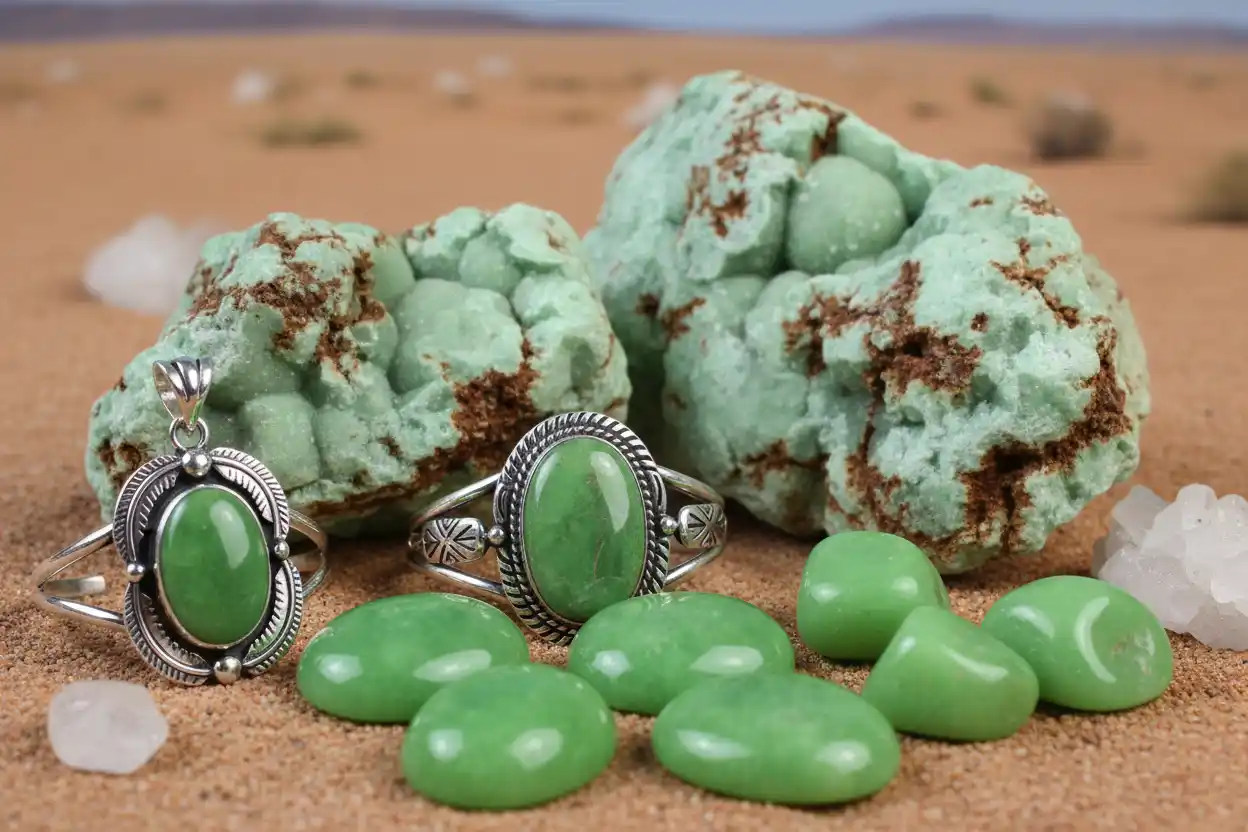
Gaspeite meaning begins with an uncommon green nickel carbonate rather than a supernatural object. Formally written gaspéite in mineralogical references, gaspeite has the ideal chemical formula NiCO₃, belongs to the calcite mineral group, crystallizes in the trigonal system, and is typically light green to yellowish or apple green. Its distinctive appearance has made it attractive for mineral specimens, cabochons, carvings, and ornamental work, but its physical identity should remain separate from modern symbolic interpretations that associate the stone with themes such as confidence, renewal, communication, or personal change.
That distinction matters because gaspeite meaning is often presented online as though mineral chemistry, cultural history, and metaphysical belief were the same category of evidence. They are not. Nickel carbonate chemistry, hardness, density, crystal structure, optical behavior, and geological occurrence are testable mineralogical characteristics. Historical naming and documented specimen use can be researched from records. Spiritual meanings, by contrast, are modern or personal interpretations unless a specific historical source demonstrates otherwise.
Readers exploring related mineral references can browse the Gemstone Guides collection. This page concentrates on gaspeite as a material first, then examines how meaning has become attached to it without duplicating the separate pages that own microscopic inclusions, optics, formation geology, lapidary technique, setting design, conservation, and provenance.
Gaspeite Meaning at a Glance
| Property or question | Evidence-based summary |
|---|---|
| Mineral name | Gaspéite; “gaspeite” is the common unaccented spelling |
| Ideal formula | NiCO₃ |
| Mineral group | Calcite group |
| Crystal system | Trigonal |
| Typical color | Light green, yellowish green, apple green to grass green |
| Transparency | Commonly translucent |
| Luster | Vitreous to dull depending on surface and material |
| Mohs hardness | Approximately 4.5–5 |
| Cleavage | Distinct to good |
| Measured density | Approximately 3.71–3.91 g/cm³ in mineralogical data |
| Major coloring component | Nickel is fundamental to the mineral’s chemistry and optical absorption |
| Documented name origin | Named for the Gaspé Peninsula in Québec, Canada |
| Common lapidary use | Cabochons, carvings, ornamental objects |
| Symbolic interpretations | Commonly framed around renewal, confidence, communication, or change in modern crystal practice |
| Scientific status of symbolism | Symbolic meanings are not established physical, medical, or psychological effects |
| Safe-use principle | Ordinary handling of intact material is different from cutting, grinding, drilling, crushing, or generating dust |
Mineralogical databases identify gaspéite as an approved mineral species and give an ideal formula of NiCO₃, trigonal symmetry, hardness around 4.5–5, and measured density roughly within the high-three-gram-per-cubic-centimeter range. Gem-oriented references describe translucent green material that may be fashioned into cabochons and ornamental objects.
What Is Gaspeite?
Gaspeite is a nickel carbonate mineral in the calcite group. In an idealized end-member composition, nickel occupies the major divalent-cation position associated with the carbonate structure, although natural material can contain magnesium, iron, and other compositional substitutions. Mineralogical references also recognize a gaspéite–magnesite compositional series, which helps explain why natural specimens need not correspond perfectly to the ideal chemical formula.
The mineral usually attracts attention because of its green color rather than large, perfectly formed crystals. It may occur as massive material, nodules, crusts, veins, aggregates, or relatively small crystals depending on locality and geological conditions. Gem material is commonly cut as cabochons because translucency, aggregate texture, veining, and matrix can be more important visually than the brilliance expected from transparent faceted gems. Gemdat describes gaspeite as occurring in bright grass-green through olive- or yellowish-green material and notes its use in cabochons, sculptures, and ornamental objects.
A specimen should not be called gaspeite solely because it is apple green. Similar colors occur in other nickel-bearing minerals, copper minerals, dyed materials, chrysoprase, variscite, certain turquoise-like materials, and manufactured imitations. Where identification matters for collection records, scientific study, or significant financial decisions, appropriate mineralogical or gemological confirmation may be necessary.
Gaspeite Identity Table
| Characteristic | Gaspeite |
|---|---|
| Mineral class | Carbonate |
| Ideal chemistry | Nickel carbonate, NiCO₃ |
| Structural relationship | Calcite group |
| Crystal system | Trigonal |
| Common appearance | Massive, nodular, crusty, veined, aggregate, or small crystalline material |
| Typical color family | Light green to yellowish, apple, grass, or olive green |
| Common transparency | Translucent |
| Typical luster | Vitreous to dull |
| Hardness | About 4.5–5 Mohs |
| Cleavage | Distinct/good in mineralogical descriptions |
| Typical gem treatment | Frequently shaped into cabochons rather than relying on facet brilliance |
| Identification caution | Color alone is insufficient to confirm gaspeite |
The identity table provides a screening framework rather than an authentication certificate. Exact composition, associated minerals, coatings, matrix material, and alteration products can complicate a specimen, especially when different green nickel minerals occur together. Microscopic textures and inclusions are examined separately in the gaspeite microscope inclusion notebook rather than being treated here as a complete identification procedure.
How Gaspeite Forms
Gaspeite is associated with nickel-rich geological environments and can occur as a secondary mineral where earlier nickel-bearing materials are altered and carbonate-bearing fluids or near-surface processes allow nickel carbonates to form. Documented occurrences in Western Australia include secondary nickel mineral assemblages connected with altered or oxidized nickel deposits, and some deposits show gaspeite in veins or in association with other nickel-bearing alteration minerals.
Formation can vary between localities, so a single simplified story should not be imposed on every specimen. Some gaspeite is associated with supergene alteration, while other occurrences may involve hydrothermal or metasomatic processes combined with later alteration. Geological setting, host rock, associated minerals, fluid chemistry, and weathering history all matter when interpreting a particular deposit. A detailed locality or genetic conclusion therefore requires evidence from the actual geological occurrence rather than an assumption based on color.
The deeper geological discussion belongs in the gaspeite formation and deposit geology guide. For gaspeite meaning, the important distinction is that geological transformation can inspire metaphors of change, but pressure, weathering, oxidation, or mineral replacement do not scientifically demonstrate that a specimen transmits transformative energy to a person.
Why Is Gaspeite Green?
Gaspeite’s green appearance is closely tied to nickel. Nickel is not merely a trace impurity accidentally present in ideal gaspeite; it is an essential part of the mineral’s end-member chemistry. Spectroscopic work on magnesian gaspeite attributes the principal electronic absorption bands to Ni²⁺, providing a physical explanation for the color rather than requiring a symbolic or energetic mechanism.
Natural gaspeite does not have to show one uniform shade. Material may appear light green, yellowish green, apple green, grass green, olive green, or mottled where composition, grain size, associated phases, weathering, matrix, transparency, and surface texture differ. Photographs introduce another layer of uncertainty because white balance, saturation, exposure, background color, and display calibration can make the same specimen appear brighter or more yellow than it does under neutral illumination.
The gaspeite optical properties and color behavior guide owns the detailed optical discussion. Color may support an identification hypothesis, but green coloration alone cannot prove that a photographed or polished object is gaspeite.
Diagnostic Characteristics of Gaspeite
Gaspeite can be approached through a combination of observable and measurable properties rather than a single visual clue. Its green color, moderate hardness, carbonate chemistry, trigonal structure, density, cleavage, and optical behavior collectively provide useful evidence. Mineralogical sources list hardness near 4.5–5 and measured density approximately 3.71–3.91 g/cm³, while gem references describe the material as generally translucent and green.
Those values should not become invitations to perform destructive household tests. Scratching polished material can damage it, and acid testing, grinding, heating, or crushing a specimen sacrifices material and may create avoidable exposure. Density measurement can also be misleading when a specimen contains matrix, voids, coatings, or multiple minerals. Professional examination may combine microscopy, refractive behavior where applicable, spectroscopy, Raman analysis, X-ray diffraction, or chemical methods depending on the question and the form of the specimen.
A major diagnostic limitation is that natural specimens can contain intergrown nickel minerals. A green area on matrix may therefore require confirmation at the precise point being identified. Scientific identification should follow the evidence available for the individual specimen rather than treating every green component as a single phase.
Gaspéite or Gaspeite: Is There a Difference?
The spelling distinction is typographic rather than mineralogical. Gaspéite is the formally accented name derived from the Gaspé Peninsula in Québec, while “gaspeite” is the common ASCII rendering used when accents are omitted. Mindat explicitly gives “Gaspeite” as the ASCII form of Gaspéite. Both forms refer to the same mineral species when used correctly.
This is an important naming boundary because minor spelling variations should not be turned into invented varieties. A seller does not have a distinct material merely because a listing drops the accent, capitalizes the name differently, or attaches a marketing adjective. Genuine variety or locality claims require mineralogical or provenance evidence beyond branding.
Documented History of Gaspeite
Gaspeite was named after the Gaspé Peninsula in Québec, Canada, where its type occurrence is located. The mineral entered formal mineralogical literature through study of nickel-rich carbonate material from that region, and its name therefore reflects geography rather than a traditional spiritual concept. Mineralogical references identify the type locality in the Mont-Albert area and preserve the original scientific description in the literature.
Later collecting and lapidary interest became strongly associated with striking green material from nickel districts in Western Australia. Documented specimens from areas such as Widgiemooltha and Kambalda demonstrate gaspeite in secondary nickel-mineral assemblages, sometimes as veins, crusts, aggregates, or conspicuous green material on matrix.
That documented mineralogical history should not be replaced with claims that gaspeite had a specific spiritual role in ancient cultures unless reliable historical or archaeological evidence supports the assertion. The history of a mineral species name, the history of geological occurrences, and the history of modern crystal symbolism are separate questions.
Gaspeite Meaning in Modern Symbolism
Modern gaspeite meaning is commonly described through themes of renewal, confidence, communication, adaptability, openness, or personal transformation. Such ideas may be meaningful within contemporary crystal practice, meditation, journaling, or personal symbolism, but they are interpretations rather than measurable properties of nickel carbonate.
A person may choose the green appearance of gaspeite as a visual reminder to approach change deliberately, communicate more clearly, reconsider an old habit, or remain attentive to a personal goal. In that context, the object works as a symbolic cue. The reflective value comes from the user’s chosen association, attention, and behavior rather than an established physical force emitted by the mineral.
Gaspeite meaning should therefore be framed in language such as “is associated with,” “is used symbolically for,” or “some practitioners interpret,” rather than “scientifically causes,” “guarantees,” or “heals.”
Gaspeite and Transformation
Transformation is one of the easiest symbolic themes to connect with gaspeite because secondary minerals can form through chemical alteration of earlier materials. That geological fact can inspire a metaphor: physical material can change when its environment changes.
The metaphor stops there. Geological alteration does not establish that gaspeite changes personality, removes trauma, alters hormones, repairs relationships, or transforms external circumstances. A person may use the mineral as a reminder that gradual change is possible, but the action remains human.
This evidence boundary allows gaspeite meaning to remain personally useful without turning geology into an unsupported therapeutic mechanism.
Gaspeite and Communication
Some contemporary crystal interpretations connect gaspeite meaning with communication, openness, or speaking clearly. That association can be used as a reflective prompt: What needs to be said? What information is missing? Am I listening accurately? Is the conversation safe and mutual?
A mineral cannot compel another person to listen, apologize, reconcile, disclose information, or change behavior. It cannot override consent or resolve conflict automatically. When communication matters, practical skills such as clear wording, listening, boundaries, documentation, and appropriate professional support remain more reliable than a gemstone claim.
The stone can symbolize an intention. It cannot substitute for the behavior required to fulfill it.
Gaspeite and Confidence
Confidence-oriented gaspeite meaning is best treated as another reminder framework rather than a physiological effect. Someone might place a cabochon near a notebook before a presentation or carry an intact polished stone as a cue to prepare, speak slowly, or remember a specific objective.
There is no established evidence that gaspeite chemically transfers confidence through the skin, changes neurotransmitters, treats anxiety, or produces guaranteed emotional resilience. Nickel contained in a mineral lattice is not automatically a nutrient, supplement, or therapeutic delivery system.
Personal symbolism can coexist with evidence-based health decisions as long as the two are not confused.
Original Information Gain: Gaspeite Specimen and Photo Verification Checklist
Because gaspeite is often encountered online as a polished green cabochon or a brightly colored specimen, the following checklist separates what a photograph can reasonably suggest from what requires stronger evidence.
| Question | Photo or listing can sometimes show | What it cannot reliably prove | Better evidence when important |
|---|---|---|---|
| Is the object green? | Apparent hue and mottling | Exact color under neutral light | Calibrated photography or direct viewing |
| Is it translucent? | Edge translucency in some images | Internal transparency throughout the object | Direct inspection under controlled lighting |
| Does it contain matrix? | Visible contrasting host material | Exact identity of every phase | Microscopy, spectroscopy, XRD, or chemical analysis |
| Is it gaspeite? | Appearance may be consistent with gaspeite | Definitive mineral identity from color alone | Appropriate gemological or mineralogical testing |
| Is it natural? | Natural-looking texture may be suggestive | Natural origin, treatment, dyeing, or imitation status | Laboratory or specialist examination where warranted |
| Is the locality correct? | A label can state a locality | Proven geological origin | Collection records, mine documentation, chain of custody |
| Is it high-grade material? | Surface appearance can be compared | A universal objective “grade” | Defined criteria and direct inspection |
| Is a cabochon structurally sound? | Large chips or fractures may be visible | Hidden cleavage, internal weakness, or setting stress | Magnification and hands-on examination |
| Does it have spiritual power? | Nothing measurable in a standard photo | Healing, manifestation, energetic, or behavioral effects | These remain belief or personal interpretation |
| Is a seller’s history claim authentic? | Listing text can be recorded | Historical truth | Primary documents, archival sources, credible provenance |
This checklist is intentionally conservative. A photograph is valuable evidence for visible features, but it is weak evidence for composition, provenance, treatment, and hidden structure. That distinction becomes particularly important when a vivid green stone is sold under several commercial descriptions or when a locality claim substantially increases perceived importance.
For specimen-specific documentation, the gaspeite provenance disclosure checklist provides the appropriate framework for recording what is known, what is seller-reported, and what remains unverified.
Claim-Audit Framework for Gaspeite Listings
| Listing statement | Evidence category | Appropriate interpretation |
|---|---|---|
| “Natural gaspeite” | Mineral identity claim | Needs reasonable evidence if authenticity materially affects value |
| “Apple-green color” | Visual description | Can usually be assessed under neutral lighting |
| “From Western Australia” | Provenance claim | Stronger with labels, collection history, or documented source |
| “Rare” | Market/mineral occurrence claim | Requires context; rarity can mean species rarity, fine-specimen rarity, or commercial scarcity |
| “Healing stone” | Metaphysical claim | Symbolic belief, not established medical evidence |
| “Detox stone” | Medical/biological claim | Unsupported without clinical evidence |
| “Improves communication” | Behavioral claim | Best reframed as a personal reminder or reflective symbol |
| “Ancient sacred stone” | Historical claim | Requires traceable historical evidence |
| “High grade” | Commercial quality claim | Meaningless unless grading criteria are defined |
| “Untreated” | Treatment claim | May require verification if commercially important |
The table helps prevent one common error in gaspeite meaning content: allowing a poetic or commercial statement to acquire the appearance of mineralogical fact simply because it is repeated across many websites.
Gaspeite Compared With Other Green Materials
Gaspeite may visually overlap with several other green materials, but comparison should remain an identification caution rather than an attempt to diagnose a specimen from text alone. Gem silica, for example, is a different material despite potentially sharing attractive green-to-blue-green colors; its mineralogical identity and formation are covered separately in the gem silica meaning guide.
Likewise, cleavage behavior matters when separating durability assumptions from mineral identity. Gaspeite’s moderate hardness and recognized cleavage mean it should not be treated as though every green cabochon has quartz-like resistance to wear. Readers comparing structural properties across gems can use the gemstone cleavage explained guide rather than applying one mineral’s behavior to another.
Color categories also cross mineral boundaries. Historical and modern gem traditions demonstrate that a color word alone does not define species—a principle also apparent when examining the broader context of garnet color meaning. Identification must begin with the material, not the symbolism of its color.
Cutting and Polishing Boundaries
Gaspeite can be fashioned into cabochons and ornamental pieces, but its hardness and cleavage mean cutting decisions should respect the material’s physical behavior. Orientation, backing, thickness, polish, existing fractures, matrix, and edge design can all affect how a piece survives lapidary work.
This page does not duplicate a lapidary procedure. Detailed workmanship belongs in the gaspeite cutting, orientation, and polish guide.
The safety distinction is more important here: ordinary handling of an intact polished gaspeite is not equivalent to grinding or sanding nickel-bearing mineral material. Cutting, drilling, sanding, and polishing can generate particulate matter, so suitable dust controls, eye protection, respiratory precautions, clean work practices, and professional lapidary procedures are appropriate.
Gaspeite in Jewelry and Wear
A polished stone may look robust, but gaspeite’s Mohs hardness around 4.5–5 is lower than many common jewelry gemstones. Hardness measures resistance to scratching, not resistance to every type of physical damage. Cleavage, impact, abrasives, setting pressure, and repeated contact with harder materials can all matter.
Jewelry suitability therefore depends on design as much as mineral identity. Pendants and earrings can face different mechanical exposure from rings or bracelets, while protective bezels, recessed settings, and thoughtful stone placement may reduce risk. The separate gaspeite setting and wear engineering guide covers those physical decisions without turning gaspeite meaning into a jewelry-construction manual.
Symbolic significance does not make a mineral harder, tougher, or immune to wear.
Safe Ownership of Gaspeite
Normal ownership of an intact gaspeite specimen can be approached differently from mineral processing. A collector can document, display, photograph, and carefully handle a stable specimen without assuming that touching it provides nutritional nickel or medical effects.
Processing changes the exposure scenario. Cutting, drilling, grinding, sanding, crushing, or dry polishing can produce dust or small particles from nickel-bearing mineral material and associated matrix. Such work should not be performed casually as a spiritual ritual or home identification test.
Gaspeite should not be powdered, ingested, added to supplements, or placed in drinking water as a mineral elixir. Nickel within a carbonate mineral does not become a safe therapeutic nutrient simply because the specimen is natural.
Specimen Conservation
Gaspeite’s moderate hardness means storage should minimize rubbing against harder minerals, abrasive surfaces, or loose objects in the same box. Labels should remain physically associated with specimens because locality and collection information can become impossible to reconstruct once separated.
A useful collection record can include photographs, dimensions, weight where relevant, acquisition source, reported locality, associated minerals, older labels, treatment information if known, and laboratory documentation. The gaspeite specimen conservation record provides the mapped framework for preserving that information.
Good documentation often adds more lasting scientific and collecting value than an unsupported story attached after acquisition.
Provenance and Locality Claims
Gaspeite has documented occurrences in Canada, Australia, and other regions, but a known occurrence does not prove the origin of an unlabeled specimen. Even a specimen whose color closely resembles classic Western Australian material still requires provenance evidence if locality is important.
Mineral databases themselves distinguish between well-referenced occurrences and questionable locality reports, which illustrates why locality should be treated as a separate evidentiary claim rather than inferred visually.
If a seller says a specimen came from a specific mine, preserve the original invoice, label, collection history, and any supporting records. Do not silently upgrade “seller stated” into “verified.”
What Gaspeite Meaning Does Not Prove
Gaspeite meaning does not demonstrate that the mineral heals disease, removes toxins, regulates hormones, treats depression, eliminates anxiety, improves cardiovascular function, restores fertility, enhances immunity, relieves pain, or changes neurological activity. Those would be medical or biological claims requiring appropriate scientific evidence.
It also does not prove that gaspeite attracts guaranteed wealth, forces manifestation, protects someone from every hazard, or changes another person’s emotions or behavior. A symbolic object can help a person remember a chosen intention, but it cannot guarantee an external outcome.
The broader distinction between mineral information and health or metaphysical claims is maintained in the Gems Lore disclaimer.
Gaspeite in the Context of Gem History
Gaspeite’s formal mineral name is comparatively modern within gem and mineral literature, so it should not automatically inherit the histories of unrelated ancient green stones. Historical cultures used many green minerals and gemstones, often under names that do not map neatly onto modern mineral species.
That problem is familiar across gem history. Even well-known mineral families can accumulate shifting names, trade descriptions, and cultural associations over centuries, as shown in the separate garnet history guide. Gaspeite should be held to the same standard: documented mineral history should remain distinct from later symbolic narratives.
A claim that an ancient culture specifically used gaspeite requires direct supporting evidence, not merely proof that the culture valued green stones.
Evidence Boundaries and Technical Certainty
This article does not claim first-hand mine visits, private laboratory measurements, unpublished authentication, or specialist examination of a reader’s specimen. Its material descriptions are based on established mineralogical and gemological references, while symbolic interpretations are labeled as such.
When exact identity, chemistry, locality, associated minerals, treatment, or unusual structure materially matters, appropriate gemological, mineralogical, geological, or laboratory confirmation may be needed. Information about the site’s general editorial scope is available on the About Gems Lore page.
Questions, corrections, or evidence that materially changes a mineralogical or historical claim can be submitted through Contact Gems Lore. This provides a correction path without pretending that every online mineral description is beyond revision.
Frequently Asked Questions About Gaspeite Meaning
What is gaspeite meaning?
Gaspeite meaning commonly refers to modern symbolic associations with renewal, confidence, communication, adaptability, and personal transformation. These interpretations are not measurable mineralogical properties and should be separated from gaspeite’s established nickel-carbonate chemistry.
What is gaspeite made of?
Gaspeite is a nickel carbonate mineral with the ideal formula NiCO₃. Natural compositions can include substitutions involving magnesium, iron, and other elements, so individual specimens may deviate from a pure ideal end member.
Why is gaspeite green?
Nickel is central to gaspeite’s composition and optical absorption. Spectroscopic research identifies Ni²⁺ as the principal source of its electronic absorption features, providing a mineralogical basis for the characteristic green coloration.
Is gaspeite the same as chrysoprase?
No. They are different materials. Gaspeite is a nickel carbonate mineral, while chrysoprase is a green variety of chalcedony. Interestingly, research has identified very small amounts of gaspeite in some chrysoprase from a specific occurrence, but that does not make the two mineralogically identical.
Is gaspeite rare?
Gaspeite is an uncommon mineral species relative to many familiar jewelry materials, but the word “rare” needs context. Fine collectible specimens, lapidary-grade material, documented locality pieces, and ordinary massive material should not automatically be treated as equally scarce.
Can gaspeite be identified by its apple-green color?
No. Apple-green coloration can support an initial hypothesis, but several natural minerals and manufactured materials can have similar colors. Reliable identification may require physical, optical, spectroscopic, diffraction, or chemical evidence depending on the specimen.
Does gaspeite have healing properties?
There is no established scientific evidence that gaspeite treats medical conditions or produces specific physiological healing effects. Claims of healing belong to metaphysical belief systems unless supported by appropriate clinical evidence.
Can gaspeite help with confidence or communication?
A person can use gaspeite as a symbolic reminder of confidence or thoughtful communication. That use depends on personal association and behavior; the mineral is not proven to chemically or energetically create confidence or control communication outcomes.
Is gaspeite safe to wear?
Intact polished material can be used in jewelry, but gaspeite is moderately soft compared with many common gemstones and should be protected from abrasion and impact. Jewelry design and setting quality therefore matter.
Is gaspeite safe to cut?
Lapidary processing is a different exposure situation from ordinary handling because drilling, grinding, sanding, or polishing can generate particulate matter from nickel-bearing material and matrix. Appropriate professional dust-control and protective practices should be used.
Should gaspeite be placed in drinking water?
No. Gaspeite should not be powdered, ingested, or used to prepare mineral-soaked drinking water. The presence of nickel or other elements in a mineral does not make them safe or beneficial for ingestion.
What is the difference between gaspeite and gaspéite?
There is no mineralogical difference. Gaspéite is the accented mineral name, while gaspeite is the common unaccented ASCII spelling.
Final Perspective
Gaspeite meaning is clearest when three layers remain distinct. The first is measurable mineralogy: gaspeite is an uncommon green nickel carbonate in the calcite group, with trigonal symmetry, moderate hardness, characteristic chemistry, and geological relationships to nickel-rich environments. The second is documented history: the mineral name comes from the Gaspé Peninsula, while later collecting and lapidary interest developed around material from additional nickel districts. The third is modern symbolism: ideas of renewal, communication, confidence, or change can be personally meaningful, but they are interpretations rather than scientific effects.
Keeping those layers separate gives gaspeite more depth, not less. Its real nickel-carbonate chemistry explains its green color, geological processes explain its formation, documentation supports its locality history, and people remain free to attach symbolic meaning without turning metaphor into medicine or unsupported fact.
For responsible ownership, preserve provenance, avoid destructive home testing, separate intact handling from dust-generating lapidary work, and seek appropriate mineralogical or laboratory confirmation whenever exact identity or origin materially affects a decision.