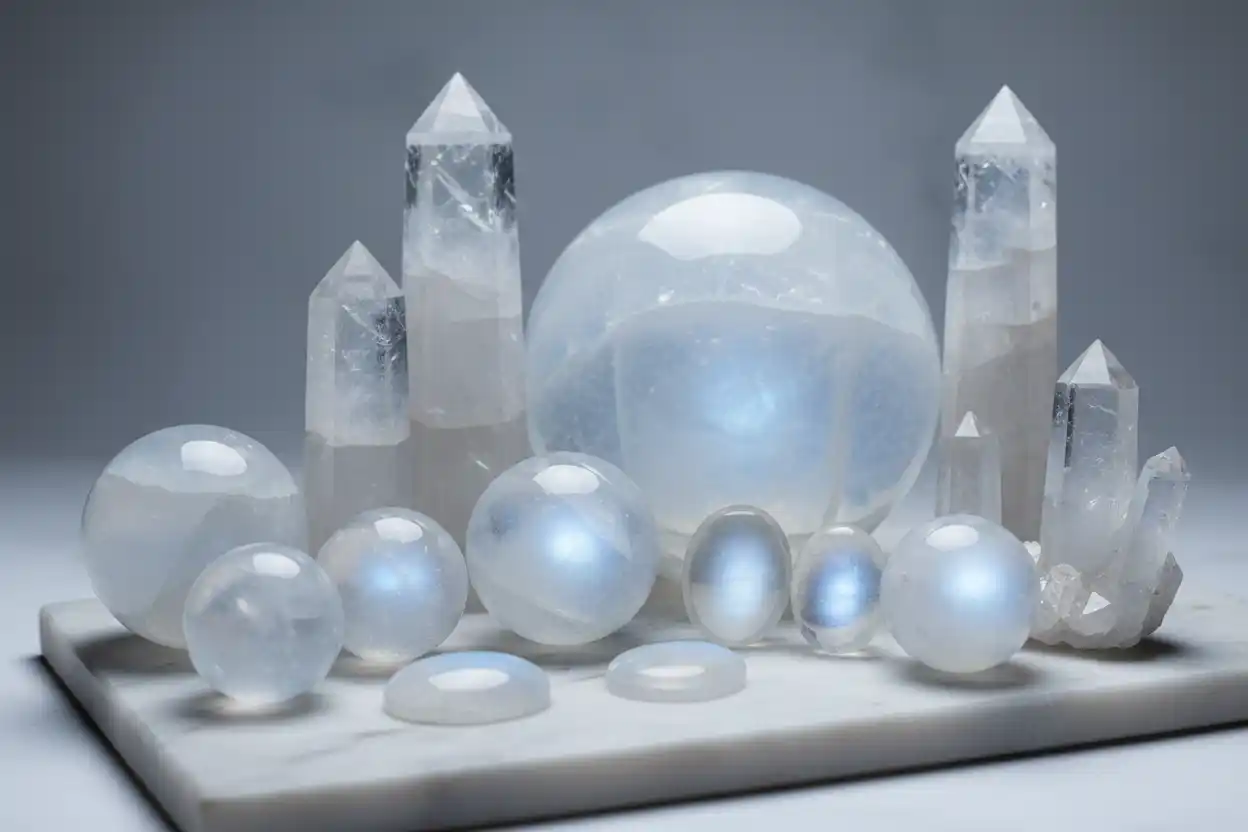
Girasol Quartz Meaning: Properties, Uses & Symbolism
Girasol quartz meaning is best understood by starting with an important naming fact: girasol quartz is quartz, not a separate formally recognized mineral species. Mineralogical reference material describes “Girasol Quartz” as a retail-trade name for opalescent quartz. The underlying material therefore retains the chemistry and crystal structure of quartz, while the commercial name describes a particular translucent, milky, softly luminous appearance rather than defining a new mineral formula.
The word “girasol” creates additional confusion because it already has an older mineralogical use connected with opal. Mindat identifies Girasol as a variety of opal and specifically distinguishes it from Girasol Quartz, noting that the quartz trade name was named after the older material. This distinction matters whenever historical, metaphysical, or commercial descriptions use “girasol,” because an older reference to girasol cannot automatically be assumed to describe the translucent quartz now sold under the modern retail name.
Within the Gemstone Guides collection, this page treats girasol quartz as a material first. Its quartz identity, soft optical appearance, naming history, practical diagnostic limits, modern symbolism, and safe ownership are addressed here without replacing the separate pages devoted to microscopic inclusions, optical measurements, formation geology, lapidary work, jewelry engineering, specimen conservation, or provenance.
Girasol Quartz at a Glance
| Property or question | Evidence-aware description |
|---|---|
| Material identity | Quartz sold under an appearance-based retail trade name |
| Chemical composition | SiO₂ |
| Mineral status | Not a separate formal mineral species |
| Crystal system | Trigonal for ordinary alpha quartz |
| Typical appearance | Colorless, white, pale gray, or softly milky and translucent |
| Characteristic visual feature | Diffuse internal luminosity or opalescent-looking light scattering |
| Mohs hardness | About 7 for quartz |
| Refractive index | Approximately 1.544–1.553 for crystalline quartz |
| Specific gravity | About 2.66 for typical gem quartz |
| Cleavage | Quartz is generally treated as lacking cleavage; fracture is commonly conchoidal |
| Common forms in trade | Spheres, palm stones, cabochons, beads, carvings, polished freeforms |
| Naming caution | Girasol Quartz is not the same material as Girasol opal |
| Symbolism | Modern themes often include reflection, calmness, clarity, patience, or self-awareness |
| Scientific status of symbolism | Symbolic interpretations are not measurable mineralogical or medical effects |
| Safety distinction | Intact handling differs fundamentally from cutting, grinding, drilling, sanding, or crushing quartz |
Quartz reference data from GIA gives the familiar SiO₂ composition, Mohs hardness of 7, refractive indices around 1.544–1.553, and specific gravity near 2.66. Those values describe quartz broadly; an individual girasol quartz object may contain inclusions, fractures, surface treatments, matrix, or other features that affect a particular measurement.
What Is Girasol Quartz?
Girasol quartz is an informal commercial designation for translucent or semi-translucent quartz that displays a soft, cloudy, opalescent-looking internal light. Rather than showing the sharp transparency expected from fine rock crystal, typical material appears slightly veiled, foggy, milk-like, or internally luminous. When a polished sphere or cabochon is moved relative to a light source, a diffuse bright region may appear to shift within the stone, creating the visual quality that makes the trade name useful.
Mineralogically, however, the important word is quartz. Mindat explicitly categorizes Girasol Quartz as a name used for opalescent quartz in retail trade rather than as a separate species. This means statements such as “girasol quartz has a unique chemical formula” or “girasol is a new mineral discovered only recently” need evidence beyond the commercial label; the name itself does not support either claim.
The retail definition is not perfectly standardized. One seller may reserve girasol quartz for strongly translucent white material with a floating glow, while another may apply the name more loosely to pale milky quartz. That variability is one reason a specimen should be described by observable properties—quartz identity, transparency, cloudiness, internal scattering, inclusions, polish, and provenance—rather than assuming the trade name carries a universally fixed gemological specification.
Girasol Quartz Identity Table
| Characteristic | Practical interpretation |
|---|---|
| Formal mineral species | Quartz |
| Trade designation | Girasol Quartz |
| Ideal chemistry | SiO₂ |
| Structure | Crystalline quartz rather than hydrous opal |
| Common color | Colorless, whitish, bluish white, pale gray, occasionally faintly tinted |
| Transparency | Usually translucent to semi-transparent |
| Luster | Vitreous on good polished surfaces |
| Hardness baseline | Mohs 7 |
| Typical fracture behavior | Brittle with conchoidal fracture typical of quartz |
| Defining commercial feature | Soft internal glow or opalescent-looking translucency |
| Diagnostic limitation | Appearance alone does not prove quartz identity |
| Major naming risk | Confusion with Girasol opal, milky quartz, rose quartz, opalite glass, or other pale translucent material |
| Best confirmation path | Standard gemological testing when identity materially matters |
The identity table is a screening tool rather than authentication. A pale translucent sphere may look exactly like a retail photograph of girasol quartz and still require testing if its material identity affects value, collection records, or a purchase decision. Glass, synthetic material, other quartz varieties, and opal can overlap visually at casual viewing distance.
Girasol Quartz Versus Girasol Opal
The distinction between these names is the most important historical and mineralogical boundary on this page. “Girasol” by itself has documented older use for an opal variety. Mindat describes Girasol opal as bluish-white translucent opal with reddish reflections and notes that the name dates back at least to the nineteenth century. Girasol Quartz, by contrast, is identified as an opalescent quartz retail term named after that older material.
Quartz and opal are both silica-rich materials, but they are not structurally identical. Crystalline quartz has an ordered SiO₂ crystal structure, whereas opal is a hydrated amorphous or poorly crystalline silica material commonly represented with variable water content. A trade name that migrated from one luminous-looking material to another should not erase that distinction.
Consequently, an old reference to “girasol” is not evidence that modern girasol quartz was known, mined, traded, or spiritually interpreted under the same name at that time. Historical claims require identification of the actual material being discussed.
What Creates the Soft Girasol Appearance?
The most defensible explanation is light scattering within translucent quartz. Microscopic inclusions, tiny cavities, cloudy growth features, internal strain, extremely fine mineral particles, and other small-scale irregularities can redirect incoming light rather than allowing it to pass cleanly through the stone. The result can be a soft luminous zone or milk-like translucency instead of rock-crystal clarity.
What should not be done is assign one universal microscopic cause to every specimen called girasol quartz without analytical evidence. Retail descriptions sometimes attribute the effect specifically to water inclusions, dumortierite, or another single inclusion type, but the trade term itself does not guarantee any one microstructure. GIA’s work on other quartz materials demonstrates that microscopic inclusions can produce cloudiness and optical phenomena in quartz, but the inclusion population in a particular girasol specimen still needs examination rather than assumption.
Readers who need that specimen-level internal examination should use the Girasol Quartz Microscope Inclusion Notebook. That page owns microscopy and inclusion documentation rather than having individual inclusions overinterpreted here.
Optical Behavior and the “Floating Glow”
The moving-light impression associated with girasol quartz can be visually persuasive because the brightest region appears to shift as the light, stone, or observer moves. It is reasonable to describe this as an internal glow in an optical sense, but that wording should not be transformed into a claim that the stone physically emits unexplained energy. The visible effect depends on illumination interacting with the material.
Several optical terms are used loosely in retail descriptions. “Opalescent,” “adularescent,” “girasol effect,” “sheen,” and “glow” may be applied to similar-looking photographs even when the underlying mechanisms differ. Adularescence has a specific association with feldspar structures, for example, while play-of-color in precious opal is another distinct phenomenon. A vague resemblance does not make the mechanisms identical.
The detailed separation of refractive behavior, translucency, scattering, color, and other optical observations belongs in the Girasol Quartz Optical Properties and Color Behavior guide. On a meaning-reference page, the essential point is that the glow is an optical appearance, not evidence of supernatural radiation.
How Girasol Quartz Forms
Because girasol quartz is quartz rather than a separate species, its geological origin must be understood through quartz formation. Quartz can crystallize from silica-bearing fluids and melts and occurs across many igneous, metamorphic, sedimentary, and hydrothermal environments. Massive quartz can fill veins and cavities, while crystals can grow into open spaces where conditions allow distinct faces to develop.
The cloudy internal structure that makes some material commercially suitable for the girasol label is a later descriptive filter applied by people. Geological processes did not “form a metaphysical girasol stone” as a separate substance; they formed quartz with particular internal features, and the trade subsequently selected material with a desirable luminous appearance.
Quartz may also occur inside cavities and mineral-lined structures, which is why broader geological forms such as geodes can help explain how open-space mineral growth differs from the massive polished material commonly encountered under the girasol name. The dedicated Girasol Quartz Formation and Deposit Geology guide owns the detailed geological and locality evidence for the material itself.
Color: Usually Subtle, Sometimes Misleading
Most girasol quartz is marketed in a restrained color range—colorless, white, faint gray, bluish white, or subtly warm under transmitted light. A specimen can appear markedly different depending on whether it is illuminated from the front, side, or behind. Thick spheres may reveal a warmer transmitted center while still looking cool or milky in reflected light.
Photographic conditions can exaggerate these differences. White balance, exposure, saturation, surface moisture, dark backgrounds, and backlighting can make ordinary translucent quartz appear dramatically more luminous. A seller photograph showing a brilliant internal orange or blue region should therefore be interpreted as an observation under a particular lighting arrangement rather than as proof of permanent body color.
Strong yellow, brown, or rusty coloration also deserves separate consideration because iron oxides or hydroxides can stain or occur with quartz. Goethite meaning covers that mineral as its own material, while Golden Healer Quartz Meaning addresses the distinct commercial identity of iron-colored quartz. Neither should be collapsed into girasol quartz merely because a specimen is cloudy quartz with warm coloration.
Diagnostic Traits and Identification Limits
An initial girasol quartz examination can record transparency, cloudiness, luster, fracture pattern, visible inclusions, polish, bubbles, surface wear, internal fractures, and how the apparent glow changes with lighting. Quartz-like hardness and refractive properties can then provide stronger evidence if proper gemological equipment and an appropriate testing method are available.
The diagnostic process should remain non-destructive whenever possible. Mohs hardness of 7 is useful reference data, but deliberately scratching a finished sphere or cabochon to prove it is quartz can damage the object. Similarly, heating, smashing, grinding, or using aggressive chemicals is not justified as a home identification method.
If technical certainty matters, refractive-index testing, microscopic examination, specific-gravity measurement, polarized-light observations, spectroscopy, or laboratory analysis may be appropriate depending on the form of the specimen. A photograph alone cannot establish every relevant property.
Original Information Gain: Girasol Quartz Name and Claim Audit
The largest information problem surrounding girasol quartz is not its formula; it is the way several names and stories overlap. The following comparison separates defensible usage from claims that need stronger evidence.
| Name or claim | Evidence-supported interpretation | What should not be assumed | Evidence needed for stronger claim |
|---|---|---|---|
| Girasol Quartz | Retail name for opalescent-looking quartz | Separate mineral species | Formal mineralogical approval would be required for species status |
| Girasol | Established name associated with a variety of opal | Automatically means quartz | Material-specific identification |
| Girasol Opal | Opal variety with luminous appearance | Same material as Girasol Quartz | Mineralogical testing distinguishes opal from crystalline quartz |
| Milky quartz | Broad descriptive quartz term | Every milky quartz specimen is commercially “girasol” | Appearance and trade usage must match |
| Opalescent quartz | Descriptive visual phrase | Material is opal | Verify crystalline quartz identity |
| Madagascar girasol quartz | Geographic provenance claim | Origin can be identified from appearance | Original locality documentation or credible chain of custody |
| Water-inclusion quartz | Proposed microscopic explanation | All girasol glow comes from water inclusions | Microscopy or analytical evidence from the actual specimen |
| White rose quartz | Trade or visual comparison sometimes encountered | Composition or color mechanism equals rose quartz | Gemological evidence for pink coloration or rose-quartz characteristics |
| Natural girasol quartz | Natural-origin statement | No treatment, coating, filling, or modification | Treatment disclosure and appropriate examination |
| Ancient girasol quartz | Historical claim | Older “girasol” references describe quartz | Primary historical evidence identifying quartz specifically |
| Healing quartz | Modern metaphysical wording | Proven medical action | Controlled medical evidence would be required |
| Energy-emitting quartz | Spiritual or marketing claim | Visible internal glow proves measurable healing energy | Appropriate physical measurement and reproducible evidence |
| High grade | Commercial quality language | Standardized universal grade | Seller must define measurable criteria |
| Rare | Context-dependent market statement | All material with the name is geologically scarce | Locality, supply, quality, size, and market evidence |
The table demonstrates why repetition is not proof. A claim copied across dozens of retail or metaphysical pages does not gain mineralogical authority unless the underlying evidence can be traced. The strongest description may sometimes be the simplest: “a translucent quartz specimen sold as girasol quartz.”
Documented History Versus Modern Trade History
The older documented part of the name belongs to girasol opal, not necessarily to quartz. Mineralogical documentation places “Girasol” within opal terminology and records usage well before the modern crystal-retail market. In contrast, Mindat treats Girasol Quartz explicitly as a retail name rather than a historic mineral variety with independent formal status.
An exact first commercial use of the phrase “girasol quartz” is difficult to establish from authoritative mineralogical literature, so it would be misleading to invent a discovery year, named discoverer, or ancient cultural origin. The reasonable historical conclusion is narrower: an older luminous-opal term was later extended commercially to quartz with a somewhat comparable soft-light appearance.
That evidence boundary is important because modern crystal lore often compresses the history of quartz, the history of opal terminology, and recent metaphysical interpretations into one seamless ancient narrative. They should remain separate.
Modern Girasol Quartz Meaning
Modern girasol quartz meaning commonly centers on clarity, patient reflection, calm observation, emotional spaciousness, self-awareness, and gentle communication. Its cloudy but luminous appearance naturally lends itself to metaphor: something does not need to be perfectly transparent to hold light, and clarity can emerge gradually rather than all at once.
Those ideas can be useful as reflective symbolism. A person may keep a polished stone near a journal as a prompt to slow down before responding, use it during meditation as a visual focus, or associate the moving light with reconsidering a situation from more than one angle.
The symbolism should remain in that category. Quartz chemistry does not establish that the stone treats anxiety, depression, neurological illness, cardiovascular disease, hormonal disorders, fertility problems, immune dysfunction, pain, or other health conditions.
Girasol Quartz and Clarity
Clarity is an especially fitting symbolic theme because girasol quartz is visually neither perfectly clear nor completely opaque. It allows light to pass while scattering it, creating a useful metaphor for situations in which understanding exists without absolute certainty.
A grounded reflective use might involve separating what is known, what is assumed, and what still needs evidence. That process can improve reasoning because the person is deliberately examining information, not because quartz transmits a measurable “clarity frequency” into the nervous system.
The distinction preserves a meaningful practice without inventing a biological mechanism.
Girasol Quartz and Emotional Reflection
Some modern crystal practices associate girasol quartz meaning with emotional calm or gentleness. A polished sphere can certainly function as a tactile or visual object during quiet reflection, and a person may subjectively find its soft appearance calming.
Subjective calm is not the same as treatment. The mineral should not be described as curing anxiety disorders, depression, trauma, panic attacks, insomnia, or other clinical conditions. If someone enjoys holding a stone while practicing an evidence-based relaxation technique, the stone can be part of the personal ritual without being credited as the therapeutic mechanism.
This is also why personal testimony and medical evidence should never be treated as interchangeable.
Girasol Quartz and Communication
Communication themes appear in modern interpretations of many pale or translucent stones. With girasol quartz, the symbolic idea can be reframed into practical questions: Am I saying what I actually mean? Have I checked the evidence? Am I leaving room for uncertainty? Am I listening before answering?
A stone cannot force another person to communicate, reveal information, reconcile, apologize, remain faithful, or change behavior. It cannot replace consent, boundaries, professional support, or direct conversation.
Using girasol quartz meaning as a reminder of one’s own conduct is a defensible personal practice. Using it as a claimed method for controlling someone else is not.
Girasol Quartz and Spiritual Symbolism
Some practitioners use girasol quartz in meditation, altar arrangements, intention-setting, or other spiritual practices. These practices can carry personal, cultural, or religious meaning for participants, but the modern use should not automatically be described as an ancient quartz tradition.
The safe factual boundary is that people today assign spiritual symbolism to the stone. Whether a particular historical culture used a specific translucent quartz material for the exact same interpretation requires documentary or archaeological evidence.
Visible luminosity can inspire symbolism. It does not prove that the mineral emits a medically or spiritually measurable force.
A Specimen and Photo Verification Checklist
Before accepting a girasol quartz identification from a photograph or listing, first ask whether the object visibly behaves like translucent quartz rather than whether its marketing story sounds convincing. Record its apparent transparency, body color, internal haze, fractures, bubbles, polish, and whether the luminous region changes when lighting changes.
Then separate the claims that the photograph can support from those it cannot. A photograph can show a milky appearance, but not chemical composition. It can show a label reading “Madagascar,” but not prove provenance. It can reveal obvious bubbles that raise questions about glass, but a bubble-free image does not prove natural quartz.
Finally, decide whether the answer matters enough for testing. An inexpensive decorative sphere may only need an honest “sold as girasol quartz” description, whereas a costly collector specimen with a specific locality or unusual optical claim may justify professional gemological or mineralogical examination.
Provenance: Madagascar and Other Locality Claims
The commercial market frequently associates girasol quartz with Madagascar, but origin should not be inferred from cloudiness, transmitted-light color, or a familiar retail appearance. Similar quartz can occur in many geological settings, and polishing removes much of the host-rock context that might otherwise help locality interpretation.
If provenance materially matters, retain the original invoice, supplier statement, collection label, photographs, prior ownership information, mine documentation if available, and any laboratory or specialist notes. The Girasol Quartz Provenance Disclosure Checklist provides the structured framework for distinguishing documented origin, seller-reported origin, and unknown origin.
A locality name becomes more useful when its evidence remains attached to the specimen.
Cutting and Polishing Girasol Quartz
Quartz has sufficient hardness for many lapidary applications, which helps explain why girasol material is commonly fashioned into spheres, cabochons, beads, carvings, and freeform polished pieces. The cutter’s challenge is not simply achieving a shiny surface; orientation and thickness can strongly influence how effectively the cloudy interior interacts with light.
A thick sphere can emphasize a deep internal pool of transmitted light, while a thin cabochon may appear clearer or less dramatic. Internal fractures may also become more obvious during shaping, and poor polishing can blur the optical appearance by adding surface haze on top of internal scattering.
Detailed procedures for orientation, polishing, fracture management, and lapidary decisions belong in the Girasol Quartz Cutting, Orientation and Polish guide rather than being duplicated on this meaning-reference page.
Jewelry Suitability and Wear
Quartz’s Mohs hardness of about 7 gives girasol quartz useful scratch resistance for many jewelry applications, but hardness is not the same as immunity to breakage. Quartz is brittle, and a cabochon with internal fractures or an exposed edge can still chip after impact.
Setting choice should account for the specific stone. Pendants and earrings generally face less mechanical impact than daily-wear rings or bracelets, while bezels and other protective designs can reduce exposure around vulnerable edges. Drilled beads also concentrate stress around holes if fractures intersect the drilling path.
The mapped Girasol Quartz Setting and Wear Engineering guide owns those design decisions in detail.
Safe Ownership: Intact Quartz Versus Quartz Dust
Ordinary handling of an intact polished quartz specimen is a very different exposure scenario from cutting or grinding quartz. The significant occupational concern arises when crystalline silica-bearing stone is sawed, drilled, ground, sanded, crushed, or otherwise processed in a way that produces respirable dust.
OSHA identifies cutting, grinding, drilling, and crushing silica-containing stone as activities capable of generating respirable crystalline silica. Inhalation of sufficient occupational exposure to that fine dust is associated with serious lung and other health risks.
Lapidary work should therefore use appropriate wet cutting, local dust control, respiratory protection where required, eye protection, equipment safeguards, and suitable cleanup practices. The safety issue is not “quartz energy”; it is the physical generation and inhalation of fine crystalline silica-containing dust.
Do Not Ingest or Powder Girasol Quartz
Girasol quartz should not be ground into powder, consumed, placed into supplements, or added directly to drinking water for supposed mineral benefits. Silicon and oxygen being present in a mineral does not make crushed quartz a nutrient, medicine, or safe oral preparation.
The same principle applies to homemade crystal elixirs. A natural stone may contain fractures, surface residues, associated minerals, polish compounds, treatments, or contaminants that cannot be assessed reliably from a retail name.
The broader evidence and health boundary for symbolic gemstone content is stated in the Gems Lore Disclaimer.
Specimen Conservation
A polished girasol quartz specimen is mechanically more durable than many softer collector minerals, but responsible storage still matters. Repeated contact with harder gemstones can scratch its polished surface, while quartz itself can scratch softer neighboring stones. Chips are also possible when heavy spheres or carvings collide.
Collection information deserves equal protection. Keep original labels, invoices, locality statements, measurements, photographs, and laboratory documents with the specimen rather than relying on memory years later. A trade name without provenance can become increasingly ambiguous when collections change hands.
The Girasol Quartz Specimen Conservation Record provides a structured way to preserve both physical-condition observations and documentary context.
How Girasol Quartz Differs From Golden Healer Quartz
Both names can refer to quartz sold through modern mineral and crystal markets, but their appearance-based definitions are different. Girasol quartz is primarily distinguished by translucent cloudiness and an internally luminous visual effect, whereas golden healer quartz is generally associated with yellow-to-golden iron coloration or coatings.
A cloudy yellow specimen could complicate the distinction, which is precisely why trade names should follow observable material features rather than symbolism alone. Mineral identity remains quartz in both cases unless analytical evidence shows otherwise, while coatings, staining minerals, inclusions, and color mechanisms may differ.
The names should not be merged merely because both are modern commercial quartz labels.
Girasol Quartz, Zircon, and Name-Based Confusion
“Girasol” does not describe zircon, cubic zirconia, or any other Z-named gemstone. Quartz and zircon have different chemistry, crystal structures, optical properties, density, and gemological behavior even when a pale specimen might appear superficially similar in a photograph.
Readers navigating identity questions around those materials can use the Gemstones That Start With Z index to reach the relevant references rather than treating name similarity or appearance as evidence of relationship.
This illustrates a larger rule in gemology: commercial names are useful only when the underlying material remains clearly identified.
Evidence Limits
This guide does not claim first-hand mine visits, unpublished laboratory tests, personal authentication of commercial girasol quartz, or specialist examination of the reader’s specimen. The strongest authoritative mineralogical statement available is deliberately modest: Girasol Quartz is a retail name for opalescent quartz.
The wider editorial scope and evidence approach are described on About Gems Lore. Where exact quartz identity, locality, treatment, unusual optical structure, historical attribution, or associated minerals materially affect a decision, an appropriate gemologist, mineralogist, geological specialist, or laboratory may need to examine the actual specimen.
Readers with traceable evidence that corrects a naming, mineralogical, historical, or safety statement can submit it through Contact Gems Lore so the claim can be reviewed against the available evidence.
Frequently Asked Questions About Girasol Quartz Meaning
What is girasol quartz meaning?
Girasol quartz meaning usually refers to modern symbolic themes such as clarity, reflection, patience, calmness, and thoughtful communication. Mineralogically, Girasol Quartz is a retail name for opalescent-looking quartz rather than a separate mineral species.
Is girasol quartz actually quartz?
Yes. The mineralogical reference classification treats Girasol Quartz as quartz sold under an appearance-based retail name. Quartz has the chemical composition SiO₂ and a Mohs hardness of about 7.
Is girasol quartz the same as girasol opal?
No. Girasol is also an established name for an opal variety, whereas Girasol Quartz refers to quartz with an opalescent appearance. The two should not be treated as the same mineral material.
Why does girasol quartz seem to glow?
Its soft luminosity is best understood as an optical light-scattering effect within translucent quartz. Internal clouds, microscopic inclusions, cavities, structural irregularities, or related features can contribute, but the exact cause in a particular specimen should not be assumed without examination.
Is girasol quartz the same as milky quartz?
The terms can overlap, but they are not necessarily identical in commercial use. Milky quartz is a broad descriptive term for cloudy quartz, while girasol quartz is generally reserved in retail trade for translucent material showing a particularly soft, luminous or opalescent-looking effect.
Is girasol quartz a type of opalized quartz?
The retail name itself does not establish opalization. A specimen called girasol quartz should be treated as quartz unless testing shows a more complex mineralogical relationship. “Opalescent” describes appearance and does not automatically mean the stone is opal.
Where does girasol quartz come from?
Commercial material is frequently associated with Madagascar, but origin cannot be reliably proven from appearance alone. A meaningful locality claim should be supported by provenance records rather than color or glow.
Can I identify girasol quartz from a photograph?
Only provisionally. A photograph can show translucent white quartz-like material, cloudiness, polish, fractures, and apparent glow, but it cannot prove chemistry, refractive index, hardness, treatment status, or geographic origin.
Does girasol quartz have healing properties?
There is no established scientific evidence that girasol quartz treats disease or produces specific physiological healing effects. Healing terminology associated with the stone belongs to modern metaphysical interpretation rather than medical mineralogy.
Can girasol quartz reduce anxiety?
Someone may find a polished stone calming to look at or use it as a focus object during reflection, but that subjective experience does not establish treatment for anxiety disorders or other mental-health conditions.
Is girasol quartz safe to touch?
Ordinary handling of intact polished quartz is different from processing it. Cutting, grinding, sanding, drilling, or crushing quartz can generate respirable crystalline silica dust and requires appropriate exposure controls.
Can girasol quartz go in drinking water?
It should not be powdered, ingested, or deliberately used to prepare mineral drinking-water elixirs. A gemstone is not a nutritional supplement, and an individual specimen can contain unknown surface residues, associated minerals, or treatments.
Is girasol quartz an ancient spiritual stone?
Quartz has a long human history, but that does not prove that the modern commercial designation Girasol Quartz or its contemporary metaphysical meanings are ancient. Older uses of “girasol” can refer to opal, making historical source identification especially important.
Is the orange glow inside some girasol quartz its true color?
Not necessarily. Thick translucent quartz can look warmer when illuminated from behind, and photographic settings can intensify the effect. Body color should be evaluated separately from transmitted-light appearance.
Is girasol quartz rare?
The term “rare” needs qualification. Quartz itself is abundant, while material that combines attractive translucency, strong internal luminosity, large clean pieces, desirable workmanship, and documented provenance may be less common in the commercial market. The trade name alone does not establish geological rarity.
Final Perspective
Girasol quartz meaning becomes much clearer once its naming problem is resolved. Girasol quartz is quartz sold for a particular softly opalescent or luminous appearance, not a separate mineral species. The older standalone term “girasol” has a documented connection to opal, so historical references must be interpreted carefully rather than automatically reassigned to modern translucent quartz.
Its measurable side remains ordinary quartz mineralogy: SiO₂ chemistry, approximately Mohs 7 hardness, familiar quartz optical properties, brittle fracture behavior, and internal structures capable of affecting transparency and light scattering. Its symbolic side—clarity, reflection, calmness, patience, or communication—is a modern interpretive framework rather than a laboratory property.
That separation gives the material a stronger story. The optical glow can be appreciated without inventing an energy mechanism, historical terminology can be preserved without rewriting opal history, and a polished stone can carry personal significance without being turned into medicine. For collectors and owners, the most reliable approach is to identify quartz first, document provenance honestly, preserve the specimen and its records, distinguish intact handling from dust-generating lapidary work, and keep modern girasol quartz meaning clearly labeled as symbolism.