Grape Agate Meaning: Properties, Uses & Symbolism
Grape agate meaning begins with a naming correction that materially improves how the stone is understood: the material widely sold as “grape agate” is not conventional banded agate. Mineralogical references describe it as grape-like aggregates of spheroidal amethystine quartz or chalcedony from the Mamuju region of West Sulawesi, Indonesia. Individual rounded bodies commonly measure a few millimeters to roughly two centimeters across and consist of radially grown quartz fibers. Thin-section examination reported in the gemological literature indicates that despite the commercial name and rounded habit, the material does not display the structural characteristics expected of true agate.
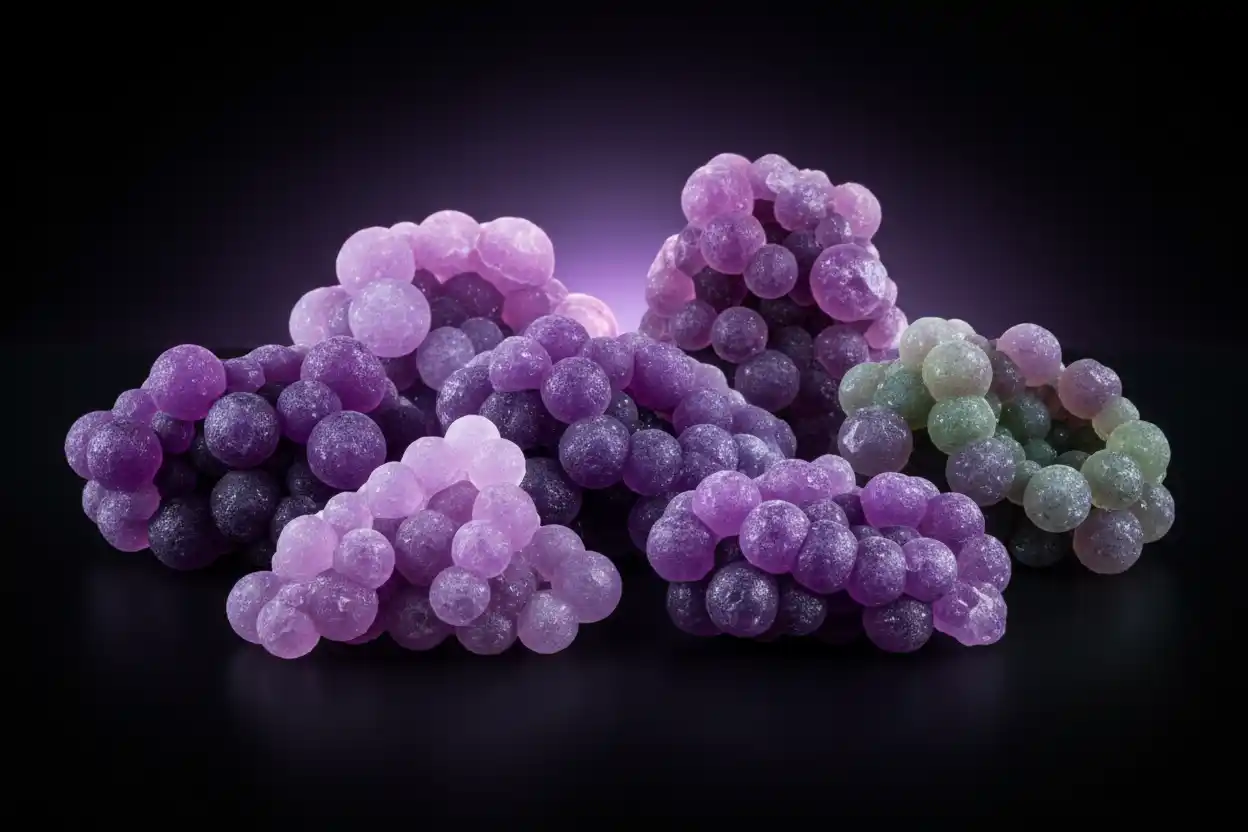
The trade name nevertheless makes immediate visual sense. Clusters of rounded lavender, purple, whitish, or occasionally green spherules resemble bunches of grapes, which made “grape agate” an effective commercial description when specimens entered the international mineral market. The material is fundamentally silica, SiO₂, and belongs within the quartz family. Purple specimens overlap mineralogically with amethystine quartz, while some references also use chalcedony terminology because of the fine-grained radial growth and aggregate character. The commercially useful name should therefore be retained with an explicit caveat: grape agate is a trade name for a distinctive botryoidal or spherulitic quartz material, not evidence that the specimen is a separate mineral species.
That distinction creates the correct foundation for grape agate meaning. Quartz identity, radial growth, color mechanisms, locality, physical properties, and diagnostic evidence belong to mineralogy and gemology. The modern symbolic associations attached to the material—often involving perspective, calm reflection, creativity, patience, community, or personal development—belong to contemporary interpretation. These categories can coexist, but they should not be presented as though quartz structure scientifically proves metaphysical effects.
Readers exploring related mineral-first references can browse the Gemstone Guides. This page defines grape agate as a material, establishes the naming boundary, summarizes formation and color, addresses documented trade history and symbolism, and leaves specialized microscopy, optical testing, geology, lapidary work, wear engineering, and specimen conservation to their mapped references.
Grape Agate Meaning at a Glance
| Property or question | Evidence-aware summary |
|---|---|
| What is grape agate? | A trade name for grape-like spheroidal aggregates of quartz, commonly amethystine |
| Is it a separate mineral species? | No |
| Is it technically true agate? | Published thin-section work indicates the characteristic material is not agate in the conventional banded structural sense |
| Chemical composition | SiO₂ |
| Mineral family | Quartz |
| Typical form | Clusters of rounded spherules with radial internal growth |
| Typical spherule size | Commonly a few millimeters to about 20 mm |
| Common colors | Purple, lavender, pale violet, whitish, grayish; green material also occurs |
| Purple color | Associated with amethyst-type iron-related color centers in quartz |
| Green color | Can be associated with included clay minerals; exact phase should not be assumed visually |
| Major known source | Mamuju Regency, West Sulawesi, Indonesia |
| Mohs hardness | Approximately 7 for quartz |
| Fracture | Brittle; quartz commonly shows conchoidal fracture |
| Main specimen risk | Individual spherules and matrix can chip or detach despite quartz hardness |
| Modern symbolism | Often associated with reflection, connection, creativity, patience, and gradual growth |
| Scientific status of symbolism | Interpretive rather than demonstrated medical or physiological effects |
| Safety principle | Intact specimen handling differs from cutting, drilling, sanding, crushing, or generating silica-bearing dust |
Mindat’s locality description identifies the material as spheroidal amethystine quartz/chalcedony and notes that the spherules consist of thin radially grown quartz fibers. It also records purple, whitish, and green specimens and cautions that poorly colored examples may sometimes be artificially dyed violet.
What Is Grape Agate?
Grape agate is best understood as a morphology-driven trade name. Instead of developing as large conventional quartz prisms, the material forms dense clusters of rounded aggregates. Those spheres may touch, overlap, stack, or grow across irregular matrix surfaces, producing the visual resemblance to grape bunches that defines the commercial name.
The underlying mineral is quartz. Mindat associates the material with quartz and amethyst and records the West Sulawesi occurrence as the important locality for what the market calls grape agate. The mineralogical literature cited there describes the spheres as radially organized quartz rather than classic agate with the layered banding and cavity-filling architecture normally associated with agate.
This makes “grape agate” similar to many successful gemstone trade names: useful for communicating appearance but insufficient by itself for technical classification. A specimen can be genuine grape agate while the word agate remains mineralogically imprecise.
The detailed internal structures that can be seen under magnification belong in the Grape Agate Microscope Inclusion Notebook rather than being turned into universal inclusion claims here.
Grape Agate Identity Table
| Characteristic | Grape agate |
|---|---|
| Formal species | Quartz |
| Trade designation | Grape agate |
| Formula | SiO₂ |
| Common purple classification | Amethystine quartz |
| Structure of rounded bodies | Radially grown fine quartz fibers |
| Aggregate morphology | Spheroidal, grape-like, commonly botryoidal in overall appearance |
| Typical color | Lavender to deep purple |
| Other colors | White, grayish, pale, green, mixed purple-green |
| Quartz hardness baseline | Mohs 7 |
| Crystal system of quartz | Trigonal |
| General quartz luster | Vitreous; fine aggregate surfaces may appear softer or waxier |
| Geographic association | West Sulawesi, Indonesia |
| Major naming caution | Commercial “agate” terminology does not establish conventional agate structure |
| Major color caution | Purple appearance should not automatically be assumed natural if treatment disclosure is absent |
| Major locality caution | Grape-like morphology does not prove West Sulawesi origin without provenance |
The identity table should be used as a screening framework rather than a photograph-based authentication method. Purple botryoidal silica, dyed aggregates, manufactured imitations, and other rounded mineral growths can resemble grape agate in online images.
Why Grape Agate Is Not Conventional Agate
Agate is generally understood as a variety of chalcedony characterized by distinctive layered, banded, or structurally organized silica deposition, commonly in cavities. Grape agate earned its name from outward appearance rather than internal banding.
Published examination of the Indonesian material found that the rounded bodies consist of radially oriented quartz fibers and that thin sections do not show the defining structure expected of agate. Mindat accordingly describes “grape agate” as a marketing name for spheroidal amethystine quartz/chalcedony and explicitly notes that it is not agate despite the trade terminology.
This does not make the material fraudulent. Trade names frequently survive because they communicate appearance more effectively than strict mineral nomenclature. The responsible approach is to retain the familiar name while explaining the mineralogical limitation.
Botryoidal, Spherulitic, or Grape-Like?
Several morphological words appear around grape agate. “Botryoidal” describes an overall surface composed of rounded, grape-like forms. “Spherulitic” describes approximately spherical growths whose internal structure often radiates outward from a center. Grape agate can reasonably be described using both concepts depending on whether the external cluster or internal radial structure is being emphasized.
The individual balls are not hollow fruit-like shells. They are mineral aggregates built from fine quartz growth. A broken sphere may therefore expose radial internal organization rather than a hollow cavity.
This is important for identification because a molded glass imitation can reproduce the external grape shape without reproducing natural radial mineral growth.
How Grape Agate Forms
The material occurs in volcanic terrain in West Sulawesi, where silica-bearing fluids interacted with cavities and open spaces in host rocks. Quartz precipitated into rounded aggregates instead of forming only large conventional crystals, producing repeated spherules across cavity surfaces and matrix.
The exact geological sequence is more complex than “silica turned into grapes.” Fluid chemistry, available space, nucleation, growth rate, temperature, host-rock alteration, and associated minerals all influence the final morphology. Different generations of silica or associated clay minerals may occur in the same specimen.
The detailed volcanic setting, host rocks, paragenesis, cavity development, and deposit relationships belong in the Grape Agate Formation and Deposit Geology guide. On this page, the important point is that the grape-like shape results from mineral growth processes, not from biological formation or a separate “grape agate crystal structure.”
Why Is Grape Agate Purple?
Most desirable grape agate specimens are lavender to purple because the quartz is amethystine. The purple color of amethyst is associated with iron-related defects and natural irradiation within quartz. GIA describes amethyst coloration as arising when iron incorporated into quartz participates in radiation-induced color-center formation.
That explanation is fundamentally different from saying that the purple color is produced by an external pigment. In naturally purple material, the color is connected with quartz’s internal defect chemistry.
However, natural color does not mean every commercial purple specimen should automatically be assumed untreated. Mindat’s locality documentation specifically notes that poorly colored specimens have sometimes been dyed violet.
The appropriate buying or collecting description is therefore proportional to the evidence: “purple grape agate,” “reported natural-color specimen,” or “dyed material” when treatment is documented.
What Causes Green Grape Agate?
Green grape agate is less common than the purple material and appears to involve included mineral matter rather than the same amethyst color mechanism. Mindat notes that green spherules can be colored by inclusions of a clay mineral, and saponite has been identified by X-ray diffraction from the locality.
That does not mean every green specimen contains saponite specifically. Fine clay phases can be difficult to identify visually, and a green color alone cannot determine the exact included mineral.
The useful description is therefore “green grape agate colored by mineral inclusions” unless analytical work establishes the phase more precisely.
The mapped Grape Agate Optical Properties and Color Behavior guide holds the deeper treatment of purple coloration, transmitted light, green inclusions, luster, transparency, and other optical questions.
Diagnostic Traits
The most recognizable grape agate feature is the dense population of rounded spherules. Purple coloration strengthens the visual association, but morphology is more informative than color because pale, white, and green examples also occur.
Under magnification, natural specimens may show fine radial structure, tiny crystal surfaces, irregular junctions between adjacent spheres, mineral inclusions, fractures, and natural matrix relationships. Broken areas can expose the internal growth rather than a homogeneous molded body.
Quartz properties add further evidence. A true specimen should behave consistently with silica-rich quartz material rather than soft resin, ordinary plastic, or incompatible glass. However, destructive scratch testing is unnecessary for a collector specimen and can permanently damage delicate spherules.
When identity materially matters, microscopy, Raman spectroscopy, X-ray diffraction, or other mineralogical methods can provide stronger evidence than casual home testing.
Original Information Gain: Grape Agate Name and Claim Audit
Grape agate is especially vulnerable to claim inflation because the trade name sounds more formally mineralogical than it actually is. The following audit separates reasonable descriptions from claims that require stronger evidence.
| Claim or label | Evidence-aware interpretation | What should not automatically be assumed | Stronger evidence when needed |
|---|---|---|---|
| Grape agate | Commercial name for grape-like quartz aggregates | Separate mineral species | Mineralogical identification |
| Grape chalcedony | Trade/mineralogical overlap used for fine-grained silica material | Conventional banded agate | Thin-section or structural context |
| Grape amethyst | Purple material may be amethystine quartz | Every purple sphere is gem-quality amethyst | Optical/mineralogical confirmation |
| Botryoidal quartz | Reasonable overall morphological description | Every rounded quartz cluster is Indonesian grape agate | Locality and detailed morphology |
| Spherulitic quartz | Describes radial rounded growth | All spheres are identical internally | Microscopy/thin-section evidence |
| West Sulawesi grape agate | Documented important origin | Locality can be recognized from photographs | Provenance records |
| Mamuju grape agate | Locality-specific claim | Every commercial specimen came from that district | Chain of custody |
| Natural purple | Potentially correct for amethystine material | No dye has been used | Treatment disclosure/examination |
| Green grape agate | Green variety occurs | Exact green mineral is known visually | Analytical identification |
| “Rare purple crystal” | Some high-quality specimens may be uncommon | All grape agate is inherently rare | Define quality, morphology, supply, and locality |
| “Ancient crystal” | Quartz itself is geologically ancient | The trade name has ancient cultural usage | Historical documentation |
| “Stone of community” | Modern symbolism based partly on clustered appearance | Mineral scientifically changes relationships | Remains personal symbolism |
| “Healing stone” | Contemporary metaphysical description | Proven treatment of disease | Clinical evidence would be required |
| “Third-eye crystal” | Modern spiritual interpretation | Measurable neurological activation | No mineralogical evidence |
| “Detox stone” | Unsupported health claim | Removal of toxins from the body | Medical evidence would be required |
The audit shows why grape agate meaning is stronger when the familiar commercial name is not allowed to carry claims about structure, provenance, antiquity, or healing that the name itself cannot establish.
Original Specimen and Photo Checklist
A controlled photograph can reveal a surprising amount about a grape agate specimen, provided its limits remain explicit.
| Observation | Photo can reasonably document | Photo cannot reliably prove |
|---|---|---|
| Spherule size | Approximate dimensions when scale is provided | Internal crystal structure |
| Grape-like clustering | Overall morphology | Geological origin |
| Purple body color | Apparent hue and saturation | Natural versus dyed color conclusively |
| Green zones | Presence and distribution | Exact clay or mineral species |
| Broken spherules | Visible radial texture in favorable examples | Complete mineralogy |
| Matrix | Physical association | Full host-rock composition |
| Surface sparkle | Fine quartz faces or luster | Refractive index |
| Damage | Missing spheres, chips, cracks | Hidden structural weakness |
| Seller locality label | What origin is being claimed | Whether provenance is correct |
| “Healing energy” | Nothing objectively measurable | Medical or spiritual efficacy |
For useful documentation, photograph the specimen under neutral white light, then take close-ups of several intact spheres, at least one junction where spheres meet, any naturally broken area, and the matrix. Include a scale. Avoid aggressive saturation, because pale lavender material can be made to look unnaturally deep purple through editing.
Documented Trade History
The commercial history of grape agate is modern and comparatively traceable. Mineralogical and gemological literature documents the distinctive West Sulawesi material under names including grape agate, grape chalcedony, and “Manakarra” quartz. The Mineralogical Record devoted a detailed article to the West Sulawesi occurrence, while the Journal of Gemmology described the grape-like quartz structure from Sulawesi.
The important historical conclusion is therefore modest: grape agate is a modern trade designation attached to a distinctive Indonesian quartz occurrence.
There is no need to manufacture an ancient origin story. Quartz and amethyst have long human histories, but that does not establish that ancient cultures specifically recognized Indonesian grape agate, called it by the same name, or assigned it today’s metaphysical interpretations.
Why Ancient Quartz History Does Not Equal Ancient Grape Agate History
A recurring content error is to take a true statement about quartz or amethyst in antiquity and transfer it directly to grape agate. That is not sound historical reasoning.
If an ancient culture used amethyst, that proves use of amethyst. It does not prove use of West Sulawesi spherulitic grape agate unless the specific material can be demonstrated archaeologically or historically.
The correct timeline separates the geological age of the quartz from the history of the commercial name and the history of modern symbolism.
Modern Grape Agate Meaning
Modern grape agate meaning commonly centers on connection, gradual growth, creativity, reflection, patience, and emotional steadiness. The clustered morphology naturally inspires those themes: many individual spheres grow together into one larger mineral display, creating an intuitive metaphor for relationships between individuality and community.
A person may use the specimen as a visual reminder that larger outcomes can be built through repeated small actions. Someone might associate each sphere with a task, conversation, habit, or incremental improvement rather than treating the cluster as a source of supernatural force.
That interpretation preserves the aesthetic power of the material without inventing a biological mechanism.
Grape Agate and Connection
Connection is one of the more understandable symbolic themes attached to grape agate meaning. Dozens or hundreds of rounded growths can occupy the same matrix while remaining visibly distinct.
A grounded reflective exercise could use that morphology to ask: Which relationships support me? Where do I need stronger boundaries? Which group commitments are useful, and which interfere with individual responsibilities?
The specimen cannot repair a relationship, attract a particular person, force reconciliation, or change someone else’s behavior. It can only serve as a chosen reminder for reflection.
Grape Agate and Gradual Growth
The repeated small spherules also lend themselves to the symbolism of incremental development. A large cluster is visually composed of many smaller growths, making it a useful metaphor for projects that are completed through cumulative steps.
A practical use could be to assign one small action to each day or stage of a project and use the specimen as a visual cue to continue.
The geological growth does not demonstrate that holding grape agate accelerates personal development, changes personality, or guarantees success.
Grape Agate and Creativity
Purple materials are frequently connected with imagination or creativity in modern crystal culture, and grape agate’s unusual form strengthens that association. Its combination of repetition and organic-looking geometry can make it visually stimulating even without any metaphysical framework.
An artist, writer, or designer may keep a specimen nearby simply because its structure inspires pattern, color, or composition.
That experience is legitimate without attributing creative ability to radiation-induced color centers in quartz.
Grape Agate and Calm Reflection
Some people find rounded forms and lavender colors aesthetically calming. A grape agate cluster can therefore function as a visual focus during meditation, journaling, or a quiet workspace routine.
A subjective sense of calm should not be converted into claims that grape agate treats anxiety disorders, depression, trauma, panic attacks, insomnia, neurological disease, or cardiovascular conditions.
The stone can be part of a personal calming routine without being represented as the therapeutic mechanism.
Grape Agate and Spiritual Symbolism
Modern metaphysical sources sometimes connect grape agate meaning with intuition, dreams, spiritual awareness, or “third-eye” concepts because of its purple color and relationship to amethyst.
Those ideas belong to contemporary spiritual practice. Mineralogical evidence does not show that quartz spherules activate a brain region, transmit psychic information, predict events, or increase supernatural perception.
A person may use the object spiritually if the symbolism is meaningful to them. The factual description should still remain clear about what is belief and what is measured mineral behavior.
Comparison With Green Calcite
Green Calcite Meaning concerns a very different carbonate mineral. Calcite is CaCO₃, substantially softer than quartz, strongly cleavable, and optically very different despite the possibility that pale green calcite and green grape agate can occupy similar color families in photographs.
A green color therefore does not establish mineral relationship.
This is particularly relevant when green grape agate is being evaluated online, because an unusual color can tempt buyers to identify material through hue rather than structure.
Comparison With Grandidierite
Grandidierite Meaning covers an orthorhombic magnesium-aluminum borosilicate known for blue-green coloration and strong pleochroism. Grape agate is quartz.
The two materials differ in chemistry, crystal structure, hardness behavior, density, optical properties, formation, and market form. A greenish-blue photograph is therefore insufficient to connect them mineralogically.
This comparison reinforces a fundamental identification rule: color is one property, not an identity.
Comparison With Green Fluorite
Green Fluorite Meaning concerns CaF₂, a cubic mineral with much lower hardness and prominent cleavage compared with quartz.
Green fluorite commonly forms recognizable cubic or octahedral crystals, while grape agate’s defining visual feature is its field of rounded quartz spherules.
Even when both are pale green, their durability and diagnostic behavior are substantially different.
Comparison With Goshenite
Goshenite Meaning addresses colorless beryl, Be₃Al₂Si₆O₁₈. Goshenite commonly occurs as transparent hexagonal crystals or faceted gems, whereas grape agate is a quartz aggregate valued primarily for clustered spherulitic morphology.
The comparison is useful because both can be silica-rich-looking and vitreous, but mineral classification depends on chemistry and structure rather than general transparency or luster.
Cutting and Polishing
Grape agate is commonly most attractive as an intact natural specimen because its defining feature is the three-dimensional cluster of spheres. Cutting through those spheres can reveal radial structure but also destroys the grape-like surface that gives the material its trade identity.
Some material may be fashioned into cabochons or decorative sections, particularly where the spherules are tightly intergrown, but fracture, matrix, and uneven surfaces can complicate workmanship.
The detailed decisions around saw orientation, polishing, preserving spherules, and handling matrix belong in the Grape Agate Cutting, Orientation and Polish guide.
Jewelry Wear
Quartz has Mohs hardness around 7, giving the silica itself useful scratch resistance. That does not mean a natural grape agate cluster is suitable for unrestricted daily wear.
A projecting sphere can chip or detach under impact, and delicate matrix may be substantially weaker than the quartz itself. Jewelry that preserves natural grape-like texture can snag clothing or expose multiple high points to repeated knocks.
The appropriate mounting and exposure decisions belong in the Grape Agate Setting and Wear Engineering guide.
Safe Ownership: Quartz Hardness Does Not Mean Specimen Invulnerability
An intact cluster should usually be handled by its stable matrix rather than repeatedly pinched by individual spheres. Even though quartz is relatively hard, hardness measures scratch resistance rather than resistance to every type of breakage.
Dropping a specimen can detach spherules, fracture the matrix, or damage aesthetically important edges.
Display stability, vibration, shelf contact, and specimen support are therefore more relevant to long-term ownership than the simple statement “quartz is Mohs 7.”
Cutting and Silica Dust
Ordinary ownership of an intact grape agate specimen is very different from grinding, sanding, drilling, sawing, or crushing it. Because the material is quartz, mechanical processing can generate respirable crystalline silica-bearing dust.
Lapidary work should use appropriate wet methods, local controls, eye protection, respiratory protection where required, suitable equipment safeguards, and competent cleanup practices.
There is no reason to pulverize grape agate for metaphysical use.
Do Not Ingest or Make Mineral Elixirs
Grape agate should not be crushed, powdered, swallowed, added to supplements, or deliberately used to prepare drinking-water elixirs. Quartz is not a nutritional supplement, and specimens can contain clay minerals, matrix, iron-bearing phases, dyes, polishing residues, contamination, or other materials that cannot be assessed from the trade name alone.
The presence of silicon, iron, or other elements does not make those elements biologically available through casual mineral ingestion or soaking.
The site-wide health and safety boundary is stated in the Gems Lore Disclaimer.
Specimen Conservation
Grape agate is especially suited to specimen conservation because its natural morphology is the feature collectors usually value most. Broken spherules cannot simply be replaced without altering the object, and aggressive cleaning can remove matrix, clay coatings, or delicate surface features that document how the mineral grew.
Photograph the specimen from several orientations, including the matrix, damaged areas, unusually colored spheres, and any old labels. Record approximate dimensions, weight if useful, acquisition source, reported locality, and treatment disclosures.
The Grape Agate Specimen Conservation Record provides the mapped structure for preserving those observations over time.
Provenance and Indonesian Origin
The most important documented grape agate locality is the Mamuju region of West Sulawesi, Indonesia. Mineralogical references specifically connect the distinctive grape-like amethystine quartz material with that locality.
That does not mean origin can be authenticated from rounded purple morphology alone. A seller’s Indonesian attribution is a provenance statement, while mineral identity is a separate question.
For a scientifically or financially important specimen, original dealer labels, export documentation, collection history, or other traceable records strengthen the locality claim far more than resemblance to online photographs.
What Grape Agate Meaning Does Not Prove
Grape agate meaning does not prove that the stone treats anxiety, depression, trauma, cardiovascular disease, hormonal conditions, neurological disorders, fertility problems, immune dysfunction, pain, sleep disorders, or any other medical condition.
Its purple color does not demonstrate activation of a chakra or brain region. Its clustered shape does not cause stronger friendships, guaranteed community acceptance, romantic reconciliation, or changes in another person’s behavior.
It also cannot guarantee manifestation, wealth, psychic ability, dream prediction, or protection from all harm.
The material becomes more trustworthy, not less meaningful, when symbolism is presented without claims that exceed the evidence.
Evidence and Technical Limits
This article does not claim first-hand mine visits in Indonesia, direct extraction of grape agate, private laboratory testing, personal authentication of reader specimens, or unpublished specialist examination. The broader evidence approach used by Gems Lore is described on About Gems Lore.
Some questions cannot be resolved from photographs. Exact identification of green inclusions, confirmation of dye, provenance verification, detailed quartz microstructure, or an unusual specimen’s mineral assemblage may require appropriate gemological or mineralogical examination.
Readers with a documented correction, analytical result, locality record, or stronger technical source can submit it through Contact Gems Lore. Information submitted through site channels is handled according to the Privacy Policy.
Frequently Asked Questions About Grape Agate Meaning
What is grape agate meaning?
Grape agate meaning usually combines the material’s grape-like quartz morphology with modern symbolic themes such as connection, creativity, patience, reflection, and gradual growth. Those symbolic themes are interpretations rather than scientifically measured properties.
What is grape agate actually made of?
It is quartz, SiO₂. The well-known Indonesian material consists of rounded, radially grown quartz aggregates, commonly with amethystine purple coloration.
Is grape agate really agate?
Not in the conventional structural sense. Published thin-section work indicates that the characteristic West Sulawesi material consists of radially grown quartz and does not show the internal structure expected of true agate. “Grape agate” remains a widely used trade name.
Why does grape agate look like grapes?
It grows as numerous rounded mineral spherules clustered together. The resemblance to bunches of grapes led to the commercial name.
Why is grape agate purple?
Purple grape agate is amethystine quartz. Amethyst color is associated with iron-related color centers produced through irradiation processes in quartz.
Is all purple grape agate naturally colored?
It should not be assumed automatically. Mindat’s locality information notes that poorly colored specimens have sometimes been dyed violet, so treatment disclosure matters.
Does green grape agate exist?
Yes. Green specimens are documented, and the color can involve included clay minerals. The exact mineral responsible in an individual specimen should not be assumed from photographs alone.
Where does grape agate come from?
The important documented source is the Mamuju region of West Sulawesi, Indonesia.
How hard is grape agate?
Its quartz composition gives it a baseline hardness of about Mohs 7. A specimen can still chip or lose individual spherules because hardness does not measure resistance to every form of impact damage.
Is grape agate the same as amethyst?
Purple grape agate can be amethystine quartz, but the name grape agate specifically emphasizes its distinctive rounded aggregate morphology. Not every amethyst is grape agate.
Is grape agate the same as chalcedony?
Some references describe the material using chalcedony terminology because of its fine radial quartz structure, while other descriptions emphasize amethystine quartz. The safest material-level description is grape-like spheroidal quartz rather than assuming conventional banded agate.
Is grape agate rare?
Its distinctive West Sulawesi morphology is geographically specialized, but “rare” needs qualification. Attractive deep-purple clusters, unusually large intact spherules, aesthetic matrix specimens, or uncommon colors may be less available than ordinary commercial pieces.
Does grape agate have healing properties?
There is no established scientific evidence that grape agate treats disease or produces specific physiological healing effects. Healing descriptions belong to modern metaphysical interpretation.
Can grape agate help with relationships?
A person may use the clustered morphology symbolically as a reminder of connection, communication, or boundaries. The mineral cannot force reconciliation, attraction, loyalty, or behavioral change in another person.
Is grape agate safe to touch?
Ordinary handling of an intact specimen is different from cutting or grinding it. Processing quartz can generate silica-bearing dust, while rough or broken specimen edges may also be sharp.
Can grape agate go in drinking water?
It should not be powdered, ingested, or deliberately used to make mineral drinking-water preparations. Natural specimens can contain associated minerals, matrix, dyes, residues, or contaminants beyond the quartz itself.
Final Perspective
Grape agate meaning becomes more accurate once the appealing trade name is separated from strict mineral terminology. The distinctive West Sulawesi material consists of rounded, radially grown quartz aggregates, commonly purple from amethystine coloration. Published examination indicates that the characteristic spheres do not possess conventional agate structure, making “grape agate” best understood as a successful commercial name rather than a separate mineral species or technically precise agate variety.
Its physical story is compelling without embellishment. Silica-rich geological processes produced repeated spherical growths across cavity surfaces, iron-related color centers can create purple amethystine material, included clay minerals can contribute green coloration, and natural specimen clusters preserve delicate relationships between spherules and matrix. Those features make the material visually distinctive and scientifically interesting before any symbolism is added.
Modern ideas of connection, gradual growth, creativity, patience, and reflection can still form a useful grape agate meaning when they are clearly identified as interpretations. The evidence-aware approach is material-first: call the stone quartz, explain why “agate” is a trade term, document locality and treatment cautiously, preserve the fragile clustered morphology, distinguish intact ownership from dust-generating processing, and allow symbolism to remain symbolism rather than converting an unusual Indonesian quartz aggregate into unsupported medicine or supernatural certainty.