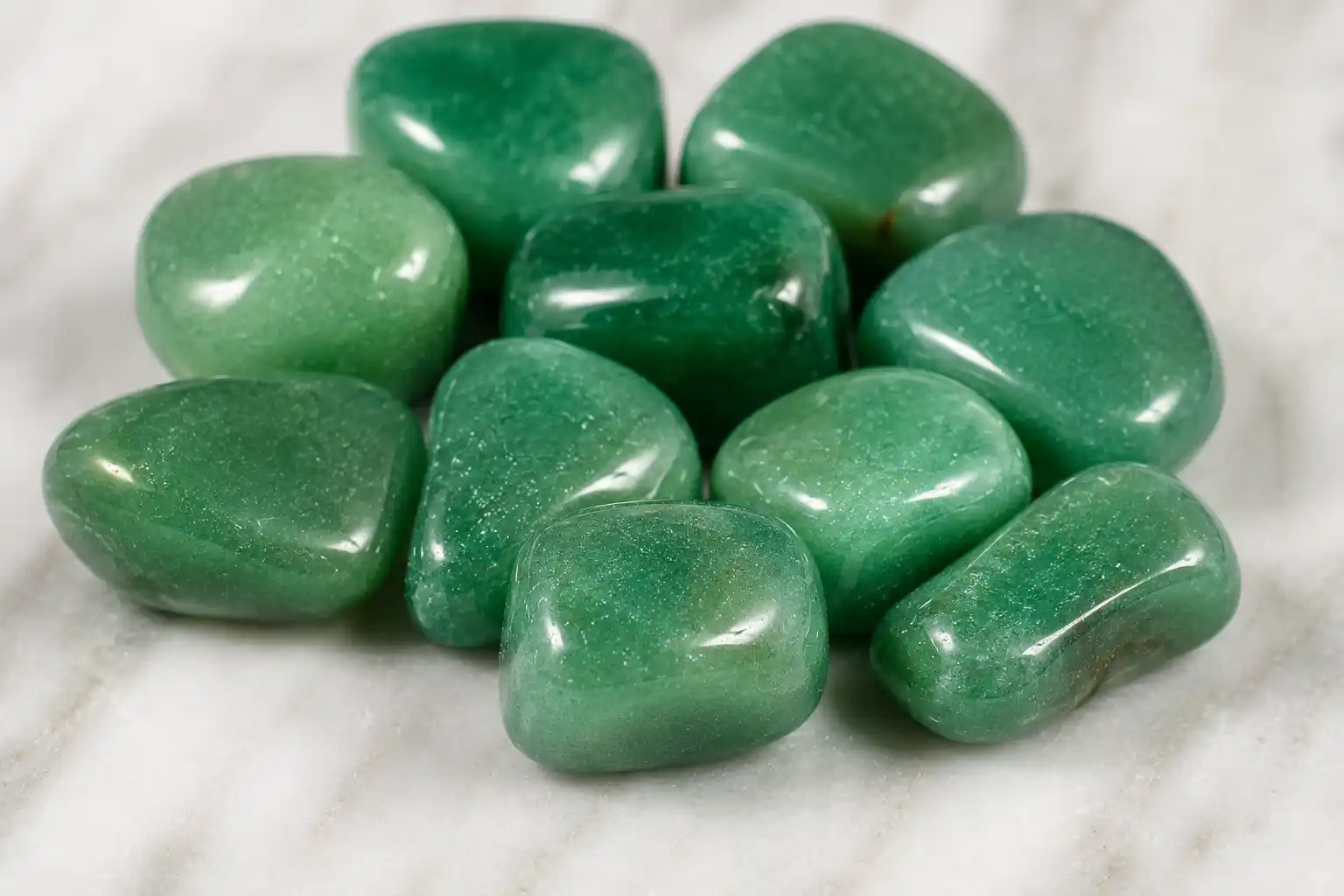
Green Aventurine Meaning: Benefits, Uses & Guide
Green aventurine meaning should begin with the material itself: green aventurine is a quartz-rich material whose characteristic green color and shimmering appearance are commonly produced by inclusions of chromium-bearing mica, especially fuchsite. The reflective platelets create the phenomenon called aventurescence, in which numerous tiny surfaces flash as the stone, observer, or light source moves. GIA describes green aventurine quartz as containing green mica that produces both its perceived body color and glittering optical effect, and gemological examination of tested material has identified fuchsite inclusions alongside quartz-like refractive index and density.
This material-first definition immediately separates green aventurine from several things it is sometimes claimed to be. It is not jade simply because both can be green and translucent. It is not emerald, despite chromium playing a role in the color of some examples. It is not aventurine glass or goldstone, even though the word “aventurine” historically became associated with natural sparkling stones through comparison with decorative glass. It is also not a unique mineral species called “aventurine”; rather, the name describes quartz-rich material containing reflective inclusions that produce a recognizable appearance. GIA’s classic description specifically identifies green aventurine quartz as quartz material containing chrome-rich muscovite mica, commonly called fuchsite.
Modern green aventurine meaning adds another layer. Contemporary crystal traditions often associate it with opportunity, optimism, personal growth, emotional reflection, confidence, or relationships. Those themes can function as metaphors, reminders, or spiritual interpretations, but they are not measurable consequences of quartz or mica chemistry. A responsible guide therefore keeps three categories distinct throughout: measurable mineral and gemological facts, documented naming and human-use history, and modern symbolism. Readers exploring the wider category can browse Healing Crystal while this page stays focused specifically on green aventurine.
Green Aventurine Meaning at a Glance
| Property or question | Evidence-aware summary |
|---|---|
| Material identity | Quartz-rich material containing reflective mineral inclusions |
| Main green inclusion | Commonly fuchsite, a chromium-bearing muscovite mica |
| Composition | Dominated by SiO₂ quartz plus included minerals |
| Typical color | Pale, medium, yellowish, bluish, or deeper green |
| Optical phenomenon | Aventurescence |
| Cause of sparkle | Reflections from plate-like mineral inclusions |
| Typical transparency | Translucent to opaque; some material may be semi-transparent |
| Quartz hardness baseline | About Mohs 7 |
| Common tested RI | Around 1.54 in aventurine quartz |
| Common tested SG | Around 2.66 in quartz-rich material |
| Structure | Often an aggregate or quartzite-like material rather than a single transparent quartz crystal |
| Common forms | Tumbled stones, cabochons, beads, carvings, spheres, decorative objects |
| Identification risk | Can be confused with jade, dyed quartz, glass, other green aggregates, or treated material |
| Treatment possibility | Polymer impregnation and dyeing can occur in some material |
| Modern symbolism | Commonly opportunity, growth, optimism, reflection, relationships, or perseverance |
| Scientific status of symbolism | Symbolic rather than demonstrated physiological or medical effects |
| Safety principle | Intact handling differs substantially from cutting, drilling, grinding, sanding, or crushing quartz |
Green aventurine can vary considerably because the quartz-to-mica ratio, inclusion size, platelet orientation, grain structure, translucency, associated minerals, and workmanship differ among specimens. A richly sparkling dark-green cabochon and a pale semi-transparent quartzite bangle can both be aventurine while looking quite different.
What Is Green Aventurine?
Green aventurine is generally a quartz-rich rock or aggregate in which small reflective green mica platelets are distributed throughout the silica host. GIA has described green aventurine quartz as quartzite containing flakes of chrome mica, while more recent laboratory work on aventurine quartz has documented fuchsite inclusions together with a spot refractive index near 1.54 and specific gravity around 2.66, values consistent with a quartz-dominated material.
That distinction matters because retail descriptions often present green aventurine as though it were a uniformly transparent single crystal of quartz containing a few glittering particles. Much commercial material is instead granular, aggregate, or quartzitic. Its mica platelets may occur throughout the rock in variable concentrations, and its polish can reveal small grain boundaries, cloudy areas, fractures, or zones with different levels of sparkle.
Aventurine therefore describes an optical and textural effect more than a narrowly defined chemical variety. The quartz host supplies much of the stone’s physical behavior, while the included mica contributes both visible green color and the aventurescent effect.
Green Aventurine Identity Table
| Characteristic | Green aventurine |
|---|---|
| Main host | Quartz-rich aggregate |
| Common green inclusion | Fuchsite / chromium-bearing muscovite |
| Dominant host chemistry | SiO₂ |
| Inclusion chemistry | Mica composition varies; chromium contributes to fuchsite’s green coloration |
| Typical texture | Massive, granular, quartzitic, inclusion-rich |
| Typical color | Light to medium green; yellow-green or blue-green variation possible |
| Characteristic phenomenon | Aventurescence |
| Host hardness | Approximately Mohs 7 |
| Common polished luster | Vitreous to somewhat waxy depending on texture |
| Fracture behavior | Variable in aggregate material; quartz itself commonly breaks conchoidally |
| Typical products | Beads, cabochons, carvings, spheres, bangles, tumbled stones |
| Main visual clue | Fine plate-like sparkles rather than one broad flash |
| Important look-alikes | Jadeite, nephrite, dyed quartz, glass, serpentine, other green rocks |
| Important treatment question | Dyeing or polymer impregnation may alter appearance |
| Main naming caution | Aventurine is not a separate formal mineral species |
A photo can support this identification, but it cannot establish all of it. A pale green tumbled stone may resemble aventurine while lacking visible aventurescence, and a strongly saturated green stone may contain dye or another mineral entirely. Technical certainty requires evidence appropriate to the value and purpose of the specimen.
What Is Fuchsite?
Fuchsite is a chromium-bearing variety of muscovite mica. Chromium substitutes into the mica structure and produces green coloration, while the platy nature of mica creates broad, reflective surfaces capable of catching light. When many small fuchsite flakes are embedded through quartz-rich material, their combined reflection produces green aventurine’s familiar sparkling effect.
GIA describes the inclusions as green chromium mica and notes that dense populations of these platelets can strongly suggest aventurine quartz during identification. The inclusions can contribute enough color that what looks like a uniformly green “quartz” body is actually quartz whose visual color is heavily influenced by disseminated mica.
This also explains why green aventurine color and sparkle are connected but not identical. A specimen can contain enough fine mica to appear green while showing restrained sparkle under diffuse light, then reveal obvious reflective flashes under directional illumination.
What Causes Aventurescence?
Aventurescence is the glittering optical effect created when light reflects from numerous small plate-like inclusions within a gemstone or rock. In green aventurine, the reflective particles are commonly green mica. GIA specifically describes the phenomenon as spangles of green mica producing both the glittery appearance and much of the perceived green body color.
The effect depends strongly on geometry. Platelets oriented favorably to the incident light can flash brightly while nearby platelets remain dark. Rotating a cabochon or sphere changes which inclusions reflect toward the eye, making the sparkling pattern seem to move.
Aventurescence should not be confused with chatoyancy, asterism, adularescence, play-of-color, or the broad sheen seen in gold-sheen obsidian. These optical effects arise from different structures.
The detailed relationship between platelet orientation, light, color, refractive behavior, and sparkle belongs in the Green Aventurine Optical Properties and Color Behavior guide.
Is Green Aventurine a Single Crystal?
Usually not in the way a clear quartz point or faceted rock crystal is. Classic green aventurine is commonly a massive quartz-rich aggregate or quartzite-like material containing disseminated mica. GIA’s earlier microscopic discussion specifically cautioned against imagining the inclusions as flakes floating in one large single crystal of quartz and instead described green aventurine as chrome mica within a quartzite matrix.
This distinction matters for both identification and durability. An aggregate contains grain boundaries and may respond differently to polishing, impact, or impregnation than a flawless single quartz crystal.
It also means that metaphysical statements such as “aventurine has one perfect crystal lattice transmitting a green frequency” do not accurately describe much of the commercial material.
How Green Aventurine Forms
Many green aventurine occurrences are associated with metamorphic environments in which quartz-rich rocks interact with chromium-bearing mineral systems. GIA has described green aventurine quartzite from chromium-rich terrains and noted that Brazilian green quartzite composed primarily of quartz and fuchsite likely developed through metamorphism of chromium-bearing sedimentary material.
That general model explains the material’s aggregate character. Rather than growing as one isolated transparent crystal, quartz recrystallizes within a rock while mica develops or persists among its grains. Chromium-bearing chemistry allows fuchsite to form, distributing green reflective platelets throughout the quartz-rich matrix.
The precise geology is locality-dependent. One deposit should not automatically be used as the formation model for every green aventurine on the market. Host rock, pressure-temperature history, fluid chemistry, chromium source, deformation, and later alteration can differ substantially.
Those locality-specific questions belong in the Green Aventurine Formation and Deposit Geology guide.
Why Does Green Aventurine Vary From Pale to Dark Green?
The simplest explanation is that not every specimen contains the same amount, size, composition, or distribution of green mica. A quartz-rich sample with sparse fine fuchsite may appear pale, semi-transparent, and only subtly sparkling. Higher concentrations of mica can produce a deeper green body color and stronger aventurescence, while grain size and platelet orientation further change the appearance.
Associated minerals also matter. Natural quartzite can include additional mica, feldspar, iron minerals, rutile, or other phases. Weathering and surface staining can modify color further.
Lighting has a particularly strong effect. Under diffuse illumination, a specimen may look muted and relatively uniform. Under directional sunlight or a small point-source lamp, reflective platelets can suddenly become much more obvious.
Green Aventurine Is Not Jade
Green aventurine has historically been confused with or marketed as jade substitutes because both can occur as tough-looking green polished materials. GIA notes that green aventurine has been miscalled “Indian Jade,” and laboratory documentation records polymer-impregnated aventurine quartz being submitted under the mistaken impression that it was jadeite.
Jadeite and nephrite have completely different mineralogical structures. Jadeite is a pyroxene mineral, while nephrite is a tightly interlocking amphibole aggregate. Their toughness, density, optical properties, inclusion patterns, and market values can differ materially from aventurine quartz.
Fuchsite platelets can provide a useful clue. GIA notes that densely packed green chromium-mica inclusions can strongly indicate aventurine quartz rather than jade.
An expensive object sold as jade should therefore not be authenticated through color or translucency alone.
Polymer-Impregnated Aventurine Exists
Treatment and stabilization should not be ignored. GIA documented a light-green semi-transparent aventurine quartz bangle that had been polymer impregnated and was being mistaken for “ice jade.” The underlying gemological measurements and fuchsite inclusions were consistent with aventurine quartz, while infrared analysis revealed the polymer treatment.
This does not mean all green aventurine is polymer treated. It means that a polished stone’s natural appearance does not establish complete treatment history.
The treatment question becomes more important when a specimen is unusually translucent, heavily fractured, marketed as a jade substitute, or priced at a level where disclosure materially affects the purchase.
Readers making an actual purchase can use Where to Buy Green Aventurine for the separate buying decision rather than turning this meaning page into a seller checklist.
Green Aventurine Versus Dyed Quartz
Green dye can be introduced into fractures or porous regions of quartz materials, and GIA has documented green dye concentrations along breaks in quartz beads during jade-substitute investigations. A uniformly vivid stone should therefore not automatically be accepted as naturally colored green aventurine merely because the seller uses that name.
Magnification may reveal suspicious color concentrations in fractures, pits, holes, or grain boundaries. However, lack of obvious dye concentrations does not prove untreated status.
A natural specimen should ideally show an inclusion structure and color distribution consistent with actual mica-bearing quartz rather than surface-only green coloration.
Diagnostic Traits
The most useful first-level green aventurine traits are its quartz-rich texture, green body color, reflective platelet inclusions, and aventurescence. Under magnification, the fuchsite may appear as flat green discs or flakes at different depths and orientations. GIA regards these platelets as an important identifying feature when separating aventurine quartz from some jade substitutes.
Standard gemological testing can reinforce the identification. GIA’s documented aventurine quartz bangle showed a spot refractive index of 1.54 and specific gravity around 2.66, both consistent with quartz-dominated material.
No single observation is universal. Some specimens display strong glitter, others much less. Fine-grained material may obscure individual mica flakes. Mixed rocks can contain additional phases.
The Green Aventurine Microscope Inclusion Notebook owns the deeper work of documenting platelet morphology, fractures, grain boundaries, associated minerals, and possible treatment indicators.
Original Information Gain: Green Aventurine Name and Claim Audit
Green aventurine is surrounded by several names and claims that sound similar but describe very different things. This audit separates them.
| Claim or label | Evidence-aware interpretation | What should not automatically be assumed | Stronger evidence when important |
|---|---|---|---|
| Green aventurine | Quartz-rich material showing green mica inclusions and aventurescence | Separate mineral species | Gemological/mineralogical identification |
| Aventurine quartz | Appropriate material description | One transparent quartz crystal | Examine aggregate texture |
| Fuchsite quartz | Quartz containing chromium-bearing mica | Every green platelet is fuchsite | Mineralogical confirmation if exact phase matters |
| Green quartzite | Can describe quartz-rich aggregate material | Every green quartzite is aventurine | Aventurescence and inclusion evidence |
| Indian jade | Historical/trade misnomer | Jadeite or nephrite | Jade testing |
| Jade substitute | Commercial/use description | Material is deceptive if properly disclosed | Honest material identification |
| Natural green | Potentially valid | No dye or impregnation | Treatment examination |
| “Emerald quartz” | Marketing-style comparison | Relationship to emerald | Mineral identity differs fundamentally |
| Aventurescence | Reflective optical effect | Same as chatoyancy or adularescence | Observe inclusion geometry |
| “Stone of opportunity” | Modern symbolic description | Proven influence on probability or luck | Remains metaphor |
| “Heart-healing crystal” | Modern metaphysical language | Medical cardiovascular effect | Clinical evidence would be required |
| “Prosperity stone” | Symbolic or spiritual interpretation | Guaranteed wealth or investment success | No mineralogical support |
| “Anxiety crystal” | Retail/metaphysical phrase | Treatment for anxiety disorders | Clinical evidence would be required |
| “Detox stone” | Unsupported health claim | Biological toxin removal | Medical evidence would be required |
| “Ancient luck stone” | Historical claim | Modern symbolism is ancient | Primary historical evidence |
The table exposes a recurring reasoning error: an optical fact or trace-element fact becomes evidence for a completely unrelated life outcome. Fuchsite explains green inclusions and sparkle. It does not explain luck, income, cardiovascular health, or another person’s feelings.
Original Specimen and Photo Checklist
Photographs can help assess whether a stone is consistent with green aventurine when they are taken deliberately.
| Observation | Photo can often support | Photo cannot reliably prove |
|---|---|---|
| Green body color | Hue, tone, general saturation | Natural versus dyed color |
| Fine reflective flakes | Aventurescent appearance | Exact mica chemistry |
| Uneven sparkle | Inclusion distribution | Full internal structure |
| Translucency | Relative light transmission | Exact refractive index |
| Grain boundaries | Aggregate texture in favorable images | Complete mineral composition |
| Fractures | Large cracks and open fissures | Treatment status |
| Color in fractures | Possible dye indicator | Definitive dye identification |
| Smooth high polish | Workmanship | Polymer impregnation |
| Seller locality | What is being claimed | Provenance |
| “Healing energy” | Nothing measurable | Medical or metaphysical mechanism |
A useful photo set should include diffuse daylight, a second image under directional light that reveals aventurescence, a close-up of the texture, and a transmitted-light view for thinner material. Heavy saturation should be avoided because editing can make pale aventurine resemble much more expensive strongly colored green material.
Original Evidence Hierarchy for a Green Aventurine Claim
Not all sources answer the same question.
| Evidence source | Best use | Limitation |
|---|---|---|
| Gemological laboratory | Material identity, treatment, optical properties, inclusions | Usually specimen-specific |
| Mineralogical study | Mineral composition, texture, formation, mica identity | May not address trade symbolism |
| Geological source | Deposit setting and metamorphic history | Does not prove retail provenance |
| Collection/dealer documentation | Specimen history and reported locality | Depends on chain of custody |
| Retail listing | Current trade terminology | Marketing claims require verification |
| Metaphysical source | Documents modern beliefs and symbolic uses | Does not establish physical or medical effects |
| Personal testimony | Describes individual subjective experience | Cannot demonstrate causation or universal benefit |
This hierarchy helps keep green aventurine meaning useful. Laboratory sources answer what the material is; contemporary spiritual sources can document what people believe it symbolizes. Neither should be forced into the other’s evidentiary role.
Where Did the Name Aventurine Come From?
The word aventurine was associated with decorative glass before it became widely applied to naturally sparkling quartz and feldspar. GIA’s historical discussion notes that the term was first used for aventurine glass and was later transferred to natural minerals displaying a similar metallic-spangled appearance.
Museum sources connect aventurine glass with Venetian glassmaking traditions and a long-standing story of accidental discovery. The exact accident narrative is less certain than popular retellings suggest, but the connection between the name and shimmering decorative glass is well established.
This history is more defensible than claiming that the modern term green aventurine was used by every ancient culture that encountered green quartz or mica-rich rock.
Modern Name, Older Material
The fact that the name has a comparatively specific trade history does not mean humans never used green quartz-rich material earlier. It means that older artifacts should not automatically be relabeled “green aventurine” without mineralogical or documentary evidence.
Historical accounts of jade, emerald, green stones, quartz, or mica cannot simply be merged into green aventurine history because color descriptions were often broad and mineral identification methods were limited.
A responsible history distinguishes the age of the geological material from the age of its present trade name.
Modern Green Aventurine Meaning
Modern green aventurine meaning commonly includes opportunity, optimism, confidence, perseverance, growth, relationships, and emotional reflection. Its green color naturally lends itself to themes of vegetation, renewal, development, and abundance, while its thousands of reflective mica flakes can inspire metaphors about small opportunities becoming visible when perspective changes.
These ideas can be personally meaningful. Someone might keep a polished stone beside a planner as a reminder to notice practical opportunities rather than waiting passively for luck. Another person may wear a green aventurine bead as a symbol of a personal transition or commitment to better communication.
The stone does not need to manipulate probability or physiology for symbolism to work.
Readers interested in the broader cultural category of similarly colored materials can explore Green Crystals while maintaining the distinction between color-based collections and actual mineral identity.
Green Aventurine and Opportunity
“Stone of opportunity” is probably the best-known modern green aventurine meaning. Taken literally as a promise of luck, the claim goes beyond evidence. Quartz and mica cannot be shown to change lottery odds, investment returns, job-selection outcomes, or random events simply by being carried.
As symbolism, however, opportunity can be translated into behavior. A green aventurine object might remind someone to submit an application, follow up with a client, study a new skill, ask a question, or notice an option they would otherwise overlook.
The useful mechanism is attention followed by action, not supernatural probability control.
Green Aventurine and Prosperity
Prosperity themes are closely related to opportunity symbolism. Green is culturally associated with growth and, in some societies, with money, while the reflective flakes add visual richness.
A responsible prosperity practice can attach the stone to concrete actions such as reviewing expenses, saving consistently, learning financial skills, sending overdue invoices, or developing a realistic business plan.
Green aventurine cannot guarantee income, profitable trading, winning games of chance, investment appreciation, or business success. Financial outcomes require evidence-based decisions and remain uncertain.
Green Aventurine and Personal Growth
The material’s green color and metamorphic geological context make growth a natural metaphor. Quartz-rich rock containing chromium mica can form and recrystallize under substantial geological change, creating a material whose present appearance reflects interactions among chemistry, pressure, temperature, and time.
A person can use that story symbolically to represent gradual change rather than instant transformation. Improving a habit, learning a skill, rebuilding confidence, or adjusting a routine usually occurs through repeated actions.
The geological analogy does not prove that wearing aventurine changes personality or accelerates emotional development.
Green Aventurine and Relationships
Some contemporary traditions connect green aventurine meaning with love, friendship, or relationship harmony, often because green is associated metaphysically with the heart.
A grounded interpretation can focus on the owner’s behavior: communicate clearly, respect boundaries, listen before reacting, and distinguish what can and cannot be controlled.
The stone cannot make someone fall in love, return to a relationship, remain faithful, apologize, communicate, or change behavior. It cannot override consent.
Readers browsing other color-based gemstone references can compare the broader material range in Green Gemstones without treating shared color as evidence of shared psychological effects.
Green Aventurine and Emotional Reflection
A smooth stone can function as a tactile or visual object during journaling, meditation, or quiet reflection. Someone may subjectively find green colors relaxing or enjoy focusing on the sparkling mica while slowing down.
That experience should not be transformed into claims that green aventurine treats depression, anxiety disorders, panic, trauma, insomnia, or neurological conditions.
A reflective object can accompany evidence-based care or ordinary relaxation without becoming the medical mechanism.
Green Aventurine and the Heart
Metaphysical systems sometimes describe green aventurine as a heart-centered or “heart chakra” stone. This is a spiritual interpretation rather than a statement about cardiovascular anatomy.
The stone is not scientifically demonstrated to treat heart disease, blood pressure, circulation, arrhythmias, cholesterol, or other cardiovascular conditions. Green color and chromium-bearing mica do not establish a medical connection to the heart.
Someone may still use the heart symbolism to represent compassion, boundaries, affection, or emotional honesty if that framework is personally meaningful.
Green Aventurine “Benefits”: What Can Be Said Responsibly?
The word benefits can mean different things. A practical benefit is that green aventurine is attractive, polishable, relatively scratch resistant because of its quartz content, and available in forms suitable for beads, carvings, cabochons, or decorative objects. A symbolic benefit may be that an owner finds it a useful reminder of a goal or reflective practice.
A claimed medical benefit is a different category requiring evidence. Green aventurine should not be presented as treating disease, boosting immunity, correcting hormones, improving fertility, regulating neurological function, relieving pain, detoxifying organs, or producing guaranteed emotional outcomes.
The strongest article therefore describes practical use and clearly labeled symbolism rather than converting the word benefits into a list of unsupported health promises.
Green Aventurine and Other Gray or Green Collections
Color-based gemstone collections can help readers compare aesthetics, but color alone does not establish mineral relationships. A gray quartz-rich rock, gray chalcedony, gray feldspar, or dark metallic mineral may have virtually nothing in common chemically with green aventurine despite appearing in a shared Gray Gemstones collection.
The same applies to Gray Crystals: a category built around appearance may contain materials with different structures, hardness, treatments, and histories.
This distinction helps prevent symbolic color associations from being mistaken for mineral classification.
Cutting and Polishing
Quartz’s hardness makes green aventurine a useful lapidary material, but its aggregate texture means cutting is not identical to faceting clean single-crystal quartz. Grain boundaries, mica-rich zones, fractures, variable translucency, and platelet orientation can influence polish and appearance.
A cutter may orient a cabochon or flat surface so that more mica platelets reflect toward the viewer, strengthening aventurescence. Other orientations may display richer body color but weaker sparkle.
Detailed saw orientation, polishing behavior, fracture management, and workmanship belong in the Green Aventurine Cutting, Orientation and Polish guide.
Jewelry Wear
With quartz as its dominant host, green aventurine has useful scratch resistance for many jewelry applications, but the aggregate structure and individual specimen condition still matter. Hardness does not measure resistance to every impact, and fractures or weakened grain boundaries can contribute to chips.
Rings and bracelets receive more knocks and abrasion than earrings or protected pendants. Beads can also develop stress around drill holes.
The detailed relationship between setting pressure, stone shape, impact exposure, and daily wear belongs in the Green Aventurine Setting and Wear Engineering guide.
Safe Ownership: Intact Stone Versus Quartz Dust
Ordinary handling of a polished green aventurine stone is fundamentally different from cutting, grinding, drilling, sanding, or crushing it. Those high-energy processes can generate respirable crystalline silica particles from quartz-bearing material.
OSHA identifies cutting, sawing, grinding, drilling, and crushing stone as activities capable of creating respirable crystalline silica dust and links significant occupational inhalation exposure with serious lung and other health risks.
Lapidary work should therefore use appropriate wet methods and engineering controls, suitable eye and respiratory protection where required, equipment safeguards, and controlled cleanup rather than uncontrolled dry dust production.
Do Not Powder or Ingest Green Aventurine
Green aventurine should not be ground into powder, swallowed, added to supplements, or deliberately placed into drinking water to extract supposed mineral benefits. Quartz and mica are geological materials, not nutritional preparations.
Chromium occurring within fuchsite should not be confused with a dietary recommendation. An element present within a mineral lattice is not automatically bioavailable, medicinal, safe for ingestion, or transferable through ordinary skin contact.
Natural specimens can also contain associated minerals, dyes, polymer treatments, polishing compounds, matrix, or surface contamination that a trade name does not reveal.
Specimen Conservation
Natural rough aventurine and polished objects benefit from basic documentation. Record photographs, dimensions, weight where useful, color, visible sparkle, fractures, source, claimed locality, treatment disclosure, and any laboratory information.
Avoid aggressive cleaning simply because the material is quartz-rich. Treated or impregnated material may respond differently from untreated stone, and abrasive cleaning can dull polish.
The Green Aventurine Specimen Conservation Record owns the detailed preservation framework without turning this meaning article into a care manual.
Provenance and Locality Claims
Green aventurine occurs in multiple geological regions. GIA documentation discusses material from India and Brazil, among other locations, while green quartzite with fuchsite is known more broadly in chromium-bearing metamorphic terrains.
A stone’s green color or aventurescence cannot prove a specific geographic source. “Indian aventurine,” “Brazilian aventurine,” or another origin description should therefore be treated as provenance information rather than a visual diagnosis.
Original supplier records, collection labels, mine information, and traceable ownership history provide stronger locality evidence than resemblance to online photographs.
Evidence and Technical Limits
This article does not claim first-hand mine visits, unpublished spectroscopy, private treatment testing, personal authentication of retail inventory, or examination of a reader’s individual stone. The broader evidence approach used by Gems Lore is explained on About Gems Lore.
Some questions require professional testing. Separating aventurine from a convincing jade imitation, detecting subtle polymer impregnation, identifying an unusual inclusion mineral, confirming dye, or assigning geographic provenance may require appropriate gemological or mineralogical examination.
The site-wide distinction between measurable gemstone properties, modern symbolism, and unsupported health claims is stated in the Gems Lore Disclaimer.
Readers with documented corrections, analytical results, provenance records, or stronger technical evidence can submit them through Contact Gems Lore.
Frequently Asked Questions About Green Aventurine Meaning
What is green aventurine meaning?
Green aventurine meaning commonly refers to modern symbolic themes of opportunity, growth, optimism, relationships, confidence, and reflection. Materially, green aventurine is quartz-rich material commonly containing reflective fuchsite mica.
What is green aventurine made of?
It is dominated by quartz, SiO₂, with green reflective mineral inclusions. Fuchsite, a chromium-bearing muscovite mica, is the classic inclusion responsible for much of the green color and aventurescence.
Why does green aventurine sparkle?
Light reflects from numerous plate-like green mica inclusions distributed through the quartz-rich host. These reflections create the optical phenomenon known as aventurescence.
Is green aventurine a quartz?
Yes, but classic material is often better understood as aventurine quartz or a quartz-rich aggregate containing mica rather than as one clear quartz crystal with a few inclusions.
Is green aventurine the same as jade?
No. Aventurine quartz, jadeite, and nephrite are mineralogically different materials. Green aventurine has historically been used as a jade substitute, making proper identification important.
Is fuchsite what makes aventurine green?
Fuchsite is the classic chromium-rich green mica found in green aventurine and contributes both green color and reflective sparkle. Other natural material can contain additional minerals, so an individual specimen should not be assumed chemically simple.
Is all green aventurine naturally colored?
Not necessarily. Natural green aventurine is widespread, but dye and polymer impregnation are possible in commercial quartz materials. Treatment status should be evaluated separately from identity.
How hard is green aventurine?
Its dominant quartz component has a Mohs hardness of about 7. Aggregate texture and fractures still influence real-world durability.
Where is green aventurine found?
Commercial and documented occurrences exist in several regions, including India and Brazil, with related quartz-fuchsite rocks occurring in chromium-bearing metamorphic environments. A particular locality should be supported by provenance rather than appearance alone.
Does green aventurine bring luck?
“Luck” or “opportunity” is a modern symbolic association. There is no scientific evidence that carrying the stone changes probability, lottery odds, business outcomes, or other random events.
Does green aventurine attract money?
It may be used symbolically as a reminder of financial goals, but it cannot guarantee income, investment profits, customers, promotions, or wealth.
Does green aventurine help relationships?
A person may use it as a reminder to communicate, maintain boundaries, or reflect on relationships. It cannot make another person fall in love, reconcile, remain faithful, or change behavior.
Does green aventurine have healing properties?
There is no established scientific evidence that green aventurine treats disease or produces specific physiological healing effects. Medical claims should not be inferred from quartz, mica, chromium, or green coloration.
Is green aventurine safe to touch?
Ordinary handling of an intact polished stone is different from processing quartz. Cutting, grinding, drilling, sanding, or crushing can generate respirable crystalline silica dust and requires appropriate controls.
Can green aventurine go in drinking water?
It should not be powdered, ingested, or deliberately used to make mineral drinking-water preparations. The stone can contain mica, associated minerals, dyes, polymer treatments, residues, or other materials in addition to quartz.
Final Perspective
Green aventurine meaning is most useful when its real mineralogical identity is allowed to lead. The material is quartz-rich and typically contains numerous chromium-bearing mica flakes, especially fuchsite. Those platelets produce much of the green appearance and the shifting reflective sparkle known as aventurescence. GIA’s observations of natural and treated aventurine demonstrate that the combination of quartz-like gemological properties and fuchsite inclusions provides a far stronger identification foundation than green color alone.
Its name also carries an instructive history. “Aventurine” became associated with natural quartz because its glittering effect resembled aventurine glass, reinforcing how commercial gemstone language can travel from one material to another without making those materials mineralogically related. That history is more credible than projecting today’s “stone of opportunity” narrative backward into unspecified ancient green stones.
Modern themes of opportunity, growth, confidence, relationships, and optimism can still form a meaningful green aventurine meaning when presented as symbolism. The evidence-aware approach is straightforward: identify the quartz-rich material first, understand fuchsite and aventurescence, distinguish it from jade and treated substitutes, preserve provenance and treatment uncertainty, handle intact stones differently from dust-generating lapidary work, and use ideas such as luck or prosperity as reflective metaphors rather than guarantees about health, money, love, or probability.