Where to Buy Real Green Aventurine and Avoid Dyed Glass Fakes
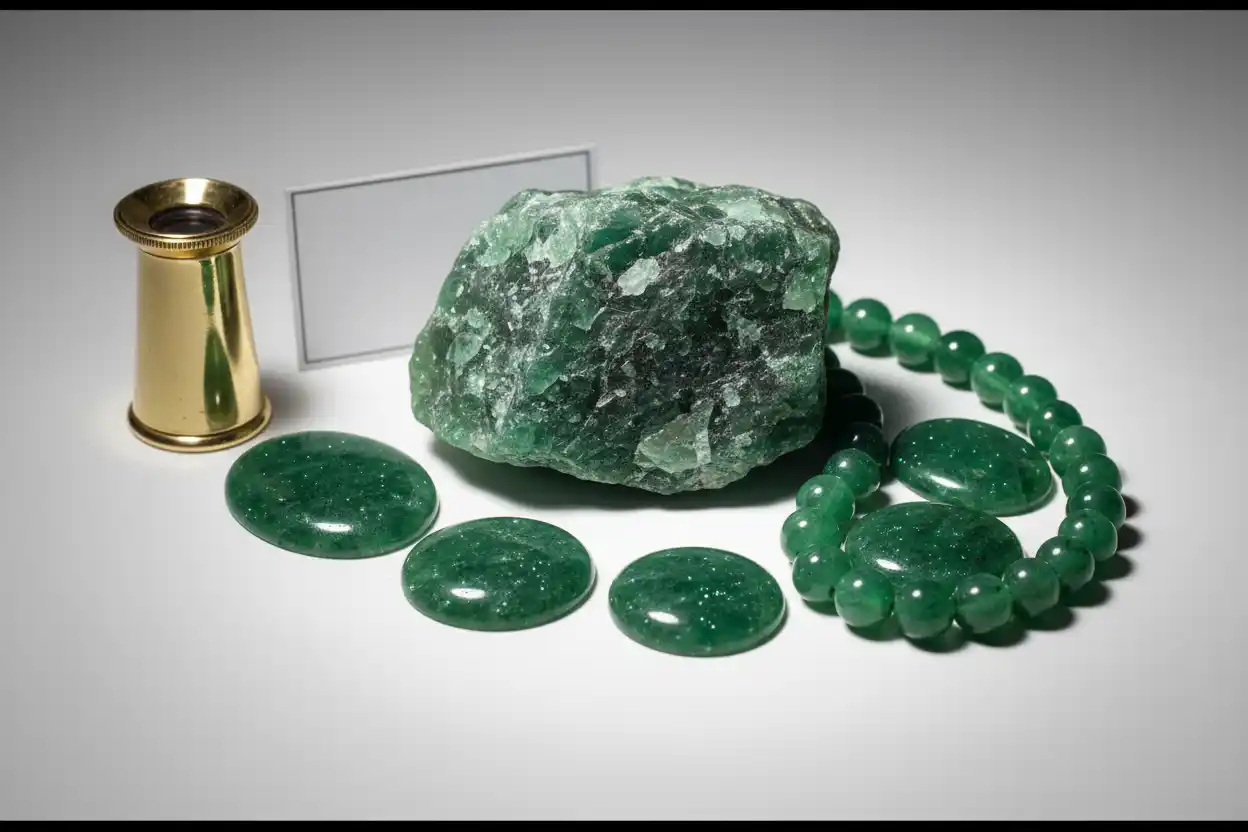
Real Green Aventurine is a quartz-rich material containing reflective mineral inclusions that produce a soft sparkling effect known as aventurescence. In traditional green material, chromium-bearing mica—commonly Fuchsite—creates much of the color and shimmer.
The effect ranges from obvious glitter to a subdued silvery-green sheen. A stone does not need to sparkle like metallic craft glitter to be genuine, but a completely featureless green body may be ordinary quartz, chalcedony, glass, dyed stone or another material sold under the Aventurine name.
The market also contains aventurine glass, polymer-impregnated quartz, dyed quartzite, green resin, serpentine and jade-like products. Some of those materials are attractive, but they should not be sold as untreated natural Green Aventurine.
The Green Aventurine meaning and properties guide covers the variety’s identity and traditional symbolism. This guide focuses on seller selection, natural aventurescence, treatment, jade confusion, product quality and value.
Green Aventurine Is Quartz with Reflective Inclusions
Aventurine is a quartz or quartz-rich aggregate containing platy or particulate mineral inclusions that reflect light.
The Aventurine family guide explains the broader material. The types of Aventurine guide separates green, blue, red and other commercial colors.
Green Aventurine commonly contains Fuchsite, a chromium-bearing variety of Muscovite mica. The reflective plates create aventurescence as the stone moves beneath light.
The Fuchsite guide covers that mica in its own right. Not every green mica-bearing rock is Aventurine, however; the quartz host and reflective internal texture must also be considered.
Some material contains additional mica, Hematite, Goethite or other inclusions. Therefore, shade and sparkle can vary across one piece.
Aventurine Quartz Is Not Aventurine Glass
Aventurine glass, also called Goldstone in some colors, is a manufactured glass containing reflective particles. The historical glass product helped popularize the word aventurescence, but it is not natural Aventurine Quartz.
Natural Green Aventurine typically has irregular mica plates distributed through a quartz-rich body. Manufactured glass may display highly uniform glitter, bubbles, flow lines and identical sparkle from one object to another.
A retailer can legitimately sell green aventurine glass if the product is clearly labeled as glass. Problems arise when it is offered as a natural crystal.
Choose the Product Form First
| Product form | Best source | Main concern |
|---|---|---|
| Natural rough | Lapidary supplier or mineral dealer | Quartz content, Fuchsite distribution, fractures and temporary oil enhancement |
| Slab | Lapidary supplier | Sparkle orientation, dye, polymer and cutting yield |
| Cabochon | Gem dealer or independent cutter | Aventurescence, translucency, filling and polish |
| Tumbled stone | Reputable crystal retailer | Dyed quartz, glass, serpentine or featureless green rock |
| Bead strand | Established bead supplier | Aventurine glass, polymer, dye and drill-hole cracks |
| Sphere | Experienced lapidary retailer | Hidden fractures, filler and weak reverse appearance |
| Carving | Skilled stone seller | Coating, resin and undercut mica-rich areas |
| Jewelry | Jeweler with treatment disclosure | Jade misrepresentation, backing, glue and setting quality |
| Jade-like bangle | Specialist gem dealer | Polymer impregnation and incorrect jade labeling |
The completed general Aventurine buying guide covers family-wide seller checks. This page owns the green-color, Fuchsite, jade and green-glass boundaries.
Where to Buy Genuine Green Aventurine
Specialist lapidary suppliers
A lapidary supplier should show dry rough, sawn faces and polished examples from the same parcel.
Water and oil deepen green color and increase apparent translucency. Therefore, ask for a dry photograph from the same angle as any wet image.
A good seller should describe whether the material is fine-grained, strongly aventurescent, highly translucent or included with larger mica plates. Each texture cuts differently.
Gem and mineral shows
Shows allow direct comparison with jade, serpentine, Prasiolite, Green Calcite and aventurine glass.
Rotate the stone beneath one focused white light. Natural mica reflections should appear and disappear from numerous internal plates rather than remaining as flat surface glitter.
Use a loupe to inspect bubbles, dye concentrations, resin-filled fractures and grain boundaries. Do not scratch the item.
Established online sellers
The online gemstone buying guide explains seller identity, protected payments and returns.
For Green Aventurine, request a moving-light video. Diffuse studio lighting can hide aventurescence, while multiple moving lights can exaggerate it.
Ask whether photographs show the exact item. Pattern and sparkle vary too much for one premium sample to represent every sphere or cabochon.
Independent cutters and jewelry makers
A cutter who worked from rough can often explain whether the material was impregnated or whether mica-rich zones caused undercutting.
For a closed-back pendant or bangle, request photographs before setting. Backing and polymer can change transparency and apparent color.
Dealers who understand jade imitations
Semi-translucent Green Aventurine has sometimes entered the market as a jadeite imitation. A knowledgeable dealer should distinguish quartz from Jadeite through gemological testing rather than color alone.
If the item is marketed as jade, use a jade specialist instead of relying on an Aventurine seller’s verbal assurance.
What Genuine Green Aventurine Looks Like
Natural Green Aventurine ranges from pale mint and gray-green to medium grass green, yellow-green and deeper forest green.
The body is commonly translucent to opaque. Finer-grained material may appear evenly colored, while larger Fuchsite plates create obvious sparkles and streaks.
Aventurescence should respond to movement. Some flakes flash brightly only at one angle because their flat surfaces are oriented differently.
Natural pieces may contain white quartz areas, color zoning, fractures, dense mica patches and areas with little sparkle.
A completely uniform green body can still be quartz-rich, but the Aventurine name should be supported by visible reflective inclusions or gemological evidence.
Extremely vivid neon color, glitter distributed with mechanical regularity or identical patterns across several beads deserves scrutiny.
Green Aventurine Versus Blue and Red Aventurine
Blue Aventurine commonly contains different inclusion materials and has blue to blue-gray color. The completed guide to buying genuine Blue Aventurine covers blue dye, Dumortierite confusion and artificial glass.
Red Aventurine typically contains iron-bearing inclusions that create orange, red or reddish-brown color and sparkle.
Color labels should describe the dominant natural appearance. A green stone coated blue is not a natural Blue Aventurine variety.
Green Aventurine Versus Jade
The planned Aventurine-versus-Jade guide owns the detailed comparison.
Jade properly refers to Jadeite or Nephrite. Jadeite is a pyroxene, while Nephrite consists of tightly interlocking amphibole fibers.
Green Aventurine is quartz-rich and commonly shows mica sparkle. That aventurescence is not typical of fine Jadeite or Nephrite.
The completed Jade buying guide explains jade texture and market quality. The real-versus-fake Jade guide and treated-Jade guide cover imitation and polymer treatment.
Trade names such as Indian Jade for Green Aventurine are misleading. The stone can be genuine natural Aventurine without being true jade.
Polymer-Impregnated Green Aventurine
Fractured or porous Green Aventurine can be impregnated with polymer. The treatment may improve translucency, strengthen the material and reduce the visibility of internal cracks.
Polymer-impregnated Aventurine has also been mistaken for translucent Jadeite. A bangle can therefore be genuine Aventurine Quartz and still have substantial treatment.
Strong blue fluorescence under long-wave ultraviolet light can support the presence of some polymers, but UV response alone is not conclusive.
Infrared spectroscopy provides stronger treatment evidence. Sellers should disclose polymer even when the material itself is natural.
Green Aventurine Versus Serpentine
Serpentine can appear mint, yellow-green, apple green or dark green and frequently enters the market under jade-related trade names.
Serpentine usually lacks the distinctive mica-driven sparkle of Green Aventurine. It is also generally softer and may show waxy, fibrous or mottled texture.
Dyed serpentine can look convincing in photographs. Raman spectroscopy or refractive-index testing provides safer identification than scratching.
Green Aventurine Versus Prasiolite
Prasiolite is transparent to translucent green quartz, often produced by heating or irradiating suitable Amethyst.
Prasiolite is generally clearer and lacks the platy aventurescent inclusions expected in Green Aventurine.
The completed Prasiolite buying guide covers treatment and faceted-gem quality in that separate market.
A transparent green faceted quartz gem should not be called Aventurine unless reflective inclusions produce the relevant optical effect.
Green Aventurine Versus Green Calcite
Green Calcite is a calcium-carbonate mineral with Mohs hardness 3 and prominent cleavage.
It is usually softer, cloudier and less sparkly than Green Aventurine. Its polished surfaces scratch more easily, while acids can etch it.
The current dedicated guide to buying Green Calcite keeps carbonate treatment and care separate from Aventurine’s quartz-and-mica market.
Green Aventurine Versus Green Glass
Glass can be colored green and filled with reflective particles. A manufactured piece may display extremely dense, uniform sparkle.
Round bubbles, flow lines, mold seams and identical glitter distribution support glass.
Natural Aventurine’s mica plates commonly vary in size, orientation and concentration. However, highly processed glass may still require gemological testing.
Dyed Quartz and Quartzite
Pale quartzite or ordinary quartz-rich rock can be dyed green. If it already contains reflective mica, the result may look very similar to natural Green Aventurine.
Dye often concentrates in fractures, porous grain boundaries and drill holes. Strong color may also fade toward the center of a thick piece.
Natural-color determination can be difficult when the host is genuine quartz-rich material. Microscopy and spectroscopy may be required for expensive claims.
Resin and Reconstituted Products
Resin can be mixed with green pigment, mica glitter and stone powder. Such products can recreate both color and sparkle.
Mold seams, bubbles, soft scratches and repeated patterns support polymer construction.
Reconstituted products may contain crushed natural quartz. They should still be sold as composites rather than solid natural Aventurine.
The fake-crystal buyer’s guide provides broader checks for glass, resin and artificial glitter.
Coatings, Wax and Oil
Oil and wax can deepen green color and improve temporary luster. Coatings can create an unusually smooth shine or increase saturation.
Inspect chipped edges and drill holes for changes in color or gloss. A clear coating may scratch differently from the stone beneath it.
The gemstone treatments guide explains the disclosure difference between a light surface treatment and polymer impregnation.
How to Evaluate Rough
Request a dry sawn face. The exterior may contain weathering or a concentration of mica that does not continue through the block.
Look for enough evenly distributed Fuchsite to produce attractive sparkle after cutting. Very large mica-rich seams can cause undercutting and weak edges.
Internal fractures reduce usable yield. A heavy block may produce fewer sound cabochons than a smaller compact piece.
Ask whether sample cabochons from the parcel maintain color and polish without resin.
How to Evaluate Slabs
Compare both faces and the edges. Green color and reflective plates should continue through the material.
Tilt the slab beneath one directional light. The sparkle should move among numerous internal plates.
Inspect for resin-filled cracks, dye concentrations and zones that appear granular or poorly cemented.
A slab with all its sparkle parallel to one face may produce excellent cabochons from that orientation but weak results if cut differently.
How to Judge Cabochons
A quality cabochon balances body color, translucency and aventurescence.
The dome should be high enough to show internal reflections but not so thick that the stone becomes dark and opaque.
The polish needs to remain even across mica-rich areas. Deep pits and uneven texture suggest undercutting or inadequate stabilization.
Inspect the back for dye, polymer, backing and open fractures.
Buying Beads and Bracelets
Natural strands should show coordinated green color without identical glitter patterns.
Inspect drill holes for dye, chips and resin. Mica-rich boundaries can fracture during drilling.
Polymer impregnation may make a translucent bangle or bead strand look more jade-like. Ask directly whether the supplier tested for treatment.
Avoid strings pulled so tightly that beads strike one another continuously.
Buying Spheres and Carvings
Request a complete rotation. One face may show concentrated sparkle while the reverse appears pale or nearly featureless.
Large objects are more likely to contain fractures, resin or mixed quartz-rich material. Ask whether the item was stabilized.
Carvings should avoid thin projections crossing mica-rich seams. A glossy coating should not substitute for a competent stone polish.
Buying Green Aventurine Jewelry
Quartz has Mohs hardness around 7, making sound Aventurine practical for many jewelry designs.
The gemstone hardness chart provides scratch-resistance context, while the toughness-versus-hardness guide explains why fractures and mica-rich boundaries can still chip.
Pendants, earrings, bracelets and protected rings are generally realistic. A bezel protects cabochon edges better than widely spaced prongs.
Ask whether the stone is backed, glued or polymer-impregnated. Jewelry care should follow the most sensitive treatment present.
Price and Value
Green Aventurine is generally affordable. Price increases with attractive natural green color, clear aventurescence, useful translucency, sound structure, cutting quality, treatment disclosure and large usable sizes.
A stone does not become higher quality merely because it contains more glitter. Excessively dense mica can reduce translucency and polishing quality.
Fine semi-translucent bangles may command more because suitable rough is harder to obtain and cutting creates breakage risk. Nevertheless, polymer-treated material should not receive an untreated premium.
Avoid arbitrary “AAA” labels unless the seller explains color, sparkle, translucency and structural criteria.
Questions to Ask the Seller
Ask whether the item is natural Green Aventurine Quartz, aventurine glass, dyed quartzite, serpentine or polymer composite.
Determine which mineral is believed to create the aventurescence. Request disclosure of dye, polymer, resin, coating, oil, wax and backing.
For rough, request dry sawn-face photographs. For cabochons, ask for front, back and moving-light views. For beads, request drill-hole close-ups.
If the item resembles jade, ask whether refractive index, specific gravity or spectroscopy confirmed quartz.
Finally, obtain a return policy that allows ordinary gemological inspection.
Professional Identification
Standard gemological testing can distinguish Aventurine Quartz from most jade, glass, calcite and serpentine.
Microscopy reveals reflective Fuchsite plates, grain structure, dye concentration, glass bubbles and resin-filled fractures.
Raman spectroscopy can identify quartz and mica inclusions. Infrared spectroscopy can detect polymer impregnation.
Testing should target both the host and the treatment. Identifying quartz does not prove natural green color or an absence of polymer.
Ethical Sourcing and Care
The ethical gemstone sourcing guide provides practical questions about mining, cutting labor and supply-chain claims.
Clean sound untreated Green Aventurine with lukewarm water, mild soap and a soft cloth. Avoid prolonged soaking when polymer, dye, backing or glue may be present.
Do not steam heavily fractured or impregnated material. Ultrasonic cleaning is unsuitable for filled, assembled or drill-fractured jewelry.
Store polished pieces away from harder gems and remove rings before heavy manual work.
Frequently Asked Questions
1. What makes Green Aventurine sparkle?
Reflective mineral plates, commonly chromium-bearing Fuchsite mica, create the aventurescent effect.
2. Is every green quartz stone Aventurine?
No. The Aventurine name generally requires visible reflective inclusions or an identifiable aventurescent texture.
3. Is Green Aventurine a type of jade?
No. It is quartz-rich material, while true jade is Jadeite or Nephrite.
4. What is aventurine glass?
It is manufactured glass containing reflective particles. It is not natural Aventurine Quartz.
5. Can Green Aventurine be dyed?
Yes. Quartz-rich rock can be dyed green, with color often concentrating in fractures and grain boundaries.
6. Can Green Aventurine contain polymer?
Yes. Fractured material may be polymer-impregnated to improve translucency and stability.
7. Does strong sparkle prove authenticity?
No. Glass and resin can contain artificial glitter. Natural inclusion texture and gemological properties also matter.
8. Is a completely opaque stone low quality?
Not automatically. Opaque material can show attractive color and sparkle, although fine translucency may receive a premium.
9. Is Indian Jade the same as Green Aventurine?
Indian Jade is a misleading trade name sometimes used for Green Aventurine or other green stones. Aventurine is not true jade.
10. Is Green Aventurine suitable for everyday jewelry?
Sound untreated material is generally wearable, although fractures and treated pieces need appropriate care.
11. Do ordinary beads need laboratory reports?
Usually not. Testing becomes more useful for costly bangles, jade-like products and disputed polymer treatment.
12. What is the biggest warning sign in a listing?
Be cautious when a flawless translucent “jade” bangle is sold as untreated Green Aventurine but the seller provides no testing, treatment statement or moving-light video.
Buy Natural Aventurescence, Not Generic Green Sparkle
Green Aventurine should reveal irregular internal mica reflections when it moves beneath one white light. Its value comes from natural quartz texture, color and polish—not from a jade-related nickname or mechanically uniform glitter.
The G crystal directory, G gemstone directory and visual gemstone guide provide wider green-stone comparisons. Choose the seller who can identify the host, reflective inclusions and every treatment.
Safety note: Green Aventurine is quartz-rich and can create hazardous respirable silica dust during cutting, drilling, sanding or grinding. Never dry-work the material. Lapidary processing requires wet methods, effective local extraction and suitable respiratory and eye protection.