Grossular Garnet Meaning: Properties, Uses & Symbolism
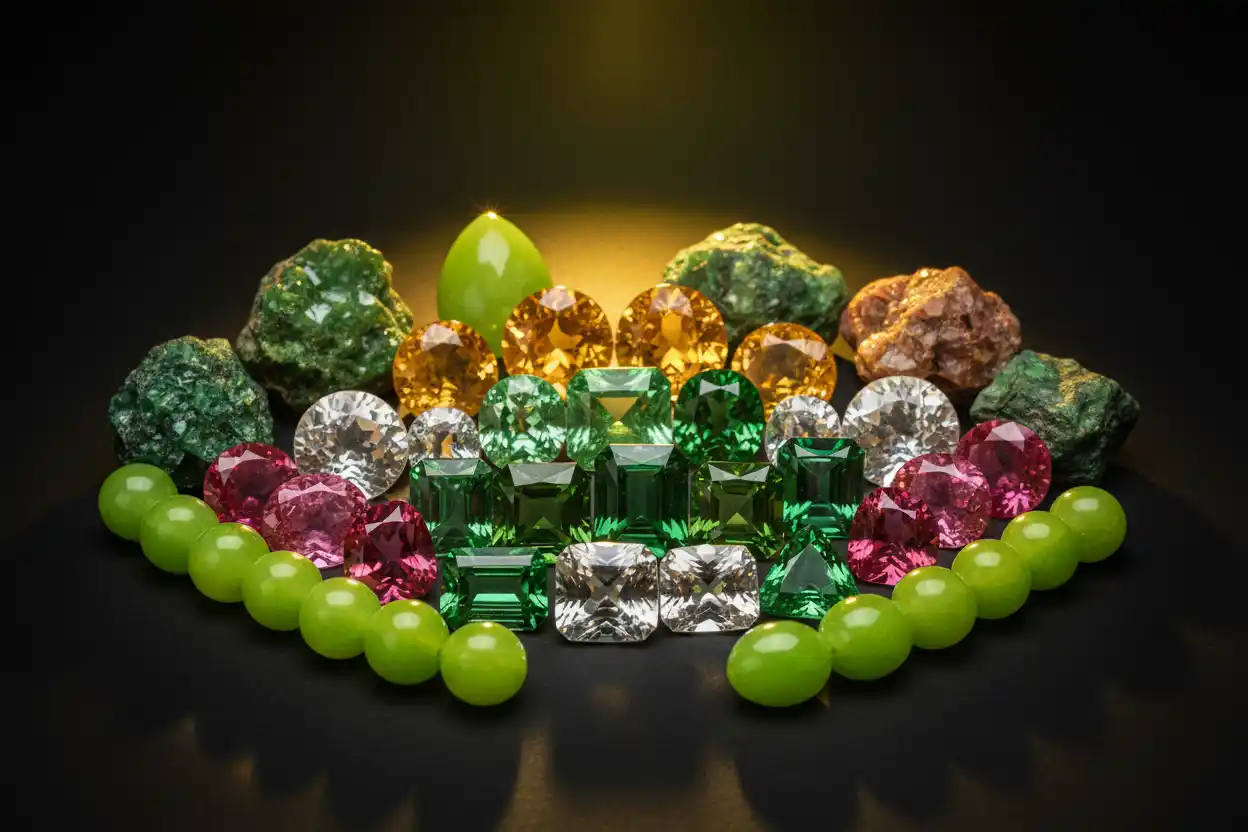
Grossular garnet meaning begins with a calcium-aluminum silicate mineral whose natural color range is far broader than the red appearance many people associate with garnet. Grossular has the ideal formula Ca₃Al₂(SiO₄)₃ and belongs to the garnet group within the cubic—or isometric—crystal system. Mindat records colors including brown, orange, red, yellow, green, white, colorless, and pink, with a Mohs hardness of approximately 6.5–7 and measured specific gravity near 3.594 for the ideal mineral. Pure grossular is theoretically colorless, while natural substitutions and trace constituents create the wide range seen in mineral specimens and gemstones.
That broad color range is important because grossular includes several familiar variety names. Hessonite describes orange to brownish-orange grossular, historically associated with cinnamon-like coloration, while tsavorite describes intensely green transparent grossular. These names are useful, but they do not replace mineral identification. Green grossular can range from pale mint shades to deeply saturated tsavorite, and its color chemistry varies between deposits. GIA research has shown vanadium to be a major chromophore in conventional tsavorite, sometimes accompanied by chromium, while other analyzed green grossulars have been dominated more strongly by chromium or by different iron-to-vanadium relationships.
The appropriate foundation for grossular garnet meaning is therefore material first, history second, symbolism third. Formula, crystal structure, refractive index, density, inclusions, formation, color centers, and species boundaries are mineralogical or gemological questions. The history of names such as grossular and hessonite can be documented. Modern themes involving growth, steadiness, confidence, abundance, perspective, or personal renewal belong to contemporary symbolism rather than measurable mineral effects.
Readers exploring related mineral references can browse the Gemstone Guides collection while this page remains focused specifically on grossular as a material and on the boundaries between its documented properties and modern symbolic interpretation.
Grossular Garnet Meaning at a Glance
| Property or question | Evidence-aware summary |
|---|---|
| Mineral species | Grossular |
| Mineral group | Garnet |
| Ideal formula | Ca₃Al₂(SiO₄)₃ |
| Crystal system | Isometric / cubic |
| Typical colors | Colorless, white, yellow, orange, brown, red, pink, pale green to vivid green |
| Mohs hardness | Approximately 6.5–7 |
| Specific gravity | Ideal grossular about 3.59; gem material varies with composition and inclusions |
| Refractive index | Approximately 1.731–1.754 across grossular compositions |
| Optical character | Isotropic, although anomalous double refraction can occur |
| Cleavage | None normally observed |
| Tenacity | Brittle |
| Fracture | Uneven to sub-conchoidal |
| Hessonite | Orange to brownish-orange grossular variety |
| Tsavorite | Transparent green grossular variety |
| Green color | Often associated with V³⁺ and/or Cr³⁺; relative contribution varies |
| Orange/brown color | Iron, especially Fe³⁺, can contribute strongly |
| Formation | Commonly calc-silicate/contact or regional metamorphic environments; deposit-specific |
| Modern symbolism | Growth, confidence, steadiness, reflection, abundance, renewal |
| Scientific status of symbolism | Interpretive rather than demonstrated medical or physiological effects |
| Main identification caution | Color alone cannot determine grossular variety or distinguish it from other garnets |
| Safe-use principle | Ordinary intact handling differs from cutting, grinding, drilling, or crushing mineral material |
Mindat gives grossular refractive-index values around 1.731–1.754 and confirms its isotropic character, while GIA’s gem-quality grossular studies show that natural composition and inclusions can shift density and optical measurements within practical ranges.
What Is Grossular Garnet?
Grossular is one of the calcium-dominant members of the garnet family. Its ideal composition contains calcium on one major structural site and aluminum on another, with isolated silicate tetrahedra forming part of the garnet framework. Natural garnets rarely behave as chemically perfect textbook end-members, so iron, chromium, vanadium, manganese, magnesium, and other constituents can enter the structure to varying degrees.
This compositional flexibility explains why grossular can look dramatically different from one specimen to another. One crystal may be nearly colorless. Another can be pale yellow. Another may show warm orange hessonite coloration, while a strongly green transparent specimen may be marketed as tsavorite. Despite their visual differences, all can remain grossular-dominant garnets.
Grossular also forms compositional relationships with other garnet species, particularly andradite. Mindat notes that grossular and andradite form a continuous series and that some natural crystals are compositionally zoned between the two. In borderline material, a visual label can therefore be less accurate than chemical analysis.
Grossular Garnet Identity Table
| Characteristic | Grossular |
|---|---|
| Mineral class | Silicate |
| Garnet family position | Calcium-aluminum garnet |
| Ideal composition | Ca₃Al₂(SiO₄)₃ |
| Structure | Isometric garnet structure |
| Typical habit | Dodecahedral and trapezohedral garnet crystals, combinations, granular masses |
| Transparency | Transparent to translucent |
| Luster | Vitreous to sub-vitreous |
| Hardness | 6.5–7 |
| Streak | White to pale brownish-white |
| Cleavage | Generally absent |
| Fracture | Uneven to sub-conchoidal |
| Optical behavior | Isotropic in ideal cubic structure |
| Typical RI range | 1.731–1.754 |
| Ideal density | About 3.594 g/cm³ |
| Major gem varieties | Hessonite and tsavorite |
| Important series | Grossular–andradite |
| Main identification issue | Color and trade name cannot establish exact garnet composition |
| Technical confirmation | RI, SG, spectroscopy, microscopy, Raman or chemical analysis as appropriate |
A green garnet can therefore be grossular, andradite, or an intermediate composition. A yellow-orange garnet can also occur in more than one garnet species. Grossular garnet meaning should never be built on a color-only assumption.
Why Grossular Comes in So Many Colors
The ideal grossular end-member is colorless. Most natural grossular is colored because other elements substitute into its structure and alter visible-light absorption. The relationship is not one color equals one element in every deposit; chromophores interact with composition, oxidation state, concentration, neighboring ions, and structural position.
Green grossular provides a useful example. Earlier GIA experimental work on East African tsavorite demonstrated that vanadium can independently produce strong green color, with chromium not required at the concentrations examined. Later work on Ethiopian grossular found a different situation in which chromium was the dominant chromophore and vanadium contributed little. Madagascar grossular studies have also documented iron and vanadium acting together in stones from one deposit.
This evidence makes broad claims such as “all green grossular is chromium garnet” or “all tsavorite is colored only by vanadium” too absolute. The correct color explanation should reflect the specific analyzed material.
The deeper spectroscopy, absorption, optical measurements, and color behavior belong in the Grossular Garnet Optical Properties and Color Behavior guide.
Hessonite: The Cinnamon-Colored Grossular
Hessonite is a traditional variety name for orange, brownish-orange, reddish-brown, or cinnamon-colored grossular. Mindat describes it as gemmy orange grossular whose coloration is associated with a small amount of ferric iron, Fe³⁺. The name hessonite derives from a Greek word meaning “inferior,” historically referring to its lower hardness and density relative to some other garnets known at the time.
The word inferior should not be interpreted as a modern quality judgment. Hessonite can be an attractive and valuable gem material, and its characteristic warm color and internal appearance are part of its identity.
A cinnamon-colored garnet should nevertheless not be called hessonite solely because of color. Composition needs to place the stone within grossular.
Tsavorite: Green Grossular
Tsavorite is the transparent green gem variety of grossular. GIA distinguishes tsavorite from demantoid by mineral species: tsavorite is grossular, while demantoid is andradite. Their green colors can overlap even though their refractive index, dispersion, hardness, chemistry, and typical inclusions differ.
The modern tsavorite story is associated with East African discoveries by geologist Campbell Bridges. GIA documents early green grossular discoveries in Tanzania and Kenya and records both richly saturated chromium- and vanadium-bearing material and lighter mint-green grossular occurring within the same broader mining environments.
The tsavorite name therefore refers to a commercially important green variety within grossular, not to a separate mineral species.
Is Every Green Grossular Tsavorite?
Not necessarily. The commercial use of tsavorite generally emphasizes transparent, attractive green grossular of gem quality. Pale green grossular, heavily included green specimens, mineral specimens, and chemically unusual green grossular may simply be described as green grossular.
Chromium-bearing grossular also exists as a mineralogical description, but the presence of chromium alone does not automatically create the commercial tsavorite designation. Mindat records chrome-bearing grossular as green grossular containing chromium substitution on the aluminum site.
The strongest description therefore separates mineral species, chemistry, transparency, color, and trade variety rather than collapsing them into one label.
Grossular-Andradite Boundaries
Grossular and andradite are both calcium garnets, but grossular is aluminum-dominant where andradite is iron-dominant on the relevant structural site. Natural crystals can lie between them and can even contain compositional zoning.
This matters particularly for green garnets because tsavorite belongs to grossular while demantoid belongs to andradite. A visually attractive green stone near the chemical boundary cannot always be assigned accurately through color, inclusion appearance, or seller terminology.
Mindat specifically cautions that grossular-andradite series material is frequently mislabeled and that some specimens are better described as belonging to the series until chemical composition is established.
That is an important specimen-level evidence rule: uncertainty is better than a confident but unsupported variety name.
How Grossular Garnet Forms
Grossular commonly develops in calcium-rich metamorphic environments, particularly where carbonate rocks interact with silica- and aluminum-bearing fluids or rocks. Calc-silicate rocks, skarns, metamorphosed limestones, marbles, and related environments can all host grossular, although individual deposits have distinct pressure-temperature histories and mineral assemblages.
Tsavorite provides a well-studied example. GIA describes East African tsavorite as forming in metamorphosed sedimentary packages containing quartzite, graphitic gneiss and schist, calc-silicate rocks, marble, and meta-evaporite components. Research summarized by GIA places tsavorite formation in high-grade metamorphic conditions associated with major regional geological events.
That geology should not be generalized to every grossular occurrence. Grossular from a contact skarn, a regional metamorphic belt, and another calc-silicate setting may have different formation histories despite sharing the same dominant mineral species.
The detailed host rocks, metamorphic reactions, fluid history, pressure-temperature conditions, and deposit comparisons belong in the Grossular Garnet Formation and Deposit Geology guide.
Diagnostic Characteristics
Grossular’s strongest diagnostic evidence comes from a combination of properties. Its RI is generally in the low-to-mid 1.7 range, its density is around the mid-3.5 to 3.6 range for many gem-quality compositions, it is isotropic in ideal cubic structure, and its hardness is approximately 6.5–7.
GIA’s large study of gem-quality grossular reported refractive-index values spanning about 1.731–1.754 and specific gravity around 3.57–3.67 in studied natural gemstones. Composition and inclusions influence those measurements, which is why one exact numerical value should not be treated as universal.
A transparent green garnet, for example, should not be assigned as grossular simply because its hue resembles tsavorite. RI, SG, spectroscopy, microscope evidence, and composition may all matter.
The Grossular Garnet Microscope Inclusion Notebook owns the detailed inclusion work rather than turning any one fingerprint, crystal, needle, or fracture pattern into a universal identification rule.
Is Grossular Always Singly Refractive?
Grossular belongs to the cubic crystal system, so ideal material is isotropic and singly refractive. Natural garnets can nevertheless show anomalous double refraction under crossed polarizers because of strain, compositional zoning, or structural irregularities.
GIA documented anomalous double refraction in certain grossular-rich green garnets while other standard properties remained consistent with grossular compositions.
Therefore, an anomalous optical reaction does not automatically mean that a suspected garnet is not garnet.
Interpretation should consider the complete gemological dataset.
Inclusions Are Evidence, Not Automatic Names
Grossular can contain fluid inclusions, mineral crystals, healed fractures, etch channels, growth structures, and other internal features. Different deposits produce different inclusion scenes.
GIA has reported apatite, fluid-related fingerprints, crystalline inclusions, and other features across different grossular studies, but no single inclusion is mandatory for every genuine grossular. Older GIA research on colorless grossular specifically noted that examined inclusions could not be reduced to one universally characteristic pattern.
An inclusion may support a diagnosis or reveal geological history. It should not be used to claim exact species or locality beyond what the evidence establishes.
Original Information Gain: Grossular Garnet Name and Claim Audit
| Name or claim | Evidence-aware interpretation | What should not automatically be assumed | Stronger evidence when needed |
|---|---|---|---|
| Grossular | Valid garnet mineral species | One fixed color | Mineral identification |
| Grossular garnet | Correct common wording | Separate species from grossular | Same mineral |
| Grossularite | Older/legacy form of the name | Different mineral | Modern nomenclature context |
| Hessonite | Orange-to-brownish grossular variety | Every orange garnet is hessonite | Confirm grossular identity |
| Cinnamon stone | Historical appearance-based term connected with hessonite/grossular | Standard modern species name | Historical context |
| Tsavorite | Transparent green grossular gem variety | Every green grossular is commercial tsavorite | Species, transparency, color, trade context |
| Chrome grossular | Grossular containing chromium | Every chromium-bearing stone is tsavorite | Chemistry and gem-quality context |
| Mint grossular | Commercial color description | Fixed mineral subtype | Confirm grossular identity |
| Grossular-andradite | Intermediate series description | Exact end-member composition | Chemical analysis |
| Grandite | Informal shorthand for grossular-andradite series | Formal single mineral species | Composition |
| “Emerald garnet” | Marketing comparison | Relationship to emerald/beryl | Garnet identification |
| “Rare green garnet” | May be true for specific quality or locality | Every grossular specimen is scarce | Define quality, size, color and market |
| “Stone of abundance” | Modern symbolism | Guaranteed money or success | Remains metaphor |
| “Heart-healing garnet” | Contemporary spiritual wording | Cardiovascular or psychological treatment | Clinical evidence would be required |
| “Ancient grossular crystal” | Historical claim | Modern grossular terminology was used in antiquity | Primary historical evidence |
The table demonstrates why species names, gem-variety names, historical names, marketing comparisons, and metaphysical labels should remain separate layers.
Original Specimen and Photo Checklist
A photograph can support some grossular observations but cannot substitute for gemological measurements.
| Observation | Photograph may show | Photograph cannot reliably prove |
|---|---|---|
| Color | Hue, saturation and tone | Exact chromophore |
| Transparency | Transparent versus translucent appearance | RI or SG |
| Crystal habit | Garnet-like dodecahedral/trapezohedral form | Exact garnet species |
| Color zoning | Visible zones | Chemical composition of each zone |
| Fractures | Major cracks and healed areas | Complete structural stability |
| Mineral inclusions | Some visible crystals | Exact mineral identity in most cases |
| “Tsavorite” appearance | Green gem-quality look | Grossular composition conclusively |
| “Hessonite” appearance | Cinnamon-orange look | Grossular identity conclusively |
| Locality label | Seller or collector claim | Geographic origin |
| “Untreated” label | What is being asserted | Laboratory-confirmed treatment status |
| “Healing energy” | Nothing objectively measurable | Medical or supernatural effect |
For useful documentation, photograph transparent specimens against both neutral light and dark backgrounds. Take a second image through the side or pavilion to show zoning and inclusions, and avoid aggressive saturation of green stones. A heavily edited mint grossular can be made to resemble vivid tsavorite, making photographs unreliable for comparative color judgments.
Source-Comparison Framework
| Source type | Best used for | Main limitation |
|---|---|---|
| Mineralogical database | Formula, physical properties, naming, series relationships | Does not authenticate an individual retail gem |
| Gemological laboratory | RI, SG, spectroscopy, inclusions, composition | Usually specimen-specific |
| Geological study | Formation environment and host-rock relationships | Does not establish symbolic meaning |
| Chemical analysis | Grossular-andradite boundaries and chromophores | Does not determine personal significance |
| Provenance record | Mine or collection history | Depends on chain of custody |
| Retail listing | Contemporary terminology and product presentation | Marketing claims require verification |
| Metaphysical source | Documents contemporary symbolism | Does not demonstrate physiology |
| Personal testimony | Records individual experience | Cannot establish reproducible effects |
Using the correct evidence source prevents a real mineralogical fact—such as vanadium producing green color—from being turned into a claim that vanadium-bearing garnet changes wealth, health, or emotions.
Documented History of the Grossular Name
Mindat records that the material was called “cinnamon stone” by Abraham Gottlob Werner before he renamed it grossularite. The later name referred to the color resemblance between early specimens and gooseberries, Ribes grossularium. The accepted species name today is grossular.
That origin is a historical naming fact rather than a metaphysical story. The gooseberry association explains the mineral name; it does not establish that grossular has a botanical energetic connection to fruit, growth, fertility, or health.
Similarly, hessonite’s name comes from a historical comparison of physical properties, while tsavorite is a much more recent green-gem trade name.
The history of the words and the history of modern crystal symbolism should not be merged.
Modern Grossular Garnet Meaning
Modern grossular garnet meaning commonly centers on growth, confidence, steadiness, opportunity, abundance, creativity, relationships, and renewal. The range of colors encourages different symbolic emphases: green material may be connected with growth or prosperity, while orange hessonite may be associated with motivation or confidence.
These interpretations can function as personal metaphors. A green grossular might remind someone to cultivate a long-term project. An orange hessonite might represent consistency during a period requiring sustained effort.
Neither color mechanism demonstrates a psychological or supernatural effect.
Grossular and Growth
The growth theme is particularly common with green grossular because green is culturally associated with plants, renewal, and development.
A grounded use of grossular garnet meaning might connect the stone with one measurable goal: practice a skill, build savings, complete a course, improve documentation, or maintain a healthier work routine.
The gemstone cannot guarantee that growth occurs. The person still has to perform the relevant actions.
Grossular and Abundance
Tsavorite and other green grossulars are sometimes described as abundance or prosperity stones. That language is symbolic rather than financial evidence.
A person could associate the stone with practical abundance-related behavior such as reviewing expenses, increasing professional skills, completing a business task, or maintaining a savings plan.
Grossular does not alter investment returns, lottery probability, customer behavior, promotions, or income simply because the crystal contains calcium, aluminum, vanadium, chromium, or iron.
Grossular and Confidence
Warm orange hessonite makes confidence another common symbolic theme. Color can influence aesthetic response, and a personally meaningful piece of jewelry may function as a reminder to prepare, speak clearly, or follow through on a decision.
That is different from claiming that grossular changes neurotransmitters or removes anxiety.
A stone can symbolize confidence without causing it biologically.
Grossular and Relationships
Green garnets may also be placed within modern heart-centered symbolism, where they represent compassion, openness, boundaries, or relationship growth.
A responsible interpretation focuses on behaviors the owner controls: communicating clearly, listening, setting boundaries, apologizing when appropriate, and recognizing uncertainty.
Grossular cannot force another person to love, return, remain faithful, tell the truth, or change behavior.
Grossular and “Healing” Claims
There is no established scientific evidence that grossular treats cardiovascular disease, anxiety, depression, hormonal disorders, infertility, neurological conditions, immune problems, pain, digestive disease, or other medical conditions.
Its chemical elements should not be converted into nutritional claims. Calcium within the garnet lattice does not make grossular a calcium supplement, and chromium or vanadium present in green material does not make wearing the stone a micronutrient delivery method.
Elements in mineral structures are not automatically bioavailable, medicinal, or transdermally absorbed in useful amounts.
The health and symbolism boundary applied across Gems Lore is stated in the Gems Lore Disclaimer.
Grossular Compared With Gypsum
Gypsum Meaning covers calcium sulfate dihydrate, CaSO₄·2H₂O, rather than a garnet. Both materials contain calcium, but their structure and mechanical behavior are radically different.
Gypsum is Mohs 2, while grossular is approximately 6.5–7. A calcium-bearing formula therefore tells almost nothing about durability unless the complete mineral structure is considered.
The comparison is also a useful reminder that shared elements do not create shared health effects or symbolism.
Grossular Compared With Green Onyx
Green Onyx Meaning addresses an ambiguous trade name that can refer to chalcedony or banded calcite. Grossular, by contrast, is a defined garnet species.
A polished green grossular may be transparent and highly brilliant, while green onyx is usually aggregate or decorative material with very different refractive behavior.
The shared green color has no taxonomic significance.
Grossular Compared With Hackmanite
Hackmanite Meaning concerns a sodalite-group mineral notable in many specimens for reversible photochromic behavior known as tenebrescence.
Grossular does not share hackmanite’s mineral structure or defining light-induced color behavior. Grossular can show unusual color phenomena in specific compositions, including documented color-change material, but those cases require their own evidence rather than being generalized to the species.
Different optical effects should be named according to their actual mechanism.
Grossular Compared With Green Fluorite
Green Fluorite Meaning covers CaF₂, a soft cubic mineral with Mohs hardness 4 and perfect octahedral cleavage. Grossular is also cubic, but its chemistry, hardness, density, RI, cleavage behavior, and formation are substantially different.
A vivid green fluorite crystal and a tsavorite can therefore share a broad hue while behaving very differently in gemological testing.
Crystal system alone is not enough to establish relationship.
Cutting and Orientation
Grossular has useful hardness for lapidary work, but cutting decisions vary with transparency, inclusions, color zoning, rough shape, garnet composition, and intended result. Transparent tsavorite may be oriented to maximize desirable green color and brightness, while hessonite requires different visual priorities.
Because garnet is isotropic, orientation is not about pleochroism in the way it is for many anisotropic gems. It can still matter for color distribution, inclusions, fractures, yield, and final face-up appearance.
The specialized lapidary scope belongs in the Grossular Garnet Cutting, Orientation and Polish guide.
Jewelry Wear
Grossular’s Mohs hardness of approximately 6.5–7 gives it useful scratch resistance for many jewelry applications, and garnet lacks a dominant cleavage plane. It is still brittle, meaning strong impacts can chip or fracture a stone.
Individual durability also depends on inclusions, surface-reaching fractures, cut shape, edge thickness, and setting pressure.
The detailed mechanical relationship between mounting, impact exposure, protective design, and repairability belongs in the Grossular Garnet Setting and Wear Engineering guide.
Safe Ownership: Intact Stone Versus Processing
Ordinary handling of an intact grossular gemstone or mineral specimen differs from cutting, drilling, grinding, sanding, or crushing it. Mechanical processing creates dust from the garnet and can also release particles from matrix minerals and inclusions.
Competent lapidary work should therefore use appropriate engineering controls, wet methods where suitable, eye protection, equipment safeguards, and respiratory protection where required.
There is no meaningful spiritual reason to grind grossular into powder.
Do Not Ingest Grossular Garnet
Grossular should not be powdered, swallowed, mixed into supplements, or deliberately soaked in drinking water as a source of supposed mineral benefits.
A natural specimen can contain inclusions, associated minerals, polishing compounds, surface contamination, adhesives, or other materials not reflected in the ideal Ca₃Al₂(SiO₄)₃ formula.
More fundamentally, mineral chemistry is not nutritional guidance.
Specimen Conservation
Grossular specimens can carry scientific and collector value through natural crystal morphology, color zoning, inclusions, associated minerals, matrix relationships, locality, and old collection history. Cutting an intact specimen can destroy information that cannot be reconstructed later.
Preserve original labels, locality statements, acquisition records, photographs, dimensions, collection numbers, and analytical documentation before cleaning or modifying an important piece.
The Grossular Garnet Specimen Conservation Record provides the mapped framework for tracking those details.
Evidence and Technical Limits
This article does not claim first-hand mine visits, unpublished chemical analyses, private laboratory authentication, direct examination of readers’ stones, or specialist review of every grossular occurrence. The broader evidence-first approach used by the site is explained on About Gems Lore.
Some questions require direct testing. Distinguishing grossular from andradite-rich intermediate garnet, establishing the exact chromophore in a green specimen, verifying unusual color-change behavior, identifying tiny inclusions, or supporting a geographic-origin claim may require appropriate spectroscopy, microscopy, Raman analysis, electron-microprobe work, or other professional examination.
Readers with documented corrections, analytical data, locality records, or stronger mineralogical evidence can submit them through Contact Gems Lore. Information submitted through site channels is handled according to the Privacy Policy.
Frequently Asked Questions About Grossular Garnet Meaning
What is grossular garnet meaning?
Grossular garnet meaning combines the mineral identity of calcium-aluminum garnet with modern symbolic themes such as growth, steadiness, confidence, opportunity, renewal, and reflection. These symbolic themes are interpretations rather than scientifically demonstrated effects.
What is grossular garnet made of?
Grossular has the ideal formula Ca₃Al₂(SiO₄)₃ and belongs to the garnet group. Natural material can contain substitutions involving iron, chromium, vanadium, manganese, magnesium, and other elements.
What colors can grossular garnet be?
Grossular can be colorless, white, yellow, orange, brown, red, pink, and many shades of green. Pure grossular is theoretically colorless, with natural trace constituents and substitutions producing most visible color.
What is hessonite garnet?
Hessonite is orange to brownish-orange grossular, traditionally associated with cinnamon-like coloration. Ferric iron contributes importantly to its warm color.
What is tsavorite?
Tsavorite is transparent green grossular garnet. Conventional East African tsavorite is commonly colored strongly by vanadium with varying chromium contribution.
Is every green grossular tsavorite?
No. Pale green, included, mineral-specimen, compositionally unusual, or otherwise non-gem-quality green grossular may simply be described as green grossular. Tsavorite is a gem-variety designation within the broader mineral species.
Is all tsavorite colored by chromium?
No. GIA studies show that vanadium can be the dominant color-causing element in conventional tsavorite, while chromium contribution varies. Other green grossular deposits can show different chemistry.
How hard is grossular?
Grossular is approximately Mohs 6.5–7. It offers useful scratch resistance but remains brittle and can chip under impact.
Does grossular have cleavage?
No prominent cleavage is normally observed. Breakage is more commonly uneven or sub-conchoidal.
Is grossular singly refractive?
As a cubic garnet, grossular is fundamentally isotropic. Some natural stones can show anomalous double refraction caused by strain or compositional irregularities.
What is the difference between tsavorite and demantoid?
Tsavorite is green grossular, while demantoid is green andradite. Demantoid has different optical properties, including higher refractive index and dispersion, and belongs to a different garnet species.
Why is grossular named after gooseberries?
The modern mineral name developed from the resemblance between early specimen colors and gooseberries, historically referred to as Ribes grossularium.
Does grossular garnet have healing properties?
There is no established scientific evidence that grossular treats disease or causes specific physiological healing effects. Healing descriptions belong to contemporary metaphysical interpretation.
Does green grossular attract wealth?
There is no scientific evidence that grossular changes financial probability or guarantees money, customers, promotions, or investment returns. It can be used symbolically as a reminder of practical goals.
Can grossular improve confidence?
A person may use a gemstone as a personal cue to prepare, communicate clearly, or follow through on decisions. Grossular has not been demonstrated to biologically create confidence.
Is grossular safe to touch?
Ordinary handling of an intact gemstone or specimen is distinct from cutting, grinding, drilling, sanding, or crushing mineral material. Processing requires appropriate workshop controls.
Can grossular go in drinking water?
It should not be powdered, ingested, or deliberately used to prepare gemstone drinking-water elixirs. Its mineral chemistry is not a reason to consume it.
Can grossular be identified from a photo?
Only provisionally. A photograph can show color, crystal habit, transparency, zoning, inclusions, and damage, but it cannot reliably establish refractive index, density, exact composition, chromophore chemistry, treatment status, or geographic origin.
Final Perspective
Grossular garnet meaning is more compelling when the species’ real diversity is allowed to replace simplified color-based narratives. Grossular is Ca₃Al₂(SiO₄)₃, an isometric calcium-aluminum garnet with approximately Mohs 6.5–7 hardness, RI broadly around 1.731–1.754, and a natural color range extending from nearly colorless through yellow, orange, brown, red, pink, mint green, and vivid green. Hessonite and tsavorite are important varieties within that larger species rather than separate mineral species.
Its color chemistry is equally nuanced. Iron contributes importantly to warm hessonite colors, while vanadium and chromium can contribute to green grossular in proportions that vary by locality and composition. Published GIA work demonstrates both vanadium-dominant tsavorite and chromium-dominant green grossular, making specimen-specific evidence more reliable than one universal chromophore story.
Modern associations with growth, abundance, confidence, renewal, and steadiness can still form a responsible grossular garnet meaning when they are presented as symbolism rather than chemistry or medicine. The material-first approach is straightforward: identify the garnet species, treat variety and color names as evidence-dependent, preserve uncertainty near the grossular-andradite boundary, document specimens carefully, distinguish intact ownership from dust-generating processing, and keep financial, medical, relationship, and supernatural promises separate from what grossular actually demonstrates.