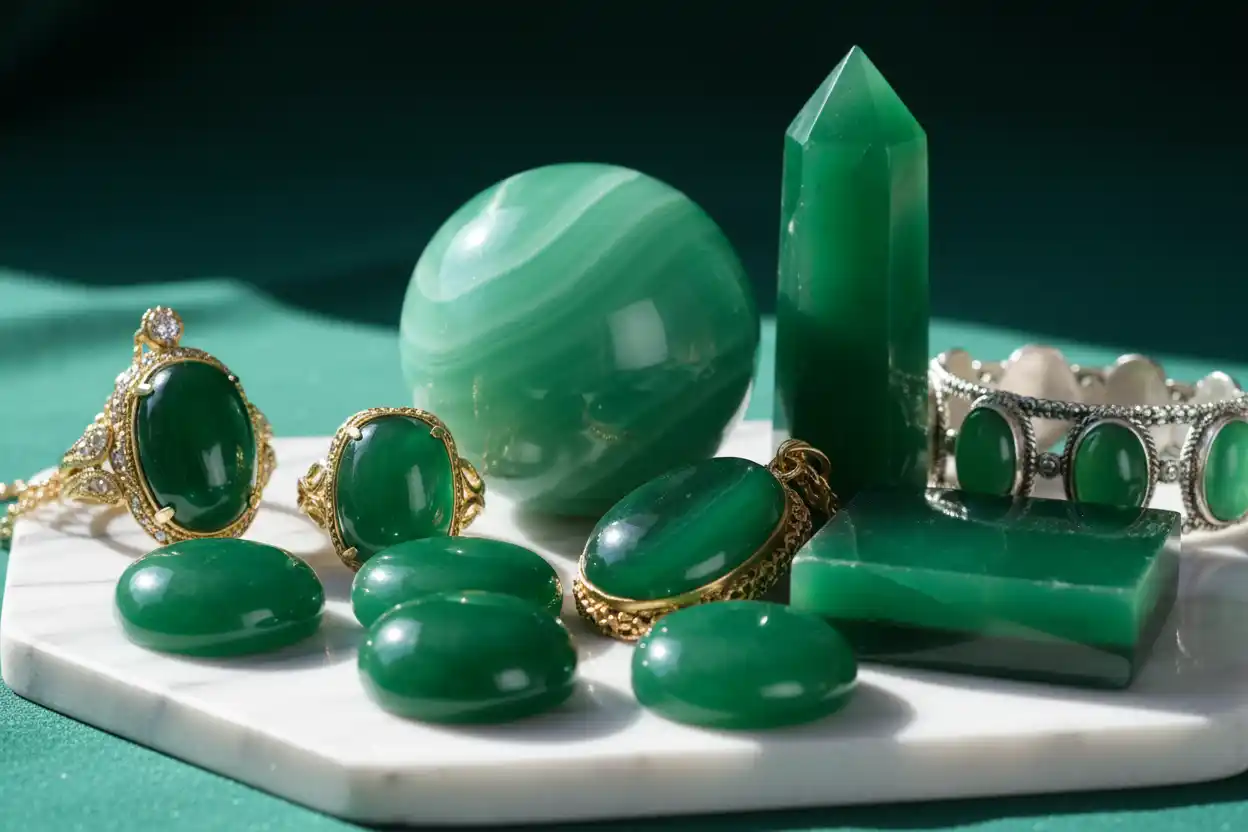
Green Onyx Meaning: Properties, Uses & Symbolism
Green onyx meaning has to begin with a naming problem rather than with a single mineral formula. “Green onyx” is used commercially for more than one material, and those materials can differ substantially in chemistry, hardness, structure, durability, formation, and treatment history. In the strict gemological sense, onyx is chalcedony—microcrystalline quartz—with straight or parallel banding. GIA historically defines onyx as quartz arranged in straight parallel layers of contrasting colors, while Mindat describes true onyx as a banded variety of agate/chalcedony within the quartz family.
The modern decorative-stone trade complicates that definition. Green banded calcite, travertine-like carbonate, and related cave-deposit material are frequently sold as “green onyx,” “onyx marble,” “Mexican onyx,” or similar names even though they are not quartz onyx. Mindat explicitly distinguishes cave or limestone onyx as banded calcite, CaCO₃, with hardness around 3 rather than the roughly 6.5–7 hardness expected for chalcedony onyx. The difference is not semantic trivia: it changes how the stone should be identified, worn, cleaned, cut, and described.
A third complication is color treatment. Chalcedony can be dyed, and GIA lists chalcedony and quartz among gem materials commonly subjected to dyeing. Natural green chalcedony also exists, so a vivid green color does not by itself prove either treatment or natural origin. For that reason, responsible green onyx meaning begins with the question “What material is this specimen?” before moving to green color, history, symbolism, or use.
Readers exploring related material-first references can browse the Gemstone Guides. This page focuses specifically on the identity dispute surrounding green onyx, the major material categories sold under the name, their documented history, modern symbolism, and safe ownership.
Green Onyx Meaning at a Glance
| Question | Evidence-aware answer |
|---|---|
| Is green onyx one mineral? | No. The commercial name can refer to more than one material |
| Strict onyx definition | Straight- or parallel-banded chalcedony/quartz |
| Chalcedony chemistry | SiO₂ |
| Common alternative sold as green onyx | Banded calcite or carbonate “onyx marble” |
| Calcite chemistry | CaCO₃ |
| Chalcedony hardness | About 6.5–7 |
| Calcite hardness | About 3 |
| Chalcedony specific gravity | Commonly about 2.55–2.70 |
| Calcite specific gravity | About 2.71 |
| Chalcedony RI | Roughly 1.53–1.54 |
| Major green-color question | Natural mineral coloration versus dye or other treatment |
| Does “green onyx” prove parallel banding? | No, not in modern retail usage |
| Does “green onyx” prove chalcedony? | No |
| Does “green onyx” prove calcite? | No |
| Most important identification step | Determine silica versus carbonate material first |
| Modern symbolism | Commonly growth, boundaries, communication, steadiness, renewal, or reflection |
| Scientific status of symbolism | Interpretive, not demonstrated medical or physiological effects |
| Main ownership issue | Care depends strongly on whether the object is chalcedony or soft calcite |
The trade-name ambiguity is so large that two objects labeled green onyx may not merely be different varieties; they can belong to completely different mineral classes. A quartz-based green onyx and a calcite-based green “onyx marble” should therefore never share one unqualified property table.
What Is Green Onyx?
Under strict mineralogical and traditional gemological terminology, onyx belongs to the chalcedony family. Chalcedony is microcrystalline quartz, and true onyx is distinguished by straight or parallel banding rather than the curved or irregular banding normally associated with agate. GIA’s gemological references describe onyx as black-and-white parallel-banded chalcedony, while Mindat allows some extension to other dark-and-light parallel banded agate combinations.
A naturally green chalcedony with suitably parallel contrasting bands could therefore reasonably fall within a broad material-first interpretation of green onyx. However, many objects marketed under the name do not fit that definition. Some are essentially uniform green chalcedony, sometimes treated. Others are banded calcite decorative stone. Still others may be commercial mixtures of carbonate layers marketed according to appearance rather than strict mineral terminology.
The safest definition is therefore:
Green onyx is a commercial name whose actual material identity must be established specimen by specimen.
That is less convenient than assigning one formula, but it is far more accurate.
Green Onyx Identity Table
| Feature | Chalcedony-based onyx | Calcite “green onyx” / onyx marble |
|---|---|---|
| Main material | Chalcedony / quartz | Calcite-rich carbonate |
| Formula | SiO₂ | CaCO₃ |
| Formal relationship to true onyx | Yes, if suitably parallel banded | No; resemblance-based trade terminology |
| Typical hardness | 6.5–7 | 3 |
| Typical SG | About 2.55–2.70 | About 2.71 |
| RI | About 1.53–1.54 | Calcite substantially different and strongly birefringent |
| Cleavage | No prominent cleavage like calcite | Perfect rhombohedral cleavage |
| Acid sensitivity | Relatively resistant to weak household acids compared with calcite | Readily attacked by acids |
| Typical banding | Parallel silica layers | Layered carbonate deposition |
| Common forms | Cabochons, beads, carvings, cameos | Slabs, bowls, decorative objects, carvings, architectural stone |
| Possible treatment | Dyeing is common in chalcedony broadly | Dyeing, filling, coating, or polishing treatments may occur depending on product |
| Main identification issue | Natural color versus dyed chalcedony | Being mistaken for quartz onyx |
| Safe-care implication | Generally more scratch resistant | Much softer and acid sensitive |
This table is intentionally comparative. A seller’s label does not establish which column applies.
Why the Name “Green Onyx” Is Disputed
The confusion developed because the word onyx has long been attractive in the decorative-stone trade. Banded calcite can visually resemble the layered structure of traditional chalcedony onyx, especially after polishing into slabs, bowls, eggs, columns, boxes, and ornamental objects.
Mindat notes that much modern carved material sold as onyx is actually banded calcite from countries including Mexico and Pakistan. Terms such as “Mexican onyx” and “onyx marble” became established commercially despite the fact that the material is carbonate rather than quartz.
The name “marble” adds another layer of imprecision because many such materials are cave or travertine-style deposits rather than metamorphic marble in the geological sense. The decorative-stone vocabulary is therefore primarily commercial, not a rigorous mineral classification system.
The key rule is simple: when a product is called green onyx, ask what it is made of.
True Onyx: The Chalcedony Definition
Traditional onyx is a variety of chalcedony characterized by straight, parallel banding. Chalcedony itself is composed of microscopic quartz and related silica components, giving the material an aggregate structure rather than the large visible crystals seen in rock crystal.
Gemdat lists onyx at approximately Mohs 6.5–7, specific gravity 2.55–2.70, and refractive index about 1.530–1.543. Those properties make quartz-based onyx reasonably durable for many ornamental and jewelry uses.
The traditional visual concept often involves black and white layers, but the structural concept—parallel banding—is more important than assuming that every legitimate onyx must be black. Historically, sardonyx applies to reddish-brown and white parallel-banded chalcedony, illustrating that the onyx concept can extend beyond a single color combination.
What it does not justify is calling every solid green stone onyx.
Calcite “Green Onyx”
Green decorative carbonate sold as onyx is usually much softer. Mindat describes cave onyx or limestone onyx as banded calcite of stalagmitic or karst origin, with the explicit warning that calling this material simply “onyx” is incorrect and confusing because true onyx is quartz.
Calcite-based green onyx can nevertheless be beautiful. Its translucent layers may range through pale mint, cream, honey, brown, gray, or deeper green, and polished slabs can reveal dramatic banding that works well in decorative objects.
Its commercial usefulness does not require pretending it is chalcedony. “Green banded calcite,” “calcite onyx,” or “green onyx marble” with a material clarification provides buyers with far more useful information.
Why Material Identity Matters So Much
Suppose one buyer owns a green chalcedony pendant and another owns a green calcite bowl, yet both were sold as green onyx. Generic advice saying “green onyx has hardness 7” would be reasonable for the chalcedony pendant and wrong for the calcite bowl. Advice saying “green onyx reacts with vinegar” might describe calcite but not true quartz onyx.
The same problem affects scratch resistance, polishing, cleavage, acid exposure, ultrasonic cleaning, jewelry suitability, and cutting methods.
Green onyx meaning therefore has an unusually strong evidence requirement: identification has to precede practical advice.
Natural Green Chalcedony Exists
The existence of dyed chalcedony does not mean every green silica stone is artificial. GIA has documented naturally colored bluish-green chalcedony using microscopy, chemical analysis, refractive-index testing, density measurement, and visible spectroscopy. The studied material showed an RI of roughly 1.531–1.539 and SG around 2.55–2.57, consistent with chalcedony, while spectral evidence helped distinguish its natural color from organic dye.
Natural green chalcedony can derive color from different mineralogical mechanisms depending on material. Chrysoprase, for example, involves nickel-related green coloration, while chrome chalcedony involves chromium-bearing phases.
This does not mean a stone sold as green onyx can be assigned to one of those categories from color alone. The material must actually be examined.
Dyed Green Chalcedony Also Exists
GIA describes dyeing as the introduction of colored substances into porous or fractured gem material and specifically identifies chalcedony and quartz among materials commonly dyed.
Dye may concentrate along fractures, grain boundaries, drill holes, cavities, or porous zones. In some stones, magnification can reveal suspicious concentrations. In others, spectroscopy or additional laboratory testing may be needed.
Importantly, a deep uniform green color is not automatic proof of dye. Natural material can also be richly colored. The correct conclusion from appearance alone is uncertainty.
Treatment terminology should therefore remain separate from material identity: a specimen can be genuine chalcedony and still be dyed.
Green Color in Calcite-Based “Onyx”
Calcite-rich green onyx presents a different color problem. Green can arise from trace chemistry, included minerals, fine dispersed phases, or associated bands. As with Green Calcite Meaning, there is no responsible basis for assuming that every green carbonate is colored by the same element.
A green calcite slab might contain copper, chlorite-group material, clay minerals, iron-related phases, or other impurities depending on deposit geology. Exact identification requires evidence from the specimen rather than a universal color story.
This is another reason a green-on-green visual match cannot prove that two products are chemically comparable.
How Chalcedony Onyx Forms
Chalcedony develops when silica-rich fluids precipitate microcrystalline silica in cavities, fractures, veins, or other open spaces. Repeated deposition can produce banding, and when those bands are sufficiently straight and parallel, the material may fall within the traditional onyx concept.
The microscopic architecture of chalcedony is complex. Rather than being one homogeneous crystal, it contains extremely fine silica fibers and aggregates arranged through successive growth.
Parallel banding can preserve changing fluid conditions through time, which gives natural onyx much of its visual appeal.
The detailed deposit, fluid, band-development, and host-rock questions belong in the Green Onyx Formation and Deposit Geology guide.
How Calcite “Onyx” Forms
Calcite onyx forms through carbonate precipitation rather than silica deposition. Groundwater moving through limestone terrain can dissolve calcium carbonate and later redeposit calcite as conditions change. Repeated deposition can form layered travertine, stalagmitic material, vein calcite, or other banded carbonate bodies.
These layers can become visually similar to agate or chalcedony after cutting and polishing, which explains how the onyx trade terminology developed.
Despite the resemblance, the atomic structure and physical properties remain those of calcite-rich carbonate.
This is a classic example of convergent appearance: two geological processes can create superficially similar banding in completely different materials.
Diagnostic Traits: First Decide Silica or Carbonate
The fastest conceptual diagnostic workflow is not “Is this green onyx?” but “Is this object quartz/chalcedony or calcite/carbonate?”
Chalcedony-based material should show properties compatible with quartz-family aggregates: relatively high hardness, RI around the low 1.53–1.54 range, SG around the mid-2.6 range, waxy-to-vitreous luster, and no calcite-style rhombohedral cleavage.
Calcite-based green onyx is much softer, typically Mohs 3, strongly birefringent when sufficiently transparent, cleaves readily, and reacts with acids.
Destructive acid and scratch testing should not be casually performed on finished objects. A polished collectible can be permanently etched or scratched for the sake of a test that could have been replaced with non-destructive gemological measurements.
What Magnification Can Reveal
Microscopy may show whether the material is an aggregate, whether green color follows fractures, whether banding is structural, whether dye appears concentrated in porous zones, and whether inclusions are responsible for part of the color.
A chalcedony specimen can display cryptocrystalline texture, subtle parallel layers, fractures, or dye concentrations. Calcite-based material may show cleavage-related structures, growth layering, mineral inclusions, or carbonate textures.
However, microscopy alone does not always settle the issue, especially in opaque carvings. RI, density, spectroscopy, Raman analysis, or other techniques may be required.
Detailed specimen-scale observations belong in the Green Onyx Microscope Inclusion Notebook.
Optical Behavior Provides a Powerful Separation
Chalcedony and calcite differ dramatically in optical behavior. Chalcedony has a relatively low but quartz-like refractive index and does not produce the spectacular double refraction seen in transparent calcite. Calcite is famous for strong birefringence, which can visibly double images through sufficiently transparent material.
That difference can be especially helpful when a thin green “onyx” slab is translucent enough for optical observation.
Color behavior must also be evaluated carefully. Natural pigments, inclusions, dyes, layered material, and transmitted light can make one specimen look significantly different under different conditions.
The dedicated Green Onyx Optical Properties and Color Behavior guide owns the detailed optical testing rather than duplicating it here.
Original Information Gain: Green Onyx Material Decision Matrix
This decision matrix addresses the core ambiguity before symbolism or care is considered.
| Observation or claim | More consistent with chalcedony onyx | More consistent with calcite “onyx” | What it does not prove |
|---|---|---|---|
| Parallel fine silica-like bands | Yes | Possible visual imitation | Exact species without testing |
| Broad translucent green/cream carbonate bands | Less typical | Common | Exact locality |
| Mohs hardness near 7 | Strongly supportive | Inconsistent | Natural color |
| Scratches easily around Mohs 3 | Inconsistent | Strongly supportive | Full composition |
| RI near 1.53–1.54 | Supports chalcedony | Not calcite | Treatment status |
| Strong visible double refraction | Inconsistent | Supports clear calcite | Geographic origin |
| Rhombohedral cleavage | Not characteristic | Strongly supportive | Commercial naming history |
| Acid etching/reaction | Not expected like calcite | Strongly supportive | Should not be tested destructively on valuable pieces |
| Green concentration around drill holes | May suggest dye | Dye is also possible in other materials | Natural versus treated without further testing |
| “Mexican onyx” label | Does not establish quartz | Often carbonate trade material | Exact mine |
| “Pakistan onyx” decorative slab | Does not establish chalcedony | Commonly carbonate in trade | Individual specimen composition |
| “Natural green onyx” | Possible | Possible | Which material or color mechanism |
| “Healing stone” | No diagnostic relevance | No diagnostic relevance | Medical efficacy |
| “Ancient onyx” | Could refer broadly to chalcedony history | Does not prove carbonate was historically called the same thing | Modern green-on-yx symbolism |
The purpose of the matrix is not to encourage destructive home testing. It establishes which properties actually separate the materials so that appropriate professional methods can be selected.
Original Green Onyx Name and Claim Audit
| Name or claim | Evidence-aware interpretation | What should not automatically be assumed |
|---|---|---|
| Onyx | Traditionally parallel-banded chalcedony | Any banded decorative stone |
| Green onyx | Ambiguous commercial term | One fixed composition |
| Green chalcedony onyx | Silica-based material if identity and structure support it | Natural color |
| Black onyx | Commonly black chalcedony, often treated in trade | Completely untreated material |
| Onyx marble | Trade term commonly applied to banded carbonate | True metamorphic marble or quartz onyx |
| Mexican onyx | Often banded calcite/travertine trade material | Chalcedony |
| Pakistan onyx | Common decorative-stone term, often carbonate | Mineral identity from origin label |
| Calcite onyx | Banded calcite resembling onyx | Quartz |
| Cave onyx | Karst/stalagmitic banded calcite | True chalcedony onyx |
| Emerald onyx | Marketing/color comparison | Relationship to emerald |
| Natural green | Possible | Untreated status |
| “Stone of protection” | Modern symbolism | Physical protective field |
| “Heart stone” | Contemporary spiritual association | Cardiovascular effect |
| “Prosperity onyx” | Symbolic/marketing wording | Guaranteed income |
| “Ancient green onyx healing stone” | Historical claim requiring evidence | Continuity of modern metaphysical interpretation |
The most important entry is the first one. If the word onyx itself is being used loosely, every later property claim inherits that uncertainty.
Specimen and Photo Checklist
A good green onyx listing should make material identification easier rather than relying entirely on the trade name.
Photograph the object under neutral white light and include an unedited side view showing banding. For translucent material, provide transmitted-light images if practical. Rough or broken surfaces can reveal whether the internal texture is microcrystalline silica or softer carbonate. Close-ups of drill holes, fractures, cavities, and color concentrations may reveal treatment clues.
A photograph can support statements such as “parallel green-and-white bands are visible” or “the object appears translucent.” It cannot reliably establish hardness, RI, exact composition, natural color, mine origin, or medical properties.
If the seller provides only highly saturated front-facing images and no information about hardness, material class, treatment, or origin, the name green onyx should be treated as a retail label rather than an identification.
Documented History of Onyx
Onyx has a long history as a carving and ornamental material, particularly because layered chalcedony can be cut so that differently colored bands form contrasting designs in cameos and intaglios. The name itself comes from the Greek word associated with a fingernail or claw, traditionally linked to the appearance of pale and flesh-colored banded stone. Mindat preserves this etymological history in its onyx reference.
What is historically secure is the long use of banded chalcedony.
What is not automatically secure is the claim that every ancient reference to onyx referred to green material, modern carbonate “green onyx,” or today’s specific metaphysical symbolism.
Historical terminology changed over time, and ancient mineral names did not always correspond cleanly with present gemological classifications.
Modern “Green Onyx” History Is More Complicated
The decorative carbonate trade expanded the meaning of onyx because banded calcite could be carved and polished into visually impressive objects. Over time, geographic trade names such as Mexican onyx became widely recognized even though mineralogically the material is calcite-rich rather than quartz onyx.
Modern green onyx jewelry adds another layer because uniform green chalcedony—natural or dyed—may be sold under the onyx name even without obvious parallel banding.
The contemporary market therefore uses onyx as both a mineralogical/gemological term and an appearance-based commercial term. A responsible article should acknowledge both usages while making the difference explicit.
Modern Green Onyx Meaning
Modern green onyx meaning commonly emphasizes growth, steadiness, communication, emotional reflection, boundaries, renewal, confidence, and deliberate decision-making. These themes are culturally understandable: green often symbolizes vegetation and renewal, while the layered appearance of some onyx can inspire metaphors about accumulated experience or boundaries.
A person may use a green onyx object as a reminder to slow down before responding, maintain personal boundaries, or work consistently toward a goal.
None of these symbolic uses requires the stone to produce a measurable field or biological change.
Green Onyx and Growth
Growth is a natural modern symbolic theme because of the green color. A practical interpretation can link the object to incremental actions rather than instant transformation.
A person might choose one measurable habit—reading several pages, practicing a skill, saving money, or completing a daily task—and let the stone represent continuity.
The stone does not accelerate personal development, alter personality, or guarantee success.
Green Onyx and Boundaries
Parallel banding makes boundaries another intuitive symbolic association, particularly in true onyx. Layers remain distinct while becoming part of one object, which can provide a useful metaphor for relationships in which connection and limits coexist.
A reflective practice might ask: Which responsibility is mine? Which belongs to someone else? What behavior am I willing to accept?
The gemstone cannot enforce those boundaries or change another person’s behavior. Boundaries become effective through communication and action.
Green Onyx and Communication
Modern crystal traditions sometimes connect green onyx with calm or constructive communication. Used responsibly, the stone can function as a reminder to state facts clearly, listen carefully, and avoid reacting impulsively.
It cannot force honesty, make someone agree, compel reconciliation, or reveal hidden thoughts.
Symbolism is strongest when it focuses on behavior the owner can control.
Green Onyx and Emotional Reflection
A polished stone can be used as a tactile object during journaling, meditation, or quiet reflection. A person may find the green color aesthetically calming, particularly if the piece carries personal or sentimental significance.
That subjective experience is not evidence that green onyx treats anxiety, depression, trauma, panic disorders, neurological conditions, or mood disorders.
A reflective object can accompany healthy routines without becoming the medical intervention.
Green Onyx and “Heart” Symbolism
Green stones are often connected with heart-centered symbolism in modern metaphysical systems. Green onyx may therefore be used to represent compassion, forgiveness, emotional openness, or relationships.
That is a spiritual framework rather than cardiovascular science.
Green onyx is not demonstrated to regulate blood pressure, improve circulation, treat heart disease, alter cardiac rhythm, reduce cholesterol, or heal tissue.
Whether the object is quartz or calcite does not change that evidence boundary.
Green Onyx and Prosperity Claims
Some sellers describe green onyx as attracting opportunity, wealth, or business success. A person may choose to use the stone symbolically while working on financial habits, but the material cannot change probability or guarantee income.
A grounded use might connect it with reviewing a budget, sending an invoice, applying for a position, or completing a practical business task.
The financial result comes from decisions and circumstances, not from SiO₂ or CaCO₃.
Green Onyx Versus Green Calcite
The comparison with Green Calcite Meaning is unusual because some commercial green onyx is actually calcite-based material. In those cases, the two names may describe overlapping physical material while carrying different trade histories.
True chalcedony onyx, however, is not calcite.
This is why asking “Is green onyx the same as green calcite?” has no universal yes-or-no answer until the specimen is identified.
Green Onyx Versus Green Fluorite
Green Fluorite Meaning covers CaF₂, a cubic mineral with Mohs hardness 4 and perfect octahedral cleavage. Neither chalcedony onyx nor calcite onyx shares that combination of properties.
Fluorite can resemble pale translucent green carbonate in photographs, but hardness, refractive index, cleavage, and optic character separate them.
Again, green is a visual characteristic rather than a mineral family.
Green Onyx Versus Grossular Garnet
Grossular Garnet Meaning concerns a calcium-aluminum silicate garnet, including green grossular varieties. Garnet is substantially harder and has much higher refractive properties than calcite-based green onyx, while also differing from chalcedony.
A transparent green faceted grossular should therefore not be grouped mineralogically with green onyx simply because jewelry sellers use similar color descriptors.
Material testing determines identity.
Green Onyx Versus Gypsum
Gypsum Meaning covers CaSO₄·2H₂O, one of the softest common minerals at Mohs 2. Gypsum can occur in pale greenish or translucent decorative forms but is mechanically much softer than either chalcedony or most calcite products.
This comparison illustrates the danger of choosing care methods by appearance.
Two pale polished stones can look similar yet respond very differently to scratching, moisture, heat, polishing, and impact.
Cutting and Polishing
Cutting decisions depend first on which green onyx material is present. Chalcedony is considerably harder and generally more suitable for conventional cabochons, beads, intaglios, and carving. Calcite-based material is softer, cleaves more readily, and can respond poorly to excessive pressure or inappropriate polishing.
Layer orientation also matters aesthetically. Parallel bands can be positioned to produce strong stripe patterns, layered cameos, or broad decorative faces.
The technical procedures belong in the Green Onyx Cutting, Orientation and Polish guide.
Jewelry Wear
Chalcedony-based green onyx can be reasonably practical in jewelry because its quartz-family hardness offers good resistance to routine scratching. Calcite-based green onyx is substantially less suitable for exposed everyday rings because hardness 3 and cleavage make it much easier to scratch and chip.
A jewelry description should therefore disclose the actual material rather than assuming that every green onyx has the durability of chalcedony.
Setting pressure, edge protection, shape, fractures, and intended wear are covered in the Green Onyx Setting and Wear Engineering guide.
Cleaning Depends on Identity
A generic cleaning rule for green onyx can be misleading. Chalcedony tolerates conditions that would damage calcite. Calcite reacts with acids, so vinegar, acidic cleaners, lemon-based products, and many bathroom or kitchen cleaning agents can etch the surface.
Dyed or filled materials may impose additional limitations regardless of base mineral.
When material identity is uncertain, conservative cleaning with minimal moisture, a soft cloth, and no harsh chemicals is safer than experimenting.
Safe Ownership
Ordinary handling of an intact polished object is different from grinding, drilling, sanding, crushing, or chemically testing it.
Chalcedony processing can generate silica-bearing dust, while calcite processing produces carbonate dust and can also involve other minerals present in the decorative rock. Matrix, fillers, pigments, dyes, and associated minerals may further complicate the composition.
Professional workshop controls should therefore be based on what is actually being processed rather than the marketing name.
Do Not Ingest Green Onyx
Neither quartz-based nor calcite-based green onyx should be powdered, swallowed, added to supplements, or deliberately soaked to prepare gemstone drinking water.
If the stone is chalcedony, it may contain dye, inclusions, polish residues, or other materials. If it is calcite, it may contain trace elements, associated minerals, fillers, coatings, or carbonate impurities.
A mineral’s elemental composition is not a recommendation for ingestion. The broader health and metaphysical boundaries are explained in the Gems Lore Disclaimer.
Specimen and Object Conservation
Documentation is particularly valuable with green onyx because the commercial name itself may obscure identity. Record whether the object was sold as chalcedony, calcite onyx, onyx marble, Mexican onyx, Pakistani onyx, or another term. Preserve photographs of banding, broken surfaces, drill holes, original labels, receipts, laboratory results, and provenance statements.
Older carved objects may also have cultural or decorative-arts significance independent of whether their historic label matches modern mineral nomenclature.
The Green Onyx Specimen Conservation Record provides the mapped framework for preserving identity, condition, and documentation over time.
Provenance Claims Need Material Context
A geographic name may describe a trade source without establishing mineral species. “Mexican onyx” commonly refers to decorative calcite, while “Pakistan onyx” is frequently used for banded carbonate architectural and carving material. That does not mean every object from either country has identical composition.
Conversely, chalcedony onyx occurs worldwide.
Origin labels should therefore be preserved as provenance claims rather than used as shortcuts for identification.
What Green Onyx Meaning Does Not Prove
Green onyx meaning does not prove that the object treats anxiety, depression, heart disease, neurological conditions, hormonal problems, fertility issues, immune disorders, pain, insomnia, trauma, or any other medical condition.
The stone cannot detoxify organs, increase calcium in the body through skin contact, provide beneficial silicon, regulate circulation, or treat nutrient deficiencies.
It also cannot guarantee wealth, romantic reconciliation, protection from all harm, truthfulness from another person, psychic perception, manifestation, or control over another person’s choices.
These boundaries remain the same whether a commercial green onyx object turns out to be chalcedony or calcite.
Frequently Asked Questions About Green Onyx Meaning
What is green onyx meaning?
Green onyx meaning commonly refers to modern symbolic themes such as growth, boundaries, renewal, communication, steadiness, and emotional reflection. Before applying those ideas, the material should be identified because the trade name green onyx can refer to different stones.
What is green onyx made of?
There is no single answer in current trade usage. Strict onyx is chalcedony/quartz, SiO₂, with straight or parallel banding. Many decorative products sold as green onyx are instead banded calcite, CaCO₃.
Is green onyx really onyx?
Sometimes. A green parallel-banded chalcedony can fit the traditional onyx concept. A green banded calcite sold as onyx marble is not true quartz onyx.
Is green onyx chalcedony?
It can be, but the retail name alone does not prove it. Confirm the material rather than relying on the label.
Is green onyx calcite?
Many decorative slabs, bowls, eggs, carvings, and architectural objects sold as green onyx are calcite-rich carbonate. That does not mean every green onyx jewelry stone is calcite.
What is onyx marble?
Onyx marble is a trade term commonly applied to banded calcite or travertine-like carbonate that resembles onyx. Mindat identifies the material as CaCO₃ rather than quartz.
What is true onyx?
Traditional gemological onyx is parallel-banded chalcedony, a quartz-family material. Classic examples show contrasting black and white layers.
How hard is green onyx?
If it is chalcedony-based onyx, hardness is approximately 6.5–7. If the object is calcite-based green onyx, hardness is only about 3. This large difference is why material identification matters.
Can green onyx be dyed?
Yes. Chalcedony can be dyed in many colors, and GIA identifies chalcedony among materials commonly treated by dyeing. A green appearance alone does not prove treatment, because natural green chalcedony also exists.
Is vivid green onyx automatically fake?
No. Natural green chalcedony exists, and naturally green carbonate materials also occur. Vivid color should prompt examination rather than automatic acceptance or rejection.
How can I tell chalcedony green onyx from calcite green onyx?
Hardness, refractive index, optical behavior, cleavage, density, and carbonate chemistry can separate them. Calcite is much softer and strongly birefringent, while chalcedony has quartz-family hardness and RI around 1.53–1.54. Destructive tests should be avoided on valuable objects.
Is green onyx the same as green calcite?
Sometimes the commercial name green onyx is applied to banded green calcite, but true onyx is chalcedony. The answer therefore depends on the specimen.
Does green onyx have healing properties?
There is no established scientific evidence that green onyx—whether chalcedony or calcite—treats disease or produces specific physiological healing effects.
Does green onyx help relationships?
It may be used symbolically as a reminder of communication, boundaries, or compassion. It cannot make another person reconcile, remain loyal, fall in love, tell the truth, or change behavior.
Does green onyx attract money?
There is no scientific evidence that green onyx changes financial probability or guarantees income. It can be used symbolically alongside practical financial goals.
Can green onyx be worn every day?
That depends on the material. Chalcedony-based onyx is much more suitable for routine jewelry wear than calcite-based material, which scratches and cleaves easily.
Can green onyx go in water?
Brief contact may not affect every specimen equally, but the name does not reveal whether the object is calcite, dyed chalcedony, filled material, or another product. Drinking-water elixirs should be avoided entirely.
Can a photograph identify green onyx?
A photograph can show banding, color, translucency, texture, and some treatment clues, but it cannot reliably establish hardness, RI, precise chemistry, natural color, or geographic origin.
Evidence and Technical Limits
This article does not claim first-hand mine visits, private laboratory testing, unpublished spectroscopy, direct authentication of retail green onyx, or examination of a reader’s individual object. The broader evidence-first approach used by the site is described on About Gems Lore.
Where the distinction between chalcedony and calcite materially affects value, jewelry wear, conservation, treatment disclosure, or historic attribution, appropriate gemological or mineralogical examination may be needed. The ambiguity of the trade name itself is well documented: true onyx is quartz-family chalcedony, while much material sold commercially under onyx-style names is banded carbonate.
Readers with documented corrections, laboratory results, or stronger historical evidence can submit them through Contact Gems Lore. Information submitted through site channels is handled according to the Privacy Policy.
Final Perspective
Green onyx meaning cannot be handled responsibly by assigning every object one formula, one hardness, or one formation story. In strict gemological usage, onyx is parallel-banded chalcedony—a quartz-family material with hardness roughly 6.5–7 and refractive index around 1.53–1.54. In the modern decorative-stone market, however, the same onyx label is commonly attached to layered calcite, including green carbonate material sold as onyx marble, cave onyx, Mexican onyx, and related trade names.
Treatment adds another layer of uncertainty. Chalcedony can be dyed, while naturally green chalcedony also exists. An intense green color therefore proves neither treatment nor natural origin by itself. The correct sequence is to establish material identity, investigate treatment when relevant, preserve provenance separately, and only then apply the physical properties that actually belong to the object.
Modern associations with growth, boundaries, renewal, communication, and emotional reflection can still form a useful green onyx meaning when they are clearly presented as symbolism. The trade-name ambiguity actually reinforces the larger lesson: a gemstone name may carry cultural and personal meaning, but chemistry, structure, durability, history, and health claims must remain tied to evidence from the material itself.