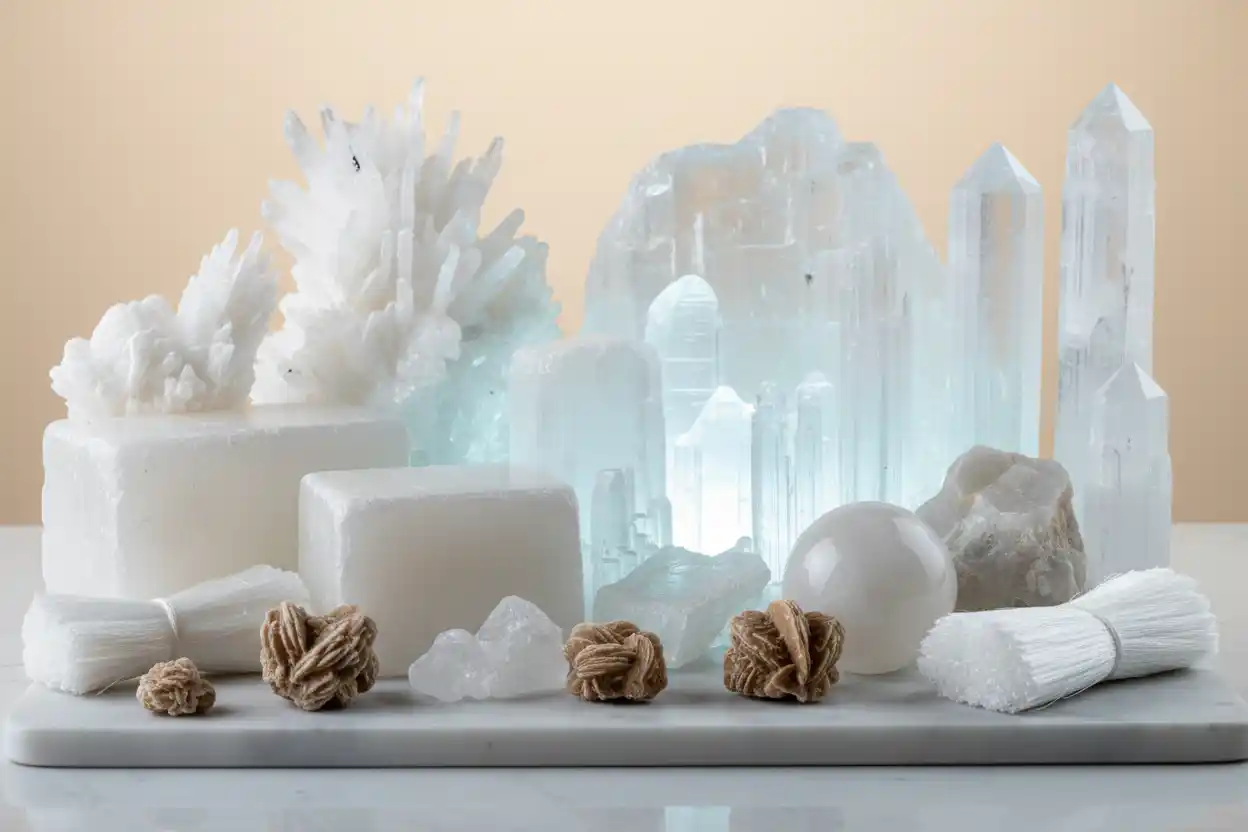
Gypsum Meaning: Properties, Uses & Symbolism
Gypsum meaning begins with one of mineralogy’s most familiar sulfate minerals: hydrated calcium sulfate, CaSO₄·2H₂O. Gypsum crystallizes in the monoclinic system, is the reference mineral for hardness 2 on the Mohs scale, has a measured density of roughly 2.31–2.32 g/cm³, and displays exceptionally easy perfect cleavage in its principal direction. It can occur as clear tabular crystals, fibrous masses, fine-grained massive stone, granular beds, rosettes, and many other habits. Mindat describes gypsum as the most common sulfate mineral and records its typical color as colorless to white, with other hues usually introduced by impurities or included material.
Those facts are important because names such as selenite, satin spar, alabaster, and desert rose are frequently presented online as though they were completely separate minerals. They are not. Selenite has historically been used for transparent crystalline gypsum, satin spar gypsum is the fibrous variety, and mineralogical alabaster is fine-grained massive gypsum. “Alabaster” is especially complicated because archaeologists, art historians, and the decorative-stone trade also use that name for fine-grained calcite and related carbonate material.
The strongest gypsum meaning therefore separates material identity from trade language and modern symbolism. Crystal structure, cleavage, dehydration, optical behavior, inclusions, formation, and industrial uses are measurable. The documented use of gypsum in plaster and building materials belongs to technological history. Contemporary associations with clarity, patience, reflection, boundaries, purification, or “cleansing” are symbolic interpretations rather than demonstrated physiological properties.
Readers exploring other mineral-first references can browse the Gemstone Guides. This page defines gypsum itself, clarifies its major variety names, explains its formation and physical properties, and then places modern symbolic meanings inside an evidence-aware boundary.
Gypsum Meaning at a Glance
| Property or question | Evidence-aware summary |
|---|---|
| Mineral identity | Gypsum |
| Formula | CaSO₄·2H₂O |
| Mineral class | Hydrated sulfate |
| Crystal system | Monoclinic |
| Mohs hardness | 2 |
| Specific gravity | Approximately 2.31–2.32 |
| Typical color | Colorless to white, with additional hues from impurities or inclusions |
| Transparency | Transparent to translucent to opaque |
| Luster | Vitreous, pearly, silky, sub-vitreous, or dull depending on form |
| Cleavage | Perfect and exceptionally easy in the principal direction |
| Optical character | Biaxial positive |
| RI range | Approximately 1.519–1.530 |
| Birefringence | About 0.009–0.010 |
| Selenite | Historical/common name for transparent crystalline gypsum |
| Satin spar | Parallel fibrous gypsum with silky luster |
| Alabaster | Fine-grained massive gypsum in mineralogical usage; name also used more broadly for calcite stone |
| Desert rose | Rosette-shaped gypsum, commonly incorporating sand |
| Main formation setting | Evaporites; also caves, hydrothermal/oxidized environments, and secondary deposits |
| Heating behavior | Loses structural water and can form hemihydrate/bassanite and eventually anhydrite |
| Major practical uses | Wallboard, plaster, cement, soil amendment, industrial products |
| Modern symbolism | Reflection, clarity, calm, boundaries, transition, or deliberate simplification |
| Scientific status of symbolism | Interpretive rather than demonstrated medical effects |
| Main ownership issue | Extreme softness and easy cleavage |
| Safety boundary | Intact handling differs from grinding, heating, dissolving, or ingesting mineral material |
Gypsum’s softness is not merely “about 2”; it is the mineral that defines Mohs hardness 2. Directional hardness can even fall somewhat below that value.
What Is Gypsum?
Gypsum is hydrated calcium sulfate. Its formula includes two water molecules structurally incorporated for each CaSO₄ unit, which distinguishes it from anhydrite, CaSO₄, and from the calcium-sulfate hemihydrate commonly associated with plaster products.
The word hydrated is important. The water is part of the crystal structure rather than simply moisture coating the surface. When gypsum is heated sufficiently, some of that structural water is released. This reversible relationship between hydrated gypsum and partially dehydrated calcium sulfate is central to the mineral’s enormous practical importance.
USGS describes industrial heating of gypsum as producing calcium-sulfate hemihydrate, after which adding water allows gypsum crystals to form again as the plaster sets. This chemistry underlies plaster, wallboard, molds, and numerous construction products.
That practical chemistry is part of gypsum’s real story. It does not imply that the mineral “absorbs emotional water,” “pulls negativity from a room,” or performs a comparable metaphysical transformation.
Gypsum Identity Table
| Characteristic | Gypsum |
|---|---|
| Formula | CaSO₄·2H₂O |
| Crystal system | Monoclinic |
| Crystal class | Prismatic |
| Typical habit | Tabular, lenticular, prismatic, acicular, fibrous, massive, granular, rosette-forming |
| Common twin forms | Swallow-tail and other contact twins |
| Hardness | Mohs 2 |
| Density | 2.312–2.322 g/cm³ measured |
| Luster | Vitreous to pearly, silky in fibrous material |
| Streak | White |
| Transparency | Transparent, translucent, or opaque |
| Cleavage | Perfect and easy |
| Optical character | Biaxial positive |
| RI | nα about 1.519–1.521; nβ about 1.522–1.523; nγ about 1.529–1.530 |
| Birefringence | Approximately 0.009–0.010 |
| Main compositional distinction | Hydrated calcium sulfate |
| Main physical vulnerability | Very low hardness plus easy cleavage |
| Important related mineral | Anhydrite, CaSO₄ |
| Main naming issue | Selenite, satin spar, alabaster, and rose forms describe varieties/habits rather than separate species |
These values form a useful diagnostic package when combined. No single property should be applied blindly to an object merely because a seller calls it selenite or alabaster.
What Is Selenite?
Selenite is gypsum. Historically and commercially, the word is commonly applied to transparent or well-crystallized gypsum rather than to fibrous or fine-grained material. Mindat notes that the term is now mostly synonymous with gypsum but has historically distinguished the transparent variety from satin spar gypsum and alabaster.
Transparent selenite can form impressive tabular, bladed, lenticular, or prismatic crystals, sometimes with distinctive twinning. Large transparent cleavage fragments are also common in the mineral trade.
The crucial point is that selenite does not have a different chemical formula from gypsum. A transparent selenite crystal remains CaSO₄·2H₂O.
Calling selenite a “higher-vibration version of gypsum” is metaphysical language, not mineral classification.
What Is Satin Spar Gypsum?
Satin spar gypsum is the fibrous variety of gypsum. Parallel fibers produce a silky appearance and can create a bright moving line of reflected light when the material is cut across the fibers. Gemological references describe this fibrous gypsum as satin spar and recognize its silky luster and possible chatoyant appearance.
This material is frequently sold under the name “selenite,” especially as polished wands, towers, palm stones, charging plates, and carved objects. That usage is commercially widespread but mineralogically imprecise.
If a white polished object has obvious parallel fibers and a silky moving light band, “satin spar gypsum” is usually the more descriptive term than transparent-variety selenite.
The distinction is about texture, not supposed differences in metaphysical power.
What Is Gypsum Alabaster?
Mineralogical alabaster is a fine-grained massive form of gypsum. It can be white and translucent, but impurities can introduce cream, yellow, brown, reddish, gray, or darker zones. Gemdat describes gypsum alabaster as a massive material long used as an ornamental carving stone.
The word alabaster is nevertheless one of the most disputed names in decorative-stone terminology. Archaeologists, museum catalogs, architects, and stone workers have also applied alabaster to fine-grained banded calcite and other carbonate stone.
This creates a similar naming problem to Green Onyx Meaning: the historical or commercial object name does not always identify one mineral species.
If care, provenance, restoration, or authentication matters, “alabaster” should be followed by the actual mineral identity whenever possible—gypsum alabaster or calcite alabaster.
Gypsum, Satin Spar, Selenite, and Alabaster Are Not Four Minerals
A useful hierarchy is:
- Gypsum = mineral species.
- Selenite = transparent crystalline gypsum terminology.
- Satin spar gypsum = fibrous gypsum.
- Gypsum alabaster = fine-grained massive gypsum.
These names describe appearance, texture, or historical use within the same broad mineral species.
The confusion becomes commercially significant when a seller assigns each form completely different “chemical properties” or claims that one contains more calcium, sulfur, or “energy” than another without analysis.
Their textures can differ dramatically, but the dominant mineral remains gypsum.
Desert Rose Gypsum
Gypsum can form rosette-like aggregates in sandy environments. As crystals grow, they incorporate grains of sand between or within their blades, producing the flower-like shapes commonly sold as desert roses.
Mindat records rosette-like clusters as a common gypsum morphology and notes that crystals containing impurities such as sand may display distinctive included zones.
A desert rose is therefore not biological and not a fossilized flower. It is a mineral aggregate whose growth geometry resembles petals.
Some desert roses consist of barite rather than gypsum, making material identification necessary when the distinction matters.
Why Is Gypsum Usually White or Colorless?
Pure gypsum is colorless, and massive aggregates composed of many small crystals often appear white because internal boundaries scatter light.
Natural specimens can appear yellow, brown, gray, orange, reddish, pinkish, blue, greenish, or nearly black when impurities, inclusions, coatings, or associated minerals modify the appearance. Mindat describes gypsum as colorless to white with other hues commonly produced by impurities.
That means color is often evidence about what is present with or inside the gypsum rather than a universal chemical variety.
One yellow specimen and one pink specimen should not automatically be assigned the same color-causing element.
Why Can Gypsum Contain Dark or Sand-Colored Zones?
Because gypsum frequently crystallizes in sediment-rich or mineral-rich environments, growing crystals can trap external particles. Sand, clay, iron-bearing material, organic matter, and other fine particles may become enclosed or concentrated in growth zones.
Some gypsum crystals famously contain hourglass-shaped zones of sand or other inclusions, producing a visible internal pattern while the surrounding crystal remains transparent. Mindat specifically notes these inclusion-defined “hourglass” zones.
These patterns can be diagnostically and geologically useful, but one particular inclusion shape should not be treated as mandatory for genuine gypsum.
Detailed inclusion interpretation belongs in the Gypsum Microscope Inclusion Notebook.
How Gypsum Forms
Gypsum is especially associated with evaporation. When saline water becomes sufficiently concentrated, dissolved ions can precipitate as evaporite minerals, including gypsum, anhydrite, and halite. USGS describes bedded gypsum and anhydrite as major evaporite minerals and notes that gypsum deposits can undergo substantial recrystallization and remobilization because of gypsum’s relatively high solubility compared with many common rock-forming minerals.
Gypsum can also form in caves, in oxidized zones of sulfide deposits, around fumarolic environments, through hydration of anhydrite, and in other secondary geological settings. Mindat identifies marine evaporites as especially important but records several additional formation environments.
That geological variety explains why gypsum morphology can differ so dramatically. Massive evaporite beds, clear cave crystals, fibrous veins, twinned crystals, and sand-filled rosettes can all represent the same mineral species.
The detailed deposit chemistry, evaporite sequences, anhydrite relationships, cave environments, and recrystallization pathways belong in the Gypsum Formation and Deposit Geology guide.
Gypsum and Anhydrite
Gypsum and anhydrite are related calcium-sulfate minerals, but gypsum contains structural water while anhydrite does not. Gypsum is CaSO₄·2H₂O; anhydrite is CaSO₄.
Heat can drive water out of gypsum, first producing partially dehydrated material such as hemihydrate/bassanite and eventually anhydrite under suitable conditions. Conversely, anhydrite can hydrate and transform toward gypsum in geological environments where water is available.
This relationship does not mean the two minerals are interchangeable in a specimen collection. Their hardness, density, crystal structure, hydration state, and behavior differ.
The transformation is chemical-mineralogical, not evidence that gypsum “transmutes emotional energy.”
Gypsum and Halite
Halite Meaning concerns sodium chloride, NaCl, another mineral strongly associated with evaporite environments. Gypsum and halite can occur in the same broad sedimentary sequences because both precipitate as saline waters become concentrated.
Their chemistry and physical behavior are nevertheless different. Halite is cubic, water-soluble, and salty; gypsum is monoclinic hydrated calcium sulfate with perfect cleavage and hardness 2.
Their geological association does not make them varieties of the same mineral.
This is a useful example of why geological neighbors should not be merged taxonomically.
Gypsum and Grossular Garnet
Grossular Garnet Meaning covers Ca₃Al₂(SiO₄)₃, a calcium-aluminum silicate garnet with hardness approximately 6.5–7.
Both gypsum and grossular contain calcium, yet their physical behavior is radically different. Grossular can function as a durable faceted gemstone; gypsum is exceptionally soft and easily cleaved.
Shared calcium content therefore does not predict hardness, durability, formation, or biological effects.
The complete mineral structure matters.
Gypsum and Hackmanite
Hackmanite Meaning concerns a sodalite-group mineral known in many specimens for reversible photochromism, or tenebrescence.
Gypsum does not share that defining phenomenon. Some gypsum may fluoresce or display visually interesting optical effects, but those should be described on their own terms rather than borrowed from more dramatic light-responsive minerals.
The comparison is useful because crystal-market descriptions frequently treat every light response as though it represented one generic “energy” property.
Optical mechanisms are mineral-specific.
Optical Properties of Gypsum
Gypsum is biaxial positive, with refractive indices around 1.519–1.530 and birefringence close to 0.010. These values are relatively low compared with many familiar gemstones but can be useful in gemological identification.
Transparent cleavage plates can show interesting optical behavior, while fibrous satin spar can display a moving silky light effect caused primarily by its aligned texture.
These phenomena are consequences of crystal structure, refractive behavior, and morphology.
The deeper treatment of birefringence, transmitted light, chatoyant satin spar, fluorescence, asterism reports, and viewing orientation belongs in the Gypsum Optical Properties and Color Behavior guide.
Diagnostic Characteristics of Gypsum
Gypsum’s combination of extreme softness, low density, perfect cleavage, monoclinic crystallography, relatively low RI, and hydration chemistry creates a distinctive identification package.
A fingernail is commonly hard enough to scratch gypsum because human fingernails are typically above Mohs 2. However, deliberately scratching a polished carving or collector crystal is still poor practice if the object matters aesthetically or historically.
Cleavage can also be highly diagnostic, but deliberately snapping a transparent crystal to demonstrate perfect cleavage destroys part of the specimen.
Where identification matters, non-destructive optical and spectroscopic methods are preferable to unnecessary damage.
Original Information Gain: Gypsum Name and Claim Audit
| Name or claim | Evidence-aware interpretation | What should not automatically be assumed | Stronger evidence when needed |
|---|---|---|---|
| Gypsum | Valid mineral species, CaSO₄·2H₂O | One particular habit or color | Mineral identification |
| Selenite | Transparent crystalline gypsum terminology | Separate mineral species | Confirm gypsum identity |
| Satin spar gypsum | Fibrous gypsum | Different chemistry from selenite | Texture/microscopy |
| Alabaster | Fine-grained massive gypsum in mineralogy | Every object called alabaster is gypsum | Mineral testing |
| Calcite alabaster | Fine-grained carbonate stone | Gypsum | RI/Raman/XRD/chemistry |
| Desert rose | Rosette-shaped gypsum or sometimes barite | Fossilized flower or unique species | Mineral identification |
| Gypsum rose | Morphological term | Separate mineral | Confirm gypsum |
| “Selenite wand” | Often satin spar gypsum in retail trade | Transparent selenite variety | Examine texture |
| “Optical selenite” | Usually transparent cleavage material | Special energetic subtype | Optical/mineralogical description only |
| “Moon crystal” | Symbolic/trade wording | Relationship to moonstone or lunar radiation | Mineral identity |
| “Cleansing crystal” | Modern metaphysical symbolism | Demonstrated removal of toxins or environmental contaminants | Scientific evidence would be required |
| “Charging crystal” | Spiritual practice terminology | Measurable recharging of other minerals | No mineralogical evidence |
| “Calcium healing crystal” | Chemistry-to-health inference | Wearing gypsum supplies nutritional calcium | Mineral formula is not a dosage route |
| “Sulfate detox stone” | Unsupported medical language | Physiological detoxification | Clinical evidence would be required |
| “Ancient selenite healing tradition” | Historical claim | Present-day crystal symbolism existed unchanged in antiquity | Primary historical evidence |
The most important distinction in this audit is between a valid variety name and a different mineral species. Selenite and satin spar look different because their texture and habit differ, not because one possesses a different basic formula.
Original Specimen and Photo Checklist
A useful gypsum photograph can document morphology without pretending to answer questions that require testing.
| Observation | Photograph can often show | Photograph cannot reliably prove |
|---|---|---|
| Transparency | Clear versus translucent appearance | Exact RI |
| Fibrous texture | Satin spar-like parallel fibers | Complete chemical identity |
| Tabular crystal habit | Selenite-like morphology | Geographic origin |
| Fine-grained mass | Alabaster-like texture | Gypsum versus calcite alabaster conclusively |
| Rosette morphology | Desert-rose structure | Gypsum versus barite without further evidence |
| Included sand | Visible particles or zones | Exact sediment composition |
| Cleavage surfaces | Flat reflective planes | Full cleavage orientation without crystallographic analysis |
| Color | Hue and zoning | Specific impurity or treatment |
| Old “alabaster” label | Historical designation | Actual mineral species |
| “Healing energy” | Nothing objectively measurable | Medical or supernatural efficacy |
A good specimen record should include several orientations, a scale, both natural and cleavage surfaces where already present, and close-ups of inclusions or fibers.
For satin spar, photograph perpendicular and parallel to the fibers so the directional silky reflection is visible. For transparent selenite, use side lighting to show cleavage and internal structure without digitally exaggerating clarity.
Source-Comparison Framework for Gypsum Claims
| Source type | Strongest use | Main limitation |
|---|---|---|
| Mineralogical database | Formula, structure, hardness, varieties, cleavage | Does not authenticate a specific retail object |
| Gemological reference | RI, SG, optical character, carving/gem observations | Often focuses on small specimen sets |
| Geological survey | Deposits, industrial use, evaporite formation | Does not establish metaphysical meaning |
| Museum/art-history source | Historic carving terminology and artifact context | “Alabaster” may use art-historical rather than mineralogical definitions |
| Laboratory analysis | Gypsum versus calcite, treatment, inclusions | Specimen-specific |
| Retail listing | Current commercial terminology | Marketing language may be mineralogically loose |
| Metaphysical source | Documents modern symbolic beliefs | Does not establish physical or medical effects |
| Personal testimony | Describes individual subjective experience | Cannot demonstrate universal causation |
This evidence hierarchy is particularly important with alabaster because an art-history catalog and a mineralogical database may use the same word under different classification traditions.
Documented History of the Word Gypsum
Mindat records the name gypsum from the Greek gypsos, meaning plaster, with known references going back to Theophrastus in antiquity.
The practical association with plaster is not accidental. Humans have used gypsum as a building and finishing material for millennia. USGS identifies early use of gypsum in building materials in Anatolia and records gypsum use in ancient Egyptian structures.
This is a well-documented historical narrative: gypsum was valued because heating and rehydrating calcium sulfate produces useful plaster-like materials.
It is more defensible than projecting modern ideas about charging crystals, chakras, aura cleansing, or manifestation backward onto every ancient use of gypsum.
Gypsum in Plaster and Wallboard
Gypsum’s industrial importance comes from its hydration chemistry. Heating gypsum removes part of its structural water to form calcium-sulfate hemihydrate. When water is added again, interlocking gypsum crystals develop as the material sets.
USGS identifies wallboard as one of gypsum’s largest modern uses and also records applications in plaster, cement, agriculture, and other industrial products.
A mineral specimen on a collector’s shelf is therefore chemically connected with an enormous construction-material industry.
That real-world connection provides far more substance than unsupported claims that gypsum’s primary purpose is energetic purification.
Gypsum in Sculpture and Decorative Art
Fine-grained gypsum alabaster has long been carved because its softness allows detailed shaping with comparatively simple tools. That same softness makes finished pieces vulnerable to scratches and abrasion.
Historical objects labeled alabaster require careful material identification because gypsum and calcite alabaster have both been used extensively in sculpture and decorative art.
The trade term may therefore preserve cultural history even when modern mineralogical terminology needs additional precision.
Material identity and historical object name can both be recorded without forcing one to erase the other.
Modern Gypsum Meaning
Modern gypsum meaning commonly centers on clarity, simplification, reflection, patience, purification, boundaries, transitions, and calm. The transparent appearance of some selenite inspires themes of clarity, while white satin spar is frequently associated with cleansing or creating a fresh start.
These associations are symbolic.
Someone might place a gypsum specimen near a workspace as a reminder to reduce clutter, clarify priorities, or pause before adding another commitment. Another person may value a selenite crystal because transparency represents honesty or careful thinking.
The psychological usefulness comes from the meaning assigned to the object and the behavior that follows, not from a demonstrated mineral emission.
Gypsum and Clarity
Transparent gypsum makes clarity an intuitive symbolic theme. A clear crystal can represent distinguishing evidence from assumption or simplifying a complicated problem.
A grounded exercise might ask three questions: What do I know? What am I assuming? What information is still missing?
The gypsum does not answer those questions.
Its role is that of a physical cue for a cognitive process.
Gypsum and Simplification
Gypsum’s white or colorless appearance and its widespread use in clean architectural surfaces make simplification another understandable modern association.
Someone could use a satin spar object as a reminder to remove one unnecessary task, organize one drawer, or reduce a decision to its essential variables.
That is a behavioral use.
The stone does not scientifically remove “energetic clutter” from a room or automatically simplify emotional problems.
Gypsum and “Cleansing”
Selenite and satin spar are widely described as cleansing crystals. In symbolic or spiritual practice, cleansing may mean marking a transition, resetting an environment, or creating a ritual boundary.
Taken literally as a physical claim, however, gypsum does not detoxify the human body, sterilize a room, neutralize environmental pollutants, remove pathogens, or scientifically “clean” other stones by proximity.
A person may perform a symbolic cleansing ritual if desired, but the language should remain distinct from sanitation, toxicology, and medicine.
Can Gypsum “Charge” Other Crystals?
Modern crystal practice sometimes places other stones on satin spar plates or beside selenite with the intention of “charging” them.
Mineralogically, one crystal sitting beside another does not restore hardness, repair fractures, alter chemical composition, increase refractive index, or replenish a measurable physical energy reservoir.
If charging is used as spiritual ritual language, it should be presented as such.
A collector should also remember that gypsum is much softer than quartz, garnet, corundum, and many other stones; physical contact can damage gypsum even when the harder stone remains unaffected.
Gypsum and Emotional Calm
A pale, smooth, visually simple mineral may feel calming to some people. That subjective response is valid as personal experience.
It does not establish treatment for anxiety, depression, panic disorders, trauma, insomnia, neurological conditions, or other medical concerns.
Someone may use gypsum as part of meditation, journaling, or a quiet routine without describing the mineral as the therapeutic mechanism.
The distinction preserves both personal meaning and medical accuracy.
Gypsum and Boundaries
Perfect cleavage provides an interesting but clearly metaphorical framework for boundaries. Gypsum separates readily along specific structural planes, showing that a material can have distinct internal directions of weakness and separation.
A person might use that property symbolically to consider where clearer boundaries are needed in work, relationships, or commitments.
The crystal does not set those boundaries.
People establish boundaries through communication, decisions, and consequences.
Gypsum and Transitions
Gypsum’s reversible connection with dehydrated calcium sulfate can inspire symbolism around transformation: heat alters its hydration state, and adding water to plaster allows gypsum crystals to reform.
This is an actual chemical transformation, but it should not be extended into claims that holding gypsum automatically changes personality, relationships, or life circumstances.
As metaphor, it can represent adaptation while maintaining a factual distinction between mineral chemistry and human change.
Gypsum and “Healing” Claims
Gypsum should not be presented as a treatment for disease. There is no established evidence that holding selenite or satin spar treats cardiovascular disease, anxiety, depression, hormonal conditions, fertility problems, neurological disorders, immune dysfunction, chronic pain, cancer, infections, or other medical conditions.
Its formula also should not be converted into a nutritional argument. Calcium in gypsum does not make the mineral an appropriate calcium supplement, and sulfate in the structure does not make the stone a detoxification treatment.
Mineral composition is not dosage guidance.
The site-wide boundary around gemstone health claims is stated in the Gems Lore Disclaimer.
Safe Ownership: Gypsum Is Extremely Soft
Gypsum’s Mohs hardness of 2 makes it much softer than most familiar gemstones. A fingernail can scratch many surfaces, while ordinary dust containing quartz can abrade it readily.
Its easy cleavage adds another vulnerability. Thin transparent plates can split, satin spar edges can fray or dent, and carved alabaster can acquire surface wear comparatively quickly.
These facts do not make gypsum unsuitable for collecting. They simply mean that ownership expectations should be based on its real material properties.
The mechanical implications for mounted or wearable material belong in the Gypsum Setting and Wear Engineering guide.
Cutting and Polishing Gypsum
Gypsum can be carved, polished, and occasionally faceted, but its softness and cleavage make precision work challenging. Gemdat notes that faceted gypsum is rare because the mineral is exceptionally soft and cleaves easily.
Fibrous satin spar, massive alabaster, and transparent crystals also require different approaches. Their textures and breakage behavior are not interchangeable simply because the chemistry is similar.
The detailed workmanship questions belong in the Gypsum Cutting, Orientation and Polish guide.
Heat Changes Gypsum
Heating is not a neutral treatment for gypsum. The mineral contains structural water and can dehydrate, becoming opaque or transforming into other calcium-sulfate hydration states under suitable thermal conditions. Mindat specifically notes loss of water and transformation toward bassanite and anhydrite as temperature rises.
This means gypsum should not be treated as though heat has no mineralogical consequence.
It also explains why the material became so useful in plaster manufacturing.
Heat sensitivity is chemistry, not spiritual “activation.”
Water and Gypsum
Gypsum is only moderately soluble compared with highly soluble evaporite minerals such as halite, but water exposure is not completely irrelevant. Mindat reports gypsum as soluble in roughly hundreds of parts water, and repeated wetting can affect delicate surfaces, fibers, soluble inclusions, or specimen appearance.
This meaning page does not attempt to replace a dedicated care guide.
The important safety boundary is that deliberate soaking for ritual drinking preparations is unnecessary and should be avoided.
Do Not Ingest Gypsum Specimens or Make Elixirs
Mineral specimens should not be powdered, swallowed, mixed into supplements, or intentionally dissolved into drinking water for metaphysical purposes.
A natural gypsum specimen may contain sand, clay, iron minerals, associated evaporites, surface contamination, dyes, adhesives, polishing compounds, or other materials beyond its ideal formula.
Industrial or pharmaceutical calcium-sulfate products are manufactured to defined standards for specific applications. A collector specimen is not equivalent to a regulated food, medicine, or supplement merely because both may contain calcium sulfate.
Symbolic use does not require ingestion.
Specimen Conservation and Documentation
Gypsum can preserve unusual crystal habits, twins, inclusions, evaporite textures, cave growth, fibrous structure, and locality-specific associations. These features often make an intact specimen more scientifically valuable than the same material after aggressive polishing or carving.
Preserve original labels, locality information, dimensions, photographs, old collection numbers, acquisition records, and analytical results. Historical labels reading “selenite” or “alabaster” may themselves carry useful information even if modern mineral identification adds clarification.
The Gypsum Specimen Conservation Record provides the mapped framework for documenting condition and provenance-related information without duplicating that workflow here.
Evidence and Technical Limits
This article does not claim first-hand mine visits, unpublished laboratory analyses, direct examination of readers’ gypsum, or personal authentication of historic alabaster objects. The broader evidence-first approach used by the site is described on About Gems Lore.
Some questions require specialist examination. Distinguishing gypsum alabaster from calcite alabaster, identifying a suspected barite desert rose, determining an unusual inclusion, verifying a locality, or interpreting a historic artifact may require refractive-index testing, Raman spectroscopy, X-ray diffraction, petrography, chemistry, museum documentation, or other appropriate methods.
Readers with documented corrections, specimen records, stronger technical sources, or analytical results can submit them through Contact Gems Lore. Information submitted through site channels is handled according to the Privacy Policy.
Frequently Asked Questions About Gypsum Meaning
What is gypsum meaning?
Gypsum meaning combines the mineral identity of hydrated calcium sulfate with modern symbolic themes such as clarity, simplification, reflection, boundaries, and transition. Those symbolic themes are interpretations rather than scientifically measured therapeutic properties.
What is gypsum made of?
Gypsum has the formula CaSO₄·2H₂O. The two water molecules are structurally incorporated into the mineral.
Is selenite the same as gypsum?
Yes. Selenite is a name historically used for transparent crystalline gypsum. It is not a separate mineral species.
Is satin spar the same as selenite?
Both are gypsum, but they describe different textures. Selenite commonly refers to transparent crystalline material, while satin spar gypsum is fibrous and typically displays a silky directional luster.
Is satin spar commonly mislabeled as selenite?
Yes. Many white fibrous towers, wands, and polished plates sold as selenite are more precisely described as satin spar gypsum.
What is gypsum alabaster?
Gypsum alabaster is fine-grained massive gypsum. The term alabaster is also used in art history and the decorative-stone trade for calcite material, so the word alone does not always determine mineral identity.
What is a desert rose?
A desert rose is a rosette-like mineral aggregate commonly formed by gypsum crystals incorporating sand. Barite can also form desert-rose structures, so the shape alone does not prove gypsum.
How hard is gypsum?
Gypsum defines hardness 2 on the Mohs scale. Its hardness can be even slightly lower in some crystallographic directions.
What is the specific gravity of gypsum?
Mindat reports a measured density of approximately 2.312–2.322 g/cm³.
Does gypsum have cleavage?
Yes. Gypsum has perfect, very easy cleavage, particularly along its principal cleavage direction. This contributes significantly to its fragility.
Where does gypsum form?
Gypsum is especially common in evaporite deposits but can also occur in caves, oxidized mineral deposits, fumarolic environments, and through hydration of anhydrite.
Why is gypsum used for plaster?
Heating gypsum removes part of its structural water to form calcium-sulfate hemihydrate. When water is added again, gypsum crystals reform and the plaster hardens.
Does gypsum have healing properties?
There is no established scientific evidence that gypsum, selenite, satin spar, or alabaster treats disease or produces specific physiological healing effects.
Does selenite cleanse other crystals?
That is a modern spiritual practice rather than a demonstrated mineralogical process. Placing another stone beside gypsum does not physically recharge, repair, or chemically restore the other mineral.
Does gypsum detoxify the body?
No evidence establishes gypsum specimens as detoxification treatments. Its calcium and sulfate chemistry does not make a collector mineral a medicine.
Can gypsum provide calcium to the body?
Holding or wearing gypsum does not function as nutritional calcium supplementation. Mineral composition should not be confused with a medically appropriate dosage form.
Is gypsum safe to touch?
Ordinary handling of an intact specimen is different from grinding, heating, crushing, or ingesting the material. Because gypsum is very soft and cleaves easily, gentle physical handling is also important for preserving the specimen.
Can gypsum go in drinking water?
Gypsum specimens should not be deliberately used to prepare gemstone drinking-water elixirs. Natural specimens can contain inclusions, associated minerals, contaminants, dyes, or residues not represented by the ideal formula.
Can gypsum be used in jewelry?
It can be carved or occasionally mounted, but Mohs hardness 2 and perfect cleavage make it poorly suited to exposed everyday jewelry compared with harder gemstones.
Can a photo identify selenite, satin spar, or alabaster?
A photograph can strongly suggest texture and habit, but it cannot always distinguish gypsum alabaster from calcite alabaster, gypsum roses from barite roses, or treated material from untreated material when technical certainty is required.
Final Perspective
Gypsum meaning becomes considerably clearer when the familiar retail names are placed back inside one mineralogical framework. Gypsum is CaSO₄·2H₂O, a monoclinic hydrated sulfate with Mohs hardness 2, density around 2.31–2.32, very easy perfect cleavage, and a broad range of crystal and aggregate habits. Transparent selenite, fibrous satin spar gypsum, and fine-grained gypsum alabaster can look radically different while sharing the same dominant mineral identity.
Its documented history is substantial without adding unsupported claims. The name reaches back to the Greek word associated with plaster, gypsum has been used in building materials for millennia, and its ability to lose structural water and reform after rehydration underpins modern plaster and wallboard manufacture. Even the confusing word alabaster becomes more informative once historical object terminology is separated from strict mineral identity.
Modern themes of clarity, simplification, reflection, boundaries, cleansing, and transition can still form a responsible gypsum meaning when they remain clearly symbolic. The material-first approach is straightforward: identify gypsum before assigning variety names, distinguish selenite from fibrous satin spar, treat alabaster terminology cautiously, understand that color often comes from impurities or inclusions, respect extreme softness and cleavage, separate intact ownership from destructive processing or ingestion, and keep medical or supernatural promises distinct from what hydrated calcium sulfate actually demonstrates.