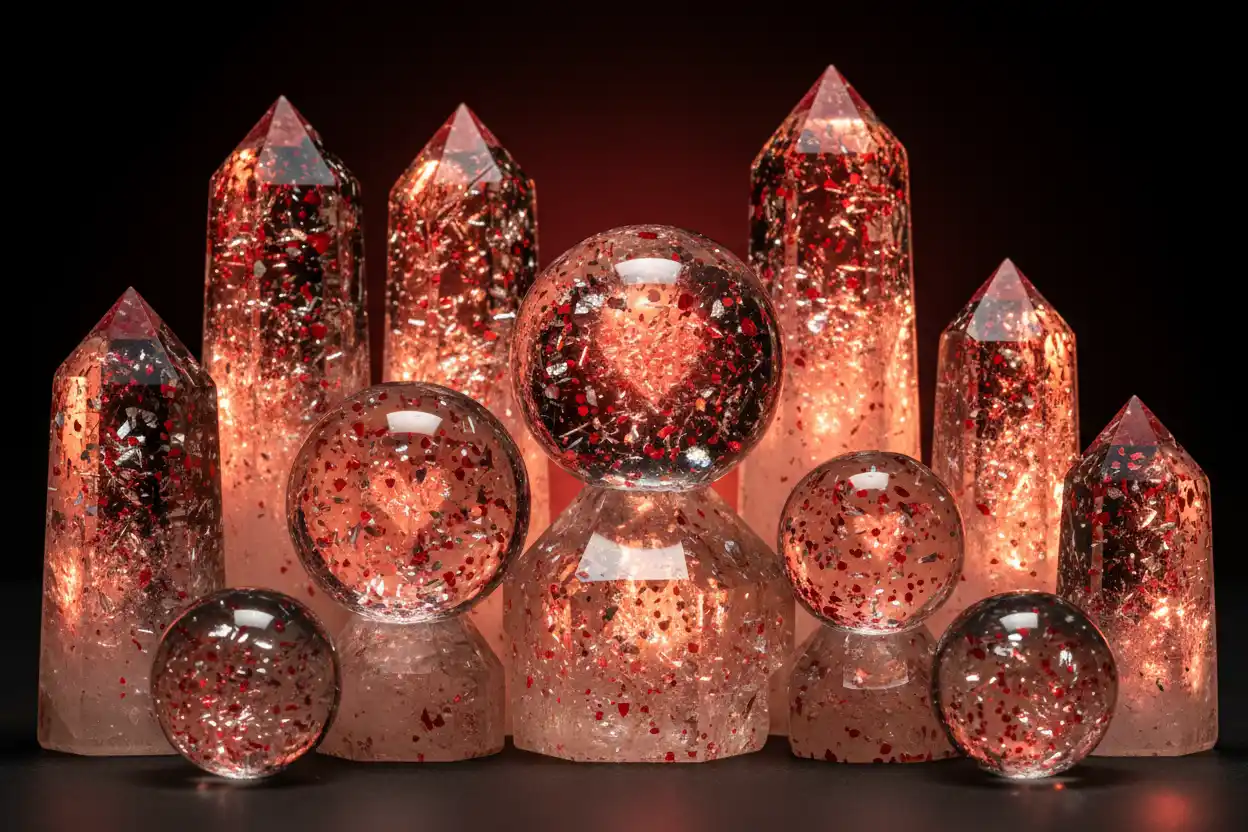
Harlequin Quartz Meaning: Properties, Uses & Symbolism
Harlequin quartz meaning should begin with a naming warning: harlequin quartz is not a formally defined mineral species or universally standardized quartz variety. In modern crystal and gemstone commerce, the name is generally applied to transparent or translucent quartz containing visually contrasting red, orange, brown, dark, metallic, or occasionally golden inclusions. Sellers frequently identify those inclusions as hematite, lepidocrocite, goethite, or mixtures of several iron minerals, but the inclusion names are not interchangeable and should not be accepted solely from color or appearance. The host itself is quartz, SiO₂, with the normal trigonal quartz structure, Mohs hardness 7, specific gravity near 2.65–2.66, and refractive indices around 1.544 and 1.553.
The inclusion question is where harlequin quartz becomes scientifically interesting. GIA has documented quartz containing red to black platy hematite inclusions, including beautifully developed hematite “roses,” and Raman spectroscopy has confirmed hematite in specimens where visual identification alone would have been less secure. Mindat adds an important corrective to modern retail terminology: red, translucent, scaly inclusions in quartz are often sold as “lepidocrocite,” but Mindat states that these inclusions are normally hematite and notes the lack of analytically confirmed red translucent scaly lepidocrocite inclusions in quartz crystals.
That evidence creates the correct framework for harlequin quartz meaning. The host mineral, quartz properties, inclusion identity, formation sequence, optical effects, and treatment questions belong to mineralogy and gemology. “Harlequin,” “fire quartz,” “hematoid quartz,” and related commercial names belong to trade language and can overlap without being perfectly synonymous. Modern associations with motivation, balance, vitality, integration, creativity, or grounded action belong to symbolism. Those meanings can be discussed responsibly, but they should not be presented as if iron oxide inclusions scientifically generate psychological or medical effects.
Readers exploring other material-first references can browse the Gemstone Guides. This page keeps its focus on what harlequin quartz is, how its inclusions should be interpreted, why several common names are disputed, and where symbolism should stop.
Harlequin Quartz Meaning at a Glance
| Property or question | Evidence-aware summary |
|---|---|
| Material identity | Included macrocrystalline quartz sold under a trade name |
| Host composition | SiO₂ |
| Crystal system | Trigonal |
| Host hardness | Mohs 7 |
| Host specific gravity | About 2.65–2.66 |
| Quartz RI | About 1.544–1.553 |
| Typical host appearance | Colorless, pale, smoky, or occasionally amethystine quartz |
| Typical inclusions | Red, brown, orange, black, metallic or golden-looking mineral inclusions |
| Most strongly documented red inclusion | Hematite is common and repeatedly analytically confirmed |
| Lepidocrocite claim | Frequently used in commerce but often unsupported; red scaly quartz inclusions are commonly hematite |
| Goethite | Can occur as inclusions in quartz and has been analytically documented in some material |
| Formal mineral status | “Harlequin quartz” is not a separate formal mineral species |
| Naming boundary | Trade term rather than standardized mineralogical classification |
| Main identification issue | Inclusion mineral cannot be determined reliably from color alone |
| Modern symbolism | Integration, vitality, persistence, creativity, grounded action, perspective |
| Scientific status of symbolism | Interpretive rather than demonstrated medical or physiological effects |
| Safe-use principle | Intact quartz handling differs from cutting, grinding, drilling, sanding, or generating mineral dust |
The word harlequin is useful because it communicates a visually patterned stone, but it does not define which iron mineral must be present, how much inclusion is required, or whether the quartz must be colorless, smoky, or amethystine.
What Is Harlequin Quartz?
Harlequin quartz is best understood as a commercial name for quartz whose appearance is strongly influenced by contrasting mineral inclusions. The host is ordinary crystalline quartz from a mineralogical perspective. What makes the specimen visually distinctive is the inclusion population: red plates, dark flakes, orange clouds, metallic-looking crystals, inclusion planes, phantoms, or combinations of these features.
The term is used inconsistently. One seller may reserve harlequin quartz for clear quartz with discrete red and black hematite plates. Another may use it for heavily iron-stained “fire quartz.” A third may require a mixture claimed to include hematite and lepidocrocite. Because there is no formal compositional definition, a specimen should be described by what can actually be established: “quartz with hematite inclusions,” “quartz with unidentified red iron-mineral inclusions,” or another evidence-based description.
This approach is more precise than trying to make the trade name function like a mineral species.
Harlequin Quartz Identity Table
| Characteristic | Harlequin quartz |
|---|---|
| Formal species | Quartz |
| Trade designation | Harlequin quartz |
| Formula of host | SiO₂ |
| Crystal system | Trigonal |
| Host hardness | 7 |
| Host SG | Approximately 2.65–2.66 |
| Host RI | Approximately 1.544–1.553 |
| Host luster | Vitreous |
| Typical transparency | Transparent to translucent |
| Common host forms | Natural points, clusters, fragments, cabochons, spheres, polished freeforms |
| Common inclusion appearance | Red plates, rust-colored clouds, dark metallic flakes, rosettes, phantom planes |
| Strongly documented inclusion | Hematite, Fe₂O₃ |
| Other possible inclusion | Goethite and other minerals can occur depending on specimen |
| Commonly disputed inclusion | Lepidocrocite |
| Main diagnostic principle | Identify host and inclusions separately |
| Technical methods | RI/optical tests for quartz; Raman, XRD, chemistry or microscopy for inclusions when necessary |
A photograph can suggest that a specimen belongs to the commercial harlequin-quartz category. It cannot reliably prove the identity of a tiny red platelet.
The Biggest Harlequin Quartz Misidentification: “Lepidocrocite”
Lepidocrocite is a genuine iron oxyhydroxide mineral with formula FeO(OH), but its name has become overused in the quartz market. Mindat specifically cautions that red inclusions in quartz crystals frequently labeled as lepidocrocite are normally hematite and states that analytically confirmed examples of the familiar red translucent scaly “lepidocrocite in quartz” appearance are not known to them.
That warning should materially change how harlequin quartz is described. A seller’s statement such as “contains lepidocrocite” is a mineral-identification claim, not merely poetic wording. Red color, thin plate morphology, sparkle, or an online comparison photo are insufficient to establish FeO(OH).
Hematite provides a much stronger default hypothesis for many red platy inclusions because it has repeatedly been confirmed analytically in quartz. That still does not mean every red inclusion is hematite. Exact identification belongs to the specimen.
The deeper inclusion work belongs in the Harlequin Quartz Microscope Inclusion Notebook.
Hematite in Quartz
Hematite is Fe₂O₃, an iron oxide that can occur as black metallic-looking crystals, thin reddish plates, rosettes, scales, or other habits. Thin hematite plates may appear deep red when light passes through them even though thicker crystals look black or metallic in reflected light.
GIA documented quartz containing complex hematite rose inclusions and confirmed the quartz host through standard gemological testing. The hematite platelets displayed triangular growth structures and deep red transmitted color. In another study, Raman spectroscopy identified hematite inclusions in quartz that visually produced strong reddish tones.
These observations explain why one harlequin quartz can display red, black, silver-gray and rusty tones even when hematite dominates much of the inclusion scene.
Goethite Can Also Occur in Quartz
Goethite, FeO(OH), is another iron-bearing mineral that can occur as an inclusion in quartz. GIA’s analytical work on multicolored included quartz identified golden broom-like inclusions as goethite while red platelets in the same broader material were identified as hematite.
That example is useful because it demonstrates that a single quartz specimen can contain multiple mineral species with different appearances.
It also shows why “all the red and gold things inside are lepidocrocite” is not a reliable identification strategy. Inclusion mineralogy can be heterogeneous.
Harlequin Quartz Is Not Defined by One Inclusion Recipe
Commercial descriptions sometimes give a formula-like rule: harlequin quartz equals quartz plus hematite plus lepidocrocite plus titanium. That may describe a seller’s preferred naming convention, but it is not a formal mineralogical definition.
Quartz can host an enormous variety of minerals. GIA has identified molybdenite, hematite, goethite, tourmaline and many other minerals in quartz through Raman spectroscopy, X-ray diffraction and other methods. An inclusion that looks dark or metallic therefore should not be assigned to titanium, hematite or another mineral simply because a commercial definition expects that mineral to be present.
Harlequin quartz is best treated as an appearance-based trade term whose individual inclusions remain evidence-dependent.
How Harlequin Quartz Forms
Quartz commonly crystallizes from silica-bearing hydrothermal fluids, pegmatitic systems, alpine-type fissures and other geological environments. Included quartz develops when other minerals, fluids or earlier growth surfaces become enclosed as the quartz crystal grows.
The timing relationship can vary. An inclusion mineral may have formed before the quartz and later become enclosed, may grow at the same time as the quartz, or may enter along later fractures. GIA’s documented hematite roses positioned along quartz growth planes provide an example of syngenetic inclusion relationships in which hematite and quartz growth histories are directly connected.
This is more informative than saying that iron minerals were “infused” into quartz. The geological relationship involves nucleation, growth surfaces, changing fluid chemistry, temperature, pressure, oxidation state and available iron.
The more detailed paragenesis, hydrothermal setting and sequence relationships belong in the Harlequin Quartz Formation and Deposit Geology guide.
Why Are the Inclusions Red, Orange, Brown or Black?
The inclusion mineral and its thickness strongly affect apparent color. Hematite is a good example. A thick hematite crystal can look opaque black or metallic gray, while a thin platelet transmits deep red light. Fine hematite particles can produce red, orange or rusty clouds depending on grain size and concentration.
Goethite may contribute yellow-brown, golden, brown or darker tones. Weathering and oxidation can further complicate the appearance of iron-rich inclusions and fracture coatings.
The quartz host can also influence the overall effect. Colorless rock crystal provides a neutral background, smoky quartz darkens the visual field, and amethyst adds purple coloration that may combine with the inclusion palette.
The specialized relationship between inclusion orientation, transmitted light, reflections and apparent color belongs in the Harlequin Quartz Optical Properties and Color Behavior guide.
Are the Metallic Flashes “Titanium”?
Not necessarily. The word titanium appears frequently in retail descriptions of harlequin quartz, but metallic appearance alone cannot identify elemental titanium, rutile, ilmenite or another titanium-bearing phase.
Hematite itself can appear metallic. Other mineral inclusions can also reflect strongly.
A seller should therefore distinguish between “metallic-looking inclusion” as an observation and “titanium inclusion” as an analytical claim.
If exact composition matters, Raman spectroscopy, X-ray diffraction, electron microscopy or chemical analysis may be necessary.
Diagnostic Characteristics
The first diagnostic task is confirming the quartz host. Quartz has formula SiO₂, Mohs hardness 7, SG around 2.65–2.66, refractive indices about 1.544 and 1.553, uniaxial positive optical character and poor cleavage with conchoidal fracture.
Once quartz identity is established, the inclusions should be evaluated independently. Magnification can reveal platelets, rosettes, acicular crystals, phantom planes, clouds and fracture coatings, but visual morphology often narrows possibilities rather than providing certainty.
GIA’s inclusion studies repeatedly demonstrate the value of Raman spectroscopy precisely because superficially similar dark or red inclusions can belong to different mineral species.
Harlequin Quartz Versus Hematoid Quartz
“Hematoid quartz” generally refers to quartz colored or visibly included by hematite or other iron oxides, often producing red, brown, orange or rusty appearances. Harlequin quartz can overlap strongly with that category when hematite is the dominant inclusion.
The distinction is commercial rather than mineralogical. A quartz point with dense red hematite clouds might be sold as hematoid quartz, fire quartz or harlequin quartz by different sellers.
Rather than attempting to enforce an unsupported universal naming rule, describe the actual observable features and, where known, the inclusion identity.
Harlequin Quartz Versus Fire Quartz
Fire quartz is another non-standard trade term frequently used for iron-rich or hematite-included quartz. Some sellers use fire quartz for heavily red or orange clouded material and harlequin quartz for clearer quartz containing discrete platelets. Others use the names interchangeably.
Neither label guarantees one inclusion mineral, one locality or one formation mechanism.
If a page, certificate or seller description needs technical precision, “quartz with hematite inclusions” is stronger than either marketing name when hematite has actually been established.
Harlequin Quartz Versus Strawberry Quartz
Strawberry quartz is itself a disputed commercial category used for reddish or pinkish quartz containing fine mineral inclusions. The name has been applied to different natural and manufactured materials.
Some specimens sold as strawberry quartz contain iron-mineral inclusions and overlap visually with harlequin or hematoid quartz. Others do not.
The shared red-speckled appearance does not create a standardized mineralogical relationship.
Harlequin Quartz and Herkimer Diamond
Herkimer Diamond Meaning concerns unusually clear double-terminated quartz crystals associated especially with Herkimer County, New York. Despite the diamond name, Herkimer diamonds are quartz.
Harlequin quartz is also quartz, but its defining commercial appeal is the contrasting inclusion scene rather than geographic origin or characteristic double termination.
The comparison is useful because both names demonstrate how trade terminology can become more memorable than the underlying species. In both cases, quartz identity should remain clear.
Harlequin Quartz and Heliodor
Heliodor Meaning concerns yellow beryl rather than quartz. Heliodor is a beryllium-aluminum silicate with different crystal symmetry, density, optical properties and hardness behavior.
Yellow or golden inclusions inside harlequin quartz can create a warm appearance that superficially resembles yellow gemstones in photographs, but the colored inclusions do not turn the host quartz into beryl.
Color is an appearance characteristic, not a taxonomic shortcut.
Harlequin Quartz and Halite
Halite Meaning covers NaCl, a soft, water-soluble cubic mineral. Quartz is far harder, chemically different and not readily soluble in ordinary water.
Both can form transparent crystals, but their physical properties diverge immediately.
This comparison is useful because clear mineral photographs can look deceptively similar when crystal habit and scale are cropped out.
Harlequin Quartz and Hackmanite
Hackmanite Meaning concerns a tenebrescent sodalite variety whose body color can reversibly change after ultraviolet activation.
Harlequin quartz’s red or dark appearance normally comes from visible inclusions rather than hackmanite-style reversible photochromism. A red hematite platelet remains a hematite platelet when lighting changes, although reflection and transmitted color can make it look different from different angles.
These are fundamentally different optical phenomena.
Original Information Gain: Harlequin Quartz Name and Claim Audit
| Name or claim | Evidence-aware interpretation | What should not automatically be assumed | Stronger evidence when needed |
|---|---|---|---|
| Harlequin quartz | Commercial name for visually included quartz | Formal mineral species | Confirm quartz host |
| Hematoid quartz | Quartz containing or colored by iron oxide, commonly hematite | Exact trade equivalence with harlequin quartz | Describe specimen |
| Fire quartz | Commercial iron-rich quartz terminology | Standardized mineral variety | Identify inclusions |
| Strawberry quartz | Red/pink included quartz trade terminology | Same material as harlequin quartz | Specimen-specific identification |
| Hematite in quartz | Well-documented natural inclusion relationship | Every red inclusion is hematite | Raman/XRD/chemistry if needed |
| Lepidocrocite in quartz | Widely claimed commercially | Red scaly inclusion proves lepidocrocite | Analytical identification |
| Goethite in quartz | Analytically documented in some specimens | Every golden inclusion is goethite | Raman or equivalent method |
| Titanium inclusion | Possible in quartz in various mineral forms | Metallic sparkle proves titanium | Mineral identification |
| “Iron oxide quartz” | Broad descriptive wording | One exact iron mineral | Identify inclusion phase |
| “Natural red quartz” | May describe included or colored natural quartz | Untreated or one formation mechanism | Gemological examination |
| “High-vibration quartz” | Metaphysical language | Measurable therapeutic radiation | Physical evidence would be required |
| “Heart and root crystal” | Modern symbolic framework | Anatomical or neurological effect | Remains symbolic |
| “Energy balancer” | Contemporary spiritual phrase | Measurable balancing of biological systems | Clinical/physical evidence would be required |
| “Ancient harlequin quartz” | Historical claim | Modern trade term existed in antiquity | Primary historical evidence |
| “Healing quartz” | Metaphysical terminology | Treatment of disease | Clinical evidence would be required |
The lepidocrocite row is particularly important because this is not a minor naming preference. Hematite and lepidocrocite are different minerals with different formulas and crystal structures. Replacing one with the other without evidence creates a factual error.
Original Specimen and Photo Checklist
Harlequin quartz is an excellent candidate for structured photographic documentation because the inclusions are central to its identity.
| Observation | Photo can often support | Photo cannot reliably prove |
|---|---|---|
| Quartz transparency | Clear, translucent or cloudy host | Exact RI |
| Red platelets | Shape, color and distribution | Hematite versus lepidocrocite conclusively |
| Black metallic crystals | Morphology and reflectivity | Exact mineral species |
| Rosette inclusions | Plate arrangement | Composition without testing |
| Orange clouds | Distribution and opacity | Specific iron mineral |
| Phantom planes | Growth-related geometry | Exact timing without further evidence |
| Fracture coatings | Surface-reaching distribution | Whether mineral formed during or after host growth |
| Host color | Colorless, smoky or purple appearance | Treatment history |
| Seller inclusion label | Claimed identification | Analytical confirmation |
| Locality claim | Seller or collection record | Geographic origin |
| “Energy pattern” | Nothing objectively measurable | Medical or supernatural effect |
For documentation, photograph the specimen against both light and dark backgrounds, then use transmitted and oblique lighting. Thin hematite can look deep red in transmitted light but black under ordinary reflection, so one lighting condition can hide important information.
If possible, photograph representative inclusions under magnification before repeating seller terminology.
Original Evidence Hierarchy for Inclusion Claims
| Evidence level | What it can support |
|---|---|
| Naked-eye appearance | General color, abundance and pattern |
| Hand lens / macro photography | Plate, needle, cloud or rosette morphology |
| Optical microscopy | Detailed shape, growth relationships, surface-reaching features |
| Standard host testing | Confirms the surrounding material as quartz |
| Raman spectroscopy | Often identifies individual mineral inclusions non-destructively |
| X-ray diffraction | Identifies crystalline phases where sample geometry permits |
| SEM/EDS or electron-probe analysis | Provides elemental/compositional information |
| Multiple methods agreeing | Strongest basis for difficult inclusion claims |
This hierarchy explains why a copied supplier label should rank below direct analysis.
Documented History Versus Modern Trade History
Quartz has an ancient human history, but harlequin quartz does not inherit every ancient quartz story automatically. Quartz was known and valued long before modern mineralogy; Mindat records ancient Greek terminology for rock crystal and notes the old belief that transparent quartz was permanently frozen ice.
Harlequin quartz, however, is a modern commercial descriptor rather than a classical mineral name. Evidence that ancient societies used quartz does not demonstrate that they recognized hematite-included quartz as a separate harlequin category or assigned today’s specific metaphysical themes to it.
The correct historical approach is therefore layered: document quartz history broadly, document verified iron-mineral inclusions scientifically, and treat modern harlequin symbolism as modern unless stronger primary evidence emerges.
Modern Harlequin Quartz Meaning
Modern harlequin quartz meaning commonly centers on integration, motivation, creativity, persistence, vitality, balance and grounded action. The visual combination makes these themes understandable: transparent quartz surrounds dense red, dark or metallic mineral inclusions, creating a contrast between clarity and material weight.
A person may use that contrast symbolically. Clear quartz can represent a goal or idea, while the iron-mineral inclusions can represent the practical work needed to act on it.
That symbolism does not require the specimen to emit a scientifically demonstrated behavioral force.
Harlequin Quartz and Integration
Integration is one of the more defensible symbolic themes because the stone visibly combines multiple mineral phases in one specimen.
Quartz and hematite remain different minerals even when they occur together. Their coexistence can therefore serve as a metaphor for holding different responsibilities, perspectives or traits without pretending they are identical.
A reflective question might be: Which parts of this situation need to work together, and which distinctions still need to be preserved?
The stone does not perform that integration for the owner.
Harlequin Quartz and Motivation
Red and orange colors are frequently associated culturally with activity, intensity and movement. Harlequin quartz containing hematite-rich red inclusions may therefore be used as a symbol of motivation or persistence.
A grounded practice could connect the stone to one defined action: start the task, complete the next step, send the message, or finish a piece of work.
The mineral cannot scientifically increase dopamine, eliminate fatigue, cure procrastination or guarantee productivity.
Harlequin Quartz and Grounded Action
Hematite is dense and metallic-looking, while quartz is often transparent. That visual difference supports a useful modern metaphor: pair ideas with practical action.
Someone might use a harlequin quartz specimen as a reminder that planning without implementation is incomplete.
Again, the mechanism is behavioral. The person sees the object, remembers the intention and chooses an action.
Harlequin Quartz and Creativity
The internal inclusion scenes can be highly individual. Rosettes, flakes, clouds, phantoms and scattered red platelets create naturally complex compositions that may appeal to artists, designers and collectors.
A specimen can therefore inspire creativity directly through its appearance.
That does not mean hematite inclusions alter neurological creativity or generate artistic ideas through an invisible field.
Harlequin Quartz and Emotional Symbolism
Some metaphysical traditions connect harlequin quartz with emotional balance, courage, passion or release. These themes may function as reflective language for a person who finds the stone meaningful.
They should not be converted into claims that quartz with hematite treats anxiety, depression, trauma, panic disorders, hormonal conditions or neurological illness.
A personally significant mineral can accompany meditation, journaling or ordinary emotional reflection without becoming medical treatment.
The broader boundary around gemstone health claims is stated in the Gems Lore Disclaimer.
Harlequin Quartz and “Energy Amplification”
Clear quartz is frequently described in metaphysical sources as an amplifier, and harlequin quartz sometimes inherits that language.
From a physics perspective, quartz has genuine piezoelectric properties under appropriate mechanical and electrical conditions. That fact is technologically important, but it does not demonstrate that a handheld crystal amplifies intentions, emotions, chakras or another gemstone’s metaphysical properties.
Piezoelectricity is measurable under defined conditions.
Metaphysical amplification is a symbolic concept.
Harlequin Quartz “Benefits”: What Is Supportable?
The clearest practical benefits are educational, aesthetic and collectible. Harlequin quartz can demonstrate mineral inclusions, crystallization sequences, transmitted-light color, inclusion morphology and the importance of analytical identification. A well-documented specimen can be useful for teaching why visual assumptions—especially the common hematite-versus-lepidocrocite problem—need verification.
As an ornamental material, quartz’s Mohs hardness of 7 provides useful scratch resistance, and attractive included pieces can be fashioned into cabochons, pendants, spheres and display objects.
Symbolically, a person may find the stone useful as a cue for motivation or integration.
These categories should remain separate from medical claims.
Cutting and Polishing
Harlequin quartz follows the general hardness behavior of quartz, but its inclusions and fractures can influence lapidary decisions. A cutter may choose an orientation that places hematite roses, phantom planes or inclusion clouds where they remain visible through the polished face.
Surface-reaching inclusions and fractures may weaken particular zones or create polishing challenges. Cutting through a fine inclusion scene can also destroy the very feature that makes a specimen valuable.
The detailed decisions belong in the Harlequin Quartz Cutting, Orientation and Polish guide.
Jewelry Wear
Quartz’s hardness of 7 makes harlequin quartz considerably more practical for jewelry than calcite, fluorite, gypsum or halite. Hardness does not make every included specimen equally durable, however.
Large fractures, open fissures, heavily included zones, thin points and surface-reaching iron minerals can affect resistance to impact and snagging. Metal inclusions also do not strengthen the host quartz merely because iron minerals may themselves appear robust.
The detailed relationship between setting pressure, inclusion placement, impact exposure and edge protection belongs in the Harlequin Quartz Setting and Wear Engineering guide.
Safe Ownership: Intact Quartz Versus Processing Dust
Ordinary handling of an intact quartz crystal or polished gem differs from cutting, drilling, grinding, sanding or crushing it. Mechanical processing of quartz can generate respirable crystalline silica dust, a recognized occupational hazard.
Processing should therefore use competent lapidary procedures, appropriate engineering controls, wet methods where suitable, eye protection, respiratory protection when required and controlled cleanup.
There is no need to powder harlequin quartz for symbolic use.
Do Not Ingest Harlequin Quartz or Make Elixirs
Harlequin quartz should not be ground into powder, swallowed, added to supplements or deliberately placed in drinking water for mineral extraction.
The host is quartz, while the inclusions can contain iron oxides, iron oxyhydroxides or other minerals whose exact identities may not even be established. Polished specimens may additionally contain residues, adhesives or surface contaminants.
Mineralogical composition is not nutritional guidance.
Specimen Conservation
A fine harlequin quartz crystal can contain more scientific information intact than after cutting. Inclusion morphology, growth-plane relationships, phantom structures, crystal faces, locality labels and matrix associations can all be lost through aggressive polishing or modification.
Record the specimen before altering it: neutral-light photographs, transmitted-light images, macro photographs of representative inclusions, dimensions, weight where useful, seller terminology, claimed locality and any analytical results.
The Harlequin Quartz Specimen Conservation Record provides the mapped framework for preserving that information over time.
Evidence and Technical Limits
This article does not claim first-hand mine visits, unpublished Raman spectroscopy, laboratory examination of retail harlequin quartz, or direct authentication of a reader’s specimen. The broader evidence-first approach used by Gems Lore is described on About Gems Lore.
The main technical limitation is inclusion identity. Even experienced visual observers can mistake one iron mineral for another, and GIA inclusion studies repeatedly demonstrate the value of Raman spectroscopy for resolving uncertain phases. A technically important claim such as “lepidocrocite inclusion,” “titanium inclusion,” or precise locality attribution may therefore require specialist testing rather than image matching.
Readers with documented Raman data, mineralogical corrections, locality records or stronger evidence can submit them through Contact Gems Lore. Information submitted through site channels is handled according to the Privacy Policy.
Frequently Asked Questions About Harlequin Quartz Meaning
What is harlequin quartz meaning?
Harlequin quartz meaning commonly combines included quartz with modern symbolic themes such as integration, motivation, grounded action, creativity and persistence. These themes are interpretations rather than scientifically demonstrated therapeutic properties.
What is harlequin quartz made of?
The host is quartz, SiO₂. Its distinctive appearance comes from mineral inclusions, commonly including hematite in documented specimens and potentially other iron-bearing minerals depending on the stone.
Is harlequin quartz a separate mineral?
No. Harlequin quartz is a commercial name applied to included quartz rather than a separate formal mineral species.
What are the red inclusions in harlequin quartz?
Hematite is a major documented possibility. GIA has analytically confirmed red platy and rosette-like hematite inclusions in quartz.
Is the red material lepidocrocite?
It should not be assumed. Mindat specifically states that many red quartz inclusions sold as lepidocrocite are actually hematite and notes the lack of confirmed examples matching the familiar red translucent scaly commercial appearance.
Can harlequin quartz contain goethite?
Yes. Goethite is known as an inclusion in quartz, and GIA has analytically identified goethite in included quartz specimens.
Does harlequin quartz always contain hematite and lepidocrocite together?
No. There is no standardized inclusion recipe for the trade name. Individual specimens need to be described according to their actual inclusions.
Is harlequin quartz the same as fire quartz?
The names overlap strongly in commerce but are not formally standardized. Fire quartz is often used for red or orange iron-rich quartz, while harlequin quartz may emphasize contrasting discrete inclusions.
Is harlequin quartz the same as hematoid quartz?
They can overlap when hematite dominates the inclusion scene. Hematoid quartz more directly communicates a hematite or iron-oxide relationship, while harlequin quartz is a broader appearance-based trade term.
Is harlequin quartz the same as strawberry quartz?
Not necessarily. Strawberry quartz is another commercial name used for pink or reddish included quartz, and its material definition is also inconsistent.
How hard is harlequin quartz?
The quartz host is Mohs 7, although individual fractures and surface-reaching inclusions can affect the durability of a particular specimen.
What is the refractive index of harlequin quartz?
Because the host is quartz, typical refractive indices are approximately 1.544 and 1.553.
Can you identify harlequin quartz inclusions from a photo?
Usually only provisionally. Color and shape can suggest possibilities, but Raman spectroscopy, XRD or other analytical methods may be necessary to distinguish similar iron minerals.
Does harlequin quartz have healing properties?
There is no established scientific evidence that harlequin quartz treats disease or creates specific physiological healing effects.
Does harlequin quartz increase energy?
A person may use the stone symbolically as a reminder to act or persist, but there is no established evidence that it biologically increases energy levels through mineral contact.
Does harlequin quartz amplify other crystals?
Quartz has genuine physical properties such as piezoelectricity, but those do not establish metaphysical amplification of intentions or other crystals.
Is harlequin quartz safe to wear?
Generally, quartz’s hardness makes it suitable for many jewelry forms. A particular stone’s fractures, inclusions, shape and setting still determine practical durability.
Is harlequin quartz safe to touch?
Ordinary handling of an intact specimen is different from cutting or grinding quartz. Dust-generating processing requires suitable silica-control precautions.
Can harlequin quartz go in drinking water?
It should not be powdered, ingested or deliberately used to make mineral drinking-water preparations. Inclusion chemistry and specimen contamination may also be uncertain.
Is harlequin quartz ancient?
Quartz itself has been known for thousands of years, but the modern commercial category “harlequin quartz” should not be projected into antiquity without historical evidence.
Final Perspective
Harlequin quartz meaning becomes much more useful when the trade name is prevented from doing work that belongs to mineral analysis. The host is quartz, SiO₂, with the familiar quartz properties of Mohs hardness 7, specific gravity near 2.65–2.66 and refractive indices around 1.544–1.553. What makes these specimens distinctive is their internal mineral population rather than a separate harlequin-quartz chemistry.
The inclusion story also provides a valuable lesson in evidence quality. Hematite has repeatedly been analytically confirmed as red, black or platy material inside quartz, while the widely repeated “lepidocrocite in quartz” label is much less secure than commercial descriptions imply. Mindat explicitly cautions that the characteristic red scaly inclusions sold under that name are normally hematite, while GIA studies demonstrate how Raman spectroscopy can resolve visually uncertain quartz inclusions.
Modern ideas of integration, grounded action, motivation, creativity and persistence can still form a responsible harlequin quartz meaning when presented as symbolism. The material-first approach is straightforward: establish quartz identity, document inclusion morphology carefully, avoid repeating lepidocrocite or titanium claims without analysis, distinguish trade names from mineral species, preserve valuable inclusion scenes, separate intact ownership from silica-dust-generating processing, and keep medical or supernatural promises distinct from what included quartz actually demonstrates.