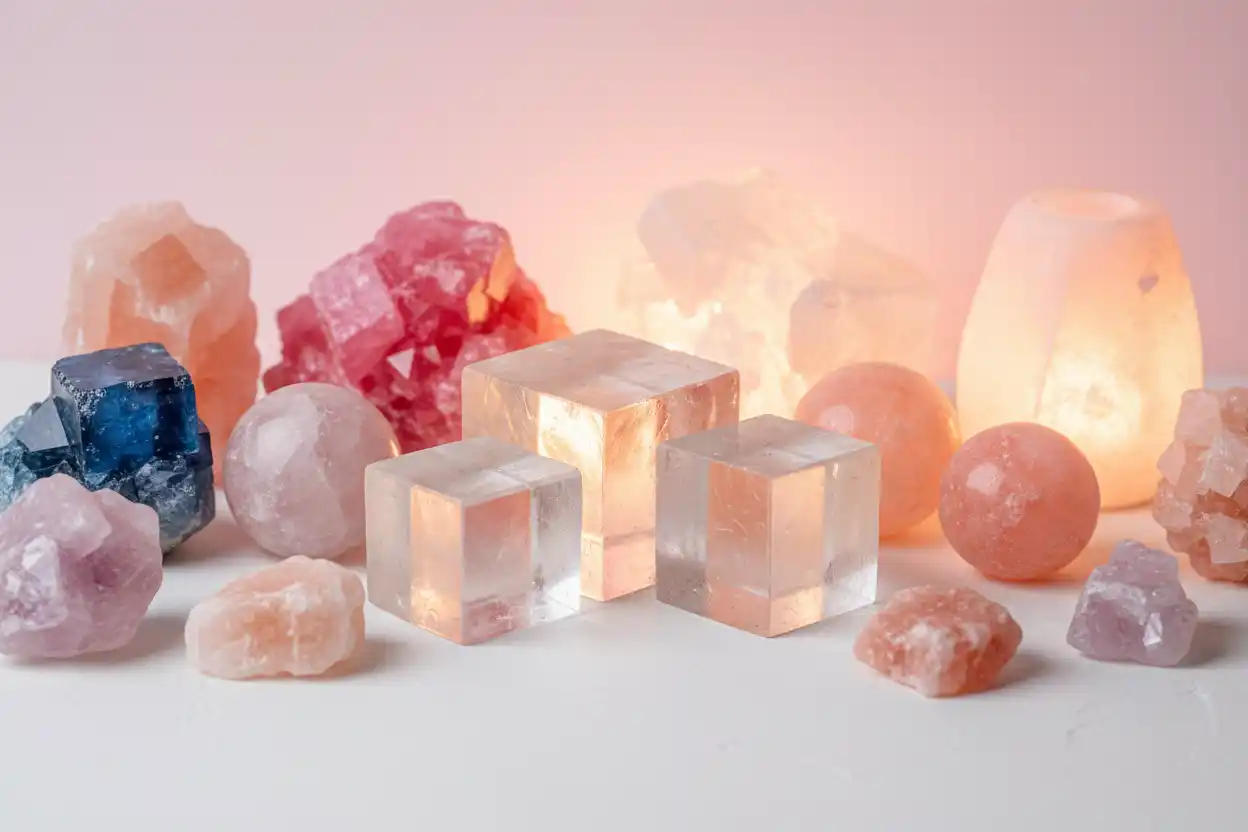
Halite Meaning: Properties, Uses & Symbolism
Halite meaning begins with one of the simplest recognizable mineral formulas: sodium chloride, NaCl. Halite is the naturally occurring mineral form of sodium chloride, commonly called rock salt when it forms large crystalline masses or sedimentary beds. It belongs to the halide mineral class, crystallizes in the cubic or isometric system, has Mohs hardness around 2.5, a measured density close to 2.17 g/cm³, perfect cubic cleavage, and a refractive index near 1.544. Mindat records halite as normally colorless or whitish but also documents yellow, red, purple, and blue material.
Its apparent simplicity hides substantial geological complexity. Halite can crystallize from concentrated saline water, form extensive sedimentary evaporite beds, accumulate in saline lakes, participate in salt-dome structures after deep burial, and trap microscopic portions of the brines and gases present during crystal growth. USGS describes thick rock-salt deposits as overwhelmingly NaCl and notes that deeply buried salt can deform plastically and rise into salt structures or domes. Fluid inclusions in primary sedimentary halite can preserve samples of concentrated ancient brine, which is why geologists use carefully screened halite to reconstruct aspects of earlier seawater chemistry, climate, and atmospheric conditions.
The symbolic layer of halite meaning is much newer and should remain separate from these measurable facts. Salt has long carried cultural associations with preservation, boundaries, purification, hospitality, necessity, and value, while contemporary crystal practices may extend those themes into ideas of cleansing, protection, grounding, or energetic boundaries. Those are cultural or spiritual interpretations. They are not demonstrated consequences of sodium and chloride ions arranged in a cubic crystal lattice.
Readers exploring other mineral-first references can browse the Gemstone Guides. This page defines halite first, explains its formation and unusual colors, outlines diagnostic traits and documented history, and then examines modern symbolism without duplicating the more specialized pages in the Halite cluster.
Halite Meaning at a Glance
| Property or question | Evidence-aware summary |
|---|---|
| Mineral identity | Halite |
| Formula | NaCl |
| Common name | Rock salt when occurring as natural mineral masses or beds |
| Mineral class | Halide |
| Crystal system | Cubic / isometric |
| Common crystal habit | Cubes; stepped hopper crystals are also common |
| Typical color | Colorless to white |
| Other documented colors | Yellow, red, purple, blue and other impurity-related shades |
| Mohs hardness | About 2.5 |
| Specific gravity | About 2.17 |
| Refractive index | About 1.544 |
| Optical character | Isotropic |
| Cleavage | Perfect cubic cleavage on {001} |
| Tenacity | Brittle at hand-specimen scale |
| Water behavior | Readily soluble |
| Common geological setting | Evaporite deposits, saline lakes, bedded rock salt, salt structures |
| Blue-color mechanism | Studied examples show lattice-defect/color-center processes and nanoscale metallic sodium |
| Fluid inclusions | Can preserve trapped brine from crystal growth when genuinely primary |
| Major practical role | Source of salt for chemical, industrial, food and deicing uses when appropriately processed |
| Modern symbolism | Purification, boundaries, preservation, grounding, simplicity |
| Scientific status of symbolism | Cultural or personal interpretation rather than demonstrated therapeutic action |
| Ownership caution | Halite is soft, cleavage-prone, water-soluble and sensitive to inappropriate cleaning |
| Ingestion boundary | Collector specimens should not be assumed food-grade |
The Smithsonian describes halite directly as a halide mineral and the natural form of sodium chloride or rock salt. Its familiar chemistry can make the material seem trivial, but crystal morphology, unusual color centers, evaporite structures, and microscopic trapped brines make halite highly informative in mineralogy and sedimentary geology.
What Is Halite?
Halite is crystalline sodium chloride. In its ideal structure, sodium and chloride ions alternate in a highly symmetrical cubic arrangement. This structure is so fundamental in crystallography that “halite structure” or “rock-salt structure” is also used as a structural model for other ionic compounds.
The external crystal habit often reflects that internal symmetry. Well-formed halite commonly develops cubes, sometimes with stepped or cavernous faces. Mindat records cubes as the normal crystal morphology and notes octahedral forms as much rarer. Hopper crystals develop when edges and corners grow more rapidly than the central portions of faces, producing recessed, stair-step surfaces rather than solid flat cubes.
Massive halite may look far less spectacular than collector crystals. Natural rock salt can form granular beds hundreds of meters thick, and burial can deform those beds because salt behaves differently from many surrounding sedimentary rocks over geological time. The mineral therefore occurs both as delicate transparent cubes and as vast underground geological units.
Halite Identity Table
| Characteristic | Halite |
|---|---|
| Formula | NaCl |
| Crystal system | Isometric |
| Crystal class | Hexoctahedral |
| Typical crystal habit | Cubic, hopper, massive granular |
| Common color | Colorless or white |
| Other colors | Yellow, red, purple, blue |
| Luster | Vitreous |
| Transparency | Transparent to translucent |
| Streak | White |
| Hardness | Mohs 2.5 |
| Density | About 2.168 g/cm³ measured |
| Refractive index | About 1.5443 |
| Optical character | Isotropic |
| Cleavage | Perfect on cube directions |
| Fracture | Conchoidal where cleavage does not dominate |
| Tenacity | Brittle |
| Solubility | Readily soluble in water |
| Major composition | Sodium and chlorine in approximately 1:1 atomic proportion |
| Common impurities | Can include bromine, iodine, iron, oxygen-related defects and diverse included material |
| Main identification caution | A salty-looking cubic crystal is not authenticated by appearance alone |
Mindat reports approximately 39.3% sodium and 60.7% chlorine by weight for ideal halite. Those percentages describe the ideal end member rather than proving that a natural specimen contains no brine inclusions, clay, iron oxides, organic matter, other evaporite minerals, or surface contamination.
Why Halite Forms Cubes
Halite’s familiar cube reflects its atomic arrangement. Sodium and chloride ions occupy repeating positions in an isometric lattice, producing equivalent crystallographic directions. Under suitable growth conditions, external faces develop parallel to those internal structural planes.
The same structural geometry controls cleavage. Halite breaks extremely readily along three mutually perpendicular directions, so cleavage fragments commonly remain blocky or cubic even after the original growth surfaces have been destroyed.
That distinction matters when describing a specimen. A perfect-looking cube can be a naturally grown crystal, a cleavage fragment, or an artificially cut object. Natural growth faces may show steps, hopper structures, dissolution features, or other textures, while fresh cleavage surfaces record breakage rather than original crystal growth.
What Are Hopper Halite Crystals?
Hopper crystals develop when a crystal grows preferentially along edges and corners, leaving the center of each face recessed. The result looks like nested square steps or a hollowed cube.
Hopper growth is common in rapidly crystallizing salts because strong supersaturation can favor non-uniform deposition. Halite crystals forming at or near the surface of concentrated brines may grow as rafts, cubes, hoppers, or bottom-grown forms depending on hydrodynamic and chemical conditions. Research using primary inclusions recognizes hopper and cumulate crystals as important evaporite textures that can preserve environmental information.
A hopper crystal is therefore a growth morphology, not a separate variety with a different formula or special metaphysical composition.
How Halite Forms
Most large halite deposits are evaporitic. Water containing dissolved sodium and chloride becomes increasingly concentrated as evaporation removes water. Once the brine becomes sufficiently supersaturated with respect to sodium chloride, halite begins to precipitate.
The process is not simply “all seawater dries and becomes halite.” Evaporite mineral sequences depend on initial water chemistry, evaporation rate, replenishment, temperature, brine density, basin geometry, biological activity, precipitation of earlier minerals, dissolution during wetter intervals, and later burial alteration. USGS studies of evaporite environments emphasize that long-term salt preservation requires a favorable balance between precipitation and subsequent dissolution.
Modern saline lakes can also produce halite, and enormous ancient sedimentary salt deposits can later be buried beneath younger sediments. Because salt can deform under pressure over geological timescales, deeply buried halite may migrate upward into salt pillows or domes.
The detailed sedimentology, brine evolution, salt-dome mechanics, recrystallization, and locality comparisons belong in the Halite Formation and Deposit Geology guide.
Halite Can Preserve Ancient Brines
One of halite’s most scientifically important features is its ability to trap tiny droplets of fluid while growing. These inclusions can occur in bands inside primary chevron, cumulate, or other sedimentary halite.
When petrography establishes that the inclusions truly formed during primary crystal growth and have not been substantially modified, their chemistry can provide evidence about the brine from which the halite crystallized. Published studies use such inclusions to investigate ancient seawater chemistry and paleoclimate.
This requires careful screening. Clear recrystallized halite can contain later inclusions that are unsuitable for reconstructing original seawater, and researchers explicitly warn against treating every trapped droplet as pristine ancient seawater.
The Halite Microscope Inclusion Notebook owns the detailed specimen-scale distinction between growth bands, primary and secondary inclusions, daughter crystals, gases, solid inclusions and recrystallized features.
Why Is Pure Halite Colorless?
Ideal NaCl does not strongly absorb visible wavelengths, so chemically and structurally simple halite appears colorless. Large masses composed of many grains, fractures, surfaces or inclusions may look white because light is scattered rather than transmitted cleanly.
Natural halite is rarely an absolutely perfect NaCl lattice. Trace impurities, structural defects, radiation effects, nanoscale particles, organic material, mineral inclusions, or iron-bearing material can produce additional colors.
This is why color should be treated as a specimen-specific property rather than as proof of a named halite variety.
Why Is Some Halite Blue or Purple?
Blue and purple halite are among the most visually striking forms of natural rock salt. Their color has been studied using Raman spectroscopy, photoluminescence and other methods because ordinary impurities alone do not adequately explain the intense blue appearance.
Research on natural blue halite has identified multiple lattice-defect color centers and concluded that studied blue crystals contained a stoichiometric excess of metallic sodium in the form of nanoscale colloidal particles. These metallic sodium nanoparticles interact with light through plasmon-related processes and contribute strongly to the blue color. Mindat likewise summarizes more recent work attributing blue halite coloration to nanosized metallic sodium particles.
This does not mean every lavender, violet or bluish salt crystal has the same nanoparticle population or geological history. Specific color mechanisms should be tied to studied material.
The deeper discussion of defect centers, absorption, unusual anisotropy under stress and color stability belongs in the Halite Optical Properties and Color Behavior guide.
What Causes Red, Pink, Yellow or Brown Halite?
Non-blue halite colors can have different origins. Fine iron oxides, clay, organic material, microorganisms, included brines, associated evaporite minerals, or other impurities may alter the appearance of natural rock salt. Historical mineral references have long noted yellowish and reddish colors in impure halite, while modern mineralogical databases record a broader natural color range.
Pink color is particularly dangerous to oversimplify because commercial “pink salt” may derive its appearance from dispersed mineral impurities in massive rock salt rather than from a single chromophore inside transparent NaCl crystals.
A pink collector specimen should not automatically be labeled “iron-rich halite” without evidence from chemistry, microscopy or its documented geological source.
Halite Is Isotropic
Halite is cubic and ideally optically isotropic. Light propagates through the crystal without the ordinary double refraction found in anisotropic minerals such as calcite, beryl or quartz.
Mindat gives halite an RI around 1.5443 and classifies it as isotropic, while noting that stress can produce weak anomalous optical effects in some colored material.
This matters when identifying clear crystals. A transparent cubic mineral with strong birefringence would not behave like ideal halite.
The low-to-moderate RI also means halite does not produce the intense brilliance expected from high-RI gemstones.
Diagnostic Characteristics of Halite
Halite’s recognizable combination includes cubic morphology, perfect cubic cleavage, Mohs hardness around 2.5, density near 2.17, isotropic optical behavior, RI near 1.544 and strong water solubility.
Classic mineral-identification guides often mention taste because sodium chloride is salty. That historical test is unnecessary and inappropriate for collector material. A mineral specimen may have been handled, cleaned, treated, stored with other minerals, exposed to mine contaminants, coated, glued or otherwise rendered unsuitable for ingestion.
No valuable or unknown specimen needs to be tasted for identification.
Non-destructive optical testing, density, crystal morphology, spectroscopy or mineralogical analysis can establish identity without putting a collector object in the mouth.
Halite Versus Sylvite
Sylvite, KCl, is structurally similar to halite and occurs in some evaporite sequences. Both are soft, soluble halide minerals with cubic symmetry, making visual confusion possible.
Their chemistry and physical measurements differ, and natural mixed evaporite material can contain both sodium and potassium salts.
Because traditional taste-based distinction is inappropriate for unknown collector specimens, instrumental or well-designed mineralogical testing should be used where exact identification matters.
This comparison demonstrates why apparently familiar “salt crystals” still deserve proper material identification.
Halite Versus Gypsum
Gypsum Meaning covers CaSO₄·2H₂O, a hydrated sulfate rather than a chloride. Both gypsum and halite are common evaporite minerals and may occur in related sedimentary sequences, but their structures and properties differ substantially.
Gypsum is monoclinic and defines Mohs hardness 2, while halite is cubic and around 2.5. Gypsum has strong directional cleavage behavior and structural water; halite is an anhydrous sodium chloride mineral with perfect cubic cleavage.
Geological association does not make two evaporite minerals chemically equivalent.
Halite Versus Hackmanite
Hackmanite Meaning covers a tenebrescent sulfur-bearing variety of sodalite. Both hackmanite and halite can contain sodium and chlorine, and both can show dramatic purple or blue coloration.
The resemblance ends quickly. Hackmanite is a complex aluminosilicate framework capable of reversible photochromism, whereas halite is simple NaCl and its unusual blue coloration is associated with defect centers and metallic sodium nanoparticles in studied material.
A purple color and sodium content therefore do not establish a close mineral relationship.
Halite Versus Harlequin Quartz
Harlequin Quartz Meaning concerns SiO₂ quartz containing visually distinctive inclusions. Quartz is approximately Mohs 7 and far harder than halite, is trigonal rather than cubic, and is not readily water-soluble.
A transparent colorless halite cube and a clear quartz crystal may both look glassy in photographs, but their shape, cleavage, hardness, optical behavior and durability separate them readily.
The comparison reinforces a recurring mineral-identification rule: transparency is not an identity.
Halite Versus Heliodor
Heliodor Meaning concerns yellow beryl, Be₃Al₂Si₆O₁₈. Heliodor is much harder, far more durable in ordinary jewelry, hexagonal rather than cubic, and colored through trace-element-related processes within beryl.
A transparent pale-yellow halite crystal can resemble a yellow gem in a carefully lit image, but it has completely different practical behavior.
Color photography should therefore never replace mineral properties.
Original Information Gain: Halite Name and Claim Audit
Halite is unusual because ordinary salt chemistry is familiar to nearly everyone, which can encourage broad assumptions about collector specimens, health uses and symbolic practices.
| Name or claim | Evidence-aware interpretation | What should not automatically be assumed | Stronger evidence when needed |
|---|---|---|---|
| Halite | Natural mineral NaCl | Every commercial salt product is a mineral specimen | Confirm geological/crystalline material |
| Rock salt | Natural or mined massive halite-rich salt | Food-grade purity | Processing and quality certification |
| Table salt | Processed food product largely based on NaCl | Mineralogical collector specimen | Product specification |
| Sea salt | Salt produced from seawater | Natural halite crystal specimen | Production method and composition |
| Pink salt | Color-based commercial description | One fixed mineral impurity or provenance | Chemistry and sourcing |
| Blue halite | Naturally blue NaCl occurs | Every blue crystal has identical color mechanism | Spectroscopic evidence |
| Purple halite | Color description | Hackmanite-like tenebrescence | Optical testing |
| Hopper halite | Stepped growth morphology | Different mineral variety | Crystal-growth observation |
| Chevron halite | Sedimentary growth texture useful in evaporite studies | Every inclusion inside it is primary | Petrographic screening |
| “Ancient seawater trapped inside” | Can be true for selected primary inclusions | Every fluid inclusion preserves original seawater | Inclusion petrography and geochemistry |
| “Edible mineral specimen” | NaCl is the same basic compound as culinary salt | Collector specimen is safe food | Food-grade processing and contamination control |
| “Purifying crystal” | Modern symbolic language | Removal of toxins, microbes or pollutants | Appropriate physical/medical testing |
| “Protection salt” | Cultural or ritual symbolism | Guaranteed protection from physical harm | No mineralogical mechanism |
| “Electrolyte crystal” | Sodium and chloride are biologically important ions | Licking a specimen is a safe electrolyte method | Regulated food/medical products |
| “Detoxifying halite” | Unsupported medical interpretation | Mineral specimen removes toxins from the body | Clinical evidence would be required |
The crucial distinction is between chemical identity and intended use. Food-grade sodium chloride and a museum halite specimen can share the same dominant compound while belonging to completely different safety, purity and handling contexts.
Original Specimen and Photo Checklist
Halite is highly photogenic, but lighting and specimen condition can create misleading impressions. A controlled photo sequence should document what is visible without claiming more.
| Observation | Photograph can often support | Photograph cannot reliably prove |
|---|---|---|
| Cubic crystal habit | Overall geometry | Natural growth versus cleavage in every case |
| Hopper faces | Stepped recessed growth | Exact brine chemistry |
| Blue or purple color | Hue, zoning and distribution | Exact defect-center mechanism |
| Pink/red material | Apparent color | Specific impurity chemistry |
| Fluid-inclusion bands | Cloudy or chevron-like zones | Primary versus secondary origin conclusively |
| Brine-filled cavities | Visible liquid pockets | Composition or geological age |
| Cleavage damage | Chips and cubic breakage | Full structural stability |
| Surface dissolution | Rounded/etched surfaces | Cause and exposure history |
| Matrix association | Physical relationship with other minerals | Exact locality |
| Seller “food-grade” claim | Label wording | Actual safety certification |
| “Healing energy” | Nothing objectively measurable | Medical or supernatural efficacy |
For clear crystals, use a dark neutral background and side lighting to reveal cubic edges and inclusion bands. Blue specimens should also be photographed under neutral white light because camera white balance and saturation can exaggerate violet or electric-blue colors. Including a scale and at least one unedited close-up materially improves specimen documentation.
Fluid Inclusions as an Evidence Hierarchy
Halite inclusions deserve a separate evidence framework because they are scientifically valuable yet easy to overinterpret.
| Observation | Defensible conclusion |
|---|---|
| Visible liquid-filled cavity | Halite contains a fluid inclusion |
| Inclusion lies along a healed fracture | Likely secondary or later than initial crystal growth |
| Inclusion bands follow documented primary growth zones | Primary origin becomes more plausible |
| Petrography establishes primary chevron/cumulate growth | Inclusion may preserve original depositional brine |
| Geochemical analysis matches depositional context | Paleo-brine interpretation becomes stronger |
| Clear recrystallized halite with isolated inclusions | Original seawater interpretation may be unreliable |
| Seller says “million-year-old seawater” | Marketing claim only until petrographic context is demonstrated |
Peer-reviewed work specifically cautions that misidentifying later inclusions as primary can distort reconstructions of ancient seawater chemistry.
Documented History of the Halite Name
The word halite derives ultimately from Greek language associated with salt or sea. Mindat traces the mineral name through the Greek root for sea/salt and later mineralogical usage. The English etymology likewise connects halite with Greek hals, meaning salt.
The mineral itself was obviously known in practical terms long before modern mineral nomenclature because sodium chloride has been indispensable to human food preservation, seasoning and commerce.
That broad historical importance belongs to salt. It should not automatically be converted into claims that ancient people used transparent collector halite cubes under today’s specific metaphysical system.
Halite and the Human History of Salt
Salt has had extraordinary practical importance because sodium chloride is essential in food preparation, preservation, chemical manufacture and many industrial processes. USGS describes salt as a commodity encountered directly or indirectly by virtually everyone and identifies major uses including chemical feedstock and deicing.
The historical symbolic weight of salt is understandable in that context. A material needed for food preservation, trade and daily life naturally acquired associations with value, permanence, hospitality, protection and purification across different cultures.
Those cultural meanings are historically more plausible than claims that halite crystals possess a measurable invisible field capable of removing emotions or disease.
Modern Halite Meaning
Modern halite meaning commonly centers on purification, boundaries, preservation, simplicity, grounding and protection. Some of these themes clearly echo salt’s practical history.
Preservation is the most direct example. Salt can inhibit microbial growth in appropriately designed food-preservation contexts because sufficiently concentrated salt changes water availability and osmotic conditions. That practical fact does not mean a halite crystal sitting in a room “preserves relationships” or biologically protects a person from illness.
The symbolic interpretation can remain meaningful when the mechanism is not exaggerated.
Halite and Purification
Salt has long been associated with purification in ritual and household contexts. Modern crystal practices sometimes extend that idea to halite by describing it as a cleansing mineral.
There is an important distinction between symbolic cleansing and actual sanitation. A decorative halite crystal does not sterilize a room, eliminate mold, remove pathogens from the body, filter drinking water or neutralize environmental toxins simply by being present.
A person may still use salt symbolically to mark a transition, create a ritual boundary or represent a fresh start.
The meaning is cultural. The chemistry remains NaCl.
Halite and Boundaries
Halite’s cubic structure and sharp cleavage create a strong visual metaphor for boundaries. A cube has clear edges, and cleavage separates the crystal along defined structural planes.
A grounded reflective use might ask: What am I responsible for? Which responsibilities belong to someone else? Where is a boundary unclear?
The mineral cannot enforce boundaries or alter another person’s behavior. Boundaries become meaningful through communication and consistent action.
Halite and Preservation
Preservation has both a practical and symbolic dimension. Sodium chloride has genuine roles in food preservation when used correctly, so the association is not arbitrary.
Symbolically, halite could represent preserving records, traditions, relationships, knowledge or priorities.
That does not mean placing a salt crystal beside an object physically preserves it. In fact, soluble salts can sometimes damage porous historic materials through crystallization cycles, which shows why symbolic language should not be confused with conservation science.
Halite and Simplicity
NaCl is chemically simple compared with many complex silicate gemstones. That can make simplicity a particularly appropriate modern halite meaning.
A person might use a halite cube as a reminder to reduce a complicated decision to its essential facts, identify the next actionable step, or remove unnecessary commitments.
The usefulness lies in the decision process.
The crystal itself does not simplify external circumstances.
Halite and Grounding
“Grounding” is common crystal-language terminology. In a psychological or symbolic sense, someone may use an ordinary physical object to redirect attention toward the present moment.
Halite’s weight, geometry and familiar connection with everyday salt may make it a useful tactile or visual cue.
This should not be represented as treatment for anxiety, panic, trauma, dissociation, neurological disorders or other health conditions.
Halite and Protection
Salt has appeared in many protective rituals and folk practices, so halite protection symbolism has a genuine cultural basis.
Cultural documentation, however, is not the same as evidence that a mineral creates a physical protective barrier. Halite cannot guarantee safety from accidents, crime, disease, harmful decisions, weather, financial losses or supernatural events.
Symbolic protection can instead represent preparedness: lock a door, check equipment, follow safety procedures, verify information or establish boundaries.
Halite “Benefits”: What Can Be Said Responsibly?
Halite has numerous demonstrable benefits as an industrial and geological material. Natural salt deposits are economically important sources of sodium chloride. Processed salt supports chemical manufacturing, food systems, water treatment and deicing applications. Halite crystals also help researchers study evaporite basins and, in suitable specimens, preserve microscopic records of ancient brines.
As a collector mineral, halite offers striking cubic morphology, hopper growth, unusual colors and scientifically interesting inclusions.
As a symbolic object, it can represent boundaries, preservation or simplicity.
Those categories should not be merged into unsupported health claims.
Halite and Health Claims
Halite should not be described as curing anxiety, depression, respiratory illness, cardiovascular disease, hormonal disorders, neurological conditions, fertility problems, infections, immune disorders, chronic pain or other medical conditions.
Sodium and chloride are physiologically important electrolytes, but that does not make a collector halite crystal a medical electrolyte treatment. Dietary sodium requirements, excessive sodium intake and electrolyte disturbances are health questions that depend on individual circumstances and appropriate medical guidance.
The fact that a mineral is chemically NaCl does not make every natural specimen suitable for consumption.
The broader health boundary applied throughout the site is stated in the Gems Lore Disclaimer.
Why You Should Not Taste Collector Halite
Traditional field mineralogy sometimes mentions taste as a diagnostic property of halite. That practice should not be recommended for unknown collector specimens.
Natural halite can contain fluid inclusions, clay, iron minerals, bituminous material, other evaporite salts or mine contaminants. A specimen may also have been treated with adhesives, preservatives, cleaning chemicals or display coatings after collection.
Even apparently pure NaCl does not come with food-safety controls simply because it looks clear.
Use mineralogical testing instead.
Can Halite Be Used as Food?
Some commercial salt is produced from mined rock-salt deposits, and sodium chloride from such deposits can become food products after appropriate extraction, processing and quality control. USGS distinguishes rock salt from other commercial salt-production forms and documents food use as one part of the salt industry.
That industrial fact should not be applied backward to an individual collector specimen.
A mineral-shop crystal is not automatically food-grade salt.
Water Solubility Changes Halite Ownership
Halite is readily water-soluble. This property is central to evaporite geology and industrial processing but creates a major conservation limitation for collector crystals.
Washing a halite specimen can round edges, dissolve growth steps, enlarge cavities, remove delicate surface structures or alter the overall appearance. Repeated high-humidity exposure can also affect some specimens, particularly where surfaces already contain brine films or soluble associated salts.
This is a mineral that should not be cleaned according to generic quartz or garnet advice.
Specimen Conservation
A high-quality halite crystal can preserve original hopper faces, growth zoning, chevron structures, fluid inclusions, rare coloration and associations with other evaporite minerals. These features are easily damaged because the mineral is soft, brittle and soluble.
Record the specimen before attempting any cleaning: overall photographs, dimensions, weight if useful, crystal habit, color zones, fluid-inclusion patterns, matrix, old labels and reported locality. Avoid unnecessary handling with wet hands and keep storage conditions stable.
The Halite Specimen Conservation Record provides the separate mapped framework for documenting condition and provenance over time.
Cutting and Polishing Halite
Halite can technically be cleaved, cut or polished, but its softness, solubility and perfect cleavage make it poorly suited to ordinary lapidary expectations. Even water-based cutting methods require special consideration because the material itself dissolves.
A faceted halite object is therefore more of a mineralogical or lapidary curiosity than a practical everyday gemstone.
The detailed handling of cleavage orientation, dry or specialized processing, surface finishing and preservation belongs in the Halite Cutting, Orientation and Polish guide.
Jewelry and Wear Engineering
Halite’s hardness around 2.5 means it scratches very easily compared with almost every conventional jewelry stone. Its perfect cubic cleavage and water solubility add further limitations.
A ring exposed to handwashing, rain, sweat, abrasion and impact is an especially poor environment for natural halite. Protected display jewelry or temporary artistic use may be possible, but expectations should remain realistic.
The detailed relationship between mounting, humidity exposure, protective enclosures and wear belongs in the Halite Setting and Wear Engineering guide.
Do Not Make Halite “Elixirs” From Mineral Specimens
The fact that culinary salt dissolves in water does not make mineral-shop halite appropriate for drinking-water preparations.
Collector specimens can contain unknown inclusions, associated minerals, contamination, mine residues, adhesives or treatment products. Deliberately dissolving a specimen also destroys it.
If sodium chloride is needed for food or medical purposes, use products manufactured and labeled for those purposes rather than geological display material.
Original Source-Comparison Framework for Halite Claims
| Source type | Best question it answers | Main limitation |
|---|---|---|
| Mineralogical database | Formula, structure, hardness, cleavage, optical properties | Does not establish an individual specimen’s geological history |
| Geological survey | Evaporite formation, salt deposits, industrial uses | Does not establish metaphysical effects |
| Fluid-inclusion research | Ancient brine chemistry and depositional conditions | Requires rigorous distinction between primary and later inclusions |
| Spectroscopic study | Blue/purple color-center mechanisms | Results may apply to specific studied material |
| Museum mineral collection | Documented specimen identity and locality | Not a substitute for chemical analysis of another stone |
| Food/industrial specification | Whether salt is appropriate for consumption or processing | Does not authenticate a mineral specimen |
| Retail listing | Current naming and seller claims | Marketing is not independent verification |
| Metaphysical source | Documents modern symbolic beliefs | Does not establish medical or physical mechanisms |
| Personal testimony | Describes an individual’s experience | Cannot demonstrate reproducible causation |
Matching evidence to the question prevents statements such as “halite contains sodium” from being used as proof of therapeutic electrolyte delivery or “blue halite contains metallic sodium nanoparticles” from being transformed into a claim about spiritual energy.
Evidence and Technical Limits
This article does not claim first-hand salt-mine visits, unpublished spectroscopy, private fluid-inclusion analysis, chemical testing of reader specimens or authentication of specific commercial halite. The broader evidence-first approach used by Gems Lore is described on About Gems Lore.
Determining whether inclusions are primary, establishing the precise cause of unusual coloration, distinguishing natural growth surfaces from cleavage, characterizing associated evaporite minerals or verifying geographic provenance can require petrography, Raman spectroscopy, photoluminescence, electron microscopy, chemical analysis or specialist geological review.
Readers with documented corrections, analytical results or specimen records can submit them through Contact Gems Lore. Information submitted through site channels is handled according to the Privacy Policy.
Frequently Asked Questions About Halite Meaning
What is halite meaning?
Halite meaning combines the mineral identity of natural sodium chloride with modern symbolic themes such as purification, preservation, boundaries, protection and simplicity. Those symbolic themes are cultural or personal interpretations rather than scientifically demonstrated therapeutic effects.
What is halite made of?
Halite is sodium chloride, NaCl, with sodium and chlorine ions arranged in a cubic crystal structure.
Is halite the same as rock salt?
Rock salt is natural salt rock composed predominantly of halite. A well-formed transparent halite cube and a massive granular rock-salt bed therefore share the same principal mineral but have different textures.
Is halite the same as table salt?
Both are dominated by sodium chloride, but table salt is a processed food product made to defined standards. A collector halite specimen is a geological material and should not automatically be treated as food-grade.
Why does halite form cubes?
Halite’s internal NaCl lattice is cubic, and crystal growth commonly develops cube faces parallel to that structure. Its perfect cleavage also produces blocky fragments.
What is a hopper halite crystal?
A hopper crystal has stepped, recessed faces produced by faster growth along edges and corners than at the center of crystal faces. It is a growth morphology rather than a separate mineral variety.
Why is some halite blue?
Studied natural blue halite contains defect centers and nanoscale metallic sodium particles capable of producing strong visible absorption and blue coloration.
Is all purple halite colored by the same mechanism?
No. Blue and purple color can involve related lattice-defect processes, but the exact mechanism should be tied to the studied specimen rather than assumed universally.
Why is some halite pink or red?
Impurities, mineral inclusions, iron-bearing material, organic matter and other components can color natural rock salt. Appearance alone does not determine the exact coloring agent.
How hard is halite?
Mindat places halite at about Mohs 2.5. It therefore scratches much more easily than quartz, garnet, beryl and most conventional gemstones.
Does halite have cleavage?
Yes. Halite has perfect cubic cleavage. This makes broken fragments commonly retain block-like forms.
Does halite dissolve in water?
Yes. Natural sodium chloride is readily water-soluble. This is important both geologically and for specimen conservation.
Can halite fluid inclusions contain ancient seawater?
Properly identified primary inclusions in primary marine halite can preserve concentrated ancient brine and are used in geological reconstructions. Not every inclusion is primary, and recrystallized halite can contain later fluids.
Should I taste halite to identify it?
No. Although saltiness appears in traditional mineral descriptions, an unknown collector specimen can contain impurities, contamination or treatments and does not need to be tasted for identification.
Can I eat a halite specimen?
A mineral-shop specimen should not be assumed food-grade. Culinary or medical sodium chloride should come from products manufactured and labeled for those purposes.
Does halite cleanse negative energy?
That is a modern symbolic or spiritual belief rather than a demonstrated mineralogical process. A halite crystal does not scientifically remove emotions, pathogens, pollutants or toxins from a person or room.
Does halite have healing properties?
There is no established evidence that a collector halite crystal treats disease or causes specific physiological healing effects.
Can halite provide electrolytes?
Sodium and chloride are important biological electrolytes, but a geological specimen is not an appropriate substitute for food-grade salt, medically formulated electrolyte products or individualized medical advice.
Is halite good for jewelry?
Its softness, perfect cleavage and water solubility make halite poorly suited to exposed everyday jewelry. It is usually more practical as a carefully protected mineral specimen.
How should halite be stored?
Keep it dry, physically protected and separated from harder minerals that can scratch it. Avoid generic wet cleaning because water can dissolve the crystal surface.
Can a photograph identify halite?
A photograph can show cubic morphology, hopper growth, apparent color, cleavage and visible inclusion bands, but it cannot reliably establish composition, color mechanism, inclusion origin or food safety.
Final Perspective
Halite meaning is most useful when familiar salt chemistry does not obscure the mineral’s genuine complexity. Halite is natural NaCl: an isometric halide with Mohs hardness around 2.5, density near 2.17, refractive index close to 1.544 and perfect cubic cleavage. It forms both delicate transparent crystals and enormous evaporite deposits, while its growth structures and primary fluid inclusions can preserve information about the concentrated brines in which the mineral formed.
Its unusual colors provide equally strong information gain. Pure material is essentially colorless, whereas natural impurities, inclusions and lattice defects can create additional hues. Detailed spectroscopic work on blue halite demonstrates that nanoscale metallic sodium and associated color-center systems can produce intense blue coloration, showing why a dramatic crystal color should be explained through actual mineral physics rather than generalized mystical language.
Modern associations with purification, preservation, boundaries, protection and simplicity can still form a responsible halite meaning when they remain clearly symbolic. The evidence-aware approach is material-first: identify natural NaCl, document crystal growth and inclusion textures carefully, keep color mechanisms specimen-specific, recognize that primary fluid inclusions require rigorous geological screening, respect softness and water solubility, never assume a collector specimen is food-grade, and keep cultural or spiritual meaning separate from unsupported medical or supernatural claims.