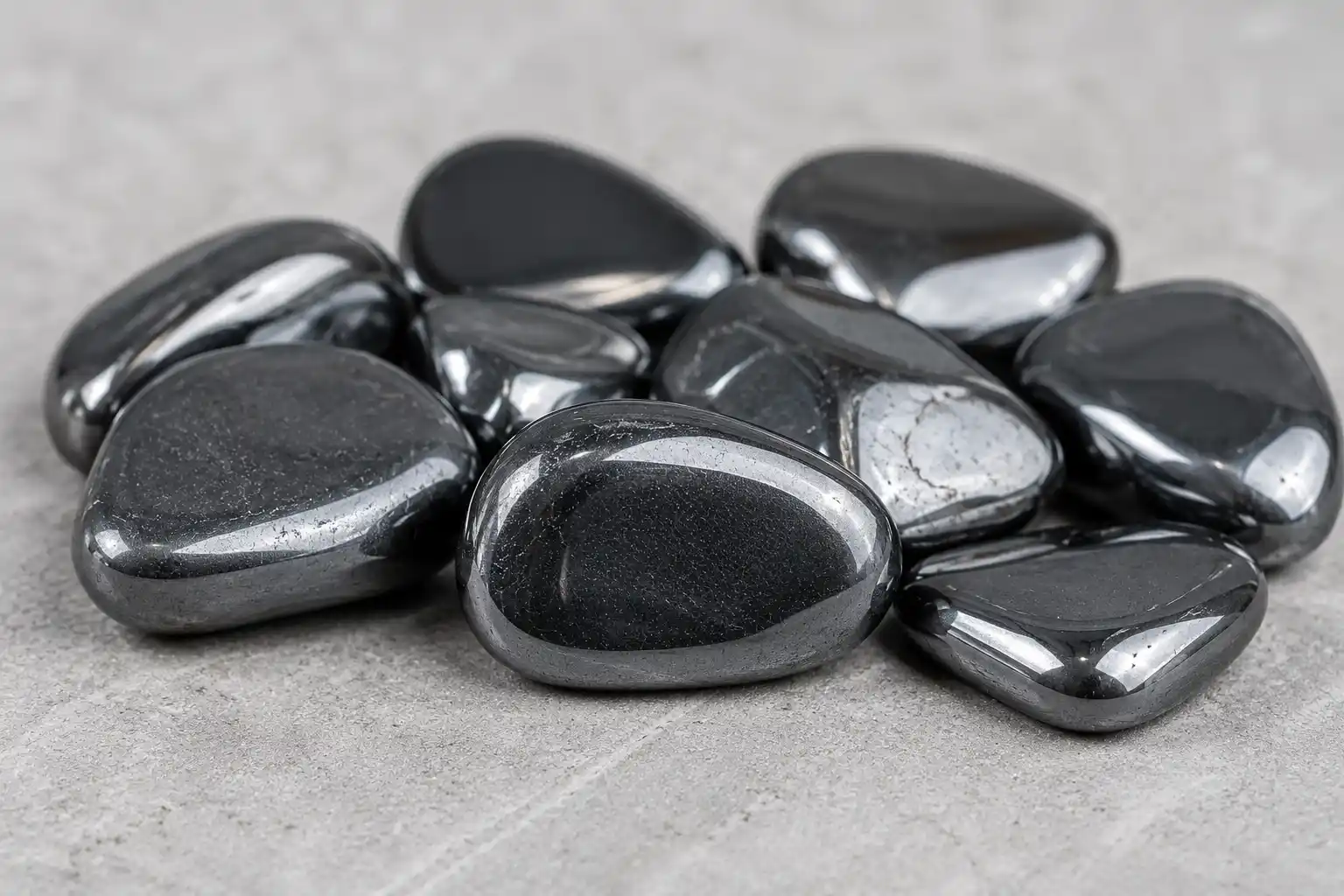
Hematite Meaning: Healing Properties, Benefits & Uses
Hematite meaning begins with iron oxide rather than with a healing claim. Hematite is a naturally occurring iron(III) oxide mineral with the ideal formula Fe₂O₃. It crystallizes in the trigonal system, typically has a Mohs hardness around 5–6, a specific gravity close to 5.26, and an unusually broad visual range that includes steel-gray to almost black metallic crystals, silvery platy aggregates, reddish-brown masses, earthy red material, kidney-shaped forms, and finely powdered red ochre. Despite those differences in outward appearance, ordinary hematite shares one particularly useful identification feature: a characteristic red to rust-red powder or streak. Mindat specifically notes that metallic black crystals and dull red earthy material can look dramatically different while still sharing the distinctive red streak associated with hematite.
That contrast explains much of the historical and modern hematite meaning attached to the mineral. A polished specimen can look almost gunmetal gray or black, yet finely divided hematite is red enough that the mineral’s name ultimately derives from the Greek concept of blood. Theophrastus used a blood-related name for the mineral centuries before modern chemical mineralogy, and later Latin and European forms of the name retained that association. Red hematite-rich ochres also have an exceptionally long human history as pigments. Smithsonian conservation records document analytically confirmed hematite-containing red ochre on prehistoric palettes and ancient objects, demonstrating that hematite’s relationship with human symbolism is much older than today’s crystal-healing vocabulary.
The responsible approach is therefore layered. Fe₂O₃ chemistry, crystal structure, streak, density, magnetism, formation, inclusions, and industrial importance belong to mineralogy. Red ochre, pigment use, historical naming, and archaeological use belong to documented human history. Modern associations with grounding, stability, boundaries, focus, resilience, or protection belong to contemporary symbolism. Medical claims require a different standard altogether. Readers exploring the broader symbolic category can browse Healing Crystal, while this page keeps hematite meaning anchored to the mineral itself before discussing interpretation.
Hematite Meaning at a Glance
| Property or question | Evidence-aware summary |
|---|---|
| Mineral identity | Hematite |
| Ideal formula | Fe₂O₃ |
| Mineral class | Oxide |
| Crystal system | Trigonal |
| Typical visual color | Steel-gray, silver-gray, black, reddish brown, rust red |
| Characteristic streak | Red to rust-red |
| Mohs hardness | Commonly about 5–6 |
| Specific gravity | About 5.26 |
| Luster | Metallic, submetallic, dull, or earthy depending on form |
| Transparency | Generally opaque |
| Common habits | Tabular crystals, platy aggregates, iron roses, massive, botryoidal, kidney ore, earthy ochre |
| Main diagnostic clue | Red-brown streak combined with unusually high density |
| Strong magnetism | Not typical of ordinary natural hematite |
| Major imitation concern | Strongly magnetic “hematite” beads can be manufactured ferrite material |
| Major geological importance | One of the principal iron-ore minerals |
| Historical importance | Red pigment/ochre and ancient “blood stone” naming |
| Modern symbolism | Grounding, stability, boundaries, focus, resilience, practical action |
| Scientific status of symbolism | Interpretive rather than demonstrated physiological effects |
| Main ownership concern | Brittle mineral; polished surfaces can scratch or chip |
| Processing boundary | Intact handling differs from grinding, sanding, drilling, or creating mineral dust |
USGS identifies hematite and magnetite as the primary iron oxides making up much of the world’s iron-ore resource, with iron ore supplying the primary iron used for steel production. This industrial role is a measurable property of hematite’s iron-rich composition; it should not be transformed into a claim that a polished stone transfers biologically useful iron into the human body.
What Is Hematite?
Hematite is the stable alpha form of iron(III) oxide under a wide range of natural surface and crustal conditions. Its ideal formula contains approximately 70% iron by weight and 30% oxygen, although natural specimens can include titanium, aluminum, manganese, water-bearing alteration products, intergrown minerals, and other impurities. Mindat classifies hematite as a valid mineral species within the hematite group and notes that it is structurally related to corundum-family oxides.
The mineral’s visual variability can make identification confusing. Specular hematite may consist of brilliant metallic flakes. Iron roses form platy crystals arranged into rosette-like aggregates. Kidney ore and botryoidal hematite form rounded masses. Earthy hematite can resemble red soil or ochre rather than a gemstone. Massive lapidary-grade material can polish to a dark metallic surface that looks completely different from its red powder.
These appearances represent morphology, grain size, surface reflectance, impurities, and texture rather than separate core chemistries.
Hematite Identity Table
| Characteristic | Hematite |
|---|---|
| Formula | Fe₂O₃ |
| Iron oxidation state | Predominantly Fe³⁺ |
| Crystal system | Trigonal |
| Mineral class | Oxide |
| Typical crystal forms | Tabular, platy, rhombohedral, rosette-forming |
| Aggregate forms | Massive, granular, botryoidal, reniform, earthy, micaceous |
| Hardness | Approximately 5–6 in common mineral references |
| Density | About 5.26 g/cm³ |
| Streak | Rust red to reddish brown |
| Luster | Metallic to submetallic; dull/earthy in fine-grained material |
| Typical transparency | Opaque |
| Cleavage | No prominent true cleavage in ordinary identification |
| Tenacity | Brittle |
| Common visual look-alikes | Magnetite, ilmenite, goethite-rich materials, metallic manufactured ferrites |
| Strongest field clue | Dense material plus red-brown streak |
| Main jewelry imitation issue | Manufactured “magnetic hematite” |
| Main historical color relationship | Finely powdered hematite produces red pigment |
The combination is more diagnostic than the dark metallic color alone. A black metallic specimen with a black streak, for example, deserves a different identification path than a black metallic specimen producing hematite’s characteristic red powder.
Why Can Hematite Look Black but Streak Red?
This apparent contradiction is one of the most interesting parts of hematite meaning and identification.
Large, well-crystallized or densely polished hematite surfaces can reflect light strongly enough to appear silver-gray, steel-gray, or black. When the mineral is reduced to very fine particles, however, the optical behavior changes. Those tiny particles absorb and scatter visible light in a way that reveals characteristic red-to-rust coloration.
That is why a polished hematite cabochon can appear metallic charcoal while its powder looks reddish brown.
The phenomenon also helps explain hematite’s historical use as pigment. Fine iron-oxide particles produce red ochre coloration even though larger crystalline masses may appear almost black.
The dedicated Hematite Optical Properties and Color Behavior reference owns the deeper relationship between particle size, reflectance, crystal orientation, trace impurities, and optical response.
The Red Streak Is Important—but Do Not Damage Finished Jewelry
A streak test traditionally involves rubbing a mineral against an unglazed porcelain plate and observing the color of the resulting powder.
For rough geological hematite, the red-to-red-brown streak is highly useful. Mindat specifically identifies rust-red streak as the common thread linking the mineral’s visually different forms.
That does not mean a collector should drag a polished bead, antique object, cabochon, or valuable crystal across a ceramic plate. A streak test removes material and can damage the surface.
If the object matters financially, historically, or sentimentally, identification should use an existing inconspicuous broken surface or non-destructive professional methods.
Why Is Hematite So Heavy?
Hematite’s specific gravity of approximately 5.26 is high compared with many familiar decorative minerals. Quartz is roughly 2.65, calcite about 2.71, and fluorite about 3.18. A solid piece of genuine hematite can therefore feel surprisingly heavy for its size.
Density is useful as supporting evidence, particularly when distinguishing hematite from lightweight glass, plastic, or resin imitations.
It is not sufficient by itself. Other iron-rich minerals and manufactured ferrites can also be dense.
The most reliable identification combines density with streak, structure, magnetism, microscopy, and analytical testing where necessary.
Is Hematite Magnetic?
Natural hematite is not normally a strongly magnetic mineral in the way magnetite or a manufactured permanent magnet is. Some natural material can show weak magnetic response because of its intrinsic magnetic properties, impurities, intergrowths, heating history, or admixed magnetite.
GIA documented genuine hematite beads that were only weakly attracted to a magnet, while strongly magnetic beads sold as hematite proved to be manufactured barium iron oxide instead.
This distinction matters because commercial “magnetic hematite” is widespread in jewelry and novelty products.
Strong magnetism should therefore increase skepticism rather than serve as proof of hematite.
What Is “Magnetic Hematite”?
The term is often misleading.
Mindat’s reference for commercial magnetic hematite describes manufactured magnetic materials containing no natural hematite, including ceramic barium-strontium ferrite or strontium ferrite products marketed under hematite-like names. GIA likewise analyzed strongly magnetic beads represented as hematite and found manufactured barium iron oxide.
These materials can be glossy, dark, heavy, bead-shaped, and visually convincing.
A strongly magnetic bracelet should therefore not automatically be described as a natural hematite bracelet.
Hematite Versus Magnetite
Hematite is Fe₂O₃. Magnetite is Fe₃O₄.
Both are iron oxides, both can look dark and metallic, and both are major iron ores. Magnetite, however, is strongly magnetic and ordinarily produces a black streak. Hematite typically produces a red-brown streak and is not strongly magnetic under normal specimen conditions.
Natural intergrowths complicate this simple comparison. Hematite may form by oxidation of magnetite, and some specimens can contain both minerals.
This is why magnetism should be combined with streak and, for technically important specimens, laboratory confirmation.
How Hematite Forms
Hematite forms through several geological pathways rather than one universal process. It occurs in sedimentary iron formations, hydrothermal deposits, metamorphic rocks, volcanic and igneous environments, soils, weathering zones, and oxidation products of other iron-bearing minerals.
One globally important setting is banded iron formation. USGS describes major iron formations containing hematite and magnetite interlayered with silica-rich layers such as chert or jasper. These enormous sedimentary units record changing chemical conditions in ancient oceans and later geological modification. Weathering and supergene enrichment can subsequently convert or enrich iron minerals toward hematitic ore, while metamorphism can recrystallize original iron-rich sedimentary material into coarser hematite-bearing rocks.
Hematite also forms when magnetite or other iron minerals oxidize under more oxygen-rich conditions. Hydrothermal fluids can precipitate hematite in veins and cavities, and high-oxygen volcanic gases can produce hematite during cooling under suitable conditions. Mindat records experimental precipitation from oxidizing volcanic gases at elevated temperatures, illustrating just how diverse its formation pathways can be.
The detailed deposit models, oxidation sequences, banded iron formations, hydrothermal systems, metamorphism, and weathering belong in Hematite Formation and Deposit Geology.
Banded Iron Formation and Hematite
Banded iron formations are among the most consequential hematite-bearing rocks on Earth.
USGS describes Superior-type iron formation as finely layered sedimentary rock containing iron-rich beds—commonly hematite or magnetite—alternating with silica-rich layers. Some deposits were later metamorphosed, weathered, structurally modified, or enriched into high-grade hematitic ore.
This geological history connects a palm-sized hematite specimen with processes operating across entire ancient marine basins.
That documented planetary story is more substantial than generic claims that hematite “comes from Earth’s grounding frequency.”
Hematite as Iron Ore
Hematite’s economic importance is directly tied to its iron content.
USGS identifies hematite and magnetite as the two principal forms of iron oxide in iron ore and reports that almost all iron ore feeds the steel industry.
Steelmaking does not occur because hematite possesses symbolic strength. It occurs because metallurgical processes chemically reduce iron oxide and recover iron.
The distinction provides a useful symbolism boundary. Hematite can reasonably symbolize strength because of its industrial association with iron and steel. It should not be claimed to physically strengthen the human body merely by being worn.
Hematite Inclusions and Intergrowths
Natural hematite can occur with quartz, magnetite, ilmenite, goethite, jasper, calcite, siderite, and numerous other minerals depending on geological setting.
Under magnification, polished material may reveal granular textures, intergrowths, fractures, porosity, specular flakes, alteration rims, or included phases. In transparent host minerals such as quartz, thin hematite platelets may appear deep red in transmitted light while looking metallic or dark in reflected light.
The Hematite Microscope Inclusion Notebook owns the specimen-scale identification of these features rather than using one texture as proof of every hematite occurrence.
Iron Roses, Specularite, Kidney Ore, and Red Ochre
Several descriptive names are commonly associated with hematite.
Iron rose refers to rosette-like aggregates of platy hematite crystals. Specularite describes highly reflective platy or micaceous hematite. Kidney ore refers to smooth reniform or kidney-shaped hematite masses. Red ochre commonly contains fine earthy hematite responsible for strong red pigmentation.
These terms describe habits, textures, appearances, or mixtures rather than separate mineral species.
Mindat specifically recognizes specularite and red ochre among hematite varieties and descriptive forms.
Original Information Gain: Hematite Name and Claim Audit
| Name or claim | Evidence-aware interpretation | What should not automatically be assumed | Stronger evidence when needed |
|---|---|---|---|
| Hematite | Natural Fe₂O₃ mineral | Strong magnetism | Mineral identification |
| Haematite | British spelling of hematite | Different mineral | Same species |
| Specularite | Reflective platy/micaceous hematite | Separate species | Morphology plus identification |
| Iron rose | Rosette-forming hematite habit | Artificial carving | Examine crystal growth |
| Kidney ore | Reniform/botryoidal hematite | One exact locality | Provenance documentation |
| Red ochre | Earthy pigment commonly rich in hematite | Pure Fe₂O₃ in every ochre | Mineral/pigment analysis |
| “Magnetic hematite” | Often manufactured ferrite material | Natural hematite | Streak, magnetism, XRD/chemistry |
| Hematine | Commercial imitation terminology | Natural stone | Material analysis |
| Black hematite | Visual description | Black streak | Hematite normally shows red-brown streak |
| “Blood stone” | Historical name relationship | Same mineral as modern bloodstone chalcedony | Historical terminology must be contextualized |
| “Iron stone” | Broad/common wording | Pure hematite | Mineral identification |
| “Grounding stone” | Modern symbolism | Measurable grounding field | Remains symbolic |
| “Blood-healing crystal” | Metaphysical/medical wording | Treatment of anemia or circulation | Clinical evidence would be required |
| “Magnetic therapy hematite” | Commercial wellness claim | Genuine hematite or proven therapy | Verify both material and medical evidence |
| “Detox stone” | Unsupported health claim | Physiological toxin removal | Clinical evidence would be required |
The magnetic-hematite row is especially important because an imitation can possess the very property—strong magnetism—that buyers are told proves authenticity.
Original Specimen and Photo Checklist
A hematite photograph can reveal useful physical evidence, but it cannot establish every claim.
| Observation | Photograph can often support | Photograph cannot reliably prove |
|---|---|---|
| Metallic luster | Reflective steel-gray surface | Fe₂O₃ composition |
| Red earthy material | Ochre-like appearance | Purity or exact pigment composition |
| Iron rose habit | Rosette morphology | Geographic origin |
| Kidney/botryoidal form | Rounded growth texture | Internal mineralogy |
| Red streak | Visible powder if performed on expendable material | Full composition |
| Strongly magnetic beads | Cannot show magnetism directly | Natural hematite identity |
| Surface pits | Lapidary texture and porosity | Specific mine |
| Intergrowths | Visible contrasting phases | Exact phase identity |
| High heft | Not visible in photo | Density |
| Seller “natural hematite” label | Claim being made | Authenticity |
| “Healing energy” | Nothing objectively measurable | Medical effect |
For polished stones, photograph both the reflective face and any natural or broken surface already present. Highly directional lighting can make metallic hematite appear mirror-bright chrome, while diffuse lighting better reveals surface texture.
A red streak photograph is useful only if the test was ethically performed on expendable rough or existing powder. Do not damage collectible material simply to create documentation.
Why “Rainbow Hematite” Requires Caution
Iridescent surfaces can occur on iron oxides through thin-film alteration, associated minerals, coatings, or treatment. The retail term “rainbow hematite” can therefore cover more than one material situation.
A vividly iridescent specimen should not automatically be assumed to be homogeneous untreated Fe₂O₃.
If natural iridescence, treatment, or mineral identity materially affects value, laboratory or mineralogical examination may be appropriate.
Colorful surface effects should be documented separately from the bulk hematite identity.
Documented History of the Hematite Name
Hematite has one of mineralogy’s oldest surviving names.
Mindat records that Theophrastus named the mineral around the fourth century BCE using Greek terminology meaning “blood stone,” an allusion to the vivid red color of the powdered material. Pliny later used a Latin form meaning bloodlike.
The English word ultimately developed through Latin and French forms of that Greek root.
This is genuine historical symbolism tied directly to an observable mineral property: red powder.
Hematite and Red Ochre in Human History
Fine hematite has been used as pigment across a vast span of human history.
Smithsonian conservation documentation of an Upper Paleolithic palette from France identified the red pigment as a hematite mixture through X-ray fluorescence, scanning electron microscopy, energy-dispersive analysis, and X-ray diffraction. Smithsonian records also document hematite-based red ochre in ancient textiles and archaeological pigments.
This provides a strong historical basis for associations with blood, color, identity, art, ceremony, and permanence.
It does not establish that prehistoric people used hematite according to today’s exact chakra, manifestation, or crystal-healing vocabulary.
Modern Hematite Meaning
Modern hematite meaning commonly centers on grounding, stability, practical thinking, boundaries, confidence, protection, resilience, and disciplined action.
Several of these themes make intuitive symbolic sense. Hematite is exceptionally dense. It is physically rich in iron. Its dark metallic surface feels visually substantial. Its historical red streak links it with blood imagery, while its industrial connection with iron and steel naturally evokes durability and strength.
These qualities can support metaphor.
They do not create evidence that holding hematite changes blood chemistry, electromagnetic balance, neurological function, or emotional state through a mineral field.
Hematite and Grounding
Grounding is probably the most widespread modern hematite meaning.
A practical interpretation can treat the stone as an attentional cue. If someone feels scattered, a hematite object might remind them to identify five concrete facts, feel their feet against the floor, slow their breathing normally, or complete one physical task before returning to abstract worries.
The behavioral practice may be useful.
The stone itself has not been demonstrated to connect the body electrically to Earth or remove excess electromagnetic energy in the medical sense.
Hematite and Focus
The dense, simple appearance of polished hematite often leads to associations with focus and mental organization.
A grounded use can be straightforward: place the stone beside a workspace and connect it with a specific rule such as finishing one task before opening another.
This is a cue-based behavior.
Hematite has not been shown to treat ADHD, memory impairment, neurological disease, brain fog, or cognitive disorders through mineral contact.
Hematite and Boundaries
A dark polished stone with substantial physical weight can also function symbolically as a boundary marker.
Someone might carry hematite while practicing a particular statement: “I can care about this without taking responsibility for everything.”
The benefit comes from articulating and maintaining the boundary.
The mineral cannot repel people, prevent manipulation, or force others to respect limits.
Hematite and Protection
Protection symbolism is common in contemporary hematite descriptions.
A responsible interpretation can convert symbolic protection into practical preparedness: check equipment, wear appropriate protective gear, verify information, secure valuables, or remove oneself from a dangerous situation.
Hematite cannot create guaranteed protection from physical injury, crime, illness, financial loss, radiation, supernatural harm, or another person’s choices.
Hematite and Resilience
The iron association makes resilience an understandable metaphor, although natural hematite itself is brittle rather than indestructible.
That detail actually creates a more nuanced symbolic interpretation: strength does not mean immunity from fracture.
A person can use hematite as a reminder to build systems, seek support, recover after setbacks, and recognize limits.
The metaphor becomes more realistic when the actual mineral is not misrepresented.
Hematite Healing Properties: Evidence Boundary
The phrase hematite healing properties is widely searched, but the evidence boundary should be explicit.
There is no established scientific evidence that wearing or carrying hematite treats anemia, improves circulation, raises hemoglobin, lowers blood pressure, reduces blood clots, improves oxygen delivery, strengthens immunity, treats anxiety or depression, heals neurological disease, regulates hormones, relieves chronic pain, or detoxifies the body.
The dedicated Hematite Healing Properties page examines those wellness claims specifically rather than duplicating that analysis here.
The basic chemistry is not enough. Hematite contains iron because it is Fe₂O₃, but iron bound inside a mineral lattice is not automatically absorbed through intact skin as a nutritional dose. Wearing an iron-bearing stone is not equivalent to consuming an appropriately formulated iron supplement or receiving medical treatment.
The site’s broader health-claim boundary is stated in the Gems Lore Disclaimer.
Hematite and Anemia Claims
The blood-related name and iron-rich formula make anemia one of the easiest claims to construct—and one of the most important to separate from mineral symbolism.
Hematite does contain a large proportion of iron by mass. That is why it is economically important as iron ore.
However, a polished stone touching the skin does not constitute a demonstrated treatment pathway for iron-deficiency anemia.
Iron status is a medical and nutritional matter involving absorption, dosage, underlying causes, laboratory testing, and appropriate treatment.
Does Magnetic Hematite Provide Magnetic Therapy?
This claim has two separate problems.
First, strongly magnetic “hematite” jewelry may not be natural hematite at all. GIA identified strongly magnetic beads sold as hematite as manufactured barium iron oxide.
Second, identifying a material as magnetic does not by itself prove that wearing it treats pain, circulation, inflammation, arthritis, or another condition.
Material authenticity and medical efficacy require separate evidence.
Hematite and Iron Nutrition
A useful distinction is:
Iron ore is not an iron supplement.
Industrial processes extract iron from hematite through high-temperature chemical reduction. The human digestive system does not perform that metallurgical process simply because a stone is worn, carried, or briefly placed in water.
Similarly, grinding mineral hematite into powder for consumption is not a safe substitute for regulated nutritional products.
Do Not Ingest Hematite or Make Mineral Elixirs
Hematite specimens should not be powdered, swallowed, added to supplements, or deliberately soaked in drinking water for metaphysical use.
Natural specimens can contain associated minerals, coatings, weathering products, polishing compounds, adhesives, metal residues, or contaminants beyond ideal Fe₂O₃.
If iron supplementation is medically appropriate, use products intended and regulated for that purpose.
Mineral specimens are for geological, decorative, educational, or symbolic use—not improvised dosing.
Carrying Hematite With Other Crystals
Modern practices often combine hematite with other symbolic stones. There is no mineralogical rule limiting how many intact stones a person can carry based on “energy overload.”
Practical constraints are more useful: total weight, sharp edges, fragile stones rubbing against harder minerals, metal settings, personal comfort, and the possibility of scratching softer specimens.
The separate How Many Crystals Can You Carry? guide addresses that practical question without requiring an invented energetic maximum.
Cleansing Hematite
Cleansing can mean two very different things: physically cleaning a mineral or performing a symbolic ritual.
Those categories should not be mixed. Physical cleaning depends on hematite’s condition, associated minerals, polish, matrix, coatings, jewelry construction, and possible manufactured imitations.
Symbolic cleansing does not need harsh saltwater, acids, extreme heat, or abrasive methods.
The dedicated How to Cleanse Hematite guide owns that practical and symbolic care question so this meaning page does not repeat a one-size-fits-all cleaning recipe.
Jewelry Wear
Hematite is harder than calcite, fluorite, gypsum, and halite but softer than quartz, beryl, garnet, corundum, and diamond. It is also brittle.
Polished cabochons, beads, signet-style pieces, and ornamental carvings can therefore perform well under moderate use but may scratch or chip under repeated abrasion and impact.
Large open fractures, porous surfaces, thin edges, and drilled holes can become failure points.
The detailed relationship between mounting pressure, impact, bead wear, and protective design belongs in Hematite Setting and Wear Engineering.
Cutting and Polishing
Dense massive hematite can take a strong metallic polish, which explains its long use in beads, cabochons, carvings, and ornamental objects.
Lapidary work nevertheless has to distinguish solid natural hematite from manufactured ferrite products and from hematite mixed with softer gangue minerals.
Dust-generating operations also change the exposure context completely. Cutting, grinding, drilling, and polishing require appropriate workshop controls rather than the assumptions used for ordinary intact handling.
The specialized workflow belongs in Hematite Cutting, Orientation and Polish.
Safe Ownership: Intact Stone Versus Dust
Handling an intact polished hematite stone is fundamentally different from crushing or grinding iron-oxide mineral material.
Mechanical processing can create fine particulate matter from hematite and any associated minerals. Proper lapidary work should use effective dust control, appropriate wet methods where suitable, eye protection, equipment safeguards, and respiratory protection when required.
The safest general rule is simple: do not intentionally create mineral powder for spiritual practice.
Buying Genuine Hematite
The biggest authenticity shortcut is not price. It is evidence.
Strongly magnetic novelty beads deserve special scrutiny because manufactured magnetic ferrites are widely sold under hematite names. Genuine hematite should be evaluated through streak where appropriate, density, surface appearance, magnetism, provenance, and professional analysis when value justifies it.
Seller selection, return policies, disclosure questions, photographs, and purchase-level verification belong in Where to Buy Hematite.
A product title alone is not a mineral identification.
Original Hematite Authenticity Decision Matrix
| Observation | Natural hematite compatible? | Manufactured magnetic “hematite” concern? | Interpretation |
|---|---|---|---|
| Rust-red streak | Strongly compatible | Often inconsistent with some ferrite imitations | Important evidence |
| Steel-gray metallic appearance | Yes | Also possible visually | Weak alone |
| Very high density | Yes | Manufactured ferrites may also feel dense | Supporting evidence |
| Weak magnet response | Possible | Less characteristic of strong novelty magnets | Supporting only |
| Beads snap firmly together magnetically | Highly suspicious | Strong concern | Investigate material |
| Black streak | Not typical ordinary hematite | Can occur in manufactured or other dark materials | Reconsider identification |
| Natural iron-rose crystal morphology | Strongly supportive | Unlikely in molded ferrite | Morphological evidence |
| Identical glossy molded beads | Possible polished product but inspect carefully | Greater manufactured-material concern | Look for molding features |
| XRD identifies hematite | Strong | Rules out many substitutes | High-quality mineral evidence |
| EDXRF chemistry plus red streak | Strong | Useful combined evidence | High confidence |
| Seller says “magnetic hematite” | Does not prove hematite | Known problematic trade terminology | Require evidence |
The table should not be used to declare every weakly magnetic specimen authentic or every magnetic specimen fake. Natural mineral intergrowths and unusual hematite exist. It establishes which observations justify further investigation.
Specimen Conservation
Natural hematite specimens can preserve iron-rose crystals, specular surfaces, botryoidal forms, pseudomorphs, matrix relationships, ore textures, alteration structures, and old collection provenance.
Aggressive polishing can destroy those features.
Preserve locality labels, collection numbers, dimensions, photographs, original surfaces, matrix, reported mine information, and analytical documentation before modifying an important specimen.
The Hematite Specimen Conservation Record provides the mapped framework for maintaining that record over time.
Hematite as Pigment Versus Polished Gem Material
Fine hematite pigment and polished metallic hematite are the same mineral species but behave visually very differently.
This is important historically because an ancient red ochre sample should not be expected to resemble a modern polished hematite bead.
Likewise, the red color of prehistoric pigment does not mean ancient users necessarily selected mirror-bright metallic crystals for the same purpose.
Grain size, preparation, impurities, and intended use matter.
Hematite Meaning and the “Blood” Association
The blood association has unusually strong historical support compared with many modern crystal meanings because the mineral’s name itself was tied to its red powder.
That does not make every modern blood-related claim valid.
It is reasonable to say hematite historically evoked blood because of its red streak and pigment. It is not reasonable to leap from that linguistic relationship to claims that the mineral increases red blood cells, controls bleeding, treats anemia, or improves circulation.
Historical symbolism and physiology are different evidence categories.
Hematite Meaning and Strength
Iron and steel give hematite a natural modern association with strength.
A grounded interpretation might use a hematite object as a reminder to prepare carefully, persist through routine difficulty, or establish practical support systems.
Hematite’s actual role as an iron ore provides a factual origin for the metaphor.
It does not prove an invisible strengthening effect on muscles, bones, immunity, or personality.
Hematite Meaning and Practical Action
One of the more coherent modern interpretations of hematite meaning is practical action.
The mineral is dense, industrially important, visually substantial, and historically tied to tangible materials such as pigment and iron ore.
Someone could associate it with moving from intention to execution: write the plan, make the call, finish the repair, or document the next step.
This type of symbolic use remains entirely compatible with mineralogical accuracy.
Evidence and Technical Limits
This article does not claim first-hand mine visits, private hematite purchases, unpublished laboratory work, medical testing, or direct authentication of a reader’s specimen. The broader evidence approach used by Gems Lore is explained on About Gems Lore.
Technically important questions—such as separating hematite from magnetite-rich intergrowths, identifying strongly magnetic jewelry, characterizing titanium-rich material, distinguishing natural coatings from treatments, or confirming ore-mineral textures—may require X-ray diffraction, Raman spectroscopy, electron microscopy, magnetic measurements, or chemical analysis.
Readers with documented corrections, analytical results, archaeological references, or better mineralogical evidence can submit them through Contact Gems Lore. Information submitted through site channels is handled according to the Privacy Policy.
Frequently Asked Questions About Hematite Meaning
What is hematite meaning?
Hematite meaning commonly combines the mineral’s iron-rich identity and long red-pigment history with modern symbolic themes such as grounding, stability, boundaries, resilience, focus, and practical action. These themes are interpretive rather than established physiological effects.
What is hematite made of?
Hematite is iron(III) oxide, Fe₂O₃. Ideal hematite is roughly 70% iron by weight.
Why is hematite called the blood stone?
The name comes from ancient Greek terminology related to blood, referring to hematite’s vivid red powder or streak. This should not be confused with the modern gemstone called bloodstone, which is a variety of chalcedony.
Why does hematite look metallic gray if its streak is red?
Large crystalline or polished surfaces reflect light differently from very fine hematite particles. The bulk surface can appear steel-gray or black while the finely powdered mineral reveals its characteristic red-brown color.
What is hematite’s hardness?
Mindat lists hematite at about Mohs 5–6. Individual textures and intergrowths can make practical scratch behavior appear variable.
Why does hematite feel heavy?
Its specific gravity is approximately 5.26, substantially higher than quartz, calcite, fluorite, and many common decorative minerals.
Is hematite magnetic?
Ordinary natural hematite is not strongly magnetic like magnetite or a manufactured permanent magnet. Genuine material can show weak attraction under some conditions. Strong magnetism in commercial beads deserves scrutiny.
Is magnetic hematite real hematite?
Often not. GIA documented strongly magnetic beads sold as hematite that were manufactured barium iron oxide, while Mindat describes commercial magnetic hematite materials made from ferrite ceramics.
How can I identify hematite?
Useful evidence includes high density, metallic-to-earthy appearance, a characteristic red-brown streak, crystal habit, and magnetism behavior. Valuable finished objects should not be damaged for a streak test.
Does all hematite look black?
No. Hematite can be steel-gray, silver-gray, black-looking, reddish brown, rust red, or earthy red depending on grain size, habit, surface texture, and impurities.
What is an iron rose?
An iron rose is a rosette-like aggregate of platy hematite crystals. It describes crystal habit rather than a separate mineral species.
What is specular hematite?
Specularite is highly reflective, platy or micaceous hematite with a bright metallic appearance.
What is red ochre?
Red ochre is an earthy pigment material commonly colored strongly by fine hematite. Archaeological analysis has confirmed hematite-rich red ochre in prehistoric and ancient pigments.
Where does hematite form?
Hematite occurs in sedimentary iron formations, weathering zones, hydrothermal systems, metamorphic rocks, oxidized iron deposits, and some igneous or volcanic environments. Major hematite ores occur in banded iron formations.
Is hematite an important iron ore?
Yes. USGS identifies hematite as one of the principal iron-oxide minerals supplying the iron used in steelmaking.
Does hematite have healing properties?
There is no established scientific evidence that carrying or wearing hematite treats disease or creates specific physiological healing effects.
Does hematite increase iron levels in the body?
Wearing hematite is not a demonstrated method of iron supplementation and should not be used to treat anemia or iron deficiency.
Does hematite improve blood circulation?
There is no established evidence that ordinary hematite jewelry improves circulation through mineral contact or magnetism.
Does hematite help with anxiety or grounding?
A person may use hematite as a symbolic or tactile reminder during grounding exercises, but the mineral has not been established as a treatment for anxiety disorders or other mental-health conditions.
Can hematite protect you?
Protection is a modern symbolic association. Hematite cannot guarantee protection from physical harm, illness, financial loss, electromagnetic exposure, or supernatural events.
Can hematite go in drinking water?
Collector hematite should not be powdered, ingested, or deliberately used to make gemstone drinking-water preparations. Natural specimens can contain associated minerals and contaminants beyond ideal Fe₂O₃.
Final Perspective
Hematite meaning becomes more substantial when its real mineralogical contradictions are allowed to lead the story. Hematite is Fe₂O₃, a dense trigonal iron oxide that can appear almost black and metallic in one specimen yet produce a vivid red-brown streak when powdered. Its hardness is moderate, its density is unusually high, and its forms range from iron roses and mirror-like specularite to kidney ore and earthy red ochre.
Its human history is equally tangible. The name itself derives from blood-related Greek terminology because of the mineral’s red powder, and analytical archaeology confirms hematite-rich ochre among prehistoric and ancient pigments. Its economic history is still more concrete: hematite remains one of the principal mineral sources of iron used by the steel industry.
Those facts provide a defensible foundation for modern symbolism involving grounding, strength, boundaries, resilience, focus, and practical action. They do not support claims that hematite treats anemia, improves circulation, delivers iron through the skin, detoxifies the body, guarantees protection, or medically “grounds” the nervous system. The same evidence discipline also exposes an important market problem: many strongly magnetic objects sold as hematite are manufactured ferrites rather than natural Fe₂O₃.
A responsible hematite meaning therefore keeps the sequence clear: establish the mineral, document its physical traits and geological formation, preserve its genuine historical relationship with red pigment and iron, treat magnetic products cautiously, and only then use grounding or strength language as consciously chosen symbolism rather than as a substitute for mineralogy or medicine.