Where to Buy Real Hematite and Avoid Magnetic Imitations
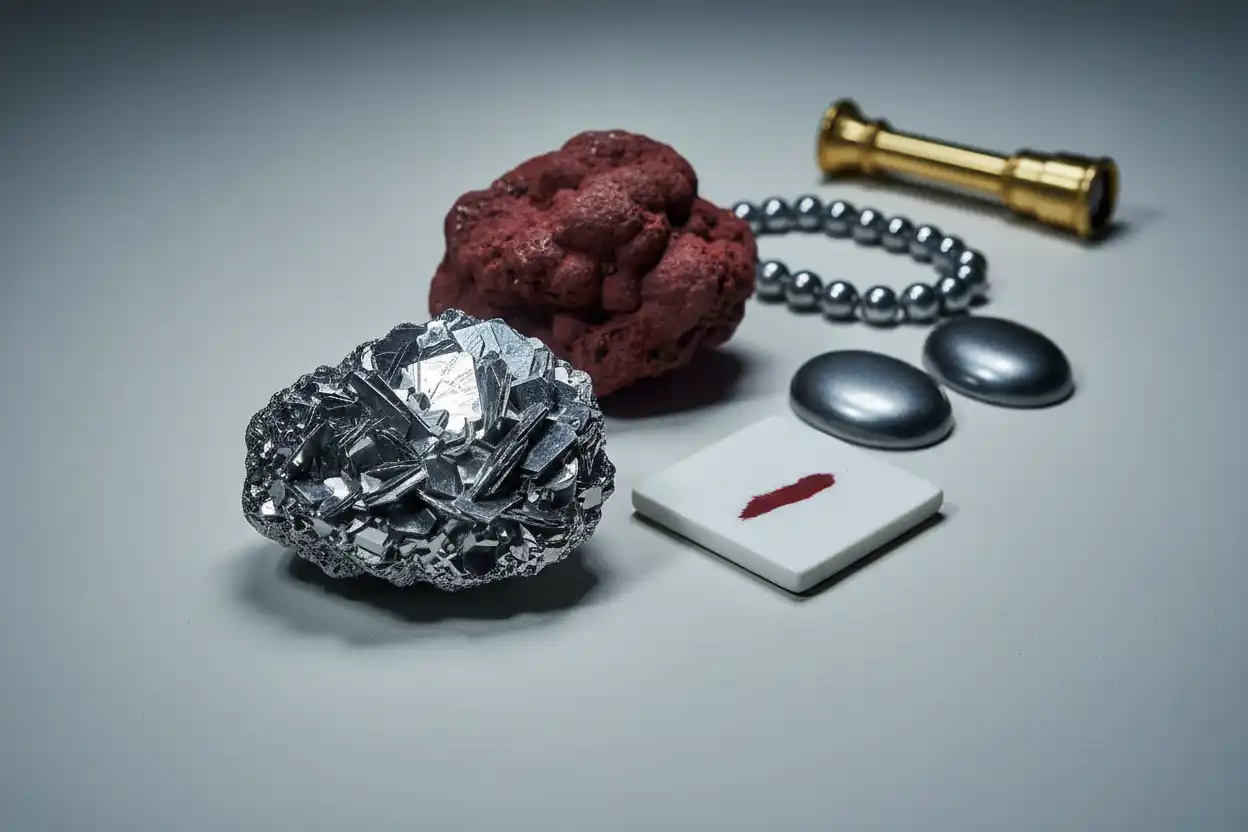
Real Hematite can look metallic steel gray, silvery black, reddish brown, earthy red or nearly black. The same iron oxide mineral may form shiny tabular crystals, sparkling Specularite, kidney-shaped botryoidal masses, compact ore, earthy pigment and polished stones.
That wide appearance creates confusion in the retail market. Strongly magnetic manufactured beads are often sold as “magnetic Hematite,” although they may consist of synthetic ferrite, magnetite-rich ceramic or another manufactured magnetic material rather than natural Hematite.
Natural Hematite itself is usually weakly magnetic or effectively nonmagnetic in ordinary handling. Some specimens can show stronger attraction because they contain Magnetite, Maghemite or another magnetic phase. Therefore, magnetism must be interpreted alongside streak, density, structure and laboratory evidence.
The Hematite meaning and properties guide covers the mineral’s identity and traditional symbolism. This page focuses on seller selection, magnetic imitations, polishing, coatings, lookalikes and buying specimens, beads or jewelry with accurate material disclosure.
Understand the Hematite Market
Hematite is iron oxide, Fe2O3, and one of the world’s most important iron-ore minerals.
It crystallizes in the trigonal system but appears in several habits:
- Flat, tabular or platy metallic crystals
- Sparkling micaceous aggregates known as Specularite
- Botryoidal or kidney-shaped masses
- Compact steel-gray ore
- Oolitic and granular material
- Earthy red or brown pigment-rich masses
- Replacement fossils and mixed iron-rich rocks
A polished black bead and an earthy red specimen can both be genuine Hematite. Their shared diagnostic feature is commonly a red, reddish-brown or rusty streak rather than the color of the surface itself.
Choose the Product Form First
| Hematite product | Best source | Main buying concern |
|---|---|---|
| Natural crystal specimen | Specialist mineral dealer | Crystal form, locality, coating and repair |
| Specularite | Mineral dealer | Natural sparkle versus metallic coating or glitter |
| Botryoidal kidney ore | Mineral dealer | Goethite, Maghemite and reconstructed surfaces |
| Massive rough | Lapidary or ore-mineral supplier | Mixed iron minerals, stability and provenance |
| Polished cabochon | Gem or lapidary dealer | Metallic coating, backing and identity |
| Bead strand | Established supplier | Magnetic ferrite, manufactured ceramic and coating |
| Tumbled stone | Reputable crystal retailer | Magnetite, industrial pellets or synthetic material |
| Carving | Stone dealer | Resin, heavy coating and composite construction |
| Ring or pendant | Jeweler with treatment disclosure | Brittleness, metal plating and adhesive |
| Educational specimen | Mineralogical supplier | Accurate distinction from Magnetite and Ilmenite |
A collector specimen should preserve mineral form and locality. A bead buyer should focus on whether the product is natural Hematite, reconstructed Hematite or manufactured magnetic material.
Where to Buy Genuine Hematite
Specialist mineral dealers
Mineral dealers are the strongest source for crystals, Specularite and locality specimens.
A listing should include dimensions, weight, locality, habit, condition and associated minerals. Request photographs of the reverse and base.
Ask whether a metallic specimen has been lacquered or coated. Some collectors apply clear coatings to reduce handling marks or stabilize fragile surfaces.
A good dealer should distinguish Hematite from Magnetite, Goethite, Maghemite and Ilmenite rather than identifying every black iron mineral visually.
Gem and mineral shows
Shows allow you to compare natural Hematite with Magnetite, Pyrite, manufactured magnetic beads and metallic glass.
Natural Hematite often feels dense for its size. However, density by hand is only a supporting observation.
A red-brown streak is diagnostically important, but do not rub merchandise on unglazed porcelain without the seller’s explicit permission. The test removes material and can scratch polished surfaces.
Use a loupe to inspect coatings, mold seams, glued particles and crystalline texture.
Established bead suppliers
Bead sellers should state clearly whether a product is:
- Natural Hematite
- Reconstituted or pressed Hematite
- Hematite-coated material
- Magnetite
- Synthetic ferrite
- Magnetic ceramic
- Metal-plated glass or another manufactured product
“Magnetic Hematite” is not a sufficient material description.
Ask whether the beads respond strongly enough to snap together from a distance. Strong permanent magnetism is inconsistent with ordinary pure natural Hematite and deserves clarification.
Established online stores
The online gemstone buying guide covers seller identity, payment protection and returns.
For Hematite, request videos that show both surface luster and magnetic behavior. The seller should explain the magnet used and whether attraction is weak or strong.
Highly polished images can conceal coating scratches, chipped plating and resin seams.
Independent jewelry makers
A maker may know whether the bead supplier sold natural stone, pressed powder or synthetic magnetic material.
Ask whether the item was drilled from solid stone, molded, plated or bonded with resin. For a pendant, determine whether the metallic surface is exposed Hematite or a coating over another base.
What Genuine Hematite Looks Like
Metallic Hematite commonly appears steel gray, blackish gray or silver-black. Earthy varieties range from bright red to reddish brown.
Specularite contains fine reflective plates that produce a natural metallic sparkle. The reflections come from mineral surfaces rather than loose craft glitter.
Botryoidal Hematite can form rounded grape-like or kidney-shaped surfaces. Broken areas may reveal radiating, fibrous or compact internal texture.
Natural polished Hematite generally has a dark metallic luster. Small scratches may reveal a less reflective gray or reddish layer beneath.
The stone is relatively dense. Nevertheless, dense metal alloys and ferrite ceramics can feel similarly heavy.
The Red Streak Test
Hematite commonly leaves a red, reddish-brown or rusty streak even when its surface looks black or metallic.
This contrast is one of its most useful identification features. Magnetite generally produces a black streak, while Ilmenite commonly produces a black to brownish-black streak.
However, streak testing is destructive. It can damage polished jewelry, crystals and collectible surfaces.
A professional or seller may test an inconspicuous rough fragment. Buyers should not perform the test on finished objects without permission.
Titanium-bearing or mixed material can also complicate the streak. Therefore, laboratory methods remain appropriate for valuable specimens.
Hematite Versus Magnetite
Magnetite is Fe3O4 and typically shows strong magnetic attraction. It commonly forms black octahedral crystals and leaves a black streak.
Hematite is Fe2O3 and usually shows much weaker magnetism with a red-brown streak.
The two minerals can occur together. A Hematite specimen containing residual Magnetite may respond noticeably to a magnet without being a manufactured fake.
The workbook does not contain a dedicated Magnetite guide, so this page should make the distinction clearly without inventing an internal URL.
For high-value material, Raman spectroscopy, X-ray diffraction or magnetic measurements provide stronger evidence than hand feel.
Hematite Versus Maghemite
Maghemite is another iron oxide, structurally related to Magnetite and often strongly magnetic.
It can form through oxidation of Magnetite and may occur with Hematite. Black polished or powdered materials can therefore contain several iron oxide phases.
A seller should not identify a strongly magnetic bead as natural Hematite solely because it contains iron oxide.
Precise phase identification requires instrumental analysis.
Hematite Versus Goethite
Goethite is hydrated iron oxide-hydroxide and commonly appears brown, yellow-brown, black or metallic.
It can form botryoidal and fibrous masses similar to Hematite. Heating or dehydration can also transform Goethite toward Hematite.
Some commercial “Hematite roses” or kidney ores may contain both minerals. A seller should acknowledge mixed iron minerals when testing has not isolated one phase.
Hematite Versus Pyrite
Pyrite is iron sulfide with brass-yellow metallic color. Hematite is iron oxide and generally steel gray, black or red-brown.
The completed real-versus-fake Pyrite guide covers gold-colored substitutes and crystal form.
Weathered Pyrite can develop iron-oxide coatings, including Hematite or Goethite. Therefore, a brown-red surface on a cubic sulfide specimen does not mean the whole object is Hematite.
Hematite Versus Ilmenite
Ilmenite is iron-titanium oxide and often appears black, metallic or submetallic.
It can resemble dark Hematite crystals, particularly when crystal habit is unclear. Ilmenite generally gives a darker streak and can show different magnetic behavior.
Visual identification may remain uncertain. Raman spectroscopy, X-ray diffraction and compositional analysis provide a more reliable answer.
Magnetic Hematite Beads
Many strongly magnetic bead strands sold as Hematite are manufactured products. They may be ferrite ceramic, sintered iron oxide, magnetic glass or metal-rich composite.
The term “hematine” has also been used commercially for manufactured metallic-looking material, although usage varies and is not always standardized.
A manufactured magnetic bead can be functional and attractive. The problem is representing it as a naturally mined Hematite crystal.
Strong magnetic attraction between beads is the primary warning sign. Ordinary natural Hematite beads generally should not behave like refrigerator magnets.
Reconstituted and Pressed Hematite
Natural Hematite powder or small particles can be combined with binders, compressed and molded into beads or carvings.
The product may contain real Hematite but is not one natural solid mineral piece.
Mold seams, identical shapes, resin-rich chips and repeated internal patterns can indicate manufacture.
Reconstituted material should be disclosed because its durability, magnetism and value differ from solid natural Hematite.
Metallic Coatings and Plating
Glass, resin, ceramic, Magnetite or another stone can receive a dark metallic coating.
Inspect drill holes, chipped edges and high-wear areas. A coating may peel or expose a lighter substrate.
Some natural Hematite beads receive clear lacquer or wax to protect the finish. That treatment is less severe than an opaque metallic plating but should still be disclosed.
The gemstone treatments guide explains coatings, impregnation and composites.
Glass and Resin Imitations
Metallic glass beads may show mold seams, bubbles beneath a coating and chipped plating.
Resin composites can be made heavy with metal or mineral powder. They may show casting marks, soft scratches and a plastic fracture.
A simple magnetic response cannot identify the substrate because manufacturers can add magnetic fillers.
The fake-crystal buyer’s guide provides broader glass, resin and manufactured-material checks.
How to Evaluate a Natural Specimen
Habit
Look for tabular crystals, Specularite plates, botryoidal masses or credible ore texture.
Luster
Metallic Hematite should show natural reflective surfaces rather than a uniform sprayed coating.
Streak evidence
Ask whether the dealer tested a rough edge and obtained a reddish-brown streak. Do not demand that a fine crystal be damaged.
Magnetism
Weak attraction can occur, especially in mixed material. Strong permanent magnetism requires explanation.
Density
Hematite feels heavy, but density alone cannot distinguish it from several iron-rich or manufactured products.
Matrix
Quartz, Calcite and other minerals may accompany Hematite. The relationship should appear geologically coherent.
Provenance
Locality labels matter for classic crystals, iron roses and historic ore specimens.
How to Evaluate Polished Stones
A polished cabochon should have a consistent metallic finish without flaking plating.
Inspect the back and girdle. Natural material should not reveal a glassy, ceramic or resin substrate beneath the surface.
Small pits can be natural, especially in botryoidal material. Thick filler or lacquer pooling within cavities should be disclosed.
Ask whether the stone was cut from solid Hematite-rich rough or formed from pressed powder.
Buying Beads and Bracelets
Ask the supplier to describe the magnetic strength explicitly. Beads that pull together forcefully are likely manufactured magnetic products.
Inspect drill holes for coatings, resin and chipped surfaces. Solid natural Hematite should maintain its dark mineral body through the hole.
Natural beads may show slight variation in luster, shape and surface texture. Perfectly identical beads can reflect precision cutting, but they can also indicate molding.
Elastic bracelets should not remain under excessive tension because heavy beads can abrade the cord.
Buying Hematite Jewelry
Hematite has respectable hardness but brittle tenacity. Thin pieces can chip or fracture after impact.
Pendants, earrings and beads are more practical than exposed rings with sharp corners.
The gemstone hardness chart and gemstone toughness-versus-hardness guide explain why density and hardness do not make a stone unbreakable.
Ask whether adhesive, plating or resin is present. Care instructions should reflect the complete construction.
Locality and Provenance
Hematite occurs worldwide and is one of the principal iron ores. Important specimens have come from Brazil, England, Italy, Morocco, the United States, South Africa and many other regions.
Classic “iron roses” and Specularite crystals can carry locality premiums. Appearance alone cannot prove origin.
An industrial ore label should also be treated cautiously because mined material can contain Magnetite, Goethite, silica and other phases.
The ethical crystal sourcing guide provides practical questions about mining, labor and traceability.
Price and Value
Common polished Hematite is affordable. Fine crystals, lustrous Specularite, aesthetic botryoidal specimens and documented classic-locality pieces can command more.
Value depends on crystal habit, luster, size, condition, matrix, locality, provenance, treatment and whether the item is solid natural material.
Strongly magnetic manufactured beads should not receive a rare-natural-Hematite premium.
A larger piece is not automatically better. A compact crystal with sharp form and natural luster can be more collectible than a heavy industrial ore fragment.
The gemstone pricing guide explains how quality, treatment and documentation affect value.
Questions to Ask the Seller
Ask whether the item is natural solid Hematite, Hematite-rich rock, pressed Hematite, ferrite ceramic, Magnetite or coated material.
Request a clear description of magnetic strength. Ask whether the seller has performed a streak or laboratory test on representative material.
Confirm coating, lacquer, wax, resin, plating and binder use.
For beads, request drill-hole close-ups. For specimens, ask for the reverse, base and locality label.
Finally, obtain a return policy that permits normal magnified and magnetic inspection without damaging the item.
Professional Identification
Raman spectroscopy and X-ray diffraction can identify Hematite and distinguish it from Magnetite, Maghemite, Goethite and Ilmenite.
Microscopy can reveal coatings, binders and pressed construction. Magnetic measurements can characterize attraction more precisely.
Compositional analysis helps identify titanium-rich or mixed iron-oxide material.
A red streak strongly supports Hematite, but laboratory work is preferable when composition affects substantial value.
Cleaning and Storage
The completed Hematite cleansing and charging guide offers non-destructive options for traditional practices.
For physical cleaning, use a soft dry or slightly damp cloth and dry the stone promptly.
Avoid prolonged soaking of porous, coated, pressed or glued products. Water can affect binders and encourage corrosion of associated iron-bearing material or metal findings.
Store polished Hematite separately from harder stones. Its dense weight can damage softer jewelry if pieces strike one another.
Frequently Asked Questions
1. Is Hematite naturally magnetic?
Pure natural Hematite is usually weakly magnetic or effectively nonmagnetic in ordinary handling. Strong attraction often indicates Magnetite, Maghemite or manufactured ferrite material.
2. Are magnetic Hematite bracelets real Hematite?
Many strongly magnetic bracelets are manufactured ferrite or magnetic ceramic rather than solid natural Hematite.
3. What color is real Hematite?
It can appear steel gray, silvery black, reddish brown, earthy red or nearly black.
4. Why does black Hematite leave a red streak?
Its powdered form reflects its iron-oxide composition differently from the metallic surface, producing a red to reddish-brown streak.
5. How is Hematite different from Magnetite?
Hematite usually has a red-brown streak and weak magnetism. Magnetite has a black streak and strong magnetism.
6. Is Specularite the same as Hematite?
Specularite is a sparkling micaceous or platy form of Hematite rather than a separate species.
7. Can Hematite be reconstructed?
Yes. Powder or fragments can be pressed with binders into beads and decorative objects.
8. Can glass imitate Hematite?
Yes. Metallic-coated glass and ceramic can resemble polished Hematite.
9. Is every heavy dark bead natural Hematite?
No. Ferrite ceramics, metal-rich resin and Magnetite can also feel heavy.
10. Is Hematite suitable for daily jewelry?
Solid sound material can be worn, but it is brittle and heavy. Coated or pressed products require treatment-specific care.
11. Do ordinary Hematite beads need certificates?
Usually not. Clear material disclosure and magnetic behavior are more practical. Testing is useful for valuable specimens or disputed composition.
12. What is the biggest warning sign in a listing?
Be cautious when beads snap together strongly but are advertised as rare untreated natural Hematite without any explanation of their manufactured magnetism.
Buy the Iron Oxide the Seller Can Name Correctly
The most important question is not whether a bead looks metallic. It is whether the seller can distinguish natural Hematite from Magnetite, ferrite ceramic, coating and pressed composite material.
The H crystal directory, H gemstone directory and visual gemstone guide provide broader comparisons. Choose the item whose streak, magnetism, construction and treatment align with its description.
Safety note: Hematite is an iron oxide, but mineral dust should not be inhaled or ingested. Avoid dry cutting, drilling, sanding or grinding. Lapidary or specimen preparation requires wet methods, effective extraction and suitable respiratory and eye protection.