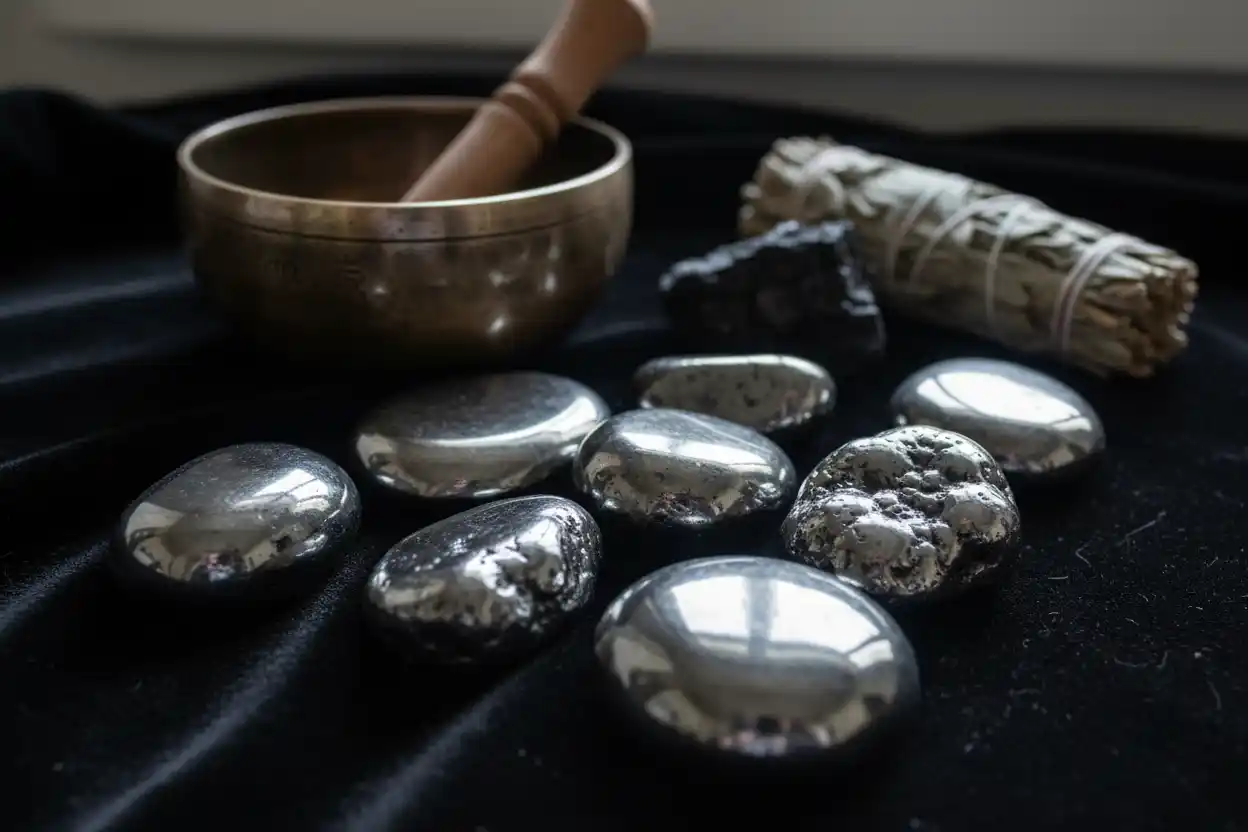
How to Cleanse and Charge Hematite
The safest ways to cleanse and charge Hematite are sound, intention, visualization, gentle breath, indirect moonlight, a written dedication, and a careful dry-cloth ritual. A brief damp wipe may be acceptable for solid natural Hematite, but soaking is unnecessary because jewelry sold under the Hematite name may include coatings, adhesives, elastic, porous beads, or manufactured magnetic imitations.
Hematite is an iron oxide, but it should not be described as ordinary metal that simply “rusts” in water. Its principal ritual risks are brittleness, abrasion, surface residue, structural weakness in thin pieces, and uncertainty about whether strongly magnetic beads are genuine Hematite.
What Cleansing and Charging Mean
Cleansing is a personal or spiritual ritual used to mark a new beginning, release previous associations, or prepare an object for meditation.
Charging generally means dedicating the object to a purpose, routine, personal value, or reminder.
Neither process is required to maintain Hematite as a mineral. No established scientific evidence shows that cleansing alters its iron-oxide chemistry, health effects, magnetism, or measurable physical energy.
The mineral’s geology, metallic appearance, red streak, history, and symbolic associations belong to the broader Hematite guide.
Belief-based wellness claims belong separately to Hematite Healing Properties.
Why Hematite Needs Care Despite Its Metallic Look
Hematite is iron oxide with the formula Fe₂O₃. It occurs in metallic, submetallic, dull, earthy, granular, botryoidal, fibrous, platy, and crystalline forms.
| Property | Ritual implication |
|---|---|
| Composition | Iron oxide |
| Typical appearance | Steel gray, black, silver gray, red brown, or earthy red |
| Mohs hardness | Approximately 5 to 6 |
| Tenacity | Brittle, though thin laminae may show some elasticity |
| Fracture | Uneven to subconchoidal |
| Cleavage | No prominent true cleavage; parting can occur |
| Safest ritual methods | Sound, intention, visualization, breath, and dry cloth |
| Water exposure | Prefer dry methods; use only a brief damp wipe when appropriate |
| Main risks | Chips, scratches, surface coatings, elastic, glue, imitation material, and hard contact |
The gemstone hardness chart explains why Quartz, Topaz, Sapphire, and other harder stones can scratch Hematite.
Its brittle tenacity means a polished stone may also chip or break after impact. The distinction appears in Gemstone Toughness vs Hardness.
Parting and fracture are different from pronounced mineral cleavage, a distinction explained in Gemstone Cleavage Explained.
The Red Streak Is Characteristic
Metallic Hematite commonly looks steel gray or black, yet its powdered streak is cherry red or reddish brown.
This contrast is one of the mineral’s defining properties.
However, a streak test damages the stone and the testing surface. It should not be performed on polished jewelry, beads, carvings, coated objects, or valuable specimens.
Earthy red residue on a rough specimen may be natural Hematite powder rather than spiritual “debris.”
Do not scrub a friable or powdery surface aggressively. Contain loose particles and use a non-contact ritual.
The broader family of red-colored materials appears in Red Gemstones, while metallic and opaque visual context appears in Black Gemstones.
Genuine Hematite Is Not Usually Strongly Magnetic
Natural Hematite may respond weakly to a magnet, particularly when intergrown with Magnetite or affected by its geological history.
However, strongly magnetic beads that snap forcefully together are often manufactured ferrite materials rather than natural Hematite.
These products may be sold as magnetic Hematite, Hematine, or magnetic stone.
The distinction matters because manufactured beads can contain coatings, binders, and drilled constructions that require different care.
Do not use a strong magnet as a ritual tool around electronics, magnetic storage media, implanted medical devices, or sensitive objects.
The purchase and identity workflow belongs to Where to Buy Real Hematite.
Inspect the Hematite Before Beginning
Examine the object beneath bright, indirect light.
Look for chips, open fractures, peeling metallic coatings, cloudy glue, damaged drill holes, stretched elastic, surface powder, loose beads, and color rubbing onto cloth.
Metallic luster alone does not prove the object is natural Hematite.
Thin polished pieces and carved points may break if twisted. Earthy specimens may shed particles under normal handling.
When the object is powdery, coated, strongly magnetic, or structurally uncertain, leave it on a padded support and use sound, intention, or visualization.
Physical Cleaning Is Separate
Symbolic cleansing does not remove skin oil, lotion, dust, or residue.
A stable polished Hematite may be wiped with a soft dry microfiber cloth.
When necessary, use a cloth barely dampened with clean water and dry the stone immediately. Do not leave beads or jewelry soaking.
Water can weaken elastic, enter drilled holes, affect glue, dull coatings, and leave residue around metal components.
Avoid acids, bleach, abrasive paste, metal polish, steam, and ultrasonic equipment.
The general method-selection framework belongs to How to Cleanse Crystals.
Method 1: Cleanse Hematite with Sound
Place the Hematite on a folded cloth or padded tray.
Ring a bell, chime, tuning fork, or singing bowl nearby. You may also hum, chant, clap gently, or play calm music.
Do not place polished Hematite inside a metal bowl while striking it. Hard contact can chip the stone, scratch its surface, or damage a coating.
Strongly magnetic beads should remain separated from the metal instrument.
Several gentle tones are sufficient.
Method 2: Use Intention
Leave the Hematite supported on its padded surface.
Choose one clear purpose. It might serve as a reminder to complete practical tasks, stay focused during a demanding day, slow down before responding, or maintain a consistent schedule.
State the intention silently or aloud.
This method works for polished stones, beads, rough specimens, coated material, strongly magnetic imitations, and fragile objects because no environmental exposure is required.
The ritual’s meaning comes from the chosen action rather than the mineral’s weight or magnetic response.
Method 3: Use Visualization
Place the Hematite where it cannot roll or strike another object.
Imagine previous associations fading while its dark metallic surface becomes connected with the new purpose.
Some practitioners visualize gray, red, black, silver, or neutral light.
The visualization is symbolic and does not alter Hematite’s magnetism, iron content, or physical structure.
Continue for several slow breaths or a few minutes.
Method 4: Use Breath Carefully
Keep the stone on a soft cloth.
Take several slow breaths and exhale gently toward it once or twice.
Avoid forceful blowing over powdery or earthy Hematite because loose iron-oxide particles may spread.
Do not create visible condensation around drill holes, elastic, or coatings.
State the intention afterward.
A non-contact breath directed toward the space above the specimen is safer than holding a fragile piece.
Method 5: Use Indirect Moonlight Indoors
Place Hematite indoors near a window on a padded tray.
An hour, an evening, or overnight indoor placement may be used according to personal preference.
Hematite’s natural color is stable under ordinary light. Indoor placement is still preferable because it prevents rain, dew, grit, loss, and impact.
The moon phase affects personal symbolism rather than the mineral’s physical properties.
The broader light comparison belongs to Which Crystals Can and Can’t Go in the Sun.
Method 6: Use a Written Dedication
Write one concise statement and place it beside the Hematite.
A practical statement might involve completing an administrative task, returning to a routine, organizing a workspace, or making one grounded decision.
Keep staples, clips, pens, and other metal objects away from strongly magnetic beads.
The note can remain beside the stone for several minutes or an evening.
This method is especially useful when the object should not be handled repeatedly.
Method 7: Use a Mindful Dry-Cloth Ritual
Place a stable polished Hematite on a padded surface.
Wipe it gently with a clean dry microfiber cloth while focusing on the purpose associated with the object.
Use minimal pressure and stop if the cloth catches on a chip, coating, or rough edge.
Do not use a silver-polishing cloth, metal polish, abrasive compound, or paper towel.
Earthy and powdery Hematite should not receive this method.
Method 8: Create a Dry Iron-Mineral Arrangement
Hematite can be placed near a written intention, photograph, dark textile, or another mineral associated with iron-rich geology.
The related hydrated iron oxide is covered in the Goethite guide.
Pyrite is an iron sulfide rather than an iron oxide, and it requires different moisture precautions. Its material profile appears in the Pyrite guide, while its ritual care belongs to How to Cleanse and Charge Pyrite.
Use separate cloths and leave space between all specimens. Direct contact is unnecessary.
Avoid Prolonged Soaking
Solid natural Hematite does not need an alarmist “it instantly rusts” warning. Nevertheless, prolonged soaking offers no symbolic advantage.
Beads may be coated, glued, elastic-strung, manufactured, porous, cracked, or mixed with metal components.
Water may also carry reddish residue from earthy surfaces and spread it across hands, fabric, or settings.
The wider environmental framework belongs to Which Crystals Can and Can’t Go in Water.
Use dry methods unless a brief damp wipe is genuinely necessary for physical cleaning.
Avoid Salt and Saltwater
Salt grains can scratch polished Hematite, collect in drill holes, and abrade coatings.
Saltwater adds prolonged moisture and can affect elastic, glue, metal findings, and manufactured ferrite beads.
Do not bury a polished stone or bracelet in coarse salt.
When salt has symbolic importance, place it in a separate bowl while the Hematite remains on a lined dish nearby.
Avoid Soil Burial
Soil contains Quartz grains, mineral debris, moisture, fertilizers, microorganisms, and organic matter.
These materials can scratch the polish, lodge in drill holes, stain stringing, and introduce grit around beads.
Outdoor burial also risks losing a small dark stone.
A safer nature-based ritual places Hematite near a plant while keeping it dry and physically separated from soil.
Avoid Smoke Residue and Heat
A brief cool-smoke ritual may be used cautiously, but smoke can leave soot and oil on reflective surfaces.
Keep Hematite away from flames, hot ash, incense coals, and heated bowls.
Strong heat may affect coatings, glue, elastic, and manufactured imitations even when natural iron oxide remains stable.
Sound and intention provide cleaner alternatives.
Hematite, Bloodstone, and Red Jasper
Hematite can occur as microscopic or visible iron-oxide material within other rocks and gems.
Bloodstone’s red spots are traditionally associated with iron-rich inclusions within green chalcedony. Its separate material profile belongs to the Bloodstone guide.
Red Jasper commonly owes its red color to iron-oxide pigments. Its material profile belongs to the Red Jasper guide.
Iron staining is also discussed in Yellow Quartz Explained.
These relationships do not make every iron-colored stone Hematite or give them identical ritual-care limits.
Safety During Ritual Use
Do not lick, grind, drill without controls, burn, or intentionally create Hematite dust.
Earthy and powdery material can transfer fine iron-oxide particles to the hands and work surface.
Wash your hands after handling friable specimens and keep them away from food preparation.
Ordinary intact handling differs from inhaling mineral dust or ingesting it. The broader safety distinction belongs to the Toxic Crystals safety list.
Frequently Asked Questions
1. What is the safest way to cleanse Hematite?
Use sound, intention, visualization, breath at a distance, a written dedication, or a gentle dry cloth.
2. Can Hematite be cleansed in water?
A stable natural stone may receive a brief damp wipe, but soaking is unnecessary and may damage stringing, coatings, glue, or imitation material.
3. Does Hematite rust in water?
Natural Hematite is already iron oxide and should not be described like bare iron metal. Complete jewelry may still be harmed by prolonged moisture.
4. Can Hematite be left in moonlight overnight?
Yes, when placed indoors on a padded surface.
5. Can Hematite be charged in sunlight?
Ordinary light is generally suitable, but indirect indoor placement avoids heat and protects coatings or manufactured beads.
6. Can Hematite be cleansed with salt?
Direct salt contact is not recommended because grains can scratch polished surfaces and affect jewelry components.
7. Is magnetic Hematite genuine?
Strongly magnetic beads are frequently manufactured ferrite imitations rather than natural Hematite.
8. Can Hematite be cleansed with smoke?
A brief cool-smoke ritual is possible, but sound or intention avoids soot and residue.
9. Can Hematite touch Clear Quartz?
Use a cloth barrier. Quartz is harder and can scratch polished Hematite.
10. Why does Hematite leave a red-brown mark?
Its characteristic powdered streak is red to reddish brown, even when the intact mineral looks steel gray.
11. How long should Hematite charge?
A few minutes or an evening is sufficient. There is no scientifically required duration.
12. Does cleansing change Hematite scientifically?
No established evidence shows that cleansing changes its chemistry, magnetism, health effects, or measurable physical energy.
Conclusion
Hematite’s reflective metallic surface can make it appear tougher and more uniform than it is. Sound, intention, visualization, and dry handling protect brittle natural material while also accommodating coated beads and magnetic imitations. A responsible ritual avoids simplistic rust claims, unnecessary soaking, and strong magnets while keeping the object’s intended purpose central.
Crystal cleansing and charging are spiritual or personal practices, not scientifically established methods for changing health, energy, magnetism, or the physical properties of Hematite.