Hiddenite Benefits: 9 Popular Uses, Deep Symbolism & Hidden Facts, Responsible Use
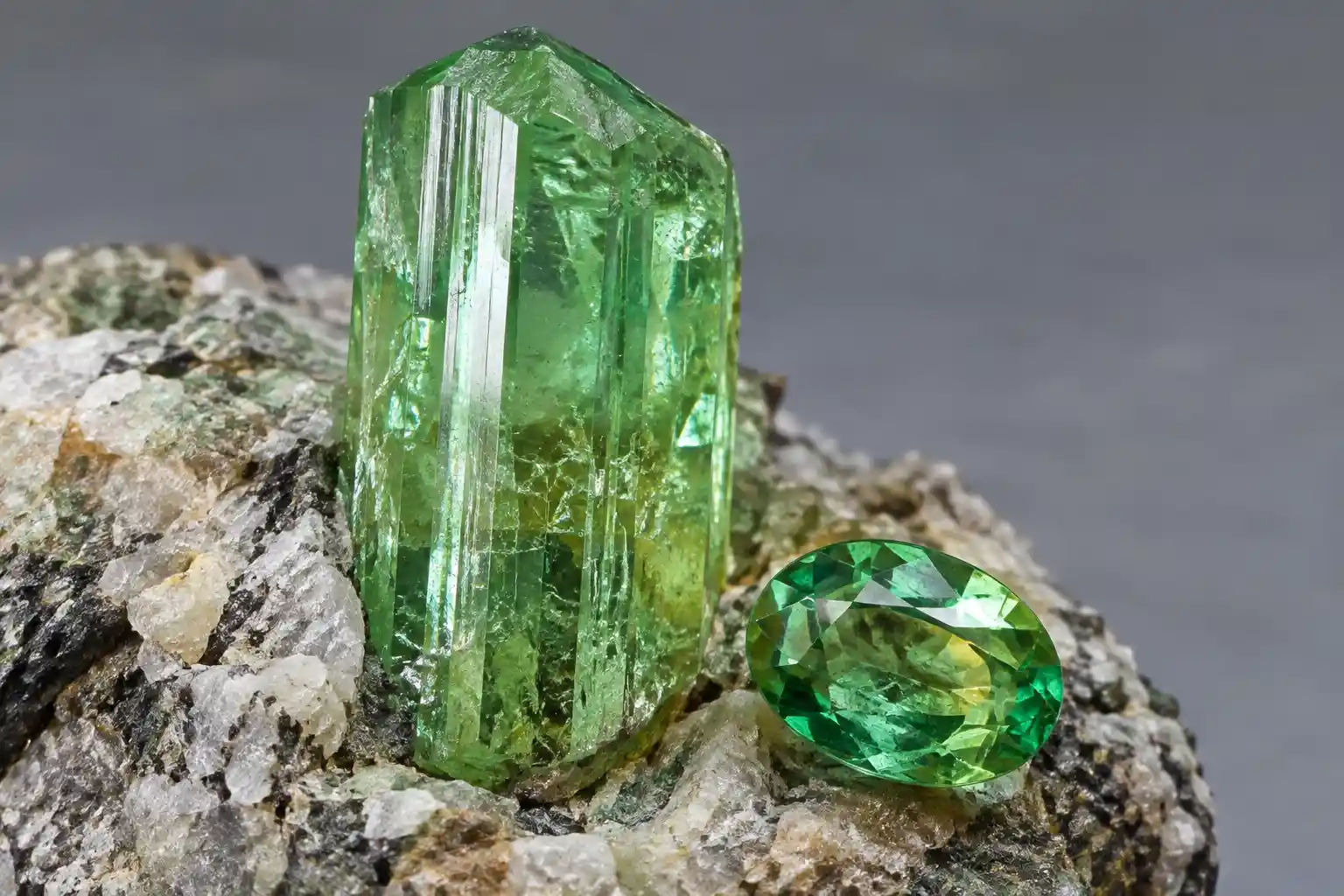
Hiddenite benefits begin with a rare combination of transparent green color, spodumene chemistry, distinctive crystal growth, useful hardness, and strong historical ties to North Carolina. Hiddenite is the green gem variety of spodumene, LiAlSi₂O₆, a lithium aluminum silicate mineral that also includes the pink-to-lilac variety kunzite. In its strictest gemological sense, Hiddenite refers especially to chromium-bearing green spodumene, with the historic North Carolina occurrence providing the classic standard for rich green color. Commercial usage can be looser, however, and pale green spodumene from other localities is sometimes sold under the Hiddenite name even when its color mechanism differs.
Fine Hiddenite can range from yellowish green and light green through bluish green, grass green, and unusually vivid emerald-like tones. Chromium is responsible for the celebrated green color of classic North Carolina Hiddenite, while other green spodumene may receive its appearance from different trace-element combinations or color centers. Transparent gem-quality crystals are comparatively uncommon, particularly when strong color, good clarity, and enough size for faceting occur together. That rarity gives Hiddenite benefits substantial importance in gemstone collecting and helps explain why high-quality stones are far less familiar than emerald, peridot, or green tourmaline.
Spodumene has a Mohs hardness around 6.5 to 7, but it also possesses strong cleavage and can be brittle. Hiddenite therefore combines respectable scratch resistance with a real risk of splitting or chipping after a poorly directed impact. These physical facts matter just as much as color when deciding whether a stone is suited to jewelry. Modern spiritual traditions also associate Hiddenite benefits with emotional openness, compassion, renewal, hope, or heart-centered reflection, but those interpretations remain symbolic rather than medical.
9 Hiddenite Benefits at a Glance
- Rare natural green color gives fine Hiddenite strong gem and collector appeal.
- Chromium-bearing North Carolina crystals provide an important example of trace-element coloration in spodumene.
- Pleochroism can reveal different green or yellow-green tones as the crystal is viewed from changing directions.
- Mohs hardness around 6.5 to 7 gives useful resistance to everyday scratching when jewelry is worn carefully.
- Transparent crystals can produce attractive faceted gems with a distinctive appearance separate from emerald or tourmaline.
- Pegmatite geology connects Hiddenite with lithium-rich mineral systems and other important gem minerals.
- Historic North Carolina discoveries give the gemstone a genuine regional identity and mineralogical story.
- Identification teaches buyers to distinguish Hiddenite from other green spodumene, glass, tourmaline, beryl, peridot, and imitations.
- Modern symbolism can represent renewal, compassion, or thoughtful personal growth when kept separate from medical claims.
Rare Green Spodumene Gives Hiddenite Its Strongest Gemstone Appeal
The most visible Hiddenite benefits come from its green color, particularly when a crystal approaches the vivid grass-green or emerald-like appearance historically associated with North Carolina specimens. Such stones are rare because gem-quality spodumene must combine transparency, desirable color, limited fracturing, and enough intact rough to survive cutting despite cleavage. A pale green crystal may still be attractive, but intense chromium-related color can place a fine specimen into a very different collector category.
Color also requires careful terminology. Hiddenite is often used commercially for almost any green spodumene, yet gemological usage has long distinguished classic chromium-bearing Hiddenite from ordinary pale green or yellow-green spodumene whose color may not have the same cause. This distinction matters because color origin, rarity, locality, and market expectations can differ considerably. A buyer comparing Hiddenite quality should therefore consider hue, saturation, transparency, clarity, pleochroism, cutting, durability, and identification together rather than assuming every green spodumene belongs to one equivalent quality class.
The rarity of richly colored transparent crystals also means photographs deserve cautious interpretation. Strong editing, dark backgrounds, and selective lighting can make a pale stone appear dramatically deeper green than it looks under ordinary conditions. Fine Hiddenite benefits from honest imaging because its natural color is impressive enough without artificial saturation.
Chromium Coloration Makes Hiddenite Scientifically Interesting
Classic North Carolina Hiddenite provides an important example of trace-element coloration within the spodumene structure. Chromium can substitute into the crystal lattice and produce vivid green absorption behavior, creating shades that differ markedly from the pink manganese-related appearance of kunzite. This chemical contrast makes Hiddenite benefits especially useful for gemology students because two gems within the same mineral species can look completely different when small amounts of different elements affect how visible light is absorbed.
The relationship also illustrates why color names alone are insufficient for identification. Green does not automatically mean chromium, and a green spodumene from another source may contain different coloring influences. Laboratory spectroscopy and chemical analysis provide stronger evidence than visual appearance when color origin matters commercially or scientifically.
For collectors, this chemistry adds another layer of interest to locality. A North Carolina crystal with documented provenance and strong chromium-related color carries a different story from pale green spodumene whose commercial label relies mainly on resemblance. The mineral species may be the same, but the geological and color history can differ substantially.
Pleochroism Adds Depth to Transparent Hiddenite
Spodumene is anisotropic and can display noticeable pleochroism, meaning color changes according to crystallographic viewing direction. In green spodumene, one direction may appear richer green while another becomes lighter, yellower, or less saturated. This creates Hiddenite benefits for both collectors and cutters because orientation influences how the finished gemstone presents its color face-up.
A lapidary working with transparent Hiddenite must therefore evaluate the rough before choosing a table direction. The orientation that preserves maximum weight may not produce the strongest green appearance, while the direction with the most desirable color may intersect cleavage or fractures unfavorably. Cutting becomes a balance between color, durability, transparency, symmetry, and weight retention rather than a simple matter of following the external shape of the crystal.
Pleochroism also helps distinguish Hiddenite from green gemstones whose color behaves differently. It is not a standalone identification test, but when combined with refractive properties, cleavage, density, inclusions, and other observations, it becomes part of a useful gemological profile.
Useful Hardness Is Balanced by Strong Cleavage
Hiddenite generally shares spodumene’s Mohs hardness of about 6.5 to 7, giving polished gems reasonable resistance to ordinary scratching. That hardness supports jewelry use, but the story changes when cleavage is considered. Spodumene has strong cleavage, and a well-directed blow can split or chip a stone even when the surface has resisted abrasion successfully.
This distinction gives Hiddenite benefits considerable educational value because it demonstrates why gemstone durability cannot be reduced to one hardness number. Scratch resistance and resistance to breakage are different properties, and a gem can perform well in one category while remaining vulnerable in another.
Pendants, earrings, brooches, and protected occasional-wear rings are generally more forgiving than exposed everyday rings. Settings that shield corners and girdle edges can reduce impact risk, while jewelry should be removed before sports, construction, heavy housework, or other activities likely to strike the stone against hard surfaces. These precautions allow Hiddenite’s color and transparency to remain practical without pretending that spodumene behaves like sapphire.
Faceting Can Reveal a Bright and Unusual Green Gem
Transparent Hiddenite rough can produce elegant faceted stones, particularly when the cutter finds an orientation that balances green saturation with brilliance. Ovals, cushions, pears, emerald-style cuts, and specialty designs can all work, although cleavage and elongated crystal habits often influence the final shape.
The optical character is different from emerald, green tourmaline, or demantoid garnet. Hiddenite does not need to imitate those gems because its value lies in its own spodumene identity, pleochroism, color, and rarity. Fine stones can appear bright and lively when transparent, while included examples may be more interesting as mineral specimens than as faceting rough.
These Hiddenite benefits also create an important decision for collectors. A complete natural crystal with strong color and documented locality may deserve preservation rather than cutting, especially if natural faces, terminations, or associations carry scientific significance. Faceting is most appropriate when the rough’s greatest value comes from transparent gem quality rather than specimen form.
Pegmatite Geology Connects Hiddenite with Lithium-Rich Mineral Systems
Spodumene commonly forms in granitic pegmatites, coarse-grained igneous environments capable of concentrating lithium and other elements during the late stages of magma crystallization. Pegmatites can grow exceptionally large crystals and may contain quartz, feldspar, mica, beryl, tourmaline, and other minerals alongside spodumene.
This geological setting gives Hiddenite benefits significant scientific depth. A green crystal is not merely decorative; it represents a particular chemical environment in which lithium, aluminum, silicon, and other elements became concentrated enough to produce spodumene. Trace chromium adds another geological requirement for classic Hiddenite coloration, making vivid green crystals even less common.
Natural specimens attached to matrix can preserve this context more effectively than loose cut stones. Associated minerals, crystal orientation, contact surfaces, growth features, and locality information may all help explain how the Hiddenite formed. For mineral collectors, those relationships can be just as valuable as transparency.
North Carolina Gives Hiddenite a Genuine Historical Identity
Hiddenite has one of the more specific geographic stories among American gemstones. Green spodumene was documented from Alexander County, North Carolina, and the variety was named in honor of William Earl Hidden, a mineralogist and exploration geologist closely associated with the discovery and development of the occurrence. The community of Hiddenite later took the same name, strengthening the relationship between the mineral and the region.
This history creates Hiddenite benefits that commercial labels from unrelated localities cannot reproduce automatically. A specimen documented from the classic North Carolina district carries mineralogical, geographic, and historical significance in addition to its color. Fine transparent stones from this occurrence are particularly celebrated because richly saturated chromium-bearing green spodumene is uncommon.
The history also provides a reason to avoid vague claims about ancient Hiddenite traditions. The variety name belongs to comparatively recent mineralogical history, so elaborate assertions that ancient cultures universally used Hiddenite for heart healing, manifestation, or spiritual awakening should be treated cautiously unless specific evidence exists.
Careful Identification Protects Hiddenite Buyers
Green gemstones overlap visually enough that photographs alone can cause confusion. Hiddenite can resemble green tourmaline, pale emerald, prasiolite, peridot, glass, synthetic stones, and other transparent green gems. Other green spodumene also complicates terminology because the mineral may be genuine spodumene even when the strict Hiddenite label is debatable.
Professional examination can consider refractive index, birefringence, pleochroism, density, inclusions, cleavage, spectroscopy, and chemistry. No single visual characteristic should carry the entire identification, particularly when the stone is expensive or accompanied by a specific origin claim.
Someone preparing to buy Hiddenite should therefore pay attention to species identification, whether the green color is natural, locality documentation when claimed, transparency, fracture condition, cutting, dimensions, and realistic color photographs. Accurate description protects the buyer while allowing genuine stones to be appreciated without exaggerated comparisons.
Modern Symbolism Can Represent Renewal and Compassion Without Healing Claims
Contemporary crystal culture frequently associates Hiddenite benefits with emotional openness, compassion, hope, forgiveness, renewal, and heart-centered awareness. The green color makes these themes easy to understand because green is widely associated with vegetation, spring, growth, and fresh beginnings.
A person may wear Hiddenite after a major transition because it represents rebuilding, choose it to mark an important relationship, or keep a crystal as a reminder to approach difficult conversations with greater compassion. Over time, those personal associations can become meaningful through memory and repeated use.
Beliefs surrounding Hiddenite healing properties may extend into claims about anxiety, depression, heart function, circulation, fertility, trauma, or physical recovery. These interpretations belong to spiritual and wellness traditions rather than established clinical medicine. Hiddenite can symbolize emotional growth without medically changing emotional or cardiovascular health.
Responsible Care Protects Cleavage, Color, and Collector Value
Because spodumene combines moderate hardness with strong cleavage, Hiddenite jewelry deserves careful handling. Lukewarm water, mild soap, and a soft brush are appropriate for many stable stones, while steam, aggressive ultrasonic cleaning, sudden heat, and strong mechanical pressure are poor choices when fractures or cleavage risks are present.
Storage should keep the gem away from harder stones capable of scratching it, and loose specimens should be handled over a padded surface. Natural crystals can develop thin terminations or cleavage-sensitive edges that break more easily than a compact polished cabochon suggests.
Lapidary work requires ordinary mineral-dust precautions, including wet methods, ventilation, eye protection, and appropriate respiratory controls. Hiddenite should never be ground for ingestion or used as a homemade source of lithium, chromium, or other elements. Its chemical composition does not make it a dietary or medical product.
These limits allow the genuine Hiddenite benefits of rarity, color, geology, collecting, and symbolism to remain the focus.
Conclusion
Hiddenite benefits include rare natural green color, chromium-related gem chemistry, pleochroism, useful hardness, faceting potential, pegmatite geology, North Carolina history, gem identification, collector appeal, and thoughtful modern symbolism. Its position within the spodumene family makes it particularly valuable for understanding how trace chemistry and crystal orientation affect gemstone appearance.
The strongest Hiddenite benefits become clearer when the stone is evaluated according to its actual identity rather than loose commercial comparisons. Fine green color, transparency, provenance, careful cutting, and accurate terminology matter, while strong cleavage requires sensible jewelry use. Symbolic themes involving renewal or compassion can add personal meaning without becoming medical promises.
FAQs
What are the main Hiddenite benefits?
The most practical Hiddenite benefits include rare green gemstone color, collectible spodumene crystals, faceting, jewelry use, pleochroism, mineral education, pegmatite geology, and North Carolina mineral history. Modern symbolism involving renewal, hope, compassion, or personal growth can also add meaning, but these themes should remain separate from claims about physical or psychological treatment.
What is Hiddenite made of?
Hiddenite is the green gem variety of spodumene, a lithium aluminum silicate with the formula LiAlSi₂O₆. Classic richly colored Hiddenite from North Carolina is associated with chromium, while pale green spodumene from other localities may have different color mechanisms and is sometimes marketed under the same name even though the terminology is debated.
How hard is Hiddenite?
Hiddenite generally has a Mohs hardness around 6.5 to 7, which gives it useful resistance to everyday scratches but does not make it exceptionally tough. Spodumene has strong cleavage, so a sharp impact in an unfavorable direction can split or chip a stone even when the polished surface has held up well against abrasion.
Is Hiddenite suitable for jewelry?
Hiddenite can make beautiful jewelry when the setting protects the stone and the wearer understands its cleavage. Pendants and earrings are relatively safe choices, while rings benefit from protected settings and should be removed during manual work, sports, or activities likely to expose the gem to repeated impact.
Why is North Carolina Hiddenite important?
The classic Hiddenite occurrence is associated with Alexander County, North Carolina, where richly colored chromium-bearing green spodumene became historically important and gave the variety its name. Documented North Carolina specimens therefore carry a specific combination of mineralogical, geographic, and collecting significance that cannot be established from green color alone.
Is every green spodumene Hiddenite?
Commercial usage varies, but strict gemological usage often reserves Hiddenite especially for chromium-bearing green spodumene, with the classic North Carolina occurrence serving as the historical standard. Pale green spodumene from other sources may be genuine spodumene while still raising questions about whether the Hiddenite variety name is the most precise description.
Does Hiddenite fade in light?
Color stability can vary among spodumene varieties and color mechanisms, so valuable green stones are best protected from unnecessary prolonged intense light and heat when their exact color origin is uncertain. Classic chromium-colored Hiddenite is discussed differently from artificially irradiated or unstable green spodumene, which makes accurate identification and treatment history important.
Can Hiddenite be confused with emerald?
Yes. Fine green Hiddenite can overlap visually with some emeralds, especially in photographs, but the minerals have different chemistry, optical properties, density, cleavage, and inclusion characteristics. Professional testing can distinguish spodumene from beryl without relying on color alone.
Does Hiddenite have healing powers?
There is no established clinical evidence that Hiddenite treats anxiety, depression, trauma, cardiovascular disease, fertility conditions, pain, or other physical or mental-health concerns through ordinary wearing or handling. Hiddenite benefits described as healing, heart-centered, emotional, chakra, renewal, or energetic effects remain spiritual and personal beliefs and should not replace qualified medical or mental-health care.