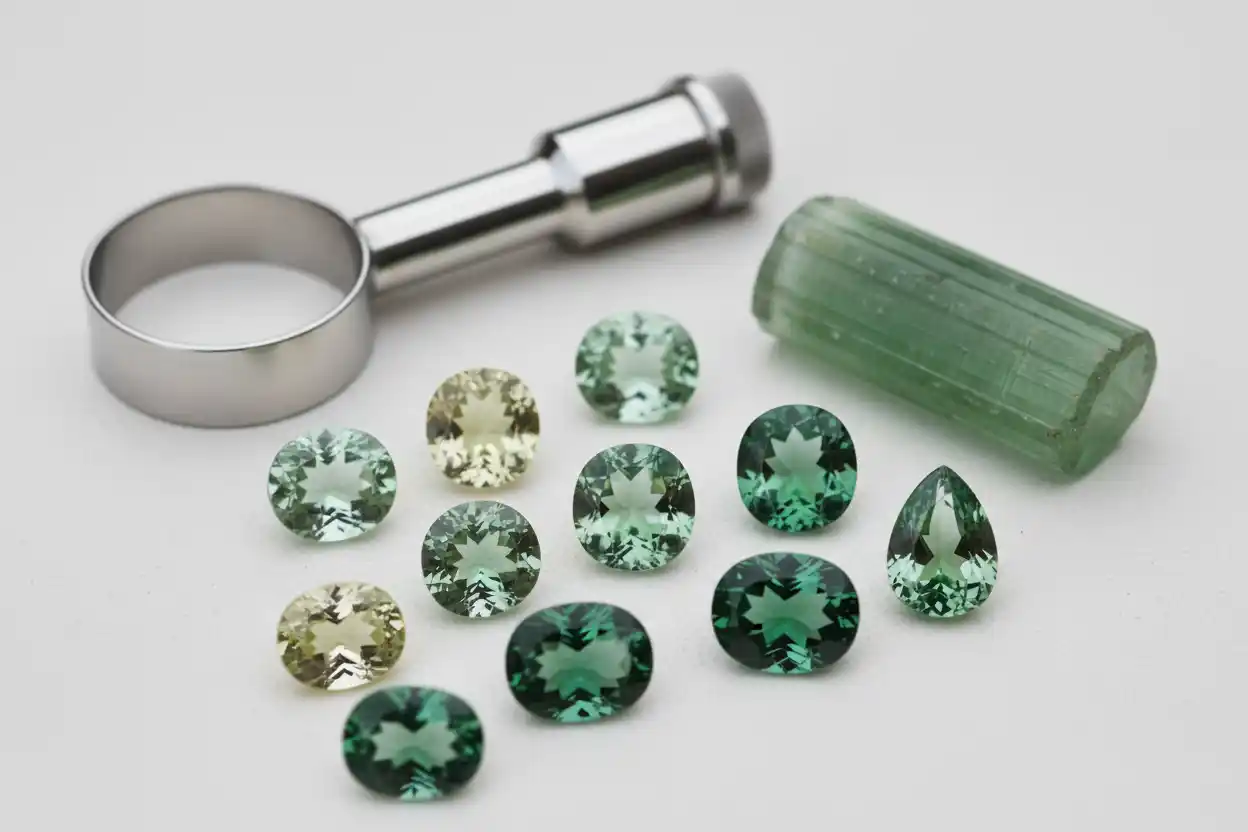
Buy Hiddenite: Smart Buying Tips & Red Flags
If you want to buy hiddenite intelligently, begin by separating three claims that are often bundled together in sales descriptions: green spodumene identity, naturally stable green color, and North Carolina provenance. A gemstone can be genuine natural spodumene without qualifying under a strict definition of hiddenite, and some spodumene can acquire an intense green color through irradiation that looks convincing when first sold but fades substantially after exposure to light.
That color-origin problem makes hiddenite fundamentally different from a generic green-gem purchase. Spodumene also has pronounced pleochroism and two perfect cleavage directions, so the strongest green may appear only along a particular crystal orientation while an otherwise beautiful stone can remain mechanically vulnerable to setting pressure or impact. When you buy hiddenite, color, orientation, treatment history, structural condition, and provenance therefore need to be evaluated together rather than as separate afterthoughts.
The strongest buying hierarchy is material identity first, stable natural green color second, pleochroic orientation third, transparency and cleavage condition fourth, cut and dimensions fifth, treatment evidence sixth, provenance seventh, and price last. A vivid green photograph, oversized carat number, or romantic “Carolina” description should never substitute for those fundamentals.
What to Judge First When You Buy Hiddenite
Hiddenite is green spodumene, a lithium aluminum silicate mineral belonging to the pyroxene group. The term is used more broadly by some sellers for transparent green spodumene from various localities, while stricter gemological usage associates hiddenite particularly with stable chromium-colored green material and historically important North Carolina stones.
The wider hiddenite properties guide explains the mineralogy, formation, color, history, inclusions, and broader gemological background. For a purchase, however, the order of evaluation matters more than a general description.
| Priority | What to evaluate | Why it matters |
|---|---|---|
| 1 | Natural green spodumene identity | Green color alone does not establish hiddenite |
| 2 | Color origin and stability | Irradiation can produce unstable green spodumene |
| 3 | Face-up green color | Attractive natural color should remain lively under neutral light |
| 4 | Pleochroic orientation | Poor orientation can make the gem pale or uneven |
| 5 | Cleavage and fractures | Spodumene can split along two perfect cleavage directions |
| 6 | Transparency | Fine faceted material should remain open and bright |
| 7 | Cut and dimensions | Windowing and deep pavilions can waste rare color |
| 8 | Treatment disclosure | Irradiation, heating, coating, filling, and repair should be addressed |
| 9 | Provenance | North Carolina origin can matter, but it requires evidence |
| 10 | Documentation and price | Evidence should become stronger as the premium grows |
When you buy hiddenite through this hierarchy, the word on the listing becomes less important than the gemstone itself.
Understand the Hiddenite Naming Problem
The first challenge when you buy hiddenite is terminology.
Historically, hiddenite became associated with emerald-green chromium-bearing spodumene from North Carolina, particularly material connected with the locality that now shares the gemstone’s name. In the broader trade, however, green spodumene from Afghanistan, Pakistan, Brazil, Madagascar, and other sources may also be offered as hiddenite.
That means two reputable sellers can use the word differently.
One may reserve hiddenite for naturally chromium-colored green spodumene.
Another may use hiddenite for essentially any attractive transparent green spodumene.
The practical solution is not to argue over the name. Ask the seller to describe the underlying claims separately:
What mineral is the stone?
What causes the green color?
Has the color been treated?
Does the green remain stable under ordinary light?
Where is the stone claimed to originate?
What evidence supports the provenance?
When you buy hiddenite, those answers matter far more than whether a retailer follows a broad or narrow naming convention.
“Lithia Emerald” Is Marketing, Not Mineral Identity
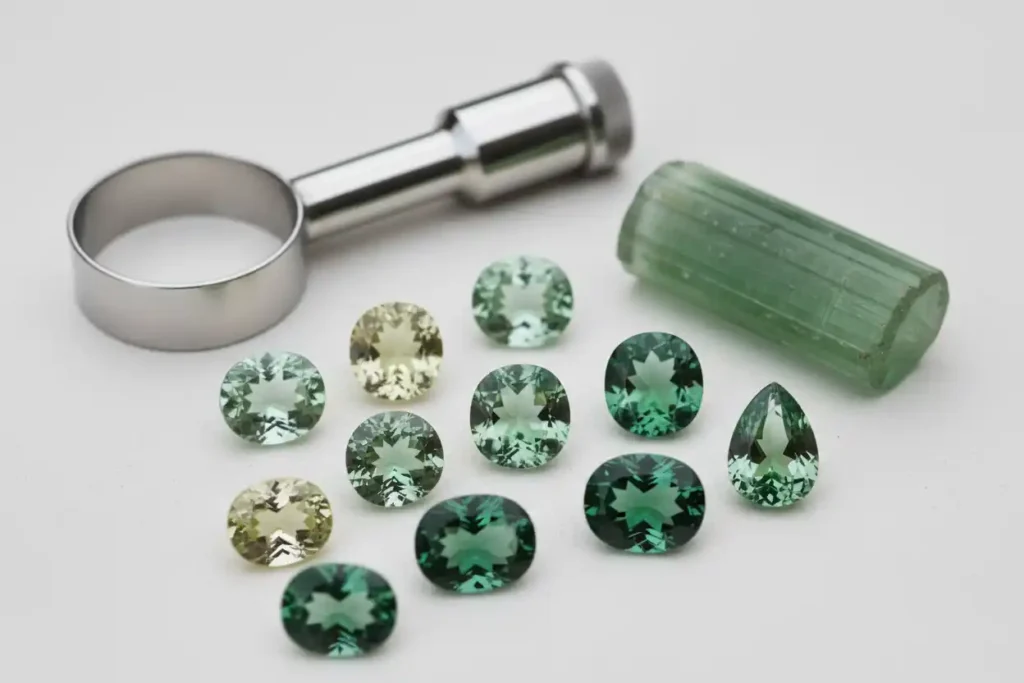
Hiddenite’s green color can overlap visually with emerald, which has led to romantic expressions such as “lithia emerald” or similar emerald-oriented descriptions.
Hiddenite is not emerald.
Emerald is chromium- or vanadium-bearing green beryl, while hiddenite is green spodumene. They have different compositions, crystal structures, optical properties, densities, cleavage behavior, durability, and market histories.
The emerald properties guide provides the beryl side of that comparison.
When you buy hiddenite, treat “emerald green” as a color description at most. It should not imply emerald composition, emerald durability, or emerald pricing.
A seller using the emerald name repeatedly while avoiding the word spodumene deserves closer scrutiny.
Color Is Important, but Stable Color Is More Important
Hiddenite can range from pale yellowish green and fresh grass green through richer medium green and, in fine material, more strongly saturated emerald-like green.
When you buy hiddenite, judge hue, tone, saturation, and brightness separately.
A pale stone may lack the saturation associated with fine material but still be attractive when transparency and cutting are excellent. A very dark stone may carry stronger apparent green yet lose brilliance or look almost black through portions of the face.
The best balance usually retains a recognizable green under normal illumination while allowing enough light to move through the gemstone.
However, no green should receive a major premium until you have addressed whether the color is stable and naturally associated with the stone rather than induced through an unstable treatment.
Irradiated Green Spodumene Is the Central Treatment Risk
Spodumene can respond dramatically to irradiation. Pink or pale material can be transformed into an intense green that resembles natural hiddenite closely enough to create a serious buying risk.
The crucial difference is stability.
Certain irradiation-created green colors in spodumene can fade quickly when exposed to ordinary bright light, shifting toward pale, pinkish, or nearly colorless appearances as unstable color centers disappear.
When you buy hiddenite, therefore, “natural spodumene” is not enough.
A gemstone can be naturally mined spodumene and still have an artificially induced green color.
Ask specifically whether the green color has been investigated for irradiation and whether the seller is representing it as stable natural color.
The broader gemstone treatment guide explains why natural geological origin and untreated color are separate claims.
Chromium-Colored Hiddenite Is Different From Unstable Irradiated Green
Classic hiddenite owes its characteristic green to chromium incorporated within the spodumene crystal rather than to the unstable irradiation color centers responsible for many treatment-created green stones.
That distinction is central when you buy hiddenite.
A stable chromium-related green is the type of material that supports the historical hiddenite identity and can justify a meaningful rarity premium. Irradiation-created green spodumene may still be genuine spodumene, but its treatment history and potential fading mean it should not be priced or represented as equivalent material.
For an inexpensive pale green stone, you may decide that exhaustive color-origin testing is unnecessary.
For a vivid, expensive gemstone whose value depends largely on stable natural green, the treatment question becomes one of the most important parts of the transaction.
Do Not Perform a Sunlight Fade Test Yourself
A buyer may be tempted to place a suspicious green spodumene in strong light to see whether the color fades.
That is a poor purchasing method.
If the stone has irradiation-induced color, you may permanently change its appearance and destroy evidence relevant to a return or dispute. If the gemstone is valuable, exposing it deliberately to conditions that may alter its color is unnecessary when professional testing is available.
When you buy hiddenite, treat color stability as something to establish through documentation, seller disclosure, controlled professional examination, and sensible observation rather than destructive experimentation.
If a seller actively recommends leaving the gemstone in strong light as an authenticity test, that itself should make you question the transaction methodology.
Evaluate Green Color Under Several Realistic Conditions
Once natural color has been addressed, judge the appearance itself.
When you buy hiddenite online, request actual-stone media under neutral broad light, ordinary indoor lighting, and a somewhat warmer environment. The purpose is not to force dramatic transformations but to understand whether the green remains attractive across realistic conditions.
Watch for:
- excessive gray;
- muddy brown influence;
- a center that becomes nearly colorless;
- one end that appears much yellower than the other;
- strong darkness at certain orientations;
- color that exists only against a black background;
- and suspiciously intense saturation that disappears in ordinary light.
The green gemstones guide places hiddenite alongside emerald, peridot, tsavorite, chrome diopside, tourmaline, and other green materials whose hues can overlap.
A strong hiddenite should remain recognizable as an attractive green gemstone without relying on aggressive presentation.
Pleochroism Changes How Hiddenite Should Be Cut
Spodumene is strongly pleochroic, meaning different crystal directions can show noticeably different colors.
A hiddenite may reveal green, yellowish green, and much paler directional appearances as it is rotated. A cutter therefore has to orient the rough carefully so that the strongest desirable green faces the viewer.
When you buy hiddenite, request a continuous rotation video.
A still photograph may show the gemstone from the single position where the green is strongest while hiding the fact that the stone becomes almost colorless after a modest tilt.
The strongest cut does not need to display identical color from every direction—pleochroism makes that unrealistic—but the normal face-up viewing range should remain attractive.
A badly oriented gemstone can carry excellent rough color yet deliver disappointing finished appearance.
Pleochroism Is Not the Same as Fading
Do not confuse a directional color shift with unstable treatment-created fading.
Pleochroism changes as the gemstone rotates relative to the viewer.
Fading changes the actual color state of the material after exposure to light or heat.
When you buy hiddenite, this distinction matters because a seller might explain a pale area as pleochroism when the stone has actually lost color, or a buyer might mistake normal directional variation for treatment instability.
A continuous video taken at one time reveals pleochroism.
Comparing the gemstone’s documented color over time and through proper testing addresses stability.
These are different questions.
Look for Color Zoning
Spodumene crystals can show uneven color distribution, and a cutter may orient an elongated shape to preserve the strongest green zones.
When you buy hiddenite, inspect whether the finished stone looks balanced rather than simply whether any green is present.
One end may be vivid while the other appears pale.
A lighter band may cross the table.
The center can lose color even though the ends remain saturated.
The stone can look green from one direction and yellowish from the opposite direction.
Color zoning is not automatically a defect and does not prove treatment. In fact, attractive natural zoning can add character.
The buying question is whether the zoning improves or weakens the face-up composition.
Compare Hiddenite With Kunzite
Hiddenite and kunzite are both varieties of spodumene, which means they share several physical characteristics even though their colors and market risks differ.
Kunzite ranges from pale pink through violetish pink and is associated primarily with manganese-related color. Hiddenite is green and, under stricter usage, associated with stable chromium-related coloration.
Both can show strong pleochroism.
Both have two perfect cleavage directions.
Both can be challenging to cut and set.
Both can be affected by color-treatment questions.
The kunzite properties guide explains the pink variety, while buyers considering it specifically can use the separate kunzite buying methodology.
When you buy hiddenite, the comparison is particularly useful because irradiated pink spodumene can be transformed into green material that imitates the appearance you are trying to purchase.
Clarity Should Support Transparency
Transparent hiddenite can be eye-clean or lightly included, and fine color deserves enough transparency to remain lively.
When you buy hiddenite, do not automatically reject every visible natural feature. Small crystals, tubes, growth structures, or enclosed inclusions may have little effect on appearance or durability.
Instead, distinguish harmless inclusions from dangerous structural features.
A tiny enclosed crystal near the girdle can be insignificant.
A broad reflective fracture running beneath the table can reduce beauty substantially.
A nearly invisible cleavage-related crack reaching a corner can be much more important than either because it creates a potential breakage path.
Clarity and durability need to be evaluated separately.
Two Perfect Cleavage Directions Are a Serious Jewelry Consideration
Spodumene has two perfect cleavage directions, making hiddenite much more vulnerable to directional impact than its surface hardness might suggest.
Its Mohs hardness is approximately 6.5 to 7, giving it reasonable resistance to ordinary scratching, but hardness does not prevent a stone from splitting after a concentrated blow or excessive setting pressure.
The gemstone hardness chart explains scratch resistance, while the hardness-versus-toughness guide explains why a gem can be fairly hard yet mechanically fragile. The separate gemstone cleavage guide is particularly relevant to spodumene.
When you buy hiddenite, structural condition should therefore receive more attention than it would for an equally clean sapphire.
Inspect Cleavage Damage Before Every Significant Purchase
Cleavage damage can appear as bright planar reflections, fissures, chips, internal separations, or fractures reaching the surface.
When you buy hiddenite, examine:
the entire girdle, every corner, pointed ends, the pavilion, the area beneath the table, and any location where a prong will apply pressure.
A damage-free stone should not show a suspicious reflective plane running from the surface deep into the gemstone.
A previously set hiddenite deserves additional scrutiny because prong tightening, removal, repair, or impact may already have created cleavage-related damage.
Do not accept “natural internal line” as a complete explanation for a feature that reaches the surface.
Ask whether it is a cleavage crack and whether it affects jewelry safety.
Cut Quality Must Balance Color and Survival
Hiddenite is challenging to facet because the cutter has to balance strong directional color, perfect cleavage, transparency, rough shape, and weight retention.
When you buy hiddenite, some cutting compromise can therefore be rational.
An elongated oval may follow the shape of the crystal while maximizing the best green orientation.
A deeper pavilion may preserve saturation.
An asymmetrical outline may avoid a dangerous cleavage plane.
Those compromises can make sense.
What should not be excused automatically is severe windowing, a permanently dark center, poor polish, very uneven facet junctions, or a fragile paper-thin girdle.
The strongest cut solves the material’s constraints while still producing a gemstone that looks intentional.
Watch for Windowing
Windowing occurs when a pavilion is too shallow or poorly proportioned to return enough light, leaving a broad central area through which the background remains visible.
When you buy hiddenite, severe windowing can be particularly damaging because it can make the middle appear paler than the already directional outer areas.
View the stone straight on over a neutral background.
If the center seems transparent while the strongest green collects around the edges, cutting may be weakening both brilliance and apparent saturation.
A small amount of transparency at some angles is normal.
A persistent empty-looking center should influence price.
Watch for Extinction Too
The opposite cut problem is excessive darkness.
A strongly colored hiddenite may develop large dark areas when the cut, tone, and viewing direction interact poorly. Some contrast is useful, but a gemstone whose face remains substantially black under ordinary light is not improved merely because the seller calls the color deep emerald green.
When you buy hiddenite, rotate the stone slowly and watch whether the dark zones move naturally or remain dominant.
The best balance retains green color without sacrificing brightness.
Compare Carat Weight With Face-Up Dimensions
Spodumene can form very large crystals, so size alone does not establish exceptional hiddenite rarity.
Fine stable naturally green material is much scarcer than ordinary pale, unstable, or treatment-created green spodumene, but a heavy stone should still be evaluated for how much visible size it provides.
When you buy hiddenite, request length, width, and depth in millimeters along with carat weight.
The hiddenite value guide explains the stone-specific pricing factors, while the broader gemstone pricing framework shows why color origin, treatment, cutting, provenance, and visible dimensions can matter more than raw weight.
A deep pavilion can preserve green color or avoid cleavage, but you should understand why you are paying for the extra depth.
Large Hiddenite Is Not Automatically Fine Hiddenite
Large spodumene crystals can occur naturally. The rarity increases when large size coincides with strong stable green, transparency, excellent cutting, good condition, and convincing provenance.
When you buy hiddenite marketed as a rare giant, ask what makes the stone rare beyond its weight.
Is the green chromium related?
Has treatment been excluded?
Does the color remain stable?
Is the stone transparent?
Is the cut efficient?
Is North Carolina provenance documented?
Does it contain serious cleavage damage?
A large pale or irradiation-created green spodumene should not inherit the market prestige of fine naturally colored hiddenite merely because both are heavy.
North Carolina Provenance Can Add Collector Value
North Carolina has a unique historical relationship with hiddenite. Classic chromium-colored material associated with the Hiddenite area created the gemstone’s identity in the first place, and documented stones from historic localities can attract serious collector interest.
When you buy hiddenite with a North Carolina premium, provenance deserves independent attention.
Useful support can include old collection labels, mine documentation, dealer invoices, rough-to-cut records, photographs of the original crystal, laboratory evidence, or a traceable chain of ownership.
A stone should not become “North Carolina hiddenite” merely because its green resembles known material.
The broader rarest gemstones guide provides useful scarcity context, but locality should never replace identity and color-origin evidence.
“American Hiddenite” Needs More Than a Seller’s Assurance
A seller may use phrases such as American hiddenite, Carolina hiddenite, original hiddenite, classic hiddenite, or old-mine hiddenite.
Each claim potentially adds value.
Each therefore deserves evidence.
When you buy hiddenite specifically because it is represented as North Carolina material, ask whether the provenance applies to this exact stone rather than merely to the seller’s parcel, an old collection, or a similar-looking specimen.
The invoice should reflect the claim if the locality materially affects the price.
If the seller becomes vague when asked to put “North Carolina origin” in writing, reconsider how much of the premium you are willing to pay.
Green Spodumene From Other Countries Can Still Be Attractive
A green spodumene does not become worthless because it comes from Afghanistan, Pakistan, Brazil, Madagascar, or another locality.
Beautiful transparent material can be interesting and desirable regardless of whether a strict gemologist would call it hiddenite.
The important issue is accurate description.
When you buy hiddenite under a broad trade definition, you may knowingly choose attractive green spodumene from another locality because you value color and transparency more than historical provenance.
That can be a completely rational purchase.
Problems arise when non-North-Carolina material is marketed as though its locality, chromium content, treatment status, and color stability are already proven.
Distinguish Hiddenite From Emerald
Emerald can overlap significantly with strong green hiddenite in photographs.
The minerals differ fundamentally, and professional gemological testing can separate them through refractive properties, optical behavior, density, inclusions, spectroscopy, and other evidence.
When you buy hiddenite because you specifically want spodumene, do not rely on a seller saying the stone is “too light to be emerald” or “too clean to be emerald.”
Emerald can be pale or remarkably clean.
Hiddenite can be strongly green or included.
The separate emerald buying guide shows how different the buying methodology becomes once the material is beryl rather than spodumene.
Peridot Is Another Common Green Comparison
Peridot commonly shows yellowish green to green color and can overlap with lighter hiddenite in online images.
The two minerals have different compositions, refractive behavior, density, inclusions, and optical characteristics.
The peridot properties guide provides the mineral context, while the dedicated peridot buying guide explains its material-specific value factors.
When you buy hiddenite at substantial value, there is no reason to risk destructive home tests to separate the materials.
Proper identification is simpler and safer.
Tsavorite and Chrome Diopside Can Also Overlap Visually
Tsavorite garnet can show vivid green color with excellent brilliance, while chrome diopside may produce saturated forest-to-emerald green at relatively accessible prices.
Both can resemble hiddenite in photographs.
The chrome diopside guide explains one of those alternatives, while buyers comparing premium green garnet can use the tsavorite buying methodology.
When you buy hiddenite, the comparison can actually improve your decision. Hiddenite is worthwhile when you specifically value its spodumene identity, pleochroism, rarity, provenance, or color character.
If your only goal is durable vivid green jewelry, another gemstone may suit you better.
Treatment Questions Should Go Beyond Irradiation
Irradiation is the central concern, but it should not become the only treatment question.
When you buy hiddenite, ask whether the gemstone has also been heated, surface coated, fracture filled, dyed, impregnated, repaired after cutting, or assembled with another material.
None of these treatments should be assumed solely from appearance.
Likewise, a gemstone that looks completely natural should not automatically be declared untreated.
A good invoice separates natural spodumene identity from treatment disclosure.
“Untreated” Should Be Supported When It Carries a Premium
The phrase untreated is commercially meaningful only when the price actually depends on it and the evidence is strong enough to support it.
When you buy hiddenite at a collector-level premium for natural chromium coloration, independent examination becomes far more useful than a seller’s in-house certificate.
A document saying “natural hiddenite” may not answer whether the green is irradiation induced.
Read the scope of the report.
Does it address treatment?
Does it discuss color origin?
Does it provide measurements that match the gemstone?
Does it identify the material specifically?
The details matter.
When a Laboratory Report Is Worth Paying For
A small inexpensive pale green stone may not justify extensive testing.
A high-value hiddenite often does.
Independent laboratory documentation becomes particularly useful when you buy hiddenite and:
- vivid natural green carries a substantial premium;
- irradiation must be excluded;
- stable chromium-related color is claimed;
- North Carolina provenance is important;
- the stone is unusually large;
- exact mineral identity is uncertain;
- another green gemstone remains a plausible lookalike;
- or the purchase is collector oriented.
The gemstone certification guide explains why independent gemological identification, treatment analysis, provenance documentation, seller cards, and financial appraisals answer different questions.
The amount of evidence should rise with the financial consequences of being wrong.
Match the Report to the Current Stone
A genuine laboratory report has little value if it belongs to a different gemstone or describes a stone before its condition changed.
When you buy hiddenite, compare report weight, dimensions, shape, color, photograph where supplied, and major inclusion features with the actual stone.
If the gemstone has been recut, the old measurements may no longer correspond.
If the color has faded since examination, the visual description may no longer match.
If the gemstone is now mounted, some identifying features may be hidden beneath metal.
Resolve those discrepancies before paying a premium based on the report.
Report and Appraisal Are Different
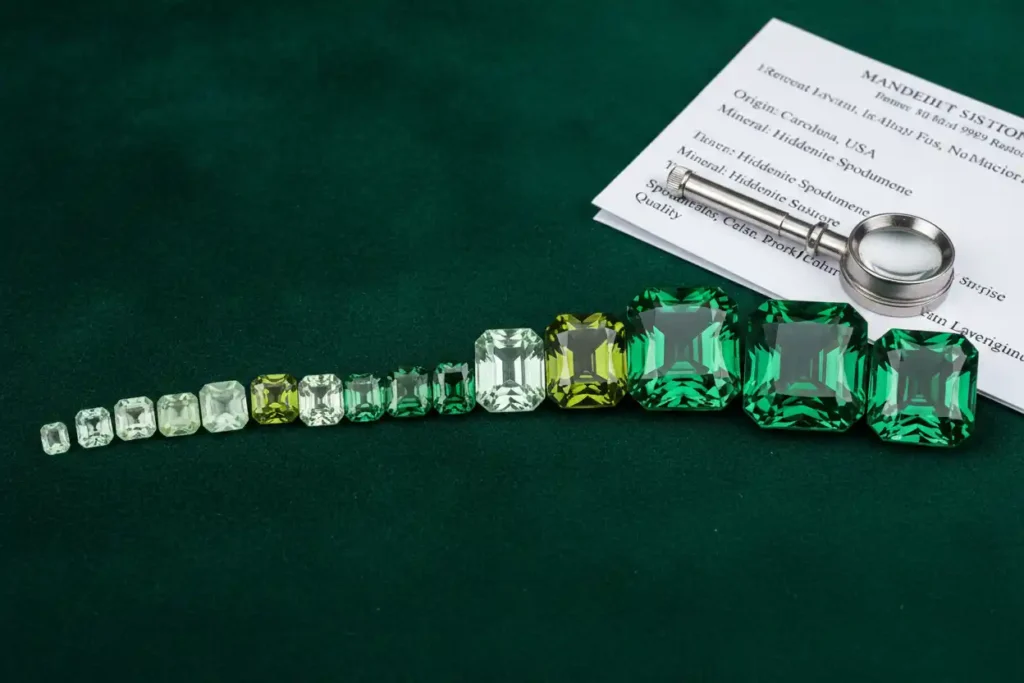
A gemological report addresses material identity and related scientific observations within its scope.
An appraisal estimates monetary value for a defined purpose.
When you buy hiddenite, an impressive replacement-value appraisal does not prove chromium color, North Carolina origin, or absence of irradiation.
Likewise, a laboratory report identifying a rare natural stone does not guarantee that the seller’s asking price is appropriate.
Use scientific documentation for identity and treatment.
Use realistic market comparison for price.
Do not allow one document to substitute for the other.
Seller Grades Such as AAA Are Not Universal
You may encounter AAA, AAAA, 5A, collector grade, museum grade, investment grade, emerald grade, or vivid green grade.
Hiddenite has no single universal retail grading framework that gives those expressions identical meaning across sellers.
When you buy hiddenite with one of these grades, translate it into actual attributes.
How green is the stone in neutral light?
Is that green stable?
What supports chromium coloration?
How transparent is it?
How well is the pleochroism oriented?
Are there cleavage cracks?
How efficient is the cut?
What are the dimensions?
Does the provenance have evidence?
If those questions are unanswered, the seller grade adds little useful information.
“Flawless” Does Not Mean Structurally Safe
A gemstone may look exceptionally clean under magnification and still contain a dangerous cleavage-related weakness near an edge.
When you buy hiddenite, do not allow the word flawless to end the inspection.
Look specifically for planar reflections, edge-reaching fissures, chips, bruises, and stress around prong locations.
Clarity grading language can focus attention on what is visible through the center while the most consequential weakness sits near the girdle.
For spodumene, structural inspection is more important than winning a contest for microscopic perfection.
Online Photography Can Exaggerate Hiddenite Dramatically
Green gemstones are easy to manipulate through cool lighting, saturation, dark backgrounds, and white-balance changes.
When you buy hiddenite online, request continuous actual-stone video against a neutral background.
The video should include complete rotation rather than one narrow face-up oscillation. You need to see how the pleochroism behaves, whether color zoning becomes obvious, and whether any pale axis dominates when the gem moves.
Also request side and pavilion photographs.
The broader online gemstone buying guide covers payment protection, seller verification, shipping, documentation, and return terms.
With hiddenite, visual honesty is especially important because a stationary image can conceal both pleochroism and instability concerns.
Ask Whether the Media Shows the Stone’s Current Color
This question is unusually important when you buy hiddenite.
A seller may photograph a vivid irradiation-created green stone soon after treatment or acquisition and continue using those images after the gem begins to fade.
The listing then represents an appearance the stone no longer has.
Ask the seller to confirm that the current gemstone matches the current media. For an expensive purchase, a fresh live video or real-time comparison can be more useful than highly polished older photographs.
If the stone is now lighter than the listing, the discrepancy should be addressed before payment.
Side and Pavilion Views Reveal Hidden Weight and Damage
A face-up image can hide excessive pavilion depth, cleavage cracks, girdle chips, repairs, cavities, and other important features.
When you buy hiddenite remotely, insist on enough side information to understand the three-dimensional gemstone.
A deep pavilion is not automatically bad because cutting may have been required to preserve green orientation or avoid cleavage. However, the extra depth should produce a meaningful benefit.
If it merely adds carat weight while reducing face-up size, the buyer should not treat those hidden carats as equivalent to visible spread.
Return Terms Are Essential for Expensive Hiddenite
A strong return policy gives you the opportunity to compare the gemstone with its description under your own lighting and, when warranted, obtain independent non-destructive examination.
Before you buy hiddenite online, confirm whether professional inspection is permitted during the return period.
Do not expose the stone deliberately to harsh light, heat, chemicals, ultrasonic cleaning, or another experimental test. Such actions may alter the gemstone and complicate return rights.
Likewise, do not resize, reset, repolish, engrave, or modify a returnable piece before deciding to keep it.
The inspection process should preserve the gemstone’s original condition.
The Invoice Should Preserve Premium-Bearing Claims
A meaningful invoice for high-value hiddenite should state more than “green stone.”
Useful wording may include natural green spodumene or natural hiddenite, carat weight, dimensions, disclosed treatments, claimed natural color status where supported, geographic provenance where relevant, and laboratory report number.
When you buy hiddenite at a North Carolina premium, the written documentation should reflect that provenance if it formed part of the sale.
When you buy hiddenite because the seller represents it as untreated chromium-colored material, that representation should not vanish from the invoice.
The more specific the premium, the more precise the transaction record should be.
Ring Buyers Need to Be Conservative
Hiddenite can be mounted in rings, but its two perfect cleavage directions make unrestricted everyday ring wear a demanding use.
When you buy hiddenite for a ring, choose a stone with no important cleavage crack beneath the proposed setting points, a sound girdle, and no exposed fragile corner.
A low-profile protective setting reduces the opportunity for impact. Bezels or partial bezels can provide useful protection when a jeweler understands spodumene’s cleavage and does not apply excessive pressure.
Pears, marquises, and other pointed shapes need additional attention at the tips.
The green engagement-ring gemstone guide is useful if you are deciding whether hiddenite’s rarity and color justify accepting more care than harder green options require.
Pendants and Earrings Are Safer Choices
For many buyers, pendants and earrings make more practical use of fine hiddenite.
These positions receive fewer direct impacts and less constant contact with desks, doors, tools, and hard surfaces. They also allow a large transparent gemstone to display its pleochroic green without exposing it to the pressure and shock associated with frequent hand wear.
When you buy hiddenite with important natural color or documented provenance, choosing lower-risk jewelry can help preserve a difficult-to-replace stone.
Rarity should influence how you wear the gemstone, not merely what you pay.
Cleaning Should Be Gentle
Spodumene’s cleavage and sensitivity to sudden physical or thermal stress make conservative cleaning the best default.
For a sound untreated stone in a secure setting, gentle hand cleaning with mild soap, lukewarm water, and a soft brush is preferable to aggressive methods.
Avoid steam.
Avoid ultrasonic cleaning.
Avoid sudden temperature changes.
Do not expose hiddenite to strong heat during repair without first informing the jeweler about the material and any possible treatment history.
Storage matters too. Keep the stone separated from harder gems so repeated contact does not abrade the polish or strike cleavage-sensitive edges.
Major Red Flags When You Buy Hiddenite
| Red flag | Why it matters |
|---|---|
| Any green spodumene called hiddenite without explanation | The name is used inconsistently |
| Vivid green presented as proof of chromium color | Irradiation can create intense green |
| “Natural spodumene” used as proof of untreated color | Natural material can still be irradiated |
| Seller refuses to discuss color stability | Fading is a central hiddenite risk |
| Strong green shown only in old photographs | Current color may differ |
| Sunlight fade testing recommended to the buyer | The test can permanently alter treated color |
| One face-up photograph only | Pleochroism may hide a pale axis |
| North Carolina origin inferred from green color | Provenance requires separate evidence |
| “Lithia emerald” treated as mineral identity | Hiddenite is spodumene, not emerald |
| Large carat weight used as proof of rarity | Spodumene can form large crystals |
| Heavy stone with small face-up dimensions | Pavilion depth may be hiding weight |
| Broad transparent central window | Cutting may weaken color and brilliance |
| Strong dark zones marketed as deep color | Excessive extinction may be present |
| Bright planar fracture near the girdle | Perfect cleavage can create serious structural risk |
| “Flawless” used to dismiss cleavage inspection | Clarity and structural condition are different |
| AAAA or investment grade presented as universal | Seller grades are not standardized |
| Seller certificate used instead of independent treatment analysis | It may simply repeat the seller’s claims |
| Appraisal used to prove chromium color or origin | Valuation does not establish gemological facts |
| Report measurements do not match the stone | Documentation may belong to another gem |
| Final-sale terms despite unresolved color origin | Independent inspection becomes difficult |
Several of these warning signs together are a strong reason not to buy hiddenite until the evidence improves.
A Practical Buy Hiddenite Decision Matrix
Strong purchase: The stone is confidently identified as natural green spodumene, shows attractive green color under neutral light, maintains useful color through normal pleochroic rotation, has no dangerous cleavage damage, is competently cut, and has treatment disclosure proportional to its price.
Strong natural-color purchase: The green is supported as stable and chromium related, the stone remains transparent and well oriented, treatment concerns are resolved, and the price reflects genuine color rarity rather than merely intense appearance.
Strong value purchase: The stone is lighter green, slightly included, from a less prestigious locality, or somewhat asymmetrical, yet remains naturally attractive, structurally sound, well cut, and accurately represented.
Broad-definition purchase: The stone is natural green spodumene from outside North Carolina and is being sold as hiddenite under a broader trade usage. The description makes that naming choice clear, and you are paying for the actual color and quality rather than implied historic provenance.
Collector purchase: The gemstone combines stable natural green, fine transparency, excellent orientation, unusual size, strong condition, and credible North Carolina or other important provenance. Several difficult qualities occur together.
Documentation-dependent purchase: A substantial part of the asking price depends on chromium coloration, untreated status, North Carolina origin, unusual size, or another claim that cannot be established securely through ordinary visual examination.
Poor purchase: The stone is vivid but suspiciously unstable, heavily windowed, excessively deep, poorly oriented, structurally fractured, or priced mainly through seller-created grading.
Walk away: The green color fades, irradiation is concealed, provenance documentation conflicts with the stone, a major cleavage crack is hidden, or the seller refuses reasonable independent inspection.
Where the Best Value Often Appears
The strongest value when you buy hiddenite does not always lie in the deepest green or most famous provenance.
A lighter naturally green stone with excellent transparency, strong orientation, and safe cutting can be more satisfying than a deeper stone whose treatment history is uncertain.
Likewise, an attractive green spodumene from another locality can provide compelling beauty at a more accessible price when the seller describes it accurately rather than presenting it as classic North Carolina material.
Some buyers may prefer to allocate their budget toward stronger natural color.
Others may care more about historical provenance.
Others may simply want an unusual transparent green gemstone.
Value improves when you know which of those qualities you are actually paying for.
Final Buying Method
The smartest way to buy hiddenite is to treat green spodumene identity, stable natural color, and historic provenance as three separate claims.
First confirm that the gemstone is spodumene. Then determine whether the green is naturally stable or potentially related to irradiation. Judge the actual hue, tone, saturation, and brightness under neutral lighting, and rotate the stone enough to understand how strongly pleochroism changes the face-up appearance.
Next, inspect transparency and structural condition separately. A harmless crystal inclusion is not equivalent to a cleavage crack, and spodumene’s two perfect cleavage directions make that distinction critical. Examine the girdle, corners, pavilion, and setting points before deciding whether the stone is appropriate for jewelry.
After that, evaluate cut quality, windowing, extinction, carat weight versus millimeter dimensions, and whether the cutter has oriented the strongest green effectively.
Only then should you pay additional premiums for chromium-related color, North Carolina provenance, unusual size, collector rarity, or special documentation.
When you buy hiddenite through this hierarchy, you are far less likely to pay classic-hiddenite prices for unstable green spodumene. The strongest purchase is the stone whose mineral identity, color origin, stability, pleochroism, structural condition, cutting, provenance, and price all tell the same convincing story.
Frequently Asked Questions
What should I check first when I buy hiddenite?
Confirm that the gemstone is natural green spodumene and then investigate how the green color formed. A vivid appearance is not enough because irradiation can create green spodumene whose color may fade substantially.
Is every green spodumene hiddenite?
Not under every naming convention. Some sellers use hiddenite broadly for green spodumene, while stricter usage reserves it for stable naturally green material, particularly chromium-bearing stones associated historically with North Carolina.
What is the best hiddenite color?
Fine hiddenite can show fresh yellowish green through richer emerald-like green. The strongest color should have enough saturation to look distinctly green while remaining bright rather than gray, muddy, or excessively dark.
What causes natural hiddenite to be green?
Classic hiddenite is associated with chromium-related green coloration within spodumene. This is different from unstable green created in some spodumene through irradiation.
Can spodumene be irradiated to look like hiddenite?
Yes. Irradiation can produce intense green in spodumene, including material that resembles natural hiddenite visually. Some irradiation-created green can fade rapidly under light, making treatment disclosure essential.
Does irradiated green spodumene count as natural hiddenite?
The underlying spodumene can be naturally mined, but its green color has been artificially induced. It should not be represented as equivalent to stable naturally chromium-colored hiddenite without clear treatment disclosure.
Does real hiddenite fade?
Stable chromium-related hiddenite is different from the unstable irradiation-induced green seen in some treated spodumene. Any expensive vivid-green stone should still have its color origin investigated rather than relying solely on appearance.
Should I test hiddenite by putting it in sunlight?
No. Intense light can alter unstable treated color, permanently changing the stone and complicating return rights. Professional examination is safer than deliberately trying to fade a gemstone.
Why does hiddenite change color when I rotate it?
Spodumene is strongly pleochroic, so different crystal directions can show different green, yellow-green, or much paler appearances. Skilled cutting should orient the most attractive direction face-up.
Is pleochroism the same as fading?
No. Pleochroism changes with viewing direction, while fading means the stone’s actual color state changes after exposure to light or heat.
Is hiddenite the same mineral as kunzite?
Yes. Both are spodumene varieties. Hiddenite is green, while kunzite is pink to violetish pink. They share strong pleochroism, perfect cleavage, and demanding cutting considerations.
Is hiddenite the same as emerald?
No. Hiddenite is spodumene, while emerald is green beryl. Their composition, optical properties, crystal structure, durability, treatments, and value systems are different.
How can hiddenite be distinguished from emerald?
Professional gemologists can compare refractive properties, optical character, density, inclusions, spectroscopy, and other evidence. Color alone is not enough for a reliable identification.
Is North Carolina hiddenite more valuable?
Documented North Carolina material can carry significant historical and collector interest, particularly when stable chromium-related green color is also established. The premium depends on credible provenance rather than simply a seller using the locality name.
Does green color prove North Carolina origin?
No. Green spodumene occurs outside North Carolina, and color alone cannot establish geographic provenance.
Can hiddenite come from Pakistan or Afghanistan?
Green spodumene occurs in several countries, including Pakistan and Afghanistan. Whether all such material should be called hiddenite depends on the naming convention being used, so the seller should describe identity, color origin, treatment, and locality separately.
Is hiddenite normally eye-clean?
Transparent hiddenite can be eye-clean or lightly included. Small natural inclusions may be acceptable, but reflective cleavage cracks and surface-reaching fissures deserve much greater concern.
Why is cleavage important when I buy hiddenite?
Spodumene has two perfect cleavage directions, so a concentrated impact or improper setting pressure can split the gemstone even though its surface hardness is reasonably good.
How hard is hiddenite?
As spodumene, hiddenite is approximately 6.5 to 7 on the Mohs scale. That gives it useful scratch resistance but does not protect it from cleavage-related breakage.
Is hiddenite suitable for an everyday ring?
It is a relatively risky daily-wear choice because perfect cleavage makes the stone vulnerable to directional impact. A protected low setting and careful wear can help, while pendants and earrings are generally safer.
Why do hiddenite dimensions matter?
Carat weight measures mass rather than visible spread. A deep pavilion can preserve color or avoid cleavage but may also hide weight below the girdle, so length, width, and depth should be compared with total carats.
Are large hiddenites always rare?
Large spodumene crystals can form naturally, so size alone does not establish exceptional hiddenite rarity. Large stones become much more significant when stable natural green color, transparency, sound condition, cutting, and provenance occur together.
Does hiddenite need a laboratory report?
A modest commercial stone may not justify extensive analysis, but a report is strongly advisable when natural chromium color, irradiation status, North Carolina provenance, unusual size, or high value materially influences the transaction.
Can an appraisal prove that hiddenite is untreated?
No. An appraisal addresses monetary value for a stated purpose. Gemological treatment analysis is needed to investigate color origin and irradiation.
What is the biggest mistake when you buy hiddenite?
The biggest mistake is paying for vivid green color or the hiddenite name before determining whether the gemstone is stable naturally green spodumene. When you buy hiddenite, mineral identity, color origin, pleochroic orientation, cleavage condition, cutting, provenance, and documentation should all support the price.