
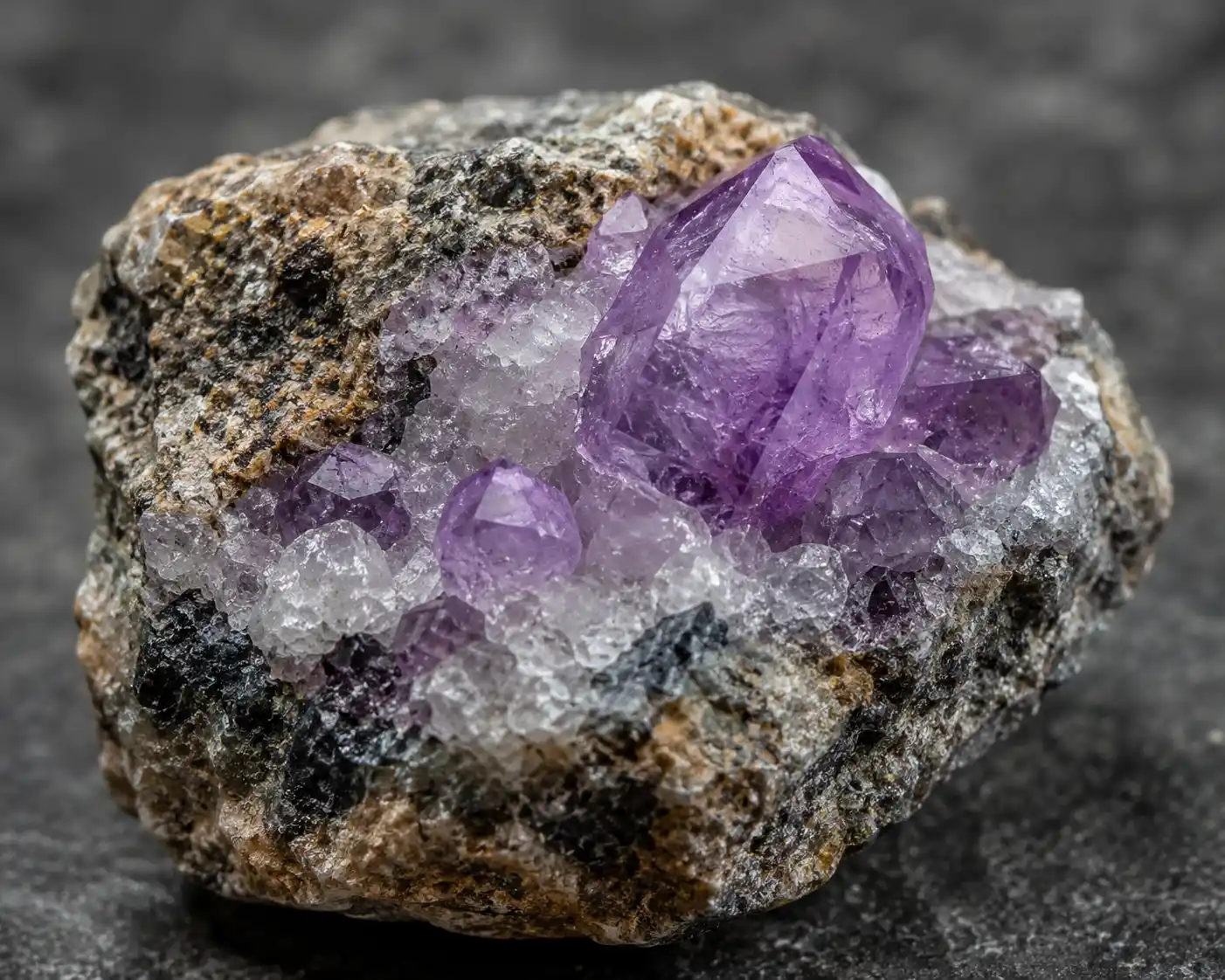

Gemstones form through several geological and biological processes rather than one universal recipe. Some crystallize as molten rock cools, others grow from mineral-rich fluids, and many develop when older rocks recrystallize under heat and pressure.
Diamonds form much deeper in Earth’s mantle than most colored stones. Opal and turquoise can develop comparatively close to the surface, while pearl and amber originate through biological processes. Obsidian and tektites are natural glasses, so they solidify without developing the ordered atomic structure of mineral crystals.
The formation environment controls which elements are available, how quickly crystals grow, what inclusions they trap, and whether the result becomes transparent gem rough, opaque ornamental material, or an ordinary mineral specimen.
Gemstone formation at a glance
| Formation process | What happens | Typical gem examples |
|---|---|---|
| Magmatic crystallization | Minerals crystallize as magma or lava cools | Peridot, feldspar, zircon, some sapphire |
| Pegmatite growth | Water-rich late-stage magma produces unusually large crystals | Tourmaline, beryl, spodumene, topaz, quartz |
| Hydrothermal growth | Hot mineral-rich fluids deposit crystals in fractures and cavities | Emerald, quartz, amethyst, topaz, some sapphire |
| Metamorphism | Existing rock recrystallizes under heat, pressure, and reactive fluids | Ruby, sapphire, jade, garnet, tanzanite |
| Low-temperature aqueous deposition | Minerals precipitate from water near Earth’s surface | Opal, turquoise, some agate and chalcedony |
| Mantle growth | Minerals crystallize at great depth under extreme conditions | Diamond, peridot |
| Weathering and secondary enrichment | Surface processes alter minerals and concentrate new gem material | Turquoise, malachite, chrysocolla |
| Sedimentary concentration | Durable gems erode from host rock and accumulate in gravel | Sapphire, ruby, diamond, zircon, garnet |
| Biological formation | Living organisms or organic material create the gem substance | Pearl, coral, amber |
| Natural-glass formation | Melt cools too quickly to crystallize | Obsidian, tektite, moldavite |
A gemstone is not always a single mineral crystal
Many gemstones are minerals with an ordered crystal structure, such as diamond, corundum, beryl, quartz, topaz, spinel, and tourmaline.
However, the gem trade also includes:
- Rocks composed of several minerals
- Natural glasses
- Amorphous or poorly crystalline materials
- Organic substances
- Biogenic materials produced by organisms
Lapis lazuli is a rock. Obsidian is natural volcanic glass. Amber is fossilized resin. Pearl forms through the activity of a mollusk. Opal consists of hydrated silica with a structure different from conventional crystalline quartz.
The broader classification appears in Types of Gemstones. The historical precious-versus-semi-precious system is explained separately in Precious vs Semi-Precious Stones.
Crystals need the right ingredients and conditions
A mineral crystal forms when atoms or ions arrange themselves into a repeating internal structure. The process requires:
- The necessary chemical elements
- Suitable temperature and pressure
- A fluid, melt, vapor, or solid environment that permits rearrangement
- Space for growth
- Enough time
- Chemical conditions that favor one mineral instead of another
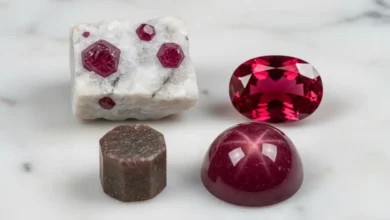
Small changes can create different minerals. Ruby and sapphire are both corundum, primarily aluminum oxide. Trace chromium can produce ruby’s red color, while iron and titanium contribute to many blue sapphires.
Emerald is beryl colored mainly by chromium or vanadium. Its formation is unusual because beryllium commonly occurs in geological environments different from those that contain chromium and vanadium. The elements must meet under the right conditions.
Magmatic crystallization
Magma is molten rock beneath Earth’s surface. As it cools, different minerals crystallize according to their chemistry and the changing temperature.
Early-forming minerals may separate from the melt, while the remaining magma becomes enriched in elements that did not fit easily into the first crystals. This process can create unusual concentrations of lithium, beryllium, boron, fluorine, and other elements important to gem formation.
Peridot is the gem variety of olivine, a mineral associated with magnesium-rich igneous rocks and the mantle. Some zircon and corundum also occur in igneous environments.
The Peridot: Meaning, Properties & Symbolism guide provides the stone-specific context without replacing the broader formation process discussed here.
Pegmatites: nature’s large-crystal chambers
Pegmatites are exceptionally coarse-grained igneous rocks, commonly associated with the final water-rich stages of granitic magma.
Water and volatile elements lower viscosity and help chemical components move efficiently. When a cavity and a sustained supply of material align, crystals can grow to impressive sizes.
Granitic pegmatites are important sources of:
- Tourmaline
- Aquamarine
- Morganite
- Heliodor
- Goshenite
- Kunzite
- Hiddenite
- Topaz
- Quartz
- Feldspar
- Spodumene
The beryl varieties share a common mineral species, which is covered in Beryl: Meaning, Properties & Symbolism. The quartz and feldspar families are explained in Quartz: Types, Properties & Meaning and Feldspar: Types, Properties & Meaning.
Pegmatites can produce large crystals, but size alone does not create gem quality. Fractures, inclusions, cloudy zones, poor color, and internal stress may leave only a small portion suitable for cutting.
Hydrothermal gemstone formation
Hydrothermal fluids are hot, chemically active waters moving through cracks, faults, cavities, and porous rock. They can dissolve elements in one location and deposit minerals elsewhere as temperature, pressure, or chemistry changes.
Quartz commonly grows in hydrothermal veins. Amethyst color can develop when iron-bearing quartz is exposed to natural irradiation under suitable conditions. Emeralds may also form through fluid-assisted reactions where beryllium-bearing and chromium- or vanadium-bearing geological environments meet.
Hydrothermal veins often produce crystals attached to cavity walls. Growth zoning, healed fractures, mineral inclusions, and fluid inclusions can preserve evidence of the changing environment.
Metamorphic formation
Metamorphism changes existing rocks without completely melting them. Heat, pressure, deformation, and reactive fluids allow minerals to break down and recrystallize.
Regional metamorphism can affect vast areas during mountain building. Contact metamorphism occurs where hot magma changes surrounding rock. Metasomatism adds or removes chemical components through fluids.
Important metamorphic gemstones include:
- Ruby
- Sapphire
- Garnet
- Jadeite
- Nephrite
- Tanzanite
- Kyanite
- Andalusite
- Some spinel
- Some emerald
The specific environments of Ruby: Meaning, Properties & Symbolism, Sapphire: Meaning, Properties & Symbolism, and Emerald: Meaning, Properties & Symbolism differ, even though all can occur in metamorphic or fluid-influenced settings.
Tanzanite and geological restriction
Tanzanite illustrates why a gemstone can be restricted to one small region. It forms where the required vanadium-bearing fluids, host rocks, pressure, temperature, and structural pathways occur together.
A mineral’s chemical formula may be straightforward, but producing gem-quality crystals requires a highly specific geological history. That is one reason a mineral can exist broadly while its gem variety remains geographically restricted.
The dedicated Tanzanite: Meaning, Properties & Symbolism guide owns the locality, color, treatment, and material-specific details.
Diamonds form in the mantle
Most gem diamonds form much deeper than ruby, sapphire, emerald, quartz, or tourmaline. They crystallize from carbon-bearing fluids or melts in Earth’s mantle, often at depths of many hundreds of kilometers.
Diamonds do not normally form from coal. Coal is a crustal material, while gem diamonds grow under mantle conditions.
Later volcanic eruptions transport diamonds rapidly toward the surface in kimberlite or related magmas. The eruption does not create the diamond; it carries an older crystal from depth.
The Diamond: Meaning, Properties & Symbolism guide covers diamond as a specific gem material.
Peridot can also come from the mantle
Olivine is a major mineral in parts of Earth’s upper mantle. Gem-quality olivine, called peridot, can reach the surface in volcanic rocks or occur in mantle fragments carried upward by magma.
A small amount of gem-quality olivine also occurs in certain meteorites. This does not mean ordinary commercial peridot came from space, so provenance claims require evidence.
Diamond and peridot demonstrate that some gemstones originate far below the crustal settings responsible for most colored stones.
Sedimentary environments
Sedimentary gemstone deposits form in several ways.
Some gem materials precipitate from low-temperature water. Others develop during weathering or chemical alteration near the surface. Many sedimentary deposits contain gems that originally formed in igneous or metamorphic rock and were later transported.
The word sedimentary therefore does not always describe where the gemstone crystal first grew. It may describe where the stone was concentrated and eventually mined.
Alluvial deposits concentrate durable gemstones
When host rock weathers, resistant minerals can survive erosion and enter streams. Water transports the particles, while differences in density, size, and shape cause certain gems to settle in gravel traps.
Alluvial deposits can contain:
- Diamond
- Ruby
- Sapphire
- Spinel
- Garnet
- Zircon
- Chrysoberyl
- Topaz
Rounded surfaces and worn crystal shapes may reveal transport. However, a stone in river gravel can still preserve inclusions identifying its original geological environment.
Alluvial mining can be easier than extracting gems from hard host rock, but the deposit may mix stones carried from several sources.
Turquoise and near-surface alteration
Turquoise commonly forms in arid or semi-arid environments where copper-bearing waters interact with aluminum- and phosphorus-bearing rocks.
Water moves through fractures and porous zones, depositing turquoise as veins, nodules, or crusts. Iron can influence green components, while the host rock creates matrix patterns.
Because the material forms close to the surface, porosity, fractures, associated minerals, and environmental alteration strongly affect quality and treatment behavior.
The stone-specific details belong to Turquoise: Meaning, Healing Properties & Uses.
Opal forms from silica-rich water
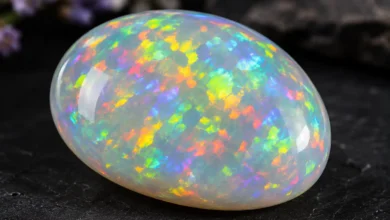
Opal commonly develops when silica-bearing water enters cracks, cavities, or porous rock and later deposits hydrated silica.
As water conditions change, silica particles can accumulate. Precious opal displays play-of-color when uniformly sized silica spheres form an ordered arrangement capable of diffracting light.
Common opal lacks the sufficiently ordered structure needed for spectral play-of-color. Both materials can share a broad chemical composition while showing very different optical results.
The dedicated Opal: Meaning, Healing Properties & Uses guide covers body types, play-of-color, treatment, and care.
Agate, chalcedony, and geodes
Agate and chalcedony form when silica-rich fluids deposit microcrystalline quartz in cavities, fractures, or porous rock. Repeated episodes can create bands with different colors, textures, and impurity levels.
A geode begins as a cavity, often in volcanic or sedimentary rock. Mineral-rich fluids enter the space and deposit crystals along the interior wall. Quartz, amethyst, calcite, celestine, and other minerals may line the cavity.
The dedicated Geodes: How They Form and What’s Inside owns the detailed cavity-development process.
Obsidian forms without crystallizing
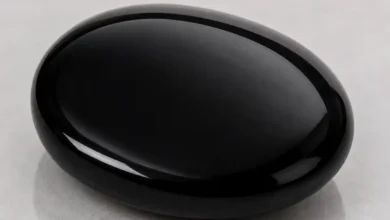
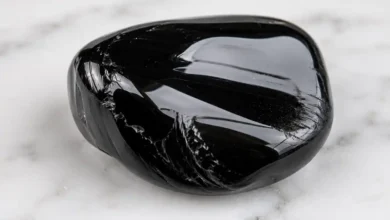
Obsidian is natural volcanic glass. It forms when silica-rich lava cools too quickly for atoms to arrange into a regular crystal structure.
Because it is amorphous, obsidian is not a mineral crystal. It remains a natural gem material used for carvings, cabochons, beads, and ornamental objects.
Flow banding, gas bubbles, crystallized inclusions, and variations in oxidation can create snowflake, sheen, mahogany, and rainbow appearances.
The material-specific article is Obsidian: Meaning, Healing Properties & Uses.
Tektites and impact glass
Tektites form when a meteorite impact melts terrestrial material and ejects it through the atmosphere. The melt cools into natural glass before falling back to Earth.
Moldavite is a green tektite associated with an impact event in central Europe. Other tektites occur in different strewn fields and may appear brown, black, green, or gray.
The impact supplies the heat, but tektites consist largely of melted terrestrial material rather than pieces of the meteorite itself.
The tracker’s Tektite: Meaning, Properties & Symbolism guide covers the material-specific properties and varieties.
Amber forms from resin
Amber begins as plant resin rather than mineral matter. Over long burial periods, chemical changes transform and stabilize the resin.
Not every recent resin is amber. Copal is younger or less polymerized material and may respond differently to heat, solvents, and testing.
Insects, plant fragments, bubbles, flow structures, and debris can become trapped in resin before burial. These inclusions may have scientific and collector interest, but they also attract imitations.
The Amber: Meaning, Properties & Symbolism guide covers amber as an organic gem material.
Pearls form through biological activity
Pearls form within mollusks when layers of material accumulate around an irritant, tissue implant, or naturally occurring nucleus.
Natural pearls develop without deliberate human intervention. Cultured pearls form after people initiate the process, but the mollusk still produces the pearl material.
Their formation differs completely from mineral crystallization in rocks, yet pearls qualify as gem materials because of their beauty, rarity, durability, and use in jewelry.
The dedicated Pearl: Meaning, Properties & Symbolism guide explains pearl types and characteristics.
What creates gemstone color?
Color can result from:
- Major elements in the mineral formula
- Trace elements
- Missing atoms or structural defects
- Natural irradiation
- Charge transfer between elements
- Microscopic inclusions
- Light interference and diffraction
- Scattering from particles or structures
Chromium can produce red in ruby and green in emerald. Iron contributes to many yellow, green, blue, and brown colors. Copper is important in Paraiba tourmaline, while color centers influence smoky quartz and several other gems.
The same trace element does not produce the same color in every mineral because crystal structure changes how electrons interact with light.
Inclusions preserve formation history
Inclusions can record a gemstone’s growth environment.
Examples include:
- Earlier mineral crystals trapped during growth
- Fluid-filled cavities
- Growth zoning
- Needles and platelets
- Healed fractures
- Melt inclusions
- Exsolution features
- Surface residues from the host rock
Gemologists study these features to support identity, treatment detection, natural-versus-laboratory-grown separation, and sometimes geographic-origin opinions.
The planned How to Identify Crystals guide will own the practical identification workflow rather than the geological processes discussed here.
Formation is different from treatment
Natural formation ends before mining, cutting, and commercial enhancement.
Heat treatment, irradiation, oiling, filling, diffusion, dyeing, impregnation, and coating occur after a material has formed. Some treatments reproduce changes that can also happen naturally, but the commercial disclosure remains important.
The full enhancement framework belongs to Gemstone Treatments Explained.
Laboratory-grown gemstones
A laboratory-grown gemstone develops through a human-controlled process rather than a natural geological environment. It may have essentially the same chemical composition and crystal structure as the natural counterpart.
Common growth methods include:
- Flame fusion
- Flux growth
- Hydrothermal growth
- Crystal pulling
- High-pressure high-temperature diamond growth
- Chemical vapor deposition
A laboratory-grown ruby is crystalline corundum, not glass. Similarly, a laboratory-grown diamond is diamond rather than a visual imitation.
The commercial and value distinctions belong to Lab-Grown vs Natural Gemstones.
How long do gemstones take to form?
There is no universal formation time.
A crystal can grow through repeated stages rather than one uninterrupted event. Fluids may enter a fracture, stop, and return later. Metamorphism can affect rocks over millions of years, while volcanic glass can cool within hours or days after eruption.
A gemstone’s geological age also differs from its growth duration. A crystal may form during a relatively short event and remain buried for hundreds of millions of years before erosion exposes it.
Practical formation checklist
When evaluating a formation claim, ask:
- Is the material a mineral, rock, glass, organic substance, or biogenic gem?
- Which geological process can produce it?
- Did it form in the mantle, crust, near the surface, or through an organism?
- Is the mine a primary host-rock or secondary alluvial deposit?
- Does the locality match known geology?
- Are claimed inclusions consistent with the material?
- Is the color natural, treated, or structurally produced?
- Could the material be laboratory-grown?
- Is a seller confusing mining location with formation environment?
- Is a meteorite or volcanic claim supported?
- Does the explanation distinguish formation from later treatment?
- Is laboratory confirmation needed for an expensive or unusual stone?
Frequently Asked Questions
1. How do most gemstones form?
Most mineral gemstones crystallize from magma, hydrothermal fluids, low-temperature water, or through recrystallization during metamorphism.
2. Do all gemstones form underground?
No. Many form underground, but opal and turquoise can develop near the surface, while pearl forms inside a mollusk.
3. Do diamonds form from coal?
No. Most gem diamonds form from carbon-bearing fluids or melts deep in Earth’s mantle, far below typical coal deposits.
4. How do rubies and sapphires form?
Ruby and sapphire form when corundum crystallizes in suitable igneous, metamorphic, or fluid-influenced environments with the trace elements needed for color.
5. How do emeralds form?
Emerald forms when beryllium-bearing geological material interacts with chromium- or vanadium-bearing environments under suitable fluid, temperature, and pressure conditions.
6. How do gemstones get into river gravel?
Weathering frees durable stones from host rock. Water transports and concentrates them in alluvial deposits.
7. Is obsidian a crystal?
No. Obsidian is natural volcanic glass with an amorphous structure.
8. Is opal a crystal?
Opal is hydrated silica and generally lacks the long-range crystalline structure of quartz. Precious opal contains ordered silica spheres that create play-of-color.
9. How does moldavite form?
Moldavite forms when a meteorite impact melts terrestrial material and ejects it, allowing the melt to cool into green natural glass.
10. Are laboratory-grown gemstones real crystals?
Many are. Laboratory-grown ruby, sapphire, emerald, quartz, and diamond have crystalline structures corresponding to their named materials, but their human-controlled origin must be disclosed.
11. Can treatment change how a gemstone originally formed?
No. Treatment can alter appearance or durability after formation, but it does not change the original geological or biological origin.
12. Can inclusions reveal where a gemstone formed?
They can provide important evidence about growth environment, treatment, and sometimes geographic origin, although conclusions usually require professional examination.
Conclusion
Gemstones form through a remarkable range of processes: magma cooling, pegmatite growth, hydrothermal deposition, metamorphism, near-surface alteration, mantle crystallization, sedimentary concentration, biological activity, and rapid natural-glass formation.
Each stone records a specific history of chemistry, pressure, temperature, fluids, time, and movement through Earth. Understanding that history makes it easier to separate scientific formation from marketing stories, post-mining treatments, and laboratory growth.