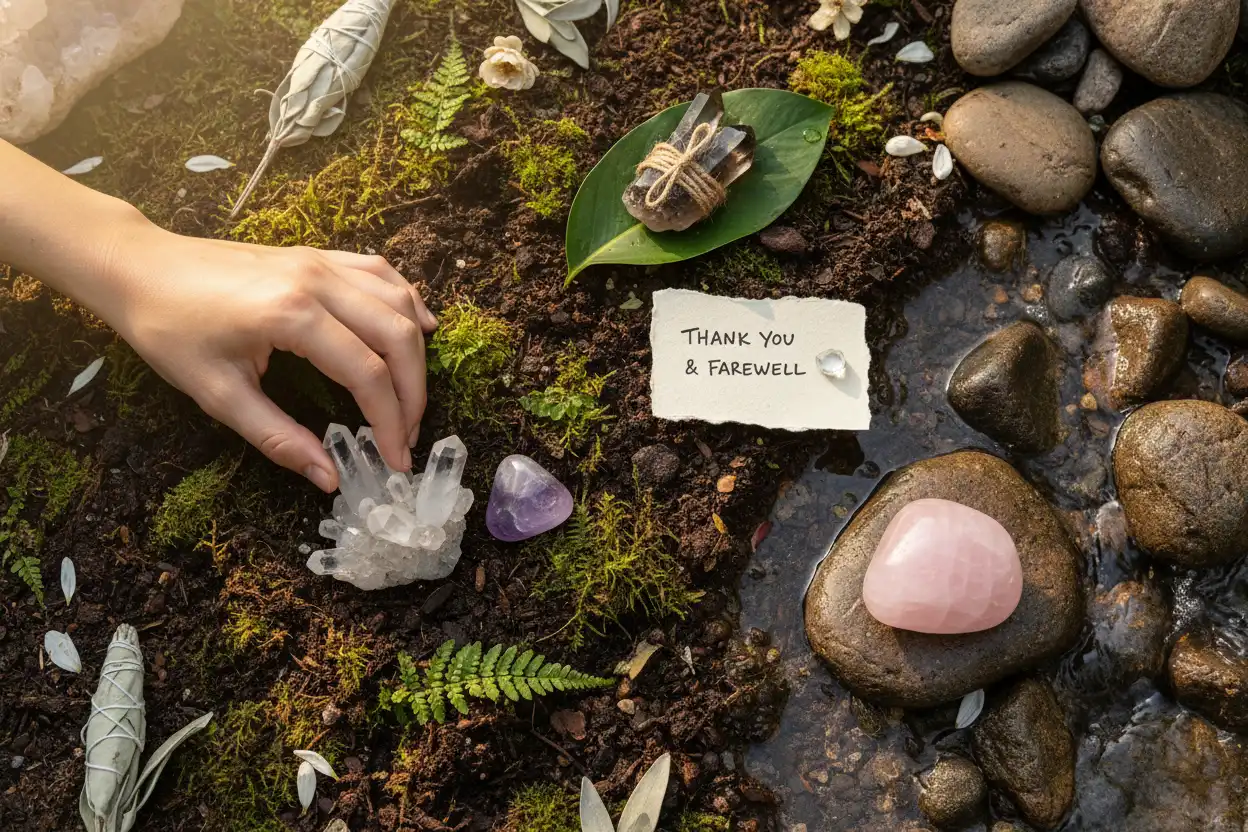
How to Dispose of or Return Crystals Respectfully
The most responsible way to dispose of an unwanted crystal is usually not to throw it away or bury it outdoors.
Depending on the material and its condition, you may be able to:
- Keep it in storage.
- Repair or repurpose it.
- Return it to the seller.
- Give it to another collector.
- Donate it.
- Sell it with accurate disclosure.
- Reuse it in jewelry or art.
- Take hazardous material to an appropriate waste facility.
A crystal does not need an elaborate farewell ritual, but you should identify the material, consider its physical safety and choose an option that does not contaminate soil, water or public spaces.
First, Identify What You Have
Do not dispose of a stone based only on its color or commercial name.
An object sold as a crystal may actually be:
- A mineral.
- A rock containing several minerals.
- Natural glass.
- Fossil material.
- Shell or another organic gem.
- Laboratory-grown crystal.
- Dyed or coated stone.
- Resin or ordinary glass.
- Metal-bearing ore.
- A radioactive collector mineral.
Identification matters because a stable quartz pebble and an arsenic-bearing mineral require very different handling.
Record:
- The name given by the seller.
- Where it came from.
- Whether it is polished or raw.
- Any treatment information.
- Whether it leaves dust or residue.
- Whether it has a collector label.
Use the non-destructive observations in How to Identify Crystals before deciding what to do.
Do Not Automatically Return Crystals to Nature
The phrase return it to the earth sounds respectful, but burying a crystal is not always environmentally responsible.
A buried object may be:
- Dyed.
- Coated.
- Resin-filled.
- Glued.
- Metal-mounted.
- Radioactive.
- Lead-bearing.
- Arsenic-bearing.
- Non-native to the area.
- Collected from a protected or distant locality.
Placing a stone in a river, lake, beach, forest or public park can also be littering or illegal dumping.
It may introduce chemicals, coatings, wire, adhesives or foreign geological material into the environment.
Why You Should Not Throw Crystals Into Water
Do not release unwanted crystals into:
- Rivers.
- Lakes.
- Wells.
- Ponds.
- Oceans.
- Drinking-water systems.
- Fountains.
- Garden water features.
Some minerals dissolve or release elements more readily in water. Others carry dirt, polish, oil, dye, metal findings or adhesive.
Even a chemically stable stone becomes an artificial object when intentionally left in a public waterway.
Option 1: Keep the Crystal in Storage
You do not need to make an immediate decision.
Store the crystal when:
- You are emotionally attached to it.
- You are unsure of its identity.
- It may be valuable.
- It has an old locality label.
- You need time to research safe disposal.
- You may want to use it again.
Choose a container appropriate for the material:
- A padded jewelry box.
- A labeled specimen box.
- A small paper packet.
- A rigid plastic container.
- A sealed secondary container for dusty minerals.
Keep the label with the specimen. Locality and collection history may be valuable to a future owner.
Option 2: Return It to the Seller
Contact the original seller when:
- The item was misidentified.
- A treatment was not disclosed.
- The stone arrived broken.
- It presents an unexpected safety concern.
- It falls within the return period.
- The seller offers a take-back program.
Photograph the item and preserve the packaging, invoice and listing description.
Explain the issue clearly rather than mailing an unknown hazardous mineral without warning.
A responsible seller may offer:
- A refund.
- An exchange.
- Identification assistance.
- Safe return instructions.
- Disposal guidance.
- Repair or restringing.
Option 3: Gift the Crystal
You may give a stable, accurately identified crystal to someone who wants it.
Disclose:
- Its correct name.
- Known treatments.
- Any repairs.
- Chips or fractures.
- Whether it is fragile.
- Whether it requires special handling.
- Whether the identification is uncertain.
Do not give hazardous minerals to children, schools or casual collectors who are not prepared to handle them.
A gift should transfer useful information along with the object.
Option 4: Donate It
Potential recipients include:
- Mineral clubs.
- Lapidary clubs.
- Educational collections.
- Community art programs.
- Charity shops.
- Museums.
- Geological organizations.
- School science departments.
Contact the organization before arriving with the material.
Many institutions cannot accept:
- Unidentified specimens.
- Radioactive minerals.
- Asbestos-form minerals.
- Lead- or arsenic-bearing material.
- Damaged glass.
- Large collections without labels.
- Items requiring specialist storage.
A labeled, documented specimen is more useful than an anonymous box of stones.
Option 5: Sell It Responsibly
You may resell unwanted crystals through:
- A mineral club.
- A local collector group.
- A specialist dealer.
- A resale marketplace.
- An estate-sale service.
- A consignment shop.
Describe the item accurately.
Include:
- Material name.
- Dimensions.
- Weight where relevant.
- Condition.
- Treatments.
- Locality if documented.
- Whether it is natural, laboratory-grown or manufactured.
- Clear photographs of the actual item.
Do not make unsupported claims about rarity, healing effects or origin.
Responsible resale extends the useful life of the material and reduces unnecessary extraction. The broader sourcing principles are covered in Ethically Sourced Crystals.
Option 6: Repurpose It
A stable crystal may be reused in:
- A display.
- A shadow box.
- A mosaic.
- A wire-wrapped pendant.
- A small sculpture.
- A decorative tray.
- A new jewelry setting.
- An educational collection.
Repurposing is appropriate only when the material is safe to cut, drill or handle.
Do not sand, tumble or drill an unknown mineral. Lapidary work can create fine airborne dust and expose elements that present little risk while locked inside an intact polished stone.
Option 7: Repair It
A broken crystal may be repairable when it is:
- Non-toxic.
- Structurally stable.
- Valuable enough to justify repair.
- Part of meaningful jewelry.
- Broken along a clean surface.
- Free from powdering or oxidation.
Possible repairs include:
- Professional resetting.
- Recutting.
- Re-polishing.
- Replacing a clasp.
- Restringing beads.
- Converting a ring stone into a pendant.
- Stabilizing a display specimen.
Do not use household glue on valuable gems, porous stones, coated material or objects that may later be professionally repaired.
The guide Why Did My Crystal Break? explains how impact, cleavage, internal fractures and thermal shock cause damage.
What to Do With Broken Crystal Jewelry
Separate the components where it is safe to do so.
A broken jewelry piece may contain:
- A reusable gemstone.
- Precious-metal settings.
- Chains.
- Clasps.
- Beads.
- Wire.
- Adhesives.
- Plated base metal.
A jeweler may be able to:
- Reset the stone.
- Replace the damaged gem.
- Recycle the metal.
- Recut a chipped stone.
- Convert the piece into another design.
- Recover undamaged accent stones.
Do not place metal-mounted jewelry into soil or water.
What to Do With Tiny Chips and Crystal Beads
Small chips and beads can be difficult to donate individually.
You may:
- Save them for repair work.
- Offer them as a labeled craft lot.
- Donate them to an appropriate art program.
- Use them in a closed decorative container.
- Recycle compatible jewelry findings separately.
- Dispose of safe, non-hazardous fragments according to local household-waste rules.
Do not scatter chips outdoors. Small pieces create ingestion hazards for children, birds and pets.
What to Do With Dyed, Coated or Treated Crystals
Treatments may include:
- Dye.
- Surface coating.
- Resin filling.
- Waxing.
- Stabilization.
- Irradiation.
- Heat treatment.
- Gluing or assembly.
Do not assume treated stones are safe to bury or place in water.
If you sell or donate them, disclose the treatment where known.
The main enhancement categories are explained in Gemstone Treatments Explained.
What to Do With Glass, Resin and Manufactured Crystals
Common manufactured materials include:
- Opalite.
- Goldstone.
- Cubic zirconia.
- Resin-filled carvings.
- Reconstituted stone.
- Coated glass.
- Crystal-themed decorations.
These should not be returned to nature.
Reuse, donate or dispose of them according to their actual material. Local glass recycling programs may reject jewelry glass, mixed glass, coated pieces and small fragments, so check the rules before placing them in a recycling container.
Wrap broken glass securely and label it when local disposal procedures require it.
What to Do With Toxic Crystals
Some minerals contain lead, arsenic, mercury, copper, uranium or other hazardous elements.
Examples may include:
- Galena.
- Realgar.
- Orpiment.
- Cinnabar.
- Vanadinite.
- Wulfenite.
- Crocoite.
- Uraninite.
- Autunite.
- Torbernite.
- Fibrous asbestos-form minerals.
Do not:
- Grind them.
- Crush them.
- Heat them.
- Place them in water.
- Throw loose dusty pieces into household bins.
- Give them to children.
- Mail them without disclosure.
- Burn them.
Place the specimen in a sealed inner container, then use a labeled secondary container.
Contact an appropriate local hazardous-waste, radiation-safety or environmental authority for instructions. Requirements vary by location and by the material involved.
Use the handling categories in Toxic Crystals: A Safety List before moving an unfamiliar specimen.
What to Do With Radioactive Minerals
Radioactive collector minerals require more care than ordinary stones.
Possible examples include:
- Uraninite.
- Autunite.
- Torbernite.
- Carnotite.
- Thorianite.
- Some monazite.
- Some zircon or xenotime specimens with elevated uranium or thorium.
Do not carry radioactive specimens in a pocket or wear them as jewelry.
Keep them:
- Labeled.
- Contained.
- Away from occupied living spaces.
- Away from children and pets.
- Separate from food and drink.
- In accordance with local rules.
Contact a qualified radiation-safety professional or appropriate public authority before disposal.
Should You Bury a Safe Natural Stone?
Burying may be physically low-risk only when the object is:
- Accurately identified.
- Naturally occurring.
- Untreated.
- Free from glue, wire and metal.
- Non-toxic.
- Non-radioactive.
- Local to the environment.
- Placed on private land with permission.
- Not buried in a protected area.
Even then, burial is rarely necessary.
Keeping, gifting, donating or repurposing the stone usually preserves more value and avoids uncertainty.
Can You Return a Crystal to Where It Was Found?
Only consider returning a personally collected stone when:
- You know the exact legal collection site.
- Access is still permitted.
- Returning it does not violate park, mine or land rules.
- The stone is untreated and unchanged.
- The landowner approves.
- The material presents no safety concern.
Do not enter closed mines, private claims or protected areas to return an object.
How to Let Go of a Crystal Symbolically
A personal closing ritual can be simple and environmentally safe.
You might:
- Clean the object safely.
- Reflect on why you no longer need it.
- Write down what you learned.
- Photograph it.
- Thank the person who gave it to you.
- Remove any old intention.
- Choose a responsible new owner or use.
- Store or transfer it carefully.
The ritual does not require abandoning the object outdoors.
What If the Crystal Has Unpleasant Memories?
An object can become associated with:
- A past relationship.
- A stressful period.
- Grief.
- Conflict.
- A failed goal.
- An unwanted gift.
You may:
- Store it out of sight.
- Redefine its purpose.
- Sell or donate it.
- Remove it from its jewelry setting.
- Ask someone else to handle the transfer.
- Keep only a photograph.
You are not obligated to retain an object that causes distress.
What Not to Do
Avoid:
- Throwing crystals into rivers or oceans.
- Burying coated or dyed stones.
- Burning minerals or resin products.
- Crushing unknown specimens.
- Donating toxic material without disclosure.
- Leaving sharp pieces in public spaces.
- Mailing hazardous specimens casually.
- Releasing non-native geological material at collection sites.
- Claiming that disposal will cause bad luck.
Respectful disposal protects people and environments rather than following a single spiritual rule.
Frequently Asked Questions
Is it bad luck to throw away a crystal?
There is no evidence that discarding a crystal causes bad luck. The practical concern is choosing a safe and environmentally responsible method.
Can I put broken crystals in the trash?
Small, non-toxic and non-radioactive pieces may be accepted as household waste in some locations. Wrap sharp fragments and follow local rules. Hazardous minerals require specialist guidance.
Can I bury rose quartz?
Burial is usually unnecessary. Gifting, donating or reusing it avoids introducing an object into soil and preserves the material.
Can I throw crystals into the ocean?
No. Leaving stones, coatings, jewelry components or foreign material in natural waters is environmentally irresponsible and may be illegal.
Can I give away a crystal that was programmed?
Yes. A personal intention does not scientifically remain trapped inside a mineral. You may symbolically clear it before transfer.
What should I do with inherited crystals?
Preserve labels, document the collection and seek identification before selling, donating or disposing of anything.
Can crystal shops take old stones back?
Some sellers offer returns, trade-ins or take-back programs. Contact the shop before bringing or mailing the item.
Should I cleanse a crystal before donating it?
Symbolic cleansing is optional. Physical cleanliness, accurate identification and treatment disclosure are more important.
What should I do with an unknown mineral?
Keep it contained, avoid water and destructive testing, and ask a mineral club, geologist or qualified laboratory for help.
Continue Exploring
Browse additional ownership, safety and identification resources in the Crystals 101 collection.