Iolite Benefits: 9 Hidden Uses, Deep Symbolism & Verified Facts, Important Cautions
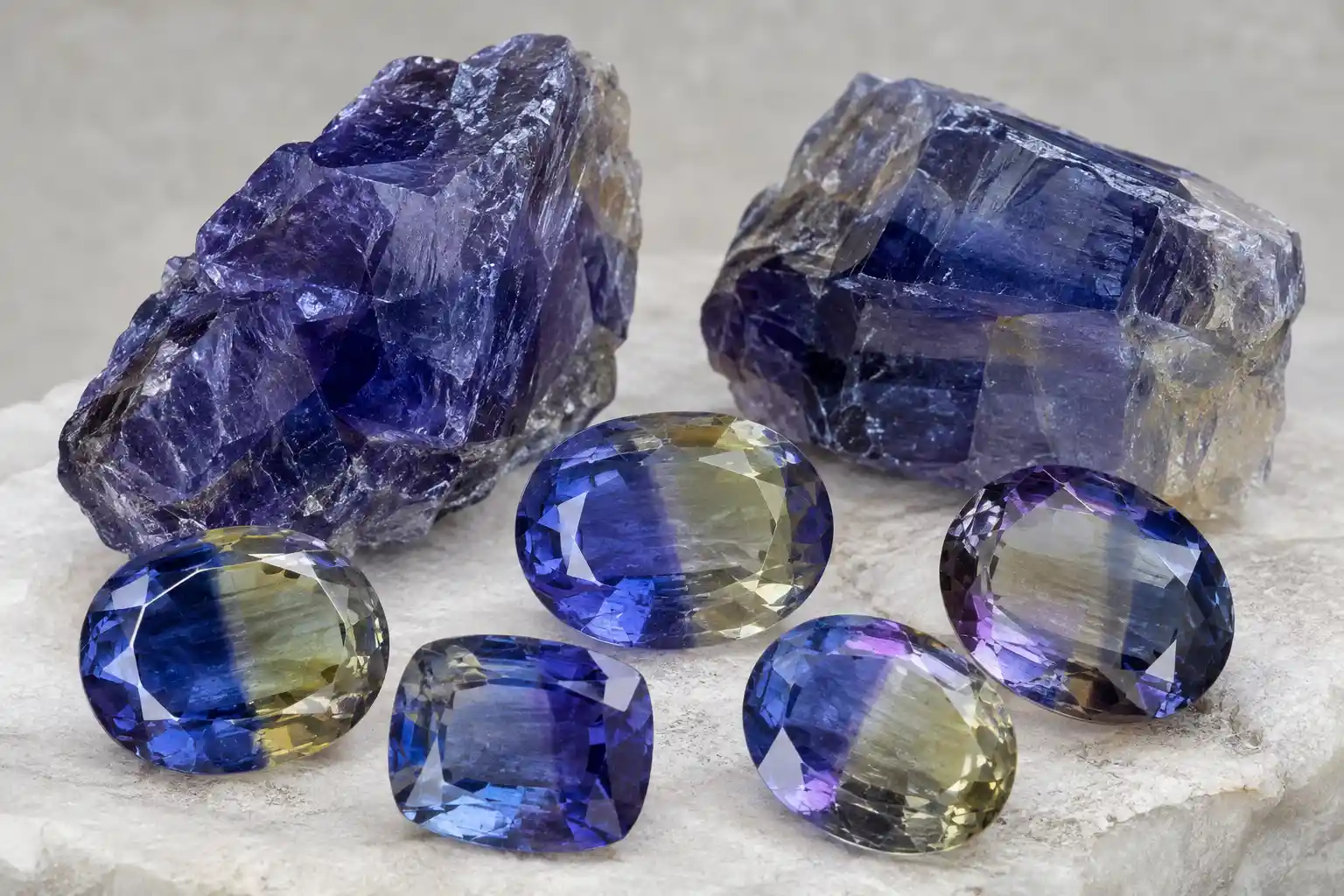
Iolite benefits begin with one of the most dramatic examples of pleochroism found in a familiar gemstone. Iolite is the gem-quality violet-blue variety of cordierite, a magnesium aluminum silicate whose composition is commonly represented as Mg₂Al₄Si₅O₁₈, with iron and other elements substituting into the structure. A well-oriented transparent stone may appear saturated violet-blue or blue from one crystallographic direction while shifting toward blue-gray, pale yellow, brownish yellow, or nearly colorless from another. This directional color is so strong that it can often be observed without specialized equipment.
The gemstone generally has a Mohs hardness around 7 to 7.5, making it sufficiently scratch resistant for many jewelry applications, yet it also has perfect cleavage in one direction and is not exceptionally tough. That combination creates useful but clearly defined Iolite benefits: the stone can perform well in pendants, earrings, protected rings, faceted jewelry, and gem collections when strong impacts and sudden temperature changes are avoided. Its pleochroism also creates a major lapidary challenge because orientation can determine whether the finished gem appears beautifully violet-blue or disappointingly pale.
Iolite has accumulated colorful history and legend as well. It is sometimes called the “Viking compass stone” because stories claim thin cordierite slices helped Norse navigators reduce glare or locate the sun under cloudy conditions. This possibility is widely repeated, but it is best described as legend or proposed historical use rather than settled archaeological fact. Modern spiritual traditions add Iolite benefits involving intuition, sleep, confidence, navigation, self-discipline, or emotional balance, yet these symbolic interpretations should remain separate from medical claims.
9 Iolite Benefits at a Glance
- Strong trichroic pleochroism makes Iolite one of the clearest examples of directional gemstone color.
- Violet-blue hues provide an attractive natural alternative to several better-known blue gemstones.
- Mohs hardness around 7 to 7.5 supports many jewelry applications when cleavage and impact risks are respected.
- Skilled faceting can emphasize desirable blue directions while minimizing pale or yellowish orientations.
- Mineral identification provides valuable lessons in cordierite chemistry, optics, cleavage, density, and pleochroism.
- Geological occurrences connect Iolite with metamorphic rocks and mineral assemblages that record high-temperature conditions.
- Some included stones can display chatoyancy or aventurescence, adding unusual collector interest.
- Iolite is not typically treated, allowing many buyers to obtain naturally colored blue gemstones.
- Modern symbolism can represent navigation, perspective, or self-direction when kept separate from medical or supernatural claims.
Strong Pleochroism Is the Most Distinctive Iolite Benefit
The strongest Iolite benefits come from pleochroism. Cordierite is optically anisotropic and can display three different colors along three crystal directions, which is why the effect is more precisely described as trichroism. Fine blue stones may show dark violet-blue in one direction, blue-gray in another, and pale yellow to almost colorless in a third. Violet stones can show their own combination of dark violet, lighter violet, and yellow-brown tones.
This property has enormous importance in cutting. A lapidary must orient the rough so the desirable violet-blue direction faces through the table of the finished stone. An orientation that maximizes weight but presents the pale direction can turn potentially fine rough into a weak-looking gem, while excessively deep cutting can make already saturated material appear too dark.
These Iolite benefits also make the stone valuable for teaching gem optics because the color change can often be seen simply by rotating the crystal. Unlike color-change gems, which respond differently to different light sources, Iolite changes because the viewing direction through the crystal changes.
Violet-Blue Color Gives Iolite a Distinctive Jewelry Identity
Fine Iolite can display violet-blue to slightly violetish-blue color that visually overlaps with sapphire or tanzanite while retaining its own optical character. The gemstone is sometimes described commercially as “water sapphire,” but that historical nickname is misleading because Iolite is cordierite rather than corundum and differs substantially from sapphire in hardness, refractive properties, density, value, and crystal structure.
These color-focused Iolite benefits are strongest in medium-toned stones with enough saturation to appear clearly blue without becoming overly dark. Grayish components are common in commercial material, and the pale pleochroic direction may become visible if cutting orientation is poor.
A buyer evaluating Iolite quality should therefore consider hue, tone, saturation, face-up pleochroism, clarity, cutting, durability, and overall brightness together. A smaller well-oriented stone can easily appear more attractive than a heavier gem that preserves extra weight at the expense of color.
Mohs Hardness Supports Jewelry but Perfect Cleavage Requires Respect
Iolite generally has hardness around 7 to 7.5 on the Mohs scale, giving polished gems useful resistance to ordinary scratching. This allows Iolite benefits to extend comfortably into pendants, earrings, necklaces, brooches, and rings designed with appropriate protection.
Durability becomes more complicated because cordierite has perfect cleavage in one direction. A sharp blow or excessive pressure can split the stone even when its surface has resisted abrasion successfully. Sudden temperature changes can also create breakage, particularly in included or stressed gems.
Protective mountings reduce risk by shielding exposed edges, while earrings and pendants remain safer than rings worn during physical work. Jewelry should be removed before sports, heavy cleaning, construction, or other activities likely to produce hard impacts.
This balance between useful hardness and structural vulnerability makes Iolite an excellent example of why one Mohs number cannot describe complete gemstone durability.
Skilled Cutting Turns Difficult Rough into Beautiful Violet-Blue Gems
Faceting provides another important set of Iolite benefits because proper orientation can dramatically improve color. The cutter must study the rough before shaping begins, identifying the strongest blue direction while also considering cleavage, crystal shape, inclusions, finished depth, and weight retention.
Step cuts can work especially well in clean transparent stones, while ovals, cushions, pears, rounds, and custom designs allow cutters to manage individual rough differently. Very dark crystals may need shallower designs or shapes that reduce optical path length, while pale stones can sometimes tolerate greater depth without losing brightness.
Cutting mistakes are especially obvious in Iolite because pleochroism can reveal undesirable yellowish or nearly colorless directions face-up. A well-oriented stone appears richly blue, while poor orientation can create patches of weak color or an overall washed appearance.
Someone preparing to buy Iolite therefore benefits from judging face-up appearance rather than relying only on the color of the rough or a seller’s verbal description.
Iolite Is Valuable for Gemstone Identification and Optical Education
Strong pleochroism makes Iolite an unusually useful teaching gemstone. Sapphire, tanzanite, blue tourmaline, glass, synthetic products, and other blue stones may resemble Iolite in photographs, but the combination of refractive properties, density, trichroism, cleavage, inclusions, and optical character helps separate cordierite from lookalikes.
The gemstone’s relatively low specific gravity is also notable. Iolite is lighter for its size than many visually similar blue gems, while its refractive index is lower than sapphire or zircon. These physical differences demonstrate why color alone never establishes mineral identity.
Microscopic examination may reveal fluid inclusions, needles, growth features, fractures, or mineral inclusions depending on the locality. When elongated inclusions are oriented appropriately, some Iolite can produce chatoyancy or other unusual optical effects rather than the transparent faceted appearance most buyers expect.
These identification-focused Iolite benefits make the gemstone especially useful in educational collections where one specimen can demonstrate color, pleochroism, cleavage, inclusions, and crystal optics together.
Geological Iolite Records High-Temperature Metamorphic Conditions
Iolite is gem-quality cordierite, and cordierite is an important rock-forming mineral in certain metamorphic environments. It commonly develops in aluminum-rich rocks subjected to relatively high temperatures and comparatively low-to-moderate pressures, including hornfels and high-grade metamorphic rocks. Associations may include garnet, sillimanite, biotite, gedrite, quartz, feldspar, and other minerals depending on the geological setting.
This creates Iolite benefits for geological study because cordierite can contribute to interpretations of metamorphic conditions. Its occurrence, chemistry, and relationships with associated minerals help petrologists understand how rocks responded to heat, pressure, and fluid activity.
Not every geological cordierite is gem quality. Much of it is opaque, included, fractured, or poorly colored, while transparent violet-blue areas suitable for cutting represent a much smaller subset.
A natural Iolite specimen on matrix can therefore preserve scientific information that disappears when transparent sections are removed and faceted.
Chatoyancy and Aventurescence Add Rare Collector Interest
Although transparent faceted Iolite is the most familiar gem form, some included cordierite can display unusual phenomena. Properly oriented parallel inclusions may produce chatoyancy, creating a cat’s-eye effect when cut as a cabochon, while other inclusion arrangements can produce aventurescent flashes.
These rare optical Iolite benefits demonstrate again that inclusions are not automatically undesirable. In ordinary transparent gems, visible inclusions may reduce clarity and value, but in phenomenal Iolite the correct type and orientation of inclusions can create the feature collectors value most.
The stone must usually be cut as a cabochon rather than faceted so the reflected band or glittering effect remains visible. Correct orientation becomes critical because an attractive phenomenon can disappear if the dome is placed incorrectly relative to the inclusion direction.
This makes phenomenal Iolite especially interesting for collectors who want examples beyond the standard transparent violet-blue faceted gem.
Natural Color Is an Important Advantage for Many Iolite Buyers
Many colored gemstones are routinely heated, irradiated, diffused, filled, or otherwise enhanced, but Iolite is not typically treated. Its violet-blue color generally reflects natural iron-related optical behavior within cordierite, making untreated appearance one of the more practical Iolite benefits for buyers who prefer gems whose familiar market color usually requires no enhancement.
This should not be interpreted as proof that every Iolite offered commercially is untreated. Any gemstone can potentially be coated, assembled, or subjected to unusual experimentation, and imitations may also exist. The more accurate point is that routine color enhancement is not a defining part of the normal Iolite market.
Untreated status can simplify purchasing, but quality still depends on color, orientation, clarity, cut, size, and structural condition. A naturally colored stone is not automatically a fine stone if it is too dark, poorly cut, heavily fractured, or weak face-up.
Natural color therefore works as one positive characteristic within a complete quality assessment.
Navigation Symbolism Is Interesting but Viking Claims Need Caution
Iolite is frequently called the Viking compass stone because a popular legend says Norse mariners used thin slices of the strongly pleochroic mineral as glare reducers or polarizing filters to locate the sun on cloudy days. The story is appealing because Iolite’s optical properties make directional light effects plausible, but the specific claim should not be presented as settled archaeological fact.
This historical caution does not remove the symbolic value. Navigation remains one of the most distinctive modern Iolite benefits because the gemstone’s changing directional color naturally evokes orientation, choosing direction, and adjusting course when circumstances change.
Someone may therefore associate Iolite with a career decision, relocation, educational transition, or other period requiring direction. The stone can mark the choice without guaranteeing that the chosen route will succeed.
Navigation symbolism becomes stronger, not weaker, when legend and documented gemology are kept separate.
Modern Iolite Symbolism Can Represent Self-Direction Without Healing Claims
Contemporary crystal traditions commonly associate Iolite benefits with intuition, self-discipline, independence, creativity, dream recall, sleep, emotional balance, and spiritual navigation. Some of these themes connect naturally with the gem’s famous directional color and navigation legend, while others arise mainly from modern metaphysical systems.
A person may keep Iolite near a desk because it represents staying on course with a long-term goal or wear a ring to mark an important decision. Such personal symbolism can become meaningful through repetition and memory even though the gemstone is not controlling motivation or judgment.
Beliefs involving Iolite healing properties sometimes extend into insomnia, addiction, liver function, vision, migraines, emotional disorders, or neurological effects. These interpretations belong to spiritual or wellness practice rather than established clinical evidence.
Iolite can therefore symbolize direction or self-discipline without being described as a medical treatment.
Important Iolite Cautions Include Cleavage, Heat, Impact, and Cleaning
Iolite’s hardness may encourage owners to treat it as tougher than it actually is, but perfect cleavage makes protection from sharp blows important. Rings should be removed before heavy manual activity, while loose stones should be stored so they cannot strike harder gems or metal edges.
Sudden temperature changes and high heat can also produce fractures. Steam cleaning is therefore a poor default, and ultrasonic cleaning should not be treated as universally safe. Lukewarm water, mild soap, and a soft brush provide a more conservative approach for most stable stones.
Lapidary work should also respect cleavage because excessive pressure during cutting, polishing, or setting can damage a gem rapidly. Careful orientation and handling preserve the same optical qualities that make Iolite desirable in the first place.
Conclusion
Iolite benefits include spectacular pleochroism, attractive violet-blue color, useful jewelry hardness, skilled faceting potential, gemological identification value, metamorphic geological significance, rare phenomenal effects, naturally occurring market color, and meaningful navigation symbolism. Few familiar gemstones demonstrate directional color so clearly, making Iolite valuable both aesthetically and educationally.
The strongest Iolite benefits appear when pleochroism, cleavage, geology, and jewelry durability are understood together. Its Viking navigation story should remain a legend rather than a certainty, while modern themes involving direction or self-discipline can remain personal symbolism without becoming medical claims.
FAQs
What are the main Iolite benefits?
The most practical Iolite benefits include jewelry use, strong pleochroism, mineral identification, faceting, geological education, naturally occurring violet-blue color, and the occasional presence of rare optical phenomena such as chatoyancy. Its navigation history and directional color also support personal symbolism involving perspective or self-direction, provided those interpretations remain distinct from health claims.
What is Iolite made of?
Iolite is gem-quality violet-blue cordierite, a magnesium aluminum silicate commonly represented by the formula Mg₂Al₄Si₅O₁₈, with iron and other elements substituting into the structure. Iron-related absorption contributes to its familiar blue and violet colors, while directional differences in absorption produce the strong pleochroism for which the gemstone is famous.
Why does Iolite show different colors from different directions?
Cordierite is strongly pleochroic and can display three distinct colors along three crystallographic directions, making Iolite an excellent example of trichroism. A blue stone may show dark violet-blue, blue-gray, and pale yellow or nearly colorless directions, which is why cutters must orient the rough carefully to place the strongest attractive color face-up.
How hard is Iolite?
Iolite generally measures around 7 to 7.5 on the Mohs hardness scale, giving it useful resistance to everyday scratching. It also has perfect cleavage in one direction, however, so strong impacts, excessive setting pressure, high heat, or sudden temperature changes can split a stone even when the polished surface remains relatively resistant to abrasion.
Is Iolite suitable for everyday jewelry?
Iolite can perform well in pendants, earrings, necklaces, and protected rings when reasonable care is used. Rings should be removed during sports or manual work because a sharp blow can exploit the stone’s cleavage, while protective settings help reduce direct impact around vulnerable edges and corners.
Did Vikings really use Iolite for navigation?
Stories about Viking navigators using thin Iolite or cordierite slices to locate the sun through cloudy skies are widely repeated, and the stone’s optical behavior makes the idea interesting. The claim should still be described as legend or proposed historical use rather than settled archaeological fact, so navigation symbolism is safer than presenting a specific Viking technique as conclusively documented.
Is Iolite usually treated?
Iolite is not typically treated to produce its familiar violet-blue color, which many buyers appreciate when comparing it with colored gemstones whose commercial appearance commonly depends on routine enhancement. Buyers should still evaluate identification, clarity, cutting, and condition because untreated color alone does not determine the quality of a finished stone.
Can Iolite help with sleep or intuition?
There is no established scientific evidence that wearing Iolite directly improves sleep, intuition, creativity, self-discipline, or neurological function. Someone may use the gemstone during meditation or as a personal reminder connected with direction and decision-making, but any practical effect comes from the surrounding behavior and personal association rather than a demonstrated biological action of cordierite.
Does Iolite have healing powers?
There is no established clinical evidence that Iolite treats insomnia, addiction, migraines, liver disease, vision problems, anxiety, depression, or other physical or mental-health concerns through ordinary wearing or handling. Iolite benefits described as healing, intuitive, sleep-related, navigational, chakra, or energetic effects remain spiritual and personal beliefs and should not replace qualified medical or mental-health care.