Buy Iolite: What Quality Looks Like, Authenticity, Origin & Price
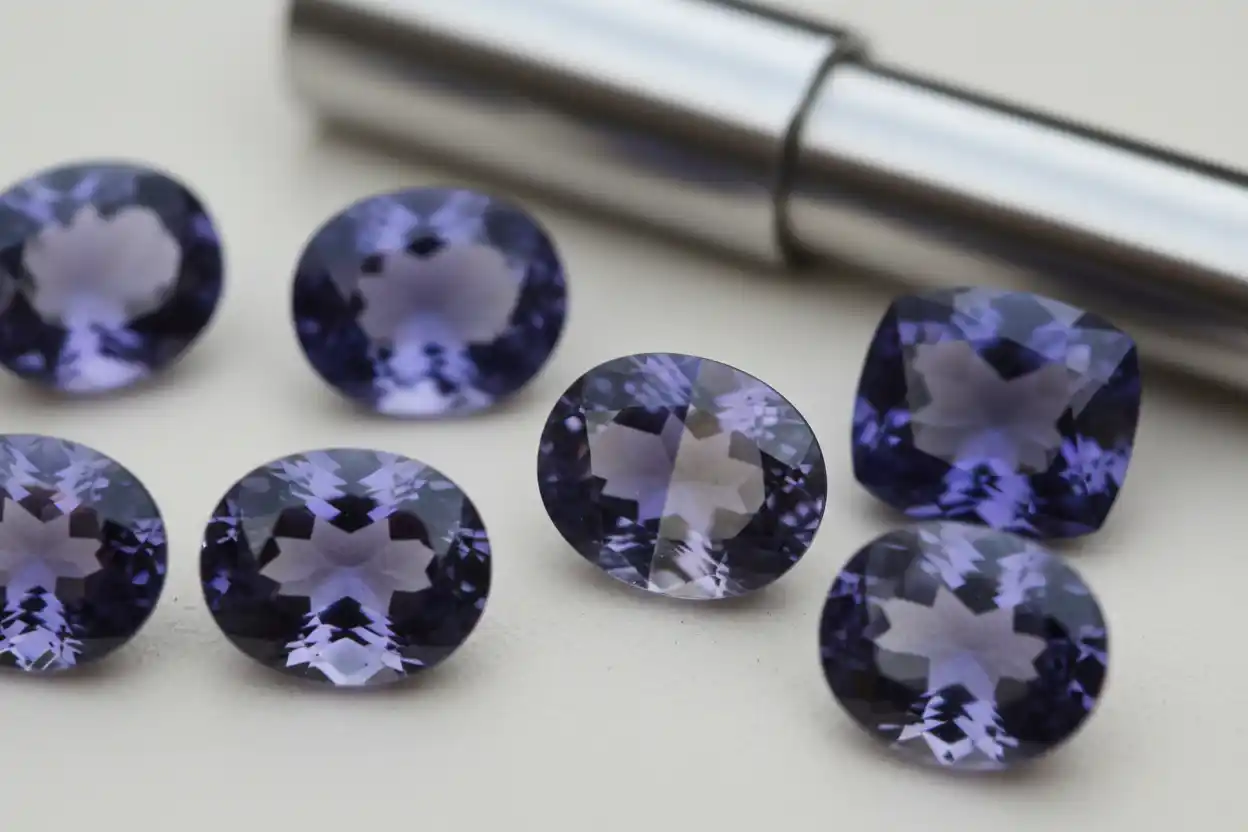
To buy iolite well, evaluate color, pleochroic orientation, transparency, clarity, cut, size, cleavage, condition, treatment disclosure, and seller documentation together rather than choosing a stone solely because it appears deep blue in one photograph. Iolite is the gem trade name for cordierite, an aluminum-iron-magnesium silicate known for striking eye-visible pleochroism. GIA describes fine iolite as violetish blue to slightly violetish blue and notes that a bluish stone can display colorless to yellow, blue-gray, and dark violet colors when viewed through different crystallographic directions.
That pleochroism is one of iolite’s defining attractions but also one of its main buying challenges. A skilled cutter must orient the rough so the most desirable violet-blue direction shows prominently through the table; poor orientation can make the finished gemstone appear gray, yellowish, nearly colorless, or excessively dark. GIA identifies saturated violet to blue as iolite’s most valuable color range and notes that commercial-quality stones often show a gray component. Buyers should therefore judge the actual face-up color under normal light rather than assuming that the deepest directional blue visible from the side represents what the mounted gemstone will look like.
Buy Iolite At a Glance
| Buying Factor | What to Examine | Why It Matters |
|---|---|---|
| Identity | Natural iolite/cordierite | Blue appearance alone does not prove iolite |
| Color | Saturated violetish blue to fine blue | Color is the leading quality factor |
| Gray Component | Whether blue remains lively rather than dull or smoky | Excess gray commonly reduces appeal |
| Pleochroism | Blue, violet, blue-gray, yellow or colorless directional changes | Orientation can transform face-up appearance |
| Cut Orientation | Best blue axis visible through the table | Poor orientation can waste otherwise fine rough |
| Transparency | Bright transparent material | Fine faceted iolite is generally transparent |
| Clarity | Eye-visible inclusions, fractures, tubes, plates | Eye-clean appearance is normally preferred |
| Phenomena | Cat’s-eye or aventurescence | Properly oriented inclusions can create collectible effects |
| Carat Weight | Weight plus millimeter dimensions | Fine faceted stones above five carats become relatively rare |
| Cleavage | Existing fractures and vulnerable structural directions | Iolite has perfect cleavage in one direction |
| Treatment | Seller disclosure | Iolite is not typically treated, which is a market advantage |
| Condition | Chips, abrasion, fractures, facet wear | Cleavage and fair toughness make damage important |
| Origin | Seller provenance rather than assumption from color | Several countries produce iolite |
| Documentation | Independent identification for significant purchases | Helps separate iolite from look-alike blue gems |
Iolite Is Cordierite
Iolite is the gemstone name commonly used for transparent to translucent gem-quality cordierite. GIA lists its composition as magnesium aluminum silicate containing iron and gives its typical color as violetish blue with strong pleochroic color directions that can include colorless or yellow.
This distinction matters because iolite can resemble sapphire, tanzanite, certain tourmalines, and other blue gemstones in photographs. It has historically even been called “water sapphire,” but GIA treats that terminology as misleading because iolite is not sapphire.
A seller should identify the material clearly as iolite or cordierite rather than using sapphire terminology that might imply corundum identity or sapphire durability.
Color Is the First Quality Factor to Judge
GIA identifies vivid violet to blue as iolite’s most valuable color range. Fine stones can display enough richness to resemble more expensive blue gemstones, while commercial material often contains a noticeable gray component.
The best buying decision balances saturation with brightness. A dark violet-blue iolite can look impressive against a bright white background yet become nearly black in ordinary indoor light, while a slightly lighter stone can remain visibly blue across more environments.
Grayness is particularly important because it can make an otherwise well-saturated stone look dull. Request video under neutral lighting and evaluate whether the blue remains attractive without extreme backlighting.
Pleochroism Is the Defining Iolite Buying Challenge
Iolite is strongly pleochroic. GIA explains that violetish stones can display light violet, dark violet, and yellow-brown directions, while bluish stones can show colorless to yellow, blue-gray, and dark violet.
This means the same crystal can look dramatically different when rotated. A buyer who examines only the side of an unset stone may see a beautiful blue direction that does not dominate once the gem is viewed face-up.
A properly cut iolite places the strongest desirable blue or violet-blue direction where the viewer sees it most prominently through the table. This orientation is one of the main reasons cutting quality can affect iolite value substantially.
Pleochroism Is Not a Defect
The yellow, gray, or nearly colorless directional colors in iolite are natural optical consequences of the crystal structure rather than evidence that the stone is fake or poorly treated. What matters commercially is how the cutter manages them.
A skillfully oriented stone can reveal its desirable violet-blue strongly while the secondary directions create subtle flashes along movement. A poorly oriented stone can allow yellowish or gray directions to dominate the face.
The buyer should therefore treat pleochroism as both an authenticity clue and a quality variable rather than a flaw.
Cut Orientation Can Matter More Than Extra Carat Weight
GIA repeatedly emphasizes that iolite is difficult to cut for best color because of its strong pleochroism. A cutter may need to sacrifice part of the rough to position the finest blue direction properly.
That creates a trade-off between yield and beauty. A heavier stone can preserve more rough yet appear gray or dark because the orientation is poor, while a somewhat smaller stone can command stronger demand because its face-up color is superior.
For the buyer, this means a lower carat weight should not automatically be interpreted as lower value when the cutting and color presentation are noticeably better.
Fine Iolite Is Usually Transparent and Relatively Clean
GIA notes that fashioned transparent iolite commonly contains relatively few inclusions and can be eye-clean. This gives clarity a different role from gems such as emerald, where visible inclusions are much more routine.
A visible central fracture, dark crystal, dense cloud, or major surface-reaching feature should therefore influence the price of a normal transparent faceted iolite.
Minor natural inclusions can still be acceptable, particularly when the color and cut are excellent. The goal is attractive transparency rather than microscopic perfection.
Some Inclusions Can Create Valuable Optical Phenomena
Iolite provides important exceptions to the usual cleaner-is-better rule. GIA notes that properly oriented long parallel tubular inclusions can create cat’s-eye iolite, while numerous reflective metallic platelets can produce aventurescence. Brownish or reddish platelet-rich material is sometimes marketed as “bloodshot” iolite.
These gems should not be judged according to ordinary faceted-iolite clarity standards because the inclusions are responsible for the desirable phenomenon.
A fine cat’s-eye should show a distinct, centered, mobile eye, while aventurescent material should display an attractive controlled sparkle rather than simply looking opaque or heavily included.
Fine Stones Above Five Carats Become More Difficult to Find
GIA states that fashioned iolite commonly ranges from roughly one to ten carats but that fine-quality faceted stones above five carats are relatively rare in the market.
This makes size more important once color, transparency, clarity, and orientation are already strong. A six-carat gray, dark, poorly oriented stone is not necessarily finer than a three-carat vivid violet-blue gem.
The strongest size premium applies when quality survives the increase in carat weight.
Face-Up Dimensions Should Accompany the Carat Figure
Like other transparent gemstones, iolite can be cut with different depths and outlines. A deep pavilion can preserve weight while reducing apparent face-up size.
Compare length, width, and depth alongside total carats. A well-cut four-carat iolite may present more visible area than a deep five-carat stone.
This becomes particularly relevant near the larger fine-size range where GIA notes supply is more limited.
Perfect Cleavage Makes Iolite More Vulnerable Than Its Hardness Suggests
Iolite rates about 7 to 7.5 on the Mohs hardness scale, providing useful scratch resistance, but GIA states that it has perfect cleavage in one direction and only fair toughness. A hard blow, excessive pressure, sudden temperature change, or careless setting procedure can therefore cause breakage.
This is a critical buying distinction because hardness and toughness measure different properties. A stone can resist many scratches yet still split structurally.
Inspect an iolite carefully for cleavage-related fractures near corners, girdles, or prongs before buying pre-owned jewelry.
Protective Settings Are Sensible for Rings
GIA recommends protective mountings for iolite and notes that pendants and earrings experience less demanding wear than exposed ring settings.
An iolite ring can still be worn successfully, but a buyer intending daily wear should consider bezel-like protection, substantial prongs, or a design that shields corners and edges.
The setting should not apply excessive pressure during mounting because cleavage makes careless installation particularly risky.
Iolite’s Color Is Stable
GIA states that iolite’s natural color is stable, although high heat or sudden temperature changes can cause breakage. This distinguishes iolite from certain gems whose color can fade with normal light exposure after treatment.
A buyer therefore does not generally need to protect untreated iolite from ordinary daylight for fear of fading.
Structural durability rather than normal-light color stability should receive greater ownership attention.
Iolite Is Not Typically Treated
One of iolite’s strongest commercial advantages is that treatment is unusual. GIA states that iolite is not typically treated and notes that the naturally produced blue and violet colors can appeal to consumers who prefer gems without routine enhancement.
This does not justify an absolute claim that treatment is impossible or that every iolite on the market is guaranteed untreated. Seller disclosure and laboratory testing remain relevant when a large premium depends specifically on treatment status.
However, compared with many other blue gemstone markets, routine color enhancement is not a defining commercial feature of iolite.
Untreated Status Should Not Replace Quality Evaluation
Because untreated iolite is normal rather than extraordinarily rare, a retailer should not use “100% untreated” to justify a dramatic premium while ignoring color, cut, transparency, or condition.
A vivid, properly oriented iolite with excellent cut can be valuable because of those qualities, not merely because it lacks treatment.
The absence of enhancement is an attractive characteristic, but it should remain one part of the overall buying decision.
Warm Soapy Water Is the Safest Cleaning Method
GIA advises against steam and ultrasonic cleaning for iolite and recommends warm soapy water. The warning reflects the gem’s perfect cleavage, fair toughness, and sensitivity to extreme pressure or sudden temperature changes.
A seller who recommends aggressive ultrasonic cleaning for every iolite without inspecting the stone’s condition is overlooking its structural vulnerability.
Proper care matters especially for larger fine stones whose replacement may be more difficult.
Origin Is Usually Secondary to Color and Cut
GIA identifies sources including India, Brazil, Norway, Madagascar, and more recently documented deposits in Canada.
Country of origin can interest mineral collectors, particularly when a deposit is unusual or a specimen has documented geological significance, but ordinary faceted iolite is generally valued more directly through color, orientation, transparency, size, and cut.
A famous country name should not compensate for gray tone, poor cutting, fractures, or weak face-up blue.
New Deposits Demonstrate Why Source Alone Does Not Define Quality
GIA’s research on British Columbia iolite documented strongly pleochroic material producing dark violet-blue faceted stones and chatoyant cabochons. The faceted stones from the studied localities were generally smaller than two carats, while cat’s-eye cabochons reached larger sizes.
This illustrates how different deposits can produce different combinations of color, inclusion profile, size, and phenomenon.
Origin is therefore most useful when it explains the material rather than functioning as a generic quality grade.
Iolite Versus Indicolite
Iolite and indicolite can both present blue to violet-blue appearances, but iolite is cordierite while indicolite is tourmaline. The Gems Lore buy indicolite guide explains tourmaline-specific issues such as iron-related blue color, strong tourmaline pleochroism, heating, irradiation, and the need to separate indicolite from Paraíba material.
The companion indicolite price guide shows why fine blue tourmaline follows a different size and pricing structure.
Correct mineral identity should therefore precede price comparison.
Iolite Versus Aquamarine
Iolite can also overlap with aquamarine in the broader blue-gem market, but aquamarine is beryl and follows different clarity, treatment, durability, and color expectations.
Gems Lore’s buy aquamarine guide and aquamarine price guide provide the relevant beryl framework.
Iolite’s pronounced pleochroism and perfect cleavage make its buying priorities distinctly different even when the face-up colors appear similar.
Iolite Versus Andalusite as a Pleochroic Gem
Andalusite is another gem known for strong directional color. Gems Lore’s buy andalusite guide and andalusite price guide show how cutting orientation can determine whether multiple directional colors become an advantage or a distraction.
Iolite follows the same general principle but in a different mineral system and blue-violet color market.
Seller Grades Are Not Universal
AAA iolite, AAAA iolite, sapphire grade, Viking grade, collector grade, and investment grade are commercial descriptions rather than a universal iolite grading system.
The buyer should replace those words with actual characteristics: face-up hue, saturation, gray component, pleochroic orientation, transparency, inclusions, size, dimensions, cut, condition, and documentation.
A beautiful stone does not require an inflated grade label to justify its appeal.
Laboratory Identification Can Be Useful for Significant Purchases
For modestly priced iolite jewelry, a reputable dealer’s identification may be sufficient for many consumers. For unusually large, expensive, phenomenal, or supposedly rare-source material, independent testing reduces uncertainty.
GIA’s iolite resources emphasize the distinctive gemological properties of cordierite, including refractive index, specific gravity, pleochroism, hardness, and characteristic inclusion possibilities.
A laboratory report should still be distinguished from a monetary appraisal. Identity does not automatically determine whether the asking price is fair.
Common Red Flags When You Buy Iolite
Be cautious when a seller calls iolite sapphire, hides gray or yellow directional color through extreme photography, sells a dark stone that appears blue only under powerful backlighting, describes treatment rarity as though untreated iolite were exceptionally unusual, uses AAA as an official laboratory grade, ignores cleavage when recommending daily ring wear, supplies carat weight without dimensions, represents a seller certificate as a market appraisal, or guarantees appreciation because the gem is supposedly rare.
A strong seller should be comfortable showing the same gemstone from several angles and under ordinary lighting because pleochroism is fundamental to how iolite actually appears.
How to Compare Iolite Listings Fairly
A meaningful comparison aligns the stones by natural cordierite identity, violet-blue hue, saturation, grayness, face-up pleochroic orientation, transparency, clarity, optical phenomenon if present, carat weight, dimensions, cut, cleavage condition, overall surface condition, treatment disclosure, provenance, and seller return rights. Once those characteristics are reasonably comparable, the price difference becomes much easier to interpret.
Conclusion
To buy iolite confidently, judge the gemstone by the quality of its face-up blue rather than the deepest color visible from any angle. Iolite is strongly pleochroic cordierite, and GIA emphasizes that proper cutting orientation is essential because the same crystal can display dark violet-blue, blue-gray, yellow, or nearly colorless directional appearances.
Fine iolite combines saturated violetish blue to blue color, limited grayness, good transparency, appropriate clarity, skillful orientation, effective cutting, and sound structural condition. Larger fine faceted stones above five carats become relatively rare, but carat weight only creates a meaningful premium when those quality factors remain strong.
Treatment is generally not a major concern because GIA states that iolite is not typically treated, yet durability deserves serious attention because perfect cleavage and fair toughness make the gem vulnerable to hard blows and careless setting. A buyer who balances those factors can obtain an exceptionally distinctive natural blue gemstone without relying on misleading sapphire comparisons or undefined retailer grades.
Frequently Asked Questions
What is iolite?
Iolite is the gemstone trade name for cordierite, an aluminum-iron-magnesium silicate known for strong pleochroism and violetish-blue color.
What color iolite is most valuable?
GIA identifies saturated violet to blue and fine violetish-blue colors as the most valuable, while commercial material often shows more gray.
Why does iolite look different from different angles?
Iolite is strongly pleochroic. Bluish stones can display colorless to yellow, blue-gray, and dark violet directions, while violetish stones can show light violet, dark violet, and yellow-brown.
Is iolite the same as sapphire?
No. Iolite is cordierite, while sapphire is corundum. The old term “water sapphire” is misleading and should not be treated as an identity statement.
Should iolite be eye-clean?
Fine faceted iolite is generally transparent and relatively free from visible inclusions, so eye-clean appearance is normally desirable. Phenomenal cat’s-eye or aventurescent iolite is an exception because inclusions create the optical effect.
Are large iolites rare?
Fashioned iolites from about one to ten carats occur in the market, but GIA notes that fine faceted stones above five carats are relatively rare.
Is iolite treated?
Iolite is not typically treated, which GIA identifies as one of its attractive commercial features.
Is iolite durable?
Iolite has a Mohs hardness of about 7 to 7.5, but its perfect cleavage and fair toughness make it vulnerable to splitting from hard impacts or extreme pressure.
Can iolite be worn in a ring?
Yes, but a protective setting and sensible wear are advisable because of its cleavage and fair toughness. GIA notes that pendants and earrings expose iolite to less wear than rings.
How should iolite be cleaned?
GIA recommends warm soapy water and advises against ultrasonic and steam cleaning.
Does origin determine iolite quality?
No. Iolite occurs in several countries, and individual face-up color, orientation, clarity, cut, size, and condition matter more than country name for most jewelry purchases.
Is iolite a guaranteed investment?
No. Iolite can be beautiful and collectible, but future value depends on quality, size, phenomenon, condition, provenance, demand, and market liquidity.