Iolite Healing Properties: 12 Important Claims, Gentle Traditions & Safe Limits
Iolite healing properties are commonly associated with mental clarity, concentration, decision-making, confidence, self-discipline, emotional perspective, communication, creativity, resilience, dream reflection, intuition, and spiritual direction. Its most remarkable verified feature, strong pleochroism, allows one crystal to display strikingly different colors when viewed along different directions, which makes symbolism involving perspective and navigation especially appealing. That optical phenomenon does not establish a therapeutic effect. Iolite has not been demonstrated to improve memory, treat anxiety or depression, correct sleep disorders, increase intuition, regulate hormones, reduce pain, or alter neurological function through gemstone contact. Mineralogically, iolite is gem-quality cordierite, an iron- and magnesium-bearing aluminum silicate commonly represented as (Mg,Fe)₂Al₄Si₅O₁₈. It crystallizes in the orthorhombic system, rates about 7 to 7.5 on the Mohs scale, has perfect cleavage in one direction, and can appear violet-blue, blue-gray, yellowish, brownish, or nearly colorless depending on viewing direction.
Iolite’s 12 Most Repeated Claims About Direction, Focus, and Inner Navigation
- Mental clarity during complicated situations
- Concentration and sustained attention
- More deliberate decision-making
- Confidence when choosing a direction
- Self-discipline and consistent habits
- Emotional perspective during stress
- Clearer communication
- Creativity and flexible thinking
- Resilience after setbacks
- Dream reflection and sleep rituals
- Intuition and self-trust
- Spiritual direction and personal purpose
These twelve themes can support distinct reflective practices without becoming twelve scientifically established healing effects. Many iolite benefits become more practical when the stone is used as a reminder to organize information, reduce distractions, review a choice from several angles, keep a journal, or act on a clearly defined priority.
Iolite Mineral Science: Cordierite Chemistry, Orthorhombic Structure, Pleochroism, and Cleavage
Iolite is the gem variety of cordierite rather than an independent mineral species. Cordierite is an aluminum-magnesium-iron silicate commonly written as (Mg,Fe)₂Al₄Si₅O₁₈. Magnesium and iron can substitute for one another within the crystal structure, which contributes to variation between specimens. Iolite belongs to the orthorhombic crystal system and may form short prismatic crystals, granular masses, or transparent sections suitable for faceting.
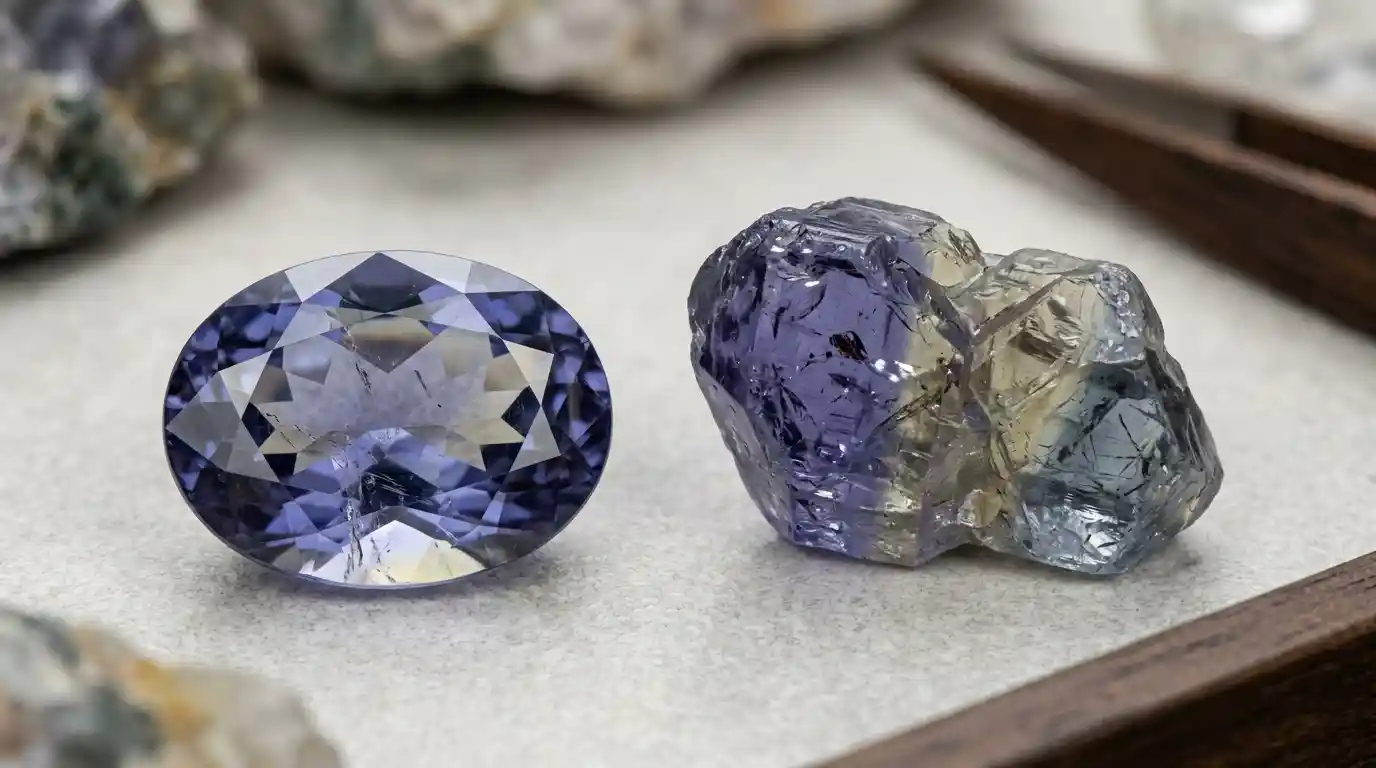
Its defining gemological feature is exceptionally strong pleochroism. A well-cut stone may appear deep violet-blue from one direction, blue-gray from another, and pale yellow, yellow-brown, or almost colorless from a third. The exact combination depends on bodycolor and orientation. This directional color is so strong that cutting orientation becomes critical. A poorly oriented gem may appear pale or gray even when the rough contains a much stronger blue direction.
Pleochroism also explains much of iolite’s modern symbolism around perspective. The same gemstone can look dramatically different as it turns, making it an intuitive metaphor for examining a problem from several viewpoints. The optical cause, however, lies in directional absorption of light inside the crystal rather than in a psychological effect.
Iolite has a Mohs hardness of approximately 7 to 7.5, which gives it respectable resistance to scratching. Durability is reduced by perfect cleavage in one direction. A sharp impact, strong pressure during setting, or sudden temperature change can exploit that cleavage and split the gemstone even when its polished surface appears undamaged. Toughness is therefore only fair despite the relatively high hardness.
Luster is usually vitreous, and transparent faceted gems may resemble sapphire or tanzanite at first glance. Iolite has historically been called “water sapphire,” but that name is misleading because sapphire is corundum, Al₂O₃, and is substantially harder at Mohs 9. Tanzanite is blue-violet zoisite with different chemistry, cleavage, optical behavior, and treatment history.
Iolite is not a hydrated mineral. Water is not an essential component of its ideal cordierite formula, although natural crystals can contain structural channels and minor constituents that vary between specimens.
Iolite Name History, Viking Navigation Legend, Geological Formation, and Major Sources
The name iolite comes from the Greek word ios, meaning violet, referring to the gemstone’s characteristic violet to violet-blue appearance. Mineralogists commonly use the name cordierite for the mineral species, while iolite is the familiar gem trade name.
Iolite is also associated with the popular “Viking compass stone” story. According to the legend, Norse navigators used thin slices of pleochroic iolite as a glare-reducing or polarizing aid to help estimate the Sun’s position under cloudy conditions. The story is frequently repeated in gemstone literature, but direct archaeological proof that Vikings specifically used iolite this way remains uncertain. It is therefore better treated as a navigation legend than as a confirmed historical technology.
Cordierite commonly forms in magnesium- and aluminum-rich rocks subjected to metamorphism. It occurs in schists, gneisses, hornfels, granulites, and some igneous or pegmatitic environments. Because its stability depends on temperature, pressure, and rock chemistry, cordierite can also provide geologists with useful information about metamorphic conditions.
Gem-quality iolite has been found in India, Sri Lanka, Madagascar, Brazil, Tanzania, Norway, and several other regions. Madagascar has produced important transparent rough, while India has supplied substantial commercial quantities. Some unusual iolite contains oriented inclusions capable of producing chatoyancy or aventurescence, although transparent strongly pleochroic stones remain the form most buyers recognize.
The workbook-verified iolite meaning can explore navigation and perspective symbolism, but these associations should remain separate from claims that cordierite physically alters cognition.
Mental Clarity, Concentration, and Decision-Making Claims
1. Mental Clarity Through Separating Facts From Assumptions
Iolite is often described as a clarity stone, partly because its changing colors suggest seeing more than one side of a situation. The gemstone does not reorganize cognition or remove mental confusion biologically. A more useful ritual is to write the problem down and separate known facts, assumptions, uncertainties, and actions still available. That process produces structure while the stone serves only as a visual reminder.
2. Concentration Through a Consistent Focus Cue
Another common claim says iolite strengthens concentration. There is no established mechanism by which cordierite increases attention span or memory. It can instead be placed beside one defined task as part of a repeatable focus routine. Silence unrelated notifications, choose a work interval, and return to the same task whenever attention wanders. The behavioral structure does the work.
3. More Deliberate Decision-Making
Pleochroism makes decision-making one of the most fitting symbolic themes for iolite. Turning the gem literally changes its apparent color, but it does not reveal which choice is correct. A practical exercise is to examine the decision from several perspectives: immediate benefit, long-term consequence, financial or emotional cost, reversibility, and missing evidence. The metaphor supports analysis without replacing it.
Confidence, Self-Discipline, and Emotional Perspective Claims
4. Confidence When Choosing a Direction
Iolite is sometimes associated with personal direction and confidence. Wearing it does not biologically increase self-esteem. Before a difficult choice, use the stone as a cue to identify what you already know, what remains uncertain, and the smallest action that can test your assumption. Confidence can develop from informed action rather than certainty.
5. Self-Discipline and Consistent Habits
Some practitioners describe iolite as strengthening willpower or discipline. The gemstone does not control impulses or create motivation. It can become a habit cue instead. Associate it with one specific routine and place it where that routine begins. Repetition can gradually strengthen the connection between the visual cue and the chosen behavior.
6. Emotional Perspective During Stress
Iolite is also used symbolically for stepping back from intense feelings. It does not suppress anxiety, anger, grief, or stress hormones. A practical ritual is to identify the emotion first, then distinguish what happened from the interpretation being added to it. Viewing the gemstone from several angles can reinforce the idea that one immediate interpretation may not be the only possible one.
Communication, Creativity, and Resilience Claims
7. Clearer Communication
Blue-violet gemstones are frequently associated with communication in modern crystal systems. Iolite cannot make another person understand or agree with you. Before an important conversation, use it as a reminder to state the main issue clearly, identify the specific request, and avoid adding unrelated complaints. Communication becomes more precise because of preparation.
8. Creativity Through Changing Perspective
Iolite’s visual changes can make it an appealing creative prompt. A writer, designer, artist, or problem-solver might deliberately generate three interpretations of the same problem before evaluating any of them. There is no evidence that the gemstone stimulates creativity neurologically, but its pleochroism provides a useful metaphor for flexible thinking.
9. Resilience After a Wrong Turn
Navigation symbolism naturally leads to themes of correction and resilience. Iolite cannot prevent failure or make someone psychologically resilient through mineral energy. After a setback, use it to ask whether the goal is still worthwhile, which part of the route failed, and what alternative remains available. Changing direction is often more useful than treating one unsuccessful attempt as final.
Dream Reflection, Intuition, and Spiritual Direction Claims
10. Dream Reflection and Bedtime Journaling
Iolite is sometimes promoted for vivid dreams, dream recall, or sleep-related insight. It has not been demonstrated to change sleep stages or reliably cause lucid dreaming. A more grounded practice is to keep the gemstone beside a dream journal and write down remembered dreams immediately after waking. The regular recording habit can make dream recall easier because attention is being directed toward remembering.
11. Intuition as a Check Between Feeling and Evidence
Modern spiritual traditions sometimes say iolite strengthens intuition. The stone does not provide hidden knowledge or extrasensory information. A practical approach is to record the first instinctive response to a choice, then compare it with known evidence and potential consequences. Intuition can be one input into judgment without being treated as supernatural certainty.
12. Spiritual Direction and Personal Purpose
Iolite’s navigation symbolism is also used in meditation around purpose, values, and direction. Someone may reflect on which commitments still fit, which goals have become outdated, and what deserves more attention. That can be a meaningful spiritual practice without claiming that cordierite communicates a predetermined life path.
Iolite Chakra Associations: Third-Eye Insight and Throat-Centered Communication
Iolite is most commonly associated with the third-eye chakra in contemporary crystal systems because of its violet-blue color and symbolism involving insight, perspective, and intuition. Some practitioners also connect bluer stones with the throat chakra and themes of communication or self-expression, while violet specimens may be linked with crown-centered contemplation.
Chakras are a spiritual framework rather than anatomical structures. Iolite has not been demonstrated to affect the brain, pineal gland, thyroid, nervous system, sleep hormones, or another organ through chakra placement. Its colors can still help organize meditation themes without turning spiritual symbolism into physiology.
Iolite Physical Care: Perfect Cleavage, Temperature Changes, Water, Steam, and Ultrasonics
Iolite’s Mohs hardness of 7 to 7.5 makes it resistant to many everyday scratches, but perfect cleavage in one direction creates a significant breakage risk. Rings should be protected from hard knocks, especially during sports, housework, exercise, or work involving tools and hard surfaces. Pendants and earrings generally expose the gemstone to less impact.
Store iolite away from sapphire, ruby, diamond, and other harder gems that could scratch it. Iolite itself can scratch softer stones, so individual compartments are preferable.
Brief contact with plain water is generally safe for untreated iolite. Warm or lukewarm water with mild soap is the safest routine cleaning method. Prolonged soaking offers little benefit and should be avoided if the setting contains adhesives or other vulnerable components.
Steam cleaning should not be used because high heat and rapid temperature changes can cause breakage. Ultrasonic cleaning should also be avoided. Vibration may exploit cleavage planes or hidden fractures, particularly in mounted stones.
Iolite is rarely treated compared with many blue gemstones, which simplifies routine care. Its natural color is generally stable to normal light, but sharp temperature changes and impact remain important concerns.
Lapidary cutting and polishing produce mineral dust. Wet cutting, effective extraction, eye protection, and suitable respiratory precautions are preferable to dry grinding.
Gentle Ritual Cleansing for Iolite Without Heat or Cleavage Risk
Ritual cleansing does not require physically stressing iolite. There is no scientifically demonstrated unwanted energy that must be removed through soaking, heat, salt, or chemical treatment.
Sound, quiet reflection, intention-setting, or dry placement on a clean cloth are low-risk approaches. A navigation-themed ritual can be especially appropriate: identify where you are now, where you want to go, and one action that moves in that direction.
Avoid steam, flame, extreme heat, ultrasonic devices, abrasive salt contact, aggressive chemicals, and hard handling. A simple ritual protects the gemstone’s cleavage-sensitive structure.
Conclusion
Iolite’s strongest connection with clarity and direction comes from a real gemological property: dramatic pleochroism that can make one crystal look blue, violet, yellowish, or nearly colorless depending on orientation. That feature supports compelling symbolism, but it does not establish healing power. Its twelve wellness themes can still serve as prompts for focus, decision-making, communication, creativity, and personal direction when the practical action remains with the person.
Frequently Asked Questions About Iolite Healing Properties
What are the main iolite healing properties people claim?
Common claims include clarity, concentration, decision-making, confidence, discipline, emotional perspective, communication, creativity, resilience, dream reflection, intuition, and spiritual direction. These are wellness or spiritual beliefs rather than proven therapeutic effects.
What is iolite made of?
Iolite is gem-quality cordierite, an aluminum-magnesium-iron silicate commonly represented as (Mg,Fe)₂Al₄Si₅O₁₈.
Why does iolite show different colors?
Iolite is strongly pleochroic. It absorbs light differently along different crystal directions, so one gemstone can appear violet-blue, blue-gray, yellowish, brownish, or nearly colorless as it turns.
How hard is iolite?
Iolite is approximately Mohs 7 to 7.5. It has good scratch resistance but perfect cleavage in one direction, which reduces toughness.
Did Vikings really use iolite for navigation?
The story that Vikings used thin iolite slices to locate the Sun on cloudy days is a well-known legend, but direct evidence that iolite was actually used this way is uncertain. It should not be presented as established archaeological fact.
Is iolite scientifically proven to improve intuition?
No. Iolite has not been shown to provide extrasensory information or improve intuition through a mineral-specific mechanism. It can instead serve as a reminder to compare instinct with available evidence.
Which chakra is iolite associated with?
Modern crystal systems commonly associate iolite with the third-eye chakra and sometimes the throat or crown chakras. These are spiritual correspondences rather than anatomical effects.
Can iolite go in water?
Brief contact with lukewarm water is generally safe for untreated iolite. Mild soap and gentle hand cleaning are appropriate, while prolonged soaking is unnecessary.
Can iolite be cleaned ultrasonically or with steam?
No. Steam and ultrasonic cleaning are not recommended because iolite has perfect cleavage and can be damaged by heat, vibration, pressure, or sudden temperature changes.
What should buyers check when choosing iolite?
Strong violet-blue color, attractive pleochroism, good cutting orientation, clarity, and limited cleavage damage are important. The workbook-verified buy iolite topic focuses on quality and purchasing checks.
Crystal healing claims are traditional or personal beliefs and should not replace qualified medical or mental health care.