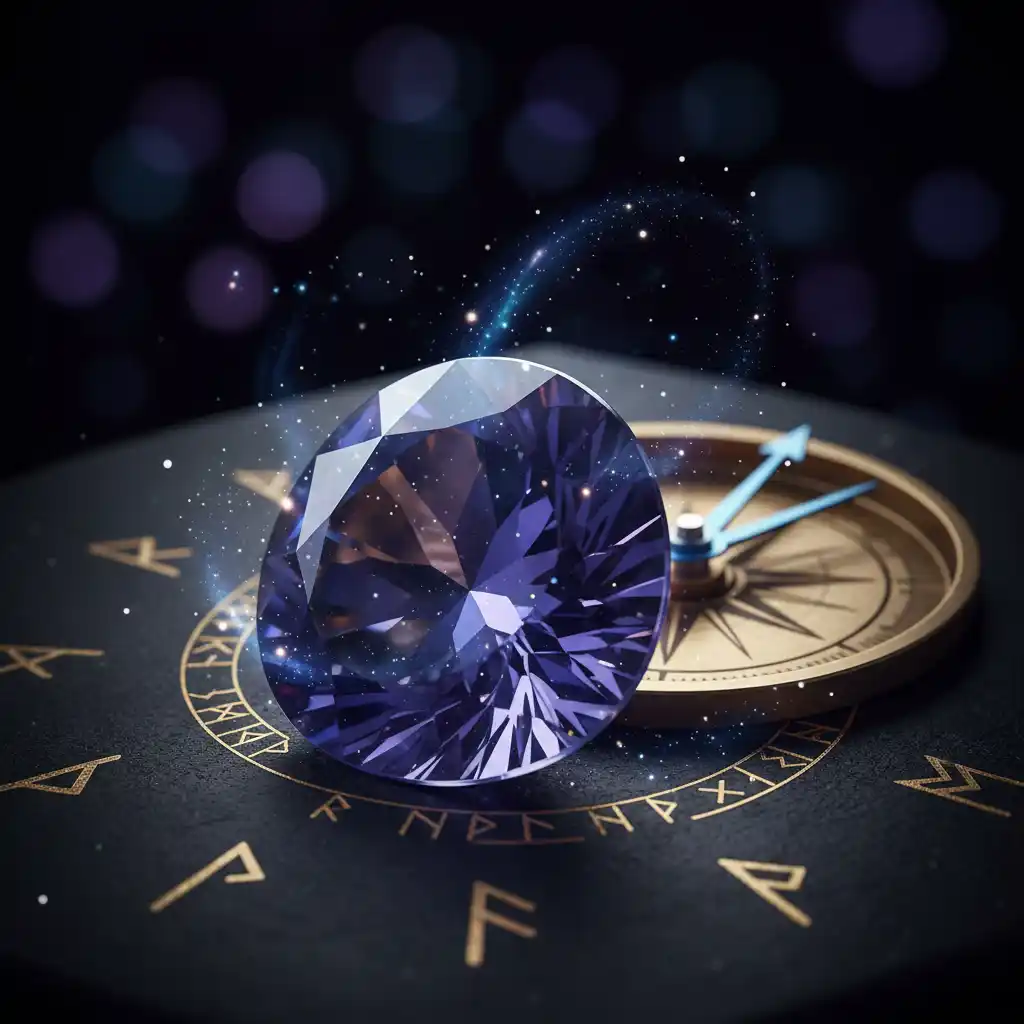
Iolite Meaning: Properties, Uses & Symbolism
Iolite meaning begins with cordierite, a magnesium-aluminum silicate mineral whose gem-quality transparent violet-blue material is known in the jewelry trade as iolite. The idealized cordierite formula is commonly written Mg₂Al₄Si₅O₁₈, although natural cordierite can contain substantial iron along with channel-bound water and other minor constituents. Cordierite is orthorhombic, commonly has Mohs hardness around 7–7.5, measured specific gravity roughly 2.6–2.66, vitreous luster, imperfect-to-poor cleavage, and strongly directional optical behavior.
The feature that defines iolite visually is extraordinary pleochroism. Rotate a suitable transparent stone and one crystal direction can look violet-blue or blue while another becomes pale yellow, grayish, or nearly colorless. GIA describes three distinct colors visible through the three principal directions and identifies iron as the principal source of the attractive violet-to-blue body color.
That optical behavior has shaped nearly every part of iolite’s identity. It explains why the gem was historically confused with sapphire, why the old commercial term “water sapphire” is misleading, why cutters must orient rough carefully, and why iolite became involved in the famous—but still unproven—story that Viking navigators used thin cordierite crystals to analyze polarized skylight. GIA presents the navigation story explicitly as legend, while experimental research shows that cordierite can indeed function physically as a polarization analyzer in hypothetical navigation systems. The experimental plausibility does not establish that historical Viking sailors actually used iolite this way.
Modern symbolism adds another layer. Iolite is commonly associated with perspective, direction, self-reflection, clear decision-making, personal responsibility, imagination, or finding a path through uncertainty. Those associations fit the gem’s directional color and navigation story well as metaphors. They are not demonstrated physiological consequences of cordierite, iron, pleochroism, or polarized light.
Readers exploring other material-first references can browse Gemstone Guides. This page focuses specifically on what iolite is, how it forms, what produces its color, how to recognize it, what its documented history actually supports, how modern symbolism can be interpreted responsibly, and what its physical structure means for ownership.
Iolite Meaning at a Glance
| Property or question | Evidence-aware summary |
|---|---|
| Mineral species | Cordierite |
| Gem/trade name | Iolite |
| Idealized formula | Mg₂Al₄Si₅O₁₈ |
| Common natural substitution | Iron can replace some magnesium and strongly influence color |
| Crystal system | Orthorhombic |
| Typical gem color | Violet-blue to blue, often with grayish or violet modifiers |
| Most characteristic optical property | Extremely strong pleochroism |
| Pleochroic directions | Commonly blue/violet-blue, pale yellow, and nearly colorless or grayish |
| Main color relationship | Iron-related absorption |
| Mohs hardness | About 7–7.5 |
| Specific gravity | Roughly 2.6–2.66 |
| Gem RI | Approximately 1.542–1.551 in GIA’s general iolite reference |
| Transparency | Transparent to translucent |
| Luster | Vitreous |
| Cleavage | One important cleavage direction; other cleavage directions weaker |
| Toughness | Limited enough that sharp blows require care |
| Common geological setting | Mg- and Al-rich high-grade metamorphic rocks |
| Can it show phenomena? | Yes; chatoyancy, asterism or aventurescent effects occur in some included material |
| Common misleading name | “Water sapphire” |
| Is iolite sapphire? | No |
| “Viking compass stone” status | Historically unproven hypothesis/legend; optical feasibility has experimental support |
| Modern symbolism | Direction, perspective, reflection, discernment, intentional action |
| Scientific status of symbolism | Interpretive rather than demonstrated medical or supernatural action |
GIA’s general gem reference gives iolite an RI of about 1.542–1.551, specific gravity about 2.61, and hardness 7–7.5.
What Is Iolite?
Iolite is the gem-trade name for transparent to translucent cordierite with attractive blue-to-violet coloration.
Mineralogists identify the material as cordierite.
Jewelry buyers usually encounter the name iolite.
This is similar to other gemstone naming systems in which a mineral species and a commercial gem name operate at different levels. Calling a blue gem iolite does not describe a separate crystal structure from cordierite; it describes gem-quality cordierite selected for its appearance.
GIA states this directly: cordierite is the mineral name, while iolite is the name commonly used in the jewelry industry.
The distinction matters because some articles describe “iolite mineral” as though iolite were formally separate from cordierite.
The material does not change species when it becomes transparent enough to facet.
Iolite Identity Table
| Characteristic | Iolite / cordierite |
|---|---|
| Accepted mineral | Cordierite |
| Gem name | Iolite |
| Idealized formula | Mg₂Al₄Si₅O₁₈ |
| Crystal system | Orthorhombic |
| Common colors | Blue, violet-blue, gray-blue, pale blue; cordierite more broadly can also be gray, brown or yellowish |
| Hardness | Mohs 7–7.5 |
| Density | About 2.6–2.66 |
| General gem RI | About 1.542–1.551 |
| Optical character | Biaxial |
| Pleochroism | Very strong |
| Luster | Vitreous |
| Cleavage | Fair to poor overall, with one structurally important direction |
| Fracture | Subconchoidal |
| Tenacity | Brittle |
| Streak | White |
| Typical gem use | Faceted stones and selected cabochons |
| Main color-producing constituent | Iron |
| Common high-grade geological setting | Amphibolite- to granulite-facies metamorphic rocks |
| Main identification advantage | Extreme directional color |
Mindat records measured cordierite density around 2.6–2.66, hardness 7–7.5, orthorhombic symmetry, brittle behavior, and poor-to-fair cleavage.
Why Is Iolite Blue?
Iron is central to iolite color.
GIA describes iolite as an aluminum-, magnesium-, and iron-bearing silicate whose characteristic violetish-blue color derives from iron in the structure.
The full mechanism is more informative than the phrase “iron makes it blue.”
Natural cordierite can contain iron in different oxidation states and structural positions. Modern spectroscopic work links its dramatic blue-violet versus yellow directional appearance to iron-related absorption, including interactions involving Fe²⁺ and Fe³⁺. Mindat’s current cordierite summary cites spectroscopic evidence connecting a broad visible absorption band and Fe²⁺–Fe³⁺ charge-transfer behavior with the strong purple/blue, pale-violet and pale-yellow pleochroic directions.
The resulting color is therefore both chemical and directional.
A stone can contain the same iron everywhere yet appear radically different depending on which crystallographic direction the observer looks through.
Why Iolite Changes Color When Rotated
Iolite does not usually “change color” in the same sense as alexandrite.
Its different colors arise principally from pleochroism.
Pleochroism occurs when an anisotropic crystal absorbs different wavelengths of light by different amounts along different crystallographic directions.
In iolite, this difference is unusually strong.
One direction may show saturated blue-violet.
Another can appear yellow-gray.
A third may be pale or nearly colorless.
GIA emphasizes that three distinct directional colors can be visible when iolite is rotated.
This is a structural optical effect.
It is not evidence that the crystal’s chemical composition changes during rotation.
It is also not evidence that its spiritual “frequency” changes with direction.
Pleochroism Versus Color Change
The difference is worth keeping explicit.
Pleochroism depends mainly on viewing direction through an anisotropic crystal.
Color change typically describes a stone whose perceived color shifts substantially when the spectral composition of the illumination changes.
An iolite can look different simply because it has been rotated under the same light.
That is pleochroism.
The deeper orientation, absorption, optical-axis, color-direction and photography issues belong in Iolite Optical Properties and Color Behavior.
Why Cutting Direction Matters
Iolite’s pleochroism creates one of the gemstone’s most important lapidary problems.
A piece of rough may contain excellent saturated blue in one direction but appear gray, pale yellow or nearly colorless from another.
GIA notes that cutters must orient iolite carefully so its best blue color is visible through the table of the finished stone.
A technically poor orientation can therefore transform potentially attractive rough into a washed-out finished gem.
The reverse can happen with very dark rough: cutting to avoid the darkest direction can improve apparent brightness.
That is why a photograph of rough cannot predict finished color reliably unless crystal orientation is known.
Detailed faceting and orientation strategy belongs in Iolite Cutting, Orientation and Polish.
Is Iolite the Same as Sapphire?
No.
Sapphire is corundum, Al₂O₃.
Iolite is cordierite.
Their chemistry, structure, density, optical behavior, cleavage and hardness differ.
The visual confusion is understandable because fine iolite can resemble violet-blue sapphire in face-up color. GIA notes that iolite was historically called “water sapphire,” but explicitly identifies that terminology as incorrect.
The term should therefore be treated as historical or commercial wording, not as a mineral relationship.
An iolite is not a watery variety of sapphire.
Why “Water Sapphire” Is Misleading
The phrase suggests one of three incorrect ideas:
that iolite is corundum,
that it is a low-grade sapphire,
or that it somehow belongs within sapphire nomenclature.
None is correct.
The resemblance is visual.
Fine iolite can have an attractive violet-blue face-up color, but strong pleochroism frequently reveals its identity immediately when the stone is rotated.
A responsible description can mention “water sapphire” as an obsolete trade term while clearly stating that the gem is cordierite.
Iolite Versus Tanzanite
Fine iolite can also resemble tanzanite.
GIA notes that when tanzanite was first encountered, gemologists initially considered whether the material might be cordierite because both can show violet-blue color and strong pleochroism.
They are unrelated minerals.
Tanzanite is blue-to-violet zoisite and has different refractive indices, density, crystallography and durability.
The comparison is useful because it demonstrates that pleochroism is a diagnostic clue but not a species identity by itself.
Several different minerals can be pleochroic.
The exact optical constants matter.
How Iolite Forms
Gem iolite is strongly associated with high-grade metamorphism.
A detailed GIA investigation of gem cordierite deposits found that iolite occurrences commonly form within magnesium- and aluminum-rich metamorphic rocks under upper amphibolite- to granulite-facies conditions. Studied deposits include cordierite-bearing schists and gneisses and rocks derived from hydrothermally altered mafic volcanic precursors that were later subjected to intense metamorphism.
This is fundamentally different from the formation of many pegmatitic gemstones.
Cordierite often records the response of an existing rock to elevated temperature and pressure, bulk-rock chemistry, fluid history, and metamorphic reactions.
It can grow as new crystals while older minerals break down and redistribute their chemical components.
The result may be coarse cordierite surrounded by mica, quartz, garnet, orthoamphibole or other high-grade metamorphic phases.
The full petrologic context belongs in Iolite Formation and Deposit Geology.
Magnesium and Aluminum Matter
Cordierite is particularly favored in rocks rich in magnesium and aluminum.
GIA’s deposit research repeatedly emphasizes Mg- and Al-rich host compositions. At studied Canadian occurrences, cordierite occurs with minerals such as gedrite, iron-rich phlogopite, quartz and almandine-pyrope garnet.
That association is not random.
The mineral assemblage reflects the chemical inventory of the rock and the temperature-pressure conditions reached during metamorphism.
A violet-blue transparent crystal may therefore be the gem-quality portion of a much larger metamorphic system whose surrounding material is unsuitable for jewelry.
High-Grade Metamorphism Does Not Guarantee Gem Quality
Most cordierite formed in metamorphic rocks is not transparent faceting material.
The GIA study of British Columbia iolite reported that the overwhelming majority of cordierite at the examined localities was not gem quality because of extensive fracturing or abundant inclusions. Only portions of individual crystals provided usable transparent rough.
This distinction matters.
Cordierite can be geologically abundant in a rock yet gem-quality iolite remain scarce.
“Rare gemstone” and “rare mineral” are therefore different claims.
Inclusions in Iolite
Iolite can contain a surprisingly diverse inclusion population.
GIA’s detailed study of gem cordierite documented iron-rich phlogopite, muscovite, zircon, xenotime-(Y), hematite, apatite and several types of fluid inclusions. Parallel acicular fluid inclusions in some material were sufficiently concentrated to create chatoyancy.
Other iolite is known for hematite inclusions.
GIA has examined “bloodshot” iolite containing eye-visible red hematite platelets and documented intergrowths with feldspar material displaying aventurescence.
These examples show why an inclusion should not automatically be called a flaw.
An inclusion can reduce transparency.
It can also produce an optical phenomenon, document geological history, or create collector interest.
The detailed specimen-scale interpretation belongs in the Iolite Microscope Inclusion Notebook.
Cat’s-Eye Iolite
Some iolite contains dense parallel inclusions capable of reflecting light as a narrow band.
When such material is cut as a properly oriented cabochon, the result can be chatoyancy—a cat’s-eye effect.
GIA documented chatoyant iolite in which abundant parallel acicular fluid inclusions aligned with the cordierite crystal structure produced the eye.
This phenomenon is optical.
The moving eye does not demonstrate energy circulation inside the stone.
It reflects organized internal structures.
Bloodshot Iolite
“Bloodshot iolite” is a descriptive trade term for material containing conspicuous reddish hematite inclusions.
GIA has documented red hematite platelets in iolite, including specimens intergrown with aventurescent feldspar.
The term should not be interpreted literally.
There is no blood inside the mineral.
Nor does hematite content demonstrate a benefit to human blood simply because hematite contains iron.
The red appearance is mineralogical.
Diagnostic Characteristics of Iolite
Iolite identification works especially well when several properties are combined.
| Observation or test | Iolite-compatible result | Diagnostic usefulness |
|---|---|---|
| Body color | Violet-blue to blue | Supporting only |
| Pleochroism | Very strong, commonly blue/violet, yellowish and pale/colorless directions | Exceptionally useful |
| Hardness | About 7–7.5 | Useful |
| Specific gravity | About 2.6–2.66 | Useful |
| RI | Roughly 1.542–1.551 for typical gem iolite | Strong |
| Crystal system | Orthorhombic | Strong in crystallographic work |
| Cleavage | Present but less obvious than in topaz or calcite | Supporting |
| Luster | Vitreous | Low specificity |
| Inclusions | Variable, including hematite and fluid inclusions | Supporting |
| Chemistry | Mg-Al silicate with Fe substitution | Strong |
| Raman/XRD | Cordierite structural response | Strong confirmation |
The pleochroism is unusually useful because few common violet-blue gemstones show such dramatic eye-visible directional contrast.
It is still not sufficient to identify every faceted stone without supporting measurements.
Original Information Gain: Iolite Name and Claim Audit
| Name or claim | Evidence-aware interpretation | What should not automatically be assumed | Better evidence when needed |
|---|---|---|---|
| Iolite | Gem-quality blue/violet cordierite | Separate mineral species | Cordierite identification |
| Cordierite | Accepted mineral species | Every cordierite crystal is gem-quality iolite | Gem quality depends on transparency/color |
| “Water sapphire” | Obsolete/misleading trade name | Corundum sapphire | Gemological testing |
| “Viking compass stone” | Famous modern/historical hypothesis | Proven archaeological use by Vikings | Direct historical or archaeological evidence |
| “Sunstone” | Proposed navigation material in experimental models | Same thing as feldspar sunstone | Context required |
| Dichroic compass crystal | Cordierite can physically analyze polarized light | Historical use established | Archaeological evidence |
| Bloodshot iolite | Iolite containing red hematite inclusions | Blood-related healing effect | Inclusion identification only |
| Cat’s-eye iolite | Chatoyant cordierite | One universal inclusion type | Microscopy |
| Aventurescent iolite | Reflective included material | Same as sunstone feldspar | Host/inclusion identification |
| “Blue sapphire substitute” | Visual/market comparison | Same physical durability or mineral species | Compare properties |
| “Vision stone” | Modern symbolism | Improved eyesight or neurological function | Clinical evidence required |
| “Navigation crystal” | Symbolic/historical wording | Guaranteed life direction | Remains metaphorical |
| “Iron healing stone” | Chemistry-to-health inference | Nutritional iron delivery | No established pathway |
| “Creativity stone” | Modern personal symbolism | Biological increase in creativity | Remains symbolic |
| “Detox stone” | Unsupported wellness terminology | Physiological toxin removal | Clinical evidence required |
The Viking claim is the most important disputed item because a physically plausible experiment and a historically demonstrated practice are not the same thing.
The Viking Compass Story
The story is compelling.
Iolite’s intense pleochroism makes it a plausible polarization analyzer. Rotating a thin cordierite crystal while viewing polarized skylight can produce brightness changes associated with polarization direction.
GIA recounts the traditional story that Viking navigators used iolite slices to reduce glare and locate the Sun through cloudy conditions, but deliberately qualifies it as legend.
Experimental research goes further in one direction: it demonstrates that cordierite can function in hypothetical sky-polarimetric navigation. Laboratory and atmospheric-optics studies have tested cordierite, tourmaline and calcite as candidate “sunstones,” and simulations show that appropriately repeated polarization observations could in principle support navigation under some cloudy conditions.
What those studies do not establish is actual archaeological use of iolite by Viking sailors.
The appropriate conclusion is:
Cordierite is physically capable of serving as a polarization analyzer in experimental reconstructions of sunstone navigation, but the familiar claim that Vikings historically used iolite remains unproven.
That distinction preserves both the interesting physics and the limits of the historical evidence.
Why Cordierite Works as a Polarization Analyzer
Pleochroism means cordierite absorbs light differently depending on polarization direction.
When partially polarized skylight passes through an appropriately oriented slice, rotation can produce detectable changes in brightness.
Experimental studies measured how accurately observers could use cordierite and other proposed crystals to determine polarization direction. In some test conditions, cordierite performed as well as or better than other candidate sunstone materials.
This is real optical physics.
It does not require supernatural navigation.
Iolite and “Sunstone” Terminology
The word sunstone creates another nomenclature trap.
In modern gemology, sunstone commonly refers to aventurescent feldspar.
In Viking-navigation discussions, “sunstone” refers instead to a hypothetical polarization-analyzing crystal that might have been calcite, cordierite or tourmaline.
Those are different uses of the same word.
Therefore:
Iolite is not feldspar sunstone.
Cordierite can be discussed as a hypothetical navigational sunstone candidate.
Context determines which meaning is intended.
Original Specimen and Photo Checklist
| Observation | Photograph can often support | Photograph cannot reliably establish |
|---|---|---|
| Violet-blue face-up color | Hue and saturation | Cordierite species alone |
| Pale yellow rotated direction | Strong pleochroism | Exact Fe chemistry |
| Nearly colorless direction | Pleochroic contrast | Geographic origin |
| Orthorhombic rough morphology | Cordierite-compatible habit | Gem variety without tests |
| Fractures | Structural condition | Formation temperature |
| Red platelets | Hematite candidate | Hematite without analysis |
| Parallel needles/tubes | Potential chatoyancy-causing structure | Inclusion composition |
| Cat’s-eye band | Chatoyancy exists | Exact inclusion species |
| Metamorphic matrix | Geological context | Deposit identity |
| Garnet association | Metamorphic assemblage | Locality |
| Seller “Viking compass stone” label | Marketing/historical claim | Viking archaeological use |
| Seller “untreated” label | Disclosure claim | Independent confirmation |
| “Water sapphire” label | Historical trade wording | Sapphire identity |
| “Healing vision” claim | Nothing objectively measurable | Medical effect |
The best educational iolite photograph does not show only the prettiest face-up color.
Photograph the same specimen at several controlled orientations.
A true documentary set should reveal the pale or yellowish direction as clearly as the violet-blue one.
That evidence communicates what makes iolite distinctive far better than digitally intensifying the blue.
How to Photograph Iolite Pleochroism
Use one stable daylight-balanced light source.
Keep exposure and white balance constant.
Rotate the gemstone rather than changing the lighting.
Photograph the most saturated blue-violet direction.
Then photograph the lighter direction.
If the rough allows it, document the third principal orientation as well.
Do not increase saturation individually between frames.
The comparison is valuable precisely because the physical crystal—not editing—creates the difference.
Documented Naming History
The name iolite derives from the Greek ios, meaning violet, a reference to its characteristic color. GIA records this etymology directly.
Cordierite was named for French geologist Pierre Louis Antoine Cordier, who studied the mineral and contributed to early microscopic mineralogy. Mindat records the mineral’s naming in his honor.
These names belong to different traditions.
Cordierite is the formal mineralogical identity.
Iolite is the gem name built around violet-blue appearance.
Neither historical name means spiritual vision, destiny, intuition, or dream guidance.
Those associations came later.
Modern Iolite Meaning
Modern iolite meaning commonly centers on direction, perspective, discernment, self-reflection, imagination, independence, decision-making, and navigating uncertainty.
These interpretations fit the material unusually well as metaphor.
One crystal can appear blue from one direction and nearly colorless from another.
A stone associated with an unproven but physically plausible navigation story naturally invites themes of finding direction.
A gemstone that must be oriented carefully before its best color becomes visible can symbolize the importance of viewpoint.
Those are strong metaphors without claiming that cordierite alters destiny.
Iolite and Perspective
Perspective is perhaps the most direct symbolic interpretation.
The crystal itself demonstrates that a single object can look radically different depending on orientation.
A useful reflective practice might ask:
What does this situation look like from my current position?
What would another informed observer see?
Which facts remain unchanged when perspective changes?
That final question matters.
Pleochroism changes appearance.
It does not mean the underlying mineral becomes three different substances.
Likewise, changing perspective can reveal information without making every interpretation equally correct.
Iolite and Direction
The Viking compass story makes direction an obvious symbolic theme.
A responsible personal use can convert “finding direction” into a practical framework:
identify the destination,
separate immediate actions from distant goals,
choose one next step,
define what evidence would justify changing course,
and review progress periodically.
That is navigation in a behavioral sense.
The gemstone does not identify a predetermined life path.
Iolite and Decision-Making
Iolite is sometimes described as a stone of inner knowing.
A stronger evidence-aware interpretation treats an intuitive impression as one input rather than as final proof.
Write down the initial judgment.
Then identify:
known facts,
assumptions,
risks,
alternatives,
and missing evidence.
The process echoes the gemstone itself. A first glance might suggest sapphire, but rotation and measurement reveal cordierite.
Good decisions improve when first impressions are tested.
Iolite and Self-Reflection
Strong directional color also supports self-reflection symbolism.
A person can ask the same question from several positions:
What do I want?
What am I afraid will happen?
What evidence supports that fear?
What responsibility belongs to me?
What would I advise another person facing the same facts?
The stone does not perform introspection.
It can act as a cue to do it deliberately.
Iolite and Creativity
GIA records creativity among beliefs associated with iolite in modern lore.
A practical interpretation can connect the gem with changing viewpoints.
Writers, designers and problem-solvers often benefit from reframing a problem, reversing an assumption, examining another audience, or testing a different constraint.
Iolite’s changing appearance provides a useful visual metaphor for that process.
There is no established evidence that cordierite chemistry directly increases creative neurological activity.
Iolite and Sleep
Modern iolite lore sometimes associates the gem with sleep.
GIA records this belief historically within contemporary gem lore but does not present it as a medical property.
Someone can include an iolite object in a bedtime routine as a reminder to finish work, journal, reduce stimulation or follow a consistent schedule.
The routine may be personally useful.
There is no established evidence that wearing iolite treats insomnia, sleep apnea, circadian disorders, or other medical sleep problems.
Iolite Healing Claims
There is no established scientific evidence that wearing or carrying iolite treats anxiety, depression, neurological disease, vision disorders, cardiovascular conditions, hormonal disorders, chronic pain, infertility, immune dysfunction, sleep disorders, or other medical conditions.
Cordierite contains magnesium, aluminum, silicon, oxygen and commonly iron.
The presence of those elements in a mineral lattice does not make a gemstone a nutritional product or medication.
Iron that contributes to iolite’s blue color is not transferred through skin as a controlled iron supplement.
Magnesium inside cordierite is not a transdermal magnesium therapy.
Mineralogy and pharmacology require different evidence.
Iolite Does Not Improve Eyesight
The gemstone is visually fascinating.
That does not mean it heals vision.
Pleochroism changes light traveling through the crystal.
It does not repair the retina, cornea, lens, optic nerve or visual cortex.
Historical or symbolic phrases such as “vision stone” should therefore be interpreted metaphorically unless genuine clinical evidence is presented.
Iolite Does Not Provide Nutritional Iron
Blue iolite owes much of its color to iron.
That iron is structurally incorporated within cordierite.
A darker blue stone is not a stronger nutritional source.
Wearing the gem does not deliver a measured iron dose.
Grinding it into powder would create an uncontrolled mineral exposure rather than a supplement.
Do Not Ingest Iolite
Iolite should not be powdered, swallowed, added to supplements, or deliberately used to prepare mineral drinking-water elixirs.
Natural material can contain other mineral inclusions, iron oxides, mica, fluid inclusions, surface contaminants, polishing residues, fracture fillers or jewelry-related substances beyond the simplified cordierite formula.
A mineral specimen is not a food product.
Symbolic practice does not require ingestion.
Safe Ownership: Hardness and Toughness Are Different
Iolite’s hardness of roughly 7–7.5 provides useful scratch resistance.
That sounds durable.
The full picture is more complicated.
GIA warns that iolite has a significant cleavage direction, is not especially tough, and can split or break under sharp blows, extreme pressure or sudden temperature changes.
This distinction matters because hardness answers:
How easily can another material scratch the surface?
Toughness answers:
How well does the gemstone resist breaking or chipping?
A gemstone can score well on the first question and poorly on the second.
Jewelry Wear
Iolite can be used successfully in rings, pendants, earrings, necklaces and bracelets when design and wear patterns respect its structural limitations.
Different jewelry forms expose the stone to different risks, so those decisions belong in the mapped practical guides rather than being repeated here:
- Iolite Bracelet covers bead construction, fit, drill holes and restringing.
- Iolite Earrings covers matched pairs, backs, weight and setting security.
- Iolite Necklace covers pendant orientation, strands, chains and clasp balance.
- Iolite Ring covers exposed wear and protective ring design.
At the material level, the key lesson is simple: Mohs 7–7.5 does not cancel cleavage or brittle failure.
The specialized mechanical analysis belongs in Iolite Setting and Wear Engineering.
Cleaning and Heat
GIA recommends warm soapy water for iolite and advises against steam and ultrasonic cleaning. High heat or sudden temperature changes can cause breakage. GIA also notes that iolite is not typically treated and that its color is generally stable.
This page does not duplicate a full cleaning procedure because that belongs in How to Clean Iolite Jewelry.
The material-level boundary is that aggressive heat, thermal shock and hard impact are unnecessary risks.
Treatment
Iolite differs from several major blue gemstones because treatment is not usually central to ordinary commercial material.
GIA states that iolite is not typically treated, so coatings and dyes are generally not major routine concerns for the gem.
That should not become an absolute statement that no treated or misrepresented iolite could ever enter the market.
It means treatment is not considered a defining widespread market issue in the way heat is for sapphire or irradiation is for blue topaz.
An unusual specimen still deserves evidence appropriate to the claim.
Buying and Price Belong on Separate Pages
A meaning reference should not duplicate transaction advice.
Questions about seller evaluation, returns, disclosure, documentation and choosing a stone belong in Buy Iolite.
Questions about color quality, clarity, carat weight, cutting, value factors and market comparisons belong in Iolite Price.
Keeping those pages separate prevents the phrase iolite meaning from turning into an unfocused buying guide.
Specimen Conservation
A natural iolite specimen can preserve much more than blue color.
It may retain crystal morphology, pleochroic orientation, metamorphic matrix, fractures, hematite inclusions, mica, garnet, quartz associations, fluid inclusions, chatoyant structures, weathering, historic labels and locality documentation.
Before cutting a significant natural crystal, photograph the specimen from several directions—especially the different pleochroic orientations.
Record dimensions, mass, matrix, color direction, fractures, inclusions, provenance and previous labels.
The Iolite Specimen Conservation Record provides the dedicated framework for preserving those details.
A scientifically useful crystal can lose important context when it is reduced to a faceted stone.
Original Source-Comparison Framework
| Source type | Best question it answers | Main limitation |
|---|---|---|
| GIA gem reference | What are accepted iolite gem properties and trade terminology? | Does not identify one reader specimen |
| Mineralogical database | What is cordierite chemically and structurally? | General species data rather than gem-quality assessment |
| Spectroscopy | What produces directional color in a particular stone? | Requires suitable instrumentation |
| Metamorphic-petrology research | Under what geological conditions does cordierite form? | One deposit does not represent every occurrence |
| Inclusion research | What microscopic features occur in documented iolite? | Inclusion populations vary by locality |
| Polarization experiments | Can cordierite physically function as a polarization analyzer? | Does not prove historical Viking use |
| Historical/archaeological evidence | Did a specific culture actually use iolite? | Evidence remains incomplete for Viking-cordierite claims |
| Seller listing | How is material marketed? | Not independent evidence for mineralogy or history |
| Metaphysical source | What symbolism is practiced? | Cannot establish medical or mineralogical effects |
The Viking example shows why source matching is essential.
Physics can show that an instrument would work.
Only historical or archaeological evidence can establish whether particular people used it.
Evidence and Technical Limits
This article does not claim first-hand collecting at iolite deposits, unpublished chemical analysis, private spectroscopy, laboratory treatment testing, or direct authentication of a reader’s stone. The broader evidence approach used by Gems Lore is described on About Gems Lore.
Exact color mechanisms, Fe²⁺/Fe³⁺ relationships, inclusion identities, metamorphic conditions, geographic origin, unusual treatment, or chatoyancy mechanisms may require spectroscopy, petrography, Raman analysis, electron-microprobe chemistry, microscopy or specialist review.
Likewise, the Viking navigation story should remain separated into two evidence questions:
cordierite can function as a polarization analyzer;
actual Viking use of iolite has not been established simply because the physics works.
Frequently Asked Questions About Iolite Meaning
What is iolite meaning?
Iolite meaning commonly combines the gemstone’s intense directional color with modern symbolism involving perspective, direction, self-reflection, decision-making, imagination and navigating uncertainty. These are symbolic interpretations rather than demonstrated medical effects.
What mineral is iolite?
Iolite is gem-quality cordierite. GIA explicitly identifies cordierite as the mineral name and iolite as the jewelry-trade gem name.
What is iolite made of?
Its idealized cordierite formula is Mg₂Al₄Si₅O₁₈, with natural iron substitution and other minor components possible.
Why is iolite blue?
Its violet-to-blue color is primarily associated with iron in the cordierite structure.
Why does iolite look yellow from another direction?
Strong pleochroism causes different crystallographic directions to absorb light differently. One direction can appear violet-blue while another becomes pale yellow or nearly colorless.
Is iolite color change?
Its most famous directional variation is pleochroism rather than ordinary light-source-dependent color change. Rotation under the same illumination can expose different colors.
How hard is iolite?
Iolite is approximately Mohs 7–7.5.
What is iolite’s specific gravity?
Gem iolite is relatively light for a blue gemstone, with SG near 2.61 in GIA’s general reference and a broader cordierite range around 2.6–2.66.
What is iolite’s refractive index?
GIA gives an approximate gem iolite RI range of 1.542–1.551.
Is iolite the same as sapphire?
No. Iolite is cordierite, while sapphire is corundum. The old name “water sapphire” is misleading.
Is iolite the same as tanzanite?
No. Tanzanite is zoisite. The gems can overlap visually because both may be violet-blue and pleochroic, but their mineral properties differ.
Where does iolite form?
Gem cordierite commonly occurs in magnesium- and aluminum-rich high-grade metamorphic rocks formed under amphibolite- to granulite-facies conditions.
Can iolite contain hematite?
Yes. GIA has documented red hematite platelets in “bloodshot” iolite.
Can iolite show a cat’s-eye?
Yes. GIA documented chatoyant cordierite in which dense parallel acicular fluid inclusions created the cat’s-eye effect.
Did Vikings use iolite as a compass?
The claim remains unproven historically. GIA presents it as legend. Experiments demonstrate that cordierite can function as a polarization analyzer in hypothetical sky-polarimetric navigation, but physical feasibility does not establish actual Viking use.
Why is iolite called a compass stone?
The name comes from the famous hypothesis that its pleochroic/polarizing behavior could help determine the hidden Sun’s direction through polarized skylight.
What does the name iolite mean?
The name derives from the Greek ios, meaning violet.
Is iolite treated?
Iolite is not typically treated according to GIA, although an individual stone should still be represented according to available evidence.
Is iolite durable for jewelry?
It has good scratch resistance at Mohs 7–7.5 but limited toughness because cleavage, sharp blows, pressure and thermal shock can cause breakage.
Does iolite have healing properties?
There is no established scientific evidence that wearing or carrying iolite treats disease or produces specific physiological healing effects.
Can iolite go in drinking water?
Iolite should not be powdered, ingested, or deliberately used to prepare gemstone drinking-water elixirs. Geological gemstones are not nutritional or pharmaceutical products.
Final Perspective
Iolite meaning becomes much more coherent once the gemstone is understood as cordierite first. It is an orthorhombic magnesium-aluminum silicate, commonly containing enough iron to produce its characteristic violet-blue color, with Mohs hardness around 7–7.5 and unusually strong pleochroism. One viewing direction can reveal deep blue or violet-blue while another becomes pale yellow or almost colorless.
That directional behavior is not a minor curiosity. It shapes the gem’s identification, cutting, photography and cultural story. A cutter who chooses the wrong orientation can lose the strongest blue. A buyer who sees only one photograph may never realize how dramatically the stone changes with direction. A historical observer without modern gemological tools could understandably compare the best blue direction with sapphire, helping explain the misleading “water sapphire” terminology.
Its geology is equally substantial. Gem cordierite commonly forms in magnesium- and aluminum-rich high-grade metamorphic rocks, and detailed deposit studies show that gem-quality zones can occur inside heavily fractured crystals associated with mica, quartz, garnet, orthoamphibole, hematite, apatite and fluid inclusions. Iolite can therefore record deformation, metamorphism, fluid activity and mineral reactions long before it becomes a polished gemstone.
The Viking compass story adds a useful evidence lesson. Cordierite really can analyze polarized light, and experiments show that it could function within hypothetical sky-polarimetric navigation. Yet the historical claim that Viking sailors actually used iolite remains unproven. Possibility is not documentation.
That distinction also provides the strongest foundation for modern symbolism. Iolite can represent direction without promising destiny, perspective without claiming every viewpoint is equally true, intuition without replacing evidence, creativity without claiming neurological enhancement, and reflection without becoming medical treatment.
The material itself already supplies the central metaphor: the same crystal can look radically different when the observer changes direction, while its underlying identity remains cordierite.
A responsible iolite meaning preserves both parts of that idea—be willing to change perspective, but keep asking what remains true regardless of the angle.