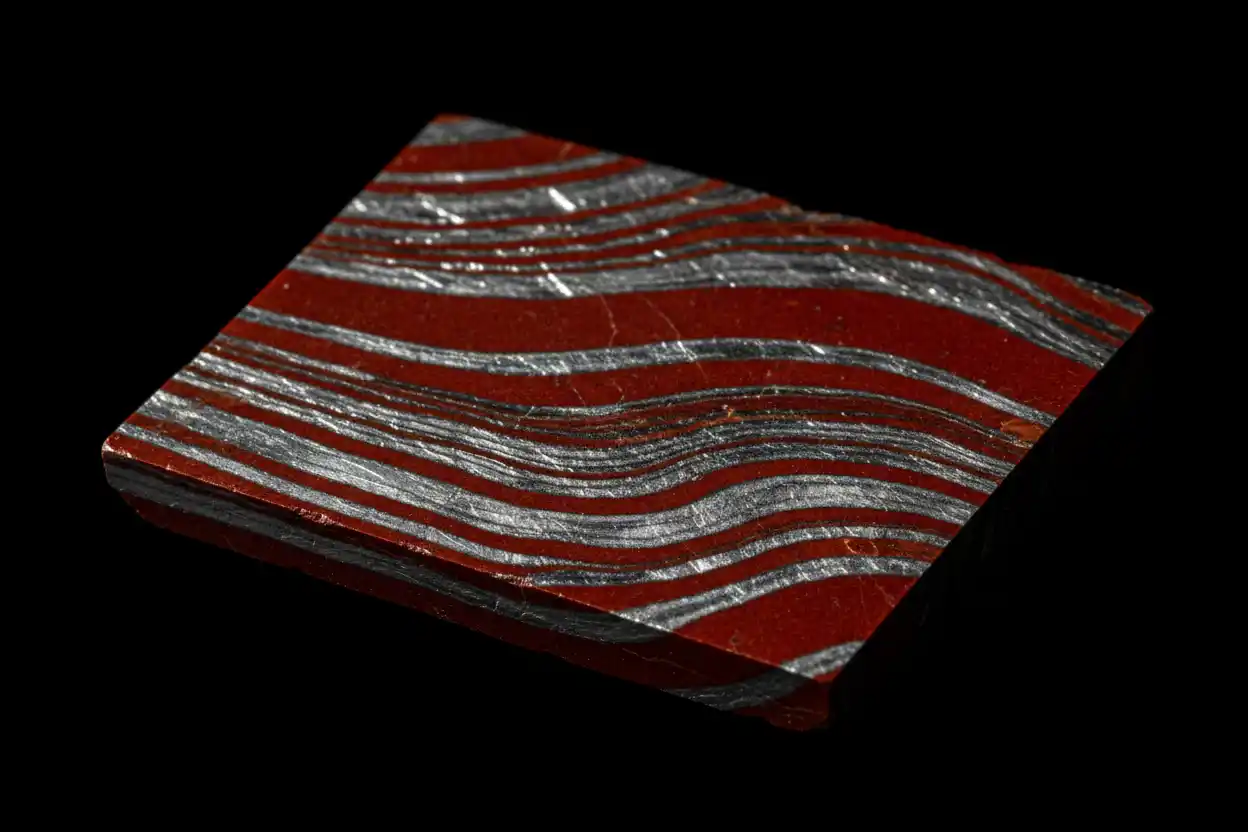
Jaspilite Meaning: Properties, Uses & Symbolism
Jaspilite meaning begins with identifying the material correctly. Jaspilite—also encountered in geological literature as jaspillite—is a rock, not a single mineral species or a transparent gemstone crystal. It is most characteristically a silica- and iron-rich banded iron formation in which layers dominated by jasper or chert alternate with iron-oxide-rich layers containing minerals such as hematite and magnetite. Studies of major jaspilite deposits describe millimeter- to centimeter-scale bands of quartz-rich silica and iron oxides, sometimes accompanied by folding, brecciation, quartz or carbonate veinlets, and later alteration.
Its dramatic appearance comes from real geological contrasts. Red jasper-rich bands can contain extremely fine hematite particles dispersed through microcrystalline quartz, whereas coarser hematite can appear steel gray, dark gray, or metallic. Magnetite can create darker black bands, and weathering may introduce goethite or alter the original iron-mineral textures. A single polished slab can therefore preserve several generations of mineral growth, deformation, replacement, oxidation, and veining rather than representing one uniformly crystallized substance. Research on jaspilite from iron formations has directly documented these sharply contrasting silica-rich and iron-rich layers.
The symbolic layer should be kept separate. Modern descriptions sometimes connect jaspilite’s red and dark bands with ideas such as strength, grounding, balance, endurance, or resilience. Those interpretations may provide personal metaphors, but they are not demonstrated physical effects of hematite, magnetite, quartz, or geological banding. This page therefore treats jaspilite first as an ancient iron-rich rock and then discusses history and symbolism within clear evidence boundaries. Related material-first references are grouped in Gemstone Guides.
Jaspilite at a Glance
| Feature | Evidence-based description |
|---|---|
| Material type | Banded iron-rich rock; commonly a variety/facies of banded iron formation |
| Single mineral species? | No |
| Major silica component | Jasper/chert and microcrystalline to recrystallized quartz |
| Major iron minerals | Commonly hematite and/or magnetite; alteration may introduce goethite and related phases |
| Characteristic structure | Alternating iron-rich and silica-rich bands |
| Typical colors | Red, maroon, brown-red, gray, steel gray, silver-gray, black and mixed patterns |
| Red color cause | Commonly very fine hematite dispersed through silica-rich jasper |
| Metallic gray appearance | Often coarser hematite/specular hematite |
| Dark bands | Commonly hematite and/or magnetite depending on specimen and locality |
| Transparency | Predominantly opaque |
| Geological significance | Important facies of ancient banded iron formations and a record of early ocean and iron-cycle conditions |
| Ornamental use | Polished slabs, cabochons, display pieces and some carved objects |
| Same as jasper? | No. Jasper can form part of jaspilite, but jaspilite includes iron-rich bands as a defining structural component |
| Same as tiger iron? | Not universally. Tiger iron is a particular banded ornamental material that can develop within jaspilite/BIF and additionally contains tiger’s-eye zones |
| Proven healing action | None established |
| Main processing safety issue | Cutting, grinding and drilling quartz-rich material can create respirable crystalline silica dust |
What Jaspilite Actually Is
A useful definition describes both composition and structure. Canada’s governmental terminology database defines jaspilite as a banded or mottled compact siliceous rock composed of hematite and quartz resembling jasper and notes its historical application to interbedded jasper and hematite in Precambrian iron-bearing formations. Both “jaspilite” and “jaspillite” are recognized spelling forms.
Modern deposit studies reinforce that description. In Brazil’s Carajás Mineral Province, researchers describe jaspilite as a banded iron formation containing hematite and quartz, with laminations ranging from millimeter to centimeter scale. Jasper and chert make up major silica-rich components, while hematite and magnetite dominate many iron-rich layers. Some specimens preserve jasper breccias in magnetite-rich matrices, quartz or carbonate veins, and considerable mineralogical variation caused by later geological processes.
This means the word jaspilite does not imply a fixed percentage of red jasper, hematite, or magnetite in every specimen. Nor does it mean every band formed or remained unchanged through the entire geological history of the rock. Depositional layering may later be folded, fractured, recrystallized, oxidized, replaced, weathered, or enriched in iron.
The difference between a rock and a mineral is essential here. Quartz, hematite, magnetite, and goethite are mineral species. Jaspilite is the aggregate rock containing combinations of those phases in a characteristic banded geological architecture.
Jaspilite Identity Table
| Observation | Typical jaspilite interpretation | Limitation |
|---|---|---|
| Red silica-rich bands | Jasper/chert rich in microcrystalline quartz, commonly colored by fine hematite | Red color alone does not establish jaspilite |
| Steel-gray metallic bands | Often hematite/specular hematite | Other metallic minerals require consideration in unusual specimens |
| Black iron-rich bands | Hematite and/or magnetite may dominate | Mineral testing is needed for precise phase identification |
| Fine regular lamination | Consistent with BIF structure | Layer thickness can vary substantially |
| Folding | Common in deformed iron formations | Folding records later tectonic history, not necessarily original deposition |
| Quartz veins | May cut older jaspilite bands | Veins represent later mineralization rather than original lamination |
| Brecciation | Can occur in altered or structurally disrupted material | Not every brecciated jasper-hematite rock is automatically jaspilite |
| High density relative to ordinary jasper | Iron oxides increase bulk density | Density varies with iron-to-silica proportions |
| Magnetic response | Possible where magnetite is abundant | Weak or absent magnetism does not exclude hematite-rich jaspilite |
| Opaque appearance | Normal | Thin silica-rich zones may behave differently at edges |
| High polish on silica bands | Expected from quartz-rich material | Metallic and porous iron-rich zones may polish differently |
| Geological context | Ancient iron formation strongly supports identification | Commercial pieces often lose their original field context |
The interaction among these features is more useful than any single test. A red-and-black polished stone can resemble jaspilite visually while belonging to another iron-rich rock, and an authentic weathered jaspilite may no longer show textbook bands clearly.
How Jaspilite Forms
Jaspilite is closely connected with banded iron formation, one of the most important rock records of Earth’s early oceans. Banded iron formations consist of repeated silica-rich and iron-rich layers and occur overwhelmingly in ancient Precambrian geological successions. USGS describes these deposits as important records of early ocean chemistry, iron cycling, biological processes, and the evolution of atmospheric and oceanic oxygen conditions, while also emphasizing that details of their origin remain an active geological research problem.
At a simplified level, dissolved iron present in ancient seawater became oxidized and precipitated into iron-bearing solids, while silica-rich material also accumulated. Repetition produced chemical sedimentary layering that could eventually lithify into banded iron formation. However, this overview should not be converted into the overly simple claim that every red and black stripe represents one annual event or one pulse of oxygen. BIF deposition involved changing seawater chemistry, hydrothermal inputs, redox conditions, sedimentary processes, and later diagenetic and metamorphic alteration.
Different jaspilite deposits also have different histories. Carajás jaspilite preserves sharply defined quartz/chert and iron-oxide bands, while Rapitan-type hematite-jaspilite occurs within a different geological setting associated with glacially influenced sedimentary successions. USGS documentation of the Rapitan metallogenic belt describes large hematite-jaspilite deposits hosted within distinctive sedimentary sequences and notes that geological models for their formation differ from those applied to older iron formations.
For that reason, the detailed sedimentology, deposit classifications, alteration sequence, and locality-specific formation models belong in jaspilite formation and deposit geology. The meaning page needs only the central geological fact: jaspilite records an interaction between silica-rich and iron-rich mineral deposition followed by a potentially complex history of burial, deformation, recrystallization, oxidation, and weathering.
Why Jaspilite Is Red, Gray, Silver, and Black
The red bands are among jaspilite’s most recognizable features. Research on classic jaspilite from the Negaunee Iron Formation documents red polycrystalline quartz bands containing finely dispersed hematite particles smaller than the grains that produce a metallic appearance. Those pigment-sized hematite inclusions impart vivid red coloration to the silica-rich jasper, whereas coarser hematite appears gray and reflective.
This distinction shows why one iron mineral can contribute very different colors depending on grain size, abundance, texture, and optical interaction with surrounding quartz. Red jasper does not require visible metallic flakes of hematite; extremely fine particles can color the silica intensely.
Dark gray to black layers can contain hematite, magnetite, or both, depending on locality and alteration history. Magnetite is naturally dark and can create a magnetic response, while specular hematite can produce bright steel-gray metallic surfaces. Later oxidation and weathering may transform iron-bearing minerals and introduce goethite, creating brown, yellow-brown, or earthy zones.
The more detailed optical distinction among pigmentary hematite, specular hematite, magnetite-rich layers, polished quartz, and surface reflections belongs in jaspilite optical properties and color behavior. For comparison, jasper color meaning addresses the broader range of physical color causes found in jasper materials rather than assuming every red jasper formed inside an iron formation.
Jaspilite Is Not Simply Red Jasper With Black Stripes
Jasper can be one major component of jaspilite, but the terms are not synonyms. Jasper is broadly a dense, predominantly opaque silica-rich material, while jaspilite describes a rock in which silica-rich jasper/chert and iron-rich layers occur together in a characteristic iron-formation context.
A piece of uniform red jasper does not become jaspilite because it contains trace iron. Conversely, a jaspilite slab may contain large proportions of iron oxide and relatively little visually dominant red jasper. The structural relationship between the bands matters.
The distinction is covered from the jasper side in jasper meaning. Keeping the names separate prevents a common commercial error in which any red-and-metallic ornamental rock is casually relabeled jaspilite without geological evidence.
Original Name and Claim Audit
Jaspilite terminology crosses geology, lapidary trade, iron-ore literature, and modern crystal marketing. The following table identifies where names overlap and where they should remain distinct.
| Name or claim | Evidence assessment | Better interpretation |
|---|---|---|
| Jaspilite | Established geological rock term | Banded silica- and iron-rich rock, commonly a BIF facies |
| Jaspillite | Accepted spelling variant | Same general geological term |
| Banded hematite jasper | Descriptive term used for some iron formations | Often closely equivalent in appropriate geological settings |
| Banded iron formation | Broader geological category | Not every BIF is specifically red jasper-rich jaspilite |
| Jasper | One silica-rich component commonly found in jaspilite | Jasper alone is not jaspilite |
| Hematite jasper | Descriptive commercial/geological wording | May describe jasper rich in hematite without proving classic BIF banding |
| Tiger iron | Banded ornamental material associated with BIF/jaspilite and containing hematite, jasper and tiger’s-eye zones | Not every jaspilite contains tiger’s-eye |
| Tiger’s-eye | Chatoyant quartz material | Not synonymous with jaspilite |
| Ironstone | Broad geological term | Too broad to identify jaspilite on its own |
| “Magnetic jaspilite” | Possible where magnetite is abundant | Magnetism is not required for all jaspilite |
| “Ancient grounding crystal” | Modern metaphysical wording | Geological age does not demonstrate a grounding mechanism |
| “Blood-building stone because it contains iron” | Unsupported biological inference | Structural iron oxide is not a nutritional iron supplement |
| “Protection stone” | Symbolic/metaphysical claim | Does not demonstrate physical protection |
| “Balances masculine and feminine energy” | Modern symbolic framework | No defined mineralogical measurement corresponds to the claim |
| “Detox stone” | Unsupported medical claim | No evidence that contact with jaspilite detoxifies the body |
Tiger iron deserves particular clarification. Mindat describes tiger iron as a banded ironstone or jaspilite containing hematite, red jasper/chert, and bedding-parallel tiger’s-eye material. GIA’s museum description of Western Australian tiger’s-eye-bearing iron formation likewise documents layers of hematite, magnetite, and jasper together with later fibrous quartz-filled structures producing chatoyancy. Tiger iron can therefore develop within jaspilite-like BIF, but the presence of tiger’s-eye is an additional feature rather than part of the basic jaspilite definition.
Diagnostic Traits
The most useful visual diagnostic is repeated contrast between silica-rich and iron-rich bands. Typical jaspilite may display deep red to maroon jasper/chert alternating with gray, metallic, or black iron-oxide bands. Band widths can range from very fine laminations to thicker layers, and structural deformation may fold or fault them.
Weight can provide another clue. Iron-rich material often feels noticeably denser than ordinary jasper of similar dimensions, although bulk density changes with the proportion of quartz, hematite, magnetite, porosity, and alteration. A magnet can detect magnetite-rich portions in some specimens, but hematite-rich jaspilite may respond weakly or not obviously at all.
Under magnification, one may observe fine red pigmentation in silica-rich domains, metallic iron-oxide grains, quartz veinlets, grain-boundary relationships, fractures, replacement textures, or weathering products. Those observations become much more informative when connected to the actual layer they came from. The appropriate detailed observation framework is provided in the jaspilite microscope inclusion notebook.
When exact phase identification matters, petrography, Raman spectroscopy, X-ray diffraction, electron microscopy, or chemical analysis can distinguish quartz, hematite, magnetite, goethite, carbonate, silicate, and other components more reliably than color alone.
Original Jaspilite Specimen and Photo Checklist
A useful specimen record should document both sides of the rock: its silica-rich bands and its iron-rich bands. This checklist provides original information gain by turning a decorative photograph into a repeatable geological observation.
| Observation | What to record | Why it matters |
|---|---|---|
| Overall banding | Straight, folded, faulted, wavy, brecciated or irregular | Preserves structural context |
| Band thickness | Approximate range in millimeters or centimeters | Helps distinguish fine lamination from coarse decorative banding |
| Red-band color | Red, maroon, brown-red, pink-red or mixed | Records silica-band appearance without assuming chemistry |
| Red-band texture | Microcrystalline, recrystallized, veined or granular | Can indicate later quartz recrystallization |
| Iron-band color | Steel gray, silver-gray, black, brown or mixed | Helps separate metallic hematite, magnetite and weathering zones |
| Metallic luster | Strong, weak, absent or patchy | Useful clue to specular hematite-rich areas |
| Magnetic response | None, weak, moderate or strong | Can support magnetite presence but cannot define the rock alone |
| Quartz veins | Present/absent; cross-cutting or parallel | Distinguishes later veins from original banding |
| Brecciation | Present or absent | Records structural or alteration history |
| Weathering | Goethite-like brown zones, porous surfaces, oxidation rinds | Important because weathering can obscure original mineralogy |
| Polish | Rough, one-face polished, fully polished | Polish changes perceived color and metallic reflection |
| Host-rock relationship | Known field context, matrix attached, isolated slab | Geological context strengthens identification |
| Locality | Documented, seller-stated or unknown | Locality names should not be assumed from appearance |
| Photo lighting | Diffuse daylight, directional, flash or edited | Metallic hematite can look very different under directional light |
| Scale | Ruler or verified dimensions | Prevents band thickness from being misread |
| Analytical evidence | XRD, Raman, petrography or chemistry if available | Provides phase identification beyond appearance |
The checklist intentionally avoids assigning a numerical authenticity score. A specimen does not become “90% genuine jaspilite” because nine visual clues match. Evidence should converge on a geological interpretation rather than be converted into artificial precision.
Documented Geological History
The history of jaspilite is fundamentally geological before it is cultural. Banded iron formations belong largely to ancient Precambrian rock successions and have become central to research on the evolution of seawater chemistry, iron cycling, atmospheric oxygen, microbial activity, and major iron-ore systems. Mindat describes BIFs as iron-rich rocks consisting of repeated iron-oxide layers alternating with chert, shale, or other iron-poor layers and notes their major importance as sources of iron ore.
In the Lake Superior region, jaspilite terminology became closely associated with interbedded jasper and hematite within major iron formations. Government terminology records specifically preserve this usage, showing that the name is rooted in geological description rather than a modern crystal-healing classification.
Mining geology later gave jaspilite another practical importance. In several major iron provinces, jaspilite acts as lower-grade iron formation or protore from which richer hematite ores can develop through silica removal and iron enrichment. Research in Carajás documents jaspilite as the protore associated with high-grade iron-ore systems, while historic USGS work in Michigan records relationships between jaspilite, carbonate iron formation, and enriched hard hematite ore.
This documented history is much stronger than claims of a universal ancient jaspilite spiritual tradition. The rock is ancient; the evidence for a distinct, named metaphysical tradition specifically centered on “jaspilite” is not comparable.
Jaspilite Meaning in Modern Symbolism
Modern symbolic interpretations often draw directly from the rock’s appearance. Alternating dark iron-rich and red silica-rich bands can inspire ideas of contrast, stability, persistence, balance, resilience, or integration. Folded bands may be used metaphorically to represent endurance through pressure or change, while the sheer geological antiquity of many banded iron formations can prompt reflection on deep time.
Those metaphors can be personally useful without being presented as physical effects. A person might keep a polished jaspilite slab as a reminder that complex structures develop over long periods, or use its contrasting bands as a visual prompt for balancing competing priorities. That is a psychological or symbolic use chosen by the person.
Jaspilite does not scientifically transmit courage, alter behavior, guarantee emotional stability, protect against accidents, increase wealth, improve manifestation, or control relationships. Its geology can inspire metaphors; it does not demonstrate supernatural causation.
This distinction is especially important when comparing jaspilite with materials that have very different histories. Jet meaning concerns an organic-origin mineraloid formed from altered wood, while Jeremejevite meaning concerns a defined borate mineral species. Similar modern symbolism across such different materials is evidence of human interpretive practice, not a shared mineralogical mechanism.
The Symbolism Boundary
Three categories should remain separate.
A geological fact can describe jaspilite as alternating iron-oxide and silica-rich bands, identify hematite or magnetite, document quartz veining, or interpret folding and alteration. Those claims can be tested with physical observations and analytical methods.
A historical fact can document the use of the term in iron-formation geology, the importance of BIFs in mining, or the scientific study of these rocks as records of ancient oceans.
A modern symbolic interpretation can associate the visual contrast with resilience or balance. It describes what the rock represents to someone rather than what the rock causes biologically.
Crossing those categories creates unsupported claims. Hematite being an iron oxide does not mean jaspilite supplies usable dietary iron through the skin. Red coloration does not prove stimulation of circulation. Magnetite does not establish a therapeutic magnetic effect simply because a specimen can respond to a magnet.
Jaspilite Does Not Provide Nutritional Iron
The word “iron” can make mineral-health claims sound superficially plausible. Hematite contains iron chemically, and magnetite contains iron in two oxidation states, but those elements are bound within mineral structures. Ordinary skin contact with a polished rock is not equivalent to consuming an appropriately formulated nutrient or receiving medical treatment.
Jaspilite should not be ground into powder and taken as an iron supplement. It should not be placed in drinking water to create a supposed mineral elixir, and mineral-soaked water should not be presented as a treatment for anemia, fatigue, circulation problems, immunity disorders, or other conditions.
The actual mineralogy of an individual rock can also contain additional phases beyond quartz and hematite, making ingestion-based practices even less defensible.
Uses of Jaspilite
Geologically, jaspilite is important because it forms part of major iron formations and can act as protore associated with economically significant iron deposits. Scientifically, it is valuable for studying depositional environments, redox conditions, iron mineralization, early-Earth processes, metamorphism, alteration, and ore enrichment.
As an ornamental material, attractive jaspilite can be slabbed and polished to emphasize alternating red and metallic bands, folds, faults, breccias, or quartz veins. Some material can be shaped into cabochons or decorative pieces, although the difference in mechanical behavior between silica-rich and iron-rich layers can complicate finishing.
That lapidary problem is sufficiently specific to belong in jaspilite cutting, orientation, and polish. A cut parallel to banding may emphasize long stripes, while a cross-cut can reveal different patterns; fractures, veins, and iron-rich zones also affect edge stability and polishing response.
For wearable objects, construction matters more than a generalized statement that the rock is “hard.” Protective mounting, edge exposure, weight, thickness, and differential wear between bands are addressed in jaspilite setting and wear engineering.
Safe Ownership and Handling
Ordinary intact handling of a stable jaspilite specimen or polished ornament is fundamentally different from mechanically processing the rock. A finished slab sitting on a shelf does not create the exposure conditions produced when quartz-rich material is cut, drilled, ground, sanded, or crushed.
Jaspilite contains substantial silica, commonly as quartz-rich jasper or chert. OSHA warns that cutting, sawing, grinding, drilling, and crushing silica-containing stone can generate respirable crystalline silica particles capable of reaching deep into the lungs. Occupational exposure is associated with serious respiratory and other health risks, and engineering controls such as wet methods and local exhaust ventilation are central to professional exposure reduction.
This distinction should remain clear: intact ownership is not the same hazard category as dust-generating lapidary work. A collector does not need to fear ordinary contact with a polished specimen because silica exists within it; a person machining the rock does need appropriate dust controls.
Jaspilite should also not be deliberately burned, heated, acid-tested, smashed, or scratched as a casual authenticity test. Those actions can damage a specimen, release particles, alter iron minerals, or erase useful surface evidence without producing reliable identification.
Cleaning and Conservation
A stable polished jaspilite specimen can usually be dusted with a soft cloth, while unnecessary chemical cleaning should be avoided when the mineral assemblage, coatings, repairs, labels, or weathering condition are unknown. Iron-rich portions may weather differently from quartz-rich bands, and porous altered zones can trap moisture or residues.
Collector value can also depend on provenance. A locality label connecting a specimen to a recognized iron formation can carry more scientific information than the polished face alone. Do not discard original labels merely because the specimen has been recut or mounted.
More detailed condition recording, storage, label preservation, old coatings, unstable weathering surfaces, and specimen documentation belong in the jaspilite specimen conservation record.
Jaspilite, Tiger Iron, and Similar Banded Materials
Tiger iron demonstrates why names must be tied to components. Mindat describes tiger iron as a banded iron formation or jaspilite containing iron-oxide and red jasper/chert bands together with discontinuous tiger’s-eye material. GIA’s study display of Western Australian material likewise shows hematite, magnetite, jasper, and later fibrous quartz responsible for the chatoyant tiger’s-eye effect.
A jaspilite without chatoyant tiger’s-eye zones should therefore not be called tiger iron simply because its red and metallic bands are attractive. Likewise, a tiger’s-eye specimen is not automatically jaspilite unless its broader rock context includes the relevant iron-formation components.
Commercial naming often compresses these relationships because shorter gemstone names sell more easily than geological descriptions. For identification purposes, however, the components and structure matter more than marketplace familiarity.
What a Photograph Can and Cannot Establish
A well-made photograph can document band thickness, folding, faulting, color distribution, metallic reflection, quartz veins, brecciation, weathering, and polish. Images taken both dry and under neutral directional light can reveal features that disappear in flat illumination.
Photography cannot reliably distinguish hematite from magnetite in every dark band, quantify mineral proportions, prove locality, or determine whether a commercial “jaspilite” has the geological context required for the name. A strong magnetism observation can support magnetite but does not map every mineral phase. Likewise, a metallic silver-gray band may suggest specular hematite without replacing analytical confirmation.
If exact composition matters, petrographic examination, Raman spectroscopy, X-ray diffraction, electron microscopy, or geochemical analysis may be appropriate. This page does not claim first-hand laboratory testing, field collection, mine visits, or unpublished specimen analysis.
Evidence Limits for Specimen Questions
The evidence approach described on About separates material observations from cultural interpretation, while the site’s Disclaimer defines the limits of educational identification and safety information. If a reader chooses to send existing specimen photographs or report information through Contact, the Privacy Policy should be reviewed before including personal or identifying information.
That does not convert an online photograph into a laboratory analysis. When a specimen’s scientific, commercial, or collection value depends on exact mineral composition, specialist petrographic or mineralogical examination remains the stronger route.
Common Misunderstandings About Jaspilite
One common mistake is calling jaspilite a mineral. It is a rock made from multiple minerals. A second is treating it as identical to red jasper even though the alternating iron-rich component is central to its identity. A third is assuming every black band must be magnetite; hematite can also be dark or metallic, and individual specimens vary.
A fourth mistake is assuming magnetism proves jaspilite. Many magnetite-bearing rocks are magnetic without being jaspilite. A fifth is treating every jaspilite as tiger iron, even though tiger iron additionally contains chatoyant tiger’s-eye zones. A sixth is assuming the bands correspond to annual layers, an interpretation that oversimplifies complex BIF deposition and post-depositional history.
A seventh misconception converts geological antiquity into therapeutic potency. Being an ancient rock does not demonstrate stronger metaphysical energy. An eighth treats iron-bearing minerals as nutritional iron sources, which confuses mineral composition with biological availability.
A Practical Evidence Hierarchy for Jaspilite Claims
A seller name is the lowest-confidence evidence. A clear scaled photograph adds structural information. Documented locality and host formation add geological context. Magnetic response and density observations can refine interpretation but remain supporting tests.
Microscopy and petrography provide stronger evidence by showing how quartz, jasper, hematite, magnetite, veins, and alteration products relate to one another. Raman spectroscopy, X-ray diffraction, electron microscopy, and chemical analysis can establish mineral phases directly.
Geological literature then provides the context required to interpret those phases as part of an iron formation rather than merely a decorative mixture of red silica and dark iron minerals.
Symbolic claims occupy a different evidence category entirely. Personal meaning can be described honestly without being assigned the status of mineralogical evidence.
Frequently Asked Questions
What is jaspilite?
Jaspilite is a banded silica- and iron-rich rock, commonly a variety or facies of banded iron formation. Typical examples contain alternating jasper/chert or quartz-rich bands and iron-oxide-rich bands dominated by hematite, magnetite, or both.
Is jaspilite a mineral?
No. Jaspilite is a rock composed of multiple minerals. Quartz, hematite and magnetite can be important constituent minerals, but the rock name refers to their banded geological association.
Is jaspilite the same as jasper?
No. Jasper is commonly a silica-rich component of jaspilite, but jaspilite also contains substantial iron-rich layers. A uniform red jasper specimen is therefore not automatically jaspilite.
Why is jaspilite red?
Many red jaspilite bands contain very fine hematite dispersed through microcrystalline or recrystallized quartz. Research on classic jaspilite has shown that pigment-sized hematite can create vivid red silica bands while coarser hematite appears metallic gray.
Why are some jaspilite bands silver or black?
Steel-gray or silver bands can be rich in coarser hematite, including specular hematite, while black bands may contain hematite, magnetite, or both. Exact mineralogy varies among deposits and should not be assigned from color alone.
Is jaspilite magnetic?
Some specimens are magnetic where magnetite is abundant. Hematite-rich jaspilite may show far less obvious attraction, so absence of strong magnetism does not rule out jaspilite.
Is jaspilite a banded iron formation?
Jaspilite is commonly treated as a jasper/chert-rich variety or facies of banded iron formation. BIF is the broader category and can include iron formations whose silica-rich bands are not visually red jasper.
Is jaspilite the same as tiger iron?
Not always. Tiger iron is an ornamental BIF/jaspilite-related rock containing iron-rich bands, red jasper/chert, and tiger’s-eye material. Ordinary jaspilite does not need to contain tiger’s-eye.
How old is jaspilite?
Many major jaspilites belong to Precambrian banded iron formations and represent extremely ancient geological environments. Exact age depends on the formation and locality, so a generic age should not be assigned to an unidentified specimen.
What does jaspilite symbolize?
Modern symbolic interpretations may associate its contrasting bands with endurance, balance, resilience, stability, or persistence. These are cultural or personal interpretations rather than scientifically demonstrated properties of the rock.
Does jaspilite have healing properties?
There is no established scientific evidence that wearing or holding jaspilite treats physical or psychological disorders. Mineralogical facts about quartz, hematite, magnetite, or iron content do not demonstrate medical effects.
Can the iron in jaspilite enter the body through the skin?
Ordinary contact with iron-bearing minerals does not make their structural iron equivalent to a nutritional or medicinal dose. Jaspilite should not be used as a substitute for medical evaluation or prescribed iron treatment.
Can jaspilite be used in gemstone elixirs?
Jaspilite should not be powdered, consumed, or intentionally used to prepare mineral drinking water for supposed health benefits. Mineral composition does not establish safe ingestion, bioavailability, purity, or therapeutic dosage.
Is jaspilite safe to cut?
Cutting is different from ordinary handling. Jaspilite contains quartz-rich silica bands, and cutting, grinding, drilling, or crushing silica-containing stone can generate respirable crystalline silica dust. Appropriate wet methods, ventilation, and professional exposure controls are important.
Can jaspilite be polished?
Yes, suitable material can produce attractive polished slabs, cabochons, and decorative pieces. Differences between hard silica-rich layers, metallic iron-rich layers, fractures, and weathered zones can make orientation and finishing more complex than polishing a homogeneous stone.
How can I identify jaspilite from a photograph?
Look for repeated silica-rich red or maroon bands alternating with dark or metallic iron-rich layers, then record band thickness, folding, veins, weathering, and scale. A photograph can support a jaspilite interpretation but cannot establish every mineral phase or prove locality without additional evidence.