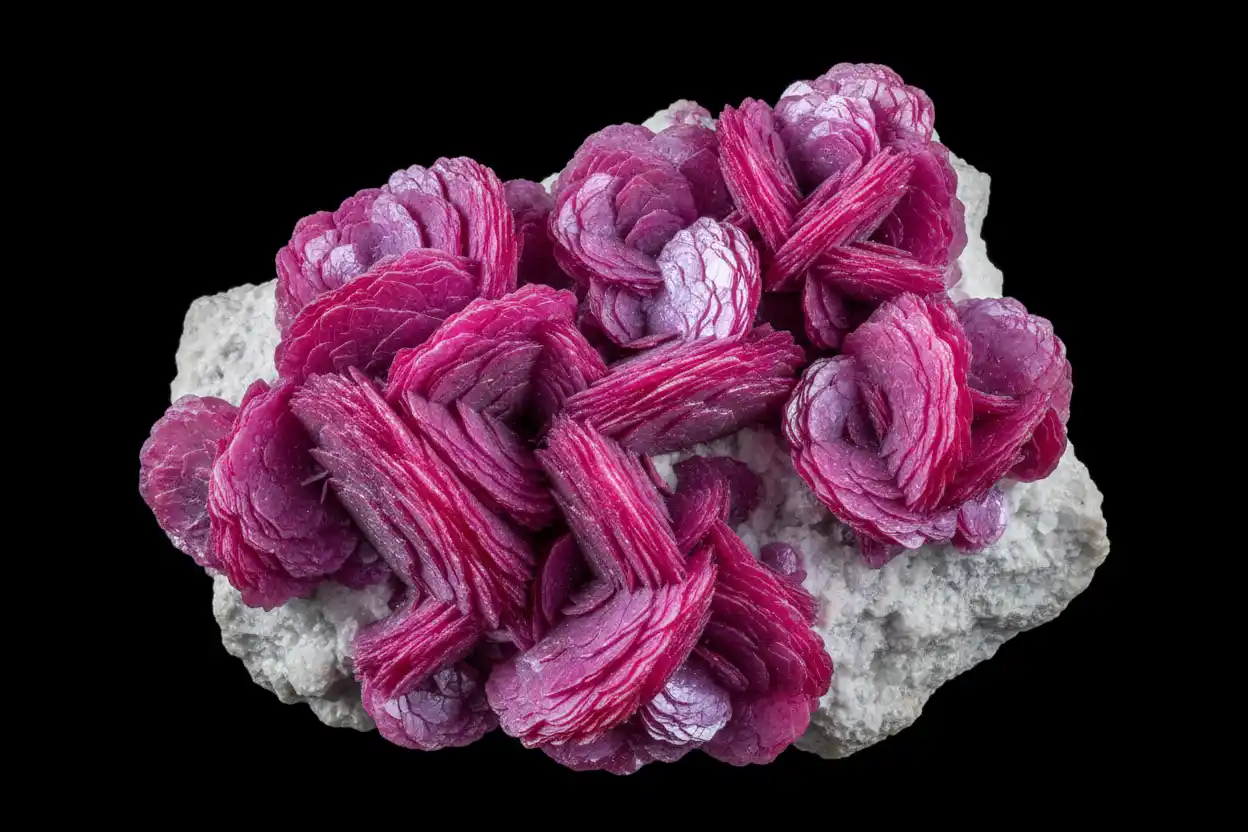
Kammererite Meaning: Properties, Uses & Symbolism
Kammererite meaning begins with an important naming correction. Kammererite, traditionally written kämmererite, is not currently treated as a separate mineral species in mainstream mineralogical classification. The name is commonly used for the striking pink, reddish-purple, lilac, or magenta chromium-bearing variety of clinochlore, a member of the chlorite group. Mindat lists kämmererite as a synonym of chromium-bearing clinochlore and gives the representative composition Mg₅(Al,Cr)₂Si₃O₁₀(OH)₈, with chromium substituting into the clinochlore structure and helping produce the unusual purple coloration.
That identity separates kammererite from hard, transparent purple gemstones such as sapphire or spinel. Clinochlore is a very soft sheet silicate with a Mohs hardness of only about 2–2.5, perfect basal cleavage, flexible laminae, and generally pearly, greasy, waxy, or vitreous-looking surfaces depending on crystal quality. Transparent chromium-rich crystals can be attractive enough to facet as collector stones, but GIA specifically notes that the combination of low hardness and perfect cleavage makes the material poorly suited to conventional jewelry wear.
Kammererite’s real mineralogy is already distinctive: a soft hydrous magnesium-aluminum silicate, enriched in chromium, that can form intense purple crystals within ultramafic and chromite-bearing geological environments. Modern metaphysical descriptions may associate it with calmness, reflection, compassion, or emotional awareness, but those ideas belong to symbolic practice rather than experimentally demonstrated mineral effects. This page therefore separates measurable properties, documented mineral history, and modern symbolism throughout the broader Gemstone Guides.
Kammererite at a Glance
| Feature | Evidence-based description |
|---|---|
| Common name | Kammererite / Kämmererite |
| Current mineralogical status | Chromium-bearing variety of clinochlore rather than a separate accepted species |
| Mineral group | Chlorite group |
| Representative formula | Mg₅(Al,Cr)₂Si₃O₁₀(OH)₈ |
| Mineral class | Hydrous sheet silicate / phyllosilicate |
| Crystal system | Monoclinic clinochlore structure |
| Typical color | Pale pink, rose, lilac, reddish purple, magenta, deep purple |
| Main color association | Chromium substitution in clinochlore |
| Typical luster | Pearly, waxy, greasy to vitreous in fine crystals |
| Transparency | Transparent to translucent |
| Mohs hardness | Approximately 2–2.5 |
| Cleavage | Perfect basal cleavage |
| Tenacity | Flexible in thin laminae |
| Typical density | Clinochlore broadly about 2.6–3.02 g/cm³; GIA measured Turkish faceted examples near 2.65–2.67 |
| Refractive-index context | Clinochlore broadly about 1.57–1.60; GIA measured chromium-rich Turkish gems around 1.580–1.588 |
| Important setting | Ultramafic rocks, serpentinite and chromite-bearing environments |
| Famous collector source | Eastern Anatolia, Turkey |
| Appropriate jewelry expectation | Collector gem rather than robust everyday stone |
| Medical effects proven? | No |
| Safe ownership | Suitable for careful specimen handling; cutting and grinding require normal mineral-dust controls |
What Kammererite Actually Is
Clinochlore belongs to the chlorite group of sheet silicates. Its atomic structure is arranged in layers, which helps explain several of its physical characteristics: low hardness, micaceous appearance, easy cleavage parallel to the basal plane, and flexible thin sheets. Ordinary clinochlore is commonly green because iron and other substitutions modify the otherwise pale mineral, while chromium-bearing clinochlore can become pink, rose-red, lilac, or vivid purple. Mindat explicitly identifies chromium-bearing clinochlore as the variety commonly called kämmererite.
The name therefore works today more like a historically established variety name than a separate mineral-species designation. A specimen labeled kammererite should still satisfy clinochlore mineralogy. Purple color alone does not create kammererite, and an unrelated violet mineral does not become chromium-bearing clinochlore simply because the trade description uses the name.
This distinction is especially important in mineral collecting because older labels may treat kammererite as though it were a standalone species. Contemporary database records preserve the historical name while linking it back to chromium-bearing clinochlore.
The naming issue is different from the trade-name corrections surrounding Kambaba Jasper meaning and K2 Stone meaning. Those pages deal with multi-mineral rocks whose commercial names obscure geological classification; kammererite is instead a chromium-bearing variety of a defined mineral species.
Kammererite Identity Table
| Property or claim | Evidence-based interpretation | Identification value |
|---|---|---|
| “Kammererite is a mineral species” | Historically used that way, but now treated as chromium-bearing clinochlore | Naming correction required |
| Chromium present | Characteristic of the purple variety | Strong compositional evidence |
| Purple or magenta color | Typical | Useful clue, not proof alone |
| Clinochlore structure | Required for correct mineral identity | Strong |
| Mohs hardness around 2–2.5 | Characteristic of clinochlore | Strong when carefully measured |
| Perfect basal cleavage | Characteristic | Strong physical clue |
| Flexible thin flakes | Consistent with chlorite structure | Useful |
| Pearly or waxy luster | Common | Supporting clue |
| Transparent crystals | Possible in fine material | Does not imply durability |
| Strong purplish-red color | Typical of chromium-rich material | Color intensity alone cannot quantify chromium |
| Black chromite association | Common at important occurrences | Geological support, not mandatory for every specimen |
| Found in ultramafic rock | Strongly consistent with classic occurrences | Geological context |
| Seller calls it “purple mica” | Descriptive but mineralogically imprecise | Needs proper identification |
| “Healing kammererite” | Metaphysical wording | No medical evidence |
| “High-vibration chromium crystal” | Symbolic/marketing language | No recognized gemological measurement |
Physical Properties
Clinochlore is much softer than most gemstones used routinely in rings or bracelets. Mindat records hardness around 2–2.5, perfect cleavage on {001}, flexible tenacity, and measured density across approximately 2.6–3.02 g/cm³. Its refractive indices broadly occupy about 1.571–1.599 depending on composition and crystallographic direction.
GIA’s examination of two faceted chromium-rich clinochlore stones from Turkey provides useful specimen-level measurements rather than merely generic chlorite values. The stones were medium-dark purplish red, had refractive-index measurements near 1.580 and 1.588, hydrostatic specific gravities around 2.65 and 2.67, and showed numerous fractures and cleavage features under magnification. They were inert to the ultraviolet wavelengths used in that examination.
Those data demonstrate why a rare faceted kammererite should not be judged by appearance alone. Its physical constants are substantially different from many harder violet gemstones, and its cleavage-rich internal structure can be immediately relevant to cutting, mounting, and handling.
Why Kammererite Is Purple
Chromium is the defining color-related substitution in classic kammererite. Ordinary magnesium-rich clinochlore commonly appears green, yellow-green, pale, or colorless, while chromium-bearing varieties can shift dramatically toward pink, crimson, magenta, and purple. Mindat explicitly notes that chromian clinochlore may be pink to purple, while research on Turkish material describes magenta clinochlore containing chromium together with magnesium, aluminum, iron, silicon, oxygen, and hydroxyl.
Spectroscopic research on Turkish purple chromium-bearing clinochlore provides a more detailed physical basis. Studied material from ultramafic rocks was reddish purple, displayed purple-to-pink pleochroism, possessed perfect basal cleavage, and contained significant chromium within the chlorite composition. The color changes observed with crystallographic direction are therefore optical behavior of the mineral rather than evidence of a changing metaphysical state.
GIA likewise describes kammererite as the red-to-purple-red chromium-rich variety of clinochlore and observed absorption behavior consistent with chromium-colored material in faceted Turkish specimens.
Color nevertheless should not be simplified to “more chromium always means proportionally darker purple.” Crystal thickness, iron content, chromium site occupancy, structural details, transparency, lighting, pleochroism, inclusions, and associated minerals all influence what the eye sees. The detailed relationship among absorption, pleochroism, thickness, and illumination belongs in Kammererite optical properties and color behavior.
Pleochroism and Viewing Direction
Purple chromium-bearing clinochlore can display noticeable color differences as the viewing direction changes. Spectroscopic work on purple Turkish material describes purple-to-pink pleochroism, while other clinochlore compositions can show green-to-colorless directional effects.
This characteristic becomes particularly important in transparent crystals and faceted collector stones. A stone oriented along one direction may appear richer purple, while another orientation can look lighter, pinker, or less saturated. The effect is physical and reproducible: light interacts differently with the crystal structure according to direction.
For photography, this means two images of the same specimen can legitimately show somewhat different tones even without digital manipulation. Accurate documentation should record lighting, viewing direction, transmitted versus reflected illumination, and whether the specimen was rotated between exposures.
How Kammererite Forms
Classic kammererite is strongly associated with chromium-rich ultramafic geological environments. Detailed work on eastern Anatolian occurrences describes chromium-bearing clinochlore within ophiolitic belts containing ultramafic rocks and podiform chromitite deposits. The most famous productive material has come from the Keşiş and Kop mountain areas of Turkey, where purple clinochlore is associated with chromite-bearing rocks.
This geological setting makes chemical sense. Ultramafic rocks can supply abundant magnesium, while chromite and related chromium-rich phases provide a chromium source. Hydration and alteration of ultramafic material can produce chlorite and serpentine-group assemblages, and chromium can enter the clinochlore structure where conditions permit.
Research on purple material from Turkey describes crystals coating cavities and fractures in serpentinized basic or ultramafic rock. Older work from North Carolina likewise documented kammererite intergrown with chromite and olivine and occurring as fracture fillings in massive chromite.
The exact reaction pathway is locality-dependent. Temperature, fluid composition, pressure, host-rock mineralogy, chromium availability, serpentinization, metamorphism, and deformation can all influence the final chlorite assemblage. Those geological details belong in Kammererite formation and deposit geology.
Association With Chromite Does Not Make Kammererite Chromite
Many classic specimens display vivid purple kammererite against black chromite-rich matrix. The contrast is visually dramatic, but the two minerals have very different structures and properties. Kammererite is a soft hydrous sheet silicate; chromite is an oxide mineral with a much harder, denser spinel-type structure.
The association reflects geology rather than mineral identity. Chromium-rich fluids and alteration reactions around chromite-bearing ultramafic rocks can contribute to formation of chromium-bearing chlorite. The chromium becomes incorporated into the clinochlore structure rather than turning the chlorite itself into chromite.
This distinction is useful when examining specimens because black matrix should not automatically be called chromite from a photograph. Magnetite and other opaque phases can occur in ultramafic rocks, and laboratory methods may be required when exact associated-mineral identity matters.
Original Claim Audit: What “Kammererite” Does and Does Not Mean
| Common claim | Evidence status | More accurate interpretation |
|---|---|---|
| “Kammererite is its own mineral species.” | Outdated classification | The name is now commonly treated as chromium-bearing clinochlore |
| “Kammererite is chromium-rich clinochlore.” | Supported | Core modern identity |
| “All kammererite is deep purple.” | Incorrect | Pale pink, rose, lilac, reddish-purple, and magenta shades occur |
| “Purple color proves kammererite.” | Incorrect | Other purple minerals can resemble it |
| “It is a type of mica.” | Structurally misleading | It is a chlorite-group sheet silicate with mica-like cleavage |
| “Kammererite is hard enough for daily rings.” | Poorly supported | Mohs hardness around 2–2.5 and perfect cleavage make it vulnerable |
| “Transparent material can be faceted.” | Supported | Rare collector gems have been cut |
| “Faceting makes it durable.” | False | Cutting does not remove low hardness or perfect cleavage |
| “Every black matrix is chromite.” | Unsupported | Chromite is common, but matrix should be identified separately |
| “More chromium automatically means more valuable.” | Unsupported simplification | Value also depends on crystal quality, size, locality, aesthetics, damage, and market |
| “Kammererite has ancient healing traditions.” | Poorly documented | The specific mineral name belongs to modern mineralogical history |
| “Chromium provides therapeutic benefits through the skin.” | Unsupported | Structural chromium in a mineral is not a medication |
| “Purple kammererite improves mental health.” | Unsupported medical claim | Symbolic use is different from treatment |
| “Its color opens a specific chakra scientifically.” | Metaphysical interpretation | No standardized mineralogical measurement supports such a mechanism |
This table matters because kammererite can be genuinely rare and beautiful without rarity being used to protect weak claims from scrutiny.
Original Specimen and Photo Checklist
A useful kammererite record should preserve mineralogical observations independently from seller language.
| Observation | What to document | Why it matters |
|---|---|---|
| Body color | Pale pink, rose, magenta, crimson-purple, violet-purple | Establishes actual appearance |
| Color distribution | Uniform, zoned, edge-concentrated, matrix-dependent | Helps separate crystal color from reflections |
| Crystal habit | Platy, pseudohexagonal, tabular, drusy, massive | Supports clinochlore interpretation |
| Crystal thickness | Approximate measurement | Thin crystals may appear lighter or more transparent |
| Luster | Pearly, waxy, greasy, vitreous | Characteristic supporting observation |
| Cleavage | Existing cleavage traces, flakes, plate boundaries | Important diagnostic and durability evidence |
| Flexibility | Observe only existing thin flakes; do not deliberately bend valuable crystals | Supports chlorite behavior without unnecessary damage |
| Matrix | Chromite-rich, serpentinized rock, calcite-bearing, unknown | Adds geological context |
| Associated minerals | Record rather than guess | Prevents every black or white phase being mislabeled |
| Transparency | Transparent, translucent, opaque aggregate | Important for collector/gem interpretation |
| Pleochroism | Record color variation on rotation where visible | Supports optical characterization |
| Fractures | Open, healed, cleavage-related, edge damage | Critical for durability |
| Dimensions | Crystal and specimen measurements | Avoids exaggerated scale in photographs |
| Locality | Documented, seller-stated, inherited label, unknown | Keeps provenance evidence explicit |
| Historical label | “Kammererite,” “chrome chlorite,” “chromian clinochlore” | Useful because taxonomy has changed |
| UV observation | Record wavelength and response if tested | Absence or presence should remain supporting evidence |
| Analytical evidence | Raman, XRD, chemistry, spectroscopy | Strongest way to resolve uncertain identification |
| Photo conditions | Neutral light, backlighting, saturation edits, scale | Purple minerals are easily oversaturated in images |
The checklist does not assign an authenticity percentage. A visually convincing purple specimen still needs its mineral identity to agree with clinochlore properties and, where necessary, analytical evidence.
Diagnostic Traits
Softness is a strong clue, although destructive testing should be avoided on collectible crystals. With hardness near 2–2.5, clinochlore is dramatically softer than quartz, corundum, tourmaline, spinel, and many transparent purple gemstones. A fragile purple crystal that can be scratched easily and displays perfect basal cleavage is more consistent with kammererite than a hard vitreous gem with poor cleavage.
Crystal habit also helps. Kammererite often occurs as platy, pseudohexagonal, micaceous crystals or drusy coatings rather than robust prismatic crystals. Thin plates may stack, overlap, or create rosette-like aggregates. The surfaces can look pearly or waxy, while particularly transparent crystals can approach vitreous luster.
Microscopy can reveal abundant cleavage, fractures, needles, crystals, pinpoint clouds, and other internal features. GIA’s faceted Turkish material contained numerous fractures and cleavage features together with included crystals and needles.
Those detailed internal observations belong in the Kammererite microscope inclusion notebook rather than being turned into a simplistic list of “inclusions that prove authenticity.”
Kammererite Versus Other Purple Minerals
A purple mineral should not be identified as kammererite simply because its color is similar. Amethyst is much harder quartz and lacks kammererite’s perfect sheet-like cleavage. Purple fluorite is harder than kammererite and belongs to the cubic crystal system. Lepidolite can be micaceous and purple but has different chemistry, mineral-group identity, and typical geological associations. Purple spinel and sapphire are dramatically harder and usually behave very differently under gemological testing.
The combination of softness, basal cleavage, platy chlorite habit, chromium-related purple coloration, ultramafic/chromite geological context, and compatible optical data is much stronger than color alone.
The same principle is visible in Kinoite meaning, where blue color does not substitute for copper-silicate mineral identification, and in Kimberlite meaning, where a famous geological association cannot substitute for identifying the rock itself.
Documented Naming History
The name kämmererite was introduced by mineralogist Nils Gustaf Nordenskiöld in honor of August Alexander Kämmerer, a Russian mining official and chemist. Mindat preserves this naming history while now listing kämmererite as a synonym of chromium-bearing clinochlore.
The taxonomic change is a useful example of how mineral classification develops. A historical specimen label may legitimately say “kammererite” even though a modern database files the material under clinochlore. The label is not automatically wrong; it reflects terminology used at the time the specimen was catalogued.
Collectors should therefore preserve old labels rather than replacing them. A better modern record might read “chromium-bearing clinochlore, historically labeled kammererite,” retaining both scientific currency and collection history.
Important Localities
Eastern Turkey is particularly famous for richly colored chromium-bearing clinochlore. Research identifies the Keşiş and Kop mountain regions as especially productive, with purple material associated with chromitite deposits in ophiolitic ultramafic rocks.
Chromium-bearing clinochlore has also been documented from the United States, Russia, Austria, Finland, Greece, Italy, Japan, Australia, and other regions. Not every occurrence produces the same crystal quality or color intensity, and locality should not be assigned solely from appearance.
North Carolina material has particular mineralogical importance because chemical work documented kammererite intergrown with chromite and olivine in an ultramafic body. This helps demonstrate that the chromium-bearing chlorite association is not unique to Turkey even though Turkish specimens dominate many collector photographs.
Kammererite Meaning in Modern Symbolism
Contemporary crystal literature often associates kammererite with compassion, emotional reflection, calmness, self-awareness, forgiveness, perspective, creativity, or spiritual contemplation. Its unusual purple-pink coloration naturally invites comparison with symbolic traditions in which purple represents contemplation, dignity, imagination, or inward focus.
These interpretations can function as personal metaphors. Someone may keep a kammererite specimen as a reminder to respond thoughtfully rather than impulsively or use its delicate structure as a symbol of handling important relationships with care.
Those are legitimate descriptions of human intention. They do not demonstrate that kammererite alters brain chemistry, nervous-system function, hormones, cardiovascular activity, sleep, immunity, or mental-health conditions.
The difference becomes especially clear when comparing it with Kambaba Jasper meaning or K2 Stone meaning. These materials have completely different chemistry and geology, yet modern crystal sources can assign them overlapping concepts such as calmness, balance, or insight. The repetition demonstrates flexible human symbolism rather than a shared mineral mechanism.
Symbolism Boundary
Three evidence categories should remain distinct.
A mineralogical statement can describe chromium-bearing clinochlore, hardness, cleavage, chemistry, pleochroism, density, refractive index, or geological setting. These characteristics can be measured.
A historical statement can document the mineral’s naming, older labels, collecting history, or occurrence in chromium-bearing ultramafic rocks.
A symbolic statement can describe how contemporary users interpret the stone.
The categories should not be used to prove one another. Chromium producing purple coloration does not establish emotional healing. Perfect cleavage does not scientifically “release emotional blocks.” A mineral’s occurrence in altered ultramafic rocks does not demonstrate grounding or spiritual transformation.
The limits between educational gemstone information, personal symbolism, health claims, and professional advice are summarized in the site’s Disclaimer.
No Proven Healing Effect From Chromium Content
The presence of chromium often encourages misleading health interpretations because chromium is also discussed in nutritional and biological contexts. Chromium inside a clinochlore crystal is part of the mineral’s solid structure. Ordinary skin contact does not establish a controlled nutritional dose, medical absorption, or therapeutic effect.
Kammererite should therefore not be powdered for consumption, used as a dietary chromium source, or placed in drinking water to create a supposed gemstone elixir. A mineral’s elemental composition does not establish bioavailability, purity, dosage, or safety.
There is likewise no established evidence that holding kammererite treats depression, anxiety, trauma, pain, endocrine disorders, cardiovascular disease, immune conditions, infertility, neurological disorders, or sleep problems.
Personal appreciation and symbolism do not require these medical claims.
Can Kammererite Be Faceted?
Yes, exceptionally transparent chromium-bearing clinochlore has been faceted into collector gems. GIA examined small faceted purplish-red examples from Turkey and later reported cabochon material as well.
The existence of cut stones should not be mistaken for evidence of normal jewelry durability. Mohs hardness around 2–2.5 means the surface scratches readily, while perfect cleavage provides an easy structural plane along which the crystal can split. GIA explicitly characterizes the material as unsuitable for ordinary jewelry and more appropriate as a mineral specimen or rare collector stone.
Cutting is therefore an exercise in specimen preservation and specialist lapidary skill rather than routine gemstone production. Orientation, cleavage avoidance, polishing behavior, yield, and fragile edges are covered in Kammererite cutting, orientation, and polish.
Durability and Jewelry Use
Kammererite is not a practical substitute for amethyst, sapphire, spinel, or other harder purple gemstones in frequently worn jewelry. A hardness of 2–2.5 means routine contact with dust, harder gemstones, metal edges, or household surfaces can scratch the polish. Perfect basal cleavage adds a separate fracture risk.
An occasional pendant, protected collector jewel, brooch, or carefully designed display piece is mechanically more realistic than an exposed everyday ring. Even then, the exact crystal condition matters. Existing cleavage cracks, thin plates, repaired sections, drill holes, and inclusions can create localized failure points.
Setting design must respond to the real material rather than its rarity. The detailed risk analysis belongs in Kammererite setting and wear engineering.
Cleaning Kammererite
Conservative cleaning is appropriate. Because the mineral is soft and cleaves perfectly, abrasion should be minimized. A loose collector crystal can often be maintained simply by avoiding contamination and removing light dust carefully with non-abrasive methods.
Do not scrub delicate crystals aggressively, use abrasive powders, or assume an ultrasonic cleaner is appropriate merely because a specimen survived polishing. Cavities, cleavage planes, attached crystals, matrix contacts, and old repairs can respond badly to vibration.
Steam, strong heat, aggressive chemicals, acid testing, and deliberate scratching are also poor authenticity tests. Even if the mineral survives chemically, physical damage to a thin crystal can be irreversible.
Safe Ownership and Processing
Ordinary handling of a stable kammererite specimen is different from sawing, grinding, sanding, drilling, or crushing mineral material. Mechanical processing creates fine particulate matter and should be performed with appropriate professional dust control, eye protection, and clean-work practices rather than by dry grinding in an enclosed living space.
Do not taste, lick, ingest, pulverize, or deliberately dissolve unknown mineral specimens. Associated matrix minerals can differ among localities, and a specimen’s full composition cannot be inferred from the kammererite name alone.
For collections, physical fragility is usually the more immediate concern. Keep delicate crystals away from harder specimens that can scrape them during storage, avoid pressure against cleavage surfaces, and preserve locality and acquisition labels. Detailed long-term handling, label preservation, condition photography, and storage decisions belong in the Kammererite specimen conservation record.
What a Photograph Can Tell You
A strong photograph can document crystal color, apparent habit, matrix relationships, cleavage plates, luster, damage, and whether the specimen contains drusy coatings or larger individual crystals. A scale reference is especially important because many intensely colored crystals are only millimeters across.
Photography cannot establish chromium concentration, refractive index, density, crystal structure, or exact locality. Purple saturation can also be strongly affected by white balance, lighting temperature, backlighting, and editing.
Backlighting deserves particular caution because thin clinochlore plates can become dramatically more translucent and vivid when light passes through them. That can be useful documentation if disclosed, but it should not be mixed with ordinary reflected-light photographs as though the two conditions were equivalent.
When Laboratory Testing Is Appropriate
Routine identification can combine habit, softness, cleavage, optical behavior, density, and geological context. A well-formed purple platy crystal from a documented chromite locality that matches clinochlore properties provides a coherent identification.
When the specimen is scientifically important, unusually valuable, detached from matrix, or inconsistent with expected properties, analytical methods provide stronger evidence. Raman spectroscopy, X-ray diffraction, electron-microprobe chemistry, and optical spectroscopy can distinguish chromium-bearing clinochlore from unrelated purple minerals and characterize its composition.
Research on Turkish kammererite has used electron microprobe, Raman methods, spectroscopic analysis, and conventional gemological measurements precisely because color and appearance alone are insufficient for rigorous characterization.
This article does not claim private laboratory testing, mine visits, unpublished chemical analyses, or first-hand authentication of individual specimens.
Evidence Scope Without Repetitive Claims
Gems Lore’s overall publication approach is described on About. Contact serves general site communication, while the Privacy Policy explains how site data is handled. Those site resources do not replace specimen-specific mineralogical analysis, and no online reference can turn an uncertain photograph into a laboratory-confirmed identification.
That distinction is particularly important with kammererite because a vivid purple color can encourage confident visual naming even when the mineral has not been tested.
Common Kammererite Misunderstandings
The first misunderstanding is that kammererite remains a fully separate mineral species in modern classification. It is more accurately treated as chromium-bearing clinochlore. The second is that every purple chlorite-like stone is kammererite. Mineral identity still needs to agree with clinochlore.
The third is that chromium-bearing clinochlore must always be dark purple. Pale pink, rose, lilac, crimson, and magenta variations occur. The fourth is that a transparent crystal suitable for faceting must also be durable enough for everyday jewelry. Kammererite demonstrates why that inference fails: transparency and beauty do not cancel low hardness or perfect cleavage.
The fifth misconception is that every black matrix mineral is chromite. Chromite is a classic associate, but specimen-specific identification is still necessary. The sixth is that the mineral’s chromium content gives it nutritional or medicinal chromium properties. It does not.
The seventh is that an old label reading kammererite is necessarily “wrong.” Historical names are valuable collection evidence even after taxonomy changes; modern cataloguing can preserve the original label while adding the current classification.
Practical Evidence Hierarchy for Kammererite
A marketplace product title is weak evidence. Color photographs improve the record but remain vulnerable to lighting and editing. A documented ultramafic or chromite locality adds geological support. Crystal habit, cleavage, hardness behavior, density, and optical properties provide stronger mineralogical evidence.
Microscopy can document internal structure, inclusions, fractures, cleavage, and growth features. Raman spectroscopy, X-ray diffraction, chemical analysis, and spectroscopic measurements provide still stronger species- and composition-level evidence.
The most reliable conclusion emerges when the lines agree: purple chromium-bearing material, clinochlore structure, compatible physical and optical properties, and an appropriate geological setting.
That same hierarchy helps keep other uncommon minerals distinct. Kinoite meaning requires evidence for a copper silicate rather than simply a blue stone, while Kimberlite meaning requires geological rock identification rather than assuming any dark igneous material is diamond-bearing kimberlite.
Frequently Asked Questions
What is kammererite?
Kammererite is the traditional name for chromium-bearing clinochlore, a pink-to-purple variety of the chlorite-group mineral clinochlore. It is no longer generally treated as a separate mineral species.
What is kammererite made of?
A representative composition is Mg₅(Al,Cr)₂Si₃O₁₀(OH)₈. It is a hydrous magnesium-aluminum silicate in which chromium substitutes into the clinochlore structure. Natural specimens can also contain iron and compositional variation.
Why is kammererite purple?
Chromium is responsible for the characteristic pink, crimson, magenta, and purple coloration of chromium-bearing clinochlore. Spectroscopic studies of Turkish material also document purple-to-pink pleochroism.
Is kammererite the same as clinochlore?
Kammererite is a chromium-bearing variety of clinochlore rather than an unrelated mineral. Ordinary clinochlore is commonly green, while chromium-bearing material can become pink or purple.
Is kammererite a type of mica?
No. It is a chlorite-group sheet silicate. Its platy habit, basal cleavage, and pearly surfaces can look mica-like, but chlorite and mica are different mineral groups.
How hard is kammererite?
Clinochlore is approximately Mohs 2–2.5. This makes kammererite much softer than quartz, tourmaline, spinel, sapphire, or most gemstones used for everyday jewelry.
Does kammererite have cleavage?
Yes. Clinochlore has perfect basal cleavage, one of the main reasons delicate kammererite crystals can split or flake relatively easily.
Can kammererite be faceted?
Yes, rare transparent crystals have been faceted as collector gems. GIA has examined faceted chromium-rich clinochlore from Turkey, but its low hardness and perfect cleavage make it unsuitable for ordinary jewelry use.
What is the refractive index of kammererite?
General clinochlore refractive indices span roughly 1.57–1.60 depending on composition. GIA measured faceted Turkish chromium-rich examples near 1.580 and 1.588.
Where is kammererite found?
Important chromium-bearing clinochlore occurrences are documented in Turkey, the United States, Russia, Austria, Finland, Greece, Italy, Japan, Australia, and other localities. Eastern Turkey is especially famous for vivid gem-quality purple crystals associated with chromitite-bearing ultramafic rocks.
Does kammererite occur with chromite?
Yes. Chromite is a classic associate at several occurrences, and kammererite can grow in fractures, cavities, or alteration zones within chromium-rich ultramafic rocks.
What does kammererite symbolize?
Modern crystal traditions may associate kammererite with reflection, compassion, calmness, emotional awareness, creativity, or contemplation. These are contemporary symbolic interpretations rather than scientifically measured properties.
Does kammererite have healing properties?
No scientifically established medical or psychological healing effect results from holding or wearing kammererite. Its chromium content and purple color do not demonstrate therapeutic action.
Can the chromium in kammererite enter the body through the skin?
There is no established evidence that ordinary contact with an intact chromium-bearing clinochlore specimen provides a medically useful chromium dose. Structural chromium in a mineral should not be treated as a nutritional supplement.
Can kammererite go in drinking water?
Kammererite should not be intentionally used to prepare gemstone drinking water or elixirs. Mineral composition does not establish safe ingestion, dosage, purity, or therapeutic benefit.
Is kammererite safe for rings?
It is a poor choice for routine ring wear. Its very low hardness and perfect cleavage make scratching and structural damage much more likely than with conventional ring gemstones. A protected collector setting or occasional-wear piece is more realistic.
Can I identify kammererite from a photograph?
A photograph can show a compatible purple color, platy habit, and matrix association, but it cannot prove clinochlore structure or chromium composition. Important or uncertain specimens may require gemological measurements, Raman spectroscopy, X-ray diffraction, or chemical analysis.