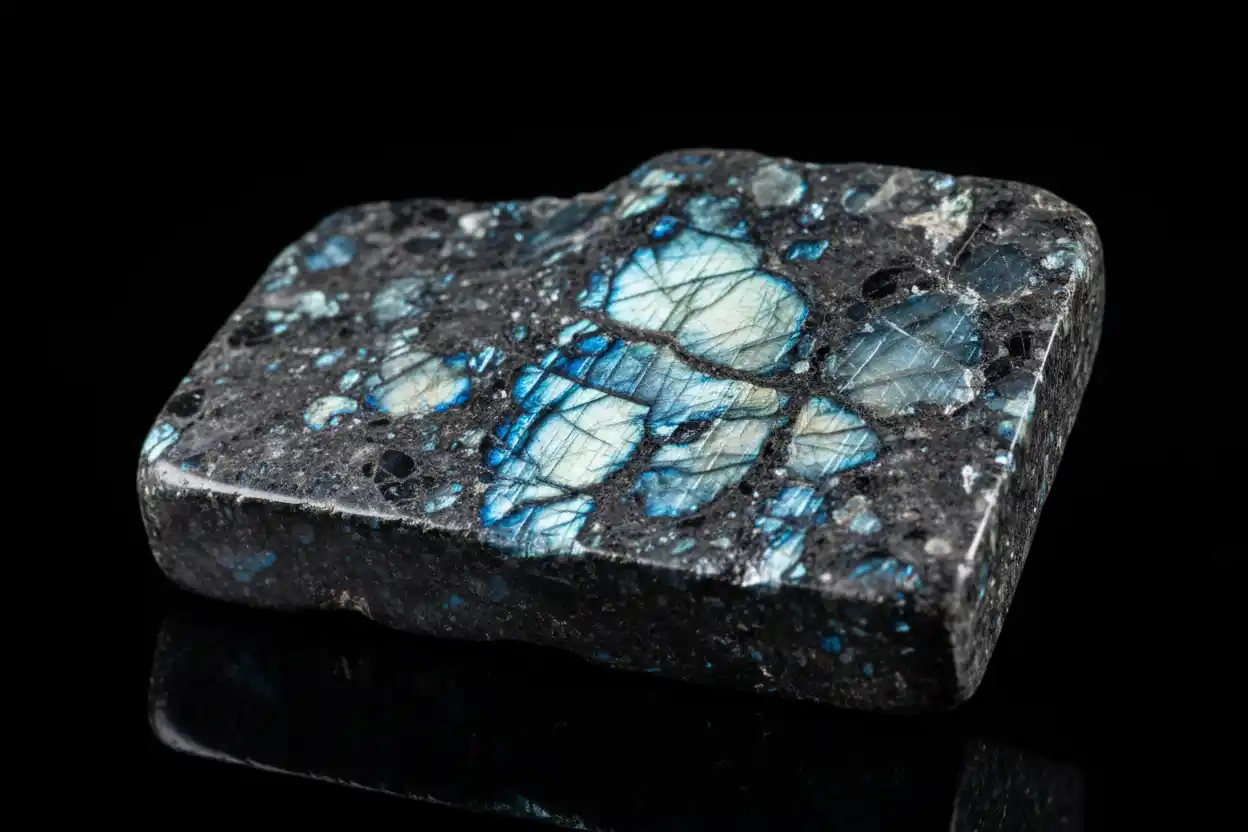
Larvikite: Meaning, Properties & Symbolism
Larvikite is a coarse-grained monzonitic igneous rock from the Oslo Rift in southeastern Norway. Its dark gray-to-black body contains feldspar crystals that can flash blue, silver, green or steel gray when polished and turned beneath the light.
Larvikite at a Glance
| Property | Larvikite Characteristics |
|---|---|
| Material type | Feldspar-rich monzonitic plutonic rock |
| Composition | Predominantly ternary feldspar with pyroxene, amphibole, biotite and variable quartz or nepheline |
| Colors | Dark gray, blue gray, black, silver gray and greenish gray |
| Crystal system | None for the rock as a whole; individual minerals retain their own structures |
| Habit or texture | Coarse-grained, interlocking and locally directionally oriented |
| Optical feature | Blue, silver or green iridescence from microscopic feldspar intergrowths |
| Luster | Dull in rough form; vitreous-to-pearly across polished feldspar grains |
| Transparency | Opaque |
| Mohs hardness | Variable, commonly about 6 across feldspar-rich areas |
| Cleavage | No rock-wide cleavage; feldspar has two good cleavage directions |
| Tenacity | Compact but brittle across fractures and grain boundaries |
| Common uses | Building façades, countertops, monuments, tiles, cabochons, beads and decorative objects |
| Main care concern | Feldspar cleavage, edge chipping, mixed mineral hardness and dyed or resin-filled products |
What Is Larvikite?
Larvikite is a rock rather than an individual mineral.
It belongs to a group of monzonitic plutonic rocks that formed within the Oslo Rift. Monzonite contains substantial alkali feldspar and plagioclase, with smaller proportions of dark minerals.
Larvikite is distinguished by large ternary feldspar crystals containing significant sodium, potassium and calcium components.
These feldspars can show microscopic intergrowth lamellae that reflect and interfere with light, producing the characteristic flash.
The rock’s name comes from the municipality of Larvik in southeastern Norway, where commercial quarries and classic geological exposures occur.
Larvikite has become one of Norway’s best-known dimension stones and has received international recognition as a Global Heritage Stone Resource.
Although crystal shops sometimes call it black labradorite or Norwegian moonstone, neither term provides an accurate geological identity.
The material belongs within the wider feldspar family because feldspar creates both its structure and optical appeal.
How Larvikite Formed
Larvikite crystallized from magma deep beneath the surface of the Oslo Rift around the Carboniferous-Permian boundary, approximately 300 million years ago.
Continental extension opened fractures in the crust and allowed alkaline magmas to rise.
Instead of erupting immediately, some magma bodies stalled underground and cooled slowly. This slow cooling gave feldspar crystals enough time to grow to visible sizes.
Successive intrusive episodes created a series of ring-shaped plutons. Their compositions changed from quartz-bearing varieties in the east toward more silica-undersaturated and nepheline-bearing rocks farther west.
Dark pyroxene, amphibole, mica and iron-titanium oxides crystallized between the feldspar grains.
Later uplift and erosion removed the overlying rock, exposing the intrusive complex near Larvik and the surrounding Oslo Rift.
The coarse texture confirms that larvikite is plutonic rather than volcanic. It cooled underground rather than solidifying rapidly from lava at the surface.
What Causes Larvikite’s Blue Flash?
The optical effect comes mainly from microscopic intergrowths inside the feldspar crystals.
As the rock cooled, one feldspar composition separated into extremely fine lamellae with slightly different optical properties.
Light reflecting from these closely spaced layers interferes constructively at selected wavelengths. Blue and silver commonly become strongest, although green, gold and steel-gray effects can also appear.
The flash is directional. A polished slab can look uniformly dark until the viewing angle aligns with the internal feldspar structure.
One grain may flash while its neighbor remains gray because their crystal orientations differ.
The effect is often called schiller, iridescence or labradorescence in the ornamental-stone trade.
However, visible labradorescence does not make the rock labradorite. Labradorite is a plagioclase-feldspar variety, while larvikite is a multi-mineral rock dominated by ternary feldspar.
Larvikite Mineral Composition
Feldspar accounts for most of the rock.
The feldspar crystals are commonly cryptoperthitic or antiperthitic, meaning that extremely fine phases have separated within what appears to be one grain.
Dark minerals can include clinopyroxene, amphibole and iron-rich biotite. Magnetite, ilmenite, apatite and other accessory minerals occur in smaller quantities.
Some larvikite varieties contain quartz, while others include nepheline because they are more silica undersaturated.
These differences produce lighter, darker, bluer or greener commercial stones.
The rock has no fixed chemical formula. Every mineral contributes its own structure and physical properties.
That multi-mineral character separates larvikite from a single feldspar crystal or a conventional faceted gemstone.
Commercial Larvikite Types
Commercial quarries divide larvikite into several ornamental varieties according to color, grain size, quarry and strength of iridescence.
Blue Pearl generally refers to lighter blue-gray material with conspicuous blue or silver feldspar reflections.
Emerald Pearl is darker and may show blue-green or greenish flashes against a nearly black background.
Malerød and Stålaker represent additional quarry-related commercial types with their own grain, color and architectural characteristics.
Brand names can change according to supplier. Therefore, they should not be treated as mineral varieties.
A product sold as Emerald Pearl contains no emerald, while Blue Pearl is neither pearl nor blue throughout.
The names describe polished appearance and stone trade rather than composition.
Larvikite vs Labradorite
Larvikite and labradorite share feldspar-related optical effects but are not the same material.
Labradorite is one feldspar variety. Larvikite is an igneous rock containing several minerals and complex feldspar grains.
Labradorite commonly shows broad blue, green, gold, orange or multicolored sheets of labradorescence. Larvikite more often displays smaller silver-blue flashes distributed among separate grains.
Labradorite rough may appear light gray, dark gray or nearly transparent at thin edges. Larvikite remains opaque and visibly coarse grained.
The types of labradorite page provides the correct place for comparing true feldspar varieties.
Sellers sometimes call larvikite black labradorite because the phrase is familiar to crystal buyers. The label is commercially common but geologically misleading.
Larvikite vs Moonstone
Moonstone shows adularescence, a floating white or blue glow caused by light interacting with fine feldspar layers.
Larvikite’s flash is generally sharper, more metallic and confined to individual grains within a dark rock.
Moonstone is cut from feldspar-dominant material and may be translucent. Larvikite is opaque and visibly multi-mineral.
The labradorite versus moonstone guide explains the difference between labradorescence and adularescence.
Commercial names such as Norwegian moonstone should therefore be understood as marketing terms rather than evidence that larvikite belongs to the moonstone varieties.
Larvikite vs Black Moonstone
Black moonstone is typically a feldspar material with soft silver, peach, gray or blue adularescence.
Its glow appears smoother and cloudier than larvikite’s separate flashing crystals.
Black moonstone often shows internal layers and color zoning rather than the salt-and-pepper grain texture of monzonite.
Polished photographs can make them look similar, especially when the larvikite has a fine grain. Magnification usually reveals the difference immediately.
Larvikite vs Indigo Gabbro
Indigo gabbro is another dark igneous lapidary rock.
Indigo gabbro commonly shows fixed black, gray, white and violet patches. Larvikite displays moving silver-blue iridescence across feldspar grains.
Gabbro is more mafic and generally contains calcium-rich plagioclase with pyroxene. Larvikite is a monzonitic rock dominated by ternary feldspar.
Both can be carved into spheres, towers and cabochons, yet their geology and optical features differ.
Where Is Larvikite Found?
True larvikite is associated with the Larvik-Lardal plutonic complex of the Oslo Rift in southeastern Norway.
Commercial quarries occur within Larvik municipality and neighboring parts of the complex.
This restricted geological origin distinguishes larvikite from similar-looking dark feldspar rocks found elsewhere.
Stone may be cut or polished in India, China, Thailand or another manufacturing center, but that location does not establish where the rough was quarried.
A seller claiming Norwegian origin should be able to explain the supply chain or identify the commercial stone type.
Larvikite has also been used extensively as architectural dimension stone. Polished panels appear on building façades, banks, monuments, floors and countertops in Norway and internationally.
Large-scale architecture remains a more important commercial market than crystal-shop carvings.
How to Identify Larvikite
A polished surface should show visible interlocking feldspar grains rather than a uniform black body.
When the stone is rotated under one light source, selected grains should flash blue, silver, gray or green.
The flash should appear beneath the surface and change according to viewing angle. Metallic paint or foil produces a flatter, surface-level effect.
A rough edge should show the same coarse texture through the stone.
Larvikite is usually heavier and more granular than obsidian. It also lacks the homogeneous glassy fracture of volcanic glass.
The matrix commonly resists a steel point, although scratch testing should not be used on a finished object.
Petrographic microscopy and chemical analysis provide definitive classification. The process in how to identify crystals should therefore account for whole-rock texture rather than treating larvikite as one crystal.
Larvikite Lookalikes and Imitations
Labradorite, black moonstone, indigo gabbro, dark granite, anorthosite and coated glass can imitate parts of larvikite’s appearance.
Resin composites may contain feldspar chips suspended in a dark binder. Bubbles, mold seams and repeated grain patterns can expose artificial construction.
Some low-cost cabochons are dyed darker to create stronger contrast with the blue flash. Dye may concentrate in fractures or around drill holes.
Commercial listings also include products openly labeled dyed larvikite. Treatment is not necessarily hidden, but it should affect price and care.
The warning signs in how to spot fake crystals help detect dye, coatings and resin, although they cannot prove Norwegian origin.
Hardness and Durability
Larvikite has no single Mohs hardness because it is a rock.
Feldspar-rich areas generally rank around 6. Dark pyroxene and amphibole commonly fall near 5–6, while accessory minerals vary.
The gemstone hardness chart should therefore be applied to individual grains.
Feldspar has two good cleavage directions. A blow can chip reflective grains or remove an edge from a cabochon.
The gemstone cleavage guide explains why different grains can fail along different planes.
Larvikite remains compact enough for countertops and exterior stone, but a small polished object may contain quarry fractures or grain-boundary weaknesses.
The distinction in gemstone toughness versus hardness is especially important for drilled beads and thin ring stones.
Jewelry and Decorative Uses
Larvikite is widely used for cabochons, beads, signet-style rings, earrings and pendants.
Broad polished surfaces reveal the largest number of flashing feldspar grains. Small faceted stones usually show less visual effect because the rock is opaque and multi-mineral.
A low dome or flat tablet often performs better than a high cabochon.
Larvikite also appears in spheres, towers, palm stones, bowls and decorative slabs.
Its gray-black body fits naturally within gray gemstones, while strong flashes place selected pieces beside blue gemstones.
Dark material may also be marketed with black gemstones, although it remains a patterned rock rather than a uniform black gem.
Treatments and Surface Enhancement
Most larvikite receives cutting and polishing.
Resin can fill pits and fractures in large slabs or carvings. Architectural material may receive sealant to reduce staining and simplify maintenance.
Cabochons and beads can be dyed black to increase contrast. Wax, oil or clear coating may temporarily strengthen the polished appearance.
Black backing can also make thin jewelry pieces appear darker and more reflective.
The natural flash should remain visible after the surface is cleaned. A disappearing metallic effect may indicate coating or artificial backing.
Treatment should be disclosed because resin and dye respond differently to heat, chemicals and prolonged sunlight.
Larvikite Price and Value
Larvikite remains affordable because it is quarried commercially as dimension stone.
| Larvikite Product | Broad Current Asking Range |
|---|---|
| Small tumbled stone | $3–$10 |
| Commercial cabochon | $4–$20 |
| Better large-flash cabochon | $15–$60 |
| Bead strand | $8–$35 |
| Small sphere or tower | $15–$50 |
| 50–70 mm sphere | $20–$100 |
| Large polished freeform or sphere | $75–$250+ |
| Silver jewelry | Commonly $30–$250 |
| Traceable designer jewelry | Potentially much higher because of metal, brand and workmanship |
The strength, coverage and color of the flash matter more than weight alone.
Fine pieces show several well-positioned blue or silver grains without excessive cracks or dull gray areas.
Value declines with weak flash, uneven polish, dyed surfaces, open fractures and unsupported Norwegian provenance.
The larvikite buying guide should own current seller comparisons.
Buying Larvikite
Request a video of the exact stone moving beneath a single light source.
Still photographs can capture one dramatic flash while hiding the ordinary face-up appearance.
Ask whether the material is from Norway, whether it has been dyed and whether resin fills visible pits.
The seller should identify larvikite as a feldspar-rich rock rather than a crystal or a variety of labradorite.
Dimensions matter more than carat weight for cabochons and carvings. Large flat surfaces reveal the pattern better than thick rough.
For expensive designer jewelry, traceability to a Norwegian quarry can provide more meaningful value than a generic healing-grade label.
Cleaning and Storage
Use lukewarm water, mild soap and a soft cloth or brush.
The stone can tolerate brief hand washing when it is untreated and structurally sound.
Avoid prolonged soaking if dye, resin or glue may be present. The guidance in crystals that can and cannot go in water should therefore be adjusted to the finished object.
Ultrasonic cleaning provides little benefit and may loosen filled fractures or weak grains. The cautions in gemstones and ultrasonic cleaners favor hand cleaning.
Store jewelry separately from sapphire, topaz and diamond. Harder stones can scratch the feldspar polish.
The raw versus polished crystals guide helps explain why a rough gray block may reveal much stronger color only after cutting.
Larvikite Meaning and Symbolism
Larvikite’s modern symbolism comes from its dark body, hidden flash and Norwegian geological identity.
Contemporary interpretations associate it with perspective, patience, self-control and recognizing qualities that appear only under suitable conditions.
Its feldspar grains can look plain until the viewing angle changes, which makes the stone a natural symbol for reconsidering first impressions.
The rock’s architectural use also inspires themes of structure, reliability and long-term work.
These meanings remain personal or cultural interpretations. Scientific evidence does not show that larvikite improves concentration, protects against electromagnetic radiation or changes emotional energy.
Frequently Asked Questions About Larvikite
Is larvikite a mineral or a rock?
Larvikite is a multi-mineral monzonitic igneous rock dominated by feldspar.
Is larvikite the same as labradorite?
No. Labradorite is a feldspar variety, while larvikite is a rock containing several minerals and complex ternary feldspar.
What causes larvikite’s blue flash?
Microscopic feldspar intergrowth lamellae reflect and interfere with light, producing directional blue or silver iridescence.
Where is real larvikite found?
True larvikite comes from the Larvik-Lardal plutonic complex in southeastern Norway.
Is Norwegian moonstone a correct name?
It is a marketing term. Larvikite is not a moonstone variety.
How hard is larvikite?
Feldspar-rich areas are generally near Mohs 6, although the rock contains minerals with different hardness values.
Is larvikite suitable for rings?
Compact cabochons can work in protective settings, but grain-boundary fractures and feldspar cleavage require care.
Can larvikite be dyed?
Yes. Some commercial beads and cabochons are dyed darker to increase flash contrast.
Can larvikite go in water?
Brief hand washing is normally safe for untreated material. Avoid soaking dyed, filled or glued pieces.
Can larvikite go in an ultrasonic cleaner?
Hand cleaning is safer because vibration may loosen grains or resin-filled fractures.
What makes larvikite valuable?
Strong blue or silver flash, balanced grain pattern, good polish, structural stability and documented Norwegian origin create value.
Why does larvikite sometimes look plain gray?
Its iridescence is directional. The microscopic feldspar layers reflect strongly only from selected viewing angles.
Larvikite’s wider alphabetical context appears in the Crystals That Start With L and Gemstones That Start With L directories.