Lab Sapphire Benefits: 10 Real Uses, Helpful Symbolism & Hidden Facts, Responsible Use
Lab sapphire benefits are strongest when they begin with what the gemstone genuinely is. A properly identified laboratory-grown sapphire is synthetic corundum, the same mineral species as natural sapphire. Its fundamental chemistry is aluminum oxide, Al₂O₃, and different trace elements or controlled growth chemistry can produce blue, pink, yellow, orange, green, colorless, and other sapphire colors. Red corundum is classified as ruby rather than sapphire.
This shared mineral identity gives laboratory-grown sapphire important practical qualities. Corundum ranks 9 on the Mohs hardness scale, has no true cleavage, and generally offers excellent toughness. Those characteristics make lab-grown sapphire suitable for many jewelry applications, including rings that receive frequent wear, provided the gemstone is well cut, securely set, and treated with normal care. The crystal can also be grown in useful sizes, colors, and configurations that give jewelry designers considerable flexibility.
Lab sapphire benefits extend beyond appearance. Synthetic corundum has played an important role in crystal-growth science, gemstone identification, industrial technology, jewelry design, and gemological education. It can provide an attractive alternative for someone who values sapphire’s physical properties and appearance without requiring natural geological origin. Its benefits should still be balanced with accurate disclosure, treatment awareness, realistic resale expectations, and careful environmental claims.
10 Lab Sapphire Benefits at a Glance
- Mohs hardness 9 provides excellent resistance to everyday scratching.
- Strong toughness and lack of cleavage support practical jewelry use.
- Genuine synthetic corundum identity distinguishes lab sapphire from ordinary imitations.
- A wide color range creates substantial jewelry and design flexibility.
- Laboratory growth can make useful sizes and matched stones more accessible.
- Different growth techniques provide scientific and gemological interest.
- Identification features make lab sapphire valuable for gemology education.
- Sapphire symbolism can give jewelry personal or cultural significance.
- Clear laboratory disclosure can support informed purchasing decisions.
- Lab sapphire can offer attractive visual value without guaranteeing investment performance or environmental superiority.
Genuine Corundum Identity Is the Foundation of Lab Sapphire Benefits
The first of the major lab sapphire benefits is authenticity at the mineral level. Sapphire is corundum, a crystalline form of aluminum oxide. A genuine laboratory-grown sapphire reproduces that crystal species under controlled conditions. Its origin is synthetic, but it is not automatically an imitation. Glass, synthetic spinel, and other substances can resemble sapphire without actually being corundum.
The natural versus laboratory-grown distinction remains important because origin affects rarity, value, history, and collector interest. A natural sapphire crystallized through geological processes before being mined, while a laboratory-grown sapphire developed through a controlled crystal-growth technique. Those two origins can produce gemstones with very similar physical and optical characteristics, which is why origin determination sometimes requires careful gemological examination.
Laboratory-grown corundum can be created through several methods. Flame fusion remains one of the best-known and most widely used processes, while flux growth, crystal pulling, and hydrothermal techniques can also produce synthetic sapphire. Each process controls crystal formation differently and can leave growth structures, inclusions, or chemical features that assist trained gemologists in determining laboratory origin.
This real corundum identity means lab sapphire benefits are not dependent on marketing language. Hardness, optical behavior, crystal structure, color chemistry, and jewelry performance can all be examined using established gemological methods.
High Hardness Makes Lab Sapphire Excellent for Many Jewelry Designs
Durability is among the most practical lab sapphire benefits. Corundum has a Mohs hardness of 9, placing it among the hardest gemstones commonly used in jewelry. That hardness gives sapphire strong resistance to scratching from many everyday substances, which is particularly useful in rings, bracelets, watches, and other objects exposed to repeated contact.
Hardness does not mean that a sapphire cannot break. Mohs hardness specifically describes resistance to scratching, not resistance to impact. Corundum is generally tough and lacks the prominent cleavage found in some other gemstones, but severe blows can still chip a stone, especially along thin girdles, sharp corners, or exposed points. Existing fractures, poor cutting, and vulnerable settings can also influence durability.
This balance makes lab-grown sapphire a sensible choice for jewelry intended to be worn regularly. A round, oval, cushion, or other well-protected shape in a secure setting can perform very well when ordinary precautions are followed. Buyers who want a frequently worn ring should still consider the quality of the mounting, the stone’s cut, and whether the design protects vulnerable areas rather than relying on hardness alone.
For people seeking a sapphire specifically because of its practical wear properties, lab sapphire benefits can therefore be substantial. The laboratory-grown stone retains the inherent hardness associated with corundum while allowing the wearer to choose among many visual styles and price points.
Color Choice Is One of the Most Visible Lab Sapphire Benefits
Sapphire occurs in many colors, and laboratory growth can reproduce an extensive range. Blue remains the most familiar, but sapphire can also appear colorless, pink, yellow, orange, green, purple, and in other hues. Red corundum is called ruby, which is why ruby and sapphire are mineralogical relatives even though the gem trade treats them as different named varieties.
Blue sapphire color commonly involves interactions involving iron and titanium within the corundum structure. Other trace elements or defect mechanisms can contribute to different sapphire colors. Chromium can produce pink shades at concentrations below those normally associated with ruby, while iron can influence yellow and green appearances depending on the chemical environment.
Laboratory producers can control growth chemistry more deliberately than geological processes do, allowing particular colors or sizes to be produced for jewelry and technical purposes. This provides designers with options for matched stones, calibrated sizes, unusual color combinations, or larger center stones that may be harder to assemble economically from comparable natural sapphire.
The benefit is not that every lab sapphire has perfect color. Synthetic stones can still be too dark, too pale, unevenly colored, poorly cut, or visually unappealing. Color should be judged on the actual gemstone, taking tone, saturation, hue, transparency, brilliance, cut, and lighting response into account.
Design Flexibility and Matched Stones Expand Jewelry Possibilities
Another practical advantage among lab sapphire benefits is consistency. Jewelry designers often need stones that closely match in dimensions, shape, and color. Natural gemstones may vary widely because each crystal formed under unique geological circumstances, while laboratory growth and manufacturing can make certain standardized sizes or matched appearances easier to obtain.
This is particularly useful for earrings, eternity bands, tennis bracelets, multi-stone necklaces, halo settings, and geometric designs where noticeable color differences between adjacent stones may disrupt the intended appearance. A pair of well-matched lab-grown sapphires can also make larger statement earrings or symmetrical designs possible without requiring the cost associated with unusually matched natural stones.
Customization is another advantage. A person may choose a lab-grown sapphire because a particular shade has personal meaning, complements a favorite metal, represents a wedding color, or fits a design concept. Laboratory origin does not remove the need to evaluate craftsmanship, but it can expand the available palette and dimensions.
When deciding to buy lab sapphire, color quality, transparency, cutting, polish, treatment disclosure, growth origin, setting construction, and seller clarity all matter. The words laboratory-grown identify origin, not an automatic level of quality.
Lab Sapphire Benefits Include Flexible Cost and Accessibility
Fine natural sapphires can become expensive when desirable color, clarity, size, origin, treatment history, and rarity occur together. Laboratory-grown sapphire is not constrained by the same geological scarcity, which can make visually impressive corundum accessible at a different price level.
This allows buyers to direct more of a jewelry budget toward design, metal quality, craftsmanship, or stone size if those priorities matter more than natural origin. Someone may prefer a larger lab-grown sapphire in a carefully made setting rather than a smaller natural stone of comparable visual quality. Another buyer may deliberately prefer natural sapphire because geological rarity and provenance are central to the purchase. Neither preference changes what the stones actually are.
Lab sapphire benefits therefore depend on the buyer’s objective. If the goal is attractive corundum with high durability and a particular color, laboratory-grown sapphire may be appealing. If rarity, mine origin, historical provenance, or natural inclusions are central, a natural sapphire serves a different purpose.
Growth method, color, cutting, size, brand, jewelry setting, and retail positioning can all influence lab sapphire price. Laboratory-grown does not mean every sapphire should cost the same, and a well-cut stone in fine jewelry should not be evaluated by crystal-production cost alone.
Scientific and Educational Value Is an Often Overlooked Benefit
One of the more interesting lab sapphire benefits is educational value. Synthetic corundum has played an important part in the development of crystal-growth science, and laboratory-grown stones give gemologists an opportunity to study how manufacturing processes create identifiable structures inside crystals.
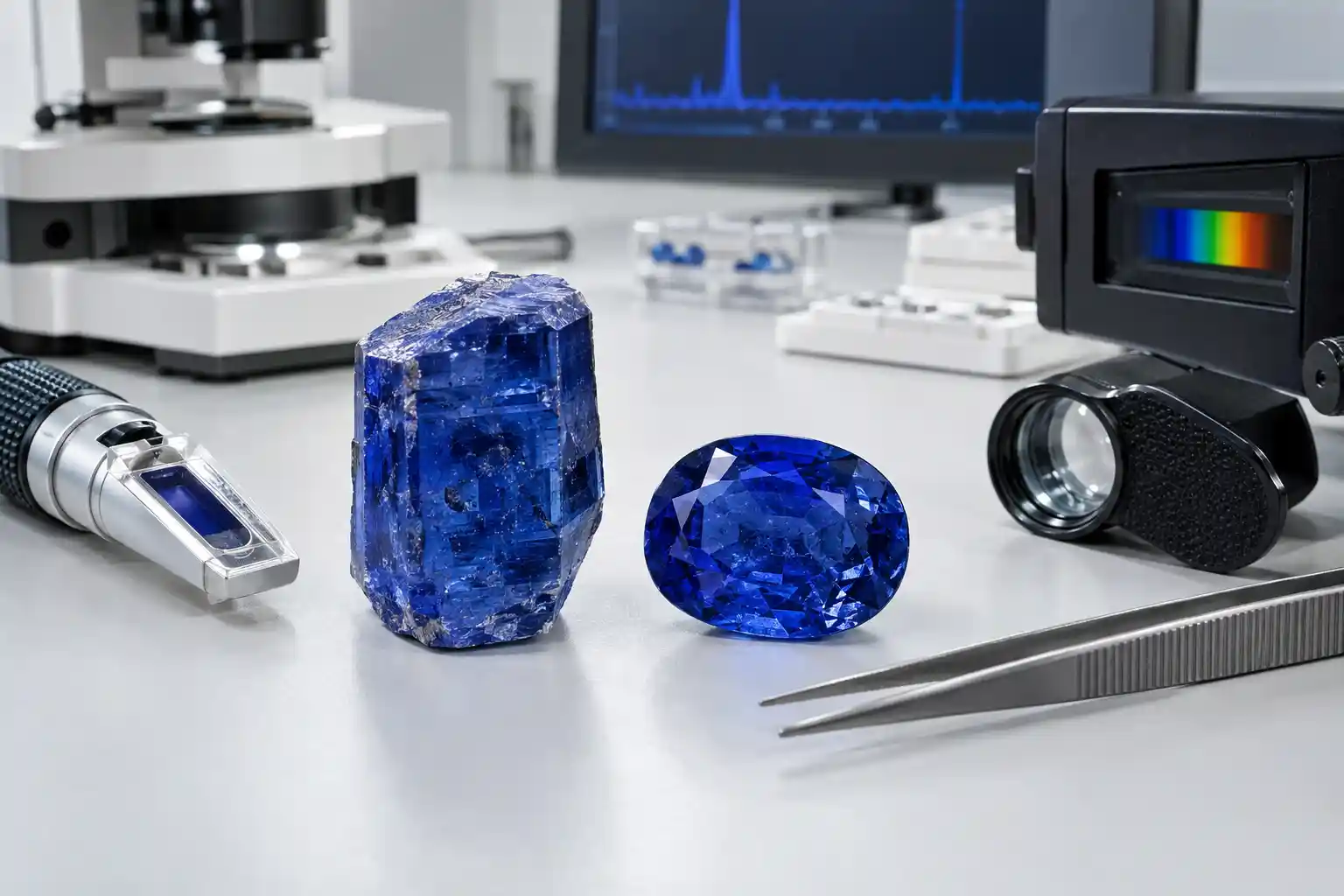
Flame-fusion sapphire may show curved growth striae or gas bubbles that differ from typical natural growth structures. Flux-grown examples can contain flux residues or inclusions connected with the growth environment. Pulled and hydrothermal stones may show other features that require careful interpretation. Advanced cases can involve spectroscopy, trace-element analysis, fluorescence, and high-magnification microscopy.
These differences make lab sapphire useful in gemology training because students learn that identification is based on evidence rather than assumptions. A clean, attractive blue stone cannot reliably be called natural simply because it looks convincing. Likewise, an included stone should not automatically be assumed natural because laboratory-grown gems can contain inclusions too.
Collectors interested in technology can also appreciate different synthetic growth methods. A flame-fusion boule, flux-grown crystal, faceted synthetic sapphire, and hydrothermal example can document distinct approaches to creating corundum. Their scientific interest exists independently of whether they command the market value of rare natural gemstones.
Sapphire Symbolism Can Add Personal Meaning Without Changing the Science
Practical qualities should come first in a benefits article, but symbolism remains part of why many people choose sapphire. Natural sapphire traditions have been associated with loyalty, truth, wisdom, commitment, dignity, faithfulness, and thoughtful judgment in different historical and cultural contexts. Laboratory-grown sapphire can carry those associations in modern jewelry because it is still sapphire at the mineral level, although ancient traditions involved natural stones rather than synthetic gems.
Blue lab sapphire is especially likely to be connected with calmness, reliability, clarity, or commitment because blue itself carries many cultural associations. A person may select the gemstone for an engagement ring because loyalty is personally meaningful, or use it to commemorate graduation because wisdom and disciplined learning fit the occasion. These uses are symbolic rather than biological effects.
Modern spiritual practices may also assign sapphire themes involving intuition, communication, focus, meditation, or particular chakra systems. Such ideas belong to personal or spiritual frameworks. There is no established evidence that a lab sapphire treats anxiety, changes neurological function, improves sleep disorders, corrects hormones, or medically affects the body.
Lab sapphire benefits can therefore include personal symbolism without presenting belief as science. Jewelry often serves as a reminder of commitments, memories, relationships, or values, and a laboratory-grown gemstone can perform that role just as effectively when its meaning matters to the wearer.
Disclosure, Treatment, and Care Still Matter
Accurate disclosure is essential because natural and laboratory-grown sapphire can differ greatly in rarity and market value. A synthetic sapphire should be sold as laboratory-grown or synthetic corundum rather than being represented as a naturally mined stone. Good disclosure allows the buyer to evaluate the gemstone according to its actual origin.
Treatment and origin are separate questions. Some sapphires, whether natural or laboratory-grown, may be altered after formation to change color, appearance, or particular optical effects. Synthetic star sapphires, for example, can be produced through processes designed to create oriented inclusions that generate asterism. Buyers should not assume that laboratory growth alone provides every piece of information about a stone.
Care is generally straightforward because corundum is durable, but jewelry should still be protected from hard impacts and careless storage. Dirt and oils can reduce brilliance, while damaged settings can create more immediate risks than the gemstone itself. The safest cleaning approach also depends on the entire piece, including metals, coatings, adhesives, treatments, and any additional gems present.
Responsible discussion of lab sapphire benefits should therefore include limitations. Durability is excellent but not absolute, synthetic origin does not guarantee quality, and disclosure remains important throughout buying, selling, appraisal, and resale.
Environmental and Ethical Claims Need Evidence
Laboratory-grown sapphire is sometimes presented as automatically environmentally superior because the crystal does not need to be extracted from a mine. That conclusion is too simple. Laboratory production requires energy, equipment, raw ingredients, heating, manufacturing facilities, cutting, transport, and other inputs. The total environmental impact can vary substantially depending on the growth process, energy source, production efficiency, factory practices, and supply chain.
Similar caution applies to ethical claims. Avoiding a particular mining supply chain may matter to a buyer, but laboratory manufacturing also involves labor, energy sourcing, industrial operations, and commercial practices that should be evaluated on their own evidence. A synthetic gemstone is not guaranteed to have ideal environmental or labor credentials merely because it was grown in a laboratory.
This does not remove sustainability from the conversation. It simply means environmental responsibility should be demonstrated rather than assumed. Buyers who prioritize these issues can look for transparent information about producers, energy use, manufacturing location, labor practices, and supply-chain policies when such information is available.
Resale Expectations Should Not Replace the Real Lab Sapphire Benefits
Jewelry purchases often combine emotional, practical, and financial considerations, but laboratory-grown sapphire should not be presented as a guaranteed investment. Synthetic production can increase supply in ways that differ fundamentally from the geological scarcity of exceptional natural sapphires. Manufacturing improvements and changing market demand can also affect future prices.
The most dependable lab sapphire benefits are available immediately: durable corundum, attractive color, jewelry versatility, design flexibility, scientific interest, personal symbolism, and potentially more accessible pricing. Those qualities can make the gemstone worthwhile even if future resale is modest.
A buyer who values a stone because it suits a particular design, commemorates an event, or provides the desired color and durability does not need future appreciation to justify the purchase. Understanding that distinction allows laboratory-grown sapphire to be appreciated for what it does well rather than for financial promises it cannot guarantee.
Conclusion
Lab sapphire benefits begin with genuine corundum properties. Mohs hardness 9, excellent toughness, lack of cleavage, varied color, strong jewelry performance, useful size availability, and scientific interest give laboratory-grown sapphire practical value. Controlled growth can also make matched stones and particular design requirements easier to achieve.
Its symbolic value can add another dimension through themes such as loyalty, wisdom, commitment, and thoughtful judgment, but those interpretations should remain separate from medical claims. Accurate origin disclosure, realistic resale expectations, careful quality evaluation, and evidence-based environmental claims allow lab-grown sapphire to be appreciated responsibly for its real strengths.
FAQs
Is lab sapphire a real sapphire?
A properly identified lab sapphire is synthetic corundum and therefore belongs to the same mineral species as natural sapphire. Its fundamental chemistry and crystal structure correspond to corundum, but its growth origin is laboratory controlled rather than geological. This distinguishes lab-grown sapphire from glass and other imitations that may look similar while having different physical and chemical properties.
What are the biggest lab sapphire benefits for jewelry?
The most important jewelry-related lab sapphire benefits are high scratch resistance, excellent toughness, lack of cleavage, attractive color choices, availability in useful sizes, and the possibility of obtaining closely matched stones for multi-stone designs. These qualities make laboratory-grown sapphire suitable for rings, earrings, bracelets, pendants, and other jewelry, although the setting and cut still influence how well a piece withstands everyday wear.
Is lab sapphire durable enough for an engagement ring?
Lab-grown sapphire is generally very suitable for engagement rings because corundum has Mohs hardness 9 and excellent toughness. It can resist many everyday scratches better than numerous softer gemstones. However, even sapphire can chip if struck severely, particularly at exposed corners or thin edges. A secure setting, good cutting, sensible design, and normal jewelry care remain important for a ring intended to be worn frequently.
Does lab sapphire have the same hardness as natural sapphire?
Yes, properly grown synthetic sapphire is corundum, so its fundamental hardness is the same as natural sapphire at about 9 on the Mohs scale. Differences between individual stones can still exist in inclusions, growth features, treatments, cut quality, and structural weaknesses, but laboratory origin does not change the basic hardness of the corundum species.
What colors can lab sapphire have?
Laboratory-grown sapphire can be produced in blue, pink, yellow, orange, green, purple, colorless, and other shades depending on the growth chemistry and trace elements involved. Red corundum is classified as ruby rather than sapphire. The wide color range is one of the most useful lab sapphire benefits for jewelry designers because it allows many visual styles while retaining the fundamental properties of corundum.
Why can lab sapphire be more affordable than natural sapphire?
Laboratory-grown sapphire does not depend on geological rarity or the costs and uncertainties associated with locating gem-quality natural crystals in the Earth. Controlled production can supply corundum in useful sizes and colors more consistently. Final prices still vary with growth method, cutting, color, size, brand, craftsmanship, documentation, and setting, so affordability should be evaluated stone by stone rather than assumed from the word synthetic alone.
Are lab sapphires always environmentally better?
No. Laboratory growth avoids mining the individual sapphire crystal, but the total environmental footprint depends on energy consumption, energy source, manufacturing efficiency, equipment, factory practices, transportation, and other supply-chain factors. Some producers may have strong environmental performance, while others may not. Environmental superiority should therefore be supported by specific information rather than assumed solely from laboratory origin.
Do lab sapphires have spiritual benefits?
Some modern spiritual traditions associate sapphire with wisdom, calmness, focus, loyalty, intuition, or communication. These interpretations can be meaningful within personal belief or meditation practices, but they are not established medical effects. Lab sapphire benefits supported by gemology concern the gemstone’s physical properties, jewelry use, appearance, scientific interest, and practical accessibility rather than treatment of health conditions.
Lab sapphire benefits involving symbolism or spiritual practice remain personal or cultural interpretations and should not replace qualified medical or mental-health care.