Buy Lab Sapphire: Smart Buying Tips & Red Flags
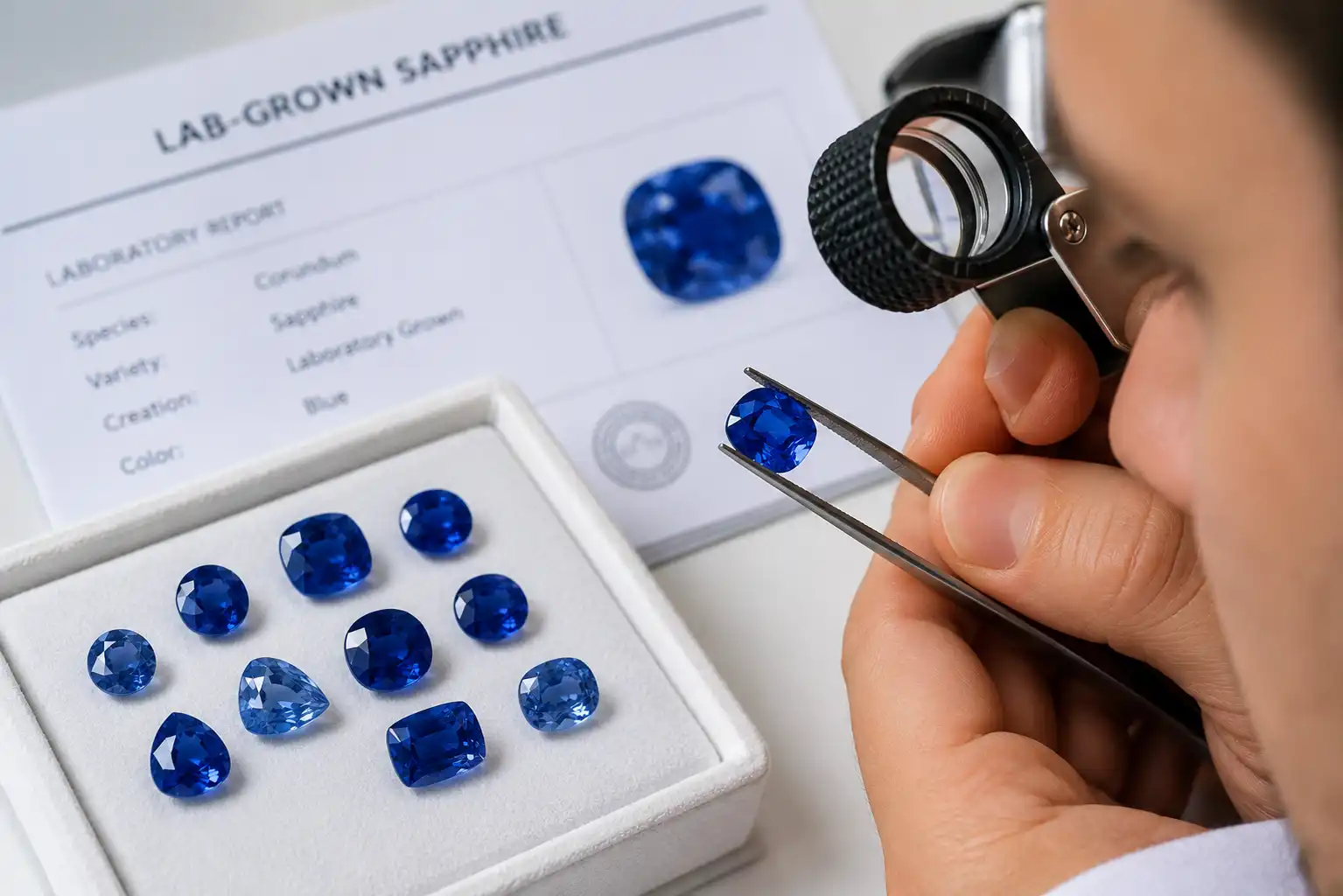
If you want to buy lab sapphire intelligently, begin with the finished gemstone rather than with whichever manufacturing method sounds most sophisticated. Laboratory-grown sapphire is manufactured corundum with essentially the same aluminum-oxide crystal structure, hardness, density, and fundamental optical properties as natural sapphire, yet laboratory production can create substantial clean crystals in blue, pink, yellow, orange, green, purple, white, color-changing, and star-bearing varieties without the geological rarity that drives much of the natural-sapphire market.
That different supply structure changes how quality should be judged. When you buy lab sapphire, a large carat weight, exceptionally clean interior, or intense blue color does not automatically indicate extraordinary rarity, while slower growth by flux or hydrothermal methods does not automatically make a gemstone better than well-produced flame-fusion material. The strongest purchase is usually the stone whose color looks convincing under neutral lighting, whose cut returns light efficiently, whose dimensions justify its weight, and whose growth and post-growth treatment history are described accurately.
The strongest decision hierarchy when you buy lab sapphire is laboratory-grown corundum identity first, color quality second, cut and light performance third, face-up dimensions fourth, transparency and structural condition fifth, growth method sixth, post-growth treatment seventh, optical phenomenon where relevant eighth, documentation ninth, jewelry construction tenth, and price last. Following that hierarchy prevents terms such as Ceylon blue, Kashmir color, hydrothermal premium, flux grade, flawless, AAAA, or investment sapphire from replacing the physical evidence of the gemstone itself.
The types of sapphire explain the extraordinarily broad corundum color family, while this page focuses specifically on how to buy lab sapphire without paying natural-stone rarity premiums for manufactured material or accepting weak cutting simply because the gemstone is inexpensive.
What to Judge First When You Buy Lab Sapphire
Sapphire is gem-quality corundum in color ranges other than the red category classified as ruby. Pure corundum is colorless, while trace elements, lattice defects, and manufacturing chemistry can create numerous colors in laboratory-grown material.
Because lab sapphire covers many colors, there is no single ideal hue that applies to every purchase.
Use this hierarchy when you buy lab sapphire:
| Priority | What to evaluate | Why it matters |
|---|---|---|
| 1 | Laboratory-grown sapphire identity | Glass, synthetic spinel, cubic zirconia, and other simulants are not sapphire |
| 2 | Color appropriate to the variety | Blue, pink, yellow, white, green, and other colors need different visual standards |
| 3 | Cut performance | Windowing, extinction, bow ties, and poor proportions can dominate appearance |
| 4 | Face-up dimensions | Deep cutting can hide considerable weight |
| 5 | Transparency and condition | Fine faceted material should usually remain clean and lively |
| 6 | Growth method | Flame fusion, flux, hydrothermal, and pulled growth are manufacturing routes |
| 7 | Post-growth treatment | Diffusion, filling, coating, and other modification should be disclosed |
| 8 | Star or color-change effect | Phenomenal stones require their own quality criteria |
| 9 | Laboratory report | Important when exact identity, treatment, or manufacturing history affects price |
| 10 | Setting construction | Metal, accent stones, and craftsmanship may represent much of the retail value |
| 11 | Price | Manufactured supply should be compared within the lab-grown market |
When you buy lab sapphire through this order, you can separate genuine gemstone quality from terminology designed primarily to increase perceived prestige.
Lab Sapphire Is Sapphire, Not a Simulant
One of the first distinctions to understand when you buy lab sapphire is the difference between laboratory-grown gemstone material and imitation.
Laboratory-grown sapphire is synthetic corundum.
Synthetic blue spinel is spinel.
Blue glass is glass.
Cubic zirconia is zirconium oxide.
Blue topaz is topaz.
Tanzanite is zoisite.
Iolite is cordierite.
These materials may imitate particular sapphire colors, but they do not become sapphire because they were also manufactured or because they look blue.
The real versus fake sapphire guide explains why identification should answer three separate questions: whether the stone is corundum, whether that corundum is natural or laboratory grown, and whether treatment has modified its appearance.
When you buy lab sapphire, the seller should answer all three clearly.
Natural Sapphire and Lab Sapphire Share Corundum Properties
Natural sapphire and laboratory-grown sapphire both consist principally of aluminum oxide, Al₂O₃.
Both can have refractive indices around the normal corundum range.
Both have specific gravity near 4.
Both have Mohs hardness 9.
Both are doubly refractive.
Both can show pleochroism.
Both can display fluorescence depending on chemistry.
Both can be blue, pink, yellow, orange, green, purple, white, or otherwise colored.
The major distinction is origin.
Natural sapphire crystallized through geological processes, while lab sapphire grew through controlled manufacturing.
When you buy lab sapphire, that distinction should remain explicit even when the visual difference is impossible to determine with the unaided eye.
Do Not Expect to Separate Lab Sapphire From Natural Sapphire by Sight
A laboratory-grown sapphire can be extremely convincing.
Some flame-fusion material shows obvious curved growth zoning under magnification, but not every synthetic sapphire displays an easy consumer-level clue. Flux-grown and hydrothermal material can contain complex internal scenes that require much more experienced interpretation.
Likewise, a natural sapphire can be exceptionally clean.
When you buy lab sapphire, do not accept arguments such as:
“Natural stones always have inclusions.”
“Lab sapphire always looks too perfect.”
“Real sapphire has a different sparkle.”
“Synthetic sapphire is lighter.”
“Natural sapphire feels colder.”
These are not reliable origin tests.
Professional gemological examination uses several properties together.
Color Should Be Judged According to the Sapphire Variety
One advantage when you buy lab sapphire is access to a remarkably broad color range.
Laboratory growth can produce:
- blue;
- violetish blue;
- teal;
- green;
- yellow;
- orange;
- pink;
- purple;
- colorless or white;
- gray;
- black;
- color-changing;
- parti-colored;
- and star-bearing material.
Each category needs its own quality hierarchy.
A rule developed for deep blue sapphire should not be applied mechanically to white sapphire.
A vivid pink stone should not be judged according to whether it resembles royal blue sapphire.
A star cabochon should not be penalized for lacking faceted transparency.
When you buy lab sapphire, identify the color category first and then evaluate how well the stone performs within it.
Blue Lab Sapphire Needs Saturation Without Blackness
Blue remains the most familiar sapphire color, so many people who buy lab sapphire begin there.
Fine blue material should show enough saturation to remain recognizably and attractively blue under ordinary lighting without becoming so dark that the center appears black.
Evaluate:
Hue: blue, slightly violetish blue, or greenish blue.
Tone: light, medium, medium-dark, or very dark.
Saturation: strength of blue.
Brightness: how much useful light the cut returns.
A darker stone is not automatically better.
Medium to medium-dark blue often offers a strong balance because the gemstone can maintain visible saturation while still returning light.
The blue gemstones comparison helps place sapphire alongside spinel, aquamarine, zircon, topaz, tanzanite, and other blue materials.
When you buy lab sapphire, however, the strongest blue is the one that survives normal lighting rather than the one that looks darkest in a product photograph.
Avoid Blue Lab Sapphire That Becomes Black Face-Up
Dark synthetic sapphire can look vivid when backlit but almost black once placed on a solid surface.
This is a major buying trap.
When you buy lab sapphire online, ask the seller to place the gemstone face-up on white or neutral gray under broad overhead light.
If the blue disappears and the center turns black, you have learned more from that simple view than from several highly illuminated studio photographs.
Deep color can be attractive.
Visible blackness covering most of the gemstone is different.
Pale Blue Can Offer Better Practical Beauty
Some buyers automatically reject lighter blue lab sapphire because it seems less luxurious than royal or dark blue.
That can be a mistake.
A lighter medium-blue stone with excellent cutting can remain bright across its entire face and display much stronger scintillation than an excessively dark competitor.
When you buy lab sapphire, compare the actual stones rather than assuming deeper tone deserves a higher price.
A vivid medium-blue gemstone may provide substantially more visible color.
Pink Lab Sapphire Needs a Different Color Standard
Laboratory-grown pink sapphire can range from pale blush through rose and bubblegum pink to vivid magenta or purplish pink.
When you buy lab sapphire in pink, judge whether the color remains clearly pink under neutral lighting rather than becoming gray, brown, or almost colorless.
The pink gemstones guide provides broader color comparisons with morganite, tourmaline, spinel, kunzite, and pink diamond.
For lab sapphire specifically, fine pink should combine attractive saturation with transparency and brightness.
Extremely intense magenta can be beautiful, but it should not become so dark that the stone loses sparkle.
Pink Lab Sapphire Is Excellent for Frequent Ring Wear
Pink sapphire’s Mohs hardness 9 gives it a durability advantage over many popular pink gemstones.
That can make it especially compelling when you buy lab sapphire for an engagement ring but want a large pink center without the pricing associated with fine natural pink sapphire or pink diamond.
The pink engagement-ring gemstones comparison places laboratory-grown pink sapphire among the stronger daily-wear choices.
When you buy lab sapphire for this purpose, prioritize setting construction and cut rather than spending excessively on microscopic clarity.
Yellow and Orange Lab Sapphire Need Brightness
Yellow and orange sapphire can look exceptionally vivid, but warm-colored material can become brown or overly dark if tone and saturation are not balanced well.
When you buy lab sapphire in these colors, inspect whether the stone remains bright in neutral light.
A rich yellow stone should not require intense warm illumination to avoid looking muddy.
Orange material should maintain clean orange or orange-pink character rather than appearing brown.
Windowing is particularly visible in pale yellow stones because the center can become nearly colorless if the pavilion is too shallow.
White Lab Sapphire Is Not a Diamond
Colorless laboratory-grown sapphire is sometimes used as a diamond alternative, but the two gemstones have different optical properties.
White sapphire has significantly less dispersion and lower refractive power than diamond, which means it generally produces less intense fire and brilliance.
That does not make white lab sapphire a poor gemstone.
It offers exceptional hardness, neutral color, and a comparatively restrained sparkle.
When you buy lab sapphire in white or colorless material, judge it according to whether you like sapphire’s optical character rather than expecting a perfect diamond imitation.
White Lab Sapphire Exposes Cut Problems Clearly
Because color is absent, cutting becomes extremely important.
When you buy lab sapphire in colorless form, inspect for:
- central windowing;
- excessive depth;
- weak brilliance;
- poor symmetry;
- obvious facet misalignment;
- abrasions;
- surface haze;
- and dull polish.
Color cannot hide those weaknesses.
A well-cut white sapphire can look crisp and bright.
A badly cut one can look glassy even though the material itself is genuine corundum.
Green and Teal Lab Sapphire Need Accurate Color Descriptions
Laboratory-grown sapphire can also be produced in green, blue-green, teal, and parti-colored appearances.
When you buy lab sapphire in these less traditional colors, make sure the description matches the face-up gemstone rather than forcing it into a more commercially famous category.
A teal stone should not automatically be marketed as Paraíba-like.
A green synthetic sapphire is not emerald.
A blue-green sapphire should not become alexandrite simply because its color shifts slightly under different lighting.
Accurate naming protects value comparisons.
Color-Change Lab Sapphire Requires Two Lighting Conditions
Laboratory-grown sapphire can be manufactured with chemistry that produces a noticeable color change under different light spectra.
Some material has historically been created to imitate alexandrite-like effects.
When you buy lab sapphire with a color-change claim, request video under two clearly different light sources.
Judge:
the starting color, the ending color, strength of change, completeness of change, brightness in both environments, and whether grayness overwhelms either side.
A weak blue-to-slightly-purple shift should not receive the same premium as a dramatic and attractive transformation.
Color-Change Sapphire Is Not Alexandrite
Alexandrite belongs to chrysoberyl.
Color-change sapphire belongs to corundum.
Both can change appearance under different light sources, but mineral identity remains different.
When you buy lab sapphire with an alexandrite-like color shift, the seller should not shorten the description to synthetic alexandrite unless the material is actually synthetic chrysoberyl.
Phenomenon does not determine mineral species.
Neutral Lighting Is Essential for Every Color
Photography can change the appearance of sapphire substantially.
Cool LEDs can strengthen blue and violet.
Warm illumination can intensify yellow, orange, and some pink hues.
A black background can make saturated stones appear deeper.
Color-corrected images can remove gray modifiers.
When you buy lab sapphire online, request white and neutral-gray backgrounds and examine whether the background itself appears neutral.
A strong stone should retain its intended color without relying on color manipulation.
Backlighting Should Supplement, Not Replace, Face-Up Evaluation
A powerful light behind the gemstone can reveal zoning, inclusions, and body color.
It can also make a weak stone look dramatically stronger than it will once mounted.
When you buy lab sapphire, evaluate ordinary reflected-light appearance first.
Then use transmitted light for additional inspection.
A blue sapphire that glows electric blue only with a flashlight underneath it may look nearly black in jewelry.
A pale pink sapphire may appear richly colored under transmitted light and almost colorless face-up.
Buy the appearance you will actually wear.
Growth Method Is Important but Should Not Lead the Decision
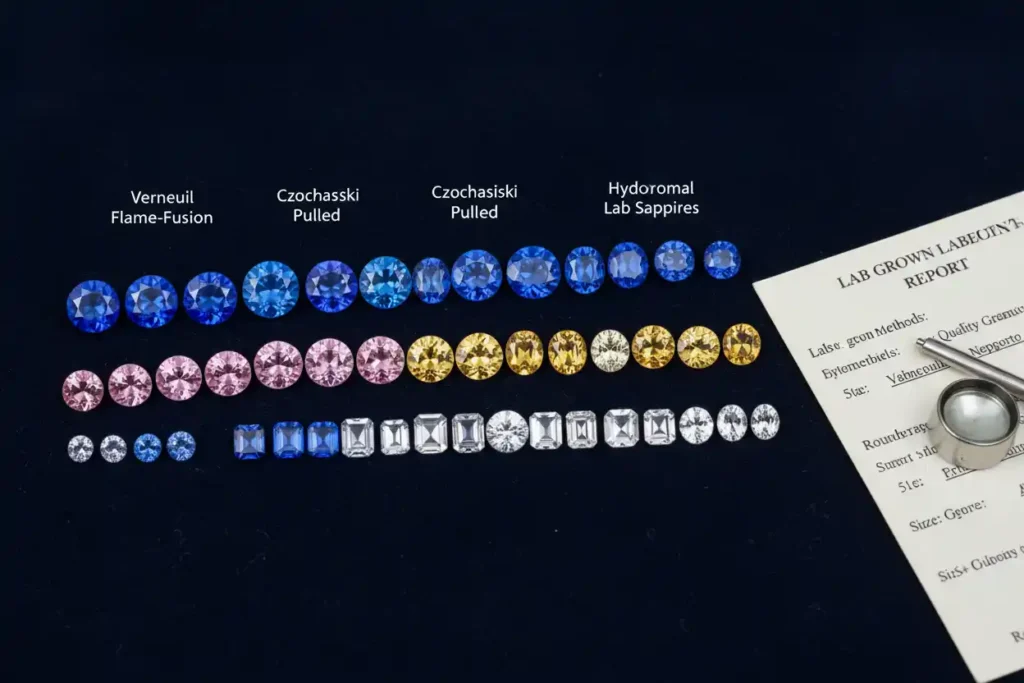
Laboratory-grown sapphire can be produced through several manufacturing routes, including flame fusion, flux growth, hydrothermal growth, and crystal-pulling or related melt-growth techniques.
Each process leaves different internal evidence.
Each has different manufacturing costs.
Each can produce attractive gemstones.
When you buy lab sapphire, growth method deserves disclosure but should not become the primary quality grade.
A beautifully cut flame-fusion sapphire can be far more attractive than a poorly proportioned flux-grown stone.
Flame Fusion Is the Most Common Commercial Method
Flame fusion, also known as the Verneuil process, is one of the most established and economical methods for producing synthetic corundum.
Powdered ingredients melt within a high-temperature flame and solidify onto a growing boule.
The method can produce intense color, high clarity, and useful sizes efficiently.
When you buy lab sapphire made through flame fusion, do not assume the stone is low quality simply because production is relatively inexpensive.
Manufacturing cost and visual quality are separate.
Curved Growth Lines Are Associated With Flame Fusion
Flame-fusion synthetic sapphire can show curved striae or curved color banding that follows the shape of the boule.
Round gas bubbles may also occur.
These features can be highly useful to a gemologist.
When you buy lab sapphire, however, do not assume that every flame-fusion stone will reveal obvious curved lines to the unaided eye.
Cut orientation, weak zoning, clarity, lighting, and later treatment can make them difficult to see.
The absence of an obvious curved line does not prove natural origin.
Flame-Fusion Sapphire Can Be Extremely Clean
Efficient manufacturing can create large areas of transparent synthetic corundum with few inclusions.
That means a highly clean flame-fusion sapphire is not automatically rare.
When you buy lab sapphire in this category, spend the budget on color and cutting before paying heavily for microscopic perfection.
Eye-clean material should be readily obtainable.
Flux-Grown Sapphire Has a Different Internal Character
Flux growth involves dissolving sapphire-forming components in a molten flux from which crystals develop gradually.
The process can create different internal characteristics from flame fusion, including flux residues, veils, crystals, or metallic-looking inclusions.
When you buy lab sapphire grown by flux, a higher price may reflect slower production, lower yield, manufacturer reputation, collector interest, or distinctive internal character.
The method itself still does not guarantee superior color or cutting.
Flux Inclusions Can Look Naturalistic
Some flux-grown synthetic sapphire can display internal features that look more geological than obvious curved flame-fusion striae.
That can make identification more challenging.
When you buy lab sapphire, do not assume a natural-looking fingerprint, veil, or crystal proves mined origin.
A professional gemologist interprets inclusion shape, growth geometry, chemistry, and other evidence together.
A synthetic gemstone can look convincingly natural under casual magnification.
Hydrothermal Sapphire Can Require More Careful Identification
Hydrothermal growth uses high-temperature aqueous solutions under pressure to crystallize material onto seed surfaces.
Laboratory-grown sapphire created this way can show seed plates, roiled-to-angular growth structures, solution-related features, and other characteristics distinct from flame fusion.
When you buy lab sapphire produced hydrothermally, judge the finished stone rather than assuming the process gives it automatic superiority.
A hydrothermal sapphire can be beautifully colored and transparent.
It can also be poorly cut or visually weak.
Pulled Sapphire Is Another Legitimate Category
Crystal-pulling processes such as Czochralski growth form synthetic corundum from a melt while a seed crystal is slowly withdrawn under controlled conditions.
Pulled material can be extremely clean and is important in both gem and technical applications.
When you buy lab sapphire produced by a pulling method, treat that information as manufacturing provenance rather than a universal grade.
The same core buying questions remain:
How good is the color?
How good is the cut?
How large does it look?
Is it treated afterward?
What does it cost compared with equivalent lab-grown material?
Do Not Let Growth Method Become a Prestige Contest
Retailers sometimes describe one growth process as superior because it is slower, more technically demanding, or capable of producing more natural-looking inclusions.
Those facts can affect manufacturing cost.
They do not create a universal quality ranking.
When you buy lab sapphire, a slower process deserves a premium only if you personally value the manufacturing provenance or if the resulting gemstone offers visible benefits.
Otherwise, buy the stronger stone.
Cut Quality Deserves More Attention in Manufactured Sapphire
Fine natural sapphire rough can be expensive and irregular enough that cutters preserve weight aggressively.
Laboratory-grown rough changes that economic pressure.
When you buy lab sapphire, there is less reason to accept severe windows, excessive pavilion depth, poor symmetry, or weak polish merely to save every possible carat.
Manufactured material should normally allow the cutter to prioritize appearance more freely.
A synthetic sapphire should look deliberately finished rather than merely heavy.
Watch for Windowing
Windowing occurs when the pavilion allows too much light to pass through rather than reflecting it back toward the observer.
When you buy lab sapphire, place the stone face-up over a neutral background and examine the center.
If you can easily see the background through a broad region, the stone may have a significant window.
This matters particularly in:
white sapphire, pale blue sapphire, yellow sapphire, light pink sapphire, and large step cuts.
A strong stone should use its pavilion to maintain color and brightness through the center.
Dark Blue Sapphire Can Suffer From Extinction
Extinction is the opposite optical problem.
Instead of becoming transparent, parts of the gemstone remain dark because little useful light returns toward the viewer.
When you buy lab sapphire in blue, teal, or dark purple material, rotate the stone under broad neutral light.
A certain amount of contrast creates attractive scintillation.
Large black areas that remain fixed across most angles are less desirable.
Do not allow the phrase deep royal blue to excuse a gemstone that is essentially black indoors.
Fancy Shapes Need Individual Inspection
Round, oval, cushion, pear, radiant, emerald, marquise, and other sapphire cuts can all perform well.
There is no one shape that automatically provides the best lab sapphire.
When you buy lab sapphire in an elongated oval, pear, or marquise, watch for dark bow-tie areas.
When you buy a step cut, watch for central windowing.
When you buy a cushion, inspect whether the pavilion creates balanced reflections or a transparent center.
When you buy a round, compare diameter and overall brightness.
The shape should suit the material.
Compare Carat Weight With Millimeter Dimensions
Corundum has specific gravity near 4, making it denser than diamond, quartz, beryl, and several other common gemstones.
Consequently, one carat of sapphire tends to look smaller than one carat of a lower-density gemstone cut to similar proportions.
The carat-versus-millimeter size chart explains this relationship.
When you buy lab sapphire, compare actual length, width, and depth rather than relying on the carat number.
Two sapphires of identical weight can have very different face-up size.
Deep Pavilions Can Hide Cheap Weight
Laboratory-grown rough does not carry natural sapphire’s geological scarcity, so extreme weight retention deserves particular scrutiny.
When you buy lab sapphire, a very deep pavilion may increase carat weight without increasing the amount of gemstone you see once mounted.
Depth can sometimes strengthen pale color or improve optical performance.
That can justify it.
If the extra depth produces no visible benefit, you may simply be paying for hidden mass.
Large Lab Sapphire Is Not Automatically Rare
Laboratory methods can produce substantial corundum crystals.
Therefore, a clean five-carat, ten-carat, or even larger synthetic sapphire does not carry the same scarcity implications as a comparable fine natural sapphire.
When you buy lab sapphire, large size becomes worth paying for when the stone also maintains:
excellent color, strong transparency, efficient cutting, attractive dimensions, good polish, and structural soundness.
A huge poorly cut sapphire remains poorly cut.
Transparency Should Usually Be Good
Laboratory-grown sapphire is widely available with strong clarity, so prominent haze and inclusions should generally reduce the quality expectation for ordinary faceted material.
When you buy lab sapphire, inspect for:
- gas bubbles;
- flux residues;
- growth structures;
- crystals;
- fractures;
- cavities;
- surface-reaching fissures;
- clouds;
- chips;
- and abraded facet junctions.
Some of these features are normal growth indicators.
The question is whether they interfere with face-up beauty or structural integrity.
Do Not Overpay for Flawless Lab Sapphire
High clarity is one of laboratory-grown sapphire’s accessible advantages.
When you buy lab sapphire, a tiny inclusion visible only under magnification should rarely outweigh obvious improvements in color or cut.
A highly transparent VS-like appearance is normally sufficient for most jewelry uses.
Do not let a seller transform microscopic perfection into a natural-gem-style rarity premium.
Structural Damage Still Matters
Corundum has no easy cleavage, but it is still brittle enough to chip after hard impacts.
Surface-reaching fractures, damaged corners, very thin girdles, and cavities therefore deserve attention.
When you buy lab sapphire for frequent wear, inspect the edges rather than assuming Mohs hardness 9 makes every stone indestructible.
Hardness measures resistance to scratching.
It does not guarantee immunity from breakage.
Laboratory-Grown Sapphire Can Still Be Treated
This distinction is critical.
Laboratory growth answers how the corundum crystal formed.
Treatment answers what happened after or around that growth process to alter its appearance.
When you buy lab sapphire, ask about post-growth:
- diffusion;
- heating or annealing;
- fracture filling;
- coating;
- dyeing where relevant;
- and treatment designed to create or strengthen optical phenomena.
Synthetic origin does not make treatment disclosure unnecessary.
Diffusion Treatment Can Modify Synthetic Sapphire
Diffusion is particularly important because color-causing elements can be introduced into synthetic corundum at high temperature.
The result may be a blue or otherwise colored surface or near-surface region that differs from the original synthetic material.
When you buy lab sapphire, a stone can therefore be both:
laboratory grown, and
diffusion treated.
Those descriptions are not contradictory.
They describe separate stages of manufacturing.
Diffusion Can Also Create a Star Effect
Asterism can be induced in synthetic sapphire through treatment that creates appropriately oriented light-scattering structures near the surface.
When you buy lab sapphire with a star, do not assume the phenomenon formed during the original crystal-growth process.
The color and the star can potentially be produced or modified through diffusion.
That history should be disclosed when known.
Recutting Can Matter With Surface-Related Diffusion
Some diffusion-created color can be concentrated relatively close to the surface.
Deep repolishing or recutting may therefore alter the appearance if part of the treated layer is removed.
When you buy lab sapphire with diffusion treatment, keep that information with the gemstone and tell future cutters or jewelers before substantial repolishing.
A treatment can be stable during normal wear yet still matter during material removal.
Fracture Filling Can Occur in Synthetic Sapphire
Laboratory-grown sapphire can contain fractures, and those fractures can potentially be filled with glass or another substance to improve apparent clarity.
When you buy lab sapphire, inspect prominent surface-reaching fissures and ask whether filling has been detected.
The surrounding corundum may have Mohs hardness 9.
The filler can have very different thermal, chemical, and mechanical properties.
This matters during cleaning and repair.
Coatings Should Be Disclosed
A coating can alter surface color without changing the sapphire underneath.
When you buy lab sapphire, an unusually intense surface effect, color concentrated along facet edges, or visible wear at scratches can justify closer examination.
Do not scrape the stone to test it.
Professional non-destructive analysis provides stronger evidence.
Treatment Does Not Automatically Make a Bad Sapphire
A diffusion-treated synthetic sapphire can remain durable and visually attractive.
A filled lab sapphire can still function as decorative jewelry when the treatment is stable enough for the intended use.
The buying issue is disclosure and price.
When you buy lab sapphire, treatment should lower or alter the value category when it substantially created the visible appearance or changed durability.
It should not be concealed.
Star Lab Sapphire Needs a Separate Quality Hierarchy
Laboratory-grown star sapphire can display striking asterism and is available in several body colors.
The star sapphire guide explains the phenomenon in broader mineralogical context.
When you buy lab sapphire with a star, judge:
- star sharpness;
- centering;
- ray completeness;
- ray straightness;
- mobility;
- body color;
- dome proportions;
- polish;
- transparency or translucency;
- and treatment disclosure.
Do not apply faceted-sapphire clarity standards mechanically.
Asterism requires inclusions or treatment-created structures capable of interacting with light.
A Good Star Should Move
Use one relatively small point light.
Move the stone or the light.
A convincing star should travel across the curved cabochon surface rather than remaining like a painted pattern.
When you buy lab sapphire with a six-rayed star, the rays should ideally remain visible enough to form an organized phenomenon.
Extremely broad blurry rays create a weaker effect.
Perfect Stars Can Be Synthetic
A highly sharp, perfectly centered star can look extraordinary.
It is not proof of natural origin.
Laboratory-grown star sapphire has been manufactured specifically to create highly organized asterism.
When you buy lab sapphire, the more perfect the star appears, the more important it becomes to avoid assuming that appearance reveals geological origin.
Compare Star Quality With Body Color
A technically sharp star on unattractive body color is not automatically a fine gemstone.
When you buy lab sapphire with asterism, balance the star against the underlying color.
A rich blue cabochon with a centered mobile star can be more desirable than a darker nearly black stone with sharper rays.
Phenomenon and color should strengthen each other.
Synthetic Star Sapphire Should Not Receive Natural-Star Rarity Pricing
Manufactured asterism can be produced more consistently than fine natural star sapphire.
When you buy lab sapphire with a star, compare the price with other synthetic star material rather than with rare natural cabochons.
The beauty can be real.
The rarity structure is different.
Growth Features Can Help Identify Lab Origin
Flame-fusion sapphire may show curved striae or bubbles.
Flux-grown material can show flux residues or veil-like structures.
Hydrothermal material can show seed-related or angular growth structures.
Pulled sapphire can show other manufacturing-related growth patterns or strain.
When you buy lab sapphire, these features can be valuable to an experienced gemologist.
They should not be treated as a consumer checklist where one visible clue automatically settles every question.
Natural-Looking Inclusions Do Not Prove Natural Origin
A sophisticated synthetic sapphire can contain inclusions that resemble geological internal features.
Likewise, post-growth treatment can change the inclusion scene.
When you buy lab sapphire, do not pay natural-sapphire prices because a seller points to one interesting inclusion and calls it proof from nature.
Origin requires a more complete gemological conclusion.
UV Fluorescence Is Supporting Evidence, Not a Verdict
Synthetic and natural sapphire can show varied ultraviolet reactions.
Some laboratory-grown material reveals characteristic growth zoning under specialized ultraviolet imaging, while some treatment can create distinctive fluorescence.
However, ordinary UV observations are not sufficient to determine every sapphire’s origin or treatment.
When you buy lab sapphire, do not accept a handheld UV demonstration as a substitute for appropriate identification.
Scratch Tests Cannot Separate Natural and Lab Sapphire
Both natural and laboratory-grown sapphire have corundum hardness.
Therefore, a scratch test cannot tell you whether the stone formed geologically or in a manufacturing facility.
It also risks damaging jewelry, another gemstone, or the test surface.
When you buy lab sapphire, avoid destructive authenticity methods.
Synthetic Spinel Is an Important Sapphire Simulant
Blue synthetic spinel has historically been used to imitate sapphire and may still appear in jewelry.
It is not synthetic sapphire.
Both are laboratory-created gemstones, but they have different compositions, refractive properties, density, crystal structures, and optical behavior.
When you buy lab sapphire, clear corundum identification is more useful than the vague phrase synthetic blue gemstone.
Glass Is Not Lab Sapphire
Colored glass can imitate virtually any sapphire hue.
Smooth round bubbles, lower hardness, different optical properties, and other features can separate glass from corundum, but consumer photographs may hide those distinctions.
When you buy lab sapphire at more than decorative cost, insist on accurate material disclosure.
A large vivid glass stone can be beautiful.
It should be priced and named as glass.
White Sapphire Can Be Confused With Other Colorless Stones
Colorless lab sapphire can resemble cubic zirconia, white spinel, topaz, and diamond at a glance.
The physical properties differ substantially.
When you buy lab sapphire specifically because you want corundum’s hardness and identity, verify the material rather than assuming every transparent colorless manufactured stone is sapphire.
Mine-Inspired Names Should Not Create Geographic Provenance
Laboratory-grown sapphire has a manufacturing origin rather than a mine origin.
A seller may describe a blue synthetic sapphire as:
Kashmir-color, Ceylon-blue, Burmese-style, Montana-like, or another appearance comparison.
Those phrases cannot make the stone geologically originate from those regions.
When you buy lab sapphire, relevant provenance can include:
manufacturer, growth method, production facility, brand, cutter, and laboratory identification.
Natural geographic-origin premiums belong to natural sapphire.
“Ceylon Lab Sapphire” Needs Clarification
The word Ceylon can be used carelessly as a synonym for a lighter or brighter shade of blue.
When you buy lab sapphire described this way, ask whether the seller is discussing color style or trying to imply Sri Lankan geological provenance.
A laboratory-grown crystal cannot possess a natural mine origin.
The color can resemble material traditionally associated with Sri Lanka.
That distinction should remain clear.
Seller Grades Such as AAAA Are Not Universal
You may encounter lab sapphire described as AAA, AAAA, 5A, premium, royal, elite, investment grade, or museum quality.
These labels do not belong to one global independent grading framework.
When you buy lab sapphire, translate the grade into actual characteristics.
What is the color?
How dark is it?
Is the stone eye-clean?
Is there a window?
How deep is the pavilion?
What are the dimensions?
What growth method produced it?
Was diffusion used?
Is filling present?
What report identifies it?
Once those questions are answered, the seller’s alphabetic grade becomes far less important.
Do Not Pay Natural-Sapphire Prices for Manufactured Rarity
Laboratory-grown sapphire can offer exceptional visual quality at relatively accessible cost.
That is one of its major advantages.
When you buy lab sapphire, do not let a retailer erase that advantage by pricing an ordinary synthetic stone according to comparisons with fine natural sapphire.
The lab sapphire price guide addresses the manufactured market directly, while the separate sapphire price guide belongs to natural and treated natural material.
Compare each stone within the correct supply category.
Growth Cost Can Still Create Legitimate Price Differences
Manufactured does not mean costless.
Flame fusion can produce material efficiently.
Flux and hydrothermal processes may require different equipment, slower growth, lower yield, or more specialized production.
Precision cutting also adds labor.
Branded or historically important synthetic material can carry collector interest.
When you buy lab sapphire, those factors can justify a premium when they actually matter to the product.
The mistake is treating manufacturing cost as geological rarity.
Precision Cutting Can Be Worth More Than the Rough
Because synthetic rough can be accessible, a substantial part of a fine lab sapphire’s price may come from cutting craftsmanship.
Precision faceting can create:
better symmetry, stronger light return, better color orientation, reduced windowing, improved face-up spread, and distinctive custom designs.
When you buy lab sapphire from a specialist cutter, a premium can be entirely reasonable when the workmanship is visible.
Matched Pairs and Suites Can Carry Real Value
A matched pair of lab sapphire earrings or a calibrated suite for a necklace requires stones with similar:
color, tone, saturation, cut, dimensions, and brightness.
Manufacturing makes matching easier than with many natural stones, but excellent matching still requires selection and cutting.
When you buy lab sapphire as a pair or suite, compare the stones side by side under the same lighting.
One should not look gray while the other appears vivid.
Large Size Needs Better Cutting, Not More Excuses
A large lab sapphire offers plenty of visual area for cut problems to become obvious.
When you buy lab sapphire in substantial dimensions, inspect for:
uneven zoning, large windows, deep pavilions, heavy extinction, asymmetrical outlines, poor polish, and visible fractures.
Large size magnifies both quality and weakness.
When a Laboratory Report Is Worth Paying For
A low-cost calibrated flame-fusion sapphire may not justify individual laboratory testing.
A report becomes more valuable when you buy lab sapphire that is:
- unusually expensive;
- represented ambiguously as natural;
- sold at a premium for flux or hydrothermal growth;
- diffusion treated;
- fracture filled;
- an exceptional star stone;
- a dramatic color-change stone;
- part of important jewelry;
- historically collectible;
- or disputed in material identity.
The gemstone certification guide explains why independent identification, treatment analysis, retailer cards, and appraisals are different documents.
What the Report Should Establish
A useful report should clearly identify the gemstone as laboratory-grown sapphire or synthetic corundum.
Depending on the laboratory and service, it may also record:
weight, dimensions, shape, cutting style, color, growth features, growth method, and detectable treatments.
When you buy lab sapphire, read the laboratory wording directly.
Do not rely solely on the retailer’s interpretation of the report.
Match the Report to the Exact Stone
A genuine report is useful only when it belongs to the gemstone being sold.
When you buy lab sapphire with documentation, compare:
carat weight, length, width, depth, shape, color, cutting style, photograph where available, and distinctive inclusions.
A curved growth band, flux veil, fracture, seed feature, color zone, or unusual facet arrangement can help connect the report with the physical stone.
If measurements differ materially, resolve the discrepancy before paying.
A Seller Certificate Is Not Automatically an Independent Report
A branded card from the retailer may be useful transaction documentation.
It is still the seller’s representation unless a genuinely independent laboratory issued it.
When you buy lab sapphire at substantial value, ask who performed the testing.
The answer matters more than the design of the card.
A Report Is Not an Appraisal
A laboratory report answers gemological questions.
An appraisal provides an estimated monetary value for a particular purpose.
When you buy lab sapphire, a high replacement appraisal does not prove that the synthetic stone is rare, untreated, or likely to resell for a similar amount.
Likewise, an excellent identification report does not prove that the retailer’s price is competitive.
Use each document for its intended purpose.
Resale Expectations Should Be Conservative
Laboratory-grown sapphire can continue to be manufactured, so ordinary modern material usually does not have the same scarcity-driven resale structure as fine natural sapphire.
When you buy lab sapphire, purchase primarily for:
color, durability, size, jewelry use, manufacturing interest, precision cutting, or initial value.
Do not assume automatic appreciation.
Branded historic synthetics, specialist flux material, exceptional stars, or early manufactured specimens may develop collector interest, but that is a specialized market rather than a guarantee for ordinary inventory.
“Investment Grade Lab Sapphire” Needs Evidence
If a seller promises significant appreciation, ask what secondary market supports that expectation.
When you buy lab sapphire, comparisons with natural sapphire auction prices are weak evidence because manufactured and geological materials have different supply structures.
A laboratory-created stone can be collectible.
Collectible does not mean guaranteed investment.
Compare the Complete Jewelry, Not Just the Center Stone
Laboratory-grown sapphire can be affordable enough that the setting costs more than the gem.
When you buy lab sapphire already mounted, evaluate:
metal purity, metal weight, prong construction, shank thickness, side stones, setting height, finishing, resizing limitations, and craftsmanship.
A carefully made platinum ring can legitimately cost much more than its synthetic sapphire.
A thin poorly constructed ring should not receive a luxury premium simply because the center stone is large.
Sapphire Is Excellent for Frequent Ring Wear
Corundum’s Mohs hardness 9 makes laboratory-grown sapphire one of the strongest colored-gem choices for regular ring use.
The sapphire ring guide explains the broader relationship among sapphire size, setting style, dimensions, and durability.
When you buy lab sapphire for a ring, still inspect:
girdle thickness, points, corners, fractures, treatment, prong placement, and setting quality.
High hardness reduces scratching.
It does not make badly damaged material indestructible.
Pointed Shapes Need Protection
Pears and marquises can be attractive, but their points concentrate impact.
Princess-like square shapes can also expose corners.
When you buy lab sapphire for frequent ring use, protect those vulnerable areas with appropriate prongs, bezels, or surrounding structures.
Synthetic origin does not change corundum’s basic fracture behavior.
Side Stones Need Accurate Disclosure
A lab sapphire center may be surrounded by:
natural diamonds, laboratory-grown diamonds, cubic zirconia, moissanite, white sapphire, or other materials.
When you buy lab sapphire jewelry, ask what every significant component is.
Mixed-material jewelry can be excellent.
It needs transparent labeling.
Online Photography Should Show the Exact Stone
For a meaningful individual purchase, stock photography is insufficient.
When you buy lab sapphire online, ask for the actual gemstone under:
neutral face-up lighting, white background, gray background, continuous rotation, side view, and pavilion view.
For star stones, request a point-light video.
For color-change stones, request two lighting environments.
For expensive included stones, request magnified images.
The evidence should match the quality claim.
Side Views Reveal Hidden Weight
A sapphire can look broad face-up while carrying an unexpectedly deep pavilion.
When you buy lab sapphire, side photographs reveal whether the carat weight comes from visible size or hidden depth.
They can also expose:
fractures, chips, cavities, thick girdles, uneven cutting, and color concentration.
Return Terms Matter
A useful inspection period allows you to determine whether the gemstone’s actual color and cut match its photographs.
When you buy lab sapphire online, confirm whether the seller allows non-destructive independent examination where appropriate.
Do not scratch, heat, repolish, recut, or reset the gemstone before deciding to keep it.
A strong return policy is particularly useful when lighting manipulation or treatment uncertainty remains possible.
The Invoice Should Identify Laboratory-Grown Sapphire Clearly
When you buy lab sapphire at meaningful value, the written record should preserve the material description.
Useful details can include:
laboratory-grown sapphire, color variety, weight, dimensions, growth method when known, disclosed treatment, report laboratory, report number, star or color-change effect, metal purity, and side-stone identity.
A synthetic sapphire should not become simply “sapphire” on the invoice in a way that could later obscure origin.
Care Depends on Treatment and Jewelry Construction
Sound laboratory-grown sapphire is generally highly durable, but treatment and setting condition can change the cleaning decision.
For routine care, mild soap, warm water, and gentle brushing provide a conservative method for most sound stones.
Filled, coated, dyed, glued, fractured, or assembled material needs additional caution.
Ultrasonic and steam equipment may be appropriate for some untreated or stable sapphire but should not be treated as automatically suitable when the treatment record is unclear.
Diffusion-Treated Stones Need Recutting Awareness
A diffusion-treated lab sapphire can tolerate ordinary wear well, yet aggressive repolishing or recutting may alter color when the treatment is concentrated near the surface.
When you buy lab sapphire with diffusion treatment, preserve that information for future jewelry repair.
A jeweler deciding to remove a damaged facet needs to know more than the word sapphire.
Filled Sapphire Needs Gentler Care
Glass, resin, or other filler within a fracture can react differently from corundum to heat and chemicals.
When you buy lab sapphire containing filler, avoid assuming that every cleaning procedure suitable for solid sapphire is also suitable for the complete treated stone.
The treatment becomes part of the object.
Major Red Flags When You Buy Lab Sapphire
| Red flag | Why it matters |
|---|---|
| Sapphire name used without laboratory-grown disclosure | Manufactured origin should be explicit |
| Blue glass or synthetic spinel sold as lab sapphire | A simulant is not synthetic corundum |
| Dark blue stone shown only while backlit | Normal face-up appearance may be nearly black |
| Every photo uses blue, green, or black backgrounds | Saturation may be exaggerated |
| Growth method marketed as an automatic quality grade | Flame fusion, flux, hydrothermal, and pulled methods can all produce good or poor stones |
| Flame fusion described as fake sapphire | Flame-fusion corundum is genuine synthetic sapphire |
| Flux growth described as proof of natural quality | Manufacturing method does not create geological origin |
| “Ceylon lab sapphire” presented as mine provenance | Synthetic sapphire has manufacturing origin |
| Large size described as automatically rare | Lab growth changes size scarcity dramatically |
| Flawless clarity used to justify a huge premium | Clean synthetic sapphire is widely obtainable |
| Broad central window | Weak proportions reduce color and brilliance |
| Permanently black center | Excessive extinction may be present |
| Carat weight listed without dimensions | Deep cutting may hide weight |
| “Lab-grown” used to imply untreated | Diffusion, filling, coating, or other post-growth treatment can occur |
| Diffusion treatment hidden | Color or star effect may have been added after growth |
| Star shown only under one dramatic photograph | Phenomenon quality needs movement |
| Perfect star presented as proof of natural rarity | Synthetic star sapphire is widely manufactured |
| Color-change stone shown under only one light | The claimed phenomenon cannot be evaluated |
| Natural-looking inclusions used as proof of mined origin | Synthetic growth can produce complex inclusions |
| Seller certificate presented as independent laboratory analysis | The document may simply repeat the seller’s claim |
| Report measurements do not match the stone | Documentation may belong to another sapphire |
| High appraisal used as proof of resale value | Replacement valuation and resale are different |
| Guaranteed appreciation claim | Manufactured supply does not guarantee investment returns |
| Side stones left unidentified | Finished jewelry may contain unexpected materials |
| Final-sale terms despite unclear identity or treatment | Independent verification becomes difficult |
Several of these warning signs appearing together are a strong reason not to buy lab sapphire until the material, treatment, and transaction terms become clearer.
A Practical Buy Lab Sapphire Decision Matrix
Strong blue purchase: The stone is clearly disclosed as laboratory-grown sapphire, shows attractive medium to medium-dark blue under neutral lighting, remains visibly blue face-up, has good transparency, efficient cutting, useful dimensions, and clear treatment disclosure.
Strong pink purchase: The sapphire retains a clean pink or purplish-pink face-up appearance, remains bright rather than gray or black, is well cut, and provides corundum durability without carrying a natural pink-sapphire rarity premium.
Strong white purchase: The stone is colorless synthetic corundum with crisp cutting, good brilliance for sapphire, minimal windowing, and a price based on sapphire rather than diamond comparisons.
Strong value purchase: Flame-fusion material provides excellent color, transparency, cutting, and durability at modest cost. You are paying for visible quality rather than a slower manufacturing process.
Flux-grown purchase: You value the growth history, manufacturer, or naturalistic inclusion scene enough to pay a premium, while the individual gemstone still performs well face-up.
Hydrothermal purchase: The process or manufacturer is personally important to you, and the stone’s color, transparency, cutting, and dimensions support the additional price.
Precision-cut purchase: Much of the cost reflects exceptional faceting, symmetry, polish, efficient spread, and color management. The craftsmanship is clearly visible.
Star purchase: The cabochon has a centered, sharp, mobile star, attractive body color, good dome proportions, and clear disclosure of synthetic origin and relevant treatment.
Color-change purchase: The stone displays an obvious attractive change under two genuinely different light sources, remains bright in both, and is accurately identified as laboratory-grown sapphire rather than alexandrite.
Treatment-dependent purchase: Diffusion, filling, coating, or another post-growth process is disclosed, the stone remains suitable for its intended use, and its price reflects the treatment.
Jewelry-value purchase: The lab sapphire itself is relatively affordable, while much of the total value comes from quality precious metal, accent stones, design, and workmanship. Those components are described separately.
Poor purchase: The sapphire is large but blackish, badly windowed, excessively deep, cloudy, heavily fractured, poorly polished, or promoted primarily through unsupported grades.
Walk away: Laboratory-grown origin is concealed, the material is actually a simulant, significant treatment is hidden, the report does not match, or the seller refuses realistic inspection.
Where the Best Value Often Appears
The strongest value when you buy lab sapphire often appears in well-cut flame-fusion or other efficiently produced material with excellent color rather than in the most technically prestigious growth method.
A medium-blue sapphire that remains bright indoors can be a better purchase than a darker flux-grown stone costing several times more. A clean pink sapphire with excellent proportions can outperform a much larger stone with a transparent center. A precision-cut white sapphire can provide better visual quality than a heavier example carrying unnecessary pavilion depth.
Likewise, a stone slightly below an arbitrary carat threshold can offer essentially the same face-up size at a lower price.
Value improves when you pay for attributes you can actually appreciate.
What Should Be Written on the Invoice
When you buy lab sapphire at meaningful value, the invoice should preserve the characteristics that influenced the transaction.
Useful information includes:
laboratory-grown sapphire, color variety, weight, dimensions, shape, growth method where known, disclosed diffusion or other treatment, star or color-change phenomenon, laboratory report number, metal purity, and accent-stone identity.
If a seller describes a stone as flux-grown untreated blue laboratory sapphire before payment but writes only “blue gemstone” on the final paperwork, ask for clarification.
The description should remain consistent.
Final Buying Method
The smartest way to buy lab sapphire is to judge the visible sapphire first and the manufacturing process second.
Begin by confirming that the material is genuine laboratory-grown corundum rather than glass, synthetic spinel, cubic zirconia, or another simulant. Then evaluate the color according to the specific sapphire variety you are buying. Blue should remain visibly blue rather than black, pink should remain lively rather than gray, yellow should avoid muddy brown, and white sapphire should be judged according to its own brilliance rather than expected to imitate diamond perfectly.
Next, examine cut performance. Look for windowing, extinction, bow ties, excessive pavilion depth, poor symmetry, weak polish, and dimensions that do not justify the stated carat weight. Laboratory-grown rough is manufactured, so severe weight-retention cutting deserves less tolerance than it might receive in rare natural rough.
Then inspect transparency and structural condition, separating harmless growth features from surface-reaching fractures and actual damage.
Only after the gemstone itself passes those tests should you compare flame fusion, flux, hydrothermal, pulled growth, manufacturer branding, diffusion treatment, filling, star creation, color-change effects, laboratory documentation, and setting craftsmanship.
When you buy lab sapphire through this hierarchy, laboratory production becomes its greatest advantage: you can choose corundum’s exceptional hardness, broad color range, large available sizes, and strong optical beauty without paying geological rarity premiums you do not need.
The wider Buying & Value section connects these principles with additional gemstone identification, pricing, treatment, and purchasing guidance.
Frequently Asked Questions
What should I check first when I buy lab sapphire?
Confirm that the material is laboratory-grown corundum, then judge its color and cutting under neutral light. Growth method, carat weight, and seller grades should come after those fundamentals.
Is lab sapphire real sapphire?
Yes. Laboratory-grown sapphire is synthetic corundum with essentially the same basic crystal structure and physical properties as natural sapphire. It differs primarily in manufactured rather than geological origin.
Is synthetic sapphire fake sapphire?
No. Synthetic sapphire is laboratory-grown corundum. Glass, cubic zirconia, synthetic spinel, and other materials used to resemble sapphire are simulants.
What colors can lab sapphire have?
Laboratory-grown sapphire can be produced in blue, pink, yellow, orange, green, teal, purple, colorless, gray, black, color-changing, parti-colored, and star-bearing forms.
What is the best blue lab sapphire color?
Many buyers prefer medium to medium-dark blue or slightly violetish blue with strong saturation and enough brightness to remain visibly blue under ordinary lighting.
Is darker blue lab sapphire better?
Not automatically. A dark stone can become nearly black face-up. A somewhat lighter sapphire with stronger brightness and cutting can be more attractive.
Is pink lab sapphire suitable for an engagement ring?
Yes. Corundum’s Mohs hardness 9 makes laboratory-grown pink sapphire one of the stronger colored options for frequent ring wear when the stone and setting are structurally sound.
Is white lab sapphire the same as diamond?
No. White sapphire is colorless corundum, while diamond is carbon. Sapphire has less dispersion and lower refractive power, so its sparkle looks different from diamond.
What is flame-fusion lab sapphire?
Flame-fusion sapphire is synthetic corundum produced by melting powdered ingredients in a high-temperature flame and allowing the material to crystallize into a boule.
Is flame-fusion sapphire low quality?
Not necessarily. It can have excellent color, clarity, hardness, polish, and cutting. The method’s manufacturing efficiency affects cost rather than automatically determining beauty.
What is flux-grown lab sapphire?
Flux-grown sapphire crystallizes from sapphire-forming ingredients dissolved in a molten flux. The slower process can produce characteristic inclusions and different manufacturing costs.
Is flux-grown sapphire better than flame-fusion sapphire?
Not universally. Flux material may have specialist collector appeal, but a well-cut flame-fusion sapphire can look much better than a poorly colored or badly cut flux-grown stone.
What is hydrothermal lab sapphire?
Hydrothermal synthetic sapphire grows from high-temperature aqueous solutions under pressure, generally on or around seed material.
What is pulled lab sapphire?
Pulled sapphire is synthetic corundum grown from a melt by slowly drawing a seed crystal under controlled conditions, such as in Czochralski-type growth.
Can I identify flame-fusion sapphire by curved lines?
Curved striae or curved color zoning strongly support flame-fusion origin when observed correctly, but their absence does not prove a sapphire is natural.
Can lab sapphire have inclusions?
Yes. Different growth methods can produce gas bubbles, curved striae, flux residues, seed features, growth structures, crystals, fractures, and other inclusions.
Do natural-looking inclusions prove sapphire is mined?
No. Flux-grown and hydrothermal synthetic sapphire can contain complicated inclusion scenes. Laboratory identification should establish origin when it matters financially.
Can lab sapphire be treated after growth?
Yes. Synthetic sapphire can receive post-growth diffusion, heating, filling, coating, or other modification. Laboratory-grown origin and treatment are separate disclosures.
Can diffusion create blue color in synthetic sapphire?
Yes. Diffusion treatment can introduce color-causing elements into synthetic corundum and modify its apparent color.
Can diffusion create a star in lab sapphire?
Yes. A star effect can be induced in synthetic sapphire through diffusion-related treatment that creates appropriately oriented light-scattering structures.
Is diffusion-treated lab sapphire fake?
No. The underlying material can remain synthetic corundum, but its color or optical phenomenon has been modified after growth and should be disclosed.
Can lab sapphire be fracture filled?
Yes. Synthetic sapphire with surface-reaching fractures can potentially receive glass or another filler to improve apparent clarity.
Does lab sapphire have cleavage?
Corundum has no easy cleavage, although parting can occur. It is hard and generally durable but remains capable of chipping after a severe impact.
How hard is lab sapphire?
Laboratory-grown sapphire has corundum’s Mohs hardness of 9, making it exceptionally resistant to ordinary scratching.
Can lab sapphire scratch?
Yes. Diamond and some abrasive environments can scratch sapphire, while sapphire can scratch most softer gemstones. High hardness does not mean zero wear.
What is windowing in lab sapphire?
Windowing is a transparent central area caused by pavilion proportions that allow too much light to pass through. It often makes pale sapphires look weak or empty.
What is extinction in lab sapphire?
Extinction is persistent darkness caused when areas of the stone return little useful light. It is especially important in deep blue or dark synthetic sapphire.
Why should I compare millimeter dimensions?
Carat measures weight rather than visible size. Deep synthetic sapphire can hide substantial mass beneath the girdle, so length, width, and depth provide a better picture of actual face-up presence.
Are large lab sapphires rare?
Large high-quality synthetic sapphires still require successful manufacturing and cutting, but they are far more accessible than equivalently fine natural sapphires. Large size should not receive the same geological rarity premium.
What is synthetic star sapphire?
Synthetic star sapphire is laboratory-grown corundum containing or treated to produce aligned light-scattering structures that create asterism after cabochon cutting.
How should a good star look?
A strong star should have organized rays, reasonable sharpness, good centering, and visible movement across the dome as the light or stone moves.
Does a perfect star prove a sapphire is synthetic?
No single visual feature proves origin, although extremely sharp and regular stars are common in synthetic material. Professional examination provides stronger identification.
Can lab sapphire change color?
Yes. Laboratory-grown color-change sapphire can be manufactured with chemistry that produces visibly different colors under contrasting light sources.
Is color-change lab sapphire alexandrite?
No. Sapphire is corundum, while alexandrite is chrysoberyl. Similar color-change behavior does not make them the same gemstone.
Does lab sapphire need a laboratory report?
A low-cost standard stone may not justify individual testing, but a report becomes useful when you buy lab sapphire at substantial value or when growth method, treatment, star effect, color change, or exact identity materially affects the price.
What should a lab sapphire report say?
A useful report should identify laboratory-grown sapphire or synthetic corundum clearly and may record weight, measurements, shape, color, growth characteristics, and detectable treatment depending on the laboratory service.
Is a seller certificate enough?
It may document the seller’s representation, but it is not automatically equivalent to independent laboratory analysis. Higher-value purchases deserve documentation proportional to the amount at risk.
Is an appraisal proof that lab sapphire is valuable?
No. An appraisal estimates monetary value for a particular purpose. It does not independently establish synthetic origin, growth method, treatment, or future resale.
Does lab sapphire hold its value?
Ordinary laboratory-grown sapphire should generally be purchased for beauty, durability, size, and initial value rather than assumed appreciation because comparable new material can continue to be manufactured.
Is lab sapphire good for everyday jewelry?
Yes. Corundum’s hardness makes sound laboratory-grown sapphire highly suitable for rings, earrings, necklaces, and bracelets. Treatment and setting condition still need to be considered.
How should lab sapphire be cleaned?
For a sound stone, warm water, mild soap, and gentle brushing provide a conservative routine method. Filled, coated, dyed, fractured, or mixed-material jewelry may require stricter care.
What is the biggest mistake when you buy lab sapphire?
The biggest mistake is paying for a growth method, huge carat weight, or mine-inspired color name before judging the actual gemstone. When you buy lab sapphire, prioritize true synthetic-corundum identity, color, cut, face-up dimensions, transparency, structural condition, treatment disclosure, documentation, and realistic pricing before manufacturing prestige.