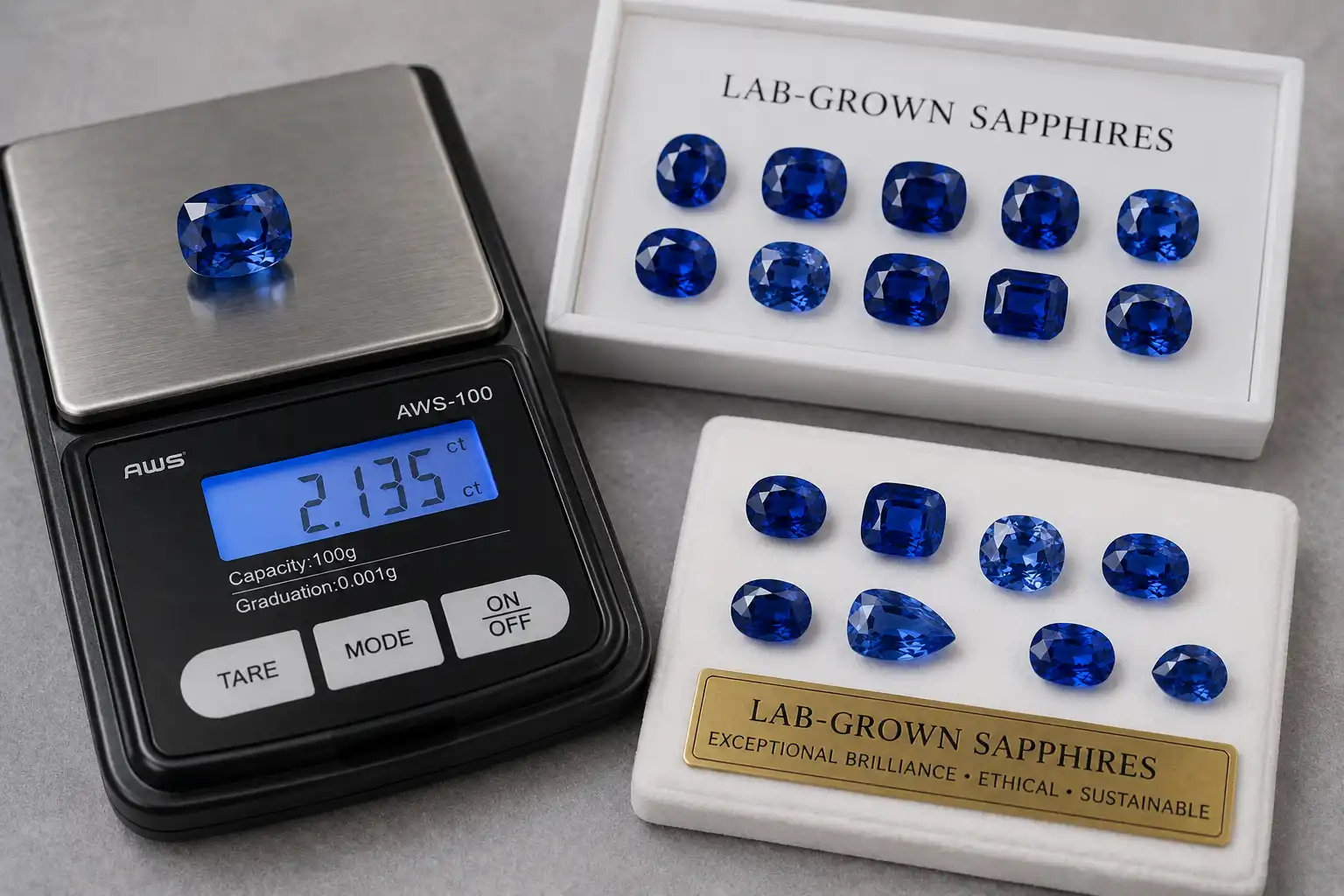
Lab Sapphire Price: Market Benchmarks, Quality, Size & Origin
Lab sapphire price spans an unusually broad market because synthetic corundum can be manufactured by highly scalable flame fusion, slower flux growth, hydrothermal methods, pulled processes, and other specialized technologies. GIA describes flame-fusion material as historically dominant in the synthetic ruby and sapphire trade while also confirming that flux-grown, hydrothermal, and pulled sapphires are commercially available and can be highly convincing counterparts of natural corundum. The manufacturing method therefore matters more to lab sapphire price than it might appear from a simple product listing because growth time, equipment cost, yield, production scale, characteristic inclusions, brand provenance, and collector interest can differ substantially.
Visual quality still matters just as strongly. GIA identifies color as sapphire’s leading quality factor, with stronger and more vivid saturation generally commanding greater demand, while cut, clarity, size, and phenomenon also affect desirability. A large clean synthetic sapphire can nevertheless remain inexpensive when made by a scalable process because manufactured supply removes the geological rarity that causes high-quality natural sapphire prices to rise sharply with size. Buyers should therefore benchmark laboratory-grown sapphire against stones of the same synthetic growth category rather than using natural Kashmir or Burmese sapphire prices to calculate supposed savings or intrinsic worth.
Lab Sapphire Price At a Glance
| Value Driver | What Usually Raises Lab Sapphire Price | What Can Lower Lab Sapphire Price |
|---|---|---|
| Identity | Confirmed synthetic sapphire/corundum | Unverified or imitation material |
| Growth Method | Specialty flux, hydrothermal, pulled, historical production | Common mass-market flame fusion |
| Color | Vivid, attractive, well-balanced hue and tone | Pale, grayish, overly dark, muddy, or uneven color |
| Transparency | Bright and transparent | Haze or dense inclusions |
| Clarity | Clean face-up appearance | Visible bubbles, fractures, clouds, unattractive growth features |
| Cut | Strong light return, symmetry, polish, efficient proportions | Windowing, extinction, poor polish, excess depth |
| Size | Larger high-quality stone in a scarce synthetic category | Large common flame-fusion weight alone |
| Star Phenomenon | Sharp, centered, mobile star | Weak, diffuse, broken, or off-center rays |
| Manufacturer | Recognized producer or documented historical origin | Generic anonymous production |
| Post-Growth Treatment | Clear disclosure | Undisclosed dyeing, induced fractures, filling, coating, diffusion |
| Documentation | Reputable laboratory identification | Seller-only paperwork |
| Condition | Crisp facets and sound structure | Scratches, chips, fractures, damaged filler |
| Jewelry Setting | High-quality metalwork and craftsmanship | Weak construction or excessive setting markup |
| Resale Context | Specialist demand for certain synthetics | Assumption that retail equals natural-sapphire resale value |
Flame-Fusion Supply Keeps Many Lab Sapphires Affordable
Verneuil flame fusion can produce synthetic corundum efficiently, which has kept large portions of the synthetic sapphire market accessible for generations. GIA states that most synthetic ruby and sapphire found in the marketplace has historically been grown through flame fusion and identifies curved growth banding as one of its characteristic features.
This production scale is one reason a large blue or pink synthetic sapphire can cost far less than a natural stone with superficially comparable appearance. The difference is not that the flame-fusion stone lacks corundum identity; the difference is that manufacturing can reproduce the material in quantity.
A thirty-carat flame-fusion sapphire can therefore remain a mass-market manufactured gem rather than becoming rare simply because the carat number is large.
Flux-Grown Sapphire Can Carry a Stronger Premium
Flux growth can be slower, less productive, and more technically demanding, and GIA documents specialty synthetic sapphires with distinctive flux residues, fingerprints, and internal cavities.
A recognized flux-grown sapphire can therefore cost considerably more than ordinary flame-fusion material even when it weighs less. The premium can reflect lower output, manufacturer reputation, technical complexity, historical importance, or collector interest.
The correct benchmark is another comparable flux-grown stone, not a cheap Verneuil boule and not a natural sapphire from a prestigious mine.
Hydrothermal Production Creates Another Price Segment
Hydrothermal growth requires high-pressure autoclaves, seed plates, supercritical fluids, mineralizers, controlled temperature gradients, and long growth cycles. GIA confirms that hydrothermal methods can produce gem-quality synthetic sapphire and has studied commercial hydrothermal sapphire with diagnostic microscopic and spectroscopic properties.
That production complexity can support higher prices than ordinary flame fusion, but no permanent price hierarchy applies. Manufacturing efficiency improves, producers vary, and individual color or cutting quality can matter more than the process name.
The premium should reflect the actual stone and producer rather than the technical-sounding label alone.
Pulled Sapphire Can Have Both Gem and Technical Value
Pulled synthetic sapphire has extensive industrial applications because large, high-quality sapphire crystals are useful far beyond jewelry. The same broad production family can supply faceting material in controlled colors.
In jewelry markets, pulled sapphire may be less familiar than flame fusion, but manufacturer and product quality can create distinct niches.
A buyer should ask what process is actually documented because some sellers use laboratory-created as a generic description without specifying whether the sapphire is flame-fusion, flux, hydrothermal, or pulled material.
Color Drives Demand Across Synthetic Categories
GIA’s sapphire quality framework identifies strong to vivid color saturation as desirable regardless of hue and considers medium to medium-dark velvety blue to violetish blue among the most prized appearances for blue sapphire. Those visual preferences also shape lab sapphire price.
A vivid blue synthetic usually commands stronger demand than a grayish, greenish, weakly saturated, or overly dark stone from the same growth process. Pink, yellow, orange, purple, colorless, and other colors each follow their own demand patterns.
Synthetic manufacturing can make vivid color less rare, but consumer preference still creates a market premium for attractive appearance.
Natural-Sapphire Color Terms Should Not Be Treated as Provenance
Retailers may describe synthetic sapphire using phrases such as Kashmir blue, Ceylon blue, Burmese blue, royal blue, cornflower blue, padparadscha color, or Montana-style teal.
These expressions can describe appearance, but a laboratory-grown sapphire does not acquire geological origin because of color similarity.
GIA emphasizes that even within one natural deposit, sapphire color and quality vary widely, making source-based trade terms imperfect quality indicators even for mined gemstones.
Clarity Has a Lower Scarcity Premium in Synthetic Sapphire
Very clean natural sapphire can be rare, whereas laboratory growth can produce highly transparent corundum much more consistently. GIA notes that natural blue sapphire typically contains some inclusions and that extremely high clarity in natural material is rare and valuable.
A nearly flawless synthetic sapphire may therefore be technically impressive without commanding a natural-sapphire rarity premium.
Clarity should still affect lab sapphire price when bubbles, fractures, dense growth features, clouds, or poor transparency are visible during normal wear.
Diagnostic Inclusions Can Add Collector Interest
Synthetic sapphire inclusions are not always economically negative. Curved growth banding can identify flame-fusion material, flux residues can reveal specialty growth, and hydrothermal structures can reflect particular manufacturing technologies.
Collectors interested in the history and science of synthetic gem growth may value a well-documented stone precisely because its internal features reveal the production method.
This collector framework differs from mainstream jewelry, where visual cleanliness generally remains more important.
Star Synthetic Sapphire Has a Separate Price Curve
Synthetic star sapphire can be produced deliberately through oriented inclusions that create asterism. GIA documents synthetic star ruby and sapphire as established manufactured products.
The price of a star synthetic depends on bodycolor, star sharpness, number and continuity of rays, centering, contrast, movement, cabochon symmetry, polish, size, growth method, and manufacturer.
A huge but diffuse synthetic star sapphire can be less desirable than a smaller stone with a crisp centered star.
Size Does Not Behave Like Natural Sapphire Size
GIA explains that size makes a greater difference to the price of fine natural sapphire because large fine-quality material is rare. Synthetic sapphire production substantially removes that geological limitation.
Manufacturers can create large crystals or boules directly, allowing large carat weights to reach the market without waiting for nature to produce exceptional rough.
Size can still raise total lab sapphire price through greater material use, longer growth, lower yield, or specialist production, but it should not automatically multiply per-carat value in the way fine natural sapphire can.
Large Specialty Synthetics Can Still Be Valuable
Manufactured does not mean unlimited. A very large flux-grown, hydrothermal, pulled, experimental, or historically documented synthetic sapphire can be unusual within its own production method.
GIA’s examination of unusually large flux-grown synthetic sapphire demonstrates that notable synthetic crystals can still attract gemological interest because production method, size, and internal features combine unusually.
The correct price question is how rare the stone is within its synthetic category, not whether an equally sized natural sapphire would be rare.
Carat Weight and Face-Up Size Can Diverge
Synthetic rough can be inexpensive enough that mass-market cutters prioritize yield, standardized sizes, or speed rather than perfect proportions.
A deep pavilion can retain significant weight but leave the gemstone looking smaller face-up. Extremely shallow cuts can create windows that weaken color and brilliance.
Compare dimensions, depth, and visual presence alongside carat weight before concluding that the heavier synthetic is the better value.
Cutting Can Represent More Value Than the Rough
Flame-fusion synthetic sapphire rough can be inexpensive, while precision faceting by a skilled lapidary can require many hours of design, cutting, and polishing.
A custom artist-cut synthetic sapphire can therefore cost many times more than a commercial stone of equal weight because craftsmanship becomes the dominant value component.
GIA’s broader colored-stone research emphasizes that cutting quality includes proportions, symmetry, polish, and how facets interact with light rather than merely the outline shape.
Post-Growth Treatment Can Change the Appropriate Price Tier
GIA recently documented laboratory-grown colorless sapphire that had been intentionally quench-crackled and dyed to produce a bluish-green appearance, with dye concentrated along induced fractures.
Such a product is still synthetic corundum, but its final color comes from an additional treatment rather than the original growth chemistry.
A dyed or filled synthetic should therefore be compared with similar treated products rather than a high-quality as-grown synthetic whose color is intrinsic to the crystal.
Diffusion and Other Treatments Require Specific Disclosure
GIA’s treatment guidance notes that sapphire can undergo lattice diffusion using added elements to create color and that feldspars such as labradorite can also receive diffusion treatment. Treatment technology can therefore cross natural and synthetic gem categories.
Consumers should not assume every laboratory-grown sapphire has been diffused or treated, but they should expect meaningful modification to be disclosed when present.
A recognized laboratory report provides stronger evidence than seller language alone when treatment significantly influences price.
Corundum Durability Gives Synthetic Sapphire Practical Value
Sapphire ranks 9 on the Mohs scale, has excellent toughness, and lacks cleavage. GIA describes it as highly suitable for daily-wear rings and other jewelry.
This physical durability has real economic value even when the synthetic rough itself is inexpensive. A well-cut lab sapphire can offer decades of practical wear in applications where softer simulants would scratch more readily.
The value proposition is therefore not merely low price; it is access to genuine corundum durability and optical behavior without natural-sapphire scarcity premiums.
Laboratory Reports Add Confidence, Not Automatic Monetary Value
GIA Colored Stone Identification Reports determine whether sapphire is natural or laboratory-grown and list detectable treatments. GIA also states that it does not assign an overall quality grade to sapphire.
A report can increase marketability by reducing uncertainty, particularly for specialty flux, hydrothermal, vintage, or high-priced synthetic sapphire.
The report itself does not make a common flame-fusion sapphire rare, and its fee can represent a significant percentage of the total value for inexpensive stones.
Manufacturer Provenance Can Create a Collector Premium
A known synthetic-gem producer can add value through documented process, historical importance, limited production, traceability, or association with a particular technology.
Vintage synthetic sapphire in original period jewelry can also attract buyers interested in design history rather than only loose gemstone value.
This manufacturer provenance is fundamentally different from mine origin. It belongs to technological and jewelry history rather than geology.
Lab Sapphire Price Versus Lab Ruby Price
Synthetic sapphire and synthetic ruby are both manufactured corundum and share several production technologies. The Gems Lore lab ruby price guide demonstrates how flame fusion can create a low-cost mass-market category while flux, hydrothermal, star, and historical synthetics occupy higher specialty tiers.
The same pattern broadly applies to sapphire, although blue and fancy-color demand create their own market preferences.
Lab Sapphire Price Versus Lab Emerald Price
The Gems Lore lab emerald price guide covers a synthetic beryl market dominated by slower flux and hydrothermal production rather than the extremely broad flame-fusion corundum supply.
This difference helps explain why one laboratory-grown gemstone cannot be priced simply by comparing carat weights with another.
Manufacturing method, material, growth speed, yield, market demand, and craftsmanship all interact.
Lab Sapphire Price Versus Lab Diamond Price
Gems Lore’s lab diamond price guide covers CVD and HPHT diamond manufacturing, a market with its own rapidly changing production economics and standardized diamond-quality documentation.
Synthetic sapphire has existed commercially for far longer and can be produced cheaply enough for both gem and industrial applications.
Both markets demonstrate why laboratory-grown gemstones must be valued within their own production category rather than by natural-stone rarity.
Retail Jewelry Price Can Be Mostly Setting Value
A large flame-fusion sapphire may represent only a small portion of a finished ring’s retail price when the setting uses platinum, substantial gold, natural diamonds, intricate handwork, or a luxury brand.
Before calculating lab sapphire price per carat from a finished jewel, separate the center stone, side gems, precious metal, craftsmanship, brand, warranty, and retailer service.
A high ring price does not necessarily indicate an expensive synthetic sapphire.
Retail and Resale Value Can Differ Sharply
Common synthetic sapphire can be manufactured readily, so a secondhand buyer has little reason to pay near-retail prices for ordinary loose material when new stones are widely available.
Specialty flux, hydrothermal, vintage, artist-cut, or historically documented synthetics may retain stronger niche collector interest.
A buyer should therefore avoid treating the original retail receipt as guaranteed future cash value.
What Usually Raises Lab Sapphire Price?
Lab sapphire price generally rises with attractive vivid color, excellent transparency, skillful cutting, efficient dimensions, specialty growth method, recognized manufacturer provenance, unusual size within a genuinely scarce synthetic category, sharp star phenomenon, historical importance, independent documentation, strong condition, and high-quality jewelry craftsmanship.
What Usually Lowers Lab Sapphire Price?
Generic flame-fusion supply, pale or excessively dark color, cloudiness, poor cutting, large windows, excessive depth, obvious bubbles, weak star effects, undisclosed treatment, uncertain manufacturer, weak documentation, chips, scratches, and seller-defined grades can reduce value.
A low lab sapphire price can still represent excellent value when the stone is accurately described and attractive for its intended use.
How to Compare Lab Sapphire Prices Fairly
Compare synthetic sapphires by growth method, confirmed identity, manufacturer, hue, tone, saturation, transparency, clarity, cut, weight, dimensions, star phenomenon, treatment, documentation, condition, loose-versus-mounted status, and seller service. Avoid placing an inexpensive flame-fusion blue stone beside a specialty hydrothermal sapphire, historic flux-grown gem, or natural Kashmir sapphire and treating their per-carat numbers as directly comparable.
Conclusion
Lab sapphire price depends heavily on which synthetic sapphire market the buyer is actually entering. Flame fusion can produce abundant clean corundum at low manufacturing cost, while flux-grown, hydrothermal, pulled, historic, phenomenal, and artist-cut material can occupy progressively more specialized categories. GIA confirms that multiple growth technologies can create convincing synthetic sapphire and that proper identification may require expert gemological analysis.
Color remains the primary visual factor, with strong saturation and balanced tone driving demand, while clarity, cutting, dimensions, size, star effects, treatment, and manufacturer provenance refine the value. Size should never receive the geological premium associated with fine natural sapphire unless the particular synthetic production method itself makes that size genuinely unusual.
A meaningful lab sapphire price is therefore the price supported by the stone’s actual synthetic category, appearance, craftsmanship, documentation, and current market—not by a prestigious natural-origin name or an undefined AAA grade.
Frequently Asked Questions
How much is a lab sapphire worth per carat?
There is no universal lab sapphire price per carat. Flame-fusion, flux-grown, hydrothermal, pulled, star, vintage, and precision-cut synthetic sapphires can occupy very different price categories.
Why are some synthetic sapphires so inexpensive?
Flame fusion can produce synthetic corundum efficiently and in substantial quantities, making large clean stones readily available. GIA notes that most synthetic ruby and sapphire encountered in the market has historically been flame-fusion material.
Why can flux-grown sapphire cost more?
Flux-grown sapphire can require slower production and may carry manufacturer, technological, or collector provenance. GIA has documented flux-grown sapphire containing characteristic flux veils and cavities.
Does hydrothermal sapphire cost more than flame fusion?
It often occupies a more specialized production tier, but no fixed premium applies. Color, size, cutting, producer, availability, and documentation still determine price.
Does large lab sapphire become rare?
Not in the same geological way as large natural sapphire. Manufacturers can grow large synthetic crystals or boules, although unusually large specialty flux or hydrothermal products can still be scarce within their own manufacturing category.
What is the most valuable lab sapphire color?
There is no one synthetic color ranking, but vivid blue generally has broad demand, while fine pink, padparadscha-like, color-change, and unusual fancy colors can attract specialty buyers. GIA broadly favors strong to vivid sapphire saturation.
Can synthetic sapphire be star sapphire?
Yes. Manufacturers can produce synthetic sapphire with asterism. A strong centered star can justify a higher price than a weakly phenomenal stone.
Can lab sapphire be dyed?
Yes. GIA has documented laboratory-grown sapphire that was quench-crackled and dyed, demonstrating that later treatment can alter synthetic material significantly.
Can GIA identify synthetic sapphire?
Yes. GIA’s Colored Stone Identification Report determines whether the material is natural or synthetic and lists detectable treatments.
Does GIA grade synthetic sapphire AAA?
No. GIA states that it does not issue an overall quality grade for sapphire. AAA and similar labels are private seller terminology.
Is Kashmir-color lab sapphire actually from Kashmir?
No. A synthetic sapphire has manufacturing provenance, not natural mine origin. Kashmir can only be a visual color comparison when used for laboratory-grown material.
Does lab sapphire hold its retail value?
Common synthetic sapphire often has limited resale liquidity because comparable new material is easy to produce. Specialty historic, flux-grown, hydrothermal, branded, or artist-cut synthetics can behave differently.
Is lab sapphire a guaranteed investment?
No. Growth technology, supply, manufacturer reputation, fashion, condition, craftsmanship, and collector demand can all change. Laboratory-grown sapphire is generally best evaluated as jewelry or a specialist synthetic-gem collectible.