7 Real Larvikite Benefits: Deep Traditions, Evidence, Safe Use & Clear Limits
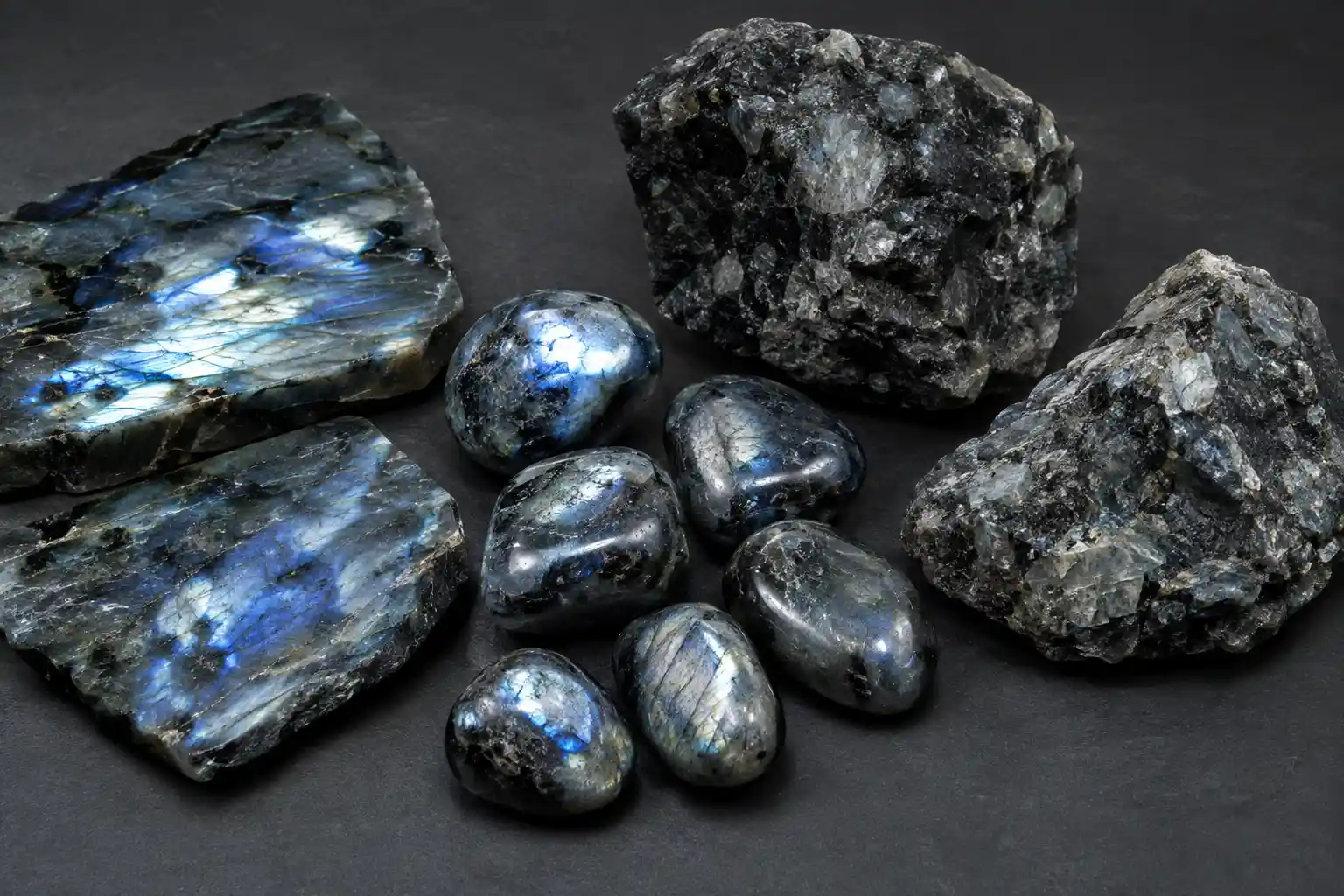
Larvikite benefits begin with features that can be seen and studied directly. Larvikite is not a single mineral or a transparent crystal species. It is a coarse-grained intrusive igneous rock dominated by feldspar and best known from the Larvik region of southeastern Norway. Many polished examples reveal striking silver, steel-blue, or bluish flashes that appear as the viewing angle changes, giving otherwise dark gray stone an unusually lively surface.
That optical appearance has helped larvikite become valuable in architecture, interior design, monuments, decorative objects, polished stones, jewelry, and geological collections. Large slabs can show the feldspar effect across substantial surfaces, while small cabochons, beads, and tumbled pieces can concentrate the same flashes into personal objects. Its geological identity also gives larvikite benefits that have nothing to do with modern metaphysical claims, including educational value for understanding igneous rocks, feldspar textures, slow underground crystallization, and the relationship between mineral structure and visible light.
Modern crystal traditions sometimes describe larvikite as grounding, protective, calming, clarifying, or useful during periods of change. Those ideas may function as personal symbolism, but they should not be presented as established medical effects or ancient universal traditions. Larvikite has a real Norwegian geological and architectural heritage, while most wellness and energetic interpretations surrounding it are contemporary.
7 Larvikite Benefits at a Glance
- Silver-blue feldspar flashes create a distinctive visual effect in polished stone.
- Architectural durability supports use in facades, flooring, countertops, monuments, and decorative building work.
- Lapidary versatility allows larvikite to be shaped into cabochons, beads, carvings, spheres, and polished objects.
- Geological interest makes the rock useful for studying intrusive igneous formation and feldspar-rich textures.
- Collector appeal comes from differences in flash intensity, crystal size, pattern, polish, and specimen character.
- Personal symbolism can connect larvikite with steadiness, adaptability, reflection, or a sense of place.
- Modern meditation and spiritual use can provide a symbolic focus when kept separate from unsupported health claims.
Silver-Blue Feldspar Flashes Are the Most Visible Larvikite Benefit
The shifting surface effect is one of the most recognizable larvikite benefits. At first glance, a piece may appear predominantly charcoal gray, blackish, or dark bluish gray. When polished and tilted toward a suitable light source, individual feldspar crystals can suddenly show silvery, blue, or steel-colored reflections. These flashes may be broad and bright in one piece and smaller or more subdued in another.
The phenomenon is related to the internal structure of the feldspar crystals rather than to a coating applied to the rock. Very fine intergrowths within the feldspar interact with light and produce the characteristic schiller-like appearance. Because crystal orientation varies across the rock, different areas may flash at different viewing angles. This creates movement across a polished slab that would be difficult to achieve with a uniformly colored stone.
Cutting orientation therefore matters. A lapidary or stone fabricator can expose more attractive feldspar reflections by selecting favorable surfaces, although no cutting method can create strong flash where the internal structure does not support it. Two pieces of similar size and color may consequently look quite different after polishing.
This optical behavior is also one reason larvikite is sometimes confused with other feldspar-rich stones. Its flashes can remind people of labradorite or moonstone effects, yet larvikite is a rock composed of several minerals rather than simply another name for those gemstones. Correct identification preserves the geological character that makes the stone interesting.
Architectural and Decorative Use Is One of the Strongest Larvikite Benefits
Larvikite benefits become particularly clear at architectural scale. The rock has been quarried as dimension stone and used in building facades, floors, stairs, countertops, monuments, memorials, wall panels, and other decorative applications. A polished surface can reveal blue and silver reflections across large areas, creating an appearance that changes subtly as people move through a space.
Commercial stone suppliers may use names that emphasize its appearance rather than its geological classification. Some larvikite has been marketed in the building-stone trade using granite-related terminology, even though geologists do not classify every larvikite as granite. Commercial names can be convenient for design and sales, but they should not replace accurate geological identification.
Its usefulness in architecture comes from more than color. Larvikite forms as a crystalline igneous rock, so sound blocks can be cut and polished into substantial pieces. Performance still depends on the individual slab, finish, installation, thickness, fractures, weather exposure, and intended application. A countertop, exterior panel, and carved object place different demands on the stone.
The architectural history also gives larvikite a documented cultural role that is more defensible than claims of ancient crystal healing. Norwegian quarrying and international use have made the rock recognizable in buildings and monuments far from its geological source. This connection between place, geology, and design is among the most significant real-world larvikite benefits.
Jewelry and Lapidary Work Reveal Larvikite on a Smaller Scale
Large architectural slabs are only one way to appreciate the rock. Larvikite can also be cut into cabochons, tumbled stones, beads, pendants, earrings, spheres, carvings, desk objects, and other polished forms. These pieces allow the feldspar flash to be observed closely and make the rock accessible to collectors who do not need a large decorative slab.
Larvikite is best treated as a rock aggregate rather than assigned one simplistic Mohs hardness number. Its dominant feldspar minerals are around 6 on the Mohs scale, but overall wear behavior also depends on the other minerals present, grain boundaries, fractures, polish, and construction of the finished piece. This means a polished larvikite pendant may perform well in ordinary use, while an exposed ring can accumulate scratches or edge damage more readily than harder gemstones such as sapphire.
Cabochons and broad polished shapes often suit the stone because they provide enough surface area for several feldspar crystals to catch the light. Tiny pieces can sometimes lose much of the visual drama because the optical effect depends on both crystal size and orientation.
A buyer interested in larvikite meaning may choose a polished stone for symbolic reasons, but craftsmanship still matters. A meaningful object is more satisfying when the surface is well polished, the strongest flash has been positioned effectively, and the setting or carving is suited to the rock’s actual physical character.
Larvikite Benefits Include Valuable Geological Education
Larvikite benefits are particularly strong for students and collectors interested in geology. The rock formed from magma that cooled and crystallized beneath the Earth’s surface, allowing relatively large mineral grains to develop. Its coarse crystalline texture therefore records a very different cooling history from volcanic rocks that solidify rapidly at or near the surface.
Feldspar dominates the visual character, while other minerals can occur alongside it depending on the exact rock composition. Examining a hand specimen gives students an opportunity to distinguish a rock from an individual mineral and to observe how several crystalline components combine into a recognizable geological unit.
Its Norwegian occurrence is also connected with an unusual igneous geological province in the Oslo region. The stone therefore provides a tangible example of how regional magmatic events can produce distinctive rock types that later become economically important as dimension stone.
The feldspar reflections add another educational layer. A polished larvikite surface demonstrates that optical effects do not require transparency or conventional gemstone faceting. Light interacting with microscopic structures inside opaque or nearly opaque minerals can produce dramatic visual changes. That makes larvikite useful when discussing crystallography, feldspar exsolution, rock textures, and decorative-stone geology in a single specimen.
Collecting Larvikite Rewards Attention to Pattern and Provenance
Collectors may approach larvikite differently from architects or jewelry buyers. Some value rough geological specimens showing grain relationships and natural weathered surfaces, while others prefer highly polished pieces that maximize the silver-blue effect. Large individual feldspar grains, strong flash, attractive contrast, and clearly documented Norwegian origin can all add interest.
Pattern matters because larvikite is not visually uniform. One specimen may show dense, bright blue reflections, another predominantly silver flashes, and another relatively little optical effect. Crystal size also affects the appearance. Coarser pieces can produce larger reflective patches, while finer textures create a different visual rhythm.
Condition should be considered as well. Chips, fractures, poorly polished surfaces, fillers, or repairs may reduce appeal depending on the type of specimen. In architectural pieces, structural integrity and finish can matter more than small natural variations, while collectors may deliberately seek unusual textures or geological relationships that would be undesirable in commercial slabs.
Larvikite benefits in collecting therefore come from variation rather than perfect uniformity. The rock rewards comparison because different specimens reveal how mineral proportions, feldspar structure, cutting direction, and polishing interact to produce the finished appearance.
Personal Symbolism Can Give Larvikite Benefits Beyond Decoration
Many modern interpretations associate larvikite with steadiness, reflection, protection, adaptability, and remaining grounded during change. These themes are not established physical properties of the rock, but they can work as personal symbolism. Larvikite’s dark background and sudden silver-blue flashes make it easy to understand why people might connect the stone with discovering clarity within an uncertain situation.
Someone beginning a new career could use a polished piece as a reminder to stay practical while adapting. A traveler to Norway might value larvikite as a connection with a particular landscape and geological heritage. An architect or geologist could appreciate it because the stone relates directly to professional interests. In these cases, meaning comes from the person’s experience rather than from a universal metaphysical rule.
The changing reflections can also serve as a simple metaphor for perspective. A surface that looks dark from one angle may become bright when the light and viewing position change. That visual fact can inspire a symbolic idea about approaching problems differently without implying that the stone itself alters thought, emotion, or neurological function.
These personal uses are among the safest and most flexible larvikite benefits because they allow symbolism without making claims that require medical evidence.
Modern Spiritual Use Has Clear Evidence Limits
Contemporary crystal practices sometimes describe larvikite as useful for grounding, energetic protection, meditation, mental clarity, emotional steadiness, intuition, or spiritual development. Some people carry a polished stone, place one in a meditation space, or use it as a tactile object while journaling or setting intentions.
A routine like this can be personally meaningful because it creates a deliberate moment of attention. Holding a familiar object may help someone focus on a chosen intention in the same way that a photograph, religious object, written phrase, or keepsake can provide a point of concentration. The existence of that ritual does not demonstrate that larvikite emits an energy capable of changing the body.
Claims grouped under larvikite healing properties therefore need clear evidence boundaries. There is no established scientific basis for saying that larvikite treats anxiety disorders, depression, trauma, neurological illness, sleep disorders, pain, circulation problems, hormonal conditions, infection, or other medical concerns.
Descriptions of chakras or energetic protection should likewise remain within spiritual belief systems rather than being presented as anatomy. Larvikite can be used respectfully in modern spiritual practice without requiring unsupported physiological explanations.
Practical Care Helps Preserve Polished Larvikite
Care requirements vary according to whether larvikite is being used as a countertop, architectural panel, polished specimen, bead, or piece of jewelry. Small personal objects should generally be protected from strong impacts and abrasion, especially along edges or thin sections. The rock contains several crystalline components and grain boundaries rather than behaving exactly like a single flawless gem crystal.
Mild soap, water, and a soft cloth are generally suitable for ordinary polished stones when there are no adhesives, coatings, or sensitive components in the finished object. Abrasive powders can dull a polished surface over time, while harsh chemicals may be inappropriate for some jewelry settings or finishes.
Jewelry pieces should be stored so that harder gems do not repeatedly rub against the polish. A separate pouch or lined compartment is simple protection. Larvikite rings and bracelets also benefit from removal during construction work, exercise, gardening, cleaning, or other activities involving frequent impacts.
Architectural larvikite requires care appropriate to the finish and installation rather than gemstone-style handling. Stone fabricators and installers can advise on sealants, cleaners, and maintenance suitable for a particular surface. Recognizing these different uses makes discussion of larvikite benefits more practical than treating every piece as if it were used in the same way.
Conclusion
Larvikite benefits include distinctive silver-blue feldspar flashes, architectural versatility, lapidary potential, geological education, collecting interest, and strong connections with Norwegian stone heritage. These are observable qualities rooted in the rock’s formation, mineral structure, and long-standing use as a decorative dimension stone.
Modern symbolism can add personal themes of steadiness, adaptability, protection, or reflection, but those interpretations belong to personal and spiritual practice rather than medical science. Larvikite is most rewarding when its real geology and visual character remain at the center of the story.
FAQs
What are the main larvikite benefits?
The most defensible larvikite benefits include its distinctive silver-blue feldspar reflections, suitability for decorative architecture, usefulness in polished objects and jewelry, collector interest, and educational value in geology. Many people also use larvikite symbolically during meditation or periods of personal change, but those interpretations are separate from scientifically demonstrated effects.
Is larvikite a gemstone or a mineral?
Larvikite is an intrusive igneous rock rather than a single mineral species. It contains several minerals, with feldspar dominating its appearance and producing much of the characteristic reflective effect. Larvikite can nevertheless be cut and sold in gemstone-like forms such as cabochons, beads, tumbled stones, and carvings, which is why it often appears in gem and crystal markets.
Why does larvikite flash blue or silver?
The blue and silver reflections arise mainly from microscopic structural features within the feldspar crystals. Light interacts with very fine internal intergrowths and can produce a schiller-like reflection at favorable angles. Because different feldspar grains have different orientations, separate areas of a polished piece may brighten as the stone or observer moves.
Is larvikite the same as labradorite?
No. The two can look superficially related because both may display striking feldspar-based optical effects, but larvikite is a particular feldspar-rich igneous rock rather than simply another name for labradorite. Commercial naming can create confusion, so geological identification should be based on composition, texture, and origin rather than visual similarity alone.
Is larvikite suitable for jewelry?
Yes, larvikite can be used successfully in pendants, beads, earrings, cabochons, and other polished jewelry. The dominant feldspars are moderately hard, but the stone is a multi-mineral rock with grain boundaries that should still be protected from strong impacts and unnecessary abrasion. Pendants and earrings usually receive less wear than exposed rings and can therefore be particularly practical choices.
Does larvikite provide grounding or protection?
Grounding and protection are common themes in modern crystal traditions, and someone may use larvikite as a personal reminder to remain steady, practical, or emotionally composed. There is no established scientific evidence that the rock creates a protective energy field or physically changes mental-health conditions. These ideas are best understood as symbolism or spiritual belief.
Is larvikite an ancient healing stone?
There is no strong basis for describing larvikite as an ancient universal healing crystal with a well-documented continuous metaphysical tradition. The rock has a genuine Norwegian geological and architectural history, while many modern spiritual interpretations developed within contemporary crystal culture. Keeping those histories separate produces a more accurate account of larvikite benefits.
How should polished larvikite be cleaned?
For ordinary polished stones and uncomplicated jewelry, mild soap, water, and a soft cloth are generally sensible. Abrasive cleaning products and harsh treatment can reduce surface polish, while impacts can chip vulnerable edges. Architectural larvikite should be maintained according to the specific finish, installation, and recommendations supplied by a qualified stone professional.
Larvikite benefits associated with energy, grounding, protection, or emotional wellness reflect modern spiritual and personal interpretations, not established medical effects or substitutes for qualified health care.