10 Larvikite Healing Claims: Gentle Traditions, Verified Facts & Safe Use
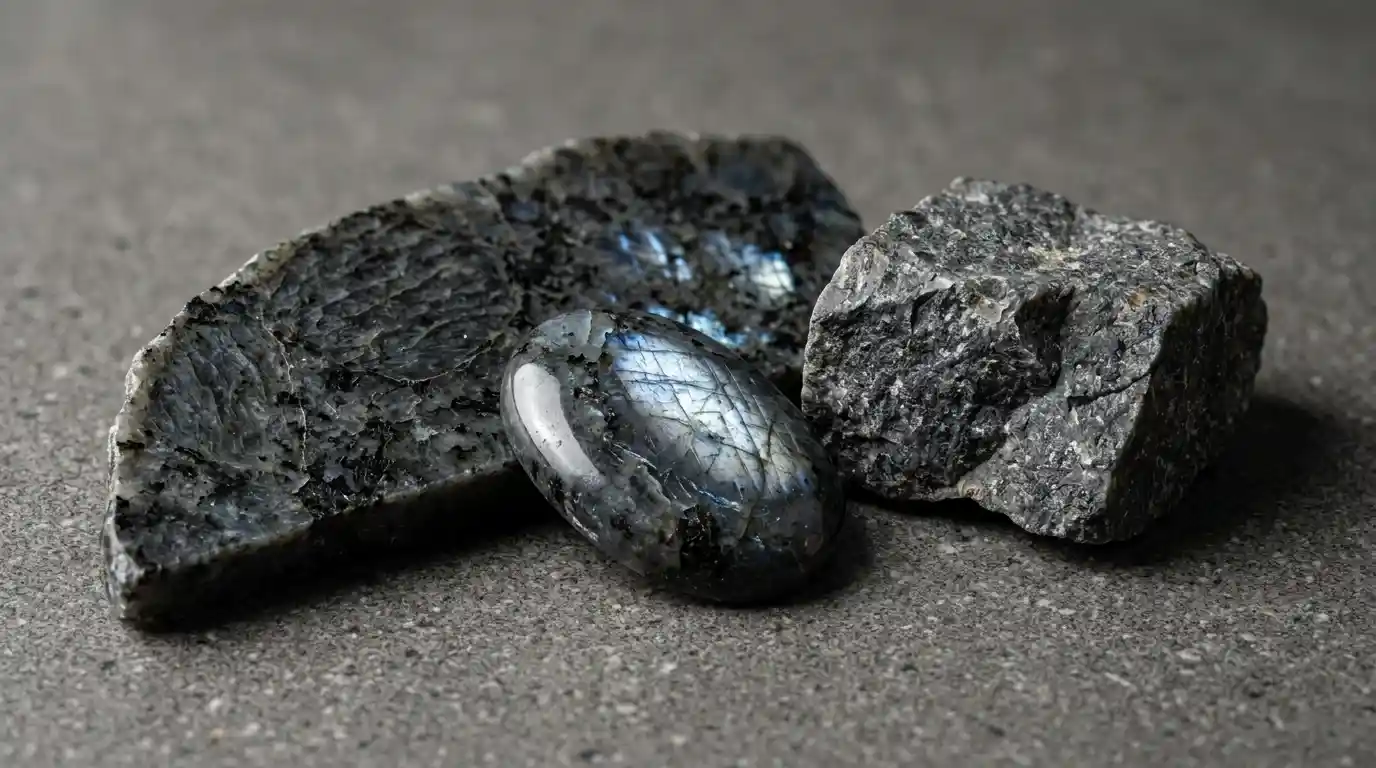
Larvikite healing properties are commonly associated with grounding, concentration, emotional steadiness, confidence, practical thinking, resilience, boundaries, adaptability, self-reflection, and spiritual awareness. Its dark gray to nearly black appearance can suddenly reveal blue or silver flashes as light crosses large feldspar crystals, which makes themes of hidden possibilities and changing perspective visually appealing. Those optical effects do not establish a healing mechanism. Larvikite has not been demonstrated to treat anxiety, depression, neurological disease, fatigue, pain, inflammation, sleep disorders, blood-pressure problems, or another medical condition, nor is there evidence that its feldspar crystals remove negative energy from the body. Scientifically, Larvikite is not a single mineral with one chemical formula. It is a coarse-grained intrusive igneous rock from the Larvik region of southeastern Norway, generally classified within the monzonite to syenite range and dominated by feldspar with smaller quantities of pyroxene, amphibole, mica, iron-titanium oxides, and other minerals.
10 Larvikite Claims Inspired by Dark Stone, Blue Schiller, and Norwegian Bedrock
- Grounding and present-moment awareness
- Concentration and practical focus
- Emotional steadiness during stressful periods
- Confidence in uncertain situations
- Clearer practical thinking
- Resilience after setbacks
- Stronger personal boundaries
- Adaptability when plans change
- Self-reflection and perspective
- Spiritual awareness and inner direction
These ten themes can support different personal routines without becoming ten verified biological effects. Many Larvikite benefits become more useful when translated into actions such as slowing down before reacting, reducing distractions, reviewing a decision, enforcing a boundary, or reflecting on what remains under personal control.
What Larvikite Really Is: Feldspar-Rich Monzonite, Blue Schiller, and Mixed Mineral Composition
Larvikite is a rock rather than a recognized single mineral species. It is a coarse-grained plutonic igneous rock, commonly described as an augite-bearing monzonite or syenitic rock depending on the exact composition. Its texture developed when magma cooled slowly underground, allowing comparatively large mineral grains to crystallize.
Feldspar dominates Larvikite’s appearance. Large ternary feldspar crystals contain extremely fine intergrowths of alkali feldspar and plagioclase. These cryptoperthitic internal layers interact with light and create the blue, silver, or bluish-white flashes known as schiller. The effect can resemble the labradorescence seen in labradorite, but Larvikite’s optical appearance arises within its own feldspar-rich rock texture.
Dark minerals may include augite and other pyroxenes, amphiboles, biotite or related micas, magnetite, ilmenite, and accessory minerals. Because the stone contains several minerals, assigning it one formula, one crystal system, or one exact hardness is inaccurate.
The dominant feldspars are around Mohs 6, so a polished Larvikite surface has moderate scratch resistance. Different grains may behave somewhat differently, and boundaries between crystals can create local weaknesses. The rock is commonly durable enough for countertops, architectural stone, tiles, carvings, cabochons, beads, and decorative objects.
The blue flash should not be interpreted as light generated by the rock. It appears when external light interacts with the microscopic feldspar structures at suitable angles. A specimen can look almost uniformly dark from one direction and strongly iridescent from another.
Larvikite’s Larvik Origin, Oslo Rift Geology, and Long Architectural Use
Larvikite is named after Larvik in Vestfold, southeastern Norway, where extensive bodies of the rock occur and have been quarried commercially. The Larvik plutonic complex belongs to the Oslo Rift geological province, an area shaped by significant igneous activity during the Permian.
Dating from important Larvikite intrusions places portions of the complex at roughly 294 million years old. This geological age describes when the magma crystallized, not the age of any human healing tradition associated with the stone.
The rock has long been important as an architectural and decorative stone because polished slabs reveal strong blue or silver schiller across large feldspar crystals. Norwegian Larvikite has been exported internationally for building facades, monuments, flooring, countertops, and ornamental work, sometimes under commercial names such as Blue Pearl.
Its genuine cultural identity therefore centers on Norwegian geology, quarrying, architecture, and decorative stone use. Contemporary grounding, protection, and meditation claims arose much later and should not be presented as ancient Scandinavian mineral medicine.
The Larvikite meaning found in crystal practice can still be personally meaningful, but its symbolism should remain separate from the geological origin of the rock.
Grounding, Concentration, and Emotional Steadiness Claims
1. Grounding Through Sensory Attention
Larvikite is frequently described as grounding because of its dense appearance, cool polished surface, and dark color. The rock does not electrically connect the body to the Earth or regulate the nervous system through an energy field. It can still be used as a tactile cue. Notice its weight, temperature, blue flashes, polished texture, breathing rhythm, and immediate surroundings. The sensory exercise provides the grounding practice.
2. Concentration Through a Stable Work Cue
Some practitioners use Larvikite for concentration and focus. Feldspar has not been shown to improve memory or attention span through physical contact. A practical approach is to keep the stone beside one active task, silence unnecessary alerts, and work for a defined interval. The consistent cue and reduced distractions create the useful structure.
3. Emotional Steadiness During Stress
Larvikite is also described as emotionally stabilizing. It does not regulate neurotransmitters or stress hormones. A more realistic ritual is to use the stone as the signal to stop reacting immediately, slow the breathing, identify the facts of the situation, and decide whether action is actually required now.
Confidence, Practical Thinking, and Resilience Claims
4. Confidence in Uncertain Situations
The dark rock and flashes hidden beneath its surface often inspire symbolism involving inner strength. Larvikite cannot biologically increase confidence. Before an unfamiliar task or conversation, use it as a reminder to identify what has already been prepared, what remains uncertain, and what first action can still be taken.
5. Clearer Practical Thinking
Grounding symbolism often extends into claims that Larvikite helps people think more practically. It has not been demonstrated to alter cognition. A useful reflection is to ask what is known, what is assumed, what can be controlled, and what information is still missing. The questions create clarity.
6. Resilience After Setbacks
Larvikite’s durable rock structure makes resilience an understandable metaphor. The stone cannot make someone psychologically tougher. After disappointment, use it to identify what failed, what survived the setback, what should change, and what next attempt remains possible. Resilience becomes adaptation rather than an energy transferred from rock to person.
Boundaries, Adaptability, and Perspective Claims
7. Stronger Personal Boundaries
Larvikite is often marketed as protective or as shielding a person from unwanted energy. No evidence shows that it creates an invisible protective field. A practical interpretation connects protection with behavior: decide what requests you will decline, what treatment you will not accept, and what action you will take when a boundary is repeatedly ignored.
8. Adaptability When Plans Change
The way Larvikite changes visually as its feldspar catches light makes flexibility a fitting symbolic theme. The rock does not alter psychological adaptability. When circumstances change, use it as a cue to distinguish the original goal from the original plan. Keeping the goal while changing the route can be more productive than rigidly defending a failed method.
9. Self-Reflection and Perspective
Larvikite’s flash can disappear completely when the viewing angle changes. That visual shift can become a useful metaphor for perspective. During journaling, write one interpretation of a difficult situation and then deliberately construct another explanation consistent with the same known facts. The exercise may reveal assumptions without suggesting that the rock supplies hidden knowledge.
10. Spiritual Awareness and Inner Direction
Modern crystal users sometimes meditate with Larvikite around themes of intuition, spiritual protection, or inner direction. Such practices can be personally meaningful, but there is no evidence that the rock opens supernatural perception or transmits information through its feldspar structure. A reflective practice can instead focus on values, responsibilities, and whether current behavior matches them.
Larvikite Chakra Associations and Modern Root-Centered Symbolism
Larvikite is most commonly connected with the root chakra in modern crystal systems because of its dark color and grounding reputation. Its blue or silver flashes also lead some practitioners to associate it with the third-eye chakra and themes involving perspective, intuition, or reflection.
Chakras are a spiritual framework rather than anatomical structures. Larvikite has not been demonstrated to affect the spine, adrenal glands, brain, pineal gland, nervous system, or another physiological system through chakra placement.
The combination of dark groundmass and blue schiller can still provide useful symbolism around stability and perspective while remaining clearly separate from medical claims.
Larvikite Physical Care: Feldspar Hardness, Grain Boundaries, Water, Chemicals, and Heat
Larvikite is generally durable enough for architectural use and polished decorative objects, but smaller jewelry pieces still require sensible handling. The dominant feldspar is around Mohs 6, so quartz, topaz, sapphire, ruby, and diamond can scratch a polished surface.
Because Larvikite is a rock composed of interlocking grains, impacts can exploit grain boundaries or natural fractures. Thin cabochons and carved edges are more vulnerable than thick slabs or rounded pieces.
Brief contact with plain water is generally safe for sound untreated Larvikite. Warm water, mild soap, and a soft cloth are appropriate for routine cleaning. Long soaking is unnecessary, especially when a piece contains fills, glue, coatings, attached metal components, or fractures.
Strong acids and harsh alkaline cleaners should be avoided because different minerals within the rock can react differently. Hydrofluoric acid is especially dangerous and attacks silicate minerals. Abrasive powders can also dull polished feldspar surfaces and reduce the visibility of the blue schiller.
Steam and ultrasonic cleaning are unnecessary defaults for jewelry or small polished stones. Thermal differences between grains, internal fractures, treatments, or glued settings can make aggressive methods less predictable than ordinary hand cleaning.
Cutting or polishing Larvikite creates mixed mineral dust that can contain silica-bearing particles. Wet cutting, extraction, eye protection, and suitable respiratory controls are important during lapidary work.
Ritual Cleansing Larvikite Without Abrasive or Chemical Methods
Ritual cleansing can remain entirely symbolic. There is no scientifically demonstrated negative energy that must be extracted from Larvikite with salt, smoke, chemicals, or prolonged water exposure.
Sound, quiet reflection, intention-setting, or placing the polished stone on a clean dry surface are low-risk methods. Someone using Larvikite for grounding might combine the ritual with noticing the physical surroundings and defining one practical action to complete next.
Avoid abrasive salt contact, aggressive chemical sprays, flame, extreme heat, prolonged saltwater immersion, and unnecessary wet burial. Gentle treatment protects the polished feldspar surface and its optical flash.
Conclusion
Larvikite does not need mystical geology to be unusual. It is a Norwegian plutonic rock dominated by feldspar whose microscopic intergrowths can produce striking blue and silver schiller. Its ten healing themes can still support grounding, concentration, practical thinking, boundaries, adaptability, and reflection when the useful effect comes from deliberate behavior rather than an unproven therapeutic property.
Frequently Asked Questions About Larvikite Healing Properties
What are the main Larvikite healing properties people claim?
Common claims include grounding, concentration, emotional steadiness, confidence, practical thinking, resilience, boundaries, adaptability, self-reflection, and spiritual awareness. These are contemporary wellness beliefs rather than scientifically proven effects.
Is Larvikite a mineral?
No. Larvikite is a coarse-grained igneous rock composed primarily of feldspar with pyroxene, amphibole, mica, iron-titanium oxides, and other minerals.
What causes the blue flash in Larvikite?
The blue or silver schiller comes from light interacting with extremely fine intergrowths inside the feldspar crystals. It is an optical effect rather than emitted energy.
Is Larvikite the same as labradorite?
No. Labradorite is a plagioclase feldspar, while Larvikite is a feldspar-rich igneous rock containing several minerals. Their optical flashes can look similar, which causes frequent confusion.
Where does Larvikite come from?
The rock is named after Larvik in southeastern Norway and is strongly associated with the Larvik plutonic complex of the Oslo Rift.
How hard is Larvikite?
Larvikite does not have one exact hardness because it contains several minerals. Its dominant feldspar is around Mohs 6, giving polished pieces moderate scratch resistance.
Which chakras are associated with Larvikite?
Modern crystal systems commonly associate Larvikite with the root chakra and sometimes the third-eye chakra. These are spiritual correspondences rather than anatomical effects.
Can Larvikite go in water?
Brief washing with clean water is generally safe for sound untreated Larvikite. Mild soap and gentle hand cleaning are preferable to prolonged soaking or harsh chemicals.
Is Larvikite suitable for jewelry?
Yes, particularly in cabochons, pendants, beads, and protected pieces. It should still be protected from hard impacts and harder gemstones that could scratch the polished surface.
What distinguishes genuine Larvikite from ordinary black stone?
Natural Larvikite commonly shows coarse feldspar crystals and directional blue, silver, or bluish-white schiller rather than a uniformly black surface. Geological provenance from Norway also supports accurate identification.
Crystal healing claims are traditional or personal beliefs and should not replace qualified medical or mental health care.