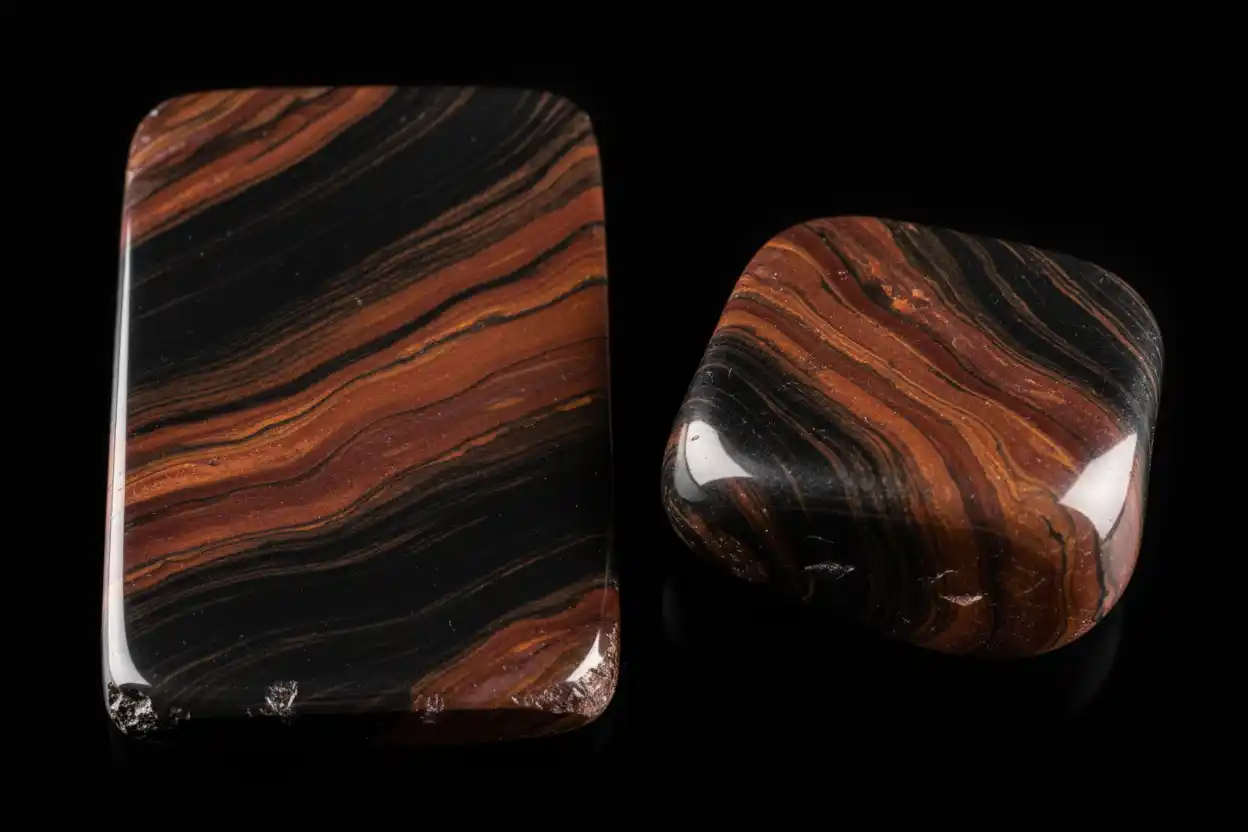
Mahogany Obsidian: Meaning, Properties & Symbolism
Mahogany obsidian is a naturally patterned form of silicic volcanic glass distinguished by reddish-brown, rust-colored, or mahogany-toned areas within a black groundmass. Its flowing patches can resemble wood grain, smoke, flames, or abstract landscapes, which makes every polished piece visually individual.
Despite its gemstone-market name, mahogany obsidian is not a crystalline mineral. It is an amorphous volcanic rock whose glassy structure, brittle fracture, and variable composition require different treatment from quartz, jasper, or onyx.
A Natural Glass with a Wood-Grain Pattern
Mahogany obsidian belongs to the broader family described in the obsidian meaning and properties guide. It forms when silica-rich lava cools quickly enough to prevent most atoms from arranging themselves into mineral crystals.
As a result, mahogany obsidian has no crystal system and no single fixed chemical formula. Its composition commonly resembles rhyolitic volcanic material rich in silica, aluminum, sodium, and potassium, with smaller amounts of iron, magnesium, and other elements.
“Mahogany” describes the red-brown and black pattern rather than a formal mineral species. Mineralogical databases classify it as a rock subtype within silicic volcanic glass.
Mahogany Obsidian at a Glance
| Property | Mahogany obsidian |
|---|---|
| Material type | Naturally occurring silicic volcanic glass |
| Classification | Obsidian rock subtype; mineraloid or glassy igneous rock |
| Composition | Variable silica-rich volcanic glass; no fixed mineral formula |
| Common colors | Black with reddish-brown, rust, chestnut, or mahogany patches and bands |
| Crystal system | None; amorphous |
| Habit or texture | Massive glass with flow banding, streaks, patches, and occasional microlites |
| Luster | Vitreous |
| Transparency | Usually opaque; translucent along thin edges or pale zones |
| Mohs hardness | Commonly about 5–5.5, with some variation |
| Cleavage | None |
| Fracture | Strongly conchoidal |
| Tenacity | Brittle |
| Common uses | Cabochons, beads, carvings, pendants, spheres, display pieces, flaked objects |
| Main care concern | Chipping, sharp fracture edges, scratching, and thermal shock |
How Mahogany Obsidian Forms
Obsidian develops from highly viscous, silica-rich lava that loses heat rapidly while containing relatively little dissolved water. High viscosity slows the movement of atoms, while rapid cooling leaves insufficient time for extensive crystal growth. The solidified result is volcanic glass.
Mahogany obsidian develops when iron-bearing and other chemically distinct areas remain unevenly distributed through the cooling glass. Flow within the lava stretches these zones into irregular patches, streaks, and bands.
Because the pattern records movement and chemical variation within molten rock, it rarely repeats. A cabochon cut a few centimeters away from another piece of the same rough may display a completely different balance of black and brown.
Over geological time, volcanic glass tends to devitrify, meaning that its disordered structure gradually reorganizes into crystalline minerals. Consequently, geologically young volcanic regions preserve most obsidian deposits.
The separate types of obsidian guide explains how mahogany, snowflake, sheen, rainbow, and other commercial varieties differ.
What Creates the Red-Brown Areas?
Iron is central to mahogany obsidian’s coloration. Different iron oxidation states and extremely fine iron-bearing phases can produce red, rust, brown, or nearly black tones within volcanic glass.
Some descriptions attribute the brown zones specifically to hematite inclusions. Hematite or related iron oxides may contribute in many examples, but mahogany obsidian is a natural glass with variable chemistry. Therefore, it is more accurate to describe the color broadly as resulting from iron-rich material and oxidation rather than assuming every piece contains an identical inclusion assemblage.
Magnesium and other minor components may also occur in the glass. However, they do not give mahogany obsidian a uniform mineral formula.
The pattern should normally extend into the material rather than sit only on its surface. When a freshly chipped area shows the same black-and-brown zoning, that continuity supports a natural internal pattern.
Documented Localities
Glass Buttes in Lake County, Oregon, is one of the best-documented localities for mahogany obsidian. Material from this volcanic area displays black and reddish-brown zones, conchoidal fracture, and occasional transitions into other obsidian patterns.
Other recorded United States occurrences include Obsidian Tank in Arizona, Mono County in California, and parts of the Jemez Mountains in New Mexico. Commercial pieces are also widely attributed to Mexico.
Nevertheless, source claims deserve scrutiny. “Mexican mahogany obsidian” appears frequently in retail descriptions, but many listings provide no mine, volcanic field, or collecting district. A country name without supporting provenance should not carry the same premium as a documented locality specimen.
For ordinary beads and cabochons, source documentation may be unavailable. Pattern quality and workmanship then become more useful buying criteria than an unsupported geographic label.
Recognizing Genuine Mahogany Obsidian
A freshly fractured surface has a curved, shell-like conchoidal form and can develop extremely sharp edges. Polished pieces show a glassy luster rather than the waxy finish typical of many microcrystalline quartz materials.
Under magnification, genuine obsidian lacks the regular granular texture expected in jasper or quartzite. Tiny crystals, microlites, bubbles, or flow features can occur, but the groundmass remains glass.
Thin edges may transmit brownish or smoky light. This feature is especially visible with a strong light behind a cabochon, although thick pieces can remain fully opaque.
Hardness testing offers limited value because destructive scratching damages a polished surface. Mahogany obsidian is softer than quartz and can accumulate scratches during wear, as the gemstone hardness chart helps illustrate.
General visual and physical testing methods appear in how to identify crystals. For expensive carvings or unusual transparent material, Raman spectroscopy, refractive-index testing, or microscopic examination can separate natural volcanic glass from manufactured glass.
Mahogany Obsidian and Similar Materials
Black obsidian with iron-rich brown zones remains closely related to black obsidian, but the latter generally lacks prominent reddish-brown patterning.
Apache tears are rounded or nodular obsidian bodies, usually black to smoky and often translucent in transmitted light. Their form and geological setting distinguish them from the broad patterned masses sold as mahogany obsidian.
Golden obsidian and silver sheen obsidian show reflective effects caused by oriented microscopic features. Mahogany obsidian relies primarily on contrasting body-color zones rather than a metallic sheen.
Rainbow obsidian produces colored interference bands, while snowflake obsidian contains pale spherulitic crystallization patterns. Individual rough pieces can occasionally combine more than one visual effect.
Onyx is microcrystalline quartz rather than volcanic glass. It is harder and commonly displays parallel or curved banding. The full distinction appears in onyx versus obsidian.
Mahogany jasper can also resemble brown-and-black obsidian. Jasper generally has a more granular or waxy appearance, a hardness near 6.5–7, and no glass-like conchoidal surface. Its edges do not usually become as sharp as freshly fractured obsidian.
Lapidary Behavior
Mahogany obsidian cuts and polishes readily, but its brittle fracture demands controlled technique. A lapidary worker must avoid sudden pressure, unsupported thin edges, and overheating.
Fine chips can break away during sawing, grinding, drilling, or setting. Rounded cabochons and substantial beads usually survive better than sharp corners, narrow points, or very thin carvings.
A high polish intensifies the contrast between black and brown zones. However, polishing marks remain visible on dark glass, so careful progression through increasingly fine abrasives is essential.
The material also supports flaking because conchoidal fracture can create predictable sharp edges. Archaeological obsidian tools demonstrate this property, although decorative lapidary work prioritizes polished surfaces rather than cutting edges.
Jewelry Durability
Mahogany obsidian works best in pendants, earrings, necklaces, brooches, beads, and protected cabochons. These formats reduce direct impact while allowing the pattern to remain visible.
Rings require more caution. An exposed domed cabochon can chip when struck against a countertop, door frame, or metal object. A substantial bezel offers more protection than prongs, although no setting can make obsidian impact resistant.
Bracelet beads may abrade or collide with harder materials. Placing softer spacers between large beads can reduce edge damage. The guide to gemstone toughness versus hardness explains why a reasonably scratch-resistant surface can still fracture suddenly.
Mahogany obsidian should not be treated as a high-durability stone merely because it has been used for cutting tools. Its ability to form a sharp edge results from brittleness, not exceptional toughness.
Treatments, Coatings, and Imitations
Most mahogany obsidian receives only cutting and polishing. Dyeing is unnecessary when the natural color zoning is attractive, and no standard heat treatment creates the ordinary mahogany pattern.
Surface oils or waxes may temporarily deepen color on low-polish material. Some decorative pieces may also receive clear coatings to increase gloss or hide small scratches. A coating can show abrasion, peeling, pooling near drill holes, or an artificial plastic-like surface.
Manufactured glass can imitate mahogany obsidian. Warning signs include mold seams, identical repeated patterns, unusually abundant round gas bubbles, perfectly uniform transparency, and colors that appear painted rather than internally distributed.
Resin products can also reproduce black-and-brown swirls. Low weight, warmth to the touch, surface scratches, and molded details may reveal plastic, but professional testing provides greater certainty.
The buyer’s guide to fake crystals explains why bubbles or low prices should be treated as clues rather than standalone proof.
Current Retail Asking Prices
Mahogany obsidian is abundant enough to remain affordable in most commercial forms.
| Product type | Broad retail asking range |
|---|---|
| Small tumbled stone | About $1–$5 each |
| Small cabochon | About $4–$15 |
| Large or strongly patterned cabochon | About $10–$35 |
| Bead strand | About $8–$30 |
| Simple pendant | About $15–$60 |
| Polished palm stone or freeform | About $10–$50 |
| Small sphere or carving | About $20–$80 |
| Large display piece | About $50–$200 or more |
| Documented collector rough or unusual pattern | Highly variable |
These are current broad asking ranges rather than guaranteed values. Designer metalwork, handmade carving, locality documentation, and exceptional patterning can raise a finished piece far above the cost of the raw obsidian.
A dedicated mahogany obsidian buying guide should own detailed seller evaluation and current marketplace comparisons. The present guide focuses on the material itself.
What Affects Mahogany Obsidian Value?
Pattern contrast has the strongest influence on ordinary lapidary pieces. Rich rust-brown areas separated clearly from glossy black glass are usually more visually desirable than muddy, low-contrast material.
Composition also matters. A balanced design often looks better than a stone dominated entirely by one color. Cabochons with dramatic flow, flame, plume, or landscape patterns can command a premium.
Cutting quality should match the pattern. A centered focal area, even dome, symmetrical outline, crisp girdle, and scratch-free polish indicate skilled lapidary work. Large stones with poor polish are not automatically more valuable than smaller, carefully cut examples.
For mineral or locality collectors, provenance can outweigh pattern. A documented Glass Buttes specimen with collecting history may hold more interest than attractive but unverified commercial rough.
Buying Considerations
Examine several viewing angles because surface reflections can hide scratches and pits. Strong side lighting often reveals polish lines, chipped girdles, and shallow fractures.
Check whether the brown pattern continues through drill holes, edges, or the back. Surface-only color may indicate paint, coating, or assembled material.
Ask the seller whether the item is natural obsidian, manufactured glass, or resin. Descriptions such as “volcanic crystal” are imprecise because obsidian is not crystalline.
For rings, choose a low profile and protective bezel. Pendants provide more freedom to select a large, dramatically patterned cabochon.
Mahogany obsidian is indexed among both crystals that start with M and gemstones that start with M, but its correct geological classification remains volcanic glass.
Cleaning and Storage
Wash mahogany obsidian briefly with lukewarm water, mild soap, and a soft cloth. A soft toothbrush can remove residue from drill holes or carved recesses, provided the stone has no fragile edges.
Rinse quickly and dry thoroughly. Although water does not normally dissolve obsidian, prolonged soaking can weaken glue, cord, backing materials, coatings, or assembled jewelry components.
Avoid steam and abrupt temperature changes. Glass can develop stress fractures from thermal shock, particularly when an existing crack is present.
Ultrasonic cleaning is unnecessary and may worsen concealed fractures or loosen settings. Household abrasives and scouring powders will dull the polish.
Store obsidian separately from harder gemstones. A soft pouch prevents scratches, while a rigid compartment protects it from impacts. Never place loose rough with razor-sharp fracture edges where someone could reach into the container without seeing them.
Meaning and Modern Symbolism
Modern crystal practices often connect mahogany obsidian with steadiness, resilience, grounded action, and the constructive processing of difficult experiences. Its interwoven dark and warm colors inspire interpretations involving balance between strength and vulnerability.
Some practitioners associate the black areas with protection and the red-brown zones with vitality, stability, or connection to the physical world. These associations vary between communities and do not represent established geological or medical properties.
Comparisons involving black tourmaline, obsidian, and onyx often discuss spiritual protection. Such interpretations belong to personal or cultural belief systems and should remain separate from mineral identification.
Scientific evidence does not show that mahogany obsidian treats illness, changes energy fields, or produces guaranteed emotional outcomes. Its symbolic value can still be meaningful as an object of reflection, art, heritage, or personal ritual.
Frequently Asked Questions
Is mahogany obsidian a mineral?
No. It is a naturally occurring silicic volcanic glass and an igneous rock subtype. Its amorphous structure prevents it from qualifying as a crystalline mineral.
What causes the reddish-brown pattern?
Iron-rich zones, oxidation, and flow-related chemical variation create the brown and rust-colored areas within the black volcanic glass.
Is mahogany obsidian different from ordinary black obsidian?
It has the same broad volcanic-glass classification, but mahogany obsidian contains conspicuous red-brown patterning that ordinary black obsidian lacks.
Can mahogany obsidian be translucent?
Yes. Thin edges, small chips, and lighter brown areas may transmit smoky brown or reddish light even when the full stone appears opaque.
Where is mahogany obsidian found?
Well-documented occurrences include Glass Buttes in Oregon, Obsidian Tank in Arizona, Mono County in California, and the Jemez Mountains in New Mexico. Commercial material is also attributed to Mexico.
How can I distinguish it from mahogany jasper?
Obsidian has a glassy luster, amorphous texture, lower hardness, and strongly conchoidal fracture. Jasper is microcrystalline quartz with a harder, more granular or waxy character.
Is mahogany obsidian usually dyed?
Most commercial mahogany obsidian relies on natural coloration and is not dyed. Manufactured glass, resin imitations, coatings, and misleading labels can still occur.
Is it suitable for an everyday ring?
It is better suited to occasional ring wear. A protective bezel helps, but its brittleness makes it vulnerable to impact and edge chipping.
Does mahogany obsidian scratch easily?
It resists very light contact but is softer than quartz and many common jewelry stones. Sand, dust, and harder gems can scratch its polish.
Can mahogany obsidian be placed in water?
Brief washing is usually acceptable for solid untreated material. Avoid long soaking because jewelry glue, coatings, cord, and hidden fractures may be affected.
Why are broken obsidian edges so sharp?
Its amorphous glass structure breaks through conchoidal fracture, which can create extremely thin, sharp edges rather than granular surfaces.
What makes a mahogany obsidian piece expensive?
Strong contrast, unusual flow patterns, large usable rough, fine polish, skilled carving, documented provenance, and valuable metalwork can all increase the asking price.
A well-cut piece should emphasize the movement already preserved within the glass rather than relying on an elaborate shape to create interest. That relationship between natural pattern and lapidary design also makes mahogany obsidian relevant to gemstones chosen for carving and cabochons.
Broken or freshly cut obsidian can produce razor-sharp edges, and grinding generates fine silica-rich dust. Wear eye protection, use wet-working methods and suitable ventilation or dust extraction, and keep sharp fragments away from children and pets.