Mahogany Obsidian Benefits: 9 Hidden Uses, Helpful Symbolism & Verified Facts, Important Cautions
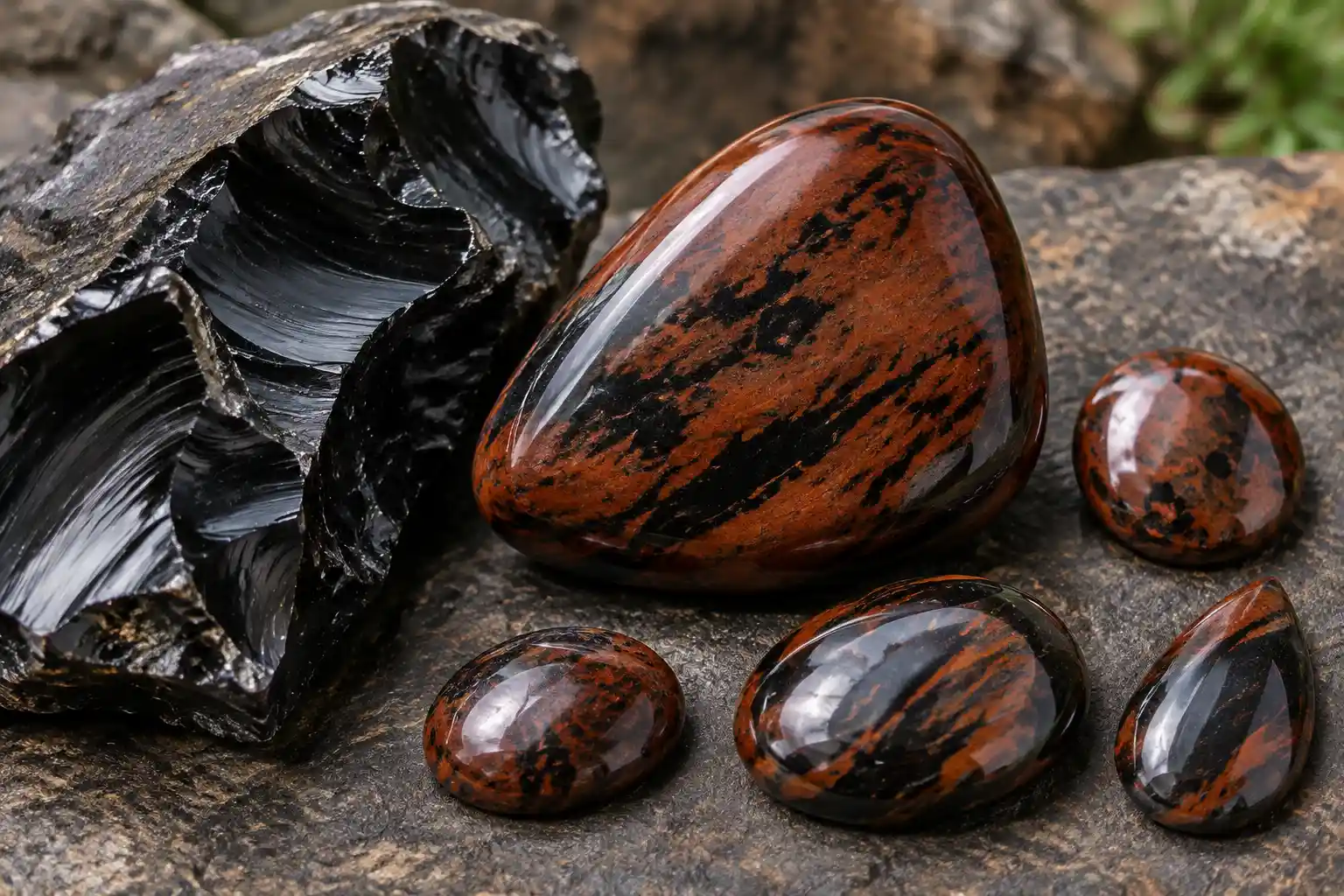
Mahogany Obsidian benefits begin with volcanic geology rather than crystal-healing claims. Mahogany Obsidian is a reddish-brown and black variety of obsidian, the natural volcanic glass produced when silica-rich lava cools so rapidly that extensive crystal growth does not occur. Its dark glassy base is broken by brown, rust-red, or mahogany-colored patches and bands associated with iron-bearing and other natural impurities.
Because obsidian is glass rather than a conventional crystalline mineral, it does not have the orderly crystal lattice associated with quartz, corundum, or feldspar. This amorphous structure contributes to the smooth conchoidal fracture for which obsidian is famous. Freshly broken pieces can develop edges sharp enough to require careful handling, a property that also explains obsidian’s long archaeological importance in cutting tools, blades, projectile points, and ritual or decorative objects.
Modern Mahogany Obsidian benefits extend into jewelry, lapidary work, collecting, geological education, and personal symbolism. Grounding, protection, resilience, strength, and stability are popular contemporary metaphysical themes, but these ideas should remain separate from medical claims. The stone’s genuine value comes from its volcanic origin, unusual patterning, cutting characteristics, archaeological context, visual appeal, and the meanings people choose to attach to it.
9 Mahogany Obsidian Benefits at a Glance
- Reddish-brown and black patterning gives each polished piece an individual appearance.
- Volcanic-glass geology provides educational value for understanding rapid lava cooling and amorphous solids.
- Conchoidal fracture makes obsidian important for studying prehistoric cutting technologies and stone tools.
- Lapidary versatility supports cabochons, beads, carvings, pendants, spheres, and decorative objects.
- Collector appeal comes from color distribution, flow patterns, locality, size, surface texture, and workmanship.
- Jewelry can display dramatic earthy colors when the stone is protected from hard impacts.
- Archaeological significance connects obsidian generally with ancient toolmaking, trade, craft, and exchange networks.
- Modern symbolism can connect Mahogany Obsidian with resilience, stability, grounding, protection, and persistence.
- Responsible care protects against chips, scratches, and razor-sharp fresh fracture edges.
Reddish-Brown Patterning Is the Most Visible Mahogany Obsidian Benefit
Color distinguishes Mahogany Obsidian from ordinary black obsidian. A polished specimen may contain large reddish-brown patches, irregular mahogany-like swirls, small rusty spots, dark bands, or mottled combinations of brown and black. The result often resembles polished wood, which explains the commercial name.
Iron-bearing compounds and other natural impurities contribute to the red-brown appearance. The distribution is rarely perfectly uniform because volcanic glass records changes in the melt as the lava moved, cooled, mixed, and solidified.
This variation gives individual stones considerable personality. One cabochon may show a broad mahogany-red field crossed by black, while another is predominantly black with isolated brown patches. A carving may be positioned so that different colors emphasize different parts of the design.
The appearance is especially effective after polishing. A glossy surface creates strong contrast between brown and black areas, while rough pieces may look more subdued. Visual transformation during cutting is one of the practical Mahogany Obsidian benefits appreciated by lapidaries.
Volcanic Glass Makes Mahogany Obsidian Geologically Interesting
One of the strongest Mahogany Obsidian benefits is the opportunity to study natural volcanic glass. Most familiar rocks consist of mineral crystals, but obsidian forms when suitable lava cools quickly enough to prevent most atoms from arranging themselves into large, orderly crystalline structures.
The result is a glassy solid rather than a single mineral species. Obsidian is commonly silica-rich, although its precise chemistry varies with the volcanic source. Minor crystals, bubbles, flow structures, and inclusions can occur even though the dominant character remains glassy.
This formation history makes Mahogany Obsidian useful in geology education. A specimen can illustrate the relationship between cooling rate and texture, the difference between crystalline rock and natural glass, and the way impurities influence appearance.
It also demonstrates that visually attractive gems do not need crystal faces. Obsidian’s beauty comes from glassy luster, fracture surfaces, flow patterns, inclusions, and color variations rather than from a formal crystal system.
Conchoidal Fracture Gives Obsidian Exceptional Archaeological Importance
Obsidian is famous for conchoidal fracture, in which a break can produce curved surfaces resembling the inside of a shell. Under controlled conditions, this behavior allows skilled knappers to remove flakes and create exceptionally sharp cutting edges.
That property gave obsidian enormous importance in many prehistoric and ancient societies. People fashioned different varieties of obsidian into knives, projectile points, scrapers, cutting flakes, and ceremonial objects. Obsidian artifacts can also reveal ancient trade because chemically distinct volcanic sources may sometimes be linked with archaeological finds through analytical techniques.
Mahogany Obsidian itself should not automatically be assigned every tradition associated with obsidian everywhere. Archaeological histories vary by locality, source, time period, and cultural group. The general history of obsidian technology is well established, while claims about a unique ancient spiritual tradition specifically for the mahogany-colored variety require stronger evidence.
The physical fracture remains relevant today. Freshly broken obsidian can create extremely sharp edges, so rough specimens should be handled carefully. This is an important practical caution within Mahogany Obsidian benefits because a beautiful glassy stone can still cut skin if fractured.
Jewelry and Lapidary Work Make Good Use of Natural Patterns
Mahogany Obsidian can be fashioned into cabochons, beads, pendants, earrings, rings, carvings, palm stones, spheres, and other ornamental forms. Broad polished surfaces are particularly effective because they reveal the contrast between red-brown and black regions.
Obsidian generally has a Mohs hardness around 5 to 5.5, which means it is softer than quartz, topaz, sapphire, and several other common jewelry gemstones. It can therefore accumulate scratches with rough wear. Glassy toughness also differs from the durability of many crystalline gems, and thin edges can chip under impact.
Pendants and earrings are relatively protected choices because they receive fewer direct blows than rings or bracelets. Rings can still be attractive when settings protect edges and the wearer removes the piece before manual work or activities involving hard surfaces.
Designers can use natural pattern strategically. A cabochon may be cut to center a mahogany-red patch, while a carving can position black and brown areas to create deliberate visual contrast. These choices make every finished object somewhat individual.
Collecting Mahogany Obsidian Rewards Attention to Locality and Pattern
Collecting is another practical area where Mahogany Obsidian benefits become apparent. Rough pieces can display natural fracture surfaces and flow textures, while polished specimens emphasize color and pattern. Collectors may value both for different reasons.
Locality information can add geological context. Mahogany-colored obsidian occurs at volcanic sources where appropriate chemistry and cooling conditions produced the characteristic red-brown and black glass. Well-documented localities allow a specimen to be connected with a specific volcanic setting instead of being treated simply as a decorative stone.
Condition matters as well. Natural fractures are expected in obsidian, but extensive chips, weathering, scratches, or poor polishing can influence the attractiveness of a finished piece. Conversely, a rough collector specimen may be valued precisely because it shows conchoidal fracture or natural flow features.
Pattern is highly subjective. One collector may prefer dramatic red-brown areas, while another may seek balanced black and mahogany mottling. The lack of a single ideal pattern creates variety across a collection.
Mahogany Obsidian Benefits Include an Archaeological Link to Human Craft
The human history of obsidian adds intellectual value even to a modern polished stone. Obsidian’s ability to produce sharp flakes made it one of the important natural substances used for cutting technology before metal tools became widespread in many regions.
Archaeologists can sometimes identify the geological source of obsidian artifacts through chemical composition. This allows researchers to reconstruct movement, exchange, trade networks, and human relationships across landscapes. A small piece of volcanic glass can therefore contribute evidence about how people traveled and interacted.
Modern Mahogany Obsidian benefits do not depend on claiming that every brown-black specimen was used anciently for a special ceremony. The established relationship between obsidian and human technology is already significant.
A collector interested in archaeology may appreciate a modern specimen as a physical example of the fracture behavior that made volcanic glass valuable to earlier toolmakers. That educational connection is far more concrete than generalized claims of ancient crystal energy.
Resilience and Stability Are Natural Modern Symbols
Contemporary crystal culture often gives Mahogany Obsidian benefits symbolic meanings involving resilience, strength, stability, grounding, and persistence. The earthy reddish-brown coloration and dark glassy areas make these interpretations visually intuitive.
Resilience is especially fitting as a metaphor because volcanic glass originates in an intense geological environment. Molten rock cools rapidly into a solid glass, and the finished stone can later be polished into a highly reflective decorative object. Someone may interpret this transformation as a symbol of adapting after difficult circumstances.
Stability can work similarly. A person beginning a demanding project might keep a polished stone on a desk as a reminder to remain practical. Another may wear a pendant representing persistence during a major transition.
These meanings are chosen by the owner. Mahogany Obsidian does not scientifically increase resilience or cause emotional stability, but an object can serve as a powerful reminder of values a person wants to practice.
The symbolism described under Mahogany Obsidian meaning becomes most useful when it remains connected with personal interpretation rather than being presented as an automatic effect of the stone.
Protection and Grounding Beliefs Belong to Modern Spiritual Practice
Grounding and protection are among the most repeated metaphysical Mahogany Obsidian benefits. Some contemporary traditions describe the stone as absorbing negativity, creating energetic boundaries, or helping a person feel rooted and secure.
These are spiritual beliefs, not established physical effects. There is no scientific evidence that a polished piece of volcanic glass creates an invisible protective field or removes harmful emotional energy from the environment.
Someone may still use the stone in meditation or ritual as a symbol of boundaries. Holding it before a difficult conversation might remind a person to remain calm and maintain appropriate limits. Keeping it near a workspace could symbolize the intention to stay focused rather than becoming distracted.
These uses depend on symbolism and behavior, not on a demonstrated energy mechanism. Claims grouped within Mahogany Obsidian healing properties should therefore remain separate from medical treatment and mental-health care.
Ordinary Obsidian Properties Explain Many Practical Benefits
Many Mahogany Obsidian benefits are simply the genuine properties of obsidian expressed through an attractive color variety. Volcanic-glass formation, conchoidal fracture, glossy polish, moderate hardness, archaeological relevance, and suitability for carving are shared with other obsidian types.
Understanding general obsidian benefits helps place the mahogany variety in context. Its principal distinction is the red-brown and black appearance, not a completely different geological substance.
This matters when commercial descriptions exaggerate the uniqueness of a particular color variety. Mahogany Obsidian can be visually distinctive and culturally meaningful without requiring a separate set of physical laws or a unique supernatural mechanism.
The stone is most compelling when its real difference is appreciated. Iron-bearing impurities and natural volcanic processes created patterns that can resemble dark wood grain, giving familiar volcanic glass a warm earthy appearance.
Care and Sharp Fracture Edges Require Important Cautions
Mahogany Obsidian should be handled according to the properties of natural glass. Its hardness is moderate, so harder gemstones and abrasive surfaces can scratch a polish. Storing pieces separately in soft pouches or lined compartments helps prevent unnecessary wear.
Impact deserves even more attention. A drop onto tile, concrete, or stone can chip an edge or break a thin piece. A fracture can create a sharp surface capable of cutting skin, so broken jewelry or rough shards should not be handled casually.
Gentle cleaning with mild soap, water, and a soft cloth is usually sufficient for uncomplicated polished pieces. Harsh abrasives are unnecessary and may gradually dull the surface. Jewelry containing adhesives, coatings, metals, or additional gemstones may require more specialized care.
Obsidian should also not be intentionally broken for casual experimentation without suitable protective equipment and knapping knowledge. The same fracture that made obsidian useful for cutting tools can create small, exceptionally sharp flakes.
What Mahogany Obsidian Benefits Do Not Include
Mahogany Obsidian benefits are substantial without medical claims. The stone offers geological interest, archaeological relevance, decorative beauty, lapidary potential, collector appeal, and meaningful personal symbolism.
There is no established evidence that wearing or holding Mahogany Obsidian cures disease, treats anxiety disorders or depression, removes toxins, changes circulation, regulates hormones, reduces medically significant pain, improves immunity, or alters organ function.
Its iron-bearing coloration also should not be interpreted as a source of nutritional iron delivered through the skin. The compounds contributing to red-brown coloration are part of the volcanic glass, not a transdermal supplement.
Grounding, protection, strength, and resilience can remain useful metaphors. They simply belong to personal and spiritual interpretation rather than medical science.
Conclusion
Mahogany Obsidian benefits come from a striking form of natural volcanic glass. Reddish-brown and black patterning, conchoidal fracture, archaeological importance, lapidary versatility, collecting interest, and geological education provide genuine reasons to appreciate the stone.
Modern symbolism involving resilience, grounding, protection, stability, and persistence can add personal value when it is clearly presented as interpretation. Practical caution remains important because obsidian can scratch, chip, and form extremely sharp fracture edges. Its real geology and human history are compelling without unsupported healing claims.
FAQs
What are the main Mahogany Obsidian benefits?
The strongest Mahogany Obsidian benefits include distinctive red-brown and black patterning, volcanic-glass geology, lapidary and jewelry use, collector appeal, archaeological interest, and educational value related to conchoidal fracture. Modern crystal traditions also associate it with grounding, resilience, stability, and protection, but those themes are symbolic rather than medically established effects.
What is Mahogany Obsidian made of?
Mahogany Obsidian is a variety of natural volcanic glass formed from rapidly cooled silica-rich lava. It is not a conventional crystalline mineral with a single crystal structure. Iron-bearing and other natural impurities contribute to the reddish-brown coloration that contrasts with darker areas of the glass.
Why is Mahogany Obsidian brown and black?
The brown to reddish-brown coloration is associated with iron-bearing impurities and related variations within the volcanic glass, while darker regions retain the familiar appearance of black obsidian. The exact distribution can produce spots, bands, swirls, or irregular patches, making individual stones look different after polishing.
Is Mahogany Obsidian suitable for jewelry?
Yes, it can be cut into cabochons, beads, pendants, earrings, rings, and other jewelry. Obsidian is moderately hard, generally around 5 to 5.5 on the Mohs scale, and can scratch or chip more readily than quartz or sapphire. Pendants and earrings are relatively protected, while rings should be worn more carefully.
Why can broken obsidian be so sharp?
Obsidian breaks with conchoidal fracture because of its glassy, noncrystalline structure. Controlled fractures can produce extremely thin, sharp edges. This property made obsidian historically important for blades and stone tools, but it also means broken specimens should be handled carefully because fresh edges and tiny flakes can cut skin.
Did ancient cultures use Mahogany Obsidian?
Many cultures used obsidian extensively for tools, weapons, decorative objects, and ritual items, but the history of a specific mahogany-colored variety should not automatically be generalized from all obsidian traditions. Documented archaeological context depends on the volcanic source, region, time period, and culture involved.
Does Mahogany Obsidian provide grounding?
Grounding is a popular modern spiritual association. Someone may use the stone as a personal reminder to remain practical, steady, or focused during challenging situations. There is no established scientific evidence that Mahogany Obsidian physically changes the body’s energy or medically treats emotional conditions.
Is Mahogany Obsidian protective?
Protection is another common symbolic theme in modern crystal practice. A person may associate the dark earthy stone with personal boundaries, resilience, or security. There is no scientific evidence that the volcanic glass creates an energetic shield or physically absorbs negativity, so these ideas should be understood as spiritual or personal symbolism.
How should Mahogany Obsidian be cleaned?
Mild soap, water, and a soft cloth are generally suitable for uncomplicated polished pieces. Abrasive cleaners should be avoided because they can reduce the gloss over time. Jewelry should be protected from hard impacts, and broken obsidian should be handled cautiously because fresh fractures can create extremely sharp edges.
Mahogany Obsidian benefits involving grounding, protection, emotional healing, or energetic effects reflect modern spiritual and personal interpretations and should not replace qualified physical or mental-health care.