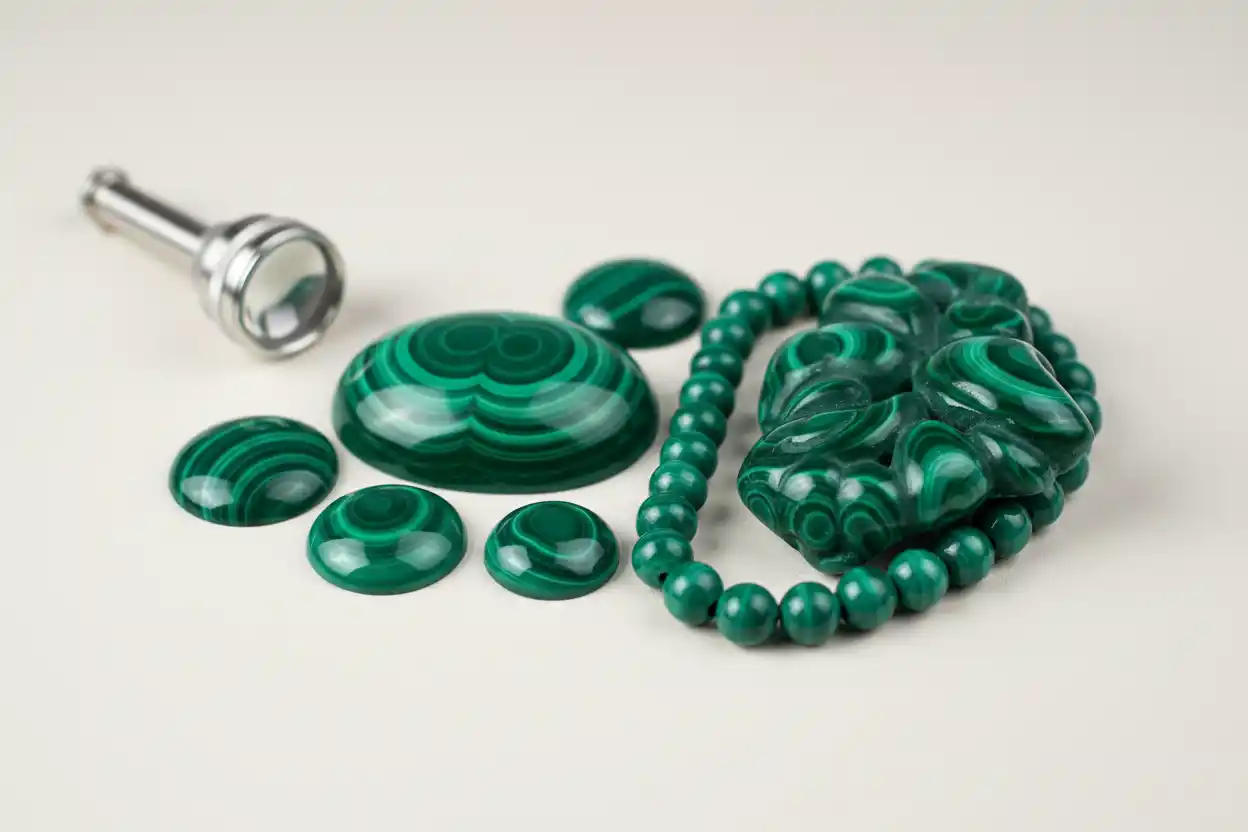
Buy Malachite: How to Compare Quality, Treatments, Grading & Cost
To buy malachite well, judge pattern, color, polish, structure, durability, authenticity, and craftsmanship together rather than relying on simple labels such as AAA green or Congo grade. Malachite is a natural copper carbonate hydroxide with the formula Cu₂CO₃(OH)₂, and current mineralogical data describe it as bright to dark green, commonly opaque, often silky or earthy in luster, about 3.5–4 on the Mohs scale, brittle, and capable of perfect cleavage in one direction. Those properties explain both its spectacular banded appearance and its practical limitations: malachite takes a beautiful polish and can produce dramatic ornamental objects, yet it scratches and chips far more easily than quartz, jade, sapphire, or diamond.
Malachite commonly forms through secondary alteration in oxidized copper deposits and can appear as banded aggregates, crusts, botryoidal masses, stalactitic growths, and radiating fibrous structures. GIA notes that enormous quantities of ornamental malachite have entered the market from the Katanga copper region of the Democratic Republic of Congo, while attractive banded material and azurite-malachite mixtures also occur in other copper districts. This broad supply means malachite itself is not an exceptionally rare mineral; the premium belongs to pieces with unusually attractive banding, tight concentric eyes, dramatic chatoyant or silky structures, large clean cutting areas, fine polish, special locality or specimen value, and superior workmanship.
Buy Malachite At a Glance
| Buying Factor | What to Examine | Why It Matters |
|---|---|---|
| Identity | Natural malachite, Cu₂CO₃(OH)₂ | Glass and other materials can imitate banded green malachite |
| Color | Rich light-to-dark green contrast | Strong color variation creates the classic malachite look |
| Banding | Natural curved, concentric, wavy, fibrous, or botryoidal structures | Pattern is one of the main quality drivers |
| Pattern Scale | Fine tight eyes versus broad ordinary bands | Distinctive structures often attract stronger demand |
| Silky Effect | Chatoyant or fibrous movement where present | Can add unusual collector and jewelry appeal |
| Azurite Association | Natural blue azurite mixed with green malachite | Can create attractive but separate ornamental material |
| Polish | Smooth high gloss without pits or scratches | Malachite’s softness makes surface finish especially visible |
| Fractures | Cracks, cleavage weakness, broken layers | Brittle material can chip or split |
| Hardness | Mohs 3.5–4 | Requires more care than many common jewelry gems |
| Size | Dimensions plus pattern quality | Large rough is available, so size alone does not establish rarity |
| Locality | DR Congo, historic Ural material, Namibia, Arizona, others | Provenance can matter to collectors |
| Imitation | Fused or layered glass | GIA identifies glass as a convincing malachite simulant |
| Synthetic Material | Laboratory-grown malachite exists experimentally | Synthetic versus natural must be disclosed |
| Treatment | Wax, coating, impregnation, reconstruction, filling where applicable | Modifications can affect durability and value |
| Care | Avoid harsh chemicals, prolonged water exposure, ultrasonic cleaning | Malachite is relatively soft and chemically sensitive |
Natural Malachite Has Distinctive Green Banding
Malachite is famous for green banding that can range from pale mint and medium green to deep forest green and nearly black-green. Mindat describes the mineral as a common secondary copper mineral occurring in crystalline aggregates, crusts, botryoidal clusters, mammillary forms, and strongly banded masses resembling agate.
The most appealing cutting material often contains several shades of green arranged in flowing bands, concentric circles, eyes, waves, or fibrous patterns. A uniform green slab can still be malachite, but complex natural structures generally create more visual interest and stronger demand.
The quality of the pattern matters more than simply counting color bands. Clean concentric eyes, tight waves, lace-like patterns, and well-centered botryoidal cross sections can command a premium when the cutter positions them effectively.
Banded Pattern Is One of the Strongest Value Factors
GIA’s discussion of malachite-azurite material notes that banded structure is among the most attractive forms and that cross sections through stalactitic growth can create striking agate-like patterns. This structural diversity allows cutters to create cabochons that look dramatically different even when they come from the same deposit.
A premium stone should ideally show an intentional-looking pattern rather than a random area of plain green. Symmetrical eyes can be especially attractive in earrings or ring stones, while sweeping directional bands may work better in long pendants or cuff bracelets.
Pattern value remains aesthetic, however, and there is no universally accepted laboratory scale ranking concentric, bull’s-eye, striped, feathered, or botryoidal forms.
Contrast Between Green Shades Improves Visual Depth
Malachite derives much of its distinctive appearance from contrast. A piece alternating pale, medium, and dark greens typically appears more dimensional than one consisting mostly of a single dull shade.
The best contrast should still look naturally integrated. Extremely sharp repetitive lines of identical thickness across many mass-produced stones can deserve closer inspection because glass and manufactured materials can imitate malachite banding.
Natural structures often vary subtly in width, curvature, texture, and intensity as the aggregate grew.
Congo Material Dominates Much of the Modern Ornamental Market
GIA reports that huge quantities of malachite enter the market from Katanga in the Democratic Republic of Congo, reflecting the region’s enormous copper mineralization and abundant secondary malachite. Current mineral databases likewise document many major Congolese malachite localities, alongside notable occurrences in Russia, Namibia, the United States, Zambia, Mexico, and numerous other copper districts.
A Congo origin therefore does not automatically make an individual cabochon rare. The region supplies ordinary and exceptional material.
The premium should be attached to pattern, cutting quality, structural soundness, collector provenance, or exceptional specimen form rather than to the country name alone.
Historic Ural Malachite Has Collector Importance
The Ural region of Russia has a celebrated history of producing malachite used in monumental decorative arts, architectural veneers, tabletops, boxes, and imperial objects. Modern commercial supply from some historic deposits is very different from the market that existed when enormous Ural decorative projects were produced, giving documented antique material potential provenance value.
A seller using Ural malachite to justify a premium should distinguish genuine documented historical provenance from a general style description.
Green concentric pattern alone cannot prove Russian origin because similar structures occur in other deposits.
Botryoidal and Stalactitic Forms Can Create Exceptional Patterns
Malachite often develops rounded botryoidal surfaces or stalactitic structures composed of radiating growth. Slicing through these forms can reveal concentric rings and eye patterns that resemble agate.
GIA documented stalactitic malachite in Peruvian azurite-malachite material, noting that cross sections created especially attractive agate-like structures.
A cutter who understands the growth direction can transform a rough stalactite into centered circular patterns, while an unfavorable slice can waste the visual potential.
Fibrous Malachite Can Show a Silky or Chatoyant Appearance
Mindat lists silky luster among malachite’s recognized surface characteristics, reflecting its ability to form fine fibrous aggregates. Some cut material can display a soft moving sheen when the fibers align favorably.
This appearance should not be confused with the sharp cat’s-eye phenomenon of a transparent gemstone, but it can add an attractive textile-like surface to certain specimens and cabochons.
Fibrous surfaces are also delicate and may not respond to polishing exactly like compact banded material.
Azurite-Malachite Is a Separate Ornamental Category
Malachite commonly occurs with other secondary copper minerals, especially azurite. GIA describes attractive azurite-malachite mixtures where deep blue azurite contrasts with light-to-dark green malachite and notes that the combination can be more visually appealing than dark pure azurite.
A blue-and-green piece should therefore not be rejected as impure malachite when it is intentionally sold as azurite-malachite.
The value system changes because buyers then judge the balance, saturation, pattern, stability, and proportion of both minerals rather than expecting a pure green object.
Glass Is a Documented Malachite Imitation
GIA explicitly identifies fused or layered glass as a convincing imitation of malachite and illustrates manufactured glass reproducing green banded patterns. Glass can be produced in repeated green layers and polished into cabochons, beads, boxes, or decorative objects that resemble natural stone.
This makes pattern inspection important. Perfectly regular layers, repeated identical designs, bubbles, glassy fracture behavior, or suspiciously uniform product batches can suggest imitation, although definitive separation should rely on gemological testing rather than one visual clue.
A convincing glass imitation should not receive natural malachite pricing simply because the banding looks attractive.
Synthetic Malachite Exists but Is Not a Major Modern Market Category
GIA’s overview of synthetic gems notes that experimental synthetic malachite has been produced but is not often seen today because natural material is relatively abundant. This is an important distinction from synthetic ruby or sapphire, where laboratory-grown products occupy large commercial markets.
A seller should still disclose synthetic origin if laboratory-grown malachite is offered.
The fact that synthetic material is uncommon does not justify assuming every green banded object must be natural, particularly because glass imitation remains much easier to encounter.
Reconstituted and Composite Malachite Should Be Disclosed
Small malachite fragments or powder can theoretically be combined with binders or used in composite decorative products. Such objects can be attractive and can make efficient use of small material, but they should not be presented as one solid piece of natural malachite.
Look closely at inexpensive beads or carvings with unusually repetitive patterning, visible polymer-like seams, or surfaces inconsistent with natural aggregate structure.
For higher-value pieces, independent identification can resolve uncertainty more reliably than destructive scratch or chemical tests.
Wax, Resin, Coating, and Filling Require Clear Description
Opaque ornamental stones can be enhanced with waxes, polymers, coatings, or fillers to improve luster, color depth, or structural integrity. GIA’s general treatment guidance explains that impregnation and surface coating can change appearance and may introduce heat or chemical sensitivity.
A stabilized or coated malachite object can remain useful jewelry when treatment is disclosed.
The key valuation question is whether the treatment merely protects the surface or whether it materially creates the appearance or structure being sold as natural fine malachite.
Malachite Is Soft Compared With Most Familiar Jewelry Gems
Mindat places malachite at Mohs 3.5–4 and describes it as brittle with perfect cleavage. This makes it far softer than the stones covered in Gems Lore’s buy jade guide or the transparent gems commonly used in engagement rings.
Everyday dust can contain harder minerals capable of scratching malachite, and careless impact can chip edges or split the stone.
The softness does not make malachite unsuitable for jewelry, but it changes which designs are practical.
Pendants and Earrings Are Easier to Maintain Than Daily Rings
Pendants, earrings, brooches, and occasional-wear pieces typically expose malachite to less impact and abrasion than rings and bracelets. A malachite ring can still be worn successfully, especially with a bezel or protective metal border, but the owner should expect more careful handling.
Large exposed domes, sharp corners, or thin stone edges increase vulnerability.
The setting should protect the stone instead of holding it under excessive pressure because brittleness and cleavage create a different risk profile from tough jade.
Water and Chemicals Deserve Caution
GIA’s durability guidance notes that prolonged exposure to water can damage malachite and that ammonia can harm the polish of softer materials including malachite. This makes routine household exposure more relevant than many buyers expect.
Remove malachite before prolonged bathing, swimming, dishwashing, or handling strong cleaning chemicals, particularly when the stone may also contain an impregnation or coating.
Short gentle cleaning is different from soaking. The goal is to minimize unnecessary chemical and moisture exposure.
Ultrasonic Cleaning Is a Poor Choice
GIA specifically lists malachite among materials that should not be cleaned ultrasonically because it is susceptible to heat and temperature changes and may also be impregnated or coated.
A soft damp cloth or brief gentle cleaning is far more conservative.
Jewelry professionals should know the stone is malachite before steaming, soldering nearby, or placing it in an ultrasonic tank.
Large Malachite Is Not Automatically Rare
GIA describes huge quantities of ornamental malachite from the Congo market, and the mineral can form large masses suitable for slabs, carvings, bowls, boxes, tabletops, and decorative veneers.
A very large object therefore does not automatically represent an exceptionally rare gem.
The stronger premium comes from maintaining beautiful banding, compact structure, low fracture content, good polish, and skilled craftsmanship over a large area.
Large Patterned Pieces Can Still Command Strong Prices
Although malachite itself can be abundant, obtaining a large slab with uninterrupted concentric eyes, tight bands, minimal cracks, beautiful green contrast, and an orientation suitable for a decorative object is more selective.
Cutting yield also matters because fractures and unwanted host material can reduce the usable portion of a large rough block.
A large high-quality tabletop or carved box may therefore be expensive because of rough selection, cutting loss, matching, workmanship, and scale rather than because malachite as a mineral is rare.
Beads Need Inspection Around Drill Holes
Malachite bead strands can look spectacular when the banding wraps naturally around each bead, but drilled areas are natural stress points in a brittle mineral.
Inspect for chips, radiating cracks, filler, uneven drill holes, and poor polish.
Matched strands can receive a premium when bead size, hue, pattern intensity, roundness, and finish are consistent.
Carvings Can Be Worth More Than the Rough
Malachite has centuries of ornamental use because its banding gives artists an unusually graphic material. A skilled carver can orient eyes, waves, and parallel bands to follow the shape of an animal, vessel, decorative panel, or sculptural object.
Large carvings therefore require dual valuation: first the quality of the malachite and then the quality of the artistic work.
Signed, antique, historically documented, or technically exceptional objects can move beyond ordinary gemstone pricing into the decorative-arts market.
Seller Grades Have No Universal Meaning
AAA, AAAA, imperial green, Congo premium, Ural grade, museum grade, and collector grade are not universal gemological malachite classifications.
A seller may legitimately create an internal system, but the grade only becomes useful when its criteria are defined.
The buyer should replace the label with actual color contrast, pattern, compactness, polish, fractures, size, treatment, locality evidence, and workmanship.
Malachite Versus Lapis Lazuli
Malachite and lapis are both opaque ornamental materials used for beads, cabochons, carvings, boxes, and decorative objects, but their value factors differ. Gems Lore’s buy lapis lazuli guide and lapis lazuli price guide emphasize rich blue color, calcite, pyrite, dye, and provenance.
Malachite instead derives much of its appeal from natural green banding, eye patterns, botryoidal growth structures, polish, and craftsmanship.
The similarity in object types should not lead buyers to use the same grading rules for both materials.
Malachite Versus Labradorite
The Gems Lore buy labradorite guide and labradorite price guide describe another ornamental gemstone where cutting orientation strongly affects visual appeal.
Labradorite relies on directional optical flash, while malachite relies on permanent structural banding and green pattern.
Both demonstrate why visual design can matter more than weight in opaque and phenomenal gems.
Common Red Flags When You Buy Malachite
Be cautious when the pattern repeats identically across many stones, layers are unnaturally regular, a seller refuses to distinguish glass from natural material, a very large piece is marketed as rare solely because of weight, serious cracks are concealed by dark photography, bright polish appears to come from a heavy coating, synthetic or reconstructed material is described simply as natural, Ural or Congo origin is asserted without evidence, AAAA is presented as an official laboratory grade, or aggressive cleaning instructions ignore malachite’s low hardness and chemical sensitivity. GIA’s documented glass imitations make authenticity checks particularly important when patterning looks unusually perfect.
How to Compare Malachite Listings Fairly
Compare natural malachite by color contrast, banding, eye or botryoidal pattern, fibrous or silky character, compactness, fractures, polish, size, dimensions, treatment, locality evidence, condition, craftsmanship, and loose-versus-mounted form. A common Congo cabochon, historic Ural decorative panel, natural azurite-malachite slice, glass imitation, laboratory-grown specimen, and signed carving belong to different market categories even when they all show green banding.
Conclusion
To buy malachite confidently, focus on natural structural pattern, rich green contrast, fine polish, sound condition, appropriate treatment disclosure, and craftsmanship rather than simply choosing the biggest stone. Malachite is Cu₂CO₃(OH)₂, generally opaque, around Mohs 3.5–4, brittle, and capable of perfect cleavage, so durability deserves considerably more attention than it would with sapphire or jade.
The modern market contains abundant natural material, particularly from the Democratic Republic of Congo, where GIA reports very large quantities entering the ornamental trade. Abundance does not prevent exceptional pieces from becoming valuable, because striking concentric banding, botryoidal cross sections, fibrous effects, large clean cutting areas, historic provenance, and master craftsmanship can all be selective.
Authentication also matters because GIA documents convincing fused-glass malachite imitation, while experimental synthetic malachite has also been produced even though it is not commonly encountered today. A buyer who separates natural malachite from imitation, evaluates the pattern and polish carefully, and accounts for softness, brittleness, and treatment will make a substantially stronger purchase than someone relying on a generic AAA label.
Frequently Asked Questions
What is malachite?
Malachite is a copper carbonate hydroxide mineral with the formula Cu₂CO₃(OH)₂. It commonly forms opaque bright-to-dark green banded, botryoidal, crust-like, and fibrous aggregates.
What makes high-quality malachite desirable?
Strong green contrast, attractive natural banding, concentric eyes, smooth botryoidal patterns, sound compact material, fine polish, low fracture content, skilled cutting, and strong craftsmanship generally improve desirability.
Is Congo malachite rare?
The Democratic Republic of Congo is a major modern source, and GIA reports huge quantities of ornamental malachite from the Katanga region. Exceptional pattern and large clean pieces can still be selective even though ordinary malachite is abundant.
Is Russian malachite better than Congo malachite?
Not automatically. Historic Ural material can have collector and decorative-arts importance, but an individual piece should still be judged by pattern, condition, workmanship, provenance, and authenticity.
Can malachite be fake?
Yes. GIA documents fused glass made to imitate malachite’s banded green appearance. Other composites or reconstructed materials should also be disclosed accurately.
Does synthetic malachite exist?
Yes. GIA notes that experimental synthetic malachite has been produced, although it is not commonly seen today because natural material is readily available.
How hard is malachite?
Malachite is approximately Mohs 3.5–4 and is brittle with perfect cleavage in one direction. It needs more protection from scratching and impact than quartz, jade, sapphire, or diamond.
Is malachite suitable for rings?
It can be used in rings, particularly protective bezel settings and occasional-wear designs, but its softness and brittleness make pendants, earrings, and brooches easier to maintain.
Can malachite get wet?
Brief gentle contact with water is different from prolonged soaking, but GIA cautions that long exposure to water can damage malachite. Conservative cleaning is preferable.
Can malachite go in an ultrasonic cleaner?
It is better avoided. GIA includes malachite among gemstones that should not be cleaned ultrasonically because of heat, temperature-change, treatment, and durability concerns.
Does AAA malachite have an official meaning?
No universal laboratory AAA grading standard applies to malachite. Compare actual color, pattern, polish, fractures, treatment, size, and workmanship instead.
Does bigger malachite mean better malachite?
No. Large material is available. A smaller stone with exceptional concentric pattern, strong contrast, clean structure, and fine polish can be more valuable than a much larger ordinary piece.
Is malachite a guaranteed investment?
No. Fine historic pieces, exceptional specimens, or major decorative objects can be collectible, but future value depends on authenticity, pattern, provenance, condition, craftsmanship, demand, and resale liquidity.