Obsidian Benefits: 10 Real Uses, Meaningful Symbolism & Verified Facts, Safe Limits
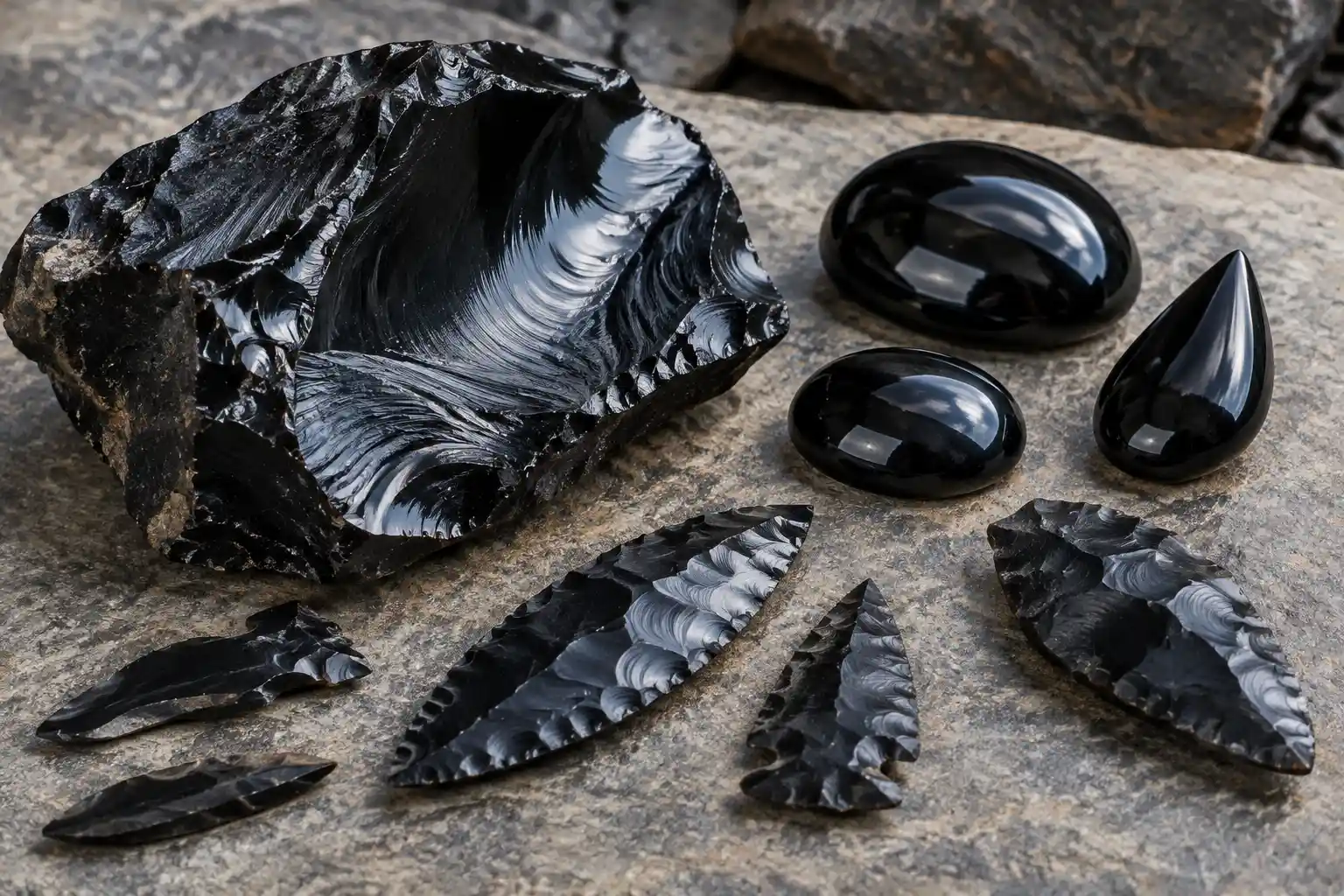
Obsidian benefits begin with volcanic geology rather than crystal structure. Obsidian is a naturally occurring volcanic glass that forms when silica-rich lava cools rapidly enough to prevent extensive crystal growth. Instead of developing the ordered internal lattice expected in a crystalline mineral, the melt solidifies predominantly as glass, producing the smooth luster and characteristic conchoidal fracture for which obsidian is famous.
This structure gives obsidian several genuinely unusual qualities. A carefully fractured piece can form exceptionally sharp edges, explaining its long archaeological importance in cutting tools, projectile points, scrapers, blades, and other worked objects. Its glossy surface can also be polished into jewelry, carvings, mirrors, decorative pieces, and collector specimens. Black is the best-known color, but natural obsidian may include brown, reddish, gray, greenish, banded, spotted, or iridescent varieties depending on inclusions, oxidation, bubbles, crystallites, and flow structures.
Modern discussions of obsidian benefits often emphasize protection, grounding, truth, emotional release, or self-reflection. These interpretations can function as personal symbolism, especially because the stone’s dark appearance and reflective polish naturally suggest boundaries and introspection. They should remain separate from claims that volcanic glass medically treats anxiety, depression, trauma, pain, digestion, circulation, or other health concerns.
10 Obsidian Benefits at a Glance
- Volcanic-glass formation provides important geological and educational value.
- Conchoidal fracture can create exceptionally sharp edges that explain obsidian’s archaeological importance.
- Ancient toolmaking connects obsidian with technological history, trade, and human movement.
- Glassy luster makes polished specimens useful in jewelry, carvings, decorative objects, and collections.
- Color and pattern varieties provide substantial visual diversity beyond ordinary black obsidian.
- Source chemistry can allow archaeologists to connect artifacts with particular volcanic regions.
- Lapidary work can produce cabochons, beads, spheres, mirrors, and sculptural forms.
- Modern symbolism can connect obsidian with boundaries, reflection, resilience, and deliberate decision-making.
- Collector value can come from locality, color, flow texture, inclusions, form, and archaeological context.
- Responsible care protects both the stone and the handler because broken obsidian can produce extremely sharp edges.
Volcanic Glass Is the Foundation of Obsidian Benefits
Obsidian benefits are easier to understand when the stone is treated accurately as natural volcanic glass. It typically forms from silica-rich lava, especially rhyolitic compositions, whose high viscosity slows movement of atoms while rapid cooling inhibits extensive crystallization.
The resulting rock can appear almost completely glassy even though microscopic crystallites or other inclusions may occur. This distinguishes obsidian from crystalline rocks in which visible or microscopic mineral grains form the dominant structure.
The glassy state is also geologically temporary over very long periods. Natural glass can gradually devitrify as atoms reorganize into more crystalline structures. This helps explain why geologically young volcanic environments provide much of the world’s familiar obsidian.
For students, these characteristics make obsidian useful for understanding cooling rates, magma viscosity, glass formation, devitrification, and the distinction between a rock and a formal mineral species.
Conchoidal Fracture Gives Obsidian Exceptional Cutting Ability
Few obsidian benefits are as historically important as conchoidal fracture. When glass breaks, fractures can propagate in smooth curved surfaces rather than following mineral cleavage planes. Controlled flaking can therefore create remarkably thin, sharp edges.
Skilled stoneworkers learned to exploit this behavior long before metal cutting tools became widespread. Obsidian could be knapped into projectile points, blades, scrapers, knives, and specialized flakes, while discarded fragments still provide archaeologists with evidence of ancient technology.
The property remains visible in a fresh hand specimen. Curved fracture surfaces can resemble the interior of a shell and may terminate in edges sharp enough to cut skin easily.
That sharpness creates an important caution within obsidian benefits. Rough specimens should not be deliberately smashed or casually handled after breaking. Tiny flakes can be difficult to see and may remain dangerously sharp even when they appear insignificant.
Archaeological Obsidian Can Reveal Ancient Trade Networks
Obsidian benefits extend far beyond cutting efficiency because volcanic glass can preserve a chemical signature related to its geological source. Researchers can compare archaeological artifacts with known volcanic deposits using analytical techniques.
When an artifact can be linked confidently with a distant source, it can provide evidence about movement, exchange, trade, migration, or social relationships. A small flake found far from its original volcanic source may therefore contribute to reconstruction of ancient human behavior.
This does not mean all obsidian objects came from long-distance trade. Some communities lived close to abundant sources, while others obtained the glass through exchange networks of varying complexity.
The archaeological value is significant because obsidian joins geology with anthropology. A volcanic eruption creates the glass, humans transform it into tools, and modern analysis can sometimes reconstruct where the stone traveled.
Black Obsidian Is Only One Part of a Diverse Volcanic-Glass Family
Black obsidian is the most familiar variety, but natural volcanic glass can show considerable visual diversity. Flow banding, bubbles, inclusions, oxidation, crystallites, and different chemical conditions can create distinctive patterns or colors.
Mahogany Obsidian typically combines black or dark glass with reddish-brown areas, while Snowflake Obsidian contains pale spherulitic crystalline structures within a dark glassy host. Rainbow and sheen varieties can display colored or metallic-looking reflections caused by microscopic structures or inclusions.
These variations share an obsidian foundation even though their appearance and trade names differ. Understanding general Black Obsidian benefits can be useful for appreciating the best-known dark variety, while the red-brown patterns behind Mahogany Obsidian benefits illustrate how inclusions and oxidation can change the appearance dramatically.
This diversity makes collecting one of the most enjoyable obsidian benefits because a collection can show several volcanic textures without leaving the same general rock family.
Lapidary Work Turns Obsidian Into Jewelry and Decorative Objects
Obsidian can accept a high polish, making it useful for cabochons, beads, pendants, earrings, rings, spheres, carved figures, mirrors, knife handles, and decorative objects.
Its Mohs hardness is generally around 5 to 5.5, which means it is softer than quartz and significantly softer than sapphire or diamond. Polished surfaces can therefore accumulate scratches if repeatedly exposed to harder objects.
Brittleness is equally important. A polished cabochon may look substantial while remaining vulnerable to hard impacts, particularly around thin edges or exposed points. Pendants and earrings are relatively protected choices, while rings should be worn more cautiously.
Experienced lapidaries also respect the sharp waste created during cutting. Grinding and shaping should use appropriate eye protection, controlled equipment, and careful cleanup because fragments can remain sharp.
Obsidian Benefits Collectors Through Locality and Natural Texture
Collectors may value obsidian for much more than polished appearance. Geological locality, flow structure, natural fracture surfaces, inclusions, color, transparency, banding, and association with a known volcanic setting can all make a specimen interesting.
A rough piece from a documented volcanic source can be educational even if it lacks jewelry quality. Conversely, highly transparent or unusually patterned obsidian may be prized primarily for aesthetics.
Source information becomes especially valuable when a collection includes examples from several volcanic regions. Differences in chemistry and texture demonstrate that the word obsidian covers natural glasses produced in distinct geological settings.
Collector specimens should generally preserve natural features when those features are significant. Polishing every rough piece may remove fracture surfaces, weathering, or flow textures that make the stone scientifically interesting.
Modern Protection Symbolism Is Personal Rather Than Physical
Protection is one of the most common modern obsidian benefits described in crystal traditions. Black color, sharp fracture, volcanic origin, and reflective surfaces all make protective symbolism visually intuitive.
Some practitioners describe obsidian as absorbing negativity or creating an energetic shield. These ideas belong to spiritual interpretation rather than established physics.
A practical personal meaning can still be useful. A person may wear an obsidian pendant as a reminder to establish boundaries, avoid unnecessary conflict, or protect time for important priorities. In this context, the stone represents an intention while the person performs the actual protective behavior.
This evidence-safe approach allows spiritual symbolism to remain meaningful without attributing an invisible physical barrier to volcanic glass.
Reflection and Truth Are Common Obsidian Symbols
Polished black obsidian can form a dark reflective surface, and obsidian mirrors have a long history in different cultural contexts. This visual characteristic helps explain modern symbolism involving self-examination, truth, hidden motives, and reflection.
A polished stone can be used beside a journal or during meditation as a cue to examine a difficult decision. Someone may associate its dark surface with looking carefully at uncomfortable facts rather than avoiding them.
The stone cannot reveal deception, read minds, uncover suppressed memories automatically, or diagnose psychological conditions. Any insight still comes from thought, evidence, communication, and experience.
Claims grouped under Obsidian healing properties require the same distinction. Symbolic reflection may be useful, but obsidian has not been demonstrated to treat trauma, anxiety disorders, depression, or other mental-health conditions.
Obsidian Benefits Include Practical Geological Education
A classroom specimen can demonstrate several geological principles at once. Students can compare obsidian with pumice, rhyolite, basaltic glass, or crystalline volcanic rocks to understand how composition, gas content, viscosity, and cooling influence texture.
The lack of visible crystals in fresh obsidian provides a clear contrast with slowly cooled igneous rocks. Conchoidal fracture illustrates the behavior of glassy substances, while flow banding can show how viscous magma moved before solidifying.
Archaeological examples add another layer by demonstrating that physical properties influence human technology. Sharp fracture encouraged toolmaking, while distinctive source chemistry now helps researchers investigate human movement.
Few ornamental stones connect volcanology, fracture mechanics, archaeology, lapidary work, and cultural symbolism as directly.
Care and Handling Are Important Obsidian Benefits to Understand
Obsidian jewelry can be cleaned with mild soap, lukewarm water, and a soft cloth. Abrasive cleaners are unnecessary because they may gradually dull the polished surface.
Separate storage is useful because harder gemstones such as quartz, topaz, sapphire, and diamond can scratch obsidian. A lined compartment or soft pouch reduces repeated rubbing.
Impact deserves the greatest attention. A strong blow can chip or break volcanic glass, potentially creating sharp edges. Damaged jewelry should be handled carefully until the fractured stone can be removed or repaired professionally.
These limitations do not make obsidian unsuitable for jewelry. They simply mean its natural glass structure should determine how it is worn and maintained.
What Obsidian Benefits Do Not Include
Obsidian benefits do not include scientifically established treatment for physical or mental-health conditions. There is no reliable evidence that carrying volcanic glass detoxifies the body, improves circulation, regulates hormones, treats digestive illness, relieves medically significant pain, cures anxiety, or removes disease-causing energy.
Claims involving psychic protection, chakra balancing, emotional extraction, or energetic cleansing belong to metaphysical belief systems rather than clinical evidence.
Obsidian’s real advantages are already substantial. It is a remarkable volcanic glass, historically important cutting stone, archaeological source marker, attractive lapidary stone, collector rock, and visually powerful personal symbol.
Conclusion
Obsidian benefits come from a combination of volcanic geology, glassy structure, conchoidal fracture, archaeological importance, lapidary versatility, collector interest, and strong visual character. Its ability to form extremely sharp edges gave it technological value for thousands of years, while modern geology and archaeology continue to use obsidian as a source of information.
Protection, reflection, boundaries, and resilience can remain meaningful modern symbols when they are clearly separated from medical or supernatural claims. Obsidian is compelling because of what natural volcanic glass actually does, not because of unsupported healing promises.
FAQs
What are the main obsidian benefits?
The strongest obsidian benefits include geological education, archaeological significance, sharp conchoidal fracture, jewelry and lapidary use, collector value, visual variety, and personal symbolism. Modern spiritual traditions also connect obsidian with protection, grounding, boundaries, and reflection, but those ideas are symbolic rather than scientifically proven physical effects.
Is obsidian a crystal?
Obsidian is a natural volcanic glass rather than a conventional crystalline mineral. It forms when suitable lava cools rapidly enough that extensive crystal growth is prevented. Tiny crystallites or inclusions may occur, but the dominant structure remains glassy.
Why is obsidian so sharp when broken?
Its glassy structure allows conchoidal fracture, producing smooth curved fracture surfaces and extremely thin edges. Skilled stoneworkers used this property to produce blades, projectile points, scrapers, and other tools. Freshly broken pieces should be handled cautiously because the edges can cut skin.
How hard is obsidian?
Obsidian generally measures around 5 to 5.5 on the Mohs scale. It can therefore be scratched by quartz and many harder gemstones. Its greater practical weakness is brittleness, because a strong impact can chip or fracture the glass.
Is obsidian good for jewelry?
Yes. Obsidian can be polished into attractive cabochons, beads, pendants, earrings, rings, and carvings. Pendants and earrings are relatively protected, while rings require more care because impacts can chip the stone. Separate storage also helps prevent scratching.
Why was obsidian important to ancient people?
Its predictable conchoidal fracture allowed skilled craftspeople to produce exceptionally sharp cutting edges. Obsidian was used in many regions for tools and projectile points, and it was sometimes transported far from geological sources. Modern archaeological analysis can use its chemistry to investigate exchange and movement.
Does obsidian protect against negative energy?
Energetic protection is a modern spiritual belief rather than an established scientific effect. Someone may use obsidian as a symbolic reminder to maintain healthy boundaries or avoid harmful situations. The physical stone has not been shown to create an invisible protective field.
Can obsidian help with emotional healing?
Obsidian can be used symbolically during journaling or reflection, but it has not been shown to treat trauma, anxiety disorders, depression, or other mental-health conditions. Emotional symbolism should remain separate from clinical treatment.
How should obsidian be cleaned?
Mild soap, lukewarm water, and a soft cloth are appropriate for many uncomplicated pieces. Abrasives and hard impacts should be avoided. Broken obsidian requires particular care because fresh edges can be extremely sharp.
Are obsidian healing benefits scientifically proven?
No. Obsidian has not been shown to diagnose, treat, cure, or prevent physical or mental-health conditions. Claims involving detoxification, pain relief, energy protection, emotional healing, or chakra effects belong to spiritual traditions rather than established medicine.
Obsidian benefits involving healing energy, psychic protection, detoxification, or emotional treatment reflect modern spiritual and personal interpretations and should not replace qualified physical or mental-health care.