Orange Calcite Benefits: 11 Hidden Uses, Deep Symbolism & Hidden Facts, Responsible Use
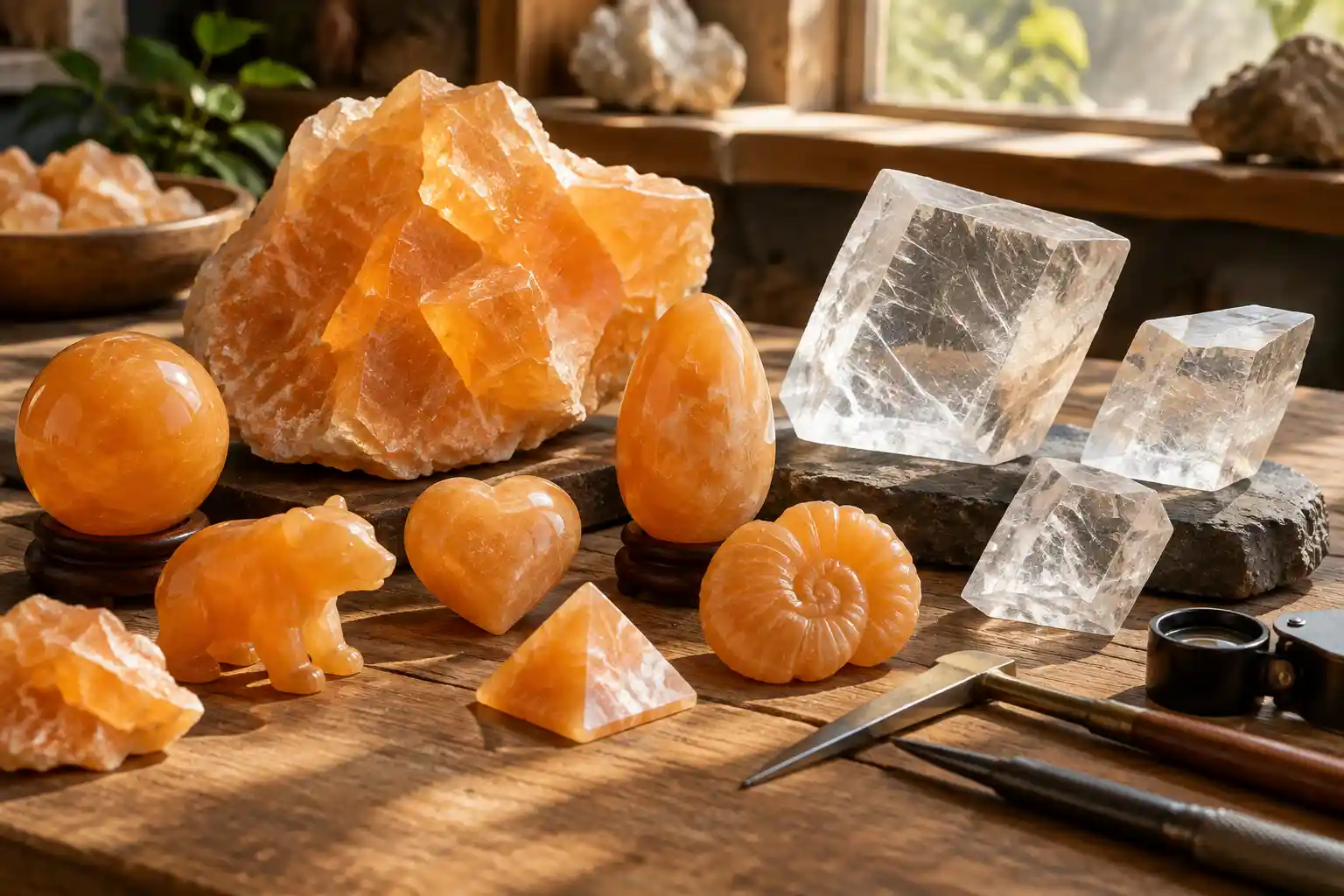
Orange Calcite benefits are easiest to understand by starting with ordinary calcite mineralogy. Orange Calcite is a color variety of calcite, calcium carbonate with the formula CaCO₃, rather than a separate mineral species. It belongs to the trigonal crystal system, has a Mohs hardness of only 3, shows perfect rhombohedral cleavage, and reacts readily with weak acids. Its warm orange, honey, peach, or reddish-orange appearance comes from impurities, trace elements, inclusions, or finely dispersed compounds within the crystal rather than from an entirely different base chemistry.
Calcite is one of the most widespread carbonate minerals on Earth and occurs in an enormous range of geological environments. It forms major components of limestone and marble, develops in hydrothermal veins and caves, fills fractures, occurs with ore deposits, and crystallizes into an extraordinary variety of habits. Orange Calcite brings the same fundamental mineral properties into a visually warmer color range that is especially popular for carvings, polished pieces, decorative objects, and mineral collections.
Modern Orange Calcite benefits often include creativity, motivation, optimism, confidence, emotional warmth, or sacral-chakra symbolism. These interpretations can be personally useful when treated as metaphors connected with color and ritual. They should not be confused with evidence that calcium carbonate crystals treat depression, regulate hormones, improve reproductive health, cure digestive illness, or deliver useful calcium through skin contact.
11 Orange Calcite Benefits at a Glance
- Warm orange, honey, and peach colors create distinctive decorative and collector appeal.
- Calcite mineralogy provides educational value through cleavage, crystal habit, acid reaction, and carbonate chemistry.
- Perfect rhombohedral cleavage demonstrates an important mineral identification property.
- Strong birefringence in clearer calcite specimens helps teach optical mineralogy.
- Some Orange Calcite specimens fluoresce under ultraviolet light, adding collector and educational interest.
- Mohs hardness of 3 allows easy carving and shaping, although it also requires careful handling.
- Polished pieces, spheres, carvings, and display specimens can showcase warm translucent color effectively.
- Geological abundance makes calcite useful for studying carbonate rocks, caves, hydrothermal systems, and mineral formation.
- Modern symbolism can connect orange color with enthusiasm, creativity, warmth, and deliberate action.
- Meditation or journaling can use Orange Calcite as a personal visual cue without requiring medical claims.
- Proper care prevents scratching, cleavage damage, and acid etching while preserving polished surfaces.
Orange Color Gives Calcite a Distinctive Decorative Character
Color is the most immediate feature behind Orange Calcite benefits. While pure calcite can be colorless or white, natural specimens occur in yellow, orange, red, green, blue, brown, gray, and several other hues when trace chemistry, inclusions, defects, or associated compounds affect the crystal.
Orange specimens range from pale peach and honey tones to deeper orange or reddish shades. Transparency can vary from nearly transparent to translucent or cloudy, while polished stones often show swirls, internal cleavage planes, color zoning, or lighter white patches.
The warm coloration gives Orange Calcite a very different visual character from clear Iceland spar or ordinary white calcite even though the underlying mineral species remains the same.
Collectors should therefore separate color variety from mineral identity. “Orange Calcite” describes appearance, while calcite describes the actual mineral.
Calcite Chemistry Gives Orange Calcite Educational Value
One of the strongest Orange Calcite benefits is its usefulness for studying carbonate mineralogy. Calcite has the formula CaCO₃ and is one of the primary minerals used to demonstrate the carbonate group’s physical and chemical behavior.
A drop of dilute acid placed on calcite produces vigorous effervescence as the carbonate reacts and carbon dioxide gas is released. Even relatively weak acids can attack polished surfaces over time.
This property has practical geological value because field geologists commonly use acid reaction to distinguish carbonate-rich rocks and minerals from many non-carbonates.
General Calcite benefits also extend far outside gemstone use because calcite is a major component of limestone and has immense importance in geology, construction, cement, industrial chemistry, and environmental systems. Orange Calcite is a visually attractive example of the same scientifically significant mineral.
Rhombohedral Cleavage Makes Calcite Easy to Recognize
Perfect cleavage is another defining physical property behind Orange Calcite benefits. Calcite breaks readily along three directions that do not meet at right angles, producing characteristic rhombohedral fragments.
This makes classroom specimens extremely useful because cleavage can often be observed directly without sophisticated equipment. A broken stone may reveal repeated smooth planar surfaces whose orientation reflects the internal crystal structure.
Cleavage also creates an important jewelry limitation. A calcite carving can look substantial but split along a cleavage plane if struck sharply. Thin edges and points are especially vulnerable.
Collectors should therefore distinguish hardness from toughness. Calcite is both soft enough to scratch readily and susceptible to cleavage damage. A polished Orange Calcite object belongs on a protected display surface rather than in a setting exposed to repeated impact.
Strong Birefringence Adds Optical Interest
Calcite is famous for strong birefringence, particularly in transparent specimens such as Iceland spar. When an object is viewed through a suitable clear calcite crystal, two images can appear because light entering the mineral divides into two rays traveling with different optical behavior.
Orange Calcite may be too cloudy or strongly colored to display this effect as clearly as high-quality transparent calcite, but the underlying mineral property remains part of its scientific identity.
This makes the stone useful for introducing optical concepts including double refraction, polarization, and anisotropy. A collection containing transparent calcite and colored varieties can demonstrate how color and inclusions influence what the observer sees while the basic mineral structure remains related.
The optical behavior provides real educational Orange Calcite benefits without requiring any claim about invisible human energy fields.
Fluorescence Can Add Collector Interest
Some calcite specimens fluoresce under ultraviolet light, sometimes displaying orange, red, pink, white, or other responses depending on trace chemistry and activators.
Manganese is a well-known fluorescent activator in calcite under suitable conditions, although other impurities can enhance, modify, or suppress fluorescence. Not every orange specimen will fluoresce strongly, and body color under daylight does not automatically predict ultraviolet response.
This variation makes UV examination useful for collectors. Two visually similar specimens may react very differently under shortwave or longwave ultraviolet illumination.
Fluorescence should also be described accurately. A glowing response under UV is an optical phenomenon caused by electronic interactions within the mineral. It is not evidence that the crystal continuously emits healing energy under ordinary conditions.
Softness Makes Orange Calcite Easy to Carve but Easy to Damage
Mohs hardness 3 creates both an advantage and a limitation among Orange Calcite benefits. The mineral is relatively easy for lapidaries and carvers to shape compared with quartz, topaz, sapphire, or other harder gems.
This allows Orange Calcite to be made into spheres, eggs, bowls, figurines, towers, palm stones, cabochons, beads, and decorative freeforms with relatively modest cutting effort.
The same softness makes polished surfaces vulnerable. Everyday dust can contain harder quartz grains capable of scratching calcite. Metal objects, harder gemstones, and abrasive cleaning cloths can also mark the surface.
Calcite carvings should therefore be handled as decorative mineral objects rather than highly durable household items. Careful display and storage preserve polish far more effectively than repeated repolishing.
Orange Calcite Works Best in Protected Decorative Uses
Because of low hardness and perfect cleavage, Orange Calcite is more practical for display pieces than for demanding jewelry. Pendants or earrings can be possible when protected, but rings and bracelets expose the stone to significantly greater abrasion and impact.
Large polished pieces can be especially attractive because thicker translucent sections intensify the warm orange color. Spheres and carvings allow light to enter from several angles, revealing cloudy zones, internal fractures, and color variations.
Mineral specimens offer another approach. Natural crystals preserve geological form and may be more scientifically valuable than a polished carving.
Neither format is inherently superior. A collector may prefer natural crystal habit, while someone decorating a room may value the warm color of a polished object.
Geological Context Adds Depth to Orange Calcite Benefits
Calcite forms in many environments, giving Orange Calcite benefits substantial geological context. It can precipitate from groundwater, crystallize in caves as stalactites and stalagmites, occur in sedimentary rocks, develop during metamorphism of limestone, fill hydrothermal veins, or grow alongside metallic ore minerals.
This widespread occurrence makes locality information useful. Two orange specimens from different regions may have different impurities, crystal habits, associations, fluorescence, and geological histories.
Collectors should therefore avoid assuming that all Orange Calcite comes from one famous source. Commercial stones can originate from several regions, and appearance alone may be insufficient to prove locality.
A documented specimen can tell a geological story extending far beyond color. Associated minerals and host rock may reveal the environment in which the calcite formed.
Creativity and Motivation Are Modern Symbolic Interpretations
Orange color strongly influences modern Orange Calcite benefits. In contemporary color symbolism, orange commonly suggests enthusiasm, warmth, sociability, creativity, movement, or optimism.
Someone may keep a polished stone near an art desk as a reminder to begin rather than endlessly refine an idea. Another person may associate it with energy because the warm hue feels visually lively.
The stone does not neurologically create creativity or motivation. The usefulness comes from symbolic association and repeated habit.
The ideas behind Orange Calcite meaning are therefore strongest when the stone’s real orange appearance is allowed to inspire personal themes without implying biological effects.
Sacral-Chakra Associations Are Spiritual Rather Than Anatomical
Modern crystal traditions frequently connect Orange Calcite with the sacral chakra because orange is commonly assigned to that chakra within contemporary energy systems. Associated themes may include creativity, pleasure, emotional expression, relationships, or sexuality.
Chakras belong to spiritual frameworks rather than scientifically established anatomical structures. An Orange Calcite stone placed near the lower abdomen has not been shown to regulate reproductive organs, hormones, fertility, digestion, kidney function, or sexual-health conditions.
Someone can still use the stone during meditation or spiritual ritual if the framework is meaningful to them. The claim should remain spiritual rather than medical.
Descriptions under Orange Calcite healing properties require the same boundary. Personal spiritual practice should not substitute for diagnosis or treatment.
Calcium Content Does Not Mean the Stone Supplements the Body
Calcite is calcium carbonate, so Orange Calcite genuinely contains calcium. This fact is sometimes misinterpreted in wellness marketing.
Holding, wearing, or placing a calcite stone on the body does not provide a controlled dietary dose of calcium. The calcium is chemically incorporated into the mineral, and ordinary skin contact does not convert the stone into a nutritional supplement.
The same principle applies to other elements that may contribute to color. Chemical composition should not be translated automatically into bodily benefit.
A mineral can contain biologically important elements without being a safe or effective route for delivering them to humans.
Meditation and Journaling Can Use Orange Calcite Responsibly
Orange Calcite can function well as a visual focus because its warm color is easy to associate with particular intentions. Someone may keep a stone beside a journal while planning a creative project or use it during meditation focused on confidence or willingness to begin something new.
Repeated association can make the object personally meaningful. Seeing it may become a cue to write, sketch, practice music, or return to a project.
The practical value lies in routine and attention rather than a proven energy mechanism.
If motivation problems are connected with depression, severe anxiety, neurological illness, or another health condition, a gemstone ritual should not replace appropriate professional support.
Orange Calcite Requires Careful Cleaning and Storage
Care is among the most important practical Orange Calcite benefits because damage is easy to prevent once the mineral’s properties are understood.
Acids should be avoided. Vinegar, lemon juice, acidic bathroom cleaners, and many commercial products can etch calcite because calcium carbonate reacts readily with acid.
Abrasive powders should also be avoided because Mohs hardness 3 makes the surface easy to scratch. Gentle wiping with a soft cloth is preferable, and a small amount of mild soap with water can be used carefully when the specimen and setting allow it.
Separate storage protects polished pieces from harder stones. Dropping a carving onto tile or stone can cause cleavage fractures even when the object appears thick.
What Orange Calcite Benefits Do Not Include
Orange Calcite benefits do not include scientifically established treatment for depression, anxiety, infertility, hormonal disorders, digestive illness, kidney problems, sexual dysfunction, chronic fatigue, pain, or other medical conditions.
The orange color does not prove neurological stimulation, and calcium carbonate does not enter the body therapeutically through ordinary skin contact.
Spiritual themes involving creativity, optimism, confidence, or sacral-chakra practice can remain personally meaningful when clearly distinguished from medical treatment.
Conclusion
Orange Calcite benefits combine warm natural color, calcium carbonate chemistry, perfect rhombohedral cleavage, strong optical properties, occasional fluorescence, geological importance, carving potential, collecting value, and modern symbolism.
Its Mohs hardness of 3, brittle nature, perfect cleavage, and acid sensitivity require careful use and storage. Creativity, enthusiasm, warmth, and spiritual chakra symbolism can remain personal interpretations, while health claims require evidence that Orange Calcite does not provide.
FAQs
What are the main Orange Calcite benefits?
The strongest Orange Calcite benefits include attractive warm coloration, educational carbonate mineralogy, crystal and cleavage study, optical interest, potential fluorescence, collector appeal, carving use, and personal symbolism. Modern traditions also associate the stone with creativity, optimism, motivation, and sacral-chakra themes, but these are not scientifically demonstrated medical effects.
What is Orange Calcite made of?
Orange Calcite is calcite, calcium carbonate with the formula CaCO₃. It is a color variety of the mineral rather than a separate species. Trace chemistry, inclusions, impurities, structural defects, or associated compounds can contribute to its orange, peach, honey, or reddish appearance.
How hard is Orange Calcite?
Calcite has a Mohs hardness of 3. This makes it much softer than quartz and vulnerable to scratches from many common objects and harder gemstones. Its perfect cleavage also means a strong blow can cause the stone to split along predictable planes.
Why does Orange Calcite react with vinegar?
Calcite is calcium carbonate and reacts readily with acids. Vinegar contains acetic acid, which can attack the surface and produce carbon dioxide bubbles. For this reason, acidic cleaners should never be used to clean polished Orange Calcite.
Can Orange Calcite fluoresce?
Some calcite specimens fluoresce under ultraviolet light, and the response may be orange, red, pink, white, or another color depending on trace chemistry. Manganese can act as an activator under suitable conditions. Not every Orange Calcite specimen fluoresces strongly.
Is Orange Calcite suitable for jewelry?
It can be used in protected pendants, earrings, beads, or occasional-wear pieces, but its low hardness and perfect cleavage make it vulnerable in rings and bracelets. Orange Calcite is generally better suited to carvings, polished display stones, mineral specimens, and protected jewelry than to demanding daily wear.
Why is Orange Calcite associated with creativity?
Its warm orange color is commonly associated in modern color symbolism with enthusiasm, movement, creativity, and sociability. Contemporary chakra traditions also connect orange with the sacral chakra. These are symbolic interpretations rather than proof that the mineral changes creative ability or brain function.
Does Orange Calcite provide calcium to the body?
No established evidence shows that wearing or holding Orange Calcite provides a useful nutritional dose of calcium. Calcium is chemically incorporated into the mineral structure. Dietary calcium and medically appropriate supplementation involve entirely different biological pathways.
Can Orange Calcite help with motivation?
Someone may use the stone as a personal cue while planning, journaling, or beginning creative work. This symbolic routine may feel useful, but Orange Calcite has not been shown to medically alter motivation, depression, fatigue, or neurological function.
How should Orange Calcite be cleaned?
Use a soft cloth and, when appropriate, a small amount of mild soap with water. Avoid vinegar, citrus cleaners, acids, abrasive powders, steam, aggressive ultrasonic cleaning, and rough handling. Separate storage helps prevent harder stones from scratching the surface.
Are Orange Calcite healing benefits scientifically proven?
No. Orange Calcite has not been shown to diagnose, treat, cure, or prevent physical or mental-health conditions. Claims involving fertility, hormones, digestion, emotional healing, sexual health, depression, or chakra-based physical effects belong to spiritual traditions rather than established medicine.
Orange Calcite benefits involving healing energy, emotional treatment, reproductive wellness, motivation, or chakra effects reflect modern spiritual and personal interpretation and should not replace qualified physical or mental-health care.