
Orange Calcite Meaning, Properties, Identification & Value

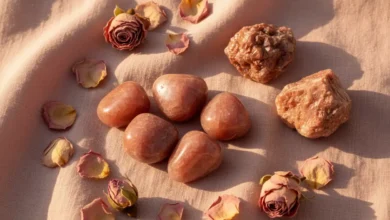
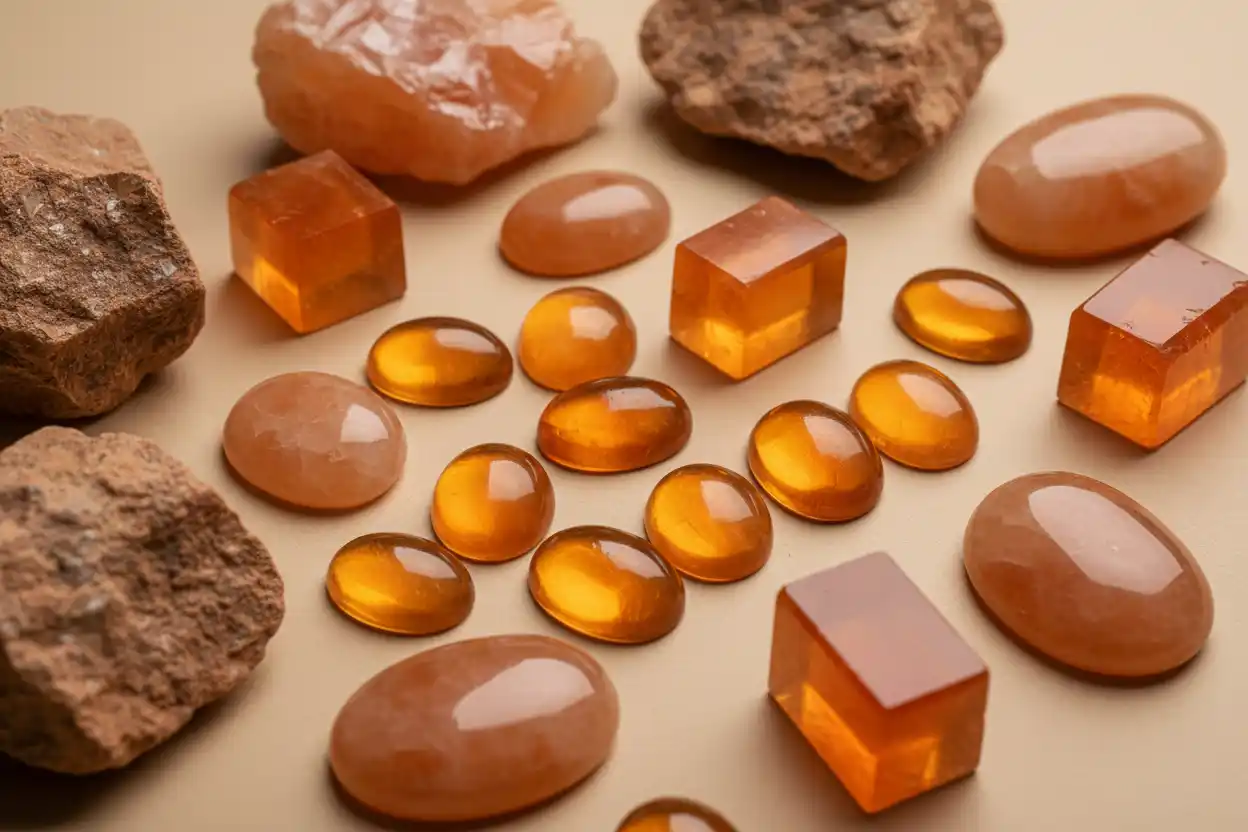
Orange calcite is a yellow-orange to reddish-orange color variety of calcite, the calcium-carbonate mineral CaCO₃. Much commercial material is translucent to opaque and occurs in massive veins or blocks suitable for palm stones, carvings, spheres, towers, beads, and occasional cabochons.
It remains calcite rather than a separate mineral species. Its orange appearance commonly results from iron-bearing inclusions or impurities, including microscopic hematite and related iron oxides, although the exact cause can vary between deposits.
Orange Calcite at a Glance
| Property | Orange calcite |
|---|---|
| Material type | Color variety of calcite |
| Composition | Calcium carbonate, CaCO₃ |
| Mineral group | Calcite group |
| Common colors | Pale peach, apricot, yellow-orange, amber, pumpkin orange, red-orange, brown-orange, and banded cream-orange |
| Crystal system | Trigonal |
| Typical habit | Massive, granular, rhombohedral, scalenohedral, veined, banded, botryoidal, and crystal clusters |
| Luster | Vitreous; pearly on cleavage surfaces; waxy after polishing |
| Transparency | Transparent to opaque |
| Mohs hardness | 3 |
| Cleavage | Perfect rhombohedral cleavage in three directions |
| Tenacity | Brittle |
| Fracture | Conchoidal to uneven outside cleavage |
| Specific gravity | Approximately 2.71 |
| Common uses | Mineral specimens, carvings, spheres, towers, palm stones, cabochons, beads, lamps, and decorative objects |
| Main care concern | Scratching, cleavage, acid etching, impact, prolonged soaking, and iron-rich or filled fractures |
Orange Calcite Is a Color Variety
Calcite has one essential calcium-carbonate structure but appears in many colors because of included minerals, trace elements, defects, organic material, and surface staining.
The parent calcite guide owns the mineral’s family-level formation, global occurrence, optical properties, and broader symbolism.
Orange calcite’s unique identity comes from its peach-to-red-orange appearance, common massive lapidary form, iron-bearing color components, lookalikes, and color-specific market.
It should not receive a separate chemical formula. A seller listing orange calcite as a unique calcium-iron mineral misunderstands the difference between a color variety and a mineral species.
The wider relationship among blue, green, yellow, honey, white, red, and manganese-bearing material appears in the guide to types of calcite.
What Causes the Orange Color?
Pure calcite is colorless. White material generally appears pale because of microscopic inclusions, fractures, grain boundaries, or light scattering.
In many orange calcites, finely dispersed hematite or other iron-oxide particles create peach, orange, red-orange, and brown tones.
Iron may also occur as a trace impurity or within associated minerals. Goethite, limonite-like alteration mixtures, clay, organic compounds, and surface staining can modify the final color.
The same color name can therefore describe several microscopic causes. One piece may contain evenly distributed iron particles, while another has orange zones concentrated along fractures or growth bands.
Heat, weathering, and oxidation can alter iron-bearing components. However, orange calcite should not be assumed heated merely because its color appears strong.
The broader relationship between calcite colors and modern symbolism is covered in calcite color meaning.
How Orange Calcite Forms
Calcite forms in sedimentary, hydrothermal, metamorphic, igneous, cave, and near-surface environments.
Orange massive calcite commonly fills fractures, veins, and cavities. Mineral-bearing fluids deposit calcium carbonate while iron-rich particles or staining create warm color.
Some material forms within limestone or marble. Other pieces occur in hydrothermal veins with quartz, fluorite, barite, sulfides, dolomite, or additional calcite generations.
Cave deposits can develop through calcium-carbonate precipitation from groundwater. Iron carried through soil and rock may stain parts of the deposit yellow, orange, or brown.
Repeated growth stages produce banding. A polished tower can therefore contain pale cream calcite, deeper orange zones, white veins, and transparent areas.
Not all orange decorative material sold as calcite is one crystal. Large carvings often come from fine-grained aggregates containing fractures, iron-rich seams, and several growth generations.
Important Commercial Sources
Mexico supplies much of the massive orange calcite sold as palm stones, carvings, rough blocks, and decorative objects. Material may range from pale peach to deep reddish orange.
Madagascar also supplies polished orange and yellow-orange calcite, including spheres, freeforms, hearts, and towers.
Pakistan and China produce orange, yellow, red-orange, and iron-stained calcite specimens as well as carved material.
Poland has produced bright orange crystal clusters, while the United States, Namibia, Romania, Brazil, and many other countries contain iron-colored calcite occurrences.
A country name does not establish exact identity or value. Calcite is widespread, and similar orange material can form in unrelated geological environments.
Mine-level provenance matters more for crystal specimens than for inexpensive mass-produced palm stones.
Crystal and Massive Orange Calcite
Transparent orange calcite crystals can show rhombohedral, scalenohedral, tabular, or complex forms. Their clarity, termination quality, and associated minerals attract specimen collectors.
Massive orange calcite lacks obvious external crystal faces. It is cut into decorative shapes that emphasize color, banding, and translucency.
A polished carving may reveal straight cleavage lines or internal reflective planes. These features can be natural but may also become future breakage paths.
Crystal clusters and massive material follow different markets. A rare undamaged crystal association may command more than a substantially larger polished tower.
A seller should not use specimen terms such as terminated, optical grade, or crystal cluster for ordinary massive carving rough.
Orange Calcite and Honey Calcite
Honey calcite usually ranges from warm yellow and golden amber to brownish honey tones. It often appears clearer or more golden than typical orange calcite.
Orange calcite commonly has stronger peach, apricot, pumpkin, or red-orange components.
The boundary remains commercial rather than formally mineralogical. Two sellers may assign different names to the same yellow-orange piece.
Color should therefore be described directly rather than relying only on honey, orange, amber, or golden labels.
Transparency, banding, locality, treatment, and structure provide more useful information than the chosen color name.
Orange Calcite and Yellow or Red Calcite
Yellow calcite has a lemon, straw, cream-yellow, or golden-yellow body without dominant orange-red coloration.
Red calcite contains stronger brick-red, rust, salmon-red, or deep reddish tones.
Orange calcite occupies the visual range between them. Natural pieces can grade from yellow through orange into red within a single block.
For that reason, a strict boundary cannot be established from a color photograph alone.
The name should reflect the dominant face-up appearance while acknowledging the material’s continuous color variation.
Orange Calcite and Mangano Calcite
Mangano calcite contains measurable manganese substituting for calcium and commonly appears pale pink to deeper rose.
Peach mangano calcite can resemble light orange calcite. Fluorescence, chemistry, color distribution, and associated minerals can help separate them.
Some sellers use peach calcite for pale orange material and others for warm pink manganese-bearing calcite. The trade term alone is therefore ambiguous.
Laboratory spectroscopy or chemical analysis can determine whether manganese contributes substantially to the specimen.
A pink response under ultraviolet light may support further investigation but does not prove mangano calcite by itself.
Orange Calcite and White Calcite
White calcite often appears as bands, veins, or cloudy patches inside orange massive material.
These pale sections may represent later calcite growth, fewer iron-rich inclusions, or differences in grain structure.
Strong white-orange banding can be decorative, but it also creates commercial confusion with banded calcite sold as onyx marble or Mexican onyx.
True quartz onyx is much harder and belongs to the chalcedony family. Many orange-and-white decorative objects marketed as onyx are actually banded calcite.
Orange Calcite and Aragonite
Aragonite has the same CaCO₃ chemistry as calcite but a different crystal structure.
Aragonite is orthorhombic and generally harder and denser. It may form radiating clusters, pseudohexagonal twins, stalactitic masses, or banded material.
Orange and brown aragonite can resemble iron-rich calcite, particularly after polishing removes crystal habit.
Raman spectroscopy, X-ray diffraction, density, cleavage, and optical testing provide reliable separation.
Because aragonite can transform into calcite over geological time, some specimens contain complex replacement or intergrowth relationships.
Orange Calcite and Carnelian
Carnelian is orange-to-red microcrystalline quartz rather than calcium carbonate.
Carnelian has a Mohs hardness near 7 and resists scratching much better than calcite. It also lacks calcite’s perfect rhombohedral cleavage and strong acid reaction.
Calcite commonly looks softer, milkier, and more strongly banded or cleaved. Carnelian often has a waxy translucency with greater resistance to wear.
Acid testing can damage calcite and should not be performed on finished objects. Non-destructive gemological methods are preferable.
Identifying Orange Calcite
Low hardness provides an important clue. Orange calcite scratches more easily than glass, quartz, agate, and most everyday dust.
Its perfect cleavage can create repeated rhombohedral planes. Polished pieces may show straight internal reflections or chipped corners following those directions.
Transparent calcite displays strong birefringence. Text or a line viewed through a clear cleavage piece can appear doubled.
A drop of dilute acid produces effervescence as carbon dioxide is released. This test permanently etches the surface and is inappropriate for jewelry, carvings, or valuable specimens.
Magnification may reveal iron-rich particles, growth bands, cleavage, resin-filled cracks, dye, and surface coating.
Professional identification uses refractive index, birefringence, spectroscopy, X-ray diffraction, and chemical analysis. The workflow in how to identify crystals explains when those methods become necessary.
Hardness, Cleavage, and Durability
Calcite defines hardness 3 on the Mohs scale. A copper coin, steel point, quartz grain, or many household surfaces can scratch it.
The comparative position appears in the gemstone hardness chart.
Perfect cleavage creates an additional weakness. A blow can split calcite along smooth rhombohedral planes even when the surface shows few earlier scratches.
The distinction between surface hardness and breakage resistance is explained in gemstone toughness versus hardness.
Orange calcite is therefore better suited to display objects, pendants, earrings, and protected cabochons than to exposed everyday rings.
Large towers and spheres should sit on stable surfaces. A fall onto tile or stone can remove corners or split the object.
Jewelry Suitability
Orange calcite cabochons can produce attractive pendants, earrings, brooches, and occasional-wear rings.
A bezel provides better edge support than prongs. Nevertheless, excessive setting pressure can activate cleavage and split the stone.
Drill holes should have sufficient surrounding material. Thin bead walls can chip under wire, cord, or knot pressure.
Bracelets receive frequent knocks and abrasion, so calcite beads may lose polish faster than quartz beads.
A ring should remain low and protected. It should be removed before housework, gardening, exercise, bathing, or food preparation.
Calcite’s soft surface can still be repolished by a lapidary, but repeated refinishing changes dimensions and may expose internal fractures.
Treatments and Imitations
Most orange calcite receives no treatment beyond cutting and polishing. However, porous or fractured material may be stabilized with resin.
Clear filler can improve surface smoothness and hold weak areas together. It may appear as glossy material within cracks or pits.
Dye can intensify orange, red, brown, or yellow. Concentrated color around fractures and drill holes raises suspicion.
Oil, wax, and clear coatings may deepen color temporarily or increase gloss. Coatings can scratch, peel, or turn cloudy.
Pressed calcite powder combined with binder can imitate natural stone. Glass, resin, gypsum, aragonite, dyed marble, and banded carbonate products may also be mislabeled.
Treatment processes are explained in gemstone treatments.
Current Orange Calcite Asking Prices
Orange calcite is generally affordable because the mineral is abundant and much commercial material is massive rather than gem transparent.
| Orange calcite product | Broad retail asking range |
|---|---|
| Small tumbled stone | About $2–$7 |
| Small rough piece | About $3–$15 |
| Palm stone or heart | About $8–$30 |
| Small tower or freeform | About $12–$50 |
| Medium sphere | About $20–$80 |
| Large tower, sphere, or carving | About $50–$200 or more |
| Standard cabochon | About $5–$25 |
| Simple pendant or bracelet | About $15–$100 |
| Attractive crystal cluster | About $15–$150 |
| Fine, large, unusual, or documented specimen | About $150–$500 or more |
These figures represent broad current asking ranges rather than appraisals or expected resale values.
A rare crystal cluster, historic locality specimen, or artistic carving may exceed the price of ordinary polished material substantially.
What Gives Orange Calcite Value?
Color quality matters, but strong saturation should still appear natural. Balanced peach, amber, or orange can be more attractive than muddy brown.
Translucency raises the appeal of carvings and spheres because light reveals internal bands and growth zones.
Crystal form drives specimen value. Sharp undamaged terminations, unusual habits, attractive matrix, and mineral associations matter more than orange color alone.
Structural condition is essential. Open cleavage cracks, crushed corners, chalky zones, resin pools, and deep scratches reduce desirability.
Cutting quality affects symmetry, polish, flatness, and whether weak seams were placed at vulnerable edges.
Large size increases decorative value only when the object remains stable and well finished.
Verified locality can add collector interest, while unsupported labels such as rare Mexican fire calcite or volcanic orange crystal add little.
Buying Orange Calcite
Ask whether the item is crystalline calcite, massive calcite, banded calcite, aragonite, or another carbonate rock.
View the product in neutral lighting. Warm light and digital saturation can turn pale yellow calcite into deep orange.
Inspect edges and the reverse for cleavage, cracks, resin, dye, and coating. Glossy material inside fractures may indicate filling.
For towers and spheres, check whether the base is stable and whether major cracks extend through the object.
Avoid paying a premium for hardness, rarity, or water-resistance claims that conflict with calcite’s known properties.
The dedicated orange calcite buying guide owns seller checks, fraud risks, and product-specific purchasing decisions.
Orange calcite also appears in the site’s orange crystal directory and orange gemstone directory.
It is indexed alphabetically through the crystals beginning with O directory and the gemstones beginning with O directory.
Cleaning and Storage
Remove dust with a soft dry cloth. For deeper cleaning, use lukewarm water, mild soap, and a soft cloth or brush.
Keep contact with water brief. Fractures, dye, resin, glue, matrix, and iron-rich seams can respond differently from solid calcite.
The broader guidance in which crystals can and cannot go in water explains why soaking is unnecessary even when brief washing is manageable.
Avoid vinegar, lemon juice, acidic jewelry solutions, bathroom descalers, and strong household cleaners. Acids dissolve and etch calcite.
Do not use ultrasonic or steam equipment. Vibration can extend cleavage cracks, while heat may affect resin and inclusions.
Store the piece separately from quartz, agate, topaz, corundum, and harder jewelry. A padded compartment protects the soft polish and brittle edges.
Orange Calcite Meaning and Symbolism
Modern crystal traditions associate orange calcite with creativity, motivation, confidence, enjoyment, and restarting activity after a stagnant period.
Its warm color often symbolizes sociability, visible expression, curiosity, and the willingness to test an idea rather than waiting for perfect certainty.
The mineral’s strong cleavage can provide a different metaphor: progress requires recognizing structural limits instead of treating every obstacle with greater force.
Because orange calcite is a color variety rather than a culturally universal sacred material, claims of one single ancient meaning should be treated cautiously.
These meanings remain modern, spiritual, artistic, or personal interpretations. Scientific evidence does not show that orange calcite treats illness, increases fertility, changes metabolism, or guarantees emotional transformation.
Frequently Asked Questions
Is orange calcite a separate mineral?
No. It is an orange color variety of the mineral calcite, CaCO₃.
What gives orange calcite its color?
Microscopic hematite and other iron-bearing inclusions commonly create the orange tone. Impurities, staining, and deposit-specific minerals may also contribute.
Is orange calcite the same as honey calcite?
Not exactly. Honey calcite is usually more yellow-gold or amber, while orange calcite contains stronger peach, apricot, or red-orange tones. The commercial boundary is subjective.
Is orange calcite the same as carnelian?
No. Carnelian is hard microcrystalline quartz, while orange calcite is soft calcium carbonate with perfect cleavage.
How can I distinguish orange calcite from aragonite?
Aragonite has a different crystal structure, greater density, and slightly higher hardness. Laboratory analysis may be needed for polished massive material.
Why does orange calcite scratch so easily?
Calcite has a Mohs hardness of 3, so common dust, metal objects, and harder gemstones can abrade it.
Does orange calcite react with vinegar?
Yes. Vinegar is acidic and can produce effervescence while permanently etching or dulling the surface.
Can orange calcite be worn in a ring?
It can be used in a protected occasional-wear ring, but pendants and earrings are safer because calcite scratches and cleaves readily.
Is orange calcite commonly dyed?
Naturally orange material is widely available, but dye can still be used to intensify weak color. Check fractures and drill holes for concentrated pigment.
Can orange calcite go in water?
Brief gentle washing is generally manageable for solid untreated material. Avoid soaking fractured, dyed, filled, glued, or matrix-bearing pieces.
Does orange calcite fluoresce?
Some orange calcite fluoresces under ultraviolet light, but response varies according to impurities, activators, and locality. Fluorescence does not prove identity alone.
What makes orange calcite valuable?
Natural color, translucency, crystal form, size, condition, locality, polish, structural stability, treatment disclosure, and craftsmanship all influence value.
Orange calcite is most convincing when evaluated as soft iron-colored calcite rather than as a rare orange gem. Its position among neighboring yellow, honey, red, white, and manganese-bearing materials becomes clearest within the complete calcite color and variety system.
Calcite is not intended for ingestion or mineral-infused drinking water. Cutting, drilling, or grinding can release fine carbonate dust and dust from iron-rich or unknown inclusions; use wet methods, effective extraction, eye protection, and suitable respiratory protection.