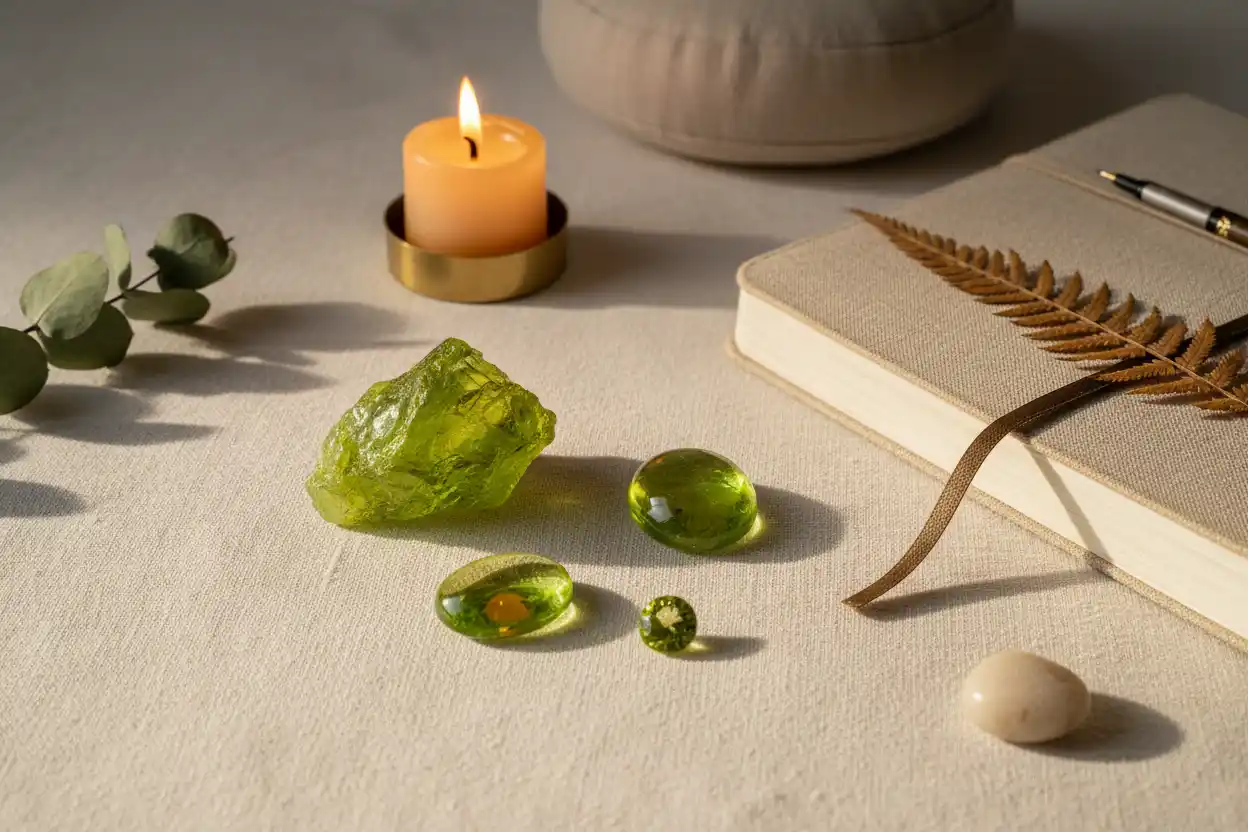
Peridot Healing Properties: 12 Claims, Ancient Lore & Safe Use
Peridot healing properties are commonly associated with optimism, confidence, emotional balance, motivation, resilience, self-worth, relationship awareness, patience, concentration, adaptability, gratitude, and spiritual protection. Its distinctive yellow-green to olive-green color has linked the gem with sunlight, renewal, prosperity, and protection for centuries, yet those associations do not establish a therapeutic mechanism. Peridot has not been demonstrated to treat anxiety, depression, digestive illness, liver conditions, cardiovascular disease, inflammation, pain, hormonal problems, sleep disorders, or another medical condition. Scientifically, peridot is the gem variety of olivine, usually a magnesium-rich member of the forsterite-fayalite series. Its chemistry is often represented as (Mg,Fe)₂SiO₄, it crystallizes in the orthorhombic system, measures about Mohs 6.5 to 7, and owes its natural green color primarily to iron within its structure rather than to surface treatment.
12 Peridot Healing Claims
- Optimism during difficult periods
- Confidence and self-worth
- Emotional balance under stress
- Motivation and purposeful action
- Resilience after setbacks
- Relationship awareness and communication
- Patience before reacting
- Concentration and practical focus
- Adaptability during change
- Gratitude and appreciation
- Release of unhelpful habits
- Spiritual protection and renewal
These twelve themes can support different reflective practices without becoming twelve scientifically verified effects. Many Peridot benefits become more practical when translated into actions such as beginning a delayed task, challenging harsh self-talk, reviewing relationship patterns, slowing down before reacting, or tracking progress after a setback.
Peridot Mineral Facts
Peridot is gem-quality olivine rather than a separate mineral species. Olivine forms a solid-solution series dominated by magnesium-rich forsterite, Mg₂SiO₄, and iron-rich fayalite, Fe₂SiO₄. Most transparent green peridot falls toward the magnesium-rich side of that series.
The gem crystallizes in the orthorhombic system and typically shows vitreous luster. Transparent faceted stones range from yellow-green through olive and rich grass green. Unlike many colored gems, peridot is idiochromatic, meaning an element essential to its chemistry, mainly iron, produces the characteristic color.
That distinction matters because peridot does not need chromium, vanadium, copper, or another trace colorant to become green. Increasing iron can shift the color toward yellowish or brownish green, while attractive gem-quality stones commonly show a lively yellow-green appearance.
Peridot measures about Mohs 6.5 to 7. Its toughness is fair to good, but it remains vulnerable to scratching by quartz-rich dust and harder gemstones. Forsterite has perfect cleavage in one direction and imperfect cleavage in another, while fracture can be conchoidal.
A familiar inclusion in peridot is the so-called lily pad, a rounded disk-like stress fracture often associated with a small mineral crystal. These inclusions can help identify natural peridot under magnification, although not every stone contains them.
Peridot Forms Deep in Earth
Most peridot has an origin very different from quartz, calcite, or feldspar gemstones formed in crustal veins and pegmatites. Olivine is a major constituent of Earth’s upper mantle, and gem-quality crystals can be carried toward the surface in volcanic rocks.
Some commercial peridot occurs as nodules or crystals within basalt and related volcanic rocks. Other notable deposits occur in tectonically exposed mantle rocks or in unusual geological settings where large gem crystals developed.
Pakistan is especially important for large fine peridot. Deposits in the Himalayan region, including the Sapat area of the Kaghan Valley, have produced impressive transparent crystals. Myanmar has also produced large high-quality gems, while Arizona remains an important source of smaller commercial stones.
Peridot can even occur in pallasite meteorites, where olivine crystals are enclosed within nickel-iron metal. Gem-quality extraterrestrial peridot is exceptionally uncommon, so ordinary jewelry peridot should not be assumed to have meteorite origin.
The gem’s deep geological formation makes themes of endurance or inner strength understandable as symbolism, but mantle origin does not create a medical or energetic property.
Peridot Ancient History
Peridot has a genuine history stretching back more than two thousand years. The most famous ancient source is Zabargad Island in the Red Sea, historically also known as St. John’s Island and connected with ancient names such as Topazios.
Ancient writers described green gems from this island, although historical gemstone terminology was not as precise as modern mineralogy. Stones now recognized as peridot were sometimes called topaz or chrysolite, creating confusion when interpreting old texts.
Ptolemaic and Roman traditions valued green olivine from the Red Sea region, and archaeological and written evidence supports gem use in the ancient Mediterranean world. The stone later became connected with ideas about light, protection, and relief from nighttime fears.
This genuine cultural history makes an ancient-lore section appropriate for peridot, but it still does not prove present-day claims involving mood, digestion, hormones, detoxification, or immunity.
The Peridot meaning associated with sunlight, abundance, renewal, and protection reflects a combination of historical lore and later spiritual interpretation rather than one continuous medical tradition.
Optimism and Confidence
Optimism Through Constructive Attention
Peridot’s bright green color has long encouraged positive symbolism. The gemstone cannot biologically create optimism or change neurotransmitters through skin contact. A useful practice is to identify one genuine difficulty, one reason improvement remains possible, and one action that would make progress more likely. Optimism becomes a way of directing attention toward workable possibilities without ignoring the problem.
Confidence Through Evidence
Peridot is also associated with self-worth and confidence. Wearing olivine does not automatically change self-esteem. Before a presentation, conversation, or unfamiliar task, use the gem as a reminder to review what has already been prepared, what skills are available, and what first action remains under personal control.
Emotional Balance and Motivation
Emotional Balance Under Stress
Some practitioners describe peridot as emotionally cleansing or stabilizing. It has not been demonstrated to regulate cortisol, serotonin, or another biological pathway through gemstone contact. A grounded ritual is to separate what happened, what emotion followed, what interpretation may be intensifying it, and what response is actually necessary.
Motivation Through Starting
Bright green peridot is often marketed as energizing. It does not increase metabolic energy or motivation biologically. A more useful routine is to place the stone beside one delayed task and begin for a predetermined period. Starting reduces the gap between intention and action.
Resilience and Relationships
Resilience After Setbacks
Peridot’s mantle origin makes endurance an attractive metaphor, but geological depth does not transfer psychological strength. After a setback, use the gem as a cue to identify what failed, what remains intact, what lesson matters, and how the next attempt should differ.
Relationship Awareness
Peridot is sometimes associated with reducing jealousy, resentment, or conflict. A gemstone cannot make another person loyal or remove difficult emotions automatically. A practical relationship review asks whether expectations are communicated clearly, boundaries are respected, and repeated actions match promises.
Patience and Focus
Patience Before Reacting
Peridot is occasionally linked with emotional release and reduced anger. It cannot biologically suppress anger or impulsivity. It can serve as a reminder to delay a non-urgent response until emotional intensity has decreased enough for clearer judgment.
Concentration Through Structure
Some users keep peridot near work or study areas for focus. The stone has not been shown to improve memory or attention span. Pairing it with one defined task, fewer notifications, and a fixed work interval creates a practical concentration routine.
Adaptability and Gratitude
Adaptability During Change
Peridot reaches Earth’s surface through dramatic geological processes, making change a fitting metaphor. The gemstone cannot make someone more psychologically flexible. When plans fail, use it as a cue to separate the goal from the method. Changing the route can preserve the goal.
Gratitude Through Specific Reflection
Peridot has strong historical associations with prosperity and abundance. A gratitude practice becomes more useful when it identifies specific people, opportunities, skills, or resources rather than expecting the stone to attract wealth. The gem can simply mark a deliberate moment of appreciation.
Habits and Spiritual Protection
Releasing Unhelpful Habits
Peridot is sometimes described as removing old emotional patterns. It cannot extract habits, memories, or resentment from the body. A practical approach is to identify one repeated behavior, determine the trigger that usually starts it, and choose one replacement response that can be practiced consistently.
Spiritual Protection and Renewal
Historical lore around peridot includes protection and light, while contemporary crystal practice often connects it with renewal and abundance. Someone may use the stone during prayer or meditation around these themes without claiming that olivine forms a measurable protective field.
Peridot Chakra Meaning
Peridot is most commonly associated with the heart chakra because of its green color. Modern practitioners connect it with compassion, relationships, emotional renewal, forgiveness, gratitude, and openness. Yellow-green stones may also receive solar plexus symbolism involving confidence and motivation.
Chakras are a spiritual framework rather than anatomical structures. Peridot has not been demonstrated to affect the physical heart, digestive organs, liver, pancreas, endocrine glands, nervous system, or another physiological system through chakra placement.
Historical protection symbolism can remain culturally meaningful without being turned into a medical claim.
Peridot Care and Safety
Peridot has Mohs hardness around 6.5 to 7 and fair to good toughness. It is durable enough for jewelry but requires more care than sapphire, ruby, or diamond. Hard impacts can cause fractures, while quartz and harder gems can scratch the surface.
Store peridot separately from harder stones. Rings should receive more protection than pendants or earrings because hands encounter repeated knocks and abrasive surfaces.
Warm soapy water is the preferred cleaning method. Use a soft brush and rinse gently. Steam and ultrasonic cleaners are not recommended because rapid or uneven heating and vibration can contribute to fracture.
Peridot is stable to ordinary light, but sudden or uneven heat can crack it. Strong acids are also unsuitable. Sulfuric acid can attack the mineral readily, while hydrochloric acid can also damage it. Long exposure to acidic perspiration may affect polished surfaces over time, so wiping jewelry after wear is sensible.
Peridot is rarely treated compared with many colored gemstones. Fracture filling can occur in some stones, and filled gems require especially gentle cleaning.
Anyone buying the stone can use the workbook-verified buy Peridot checks to focus on natural color, clarity, cutting, inclusions, treatment disclosure, and durability rather than healing claims.
Safe Ritual Cleansing
Peridot does not require saltwater, intense sunlight, heat, smoke residue, or chemical exposure for ritual cleansing. There is no scientifically demonstrated unwanted energy that must be removed from olivine.
Sound, intentional breathing, dry placement, reflection, or gentle washing with warm soapy water are low-risk options. A renewal-themed ritual can involve identifying one habit that should end and one concrete action that will replace it.
Avoid steam, flame, acids, abrasive salt, ultrasonic devices, sudden temperature changes, and harsh chemical cleaners.
Conclusion
Peridot combines genuine ancient history with unusual geology. It is green gem-quality olivine formed mainly in Earth’s mantle, carried toward the surface through geological processes, and valued since antiquity at sources such as Zabargad. Its twelve healing themes can support optimism, confidence, resilience, gratitude, and reflection when cultural symbolism remains separate from medical claims.
FAQs
What are the main peridot healing properties?
Common claims include optimism, confidence, emotional balance, motivation, resilience, relationship awareness, patience, concentration, adaptability, gratitude, release, and spiritual protection. These are traditional or contemporary beliefs rather than scientifically proven therapeutic effects.
What is peridot made of?
Peridot is gem-quality olivine, usually magnesium-rich, with chemistry commonly represented as (Mg,Fe)₂SiO₄.
What gives peridot its green color?
Iron is part of olivine’s chemistry and produces peridot’s natural yellow-green to olive-green color.
How hard is peridot?
Peridot measures about Mohs 6.5 to 7 and has fair to good toughness, but it can still scratch or fracture with hard wear.
Does peridot have genuine ancient traditions?
Yes. Peridot from Zabargad in the Red Sea was known in the ancient Mediterranean world, although historical names such as topaz and chrysolite can complicate identification in old texts.
Can peridot come from meteorites?
Yes. Olivine occurs in pallasite meteorites, and rare crystals can be gem quality. Most commercial peridot, however, comes from terrestrial geological sources.
Which chakra is peridot associated with?
Modern crystal practice most commonly links peridot with the heart chakra and sometimes the solar plexus chakra. These are spiritual correspondences rather than anatomical effects.
Can peridot go in water?
Yes. Warm soapy water is the recommended routine cleaning method. Avoid prolonged exposure to harsh chemicals or acids.
Can peridot be cleaned ultrasonically?
Ultrasonic and steam cleaning are not recommended. Warm soapy water and gentle hand cleaning are safer.
Is peridot normally heat treated?
Peridot is rarely treated, and heating is not a standard method used to improve its color. Claims emphasizing “unheated peridot” are therefore usually not meaningful quality distinctions.
Crystal healing claims are traditional or personal beliefs and should not replace qualified medical or mental health care.