
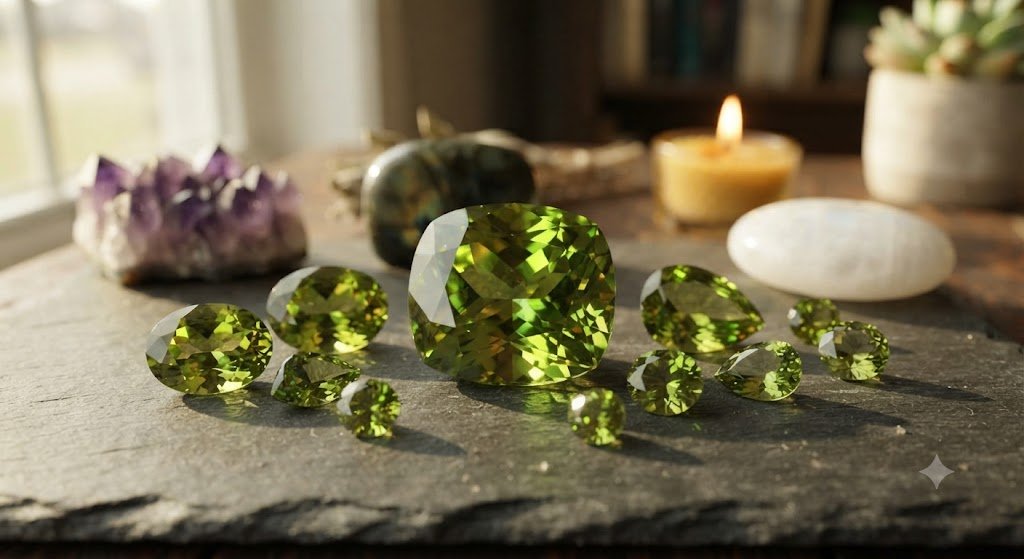

Peridot is the transparent yellow-green to green gem variety of olivine. Its color comes from iron within the mineral’s composition rather than from an unrelated trace element, which is why every natural peridot belongs somewhere within a relatively focused green palette.
The gem has an unusually deep geological identity. Most peridot crystallizes in magnesium-rich rocks associated with Earth’s upper mantle, then reaches the surface through volcanic activity or tectonic processes. Rare gem-quality olivine has even been found inside pallasite meteorites, giving peridot one of the most striking origin stories in the jewelry world.
Across different periods, peridot has represented light, protection, prosperity, renewal and the ability to move beyond resentment. Those meanings come from historical traditions and modern spiritual interpretation rather than scientifically established gemstone effects.
Peridot at a Glance
| Property | Peridot |
|---|---|
| Mineral family | Olivine |
| Common mineral species | Magnesium-rich forsterite |
| General composition | Magnesium–iron silicate |
| Typical color | Yellowish green to green |
| Color cause | Iron within the crystal structure |
| Crystal system | Orthorhombic |
| Luster | Vitreous |
| Transparency | Transparent to translucent |
| Mohs hardness | Approximately 6.5–7 |
| Toughness | Fair to good |
| Cleavage | Poor or indistinct |
| Refractive character | Doubly refractive |
| Common cuts | Oval, cushion, round, pear, emerald, checkerboard |
| Notable inclusions | Dark crystals and reflective “lily-pad” fractures |
| Major sources | Myanmar, Pakistan, Arizona, China, Vietnam, Tanzania and Egypt |
| Birthstone association | August |
| Main care concern | Impact, abrasion and thermal shock |
Peridot belongs to the olivine group, but the two terms do not describe identical search intent. The olivine guide covers the broader mineral family, including its geological range and non-gem forms. Peridot refers specifically to transparent gem-quality olivine suitable for cutting, collecting or jewelry.
What Is Peridot?
Peridot is a magnesium–iron silicate whose gem-quality material usually lies toward the magnesium-rich, forsterite side of the olivine mineral series. Iron substitutes for some magnesium within the structure and creates the characteristic green color.
Unlike sapphire, tourmaline or spinel, peridot does not occur naturally across a broad rainbow of hues. Its identity is tied closely to green. Individual stones may appear greenish yellow, lime green, olive green, yellowish green or a more balanced grass green, but brown and excessive darkness generally reduce desirability.
The name applies to the gem variety, not every piece of green olivine. Material needs sufficient transparency, color and durability to be fashioned into a recognizable gem. Less transparent olivine may remain scientifically important or attractive as a mineral specimen without qualifying as fine peridot.
How Peridot Forms
Olivine is one of the important minerals in Earth’s upper mantle. It crystallizes in magnesium- and iron-rich environments and is common in low-silica igneous rocks such as basalt and peridotite.
Some peridot reaches the surface when volcanic magma carries fragments of mantle rock upward. These fragments, known as xenoliths, may contain green olivine grains embedded within darker minerals. Arizona and parts of China are associated with this basalt-hosted style of occurrence.
Other notable deposits formed where hot fluids altered or recrystallized magnesium-rich mantle rocks that had been pushed toward the surface by tectonic activity. Important peridot sources in Myanmar, Pakistan and the historic Egyptian locality of Zabargad are associated with this broader geological setting.
Once exposed at the surface, olivine weathers more readily than highly resistant minerals such as quartz. As a result, sharp, well-preserved gem crystals require geological conditions that protected them long enough to be recovered.
Peridot from Meteorites
A small amount of gem-quality olivine occurs in pallasites, rare stony-iron meteorites composed partly of nickel–iron metal and partly of olivine crystals.
Transparent meteorite olivine may be faceted, although suitable pieces are scarce, frequently included and often small. Not every green crystal in a pallasite is clean enough for jewelry.
Meteorite origin does not make a gem automatically superior in conventional color or clarity. Its appeal comes primarily from rarity, provenance and extraterrestrial formation. Documentation is essential because a seller’s story alone cannot establish that a loose green gem came from a meteorite.
Earth-mined peridot and pallasite olivine share mineralogical relationships, but they occupy different collecting markets. Most peridot seen in commercial jewelry formed within Earth.
Peridot Color
Peridot’s color range runs from greenish yellow through yellowish green to green. Fine stones generally show lively saturation, an open medium tone and little distracting brown.
A pure or nearly pure green is rare. Nevertheless, color should not be judged by removing every trace of yellow. A vivid yellowish-green stone can be more beautiful than a dark gem marketed as “deep green.”
Larger peridots often show stronger color because light travels through more material. Small calibrated stones can appear lighter even when their underlying composition resembles that of larger gems.
Warm incandescent light may emphasize yellow, whereas cool daylight can make the same stone appear greener. A good peridot remains attractive across ordinary lighting rather than looking impressive only under concentrated display lamps.
The planned green gemstones guide will place peridot beside emerald, green tourmaline, jade, tsavorite, prasiolite and other materials without transferring their identities or value standards onto it.
Clarity and Peridot Inclusions
Fine peridot is often eye-clean, particularly in normal commercial sizes. When inclusions are visible, they commonly include tiny dark mineral crystals or reflective disk-like fractures known descriptively as lily pads.
Lily-pad inclusions may resemble circular or irregular reflective plates surrounding a small crystal or stress point. They can support identification under magnification, but they are not required in every natural peridot.
A discreet inclusion does not necessarily ruin the gem. Its effect depends on size, location, contrast and whether it reaches the surface. Dark spots positioned under the table are more distracting than a small feature near the edge.
Surface-reaching fractures deserve greater caution in rings and bracelets because they can collect dirt and create vulnerable points. An otherwise attractive peridot should not be dismissed for a minor natural feature, but significant durability concerns should be reflected in the setting and price.
Peridot’s Double Refraction
Peridot is doubly refractive, meaning light entering the gem can split into two rays. When viewed through certain directions, back facets may appear doubled.
This feature can be conspicuous under magnification and sometimes visible to the unaided eye in larger stones. It is not the same as a blurred photograph or poor polish.
Cutters account for peridot’s optical behavior when orienting the rough. The goal is to preserve strong color while producing an orderly pattern of reflections. Severe windowing, broad extinction or a visibly crooked outline remains a cutting issue rather than a natural consequence of double refraction.
Peridot Cuts and Shapes
Peridot appears in most standard faceted shapes, including round, oval, cushion, pear, marquise, emerald and radiant-style cuts. Ovals and cushions are especially common because they preserve useful weight from irregular rough.
Brilliant cuts produce lively flashes, while step cuts emphasize color and clarity. Mixed cuts combine a brilliant-style crown with a step-cut pavilion. Checkerboard crowns are also seen in larger stones and create a textured pattern across the surface.
Cabochons are less common in transparent fine material but may be used for included, translucent or phenomenal peridot. Beads and carvings allow lower-clarity material to be used without pretending it meets faceting standards.
A rare piece of rough does not justify poor execution. A finished gem should still distribute color across the face and avoid a large transparent window.
Historic Zabargad Peridot
Zabargad Island in the Red Sea is the most famous historic peridot source. The island was known in the Greco-Roman world as Topazios, and its green stones contributed to centuries of confusion among peridot, topaz and emerald.
Mining on the remote island dates back more than two thousand years. Golden-green crystals from the locality entered Egyptian, Mediterranean and later European jewelry traditions.
Before modern mineral identification, green gems were frequently named by color, source or appearance rather than chemical composition. Some stones once described as emeralds or topaz were eventually recognized as peridot.
Historic Zabargad gems remain desirable because of their locality and association with ancient trade. Provenance should be documented, since visual appearance alone cannot prove that a cut stone came from the island.
Peridot in Ancient and Medieval Jewelry
Peridot appeared in beads, religious ornaments, talismans and ceremonial jewelry. Its bright color made it suitable for objects associated with sunlight, spiritual protection and wealth.
European church treasures contain green stones that were once regarded as emerald but later identified as peridot. This historical confusion does not mean the gems were fraudulent; mineral species were not classified using modern laboratory criteria.
Stories that every famous ancient emerald collection was actually peridot should be treated cautiously. Historical speculation can be interesting, but it should not be repeated as confirmed provenance without direct evidence.
Modern Peridot Sources
Myanmar has produced large, transparent crystals with deep yellow-green to green color, particularly from the Mogok region. Fine Burmese material may show strong saturation and excellent clarity.
Pakistan became especially important for large peridot crystals recovered from mountainous terrain in the Kohistan region. Some pieces combine impressive size with bright color and high transparency, making them significant for collectors and custom cutters.
Arizona supplies substantial quantities of commercial peridot from the San Carlos Apache Reservation. Much of the material occurs as grains or smaller crystals in basaltic rocks, making it well suited to calibrated jewelry.
China, Vietnam and Tanzania are also important commercial sources. Egypt remains historically prominent, although modern availability from Zabargad is limited compared with major contemporary deposits.
Geographic origin may add collecting interest, yet color, clarity, cut and condition still determine how a particular stone looks. Origin should not be inferred from shade alone.
Is Peridot the Same as Chrysolite?
The name chrysolite has been used historically for several yellow-green or golden gems. In some contexts it referred to peridot, while in others it described materials that modern gemology classifies differently.
Because the term has been applied inconsistently, contemporary sellers should identify the gemstone as peridot or olivine rather than relying on chrysolite alone.
An antique document using the name chrysolite requires contextual interpretation. It should not automatically be treated as proof that the piece contains modern gemological peridot.
Peridot Versus Emerald
Peridot and emerald are both green, but their mineralogy and typical appearance differ. Peridot belongs to olivine and commonly has a yellow component. Emerald is chromium- or vanadium-colored beryl and often shows bluish-green to green color.
Emerald is harder on the Mohs scale, yet it can be heavily fractured and frequently treated with oil or resin. Peridot is generally softer and vulnerable to thermal shock, but fine examples may be comparatively clean.
The dedicated peridot-versus-emerald guide owns the complete side-by-side identification workflow. Color alone should not be used to authenticate either material.
Peridot Versus Prasiolite
Prasiolite is green quartz, whereas peridot is gem-quality olivine. Prasiolite commonly appears pale and cool green, while peridot more often shows a stronger yellow-green component.
The two differ in refractive behavior, density, optical properties and treatment history. Much commercial prasiolite results from heating or irradiation of suitable quartz, while routine appearance-enhancing heat treatment is not associated with peridot.
The planned prasiolite-versus-peridot comparison will retain the full diagnostic boundary.
Peridot Hardness and Durability
Peridot measures approximately 6.5–7 on the gemstone hardness chart. It can resist ordinary light wear but scratches more easily than sapphire, spinel or diamond.
Hardness describes resistance to scratching, not resistance to every form of damage. The distinction is covered in gemstone toughness versus hardness.
Peridot has fair-to-good toughness and can fracture from a hard blow. Rapid or uneven heating creates another risk because thermal shock can open fractures.
The gem has poor or indistinct cleavage, but that does not mean it cannot chip. The gemstone cleavage guide explains why setting pressure, impact and internal features must all be considered.
Earrings and necklaces are comparatively protected uses. Rings and bracelets require secure settings and more deliberate wearing habits.
Peridot Treatments
Peridot is not known for routine heat treatment to improve its color. Therefore, “unheated peridot” should not be presented as an exceptional rarity in the way untreated status may affect some other gemstones.
This does not mean every green object sold as peridot is untreated and authentic. Coatings, assembled products, glass imitations and misleading descriptions can occur.
The gemstone treatments guide owns the wider treatment framework. Buyers should request accurate disclosure without paying an automatic premium for unsupported “untreated” language.
Buying Peridot
Color should lead the evaluation. Look for a lively green or yellowish green that remains attractive under more than one light source. Excessive brown, darkness or grayness generally reduces appeal.
Fine peridot is usually expected to be eye-clean. Next, examine the cut for windowing, asymmetry and unnecessarily deep weight retention.
The complete purchase workflow belongs in the peridot buying guide. Current market ranges and size premiums remain within the peridot price guide.
A laboratory report may be worthwhile for a large, costly or provenance-dependent gem. The gemstone certification guide explains the distinction between an identification report and a retail appraisal, while how to read a gem lab report covers report language.
Peridot Jewelry
Peridot’s lively color works well in yellow gold, which emphasizes warmth, and in white metals, which create cooler contrast.
A peridot bracelet needs secure articulation and protection from wrist impact. Peridot earrings provide a safer format for matched stones and face-framing color.
A peridot necklace can concentrate the budget on one strong gem or distribute color through stations and beads. A peridot ring requires the most careful setting because the hand receives frequent contact.
The August birthstone jewelry guide owns gift combinations involving peridot, spinel and sardonyx.
Cleaning Peridot
Warm water, mild soap and a soft brush provide the safest routine for most peridot jewelry.
Steam and ultrasonic cleaning are not recommended because rapid heat, vibration and existing inclusions may increase risk. Strong acids and harsh household chemicals should also be avoided.
The full procedure belongs in how to clean peridot jewelry safely. Store peridot away from diamonds, sapphires and other harder stones that may scratch it.
Peridot Meaning and Symbolism
Historical and contemporary traditions connect peridot with light, protection, prosperity, renewal and emotional release.
Its sunlight symbolism likely reflects the gem’s bright yellow-green color and ancient association with protection from darkness or nighttime fears. Modern practitioners frequently interpret it as a stone of optimism and purposeful change.
Green also encourages symbolic connections with growth, opportunity and the natural world. However, these meanings differ across periods and communities and should not be presented as universal facts.
Peridot Healing Beliefs
Contemporary crystal-healing traditions associate peridot with confidence, releasing resentment, reducing comparison and beginning again.
These are spiritual or personal-belief practices rather than scientifically proven health effects. The detailed practices, chakra interpretations, meditation methods and safety boundaries belong in the peridot healing properties guide.
A grounded use treats the stone as a reminder of a chosen behavior. It does not assign peridot responsibility for curing anxiety, depression, illness or relationship problems.
Peridot as an August Birthstone
Peridot is one of August’s recognized birthstones, together with spinel and sardonyx in modern lists.
The August birthstone guide owns the month’s history, alternative stones and gifting tradition. Peridot is also associated with the sixteenth wedding anniversary in some modern jewelry conventions.
Birthstone status does not determine gem quality. An August piece should still be assessed for color, clarity, cut, durability and construction.
Peridot and Zodiac Associations
Peridot is often linked with Leo because much of August falls within the sign. Its bright color is interpreted symbolically as confidence, warmth and generosity. The broader sign tradition is covered in the Leo birthstone guide.
Late-August birthdays may connect the gem with Virgo and themes such as renewal, practical growth or releasing excessive self-criticism. The planned Virgo birthstone guide retains that sign-specific intent.
Astrology is a symbolic system rather than a scientifically demonstrated method of predicting personality, health or events.
Frequently Asked Questions
1. What does peridot symbolize?
Peridot has symbolized light, protection, prosperity, renewal and emotional release in different historical and contemporary traditions.
2. Is peridot a type of olivine?
Yes. Peridot is the transparent gem variety of magnesium-rich olivine, commonly associated with the mineral species forsterite.
3. Why is peridot always green?
Iron is part of peridot’s mineral composition and causes its green to yellow-green color. The gem does not naturally occur across the broad color range seen in tourmaline or sapphire.
4. Where does the best peridot come from?
Myanmar and Pakistan are known for fine large material, while Arizona, China, Vietnam and Tanzania are important commercial sources. Quality should still be judged stone by stone.
5. Is peridot from a meteorite?
Most peridot forms within Earth. Rare gem-quality olivine occurs in pallasite meteorites, but extraterrestrial origin requires reliable documentation.
6. What are lily-pad inclusions?
Lily pads are reflective disk-like fractures seen in some peridots, often surrounding a small crystal or stress point. They can support identification under magnification.
7. Is peridot an emerald?
No. Peridot is olivine, while emerald is green beryl. Their composition, optical properties, inclusions, treatment patterns and market values differ.
8. Is peridot treated?
Routine heat treatment is not known to improve peridot’s appearance. Buyers should still watch for coatings, imitations and inaccurate descriptions.
9. Can peridot be worn every day?
Earrings and necklaces can be worn regularly with care. Daily rings and bracelets face greater scratching and impact risk and need protective settings.
10. Is peridot valuable?
Small commercial peridot can be affordable. Value rises with vivid green color, strong clarity, efficient cutting, larger size and credible provenance.
11. What month is peridot’s birthstone?
Peridot is an August birthstone. Spinel and sardonyx are also recognized as August stones in modern traditions.
12. How should peridot be cleaned?
Use warm water, mild soap and a soft brush. Avoid steam, ultrasonic cleaners, sudden heat and harsh chemicals.
Peridot joins an ancient jewelry history with a geological story that begins far below Earth’s surface. Its identity is strongest when the stone is understood on its own terms: not as a substitute for emerald, not as merely green crystal and not as proof of a healing claim, but as the bright gem form of olivine with distinctive color, optical behavior and cultural meaning.
Peridot appears in both Gemstones That Start With P and Crystals That Start With P.
Peridot symbolism, chakra associations and healing interpretations are cultural, spiritual or personal beliefs rather than medical facts. Peridot does not diagnose, prevent or cure illness.