Buy Peridot: How to Choose, Treatments & Value
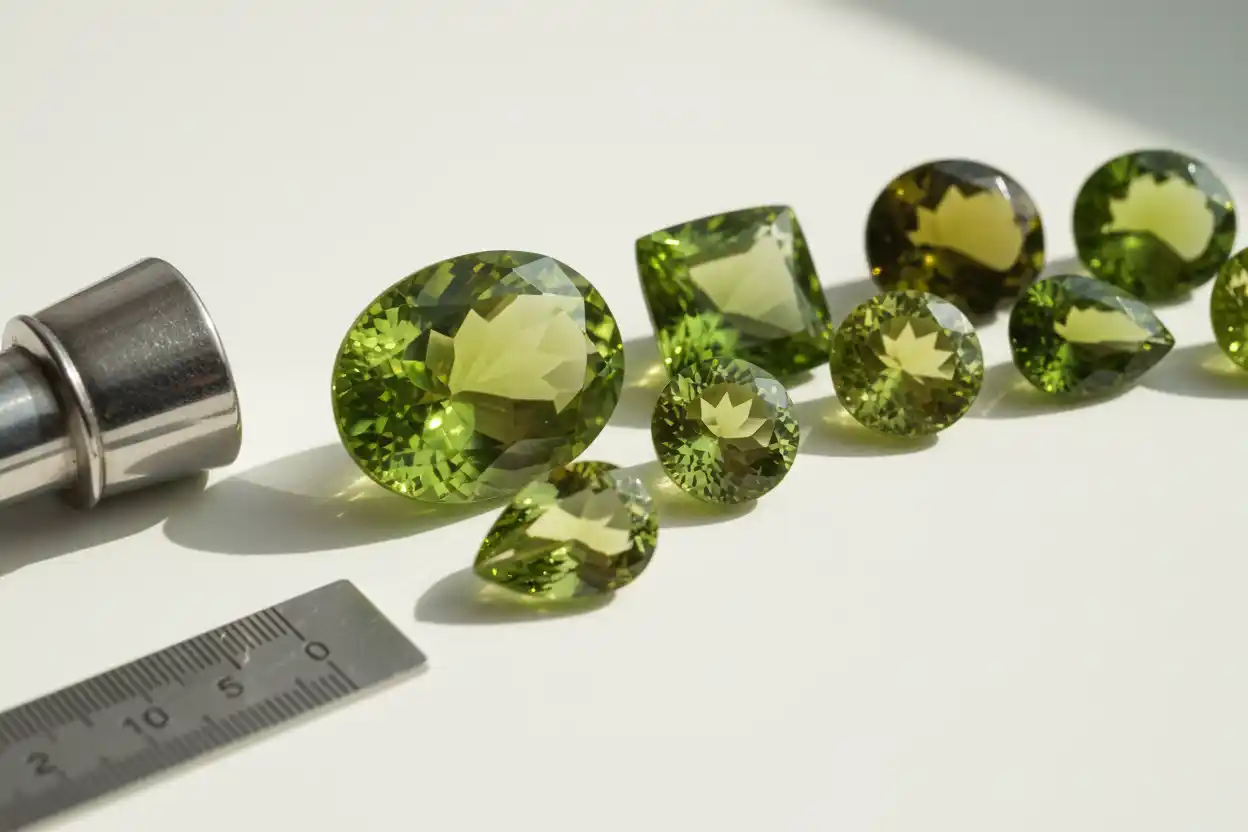
To buy peridot intelligently, prioritize a lively saturated green appearance, good transparency, competent cutting, and freedom from distracting eye-visible inclusions rather than relying on seller grades such as AAA or claims that a stone is unusually valuable because it is “unheated.” Peridot is the gem variety of olivine and obtains its characteristic yellow-green to green color intrinsically from iron within its composition rather than from a trace impurity added to an otherwise colorless host. GIA identifies richly saturated green with minimal brown as the most desirable appearance, while most commercial peridot shows some yellowish-green character. Fine material is typically eye-clean, and the gem’s unusually strong double refraction can cause doubled pavilion-facet edges when viewed through the stone.
Treatment is refreshingly straightforward compared with many colored-stone markets. GIA states that no peridot is known to be routinely heated to improve its appearance and that promoting an ordinary stone as “unheated” is technically true but commercially misleading because heating is not a standard value distinction for the gem. GIA also notes that peridot is rarely treated, although fracture filling can occasionally occur and should be disclosed because filling can change cleaning requirements. This means a buyer’s money is generally better spent on visibly superior color, cut, clarity, face-up size, and workmanship than on unsupported rarity language surrounding treatment.
Buy Peridot At a Glance
| Buying Factor | What to Examine | Why It Matters |
|---|---|---|
| Color | Rich green to slightly yellowish green | Color is the strongest visual quality factor |
| Brown Modifier | Little or no visible brown | Brown generally lowers desirability |
| Saturation | Strong lively green without excessive darkness | Fine color creates the strongest premium |
| Tone | Medium enough to retain brightness | Very pale or overly dark material can look less vivid |
| Clarity | Eye-clean appearance | Fine peridot is normally expected to be relatively clean |
| Dark Inclusions | Visible black mineral crystals | Eye-visible dark inclusions reduce value |
| Lily-Pad Inclusions | Reflective disk-like inclusions | Characteristic but can distract when prominent |
| Cut | Even brilliance, good symmetry, limited windowing | Cutting strongly affects brightness and visible color |
| Double Refraction | Natural doubling of facet edges | Characteristic optical property, not a defect |
| Size | Compare weight with color and dimensions | Fine larger peridot becomes more selective |
| Origin | Pakistan, Myanmar, Arizona, Vietnam, China, historic Zabargad | Fine material comes from several localities |
| Treatment | Usually untreated; ask about fracture filling | “Unheated” is not a meaningful routine premium |
| Seller Grade | Translate AAA/AAAA into actual quality | No universal peridot grading scale exists |
| Durability | Mohs 6.5–7, fair-to-good toughness | Suitable for jewelry with sensible care |
| Cleaning | Warm soapy water | Steam and ultrasonic cleaning are not recommended |
Color Should Be the First Buying Decision
GIA identifies rich green color as the central visual quality factor in peridot and notes that the finest gems approach a pure grass-green appearance, whereas most stones are yellowish green. Brown modifiers generally lower value because they make the gem appear more olive, muddy, or subdued. A buyer should therefore compare several stones side by side before deciding whether a particular listing genuinely deserves a premium. A saturated green gem can look dramatically different from inexpensive commercial material even when both are correctly identified as natural peridot.
Color should be judged in neutral lighting because yellow-gold settings, warm photography, and background colors can alter the perceived balance between green and yellow. A strong stone should remain recognizably lively green under normal daylight-equivalent and indoor lighting rather than looking attractive only beneath intense jewelry spotlights. When purchasing online, video is particularly useful because it shows whether the gem maintains brightness across movement or becomes dark and olive from certain directions.
Pure Green Is Rare Enough to Deserve Attention
GIA notes that the best peridot color is a richly saturated green to slightly yellowish green with no brown component and that this premium appearance is often better developed in larger stones. This does not mean every stone above a particular carat weight becomes fine automatically, but size can allow enough optical path length for strong green to appear more convincingly than in small pale commercial gems.
A medium-toned richly green stone can therefore justify a higher price even when another gem has the same weight and cleaner microscopic clarity. Peridot is a colored gemstone, so visible beauty takes priority over laboratory-style perfection that cannot be appreciated without magnification.
Brown and Excessive Yellow Usually Lower Commercial Appeal
Peridot naturally occupies a yellow-green family, so some yellow is expected and does not make a stone poor quality. The price difference becomes more noticeable when yellow dominates strongly or when brown produces an olive appearance. GIA’s buying guidance explicitly advises consumers to compare stones side by side because color variation can be much more obvious when several qualities are seen together.
Olive-green peridot can still be attractive, particularly in vintage designs, warm gold, or jewelry chosen for affordability. The important distinction is that lower market price may reflect color preference rather than incorrect identity or structural inferiority. Buyers seeking maximum value can sometimes choose slightly more yellow material with excellent cutting and clarity rather than paying heavily for the purest green.
Eye-Clean Clarity Is a Reasonable Expectation
GIA states that fine-quality peridot normally has no eye-visible inclusions, although tiny mineral crystals and other features can appear under magnification. This clarity standard differs sharply from emerald, where obvious inclusions are common even in valuable stones. A conspicuous black crystal or large reflective fracture in the center of a peridot deserves a meaningful discount because cleaner alternatives are readily available in many commercial sizes.
The buyer should still avoid paying excessive premiums for microscopic perfection once a gemstone looks clean to the naked eye. Fine color and competent cutting often create a larger visible improvement than moving from one internally clean stone to another whose minor inclusion differences require magnification to detect.
Lily-Pad Inclusions Are Characteristic but Not Automatically Desirable
Peridot is well known for reflective disk-like features traditionally described as lily pads. GIA identifies these inclusions as characteristic structures associated with fractures around small crystals. Small lily pads can provide natural character without affecting face-up beauty, especially when they sit near the pavilion or edge and remain invisible in ordinary wear.
Large reflective lily pads crossing the center of a transparent stone can reduce brilliance and commercial value. Their presence should therefore be treated as a clarity factor rather than as an automatic authenticity premium. Natural origin is established through gemological evidence as a whole, not through one inclusion type.
Black Mineral Crystals Can Reduce Value Strongly
GIA specifically notes that visible black mineral inclusions reduce peridot value, with light-colored stones suffering particularly when dark spots become obvious face-up. This makes dark crystals one of the first things to check in magnified product photographs, especially when a listing is priced as top quality.
A small dark inclusion hidden beneath a prong can have little visual impact after setting, while a similar crystal near the table may remain conspicuous. Inclusion position therefore matters in addition to size and number.
Cut Quality Can Transform Ordinary Rough
GIA identifies cut as one of the most important factors in peridot’s appearance and notes that poorly cut stones are less marketable and sell at discounts. Peridot is available in rounds, ovals, cushions, pears, emerald cuts, marquises, triangles, checkerboards, and numerous designer cuts, so buyers are not restricted to one ideal shape. The important question is whether the finished geometry returns light evenly, presents color attractively, minimizes obvious windowing, and avoids persistent black extinction.
A stone carrying extra weight in a deep pavilion can look smaller than a lighter gem of similar outline, while a shallow stone can display a large transparent window through the center. Compare millimeter length, width, and depth alongside carat weight before assuming that the heavier listing provides greater visible value.
Double Refraction Is Normal in Peridot
GIA highlights peridot’s very strong double refraction and notes that observers can often see doubled pavilion facet edges when viewing through the gemstone. This optical feature is characteristic of the material and should not be mistaken for poor cutting or internal damage.
The effect can be more noticeable in larger stones and through certain viewing directions. A skilled cutter considers the crystal’s optical behavior while orienting rough, but double refraction cannot simply be eliminated because it is intrinsic to peridot.
Carat Weight Becomes More Important in Fine Large Material
Commercial peridot exists abundantly in smaller calibrated sizes, while GIA notes that prices rise for larger gems, particularly above approximately 10×8 mm, and that the finest large stones have historically come from Myanmar and from high-altitude deposits in Pakistan. Large crystals can produce faceted stones above 50 carats, proving that substantial size is possible, but exceptional large gems combining pure green color, clarity, brilliance, and fine cutting become much more selective.
A large pale stone should therefore not be given the same multiplier as a large saturated green gem. Size amplifies quality rather than replacing it.
Pakistan Is an Important Source of Fine Large Peridot
GIA specifically identifies high Himalayan deposits in Pakistan as an important modern source of fine large stones and illustrates substantial Pakistani crystals and cut gems. Gemological research also identifies Kohistan, Pakistan, among commercially important peridot sources.
Pakistani provenance can interest collectors, especially for unusually large or vividly colored gems, but origin should remain secondary to visible quality. A medium-size stone from another locality can be superior to a weakly colored Pakistani gem.
Myanmar Has a Long Reputation for Fine Material
Myanmar’s Mogok region has historically produced impressive peridot, including fine large crystals. GIA continues to identify Myanmar among notable sources and notes that some of the finest large material has come from there.
As with Pakistan, the country name should not function as a grade. A seller charging a provenance premium should still demonstrate strong color, clarity, cut, and documentation appropriate to the price.
The Arizona Produces Large Quantities of Commercial Peridot
Arizona is a major source of smaller commercial material, and GIA contrasts its more standardized production with the exceptional larger stones associated with Myanmar and Pakistan. Arizona peridot can provide excellent value for everyday jewelry because bright attractive yellow-green stones are available in calibrated sizes.
A lower price does not make Arizona material fake or inherently poor. The market simply has more supply in common commercial sizes and colors.
Historic Zabargad Origin Can Carry a Provenance Premium
GIA notes that fine peridot occurs from many locations and specifically states that confirmed material from Zabargad Island in Egypt may carry a slight premium because the historically important source is no longer commercially producing.
This premium should require credible provenance because appearance alone cannot reliably prove that a stone came from Zabargad. Historical source value is meaningful only when documentation supports it.
“Unheated Peridot” Is Not a Premium Category
GIA directly addresses this marketing phrase and states that no peridot is known to be heated routinely to improve its appearance, making “unheated” technically accurate but misleading as a special value claim. Buyers familiar with sapphire, ruby, or morganite markets can otherwise assume incorrectly that untreated status is scarce.
A seller charging extra merely because peridot is unheated is therefore converting a normal material characteristic into an artificial rarity premium.
Peridot Is Rarely Treated
GIA describes peridot as rarely treated and notes that fracture filling can occasionally be present. This relatively uncomplicated treatment landscape is one of the gemstone’s advantages because buyers generally can focus on visible natural quality rather than navigating a hierarchy of routine heating, diffusion, irradiation, or impregnation.
Rare treatment does not mean treatment is impossible. A meaningful purchase should still include accurate disclosure when a filled fracture or other modification is present.
Fracture-Filled Peridot Requires More Conservative Care
GIA recommends warm soapy water for peridot and states that fracture-filled gems should be cleaned only through this gentle method. The filling itself can respond differently to heat or cleaning chemicals than untreated olivine.
A seller should therefore disclose fracture filling before sale because it affects both value and ownership.
Peridot Is Durable Enough for Jewelry With Sensible Protection
Peridot measures approximately 6.5–7 on the Mohs hardness scale and has fair-to-good toughness. GIA considers it durable enough for jewelry while recommending care against scratching and hard blows. Rings can be worn successfully, but exposed high settings deserve more caution than protected bezels or pendants.
Peridot is substantially softer than sapphire and diamond, so storing it loose beside harder gemstones can cause surface abrasion over time.
Sudden Heat Can Fracture Peridot
GIA warns that rapid or uneven heating can cause peridot to fracture and recommends against steam cleaning. Ultrasonic cleaning is also not recommended, while warm soapy water is considered the safest routine method.
This matters during jewelry repair as well as home cleaning. A jeweler should know the center stone is peridot before using a torch or steam equipment near it.
Peridot Versus Demantoid Garnet
Both peridot and demantoid can show attractive green, but their chemistry, optical effects, rarity, and market pricing are entirely different. Gems Lore’s buy demantoid garnet guide and demantoid garnet price guide explain why demantoid’s dispersion, horsetail inclusions, locality, and rarity create a separate value framework.
Peridot generally offers larger clean green stones at more accessible prices, making it an appealing choice when color and size matter more than extreme scarcity.
The Peridot Versus Heliodor
Peridot can overlap visually with yellow-green beryl in some lighting, but Gems Lore’s buy heliodor guide and heliodor price guide cover a completely different mineral species whose clarity, crystal size, treatments, and color mechanisms differ.
A seller should identify the material rather than relying on appearance or a green-gold marketing name.
AAA and AAAA Peridot Are Seller Grades
GIA explicitly states that no standard AAA, AA, or A grading scale exists for peridot. A retailer can create a private quality system, but the buyer should ask what the grade represents in observable terms.
A useful listing states hue, saturation, tone, clarity, dimensions, weight, cut quality, treatment, provenance, and condition instead of expecting the letters to explain everything.
Common Red Flags When You Buy Peridot
Warning signs include an exaggerated “unheated premium,” a large brownish or pale stone marketed as top green quality, visible dark inclusions hidden beneath retouched photography, excessive pavilion depth used to inflate carat weight, AAAA presented as an official laboratory grade, prestigious origin asserted without documentation, steam-cleaning recommendations that contradict peridot’s heat sensitivity, fracture filling omitted from treatment disclosure, or a seller using rarity language to justify weak color. GIA’s guidance makes clear that peridot quality is principally about color, clarity, cutting, and size—not a manufactured treatment hierarchy.
How to Compare Peridot Listings Fairly
Compare natural peridots by hue, saturation, tone, brown modifier, eye-visible clarity, dark inclusions, lily pads, cut, windowing, extinction, dimensions, carat weight, origin evidence, treatment disclosure, condition, setting, and return rights. A 2 ct Arizona yellow-green oval, 12 ct Pakistani rich-green cushion, historic Zabargad-provenance gem, heavily included Myanmar stone, and fracture-filled commercial peridot should not be reduced to a single generic price-per-carat comparison.
Conclusion
To buy peridot well, prioritize saturated green color, eye-clean clarity, and skilled cutting. GIA identifies the finest traditional color as rich green to slightly yellowish green without brown, notes that fine stones are usually eye-clean, and emphasizes the importance of cut in creating a lively face-up appearance.
Treatment is comparatively uncomplicated because peridot is rarely enhanced and ordinary material does not gain a special premium simply for being unheated. Larger fine gems can become substantially more valuable, particularly when rich color persists, while origin names such as Pakistan, Myanmar, Arizona, or historic Zabargad should remain secondary to actual quality unless provenance itself is documented and collectible.
The strongest purchase is therefore not necessarily the largest or most dramatically graded listing. It is the stone that remains vivid green, clean, bright, well proportioned, correctly disclosed, appropriately priced, and durable enough for its intended jewelry use.
Frequently Asked Questions
What color peridot is best?
GIA identifies rich saturated green to slightly yellowish green with little or no brown as the strongest traditional quality.
Is yellowish-green peridot lower quality?
Not automatically because yellow-green is normal for peridot, but stones approaching purer saturated green generally receive stronger demand. Excessive yellow or brown usually lowers the premium.
Should peridot be eye-clean?
Fine peridot is normally expected to be eye-clean. GIA notes that visible dark inclusions reduce value, while small inclusions detectable only under magnification can be acceptable.
What are lily-pad inclusions?
They are reflective disk-like fracture features commonly seen in peridot, often associated with small crystals.
Is unheated peridot more valuable?
No routine premium is justified. GIA states that no peridot is known to be heated to improve its appearance, making “unheated” a misleading special selling point.
Is peridot usually treated?
No. GIA describes peridot as rarely treated, although fracture filling can occasionally occur.
Which origin produces the best peridot?
Fine peridot comes from multiple localities. GIA highlights Myanmar and Pakistan for exceptional large stones but states that no one origin should replace direct quality assessment.
Does Egyptian peridot cost more?
Confirmed historic Zabargad Island material can receive a modest provenance premium because commercial production there is no longer active.
Does large peridot become more valuable?
Yes, when fine color, clarity, and cutting remain strong. GIA notes rising prices in larger dimensions and documents fine gems above 50 carats.
Why do facets look doubled inside peridot?
Peridot has strong double refraction, which can make pavilion facet edges appear doubled when viewed through the gem.
How hard is peridot?
Peridot measures approximately 6.5–7 on the Mohs scale and has fair-to-good toughness.
Can peridot be steam cleaned?
GIA does not recommend steam or ultrasonic cleaning. Warm soapy water is the safest routine method.
Does AAA peridot have an official meaning?
No. GIA states that no standard AAA, AA, or A peridot grading system exists.
Is peridot a guaranteed investment?
No. Fine large stones and documented historical provenance can be collectible, but future value depends on quality, demand, condition, transaction costs, and resale liquidity.