Phantom Quartz Benefits: 11 Real Uses, Meaningful Symbolism & Hidden Facts, Responsible Use
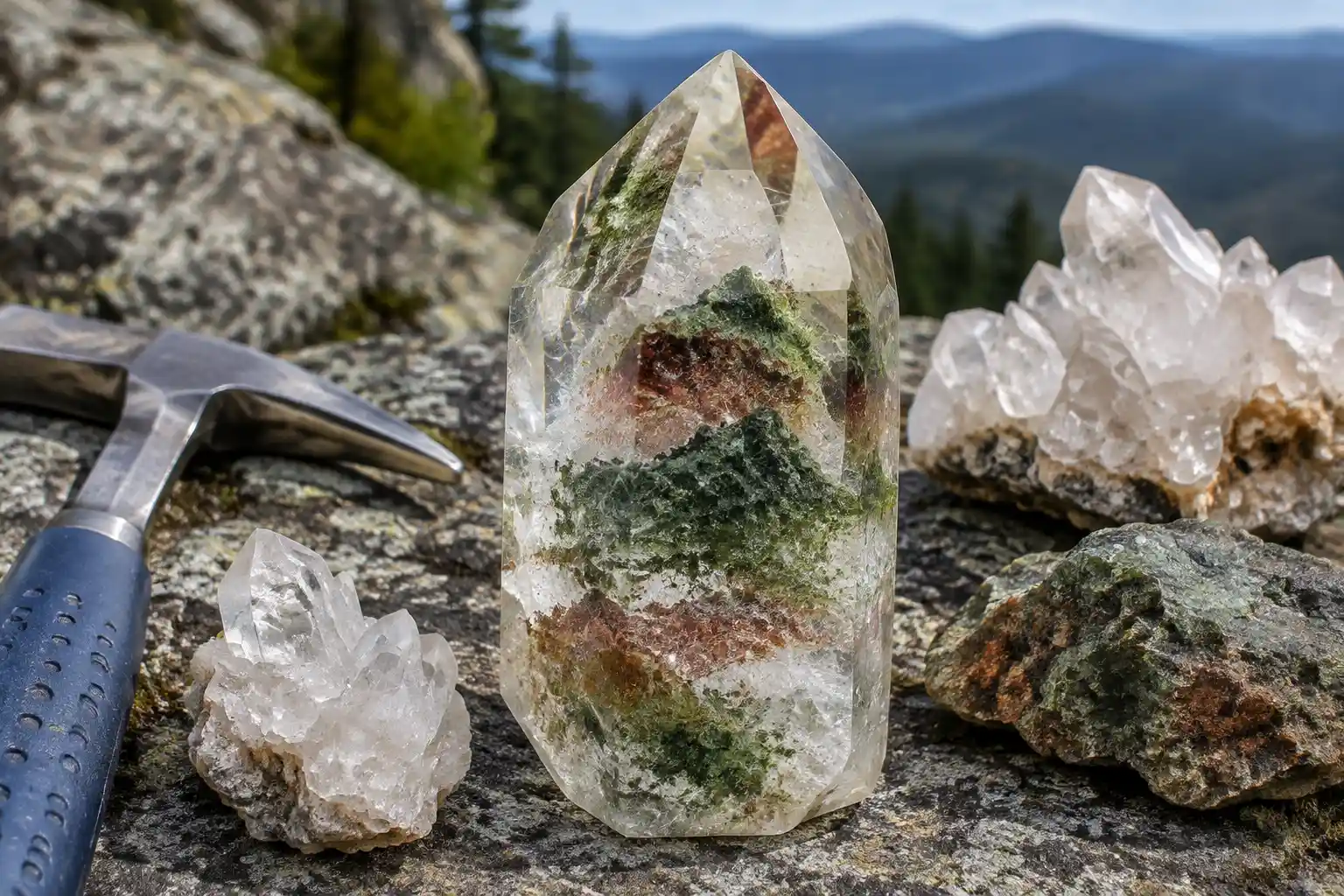
Phantom Quartz benefits begin with a visible record of interrupted crystal growth. A phantom is not usually a separate miniature quartz crystal floating inside a larger one. Instead, the ghost-like outline records an earlier stage in the growth of the same crystal. Quartz growth paused or conditions changed, particles or another mineral accumulated on exposed crystal faces, and later quartz growth enclosed that earlier surface. The result is an internal outline that can preserve the shape the crystal had at a particular stage of its development.
This growth history makes Phantom Quartz especially valuable for mineral collectors and students. Green chlorite, clay minerals, iron oxides, hematite, or other particles may define the old surface, while some phantoms arise from abrupt differences in opacity, color, or growth zones. A crystal can contain one phantom or several nested outlines, effectively recording repeated changes in its growth environment.
Real Phantom Quartz benefits therefore include mineralogical education, visible growth history, collector appeal, specimen diversity, lapidary interest, quartz durability, and strong visual symbolism. Themes such as growth, patience, resilience, changing stages, and preserving lessons from the past are easy to understand because they mirror the actual appearance of an earlier crystal form enclosed within later growth. These ideas should remain symbolic rather than becoming claims that Phantom Quartz medically heals trauma, treats anxiety, detoxifies the body, or changes cellular function.
11 Phantom Quartz Benefits at a Glance
- Internal phantom outlines preserve visible evidence of earlier quartz growth stages.
- Multiple phantoms can record repeated interruptions or changes during crystal development.
- Chlorite, iron oxides, clay minerals, and other inclusions can create striking color and pattern variation.
- Quartz host hardness of Mohs 7 provides useful scratch resistance for collecting and some jewelry uses.
- Geological structure makes Phantom Quartz valuable for teaching crystal growth and mineral inclusions.
- Natural specimens can preserve locality-specific mineral associations and hydrothermal history.
- Transparent crystals with sharp internal outlines offer significant collector and display appeal.
- Lapidary cutting can reveal internal landscapes that ordinary surface inspection may not show.
- Growth-stage symbolism can represent patience, development, reflection, and learning from earlier experiences.
- Professional identification helps distinguish true natural growth features from ordinary fractures, surface deposits, or artificial imitations.
- Responsible care protects both the quartz host and any internally fractured or heavily included zones.
Preserved Growth Stages Are the Most Important Phantom Quartz Benefit
The defining feature behind Phantom Quartz benefits is the internal outline of an earlier crystal growth stage. During crystal development, the quartz may experience a change in temperature, fluid chemistry, pressure, mineral supply, or another environmental factor.
Growth can slow or pause while particles accumulate on the exposed faces. When quartz growth resumes, clear or differently colored silica can cover that coated surface and continue outward.
The earlier shape remains visible because inclusions or structural differences mark the old boundary. Looking into a well-formed specimen can therefore reveal something resembling a smaller crystal point inside the larger one.
This visual effect is not merely decorative. It is a record of crystal development.
For mineralogy students, a sharp phantom demonstrates that crystal growth is not necessarily continuous and uniform. A natural crystal may respond to changing geological conditions several times before reaching its final shape.
Multiple Phantoms Can Record Repeated Geological Changes
Some of the most interesting Phantom Quartz benefits appear in specimens containing two, three, or many nested outlines.
Each visible boundary can correspond to a separate interruption or significant change in growth conditions. The crystal may stop developing, receive a coating of fine particles, resume growth, and later experience another interruption.
The resulting structure resembles a set of nested mountains or repeated crystal points.
This is particularly valuable because the final outer surface alone does not reveal the entire story. The internal boundaries show that the crystal developed through stages.
Not every line inside quartz is automatically a phantom. Growth zoning, fractures, healed fractures, veils, fluid inclusions, and color zoning can create different internal structures. Accurate interpretation depends on examining whether the visible outline actually follows an earlier crystal form.
Chlorite and Other Inclusions Create Distinctive Phantom Colors
Green is one of the best-known Phantom Quartz colors because chlorite-group minerals can coat an earlier quartz surface and later become enclosed by new quartz growth.
Other phantoms may appear white, gray, brown, reddish, black, or nearly colorless depending on the included particles and growth conditions. Iron oxides or hematite can create warm reddish or brown tones, while clay-rich coatings may create pale internal outlines.
This variation gives Phantom Quartz benefits substantial collector appeal because two specimens can record completely different mineral environments while sharing the same basic phantom-growth mechanism.
The inclusions should not automatically be identified by color alone. Green does not prove chlorite in every case, just as red does not prove hematite without supporting evidence.
For significant specimens, locality information and analytical identification can provide more reliable interpretation than trade labels.
Phantom Quartz Is Useful for Understanding How Crystals Grow
Educational value is one of the strongest Phantom Quartz benefits. Quartz has the chemical formula SiO₂ and normally crystallizes in the trigonal crystal system. Its familiar six-sided prism and pointed termination provide a recognizable shape that can be preserved clearly within a phantom.
A student examining a specimen can see how the crystal existed at one earlier size before additional quartz accumulated around it.
This transforms an abstract concept of crystal growth into something visible.
The phenomenon can also introduce more advanced topics such as supersaturation, hydrothermal fluids, inclusion formation, crystal-face stability, changing growth conditions, and the relationship between mineral chemistry and crystal habit.
A phantom is therefore useful not because it is mysterious but because it records a natural process unusually clearly.
Quartz Hardness Gives Phantom Specimens Practical Durability
The host stone in Phantom Quartz is quartz, which has Mohs hardness 7. This provides good resistance to ordinary scratching and makes many specimens durable enough for display, handling, cabochons, pendants, beads, and certain other jewelry uses.
Hardness does not make every specimen equally tough. A crystal with numerous fractures, cavities, contact damage, or heavily included zones may be mechanically weaker than a cleaner crystal.
Natural points can also have thin tips that chip when dropped.
For jewelry, protected pendants and earrings generally pose less risk than rings exposed to repeated impacts. Polished stones can tolerate normal wear reasonably well when the internal structure is sound.
The quartz host is durable enough to make Phantom Quartz benefits practical, but specimen-specific condition should always guide use.
Collector Appeal Comes From Natural Internal Architecture
Collectors often value Phantom Quartz because the principal feature exists inside the crystal rather than only on its outer surface.
A specimen can reveal a sharply defined internal mountain-like outline, several nested layers, mossy chlorite coatings, reddish iron-rich zones, or subtle ghost structures visible only from particular directions.
Transparency matters because clear surrounding quartz allows the internal form to be seen more easily. At the same time, heavily included specimens can have their own appeal when the inclusion pattern creates unusual internal scenery.
Locality can add further interest. Phantom Quartz occurs in several quartz-producing regions, and different deposits can produce characteristic inclusion combinations and crystal habits.
Good documentation helps preserve that context. A specimen with known locality and identified associated minerals provides more geological information than a visually similar piece with no source history.
Lapidary Cutting Can Reveal Hidden Phantom Structures
Rough Phantom Quartz does not always display its internal structure optimally. A polished window, cabochon, sphere, freeform, or carefully oriented faceted piece can reveal phantoms that were difficult to appreciate through natural surfaces.
Cutting requires judgment because removing too much quartz may destroy the visual relationship between the phantom and outer crystal.
Some collectors therefore prefer complete natural points, especially when the phantom follows the crystal’s original termination perfectly. Others appreciate polished pieces because clarity and contrast improve.
A sphere can be particularly interesting because rotating it reveals how the phantom extends through three dimensions rather than existing as a flat picture.
This makes lapidary work one of the more creative Phantom Quartz benefits while still respecting the underlying geological feature.
Natural Phantoms Can Help Teach Mineral Identification
One subtle Phantom Quartz benefit is the opportunity to distinguish inclusions from the host crystal.
Quartz itself remains SiO₂, while the material defining a phantom may be chlorite, clay, hematite, iron oxides, another mineral, tiny fluid inclusions, or a zone with different transparency.
This teaches an important gemological principle: an inclusion is not automatically the same substance as its host.
The color of a phantom may therefore provide clues but not a complete identification. Microscopy, locality information, associated minerals, spectroscopy, or other analytical methods may be required when exact composition matters.
That scientific caution is useful for buyers because commercial names such as “green phantom,” “red phantom,” or “garden phantom” can describe appearance without establishing mineral identity.
Growth and Personal Development Are Intuitive Modern Symbols
Among symbolic Phantom Quartz benefits, growth is the easiest theme to understand. The crystal visibly contains evidence of what it looked like at an earlier stage before growth continued.
Someone may interpret that structure as a reminder that an earlier version of oneself is not erased simply because development continues.
A graduate might associate the inner outline with earlier years of study. A person building a long-term business could see each stage as part of a continuing process rather than a discarded past. Another owner may connect multiple phantoms with several major changes in life.
The symbolism is particularly effective because it comes directly from the stone’s physical structure.
Quartz does not cause personal growth, but its recorded growth stages provide a clear visual metaphor for it.
The future Phantom Quartz meaning can develop this idea further while keeping symbolic interpretation separate from geology.
Patience and Interruption Are More Realistic Symbols Than Constant Progress
Phantom Quartz benefits also support a useful theme that differs from simplistic ideas of uninterrupted growth.
The phantom exists because crystal development changed or paused. The interruption did not necessarily end the crystal’s formation. Under suitable conditions, growth resumed around the earlier surface.
This makes patience, pause, and continuation natural symbols.
A person experiencing a delay in education, career development, creative work, or another long-term project may interpret the stone as a reminder that interruption and failure are not always the same thing.
Some processes continue differently after a pause.
Again, the stone does not determine whether a human project succeeds. The physical growth history simply provides a thoughtful metaphor for nonlinear development.
Reflection Can Focus on Lessons Rather Than Erasing the Past
A phantom preserves an earlier form instead of removing it. This makes reflection another meaningful interpretation.
Modern wellness culture sometimes frames growth as leaving the past completely behind. Phantom Quartz offers a different metaphor: earlier stages can remain visible while additional development takes place around them.
Someone may use the crystal during journaling to consider which past experiences still influence current choices. Another person may connect it with remembering lessons without allowing earlier mistakes to define the future.
This is symbolic reflection rather than psychotherapy. A gemstone cannot process trauma, resolve grief, or treat anxiety disorders.
If someone is dealing with significant psychological distress, the crystal can remain a personal object while professional support addresses the actual condition.
Phantom Quartz Does Not Have One Universal Ancient Spiritual Tradition
Phantom Quartz benefits are sometimes marketed with claims of very specific ancient healing systems, past-life access, ancestral memory, cellular cleansing, or other powerful effects.
The geological phenomenon itself is real, but those claims require a different standard of evidence.
Quartz has been used by many cultures, yet that does not mean every modern interpretation of a specific inclusion pattern can be projected backward into antiquity.
The responsible approach is to describe modern spiritual interpretations as modern unless reliable historical documentation establishes otherwise.
This does not reduce personal meaning. A new symbolic tradition can be valuable when its modern origin is acknowledged accurately.
Healing Claims Need Clear Limits
Modern descriptions sometimes attribute Phantom Quartz benefits to emotional healing, trauma release, detoxification, immune support, cellular regeneration, chakra clearing, pain reduction, or treatment of anxiety and depression.
There is no established scientific evidence that wearing, holding, or meditating with Phantom Quartz produces these medical outcomes.
Quartz is silicon dioxide, and the minerals enclosed within the phantom do not become therapeutic supplements through normal skin contact.
Claims covered under Phantom Quartz healing properties should therefore remain identified as metaphysical beliefs rather than healthcare guidance.
Meditation and journaling can still use the stone as a symbolic focus. The ritual may be meaningful because of attention, habit, and personal association without requiring a biological healing mechanism.
Care Depends on the Condition of the Individual Crystal
Most sound Phantom Quartz can be cleaned with lukewarm water, mild soap, and a soft brush. Quartz itself is chemically stable under normal household conditions and relatively resistant to scratching.
Individual specimens may contain fractures, cavities, fragile tips, associated minerals, or altered inclusions that require more cautious treatment.
Ultrasonic cleaning is not automatically appropriate for a heavily fractured specimen because vibration can exploit existing weaknesses. Strong heat and sudden temperature changes are also unnecessary.
Natural crystal points should be stored so their terminations do not strike harder objects.
A polished piece may be durable enough for routine jewelry, while a rare mineral specimen may be better preserved in a display cabinet with minimal handling.
What Phantom Quartz Benefits Do Not Include
Phantom Quartz benefits do not include scientifically established treatment for trauma, anxiety, depression, immune disorders, chronic pain, hormonal conditions, neurological illness, digestive disease, or other health concerns.
The internal growth outline does not store memories in the neurological sense, and inclusions do not transmit medically useful minerals through the skin.
Its genuine value already includes quartz mineralogy, preserved growth history, inclusion study, collector appeal, educational value, lapidary use, and unusually strong visual symbolism.
Conclusion
Phantom Quartz benefits come primarily from its ability to preserve earlier stages of crystal growth inside later quartz. Temporary growth interruptions, mineral coatings, particles, and changing conditions can create visible internal outlines that record a crystal’s geological development in remarkable detail.
That real structure naturally supports modern symbolism involving growth, patience, interruption, reflection, resilience, and carrying earlier experiences forward. These themes can remain personally meaningful without turning Phantom Quartz into a medical treatment or inventing unsupported ancient traditions.
FAQs
What are the main Phantom Quartz benefits?
The strongest Phantom Quartz benefits include visible crystal-growth history, mineralogical education, collector appeal, inclusion study, quartz durability, lapidary possibilities, and symbolic themes involving growth, patience, reflection, and development. Medical healing claims are not scientifically established.
What exactly is Phantom Quartz?
Phantom Quartz is quartz containing a visible internal outline that records an earlier stage of the crystal’s growth. The outline may be marked by chlorite, clay minerals, iron oxides, other inclusions, or a sharp difference in opacity or color.
Is there really another crystal inside Phantom Quartz?
Usually the “inner crystal” is not a separate floating quartz crystal. It is the preserved shape of the same crystal at an earlier stage of development. Later quartz grew around that earlier surface, leaving its outline visible inside.
Why does Phantom Quartz have green or red layers?
Different minerals or particles can coat the quartz during pauses in growth. Green phantoms are often associated with chlorite-group inclusions, while reddish or brown phantoms may involve iron-rich minerals such as hematite or iron oxides. Exact identification should not be based on color alone.
How hard is Phantom Quartz?
The quartz host has Mohs hardness 7. This provides good scratch resistance, although individual specimens may contain fractures, cavities, or fragile points that reduce practical durability.
Can Phantom Quartz have several phantoms?
Yes. Repeated changes or interruptions in crystal growth can create multiple nested phantom outlines. Each boundary can preserve an earlier stage in the crystal’s development.
Does Phantom Quartz symbolize personal growth?
Personal growth is a common modern interpretation because the crystal visibly preserves earlier growth stages beneath later development. This can make it a useful symbol of change, patience, and learning from the past, although the stone does not physically cause personal growth.
Is Phantom Quartz an ancient healing crystal?
Quartz has a long cultural history, but specific modern claims about Phantom Quartz should not automatically be described as ancient. Many current metaphysical interpretations appear in contemporary crystal practice and should be identified accordingly.
Can Phantom Quartz heal trauma or anxiety?
There is no established scientific evidence that Phantom Quartz treats trauma, anxiety disorders, depression, or other mental-health conditions. It may be used as a symbolic object during reflection, but significant psychological symptoms require appropriate professional support.
How should Phantom Quartz be cleaned?
Sound specimens can usually be cleaned gently with lukewarm water, mild soap, and a soft brush. Heavily fractured crystals, delicate terminations, or specimens with associated minerals may require greater caution. Strong impacts and abrupt temperature changes should be avoided.
Are Phantom Quartz healing benefits scientifically proven?
No. Phantom Quartz has not been shown to diagnose, treat, cure, or prevent physical or mental-health conditions. Claims involving detoxification, trauma release, cellular healing, immune support, chakras, or pain treatment belong to metaphysical interpretation rather than established medical evidence.
Phantom Quartz benefits involving healing energy, trauma treatment, detoxification, cellular regeneration, or chakra effects reflect modern spiritual and personal interpretation and should not replace qualified physical or mental-health care.