Phantom Quartz Healing Properties: 11 Claims, Growth Records & Safe Use
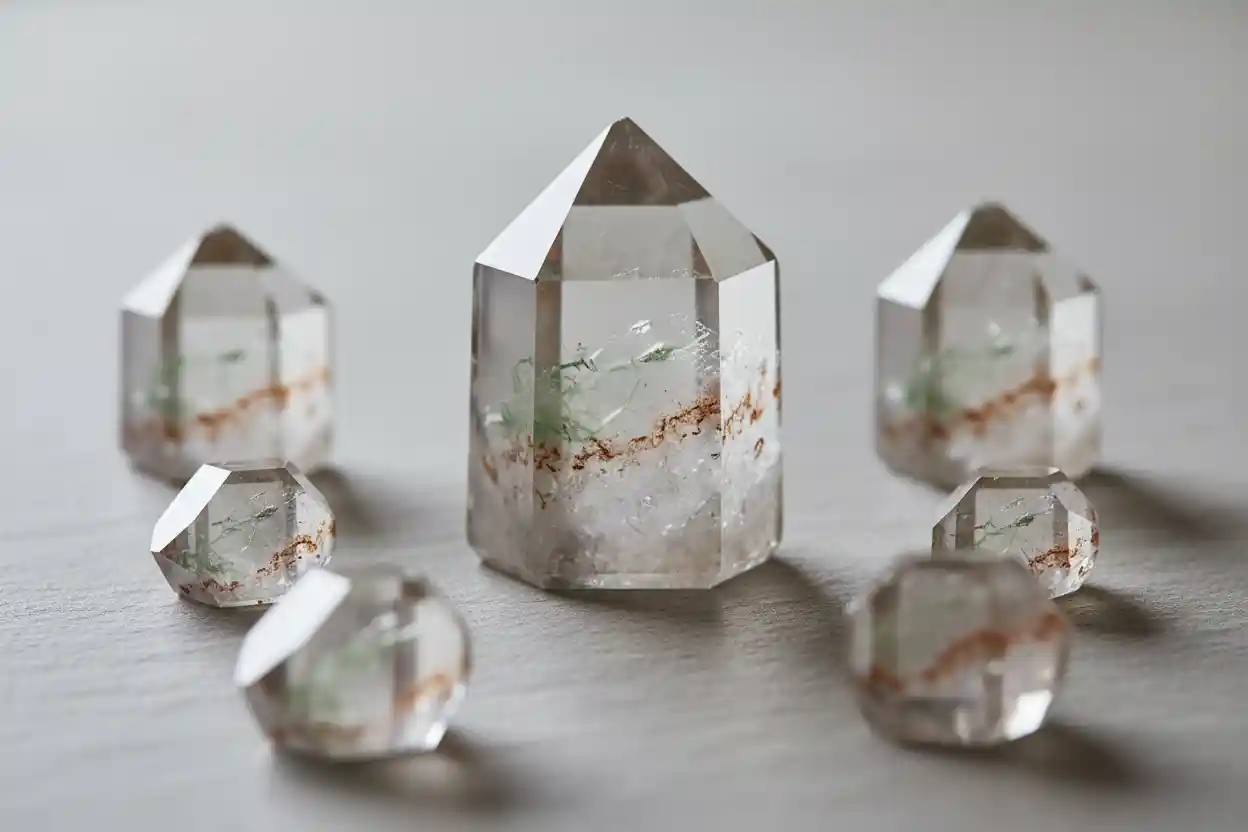
Phantom quartz healing properties are commonly associated with personal growth, resilience, patience, self-reflection, emotional perspective, concentration, adaptability, motivation, confidence, meditation, and spiritual renewal. The defining feature is a ghost-like outline of an earlier crystal surface preserved inside a later stage of quartz growth. That visible record makes ideas of interruption, continuation, and layered development especially compelling, but the phantom does not contain memories, past lives, or ancient messages. Phantom quartz has not been demonstrated to treat anxiety, depression, trauma, neurological disorders, fatigue, pain, inflammation, sleep disorders, or another medical condition. Scientifically, phantom quartz is ordinary quartz, SiO₂, whose growth was interrupted or altered long enough for inclusions, coatings, color changes, or other features to mark an earlier crystal form before quartz growth resumed and enclosed it.
11 Phantom Quartz Healing Claims
- Personal growth through gradual change
- Resilience after setbacks
- Patience with long-term progress
- Self-reflection and pattern awareness
- Emotional perspective during stress
- Concentration and sustained attention
- Adaptability when circumstances change
- Motivation to resume interrupted goals
- Confidence built from past progress
- Meditation and focused awareness
- Spiritual renewal and transition
These eleven themes can support distinct reflective practices without becoming eleven scientifically proven effects. Many Phantom Quartz benefits become more useful when translated into actions such as reviewing earlier progress, restarting an interrupted project, documenting recurring patterns, or deliberately changing a strategy that no longer works.
Phantom Quartz Mineral Facts
Phantom quartz is a variety or descriptive form of quartz rather than a separate mineral species. The host crystal is silicon dioxide, SiO₂, with the same basic chemistry and physical properties as ordinary rock crystal.
Quartz belongs to the trigonal crystal system and commonly forms six-sided prisms terminated by rhombohedral faces. It has vitreous luster, Mohs hardness 7, no useful cleavage, and conchoidal fracture. Tenacity is brittle despite the stone’s good scratch resistance.
A phantom is defined by an internal outline that records an earlier stage of crystal growth. The outline often resembles a smaller quartz point suspended inside the final crystal.
This internal form can be delineated by mineral inclusions, clay, fine sediment, oxides, sulfides, chlorite, hematite, or other substances deposited on the crystal during a temporary change in the growth environment.
Quartz then begins growing again around the earlier surface, trapping that layer inside the expanding crystal. The visible phantom is therefore a geological record of interrupted or changing growth conditions.
A single quartz crystal may contain one phantom or several nested outlines. Multiple stages can create a stacked appearance in which successive earlier crystal forms are preserved within one final crystal.
How Quartz Phantoms Form
Phantom formation begins while a quartz crystal is still growing in a cavity, vein, hydrothermal system, or other silica-rich environment. Under stable conditions, silica-bearing fluids add new quartz continuously to the crystal surface.
If those conditions change, another mineral or fine sediment may coat part of the crystal. The interruption may reflect changes in fluid chemistry, temperature, pressure, mineral saturation, available impurities, or the movement of fluids through the cavity.
When silica-rich conditions return, quartz growth can resume. New transparent quartz forms over the coated surface and seals it inside the crystal. Because the coating followed the earlier crystal faces, its outline preserves the former shape.
GIA has documented quartz phantoms formed by identifiable minerals such as molybdenite and wurtzite. In those specimens, inclusions were deposited on earlier quartz surfaces and were later enclosed when the host continued to grow.
Green phantoms are often associated with chlorite inclusions, while reddish or brown phantoms can involve iron-rich compounds. Dark phantoms may contain several possible minerals, and appearance alone cannot establish the exact inclusion species.
Some collector definitions also include internal zones of milky quartz, amethyst, or other contrasting growth stages when they reproduce an earlier crystal form. The essential idea is that the internal outline preserves an earlier stage of growth.
Phantom Quartz Is Not an Ancient Crystal Type
Quartz itself has an enormous geological and cultural history, but “phantom quartz” as a modern collector and metaphysical category should not automatically be given an ancient healing tradition.
Ancient people used quartz and quartz-rich stones for tools, carvings, beads, seals, ornaments, and ritual objects. That evidence does not demonstrate that clearly identified phantom quartz was recognized as a separate healing stone with today’s growth, karma, past-life, or transformation meanings.
The modern Phantom Quartz meaning centers heavily on the visible record of earlier crystal growth. Themes such as progress, lessons from the past, persistence, and transformation are understandable metaphors drawn from real mineral formation, but they remain symbolic interpretations.
Claims that a phantom stores literal memories of the Earth or information from ancient civilizations are not established by mineralogy. The inclusion layer records physical growth conditions, not semantic information.
Growth and Resilience
Personal Growth Through Small Changes
The preserved earlier crystal outline makes personal growth one of the most intuitive Phantom Quartz themes. The stone cannot cause psychological development. A useful practice is to choose one behavior that needs improvement and track it over time. The phantom becomes a visual reminder that later stages can build on earlier ones without erasing them.
Resilience After Setbacks
Phantom formation often involves an interruption followed by resumed growth, which makes resilience an especially fitting metaphor. The crystal does not transfer resilience to a person. After a setback, use it as a cue to identify what stopped progress, what remains usable, and what first step would restart movement.
Patience and Reflection
Patience With Long-Term Progress
Phantoms can form through multiple stages that unfold over geological time. They therefore provide strong symbolism for gradual development. A stone cannot biologically increase patience, but it can remind someone to evaluate a long-term goal over weeks or months rather than judging it from one difficult day.
Self-Reflection and Pattern Awareness
The internal outline literally preserves a former surface, making reflection a natural theme. Phantom quartz cannot reveal hidden memories or subconscious truth. Keeping it beside a journal can still create a consistent cue to review repeated triggers, reactions, decisions, and consequences.
Emotional Perspective and Focus
Emotional Perspective During Stress
Some practitioners describe phantom quartz as helping people process earlier experiences. Quartz cannot remove trauma, grief, or emotional pain from the body. A grounded approach is to separate what happened in the past from what is happening now and identify which part of the current response belongs to present circumstances.
Concentration Through a Visual Cue
Quartz is frequently marketed for focus and amplification. There is no evidence that SiO₂ increases attention span through contact. A phantom crystal can still function as a visual work cue when paired with one task, reduced notifications, and a defined period of uninterrupted attention.
Adaptability and Motivation
Adaptability When Circumstances Change
A phantom records growth under changing conditions, making adaptability a reasonable metaphor. The crystal cannot change psychological flexibility biologically. When a plan stops working, use it as a reminder to preserve the underlying goal while altering the method.
Motivation to Restart
Phantom quartz is especially well suited symbolically to interrupted projects because the crystal itself shows renewed growth after an earlier stage ended. The stone cannot create motivation. It can mark a restart point. Choose one unfinished task and take the smallest concrete action necessary to resume it.
Confidence and Meditation
Confidence From Past Progress
Nested phantoms visibly show that an earlier stage remains inside the final crystal. Someone can use that idea to review evidence of past progress instead of assuming that every new challenge starts from zero. The confidence comes from recognizing acquired skills, experience, and completed steps.
Meditation With Internal Growth Lines
A clear phantom crystal can provide an effective meditation object. Focus on one internal outline, observe how it follows the geometry of the outer crystal, notice when attention wanders, and return to the phantom or breath. This is a genuine concentration exercise without proving that the crystal alters consciousness.
Spiritual Renewal and Transition
The eleventh claim centers on spiritual renewal, transformation, and transition. Modern metaphysical traditions sometimes interpret multiple phantom layers as previous lives, karmic stages, ancestral memory, or stored Earth knowledge.
Those ideas are spiritual interpretations rather than mineralogical facts. A phantom records a former physical growth stage, not a verified memory. Someone can still use the crystal during prayer or reflection on transition, lessons learned, and future direction without presenting those beliefs as scientific evidence.
Phantom Quartz Chakra Meaning
Phantom quartz is commonly associated with the crown and third-eye chakras in modern crystal systems because the host is clear quartz and the visible internal layers encourage themes of awareness, reflection, and spiritual development.
Green chlorite phantoms may also receive heart-chakra associations, while reddish or iron-rich phantoms can be linked symbolically with lower chakras.
Chakras are a spiritual framework rather than anatomical structures. Phantom quartz has not been demonstrated to affect the brain, pineal gland, heart, endocrine system, nervous system, or another physiological structure through chakra placement.
Different phantom colors reflect different inclusions or growth zones, not proven changes in therapeutic action.
Phantom Quartz Care and Safety
The quartz host has Mohs hardness 7, which gives Phantom Quartz good scratch resistance. It can scratch feldspar, calcite, fluorite, opal, and many softer gemstones, while topaz, sapphire, ruby, and diamond can scratch quartz.
Quartz has no useful cleavage, but it is brittle. Crystal points can chip, especially at terminations and edges. Internal fractures may also be associated with some phantom layers or mineral inclusions.
Warm water, mild soap, and a soft brush are suitable for many sound untreated quartz specimens. Brief water contact is generally safe for the quartz host.
Care becomes more nuanced when a specimen contains unknown inclusions, surface coatings, attached matrix, metallic sulfides, iron minerals, glue, repairs, or open fractures. Prolonged soaking is unnecessary because included minerals may respond differently from quartz.
Steam and ultrasonic cleaning should not be automatic choices for heavily included or fractured specimens. Vibration and rapid heat can exploit existing weaknesses even when clean rock crystal would otherwise be durable.
Hydrofluoric acid attacks quartz and is extremely hazardous. Strong alkaline solutions can also attack silica under suitable conditions.
Cutting, drilling, and grinding quartz create respirable crystalline silica dust. Lapidary work requires wet methods, effective extraction, eye protection, and suitable respiratory controls. Phantom quartz should never be intentionally powdered or ingested for wellness purposes.
Safe Ritual Cleansing
Phantom quartz does not need aggressive treatment for symbolic cleansing. There is no scientifically demonstrated negative energy stored inside the phantom layers.
Sound, intentional breathing, meditation, dry placement, or gentle washing are low-risk options. A renewal ritual can be made practical by writing down one interrupted goal, why it stopped, and the specific action that will restart it.
Avoid harsh chemicals, flame, extreme thermal change, abrasive salt, and prolonged soaking when the inclusions or attached matrix have not been identified.
Conclusion
Phantom quartz has a compelling verified story because its internal outlines preserve earlier stages of real crystal growth. Quartz stopped or changed, another substance marked its surface, and later quartz enclosed that record as growth resumed. Its eleven healing themes can support reflection on resilience, patience, progress, motivation, and change when the phantom is treated as geological evidence and useful symbolism rather than a storehouse of medical or supernatural power.
FAQs
What are the main phantom quartz healing properties?
Common claims include personal growth, resilience, patience, self-reflection, emotional perspective, concentration, adaptability, motivation, confidence, meditation, and spiritual renewal. These are contemporary wellness or spiritual beliefs rather than scientifically proven therapeutic effects.
What is Phantom Quartz?
Phantom Quartz is quartz containing one or more internal outlines that preserve earlier stages of the crystal’s growth.
What is Phantom Quartz made of?
The host is quartz, SiO₂. The phantom itself may be outlined by chlorite, clay, iron compounds, sulfides, other minerals, sediment, or contrasting quartz growth.
How do phantoms form inside quartz?
A growing quartz crystal becomes coated or changes appearance during one stage of development. Quartz later resumes growing and encloses that earlier surface, preserving its outline inside the final crystal.
Is Phantom Quartz an ancient gemstone tradition?
Quartz has ancient cultural use, but the modern Phantom Quartz healing identity should not automatically be described as an ancient tradition. Its current metaphysical meanings are largely contemporary.
How hard is Phantom Quartz?
The quartz host has Mohs hardness 7. It has good scratch resistance but remains brittle enough for crystal points and fractured areas to chip.
Do green Phantom Quartz crystals contain chlorite?
Many green phantoms are caused by chlorite inclusions, but appearance alone is not enough to identify every green inclusion with certainty.
Which chakra is Phantom Quartz associated with?
Modern crystal practice commonly links it with the crown and third-eye chakras. Colored phantoms may receive other chakra associations based on their appearance. These are spiritual rather than anatomical correspondences.
Can Phantom Quartz go in water?
Brief cleaning with lukewarm water is generally safe for the quartz host, but prolonged soaking should be avoided when the identity of inclusions, matrix minerals, coatings, repairs, or fractures is uncertain.
Does a phantom store memories from earlier crystal growth?
A phantom preserves physical evidence of an earlier growth stage, but there is no evidence that it stores human memories, past-life information, or encoded spiritual messages.
Crystal healing claims are traditional or personal beliefs and should not replace qualified medical or mental health care.