Phantom Quartz: Meaning, Properties & Symbolism
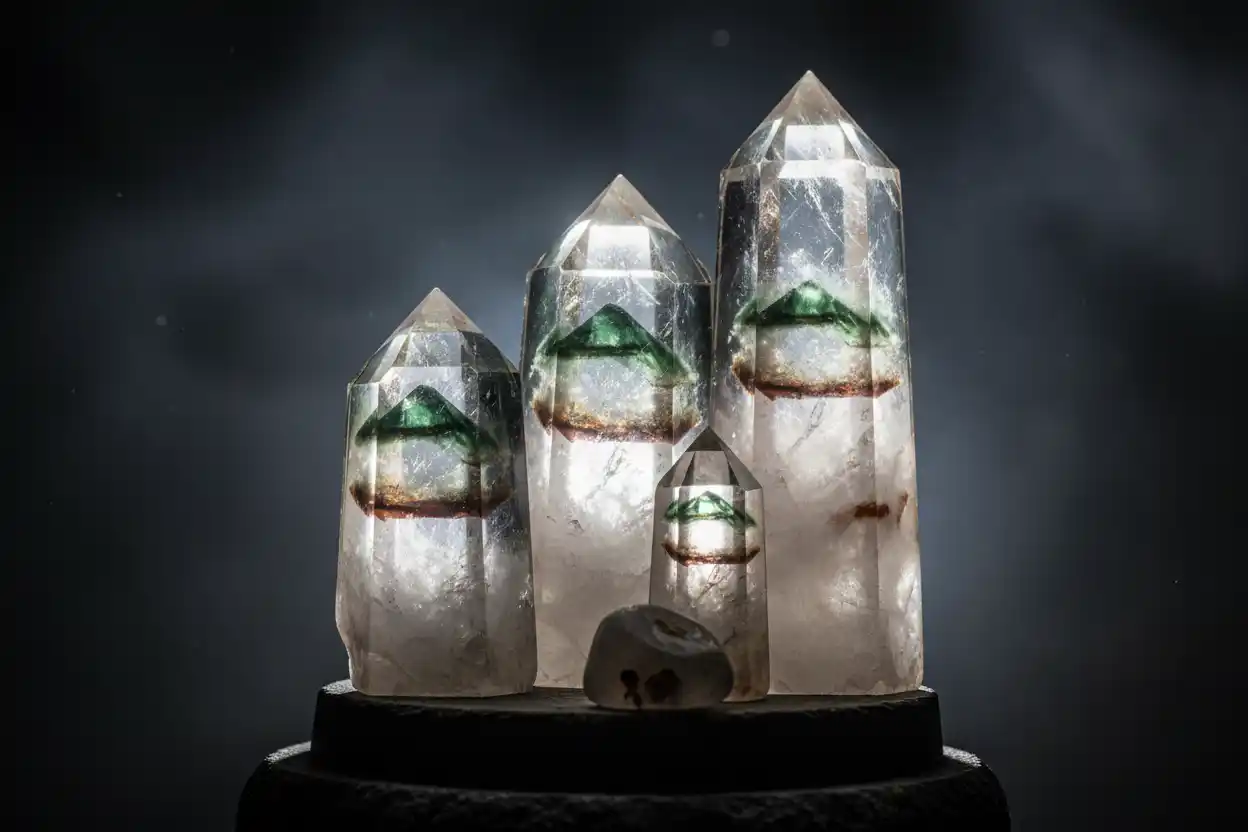
Phantom Quartz is quartz containing one or more visible outlines of earlier stages in the crystal’s growth. These internal “ghost crystals” may appear green, red, brown, gray, white, smoky, or nearly colorless, depending on the mineral particles, fluid inclusions, or color zoning that marked the older crystal surface.
A phantom is not a separate mineral species. It is a growth feature preserved when quartz temporarily stopped or changed its growth conditions, acquired a coating or color boundary, and later resumed crystallizing around the earlier form.
Phantom Quartz at a Glance
| Property | Phantom Quartz |
|---|---|
| Material type | Quartz containing visible former crystal-growth stages |
| Composition | Silicon dioxide, SiO₂, with variable mineral or fluid inclusions |
| Mineral family | Quartz |
| Common phantom colors | White, gray, smoky brown, black, green, red, orange, yellow, purple, and colorless |
| Common inclusion materials | Chlorite-group minerals, hematite, goethite, clay minerals, iron oxides, fluid inclusions, and other deposit-specific phases |
| Crystal system | Trigonal |
| Typical habit | Six-sided prisms with rhombohedral terminations; single points, clusters, scepters, and doubly terminated crystals |
| Luster | Vitreous |
| Transparency | Transparent to opaque, commonly transparent around the phantom |
| Mohs hardness | 7 |
| Cleavage | None |
| Tenacity | Brittle |
| Fracture | Conchoidal to uneven |
| Common uses | Mineral specimens, cabochons, pendants, beads, carvings, polished points, spheres, and collector jewelry |
| Main care concern | Chipped terminations, internal fractures, undisclosed polishing or filling, false inclusion claims, and respirable silica dust during cutting |
What Makes a Quartz Phantom?
A classical phantom reproduces the recognizable outline of an earlier crystal stage. Its internal surfaces should correspond broadly with quartz prism faces, termination faces, or both.
The older crystal did not remain as a separate loose object. Instead, it became part of one continuously developed quartz crystal.
During growth, environmental conditions changed. The supply of silica, temperature, pressure, fluid chemistry, growth rate, or available space may have shifted.
Tiny particles could then settle onto the exposed crystal faces. In other cases, the quartz itself changed color, transparency, or inclusion density along the growth boundary.
When conditions once again favored clear quartz deposition, new material enclosed the marked surface. The earlier outline remained visible inside the enlarged crystal.
The parent quartz guide explains quartz’s wider mineralogy, while this page owns the specific interrupted-growth structure that creates a phantom.
How Phantom Quartz Forms
Most natural Phantom Quartz develops in hydrothermal veins, pegmatitic cavities, Alpine-type clefts, volcanic cavities, and other spaces where silica-bearing fluids circulate through rock.
Quartz begins growing on a cavity wall, earlier crystal, or mineral substrate. Its prism and termination faces advance as dissolved silica reaches the surface.
Growth may slow or stop when temperature, pressure, fluid flow, or chemistry changes. A new mineral can precipitate during that pause.
Chlorite-group minerals may coat the crystal with green particles. Hematite or other iron oxides can create red, rust, orange, or brown layers.
Clay, mica, carbonaceous matter, sulfides, or fine unidentified particles can produce gray, black, white, or cream outlines.
Quartz then resumes growth. Clear or differently colored silica covers the earlier coating until the phantom sits entirely inside the final crystal.
Several interruptions can create nested phantoms. Each outline records a separate growth boundary rather than a crystal trapped physically inside another completed crystal.
Growth Zoning versus a True Phantom
Quartz commonly shows growth zoning, but not every zone qualifies as a distinct phantom.
A true phantom normally preserves enough of an earlier crystal outline to suggest prism faces, termination geometry, or a complete internal point.
Simple color bands can follow growth sectors without producing a recognizable ghost crystal. Such material is zoned quartz rather than necessarily Phantom Quartz.
A cloudy internal layer may also represent a healed fracture, fluid-inclusion plane, or abrupt change in transparency.
Capped quartz represents an extreme related structure. A concentrated layer forms around an earlier crystal stage and separates visually from the later overgrowth.
The guide to types of clear quartz provides a broader framework for growth forms, inclusions, and commercial names without making every internal line a phantom.
Green Phantom Quartz
Green Phantom Quartz most commonly owes its color to chlorite-group minerals coating an earlier crystal surface.
The phrase chlorite phantom does not identify one specific chlorite species. Clinochlore, chamosite, cookeite, or another fine-grained sheet silicate may be involved, depending on the deposit.
Green particles can form a crisp, thin outline or a thicker mossy layer. Some crystals contain several green stages separated by clear quartz.
Epidote, actinolite, hedenbergite, and other green minerals may also occur with included quartz. Consequently, green color alone cannot prove chlorite.
A laboratory may use Raman spectroscopy, X-ray diffraction, or chemical analysis when the inclusion species matters scientifically or commercially.
Red and Orange Phantom Quartz
Red phantoms commonly contain hematite or other iron-rich particles.
A thin hematite coating can reproduce a sharply defined red termination inside clear quartz. More dispersed inclusions may create clouds, flakes, or irregular orange-red patches instead.
Goethite and mixed iron-oxide or hydroxide phases can contribute yellow, orange, brown, and rust tones.
Heating, oxidation, weathering, and relationships among iron minerals may alter the final appearance. Therefore, every red layer should not be assigned to hematite without analysis.
Bright red phantom material attracts strong retail attention, which also makes it vulnerable to dye, coatings, and unsupported locality claims.
Smoky, White, and Black Phantoms
Smoky phantoms can form when radiation-related color centers developed during one growth stage and clearer quartz later enclosed the darker zone.
The surrounding crystal may be clear, smoky, or partly amethyst. The dedicated Smoky Quartz guide explains the aluminum-related color-center mechanism without duplicating phantom growth.
White phantoms commonly result from fine inclusions, microscopic fluid cavities, milkiness, or a dense surface layer marking the earlier crystal.
Black or charcoal phantoms may contain chlorite, carbonaceous material, dark iron minerals, magnetite, clay, or another inclusion mixture.
A dark outline should not be described as carbon, tourmaline, or magnetite solely from its color.
Amethyst Phantom Quartz
Phantom structures can occur inside purple quartz.
An amethyst crystal may preserve a pale inner stage surrounded by deeper purple growth, or a clear outer zone may cover an earlier amethyst point.
Iron-related color zoning and irradiation determine the purple appearance, while the phantom records a separate boundary in the growth history.
A specimen can therefore be both Amethyst and Phantom Quartz without becoming a distinct mineral species.
Fine examples show clear separation between the inner termination and later purple or colorless layers.
Heating amethyst may alter its color while leaving the physical phantom outline intact. Treatment disclosure remains important when the bodycolor contributes to value.
Multiple and Stacked Phantoms
Repeated growth interruptions create multiple nested outlines.
Some crystals contain two or three clearly separated internal points. Others display many closely spaced layers marketed as thousand-layer, staircase, or stacked Phantom Quartz.
A greater number of layers does not guarantee higher quality. Weak, muddy, or poorly oriented boundaries may be less attractive than one sharp complete phantom.
Fine examples preserve the same general crystal orientation through several stages. Distorted or offset outlines may reflect changing growth rates, contact with neighboring minerals, dissolution, or physical disruption.
Multiple phantoms provide a visible record of changing fluid conditions within one crystal cavity.
Phantom Quartz and Garden Quartz
Garden Quartz, also called lodolite, contains scenic inclusions resembling moss, soil, underwater landscapes, gardens, clouds, or distant hills.
Garden Quartz can contain phantoms, but the terms are not synonymous.
A Phantom Quartz crystal needs a visible former growth outline. Garden Quartz can qualify through irregular inclusions without reproducing an internal crystal shape.
Conversely, a sharply defined white phantom in otherwise clean quartz may contain no garden-like scenery.
Retailers often combine the terms lodolite, garden, landscape, scenic, and phantom because one stone may display several inclusion types. The most accurate description should state which features are actually visible.
Other Included-Quartz Comparisons
Rutilated Quartz contains needle-like rutile rather than requiring a former crystal outline. Needles may cross several growth zones without defining a phantom.
Tourmalinated Quartz contains tourmaline crystals, commonly black schorl needles or prisms. Those inclusions do not become phantoms unless they also coat an earlier quartz surface in a crystal-shaped layer.
Fluid-inclusion quartz may contain cavities, moving bubbles, or liquid veils. These features can follow growth zones but do not always reproduce the earlier external form.
Included quartz categories overlap naturally. A single crystal may contain chlorite phantoms, rutile needles, healed fractures, and fluid inclusions.
Important Phantom Quartz Sources
Brazil supplies clear, smoky, green, red, and multi-layered Phantom Quartz from numerous hydrothermal and pegmatitic environments.
Pakistan’s Gilgit-Baltistan region produces clear quartz with chlorite, hematite, epidote, and other inclusions, frequently in sharp mountain-cleft crystals.
The Himalayan trade includes material associated with India, Nepal, and Tibet, although exact mine-level provenance is often lost or generalized during wholesale distribution.
Madagascar supplies polished included quartz, phantom cabochons, freeforms, and natural points.
Arkansas and Colorado in the United States produce quartz with growth zoning and occasional phantom structures.
Namibia, South Africa, Romania, Austria, Switzerland, Mexico, Morocco, China, and several other countries also yield phantom-bearing quartz.
No visual feature can establish a country by itself. The same green, red, or smoky growth pattern can develop in unrelated deposits.
How to Identify Phantom Quartz
First establish that the host is quartz. It should have vitreous luster, no cleavage, conchoidal fracture, hardness near 7, and the expected optical properties.
Next, rotate the specimen under a strong single light. A genuine phantom should remain inside the quartz and reveal an earlier crystal-shaped boundary from several viewing angles.
Magnification can show individual particles distributed across the old growth surface. The layer may become more concentrated along termination faces or prism edges.
Surface paint, coating, or a shallow carved line will not maintain the same three-dimensional relationship through the stone.
A fracture veil can imitate part of a phantom but usually cuts across the crystal irregularly rather than following a complete termination.
Raman spectroscopy can identify the quartz host and many inclusions. Microscopy, infrared spectroscopy, X-ray diffraction, and elemental analysis may provide additional information.
The systematic process in how to identify crystals helps separate useful observations from destructive scratch tests.
Natural, Laboratory-Grown, and Imitation Material
Natural Phantom Quartz is common enough that synthesis is usually unnecessary for ordinary commercial pieces.
Nevertheless, laboratory-grown quartz can develop growth boundaries, seed-related structures, zoning, and intentionally staged inclusions. A phantom-like appearance therefore does not prove natural origin by itself.
Glass and resin imitations may contain suspended colored flakes or a molded internal point. Round bubbles, flow lines, low hardness, mold seams, and an artificial-looking repeated pattern provide clues.
Composite products can place a small included-quartz slice beneath a clear cap or inside resin.
Polished towers may be cut from genuine included quartz but shaped so heavily that the original natural crystal form is lost. Such an item is still natural quartz, although the external point is manufactured.
The dedicated real-versus-fake Clear Quartz guide owns detailed glass, synthetic, and composite identification.
Treatments
Ordinary cutting and polishing are common for Phantom Quartz cabochons, towers, spheres, and carvings.
Fracture filling can make cracks less visible and improve stability. Clear resin may collect along internal fractures or surface pits.
Dye can strengthen red, green, black, blue, or yellow inclusions, particularly where fractures connect with the surface.
Coatings can create iridescence or deepen smoky and metallic effects. Their color may wear away at edges.
Irradiation and heat can alter the quartz bodycolor, producing or changing smoky, amethyst-like, citrine-like, or other appearances without creating the original phantom structure.
A glued base may stabilize a cluster or allow a point to stand upright. Repairs should be disclosed when they affect value or natural form.
The full enhancement framework appears in gemstone treatments explained, while quartz-specific alteration belongs on treated Clear Quartz identification.
Durability and Jewelry Suitability
Quartz has a Mohs hardness of 7, giving Phantom Quartz good resistance to many everyday scratches.
Its position appears on the gemstone hardness chart.
However, the mineral remains brittle. Internal fractures, points, thin edges, and drilled holes can chip after impact.
The difference between hardness and resistance to breakage is explained in gemstone toughness versus hardness.
Cabochons work well in pendants, earrings, brooches, and protected rings. A transparent dome can reveal the phantom more effectively than a shallow flat cut.
Faceted stones are possible, although excessive brilliance may distract from the internal outline. Step cuts and portrait cuts can present inclusions more clearly.
Natural points are often wire wrapped, drilled, or mounted as pendants. The setting should not place pressure on the termination or an edge-reaching fracture.
Bracelets expose beads to repeated impact, so heavily fractured material requires careful wear.
Current Phantom Quartz Asking Prices
Phantom Quartz spans inexpensive polished products and highly aesthetic mineral specimens.
| Phantom Quartz product | Broad July 2026 retail asking range |
|---|---|
| Small tumbled stone | About $4–$15 |
| Mini polished point or tower | About $10–$35 |
| Standard cabochon | About $10–$50 |
| Strongly defined or multicolored cabochon | About $40–$150 |
| Small natural crystal specimen | About $15–$75 |
| Attractive chlorite or hematite specimen | About $50–$250 |
| Large cluster or display crystal | About $150–$750 |
| Exceptional documented collector specimen | About $500–$5,000 or more |
| Sterling-silver jewelry | About $50–$500 |
| Designer gold jewelry | Determined mainly by the setting, cutting, and craftsmanship |
These figures represent broad asking prices rather than formal appraisals or resale guarantees.
Listings frequently apply rare to ordinary cloudy quartz. A price premium should reflect a visible, attractive, three-dimensional growth record rather than the name alone.
What Gives Phantom Quartz Value?
Phantom definition is the principal factor. A complete internal point with recognizable terminations is generally more desirable than a vague cloud.
Contrast matters. A green, red, white, or smoky layer should remain visible against the surrounding quartz.
Transparency helps reveal depth. Completely opaque outer quartz can conceal the structure, although strongly contrasting opaque specimens have a separate collector appeal.
Multiple nested stages can raise value when each remains distinct.
Crystal condition matters for specimens. Complete terminations, bright luster, minimal contact damage, balanced matrix, and natural form all support value.
Cabochons and carvings should frame the phantom intentionally. Cutting through the most important outline reduces visual quality.
Inclusion identity can add interest when verified, particularly for unusual chlorite species, hematite coatings, rare associated minerals, or documented localities.
Treatment, repairs, synthetic origin, and unsupported locality claims should be reflected in the price.
Buying Phantom Quartz
Ask whether the item is a natural crystal, polished natural quartz, laboratory-grown quartz, glass, resin, or a composite.
Request a rotating video under one concentrated light. The internal outline should remain three-dimensional rather than appearing as a flat photograph or surface design.
Inspect the base, sides, and termination for repairs, glue, resin, chips, paint, and artificial polishing.
Confirm what the seller means by green, red, black, or angel-wing phantom. Many descriptive names have no standardized mineralogical definition.
Do not assume that every scenic included quartz qualifies as a phantom. Look for an earlier crystal outline.
A locality premium should require more than Himalayan, Brazilian, or Tibetan in the listing title.
Detailed seller and product checks belong on where to buy real Phantom Quartz.
The material also appears in the crystals beginning with P directory and the gemstones beginning with P directory.
Cleaning and Storage
Clean a stable polished piece with lukewarm water, mild soap, and a soft brush.
Use a softer approach around natural clusters. Brush toward the base rather than catching delicate terminations.
Avoid ultrasonic cleaning when the quartz contains fractures, filling, glue, coatings, or vulnerable associated minerals.
Steam can create thermal stress or damage resin and repairs.
Brief water contact is generally suitable for sound untreated quartz, but included minerals, matrix, dyes, and construction can create different limitations. The broader context appears in which crystals can and cannot go in water.
Store points so their terminations cannot strike one another. A padded compartment protects both natural faces and polished surfaces.
Phantom Quartz Meaning and Symbolism
Modern crystal traditions associate Phantom Quartz with gradual development, patience, perspective, and recognizing earlier versions of oneself without remaining confined by them.
Its nested crystal outlines create a direct visual metaphor for growth occurring in stages.
A clear outer crystal surrounding a darker earlier form can symbolize carrying previous experience forward while continuing to change.
Multiple phantoms are often interpreted as repeated cycles of interruption, adaptation, and resumed progress.
Green phantoms receive modern associations with renewal and practical growth, while red layers are linked with motivation and endurance.
These interpretations are contemporary, personal, artistic, or spiritual. Scientific evidence does not show that Phantom Quartz treats illness, clears trauma, records human memories, or guarantees personal transformation.
Frequently Asked Questions
Is Phantom Quartz real quartz?
Yes. The host is quartz, while the phantom is a visible boundary marking an earlier growth stage.
What causes the phantom shape?
A coating, inclusion layer, color zone, or change in transparency marked an exposed crystal surface before later quartz enclosed it.
Is a phantom a separate crystal trapped inside quartz?
Not usually. It is generally an earlier stage of the same continuously growing quartz crystal.
Are all Phantom Quartz inclusions chlorite?
No. Chlorite commonly creates green phantoms, but hematite, goethite, clay, fluid inclusions, color zoning, and other materials can produce different outlines.
How is Phantom Quartz different from Garden Quartz?
Phantom Quartz must show an earlier crystal-growth outline. Garden Quartz is defined more broadly by scenic inclusions and may or may not contain a phantom.
Can Smoky Quartz and Amethyst contain phantoms?
Yes. Phantom structures can occur in clear, smoky, purple, yellowish, and other quartz varieties.
What is multiple-phantom quartz?
It contains several nested growth outlines formed during repeated interruptions or changes in crystal growth.
Can Phantom Quartz be laboratory grown?
Yes. Laboratory-grown quartz can show staged growth, zoning, or introduced inclusions. A phantom appearance alone does not prove natural origin.
Is Phantom Quartz suitable for jewelry?
Yes. Quartz is reasonably hard, although fractures, drilled areas, and natural points remain vulnerable to impact.
Is Phantom Quartz normally treated?
Many pieces receive only cutting or polishing, but filling, dye, coating, irradiation, heating, repairs, and composite construction can occur.
Can Phantom Quartz go in water?
Brief washing is generally suitable for intact untreated quartz. Avoid soaking pieces with soluble inclusions, unstable matrix, dye, glue, resin, or coatings.
What makes Phantom Quartz valuable?
A sharp complete phantom, attractive contrast, transparency, multiple growth stages, crystal condition, inclusion identity, locality, size, cutting, and treatment disclosure determine value.
Phantom Quartz is most useful when its internal outline is read as geological evidence rather than simply a decorative cloud. Stones whose inclusions form landscapes without a complete crystal boundary are better understood through the separate Garden Quartz guide.
Cutting, drilling, grinding, or sanding Phantom Quartz can release respirable crystalline-silica dust. Use wet lapidary methods, effective local extraction, eye protection, and suitable respiratory protection rather than dry processing.