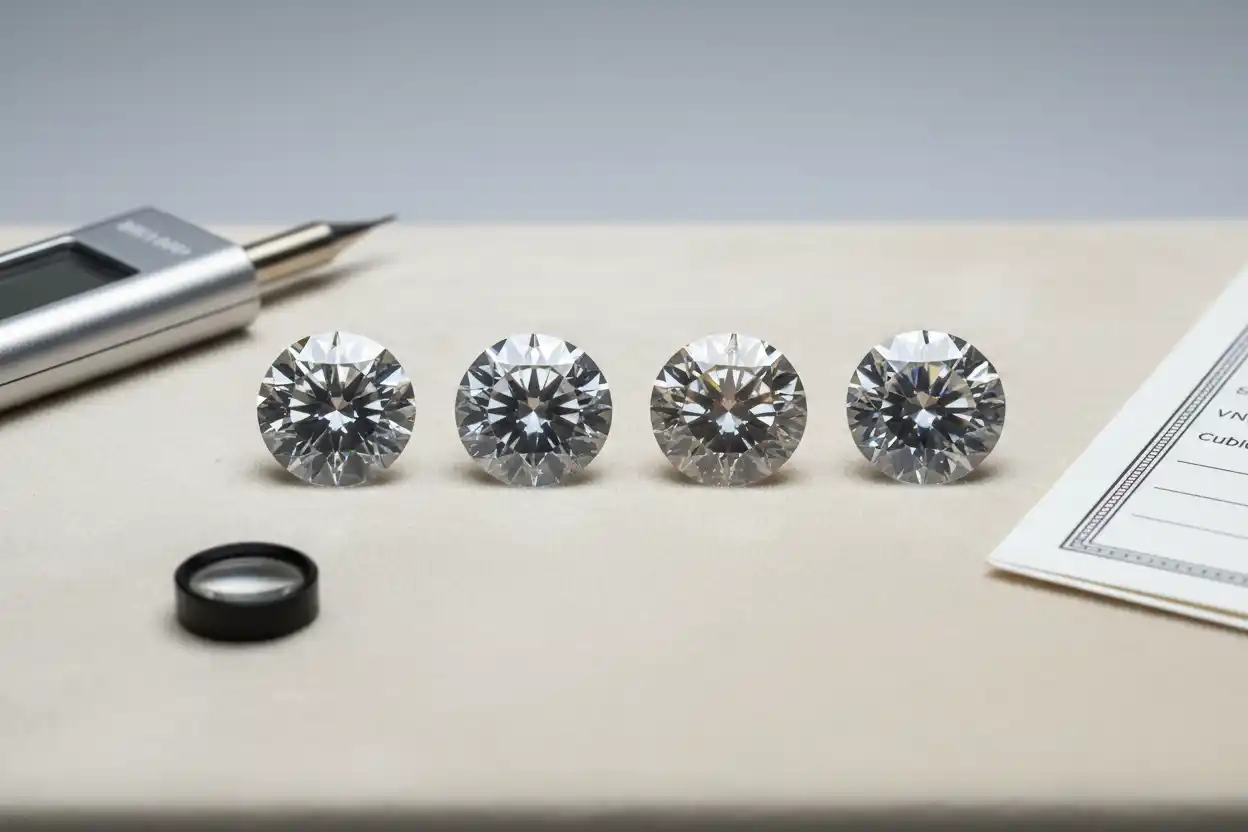
Real vs Fake Diamond: Natural, Lab-Grown and Simulant Tests
A real diamond is crystalline carbon. It may have formed naturally deep within Earth or grown in a laboratory through high-pressure, high-temperature or chemical-vapor-deposition processes.
Natural and laboratory-grown diamonds are both diamonds. They share essentially the same chemical composition, crystal structure, hardness, refractive index and brilliance. Their principal distinction is growth origin.
Moissanite, cubic zirconia, glass, white sapphire and other materials are diamond simulants. They can resemble diamond but do not share its carbon crystal identity.
Therefore, a diamond-authentication question has three stages: determine whether the stone is diamond, determine whether it is natural or laboratory-grown, and determine whether its color or clarity has been treated. No ordinary home test resolves all three stages.
This page owns the direct authenticity workflow. The treated-diamond guide retains color treatment, fracture filling, laser drilling and laboratory-growth detection in greater detail.
Natural Diamond vs Lab-Grown Diamond and Simulants
| Feature | Natural diamond | Laboratory-grown diamond | Moissanite | Cubic zirconia |
|---|---|---|---|---|
| Material | Naturally formed crystalline carbon | Laboratory-grown crystalline carbon | Silicon carbide | Zirconium oxide |
| Mohs hardness | 10 | 10 | About 9.25 | About 8–8.5 |
| Refractive index | About 2.42 | About 2.42 | About 2.65–2.69 | About 2.15–2.18 |
| Specific gravity | About 3.52 | About 3.52 | About 3.22 | About 5.6–6.0 |
| Refraction | Singly refractive | Singly refractive | Doubly refractive in most directions | Singly refractive |
| Thermal conductivity | Very high | Very high | Also high enough to confuse basic testers | Much lower |
| Typical visual character | High brilliance and balanced fire | Essentially the same by eye | Stronger spectral fire and possible facet doubling | Bright but often glassier, with greater weight |
| Natural-vs-grown separation | Advanced laboratory analysis | Advanced laboratory analysis | Standard gemological tests | Standard gemological tests |
| Correct disclosure | Natural or mined diamond | Laboratory-grown, laboratory-created or synthetic diamond | Moissanite | Cubic zirconia |
The table summarizes tendencies rather than creating a home grading system. Cut quality, size, color and setting can change how each material looks.
What Is a Natural Diamond?
Diamond consists of carbon atoms bonded within the diamond cubic structure.
Most natural diamonds formed deep in Earth’s mantle under high pressure and temperature, commonly more than a billion years ago. Volcanic eruptions later transported them toward the surface in kimberlite or related rocks.
Diamond ranks 10 on the Mohs scale and has exceptional thermal conductivity. It is also brittle enough to chip along cleavage directions after a sharp blow.
The types-of-diamond guide owns color, crystal form, fancy-color and commercial variety classifications.
What Is a Laboratory-Grown Diamond?
A laboratory-grown diamond has the same essential carbon crystal identity as a natural diamond but grows through a manufactured process.
High-pressure, high-temperature production recreates aspects of mantle growth around a seed. Chemical vapor deposition builds diamond layer by layer from carbon-containing gas inside a chamber.
Laboratory-grown diamond is not cubic zirconia, moissanite or glass. It can receive the same cut, color and clarity evaluation used for natural diamonds.
Its manufactured origin must be disclosed clearly. The types-of-lab-diamond guide explains HPHT, CVD and post-growth categories.
Is a Lab-Grown Diamond Real?
Yes, in the material sense. It is crystalline carbon with diamond’s essential physical and optical properties.
It is not a naturally mined diamond. Therefore, the accurate description is laboratory-grown diamond, laboratory-created diamond or another clear equivalent.
Using diamond alone without the growth disclosure can imply natural origin incorrectly.
The laboratory-grown-versus-natural gemstones guide explains why laboratory-grown, treated and imitation are separate categories.
What Is a Diamond Simulant?
A simulant is a material chosen or manufactured to resemble diamond.
Moissanite is silicon carbide. Cubic zirconia is zirconium oxide.
White sapphire, white topaz, zircon, glass and synthetic spinel may also imitate diamond.
These materials can be attractive gemstones in their own right. They become deceptive only when sold as diamond or described with ambiguous terminology.
The best diamond alternatives guide compares their appearance, durability and price without treating every alternative as fraudulent.
Why Appearance Alone Is Not Enough
A well-cut moissanite, cubic zirconia or laboratory-grown diamond can look convincing without magnification.
Lighting conditions alter perceived brilliance and fire. Jewelry-store spotlights can make almost any transparent faceted stone look more dramatic.
Natural diamond may also appear dull when covered by oil or cut poorly.
A photograph cannot reliably separate natural diamond, laboratory-grown diamond and the strongest simulants. Camera exposure and digital sharpening further reduce useful evidence.
The Fog Test
The fog test involves breathing on a stone and observing how quickly condensation disappears.
Diamond conducts heat efficiently, so fog may clear rapidly. However, environmental temperature, surface contamination, stone size and setting affect the result.
Moissanite also has high thermal conductivity. A small glass or cubic-zirconia stone may clear quickly under selected conditions.
The test cannot separate natural from laboratory-grown diamond because both are diamond.
It is too inconsistent to support a purchase decision.
The Water Test
Some online guides suggest dropping a loose stone into water and checking whether it sinks.
Diamond, moissanite, cubic zirconia, sapphire, glass and many other gemstones all sink because their densities exceed water.
Jewelry settings add further variables.
The test provides almost no useful discrimination and creates a risk of losing the stone down a drain.
The Newspaper or Dot Test
This test places a loose stone over printed text or a black dot.
A well-cut round brilliant diamond usually prevents a clear image from being seen straight through its pavilion. A shallow or poorly cut diamond may allow transparency, while some simulants can create a similar obscured view.
Fancy shapes, mounted stones and pavilion angles change the result.
Cut assessment is not material identification. The test cannot separate natural and laboratory-grown diamond.
The Scratch Test
Diamond can scratch every other common gemstone, but deliberate scratch testing is destructive and unnecessary.
A diamond can chip at an edge, particularly when pressure is applied near cleavage. A test surface may also scratch the metal setting.
Laboratory-grown diamond has the same hardness as natural diamond, so the test cannot resolve origin.
Never scratch a suspected diamond against glass, sandpaper or another stone.
The gemstone-hardness chart explains comparative scratch resistance without recommending destructive testing.
Thermal Diamond Testers
Basic diamond testers measure how rapidly heat moves away from the probe tip.
Diamond conducts heat extremely well, so the device can separate it from cubic zirconia, glass and many other simulants.
Moissanite also conducts heat strongly and may register as diamond on a basic thermal tester.
Dirty surfaces, small stones, nearby metal, incorrect calibration and poor probe contact can create false readings.
A tester can be a screening instrument, not a complete natural-diamond authentication tool.
Multi-Testers and Electrical Conductivity
More advanced handheld testers may combine thermal and electrical conductivity.
Moissanite commonly differs from most colorless diamonds in electrical response, allowing many multi-testers to separate them.
Exceptions and instrument limitations remain. Some diamonds containing boron conduct electricity, while very small stones and mounted jewelry complicate testing.
A multi-tester still cannot reliably distinguish a natural diamond from a laboratory-grown diamond because both are diamond.
Moissanite Clues
Moissanite typically shows stronger dispersion than diamond, producing more intense rainbow fire.
Because it is doubly refractive, rear facet junctions may appear doubled through certain viewing directions under magnification.
Modern moissanite cutting can reduce the obviousness of doubling, and some viewing directions show single refraction.
The full visual and instrumental comparison belongs in moissanite versus diamond versus lab diamond.
The dedicated lab-diamond-versus-moissanite guide owns the laboratory-grown comparison, while real-versus-fake moissanite retains moissanite authenticity.
Cubic Zirconia Clues
Cubic zirconia is substantially denser than diamond. A loose CZ of the same dimensions weighs much more.
It may show strong brilliance but can look glassier or display broader flashes than a well-cut diamond.
Over time, facet junctions may abrade and the surface may collect scratches more readily.
CZ is singly refractive, so facet doubling does not separate it from diamond. Density, thermal conductivity and refractive properties are more useful.
The moissanite-versus-cubic-zirconia guide owns their direct comparison. The cubic-zirconia buying guide explains quality and setting expectations.
White Sapphire and Other Natural Simulants
Colorless sapphire is hard and durable but has lower refractive index and dispersion than diamond.
It may appear less brilliant, especially after surface residue accumulates.
Colorless zircon can show strong dispersion and double refraction. White topaz is less brilliant and has cleavage.
These are genuine natural gemstones when represented accurately. They are not natural diamonds.
Inclusions Under Magnification
Natural diamonds may contain crystals, clouds, feathers, needles, graining and other inclusions.
Laboratory-grown diamonds may contain metallic inclusions, graphitic material, growth striations, clouds and other manufacturing-related features.
Moissanite can contain needles, tubes or manufacturing remnants. Cubic zirconia is often clean but may show bubbles or flow structures.
No single inclusion proves origin. Modern natural diamonds can be flawless, while laboratory-grown material can contain complex inclusions.
A trained laboratory combines inclusion evidence with fluorescence imaging and spectroscopy.
Laser Inscriptions
Many graded diamonds carry a microscopic inscription on the girdle.
The inscription may include a laboratory report number and, for laboratory-grown products, a disclosure marking.
Verify the report number in the issuing laboratory’s database and compare the listed measurements with the stone.
An inscription can be forged, polished away or copied onto another stone. It supports identification but does not replace testing.
A genuine report paired with a different diamond is a known transaction risk.
Natural Versus Laboratory-Grown Diamond
Natural and laboratory-grown diamonds can be indistinguishable by unaided vision.
Both have the same refractive index, specific gravity, hardness and thermal behavior.
Laboratories distinguish them through growth structure, fluorescence and phosphorescence imaging, infrared spectroscopy, ultraviolet-visible spectroscopy and other advanced methods.
HPHT and CVD diamonds can also receive post-growth treatment to change color.
A handheld thermal tester cannot determine growth origin.
Treated Natural Diamonds
A treated diamond remains diamond.
Laser drilling may create channels to reach dark inclusions. Fracture filling introduces glass-like material into surface-reaching breaks to reduce visibility.
HPHT processing can alter color in selected diamonds. Irradiation and annealing can produce green, blue, yellow, orange and other colors.
Coatings can modify face-up appearance but may abrade.
The treated-diamond guide owns treatment detection, care and value implications.
Coated and Composite Diamond Products
A thin coating can make a low-color diamond appear whiter or create fancy color.
Inspect facet edges, scratches and areas hidden by prongs for color differences.
Composite products may combine diamond with another material, though they are less common than ordinary simulants.
Clarity-enhanced stones can contain fillers with different luster or flash effects.
These constructions require specific disclosure because repair, cleaning and value differ from untreated diamond.
Mounting and Metal Stamps
A stamp such as 14K, 18K, PT950 or 925 describes the metal, not the gemstone.
Real diamonds can be mounted in silver, and cubic zirconia can be mounted in platinum.
A high-quality setting increases the likelihood of a valuable center but provides no proof.
Inspect whether the stone is secure and whether mounting geometry prevents complete testing.
Ultraviolet Fluorescence
Many natural diamonds fluoresce blue under long-wave ultraviolet light, while others are inert or show different colors.
Laboratory-grown diamonds may show distinctive fluorescence or phosphorescence patterns, but reactions vary with growth method and treatment.
Moissanite, cubic zirconia and glass can also fluoresce.
A home UV lamp cannot reliably determine diamond identity or origin.
Laboratories use controlled imaging across several wavelengths and interpret the resulting growth patterns.
Refractive Index and Density
Diamond’s refractive index is approximately 2.42, and its specific gravity is about 3.52.
Most standard gemological refractometers cannot measure diamond directly because its refractive index exceeds the instrument’s ordinary range.
Density can separate loose diamond from cubic zirconia and some other simulants, but small-stone weighing requires precision.
Natural and laboratory-grown diamond share the same values.
Brilliance, Fire and Scintillation
Diamond’s appearance depends strongly on cut.
Brilliance refers mainly to white-light return, fire to spectral color flashes and scintillation to the pattern of flashes during movement.
Moissanite commonly produces more fire, while cubic zirconia may show broad flashes and less crisp contrast.
A poorly cut diamond can look less lively than a well-cut simulant. Sparkle cannot authenticate material.
The diamond buying guide owns cut, color, clarity and carat evaluation.
Carat Weight and Millimeter Size
Different materials have different densities.
A one-carat cubic zirconia is smaller than a one-carat diamond when cut to similar proportions because CZ is much denser.
Moissanite is slightly less dense than diamond, so an equal-size stone weighs less.
Retailers often sell moissanite by diamond-equivalent size rather than actual carat weight.
The carat-versus-millimeter chart helps compare visible dimensions rather than relying on labels.
Reports and Certification
A respected laboratory report is the strongest consumer tool for an important diamond.
The report should identify whether the diamond is natural or laboratory-grown, list measurements and provide quality information appropriate to the service.
Treatment disclosure should appear clearly.
The gemstone-certification guide explains report providers. Use how to read a gem lab report to verify report number, measurements, inscription and treatment wording.
An appraisal is not a substitute for a grading or identification report.
Buying Natural or Laboratory-Grown Diamond
Use the natural-diamond buying guide for the 4Cs, cut performance and report comparison.
The lab-diamond buying guide covers growth method, post-growth treatment and current pricing.
Natural-diamond market figures remain in the diamond price guide, while laboratory-grown pricing belongs in the lab-diamond price guide.
For remote purchases, follow how to buy gemstones online and verify the report independently before the return period expires.
Engagement Rings and Finished Jewelry
The diamond engagement-ring guide owns natural-diamond ring selection.
The laboratory-grown diamond engagement-ring guide covers the corresponding lab-grown decision.
A broader diamond ring guide addresses settings and styles outside engagement jewelry.
Prong security, cut and report matching matter regardless of growth origin.
Cleaning Diamond Jewelry
Diamond attracts oils readily, and a dirty surface can reduce brilliance dramatically.
Use the procedure in how to clean diamond jewelry safely for natural diamonds.
Laboratory-grown diamonds have the same basic cleaning behavior, but the setting and any treatment still matter. The dedicated procedure appears in how to clean lab-diamond jewelry.
Fracture-filled diamonds require special caution because heat and chemicals can affect the filler.
A Safe Home Screening Sequence
Begin with documentation. Verify the report number and compare measurements with the stone.
Clean the gemstone before testing because oil interferes with optical observation and handheld devices.
Use magnification to inspect facet junctions, girdle inscriptions, inclusions and possible moissanite doubling.
A calibrated multi-tester can screen diamond from many simulants but should not be treated as final proof.
Compare dimensions and weight when the stone is loose. Unusual heaviness may suggest cubic zirconia.
Do not rely on fog, water, newspaper, scratch or UV tests.
When natural versus laboratory-grown origin affects value, use an independent gemological laboratory.
Frequently Asked Questions
1. Is a laboratory-grown diamond a real diamond?
Yes. It is crystalline carbon with diamond’s essential properties, but its laboratory origin must be disclosed and it is not a mined diamond.
2. What is a fake diamond?
The phrase usually refers to a simulant such as moissanite, cubic zirconia, glass or white sapphire when it is misrepresented as diamond.
3. Can a diamond tester identify a real diamond?
A basic thermal tester can separate diamond from many simulants, but moissanite may register as diamond and the device cannot determine natural versus laboratory-grown origin.
4. Does the fog test work?
It is inconsistent and cannot separate diamond from moissanite or natural from laboratory-grown diamond.
5. Can a real diamond scratch glass?
Yes, but many hard materials can scratch glass. Deliberate scratch testing can damage jewelry and provides no growth-origin information.
6. How can I distinguish moissanite from diamond?
Moissanite may show stronger fire, facet doubling and different electrical conductivity. Professional testing provides the most reliable conclusion.
7. How can I distinguish cubic zirconia from diamond?
CZ is much denser, has lower thermal conductivity and develops surface abrasion more readily. Gemological testing confirms the material.
8. Can natural and lab-grown diamonds look identical?
Yes. By eye they can be indistinguishable, so laboratories use growth imaging and spectroscopy.
9. Does a laser inscription prove the stone is genuine?
It supports identification when verified against a matching laboratory report, but inscriptions can be forged or transferred fraudulently.
10. Is a treated diamond still real?
Yes. The base material remains diamond, but treatments affecting color, clarity, care or value must be disclosed.
11. Do all real diamonds fluoresce blue?
No. Fluorescence varies, and both natural and laboratory-grown diamonds may be inert or show several reactions.
12. What is the most reliable diamond-authentication method?
Use a trained gemologist or independent laboratory that can distinguish diamond from simulants and determine natural or laboratory-grown origin.
A convincing sparkle answers only whether a stone looks attractive under one light. It does not establish carbon identity, geological origin or treatment history. Moissanite and cubic zirconia can be screened with standard gemological tools, while natural and laboratory-grown diamonds require advanced growth analysis. For a purchase whose value depends on origin, a verified independent report is more useful than every popular home test combined.