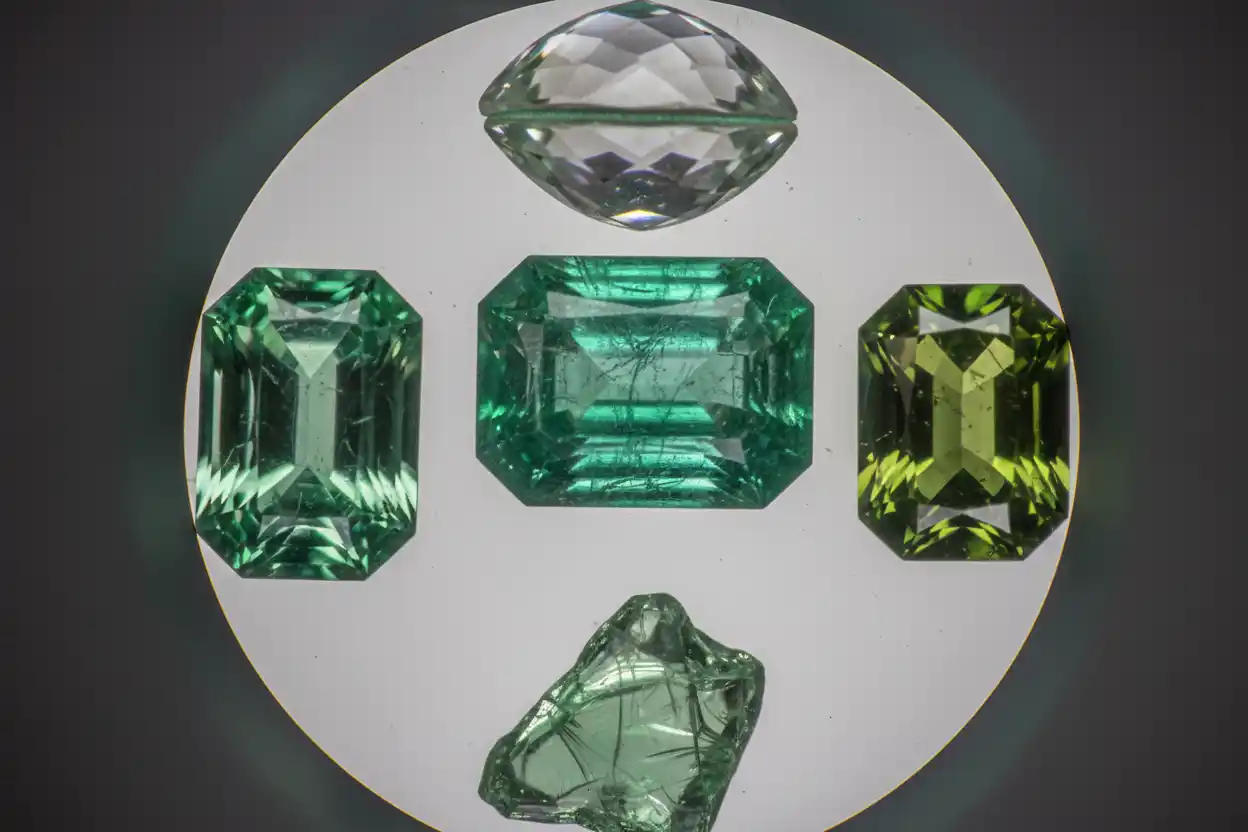
Real vs Fake Emerald: Natural, Synthetic and Treated Tests
A real natural emerald is green to bluish-green beryl whose color is principally associated with chromium, vanadium or both. It formed geologically rather than through laboratory growth, and it may contain fractures, mineral crystals, fluid inclusions, growth zoning and other internal evidence of its natural history.
The market also contains laboratory-grown emerald. Synthetic emerald has essentially the same beryl composition, crystal structure and optical properties as natural emerald but develops through a manufactured flux or hydrothermal process. It is a legitimate gemstone when its origin is disclosed accurately.
Green glass, synthetic spinel, cubic zirconia, green quartz, assembled doublets and coated beryl are emerald simulants rather than emeralds. Meanwhile, natural emerald may be filled with oil or resin to make surface-reaching fractures less visible. That treatment does not make the base stone fake, but it materially affects value, care and disclosure.
Therefore, identification requires three separate questions: Is the material emerald? Is it natural or laboratory-grown? Has it been treated, filled, coated or assembled?
This article owns the direct authenticity workflow. The completed treated and synthetic emerald guide retains the full enhancement taxonomy and laboratory-treatment boundary.
Natural Emerald vs Synthetic Emerald and Simulants
| Feature | Natural emerald | Synthetic emerald | Green glass | Green synthetic spinel or other simulant |
|---|---|---|---|---|
| Material | Naturally formed green beryl | Laboratory-grown green beryl | Manufactured glass | Different manufactured gem material |
| Typical color cause | Chromium, vanadium or both | Introduced colorants, commonly chromium | Manufactured colorants | Depends on simulant |
| Mohs hardness | Approximately 7.5–8 | Approximately 7.5–8 | Commonly about 5–6 | Material-dependent |
| Refractive index | About 1.577–1.583 | Usually overlaps emerald | Commonly lower, though glass varies | Usually different from beryl |
| Specific gravity | About 2.72 | Usually close to natural emerald | Variable | Material-dependent |
| Birefringence | Approximately 0.005–0.009 | Beryl-range birefringence | None in ordinary glass | Depends on material |
| Common inclusions | Multiphase fluids, mineral crystals, growth tubes, fingerprints and fissures | Flux residues, veils, chevron growth, nail-head spicules or seed-related structures | Round bubbles and curved flow lines | Synthetic growth features |
| Common treatments | Oil, resin, wax, fillers and occasional coating | May be untreated after growth or receive additional treatment | Color is part of manufacture | Depends on product |
| Strongest confirmation | Microscopy, optical testing, spectroscopy and laboratory analysis | Same methods | Standard gem testing often separates it | Standard and advanced testing |
Natural and synthetic emerald can overlap in hardness, density and refractive index. Consequently, confirming beryl does not by itself confirm natural origin.
What Is Genuine Natural Emerald?
Emerald belongs to the beryl family, which also includes aquamarine, morganite, heliodor, goshenite and red beryl.
The emerald meaning guide owns its geology, symbolism, localities and general properties. The planned types of emerald guide retains variety, color and locality categories.
Emerald must be green enough and sufficiently saturated to fall within the emerald color range. Very pale green beryl may be described simply as green beryl instead.
Natural emeralds form through several geological pathways. Colombian deposits are strongly associated with hydrothermal fluids moving through sedimentary rocks, while many African and Brazilian deposits occur where beryllium-bearing fluids or rocks interact with chromium- or vanadium-bearing environments.
These uncommon geological combinations explain why natural emerald commonly contains inclusions and fractures.
Emerald Color
Emerald ranges from green through bluish green, with tone varying from relatively light to dark.
Fine color combines sufficient saturation with brightness. A very dark stone may appear impressive under concentrated light but become nearly black indoors.
Yellowish modifiers can weaken the classic emerald appearance, while excessive blue may move the material toward another green-blue beryl description.
Color alone cannot authenticate emerald. Glass, synthetic emerald and coated beryl can all reproduce a persuasive green.
Photographs are especially unreliable because white balance, saturation, dark backgrounds and spotlighting can exaggerate color.
Natural Emerald Inclusions
Natural emerald is famous for its inclusion scene, sometimes described by the French word jardin, meaning garden.
Inclusions may include mineral crystals, partially healed fissures, needles, growth tubes and liquid-filled cavities containing two or more phases.
Colombian emerald may contain characteristic multiphase inclusions with liquid, gas and solid components. Emeralds from other geological environments show different inclusion populations.
Natural-looking inclusions support a geological origin only when interpreted correctly. Dust, scratches and filler flashes can be mistaken for crystals or fluids.
A natural emerald can also be relatively clean. Inclusion absence does not prove laboratory growth, particularly in small stones.
Synthetic Emerald
Synthetic emerald is laboratory-grown beryl with emerald-producing colorants.
Two major production approaches are flux growth and hydrothermal growth.
Flux-grown emerald crystallizes slowly from a molten chemical solution. Hydrothermal emerald grows from a hot water-based solution under high pressure, often around a seed crystal.
Both methods can produce material whose color, hardness, refractive index and density closely match natural emerald.
A disclosed synthetic emerald can be beautiful and durable enough for jewelry. It should be described as laboratory-grown, laboratory-created or synthetic emerald throughout the sale.
The lab emerald guide owns its growth methods and material profile, while the lab emerald buying guide retains its purchase workflow.
Flux-Grown Synthetic Emerald Clues
Flux-grown material may contain wispy veils, flux-filled fingerprints, metallic platelets, growth zoning and inclusions formed from the growth medium.
Some flux inclusions can look strikingly similar to healed fractures in natural emerald.
Synthetic crystals may also contain small beryl crystals or manufacturing-related residues not expected in the same configuration in natural material.
Modern production continues to improve. A single veil or fingerprint cannot establish laboratory origin without supporting optical and spectroscopic data.
Hydrothermal Synthetic Emerald Clues
Hydrothermal synthetic emerald may show chevron or angular growth zoning, nail-head spicules, seed-related boundaries and unusual internal graining.
Some products contain phenakite or other inclusions associated with the laboratory process.
A seed plate may remain visible as a straight boundary, although cutting can remove or conceal it.
Natural hydrothermal emerald deposits also produce fluid-rich features, so the word hydrothermal does not automatically mean synthetic. The complete inclusion scene must be interpreted in context.
Emerald Treatments
Most natural emeralds contain surface-reaching fissures. Filling those fissures with a transparent substance reduces their visibility and improves apparent clarity.
Traditional fillers include oils such as cedarwood oil. Modern products may use natural resins, waxes, epoxy resins and other polymers.
A filled emerald remains natural emerald if the underlying stone is natural. However, the degree and type of filling affect price, durability and cleaning.
Treatment descriptions may use terms such as minor, moderate or significant clarity enhancement.
The broader gemstone treatments guide explains why oiling, resin filling, coating and laboratory growth are different categories.
How Filler Looks Under Magnification
A filled fracture may produce a colored flash when viewed under dark-field or oblique illumination.
Blue, orange, yellow or purple flashes can appear as light reflects from the filler–emerald boundary. The effect varies with filler type, viewing angle and fracture thickness.
Flattened gas bubbles may occur within resin-filled fissures.
Areas of different luster can also reveal where filler reaches the surface.
An untreated fracture can reflect light too, so flash effects require trained interpretation. A home loupe may identify suspicious features but cannot quantify treatment reliably.
Coated Beryl and Coated Emerald
Colorless or pale beryl may receive a green coating to imitate emerald.
Coated emerald also exists when a natural or synthetic green stone receives an additional surface film to improve its color.
Inspect facet edges, girdles, scratches and areas protected by prongs. Abrasion may expose a paler underlying material.
Color concentrated at the surface, inside drill holes or beneath a transparent film supports coating.
Coatings can be difficult to detect in mounted stones and may be damaged by polishing or repair.
Emerald Doublets and Triplets
An assembled emerald imitation combines two or more layers.
A doublet may use a green glass or synthetic layer beneath a colorless crown. Another construction may join pale natural beryl to colored cement.
A triplet includes three layers, sometimes using a colored central adhesive.
Inspect the girdle and profile for a straight join line, trapped bubbles or an abrupt change in inclusions.
Closed-back settings may hide the assembly. A loose-stone examination is preferable when the seller permits it.
Green Glass
Green glass is one of the oldest emerald imitations.
Round gas bubbles, curved flow lines, mold marks and a homogeneous interior are common clues.
Some glass is nearly bubble-free. Other products contain deliberately added inclusions to imitate emerald’s garden-like appearance.
Glass is usually softer and singly refractive. Its density and refractive index generally differ from beryl.
Deliberate scratch testing is unnecessary and can damage the object. Optical measurements offer safer evidence.
Synthetic Spinel, YAG and Other Simulants
Green synthetic spinel, YAG, cubic zirconia and other manufactured crystals can imitate emerald.
These products may have strong brilliance, high clarity and colors ranging from yellowish green to bluish green.
Their refractive indices, densities and spectra differ from emerald, so routine gemological instruments commonly separate them.
They are not synthetic emerald because their chemistry and crystal structure differ from beryl.
The laboratory-grown versus natural gemstones guide explains the difference between a synthetic counterpart and a simulant.
Emerald Versus Peridot
Peridot is olivine and usually appears more yellow-green than emerald.
It has strong birefringence that can produce doubled rear facets, while emerald’s doubling is much weaker.
Peridot is also denser and has a different refractive-index range.
The completed peridot versus emerald guide owns the complete side-by-side workflow.
Emerald Versus Tsavorite Garnet
Tsavorite is green grossular garnet.
It is singly refractive and generally lacks emerald’s characteristic beryl inclusions and clarity-enhancement expectations.
Fine tsavorite can show vivid green with greater brilliance and fewer fractures.
The planned tsavorite versus emerald guide owns the direct comparison.
A green stone should not be called emerald merely because it is valuable and saturated.
Emerald Versus Green Tourmaline
Green tourmaline can overlap emerald in hue but commonly displays stronger pleochroism and different refractive properties.
Tourmaline may show elongated growth tubes and stronger directional color.
Chrome tourmaline can be exceptionally vivid and may resemble fine emerald visually.
Professional testing separates them readily, while unaided color inspection does not.
Emerald Versus Green Quartz
Green quartz may include prasiolite, dyed quartz, coated quartz or chromium-bearing varieties.
Quartz has lower refractive index and density and different inclusions.
Dyed quartz often shows color concentration in fractures. Coated quartz may show surface wear.
A commercial name containing emerald—such as emerald quartz—does not establish beryl identity.
Hardness Tests
Emerald ranks approximately 7.5–8 on the gemstone hardness chart.
However, emerald is commonly fractured and may be filled. Deliberate scratch testing can chip the stone or damage its filler.
Hardness also cannot distinguish natural emerald from synthetic emerald because both are beryl.
The gemstone toughness-versus-hardness guide explains why emerald’s respectable hardness does not make heavily fractured material impact-proof.
Refractive Index
Emerald generally has a refractive-index range of approximately 1.577–1.583.
Its birefringence is relatively low, commonly about 0.005–0.009.
Glass, quartz, synthetic spinel and garnet usually provide different readings.
Natural and synthetic emerald overlap, making refractive index useful for material identity but inadequate for growth-origin determination.
A mounted stone may provide only limited access for testing.
Specific Gravity
Emerald’s specific gravity is commonly near 2.72.
Garnet, synthetic spinel and cubic zirconia are generally denser, while selected glass and quartz products may fall closer.
Hydrostatic testing requires a loose stone and precise measurements. Fillers and inclusions can shift the apparent result slightly.
Judging weight by hand is unreliable.
Dichroism
Emerald is doubly refractive and commonly dichroic.
A dichroscope may reveal bluish green and yellowish green directional colors.
The strength varies with orientation, saturation and stone size.
Glass lacks true dichroism, while other crystalline simulants may show their own pleochroism. The observation supports beryl identification without proving natural origin.
Ultraviolet Fluorescence
Emerald fluorescence varies with chromium, iron, filler and source.
Some emeralds show red fluorescence, while iron-rich stones may react weakly or remain inert.
Synthetic emeralds and simulants can also fluoresce.
Oil or resin may produce a different reaction within fractures.
Ultraviolet light contributes evidence but is not a standalone authenticity test.
Infrared, Raman and Chemical Analysis
FTIR spectroscopy can reveal oils, resins and other fillers. It can also help separate natural emerald from flux- and hydrothermal-grown synthetic material through water- and hydroxyl-related features.
Raman spectroscopy can identify inclusions and confirm beryl or simulant materials.
Trace-element chemistry supports natural-versus-synthetic separation and, in suitable cases, geographic-origin analysis.
These methods become important when visual evidence and routine measurements overlap.
Geographic-Origin Claims
Emeralds come from Colombia, Zambia, Brazil, Afghanistan, Pakistan, Ethiopia and other locations.
Origin can affect market perception, but no locality is guaranteed by one shade of green.
Inclusions and trace chemistry help laboratories form an origin opinion. Some stones remain inconclusive.
“Colombian color” is not equivalent to documented Colombian origin.
A buyer should pay an origin premium only when an independent report supports the claim.
Buying Real Emerald
The completed emerald buying guide owns color, clarity, cut, size and seller evaluation.
The emerald price guide retains market ranges and treatment premiums.
Ask whether the stone is natural or laboratory-grown and request the degree of clarity enhancement.
A claim of no oil, insignificant enhancement or Colombian origin should be supported by an independent report when it affects price materially.
For remote purchases, follow how to buy gemstones online and retain sufficient time for independent inspection.
Laboratory Reports
The gemstone-certification guide explains identification and origin reports.
A suitable emerald report can confirm natural or laboratory-grown origin and describe detectable treatment.
Some laboratories quantify filling as minor, moderate or significant. Treatment wording should be compared carefully rather than reduced to certified.
Use how to read a gem lab report to verify dimensions, report number, filler language and origin opinion.
Emerald Jewelry and Care
Emerald’s fractures and fillers require gentler handling than its hardness number suggests.
The emerald engagement-ring guide owns daily-ring setting decisions, while the emerald ring guide covers broader styles.
Emerald earrings and an emerald necklace receive less impact than an emerald bracelet.
Use the dedicated emerald jewelry cleaning guide rather than steam or ultrasonic cleaning. Heat and vibration can affect fractures and fillers.
Emerald’s calendar tradition remains within the May birthstone guide.
A Safe Home Screening Sequence
Clean the stone gently without heat or ultrasonic vibration.
Observe color under neutral daylight and warm indoor light. Then inspect inclusions with a 10× loupe.
Look for round glass bubbles, curved flow lines, join planes, coating wear and filler flashes.
A dichroscope can support beryl identification, while a professional refractometer can separate many simulants.
Review the report and invoice for natural or laboratory-grown origin and degree of enhancement.
Do not scratch, heat, soak in solvents or attempt to remove oil.
When the purchase value depends on natural origin, treatment or locality, obtain independent laboratory testing.
Frequently Asked Questions
1. What is a real emerald?
A real natural emerald is naturally formed green to bluish-green beryl colored principally by chromium, vanadium or both.
2. Is laboratory-grown emerald real?
It is genuine synthetic beryl with emerald properties when disclosed accurately, but it is not naturally mined emerald.
3. Are inclusions proof that an emerald is natural?
No. Natural emeralds commonly contain inclusions, but synthetic emeralds can also contain convincing growth features.
4. Can a natural emerald be eye-clean?
Yes. Fine natural emerald can be relatively clean, especially in smaller sizes, although inclusions are common.
5. Is oiled emerald fake?
No. It is treated natural emerald if the underlying stone is natural. The filling should be disclosed and quantified.
6. What is the most common emerald treatment?
Introducing oil or resin into surface-reaching fractures is the most common clarity enhancement.
7. Do bubbles prove an emerald is glass?
Ordinary isolated round bubbles strongly suggest glass, but fluid inclusions in natural emerald can contain gas phases. Context matters.
8. Can a scratch test identify emerald?
No. It can damage a fractured or filled stone and cannot separate natural from synthetic beryl.
9. How can synthetic emerald be identified?
Laboratories combine inclusions, growth structures, FTIR, Raman spectroscopy and trace-element chemistry.
10. Does deep green color prove an emerald is valuable?
No. Color may be enhanced by coating, synthetic growth or photography. Treatment, clarity, cut and origin also matter.
11. Does a certificate prove Colombian origin?
Only when an independent laboratory specifically provides a Colombian origin opinion. Identification alone does not establish locality.
12. When should an emerald receive laboratory testing?
Testing is advisable when natural origin, treatment degree, geographic origin or price materially affects the purchase.
Emerald authentication is not solved by searching for a garden of inclusions or one perfect shade of green. Natural emerald, synthetic emerald, filled emerald and green simulants can overlap visually. A reliable conclusion combines beryl properties, microscopic growth evidence, treatment analysis and documentation that addresses the claims actually affecting value.
Emerald appears in Crystals That Start With E and Gemstones That Start With E.