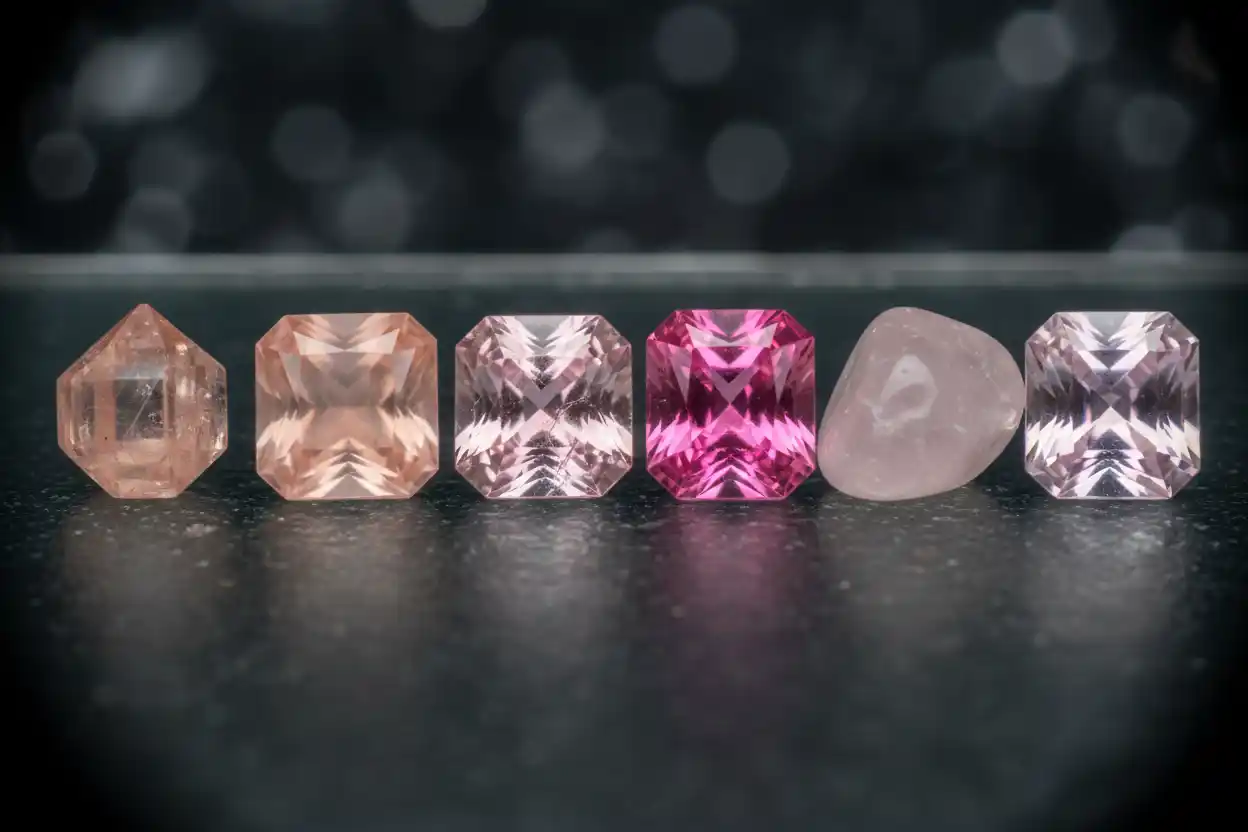
Real vs Fake Morganite: Natural, Synthetic and Glass Tests
Real natural morganite is the pink, peach, salmon, or orange-pink variety of beryl. Its color is associated principally with manganese, while its beryl structure gives it the same broad mineral framework as aquamarine, emerald, heliodor, goshenite, and red beryl.
Morganite imitations include pink glass, cubic zirconia, synthetic spinel, rose quartz, kunzite, pink tourmaline, pink sapphire, and coated colorless stones. Laboratory-grown pink beryl also exists, although it is much less common commercially than laboratory-grown emerald or sapphire.
Treatment creates another important distinction. Much commercial morganite is heated to reduce orange or yellow modifiers and leave a purer pink. The stone remains natural beryl, but its finished color is treated. Because this heating is usually stable and may not be detectable, seller disclosure and supply-chain documentation often matter more than a visual test.
This page owns the direct material-identification workflow. The completed treated and synthetic morganite guide retains the detailed treatment, coating, filling, and laboratory-growth boundaries.
Natural Morganite vs Common Alternatives
| Feature | Natural morganite | Synthetic morganite | Pink glass | Rose quartz | Kunzite |
|---|---|---|---|---|---|
| Material | Naturally formed pink beryl | Laboratory-grown pink beryl | Manufactured glass | Pink quartz | Pink-to-violet spodumene |
| Typical color | Peach, salmon, pale pink, orange-pink, or stronger pink | Pink to orange-pink | Any manufactured pink | Pale to medium cloudy pink | Pink, lilac, or violet-pink |
| Mohs hardness | 7.5–8 | 7.5–8 | Commonly about 5–6 | 7 | 6.5–7 |
| Refractive index | About 1.583–1.590 | Overlaps natural beryl | Usually different | About 1.544–1.553 | Higher than morganite |
| Specific gravity | About 2.80–2.91 | Similar | Variable | About 2.66 | Significantly higher |
| Pleochroism | Usually weak pink-to-nearly-colorless directional color | Growth-dependent | None in ordinary glass | Usually weak | Often distinct |
| Common inclusions | Fluid inclusions, tubes, mineral crystals, fingerprints, feathers | Seed-related structures and hydrothermal growth features | Round bubbles and curved flow lines | Cloudiness, needles, veils, fractures | Tubes, liquid inclusions, cleavage and growth features |
| Main risk | Undisclosed heat or coating | Sold as mined natural morganite | Sold as gemstone beryl | Mislabeled as transparent morganite | Confused through pink-violet color |
| Best confirmation | Optical testing, microscopy, spectroscopy, and chemistry | Advanced growth-origin testing | Standard gemological testing | RI, density, and inclusions | RI, density, pleochroism, and cleavage |
No single visible feature separates every material. Natural and laboratory-grown morganite can share the same core beryl properties.
What Is Genuine Morganite?
The completed morganite meaning guide owns the gemstone’s geology, symbolism, localities, and general properties.
Morganite belongs to the beryl family. Beryl has a hexagonal crystal structure and commonly develops elongated six-sided prisms.
Gem-quality morganite typically forms in granitic pegmatites. These coarse-grained rocks can also contain quartz, feldspar, mica, tourmaline, spodumene, and other rare-element minerals.
Natural crystals range from almost colorless with a faint pink tint to saturated pink or salmon. Many are comparatively clean because beryl can grow in large transparent crystals.
Consequently, a large eye-clean stone is not automatically synthetic or glass. Size and clarity must be considered with optical properties and seller disclosure.
Morganite Color
Untreated morganite commonly shows peach, salmon, orange-pink, or pink with a yellowish modifier.
Pure pink or magenta-pink stones are generally preferred in the market. However, many receive heat treatment to remove orange or yellow components.
Pale color is common, particularly in small stones. Morganite’s tint often becomes more visible as size increases because light travels through more colored material.
Lighting can change the appearance substantially. Rose gold may intensify warmth, while a white-metal setting can make a pale stone appear cooler.
Photographs taken against pink backgrounds or with increased saturation can make a weakly colored gem look much stronger. Evaluate the exact stone against neutral white, gray, and skin-toned backgrounds.
Heat-Treated Morganite
Heating is widely used to produce a purer pink.
The treatment modifies manganese-related color centers, commonly reducing yellow or orange coloration. It does not turn beryl into another mineral.
The resulting pink is generally stable during ordinary wear. Furthermore, treatment may leave no features that allow a laboratory to determine definitively whether heating occurred.
A report identifying natural morganite therefore does not necessarily prove untreated color unless it states that color origin was evaluated and a conclusion was possible.
Undetectable treatment makes seller transparency important. Buyers should not pay a large untreated premium based only on verbal assurances.
Is Heated Morganite Fake?
No. A heated stone remains natural morganite if the original material formed geologically.
The accurate description is heat-treated natural morganite.
It becomes misleading when a seller represents the color as untreated, exceptionally rare, or naturally pure pink without reliable evidence.
Treatment status and material identity should remain separate. Genuine natural beryl can have treated color, while pink glass is an imitation regardless of whether its color was added during manufacture.
The broader gemstone-treatment guide explains why heating, coating, filling, laboratory growth, and imitation describe different processes.
Natural Morganite Inclusions
Morganite may contain liquid inclusions, gas bubbles enclosed within fluid cavities, mineral crystals, growth tubes, partially healed fractures, and fingerprints.
Two- or three-phase inclusions can contain liquid, gas, and a solid crystal. Their irregular cavities differ from ordinary bubbles freely suspended in glass.
Pegmatite-related minerals may occur as solid inclusions. Some specimens contain tourmaline, mica, zircon, helvine, or other associated crystals.
A natural gemstone can be exceptionally clean, so absence of inclusions proves little.
Likewise, one complicated inclusion does not guarantee natural origin. Laboratory-grown beryl can contain seed-related boundaries, fluid features, and manufacturing inclusions.
Synthetic Morganite
Laboratory-grown morganite is synthetic pink beryl.
Hydrothermal methods can grow beryl from a hot aqueous solution under pressure. A seed crystal guides the growth inside a controlled vessel.
Synthetic morganite shares beryl composition, crystal structure, hardness, refractive index, and density with natural material. Ordinary scratch or weight tests cannot separate the two reliably.
Possible clues include seed plates, chevron growth, unusual zoning, nail-head-like spicules, and inclusions associated with the growth process.
Commercial production is limited compared with synthetic emerald. Nevertheless, a large, intensely colored, very clean stone sold cheaply as natural still warrants verification.
The completed laboratory-grown versus natural gemstone guide explains the terminology.
Pink Glass Imitations
Pink glass can reproduce pale morganite at very low cost.
Round gas bubbles, curved flow lines, molded seams, and an unusually homogeneous interior are useful clues when present.
Some glass contains no visible bubbles. Other products contain deliberately created fractures or particles intended to resemble natural inclusions.
Glass generally has lower hardness and different refractive properties. However, deliberate scratching is unnecessary and can damage jewelry.
A polariscope can help because beryl is doubly refractive while ordinary unstressed glass is isotropic. Strained glass may show anomalous light patterns, so additional measurements remain necessary.
Cubic Zirconia
Pink cubic zirconia can imitate a strongly saturated morganite.
It is much denser and normally displays stronger brilliance and broader fire. An equal-size CZ weighs considerably more than beryl.
CZ is singly refractive, whereas morganite is doubly refractive.
Because mounted stones cannot be weighed accurately by hydrostatic methods, refractive behavior and thermal testing may provide faster screening.
Facet edges on older cubic zirconia can show abrasion, while morganite also develops wear eventually. Surface condition alone is not proof.
Synthetic Spinel
Synthetic pink spinel appears frequently in inexpensive and vintage jewelry.
It is harder and denser than morganite and generally has a refractive index near 1.72, distinctly higher than beryl.
Flame-fusion material may contain curved growth lines and gas bubbles. Better-quality synthetic spinel can look clean and convincing.
Synthetic spinel is not synthetic morganite because its composition and crystal structure differ.
A retailer should name the material as synthetic spinel rather than using vague language such as lab-created pink stone.
Morganite Versus Rose Quartz
Rose quartz is a pink quartz variety.
Most rose quartz is translucent or cloudy, while faceted morganite is commonly transparent and more brilliant. However, unusually transparent rose quartz exists.
Quartz has lower refractive index and density. Morganite is also slightly harder.
The completed morganite-versus-rose-quartz guide owns the full side-by-side comparison.
Color alone cannot separate them because both range from pale blush to stronger pink.
Morganite Versus Kunzite
Kunzite is the pink-to-violet variety of spodumene.
It often shows stronger pleochroism than morganite and may appear pink from one direction and nearly colorless from another.
Kunzite is denser, has higher refractive properties, and possesses perfect cleavage. That cleavage makes it more vulnerable during cutting, setting, and wear.
The completed kunzite-versus-morganite guide owns the detailed comparison.
Kunzite may fade after prolonged intense light, while heated morganite’s ordinary commercial pink is generally stable.
Morganite Versus Pink Tourmaline
Pink tourmaline can overlap morganite in peach, salmon, rose, and reddish-pink shades.
Tourmaline commonly shows stronger pleochroism and may have more pronounced growth tubes or color zoning.
Its refractive index and density differ from beryl.
Tourmaline may also display a more saturated or reddish color in smaller stones, while pale morganite often needs greater size to show its color clearly.
A standard gemological examination separates them more reliably than photographs.
Morganite Versus Pink Sapphire
Pink sapphire is corundum and ranks 9 on the Mohs scale.
It is denser, more refractive, and usually more brilliant than morganite. Fine pink sapphire also carries a substantially different price structure.
Natural, synthetic, heated, diffusion-treated, and filled pink sapphires occur.
A vivid small pink stone should not be assumed to be morganite merely because the setting uses rose gold.
Coated Morganite and Coated Beryl
Colorless beryl, pale morganite, glass, or another stone can receive a pink coating.
Inspect facet junctions, girdles, scratches, and areas protected by prongs. Wear may expose a colorless or differently colored body.
A pavilion coating can influence the entire face-up appearance while remaining hidden in a closed setting.
Coated natural morganite still has a genuine beryl base, but the apparent color is treatment-dependent.
Polishing, repair, ultrasonic cleaning, or abrasion may damage a coating.
Filled and Composite Material
Surface-reaching fractures may contain oil, resin, glass-like filler, or another transparent substance.
A filler can reduce the visibility of cracks or improve durability temporarily. Under magnification, it may produce flash effects, bubbles, or differences in luster.
Doublets and triplets can combine a pale crown with a colored layer or backing.
Inspect the profile for a straight join, glue bubbles, or a sudden change in inclusions.
Assembled material requires disclosure even when one component is natural morganite.
Hardness and Durability
Morganite ranks 7.5–8 on the gemstone hardness chart.
That hardness supports frequent jewelry wear, but it does not make the stone immune to abrasion or chipping.
The completed gemstone toughness-versus-hardness guide explains why impact resistance is separate from scratch resistance.
Beryl has imperfect basal cleavage, discussed in the gemstone-cleavage guide. Existing fractures and thin corners can still break under a sharp blow.
A scratch test cannot distinguish natural from synthetic morganite because both are beryl.
Refractive Index and Density
Morganite commonly has a refractive-index range of approximately 1.583–1.590 and specific gravity of about 2.80–2.91.
These measurements separate it from quartz, glass, cubic zirconia, synthetic spinel, and kunzite in many cases.
Natural and synthetic morganite overlap.
A refractometer requires a polished facet and suitable contact. Hydrostatic weighing requires a loose stone and an accurate scale.
Mounted jewelry should not be judged through subjective heft alone.
Pleochroism
Morganite can show weak to moderate directional color, commonly varying between pink and a paler or nearly colorless direction.
The effect is often less dramatic than kunzite or tourmaline.
A dichroscope can support beryl identification, but the result depends on color strength, orientation, cut, and lighting.
Ordinary glass does not show true pleochroism, although colored backing and internal strain can create misleading visual effects.
Ultraviolet Light
Morganite’s fluorescence varies according to chemistry, treatment, and source.
Natural, synthetic, coated, and imitation materials may react or remain inert.
Ultraviolet light may reveal filler or coating differences but cannot provide a universal authenticity result.
A strong or unusual reaction should prompt further testing rather than an immediate verdict.
Laboratory Identification
A laboratory may combine refractive index, density, microscopy, polarized-light testing, ultraviolet-visible spectroscopy, infrared spectroscopy, Raman analysis, and trace-element chemistry.
Microscopy can reveal natural inclusions, hydrothermal growth structures, glass bubbles, coatings, and composite construction.
Chemistry and spectroscopy become particularly important when natural and laboratory-grown beryl overlap in routine measurements.
The completed gemstone-certification guide explains identification reports. Use how to read a gem-lab report to determine whether the laboratory identified natural origin, treatment, or merely pink beryl.
A Safe Home Inspection Sequence
Clean the stone gently before examination.
Observe it under neutral daylight, warm indoor light, and against a white background. Note peach, orange, or brown modifiers that photographs may conceal.
Use a 10× loupe to look for natural inclusions, glass bubbles, curved flow, coatings, join planes, and fillers.
Compare millimeter dimensions with weight when the stone is loose. An unusually heavy gem may be cubic zirconia or another dense simulant.
Review the seller’s origin and heat-treatment disclosure.
Do not scratch, heat, expose the stone to acid, or use a flame. Seek professional testing when natural origin affects value.
Buying Genuine Morganite
The completed morganite buying guide owns color, clarity, cut, size, and seller evaluation.
Detailed values remain within the morganite price guide.
Ask whether the stone is natural or laboratory-grown, whether it has been heated, and whether coating or filling is present.
A description such as natural pink stone does not answer those questions.
For remote purchases, follow how to buy gemstones online and preserve enough time for inspection.
Morganite Jewelry and Care
A morganite engagement ring can support frequent wear with a protective setting and regular cleaning.
The completed morganite ring guide owns broader styles. Morganite earrings and a morganite necklace receive less impact than a morganite bracelet.
Morganite readily shows skin oil and residue because pale transparent stones need clean surfaces to remain bright.
Use the completed morganite jewelry cleaning guide and avoid ultrasonic or steam cleaning when fractures, fillers, coatings, or setting damage are present.
Frequently Asked Questions
1. What is real morganite?
Real natural morganite is naturally formed pink-to-orange-pink beryl colored principally by manganese.
2. Is most morganite heat-treated?
Heat treatment is very common because it removes orange or yellow modifiers and produces a purer pink.
3. Is heated morganite fake?
No. It remains natural beryl, but its finished color is treated and should be disclosed.
4. Can heat treatment be detected in morganite?
It is commonly undetectable, so laboratory identification may confirm natural beryl without proving untreated color.
5. Does synthetic morganite exist?
Yes. Laboratory-grown pink beryl exists, although it is not produced in the same commercial volume as many other synthetic gems.
6. Can natural morganite be flawless?
Yes. Morganite commonly occurs in large, transparent crystals and can be eye-clean.
7. Do bubbles prove morganite is glass?
Smooth round bubbles within a homogeneous body suggest glass, but natural fluid inclusions can contain gas bubbles inside irregular cavities.
8. How is morganite distinguished from rose quartz?
Morganite is generally more transparent, denser, harder, and more refractive. Rose quartz often has cloudy or hazy internal texture.
9. How is morganite distinguished from kunzite?
Kunzite has stronger pleochroism, greater density, higher refractive index, and perfect cleavage.
10. Can a scratch test authenticate morganite?
No. It can damage the gem and cannot distinguish natural from laboratory-grown beryl.
11. Does a certificate prove untreated morganite?
Only when the report specifically addresses treatment and reaches a conclusion. A basic pink-beryl identification does not prove untreated color.
12. When should morganite receive laboratory testing?
Testing is useful for expensive stones, claimed untreated color, suspected synthetic material, coatings, fillers, or stones whose identity affects a major purchase.
Morganite authentication starts by confirming pink beryl, not by searching for one ideal blush color. Glass, quartz, kunzite, synthetic spinel, and cubic zirconia can be separated through optical and density testing. Natural versus synthetic beryl requires closer examination, while heat history may remain undetectable. Honest treatment disclosure is therefore part of a reliable identification.
Morganite appears in Crystals That Start With M and Gemstones That Start With M.