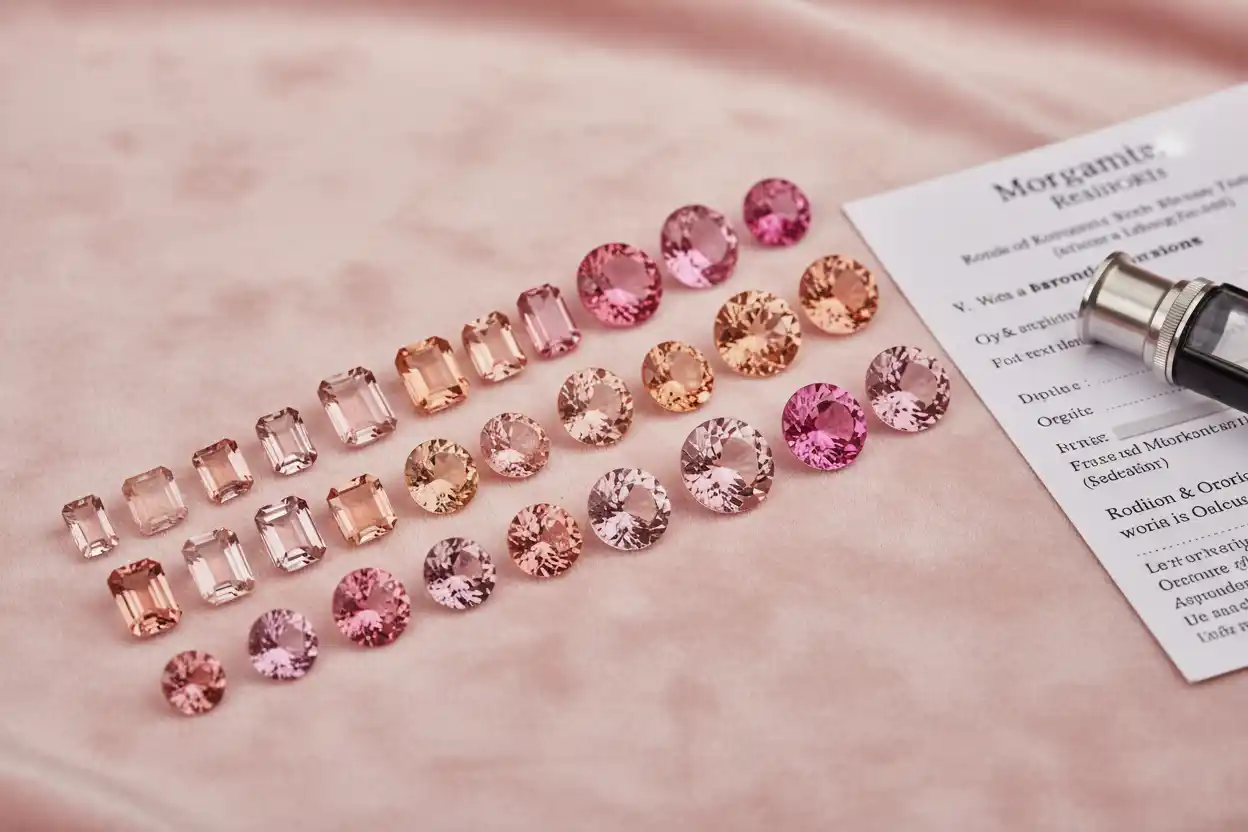
Morganite Price Guide: Value and Cost in 2026
Morganite prices in 2026 commonly range from approximately $30 to $500 per carat. Pale commercial stones may cost less, while vivid pink or peach-pink gems with excellent cutting can reach the upper end of that range.
Most attractive jewelry-quality Morganite falls between approximately $70 and $250 per carat. Although large transparent stones are readily available, strong saturation remains scarce enough to create meaningful premiums.
Morganite Price per Carat in 2026
The following ranges represent broad U.S. retail expectations for loose natural Morganite. Individual stones may fall outside them because color, cutting, weight, treatment disclosure and seller positioning vary.
| Morganite quality | Typical characteristics | Approximate 2026 retail price |
|---|---|---|
| Entry commercial | Very pale pink, grayish, visibly included or poorly cut | $20–$60 per carat |
| Good commercial | Light pink or peach, eye-clean appearance and acceptable cutting | $50–$120 per carat |
| Fine | Attractive peach-pink or pink, strong transparency and balanced proportions | $100–$250 per carat |
| Premium | Rich pink, rose-pink or saturated peach with excellent cutting | $200–$400 per carat |
| Exceptional | Vivid color, large size, precision cutting or documented collector quality | $400–$500+ per carat |
These ranges apply to loose faceted stones. Finished jewelry includes metal, manufacturing, accent gems, retailer margin and brand positioning.
The broader interaction among color, clarity, cutting, size and demand appears in How Gemstone Prices Are Determined.
Morganite Prices by Size and Quality
Morganite does not follow the same steep size premiums as Ruby, Emerald or fine Sapphire. Gem-quality beryl crystals can grow large enough to produce substantial transparent stones.
However, saturation often becomes more visible in deeper or larger gems. As a result, fine large Morganite can cost more per carat than small pale material.
| Carat weight | Commercial quality | Fine quality | Premium saturated quality |
|---|---|---|---|
| Under 1 ct | $20–$60 per carat | $60–$120 per carat | $100–$180 per carat |
| 1–3 ct | $40–$90 per carat | $90–$180 per carat | $150–$300 per carat |
| 3–5 ct | $50–$100 per carat | $100–$220 per carat | $180–$350 per carat |
| 5–10 ct | $50–$120 per carat | $120–$250 per carat | $220–$450 per carat |
| Above 10 ct | $60–$130 per carat | $140–$280 per carat | $250–$500+ per carat |
A pale ten-carat stone can cost less than a vivid three-carat gem. Weight should therefore be considered after face-up color and cutting.
What Is Morganite?
Morganite is the pink, peach, salmon or violetish-pink variety of beryl. Manganese contributes to its color.
It belongs to the same mineral family as Emerald, Aquamarine, Heliodor, Goshenite and Red Beryl. Those varieties share the same broad crystal structure but occupy very different markets because their colors and geological supply differ.
The completed Morganite guide owns its mineral identity, formation, localities and traditional symbolism. The completed Beryl guide explains how Morganite relates to the other beryl varieties.
This page remains focused on current pricing and value.
Color Is Morganite’s Primary Value Factor
Morganite ranges from nearly colorless blush to pink, peach, salmon, rose and violetish pink.
The market generally pays the strongest premiums for medium pink and saturated peach-pink. Color should remain visible in ordinary indoor lighting rather than appearing only against a white tray or through concentrated illumination.
Very pale Morganite is common. Large stones with weak saturation may look almost colorless once mounted, particularly in white metal.
Gray, brown and muddy orange modifiers reduce value. A warm salmon tone can remain attractive, although demand is usually stronger for pink and balanced peach-pink.
Color preference also depends on the setting. Rose gold can strengthen warm peach tones, while white gold or platinum may emphasize cooler pink.
The broader range of pink jewelry materials appears in Pink Gemstones, while practical bridal options appear in Pink Gemstones for Engagement Rings.
Why Morganite Often Looks Pale
Morganite’s color can be delicate even when the stone is natural and correctly identified.
Small stones contain less physical depth for light to travel through, which can make their color appear weaker than larger examples cut from similar rough.
Shallow cutting creates another problem. Although a broad face may look large, the missing depth can reduce apparent saturation.
Dark backgrounds, rose-gold reflectors and warm lighting can make a listing appear much pinker than the loose stone looks on a neutral surface.
Some product images are also digitally saturated. Buyers should therefore request videos against white, gray and skin-toned backgrounds.
A stone should not be priced as premium simply because one marketing photograph makes it look vivid.
Pink vs Peach Morganite
Pure pink commonly receives the strongest demand in Western bridal jewelry. However, high-quality peach Morganite also has an established market.
Pink stones may look cooler and pair naturally with white metals. Peach stones often complement rose or yellow gold and can create a warmer overall design.
Neither hue is universally more valuable. Saturation, brightness and visual balance matter more than whether the seller uses the word pink or peach.
A vivid peach-pink gem can be worth more than a pale pure-pink stone. Likewise, an excessively orange or brown appearance normally lowers value.
Trade labels such as rose Morganite, champagne Morganite and pink Emerald are promotional rather than standardized gemological varieties.
Clarity and Transparency
Faceted Morganite is generally expected to appear eye-clean. Transparent rough is available in useful sizes, so visible fractures, dark crystals and heavy clouds reduce value substantially.
Minor internal features may be acceptable in strongly colored or unusually large stones. Nevertheless, high transparency remains a normal expectation for fine jewelry material.
Surface-reaching fractures deserve additional attention because they can collect dirt and create setting risks.
A clean stone is not automatically valuable. Morganite with excellent clarity but almost no visible color can remain inexpensive.
Therefore, transparency should be evaluated together with saturation, brilliance and cutting rather than treated as an independent premium.
Cut Quality and Face-Up Color
Cutting can strengthen or weaken Morganite’s apparent color.
An excessively shallow pavilion creates a transparent window through the center. That window allows the setting or wearer’s skin to show through and makes the stone appear paler.
A very deep pavilion can strengthen color but hide substantial weight below the girdle. The buyer then pays for carats that do not produce proportionate visible size.
Ovals, cushions, pears and emerald cuts are common because they preserve beryl crystals efficiently. Rounds usually require more rough loss and may cost more when their proportions are strong.
A well-cut Morganite should show:
- Even color across the face
- Useful brilliance
- Minimal central windowing
- Balanced symmetry
- A secure girdle
- Appropriate depth for its shape
Detailed cut inspection and seller questions belong to the Morganite Buying Guide.
Does Morganite Become More Valuable at Large Sizes?
Morganite is available in large transparent stones, so weight premiums remain moderate through much of the market.
| Example stone | Approximate price per carat | Approximate total price |
|---|---|---|
| 1 ct commercial Morganite | $30–$90 | $30–$90 |
| 2 ct fine Morganite | $80–$200 | $160–$400 |
| 3 ct premium Morganite | $150–$300 | $450–$900 |
| 5 ct fine saturated Morganite | $180–$400 | $900–$2,000 |
| 10 ct exceptional Morganite | $250–$500+ | $2,500–$5,000+ |
Large size becomes valuable when saturation and cutting remain exceptional. A twenty-carat pale stone may cost less per carat than a fine five-carat center.
Dimensions also matter. A deep five-carat gem can appear smaller than a well-proportioned four-carat stone.
Heat Treatment
Heat treatment is widely accepted in the Morganite market. It can reduce yellow or orange components and produce a pinker appearance.
The resulting color is generally considered stable during normal wear. Routine heating is often reflected in ordinary commercial pricing rather than creating a major discount.
Detecting low-temperature heating can be difficult, so many reports may not determine whether treatment occurred.
Untreated status becomes commercially meaningful when a vivid naturally colored stone is accompanied by credible laboratory or provenance evidence.
However, untreated does not automatically mean valuable. A pale untreated Morganite can still cost far less than a beautiful heated stone.
The dedicated How to Spot Treated or Synthetic Morganite page owns treatment and laboratory-origin evidence. The general framework appears in Gemstone Treatments Explained.
Irradiation and Color Modification
Irradiation can alter color in beryl, including pink, peach, yellow and orange appearances.
Some experimental or commercial treatments combine irradiation and heat to produce a desired final color. Treatment stability and disclosure can vary.
A seller should describe known enhancement rather than relying only on the word natural. Natural origin does not prove that the color has never been modified after mining.
An unusually vivid Morganite offered far below normal market prices deserves closer examination. The possibilities include treatment, laboratory-grown beryl, misleading photography or incorrect identification.
Independent testing becomes more useful as the price and color claims increase.
Morganite Sources
Brazil has historically supplied significant Morganite rough, including large transparent crystals.
Madagascar produced some of the material originally associated with the name rose beryl and continues to be important in the collector market.
Mozambique and Ethiopia have become notable modern sources. Afghanistan, Pakistan, Namibia and the United States have also produced Morganite.
Origin usually creates less price difference than color and cutting. A fine Mozambican stone can be worth more than an ordinary Brazilian gem.
Specific mine provenance may interest mineral collectors, particularly when a crystal retains a natural termination or associations with Tourmaline, Quartz or Albite.
For ordinary faceted jewelry, visible quality remains more important than country.
Morganite vs Aquamarine Value
Morganite and Aquamarine are both beryl varieties and commonly occur as clean stones in substantial sizes.
Fine Aquamarine can cost several hundred dollars per carat, especially when it shows saturated blue color. Commercial pale Aquamarine may overlap with Morganite pricing.
The current blue-beryl market appears in the Aquamarine Price Guide.
Morganite generally receives its strongest demand from bridal and rose-gold jewelry, while Aquamarine benefits from broader recognition and March birthstone demand.
Neither stone is universally more valuable. Saturation, cut and size determine the result.
Morganite vs Emerald Value
Emerald is also beryl, but its vivid green color, formation conditions and collector demand create a far higher market.
A clean five-carat Morganite may cost hundreds or a few thousand dollars. A comparable-size fine Emerald can cost tens of thousands or more.
The difference demonstrates why clarity and size do not determine value alone. Emerald is commonly included, yet rare saturated green color supports its premium.
Current Emerald pricing belongs to the Emerald Price Guide.
Morganite should not be marketed as pink Emerald without a clear explanation that the term is promotional rather than a separate mineral species.
Morganite vs Goshenite and Heliodor
Goshenite is colorless beryl and generally costs less because it lacks a rare-color premium. Its current market appears in the Goshenite Price Guide.
Heliodor is yellow to golden beryl. Strongly saturated examples may overlap with Morganite pricing, while pale yellow stones can cost less.
Current yellow-beryl prices appear in the Heliodor Price Guide.
Within the beryl family, color creates the primary distinction. Large clean size is relatively available in all three varieties.
Morganite vs Kunzite
Morganite and Kunzite can both show pink, peach and violetish-pink color.
Morganite is beryl, while Kunzite is spodumene. Kunzite commonly provides larger visual size at lower prices but has perfect cleavage and greater light-sensitivity concerns.
Morganite has better practical toughness and a more established engagement-ring market.
The complete physical and visual comparison belongs to Kunzite vs Morganite. Current Kunzite pricing appears in the Kunzite Price Guide.
Morganite vs Rose Quartz
Rose Quartz is usually translucent rather than transparent and commonly displays a softer cloudy pink.
Commercial Rose Quartz costs far less than faceted Morganite. Fine star or unusually transparent Rose Quartz can receive premiums, but its overall market remains lower.
The complete identification comparison belongs to Morganite vs Rose Quartz.
Current quartz pricing appears in the Rose Quartz Price Guide. Morganite should not be priced from resemblance alone because the two materials have different optical and physical properties.
Morganite Engagement Ring Prices
| Ring type | Broad 2026 U.S. retail range |
|---|---|
| Small silver or gold-plated ring | $100–$500 |
| 1–2 ct Morganite ring in 10K or 14K gold | $500–$2,000 |
| 2–3 ct rose-gold solitaire | $800–$3,000 |
| Halo ring with Morganite and Diamonds | $1,500–$5,000 |
| Fine large Morganite in platinum or designer gold | $3,000–$12,000+ |
The center stone may represent only a modest part of the finished price. Gold, Diamonds, setting labor and retailer services often cost more than the loose Morganite.
The complete bridal selection process belongs to the Morganite Engagement Ring Guide.
Broader style options appear in the Morganite Ring Guide.
Other Morganite Jewelry Prices
| Jewelry type | Broad 2026 U.S. retail range |
|---|---|
| Silver Morganite pendant or earrings | $75–$500 |
| Gold pendant with a 1–3 ct stone | $400–$2,500 |
| Gold Morganite earrings | $600–$3,500 |
| Morganite bracelet | $500–$5,000+ |
| Designer necklace with large Morganite | $2,000–$15,000+ |
Matched earrings command premiums because the stones must align in hue, saturation, shape and dimensions.
Style-specific content belongs to the Morganite Earrings Guide, Morganite Necklace Guide and Morganite Bracelet Guide.
Authenticity and Laboratory-Grown Material
Glass, Cubic Zirconia, synthetic spinel, Kunzite and other pink stones can imitate Morganite.
Laboratory-grown pink beryl may also have a composition similar to natural Morganite. Its value should be much lower because it lacks geological rarity.
Visual inspection alone may not separate every laboratory-grown beryl from a clean natural stone.
The full authenticity process belongs to Real vs Fake Morganite.
The broader economic distinction between mined and manufactured gemstones appears in Lab-Grown vs Natural Gemstones.
Certification and Appraisal
Most low-cost Morganite does not require a major laboratory report.
Independent documentation becomes more useful when:
- The stone has unusually vivid color
- Untreated status creates a premium
- Geographic provenance matters
- The stone is represented as a rare collector gem
- Natural origin is uncertain
- The purchase requires insurance documentation
A laboratory can identify natural beryl and disclose detectable treatment within its testing scope. It does not determine whether a retailer’s price is fair.
The Gemstone Certification Labs comparison explains report services and limitations.
Durability, Condition and Care
Morganite has a Mohs hardness of approximately 7.5 to 8, making it suitable for jewelry.
However, it can chip when struck, especially at exposed corners, thin girdles or existing fractures.
Oil and soap residue can collect behind the stone and make its pale color appear dull. Regular gentle cleaning helps restore brilliance.
Heat should be avoided during repair because sudden temperature changes or inclusions can create damage risk.
The complete maintenance process belongs to How to Clean Morganite Jewelry Safely.
Does Morganite Hold Its Value?
Commercial Morganite usually resells below retail. Large clean material remains available, and secondhand demand is smaller than demand for Diamond, Sapphire or Emerald.
Fine saturated stones may attract stronger buyers, particularly when their cutting and color are exceptional. Nevertheless, the market does not generally reward Morganite as an investment asset.
Finished jewelry may retain more value through gold, platinum, Diamonds or designer authorship than through the center stone.
The broader resale framework appears in Do Gemstones Hold Their Value?.
Price Guide vs Buying Guide
This page owns Morganite’s 2026 price ranges and value factors. Detailed inspection, setting selection and seller questions belong to the dedicated buying guide.
Online buyers should request neutral-light videos, exact dimensions, treatment disclosure and a clear return policy. The wider process appears in How to Buy Gemstones Online Without Getting Scammed.
The Buying & Value hub connects Morganite pricing with certification, treatment, comparison and resale content.
Frequently Asked Questions
1. How much is Morganite worth per carat in 2026?
Most Morganite costs approximately $30 to $250 per carat. Fine saturated stones may reach $250 to $500 per carat or more.
2. What Morganite color is most valuable?
Medium-to-vivid pink and saturated peach-pink generally receive the strongest prices.
3. Why is Morganite often pale?
Its color is naturally delicate, particularly in small or shallow stones. Lighting and photography can also exaggerate saturation.
4. Does large Morganite cost more per carat?
Only when strong color and cutting continue into the larger stone. Large pale material remains relatively affordable.
5. How much is a two-carat Morganite?
A two-carat loose Morganite commonly costs approximately $100 to $500, depending on color, clarity and cut.
6. How much is a five-carat Morganite?
A five-carat stone may cost about $300 for pale commercial material to $2,000 or more for premium saturation and cutting.
7. Is pink Morganite more valuable than peach Morganite?
Pure pink often receives stronger broad demand, but a vivid peach-pink gem can be more valuable than a pale pink stone.
8. Is Morganite normally heat-treated?
Heat treatment is common and accepted. It can reduce orange components and create a pinker appearance.
9. Does Morganite fade in sunlight?
Its color is generally considered stable in ordinary light, although prolonged extreme exposure and repair heat should still be avoided.
10. Does Morganite need a certificate?
Commercial stones usually do not. A report becomes useful when natural origin, untreated status or collector provenance affects the price.
11. Does Morganite hold its value?
Most commercial Morganite resells below retail. Exceptional saturated stones may perform better, but appreciation is not guaranteed.
12. Is Morganite a good engagement-ring stone?
It offers good hardness and large visual size, although it requires a secure setting and more care than Diamond or Sapphire.
Morganite Value Depends on Saturation, Not Size Alone
Morganite offers large natural pink and peach gemstones without the steep weight premiums found in rarer materials. That availability creates excellent visual value, but it also means a large carat total does not prove high quality.
In 2026, the strongest buying range generally sits between $70 and $250 per carat. Prices above that level should correspond to visible saturation, excellent cutting or documentation that distinguishes the stone from ordinary pale Morganite.